How to Start a Cold Email: 9 Openers That Get Replies
The first 12 words of a cold email decide whether the other 150 get read. Here are nine opening lines that survive the preview pane, plus the four that quietly kill your reply rate.
TL;DR
- Your opening line has one job: prove in under 12 words that this email was written for one person, not 4,000.
- Delete "I hope this email finds you well," "My name is…," and "I'm reaching out because…" — they burn the only attention you get.
- The highest-performing openers fall into three buckets: observed trigger, specific outcome, and direct permission ask.
- Personalization only works if the underlying data is right. A perfect opener sent to a bounced or mistyped address earns zero replies.
- Start with a hook, one sentence of relevance, one question. Everything else belongs in follow-up.
Why does the first line of a cold email matter so much?#
Because it's the only part most people read.
In Gmail, Outlook, and every mobile client, the recipient sees three things before deciding: sender name, subject line, and roughly the first 90 characters of the body as preview text. That preview is your opening line. If it says "I hope this email finds you well," you've spent your entire preview budget on a phrase that appears in millions of unread messages.
Think of it like a doorstep conversation. You get one sentence before the door closes. "Hi, I'm calling on behalf of…" gets the door shut. "Your gutter is leaking onto your car" gets you thirty more seconds.
The mechanics back this up. Reply rate correlates far more tightly with relevance signals in the first two sentences than with email length, formatting, or send time. When response rate drops on a campaign that used to work, the opener is usually the first thing that went stale — not the offer.
What are the four openers that kill your reply rate?#
These aren't stylistic preferences. Each one signals "template" to a reader who scans for exactly that.
- "I hope this email finds you well." — Zero information. Appears in a majority of cold emails. It tells the reader you had nothing specific to say, so you filled the space.
- "My name is [Name] and I'm the [Title] at [Company]." — Your identity is in the signature and the From field. Leading with it means the first thing you asked them to care about is you.
- "I'm reaching out because…" — Every email is a reaching out. This is throat-clearing before the actual sentence, and the actual sentence is the one you should have started with.
- "I came across your LinkedIn profile and was impressed by your work." — Impressed by what, exactly? Vague flattery reads worse than no flattery, because it advertises that you skimmed.
There's a shared failure mode here: each opener could be pasted into any email to any prospect without editing a word. That's the test. If your first line survives a find-and-replace across your entire list, it isn't an opener — it's padding.
How do you start a cold email that actually gets read?#
Use one of three structures. Each one front-loads relevance.
Structure 1: The observed trigger#
You name something that recently changed in their world.
"You posted three SDR roles last month — usually that means the current team is drowning in list-building rather than calling."
Triggers that work: new funding, new hires in a specific function, a product launch, a leadership change, a conference talk, a shift in their job posting language, a new tool showing up in their tech stack. Triggers that don't: work anniversaries, generic "congrats on the growth," and anything you found on the homepage.
Structure 2: The specific outcome#
You lead with a number that belongs to someone like them.
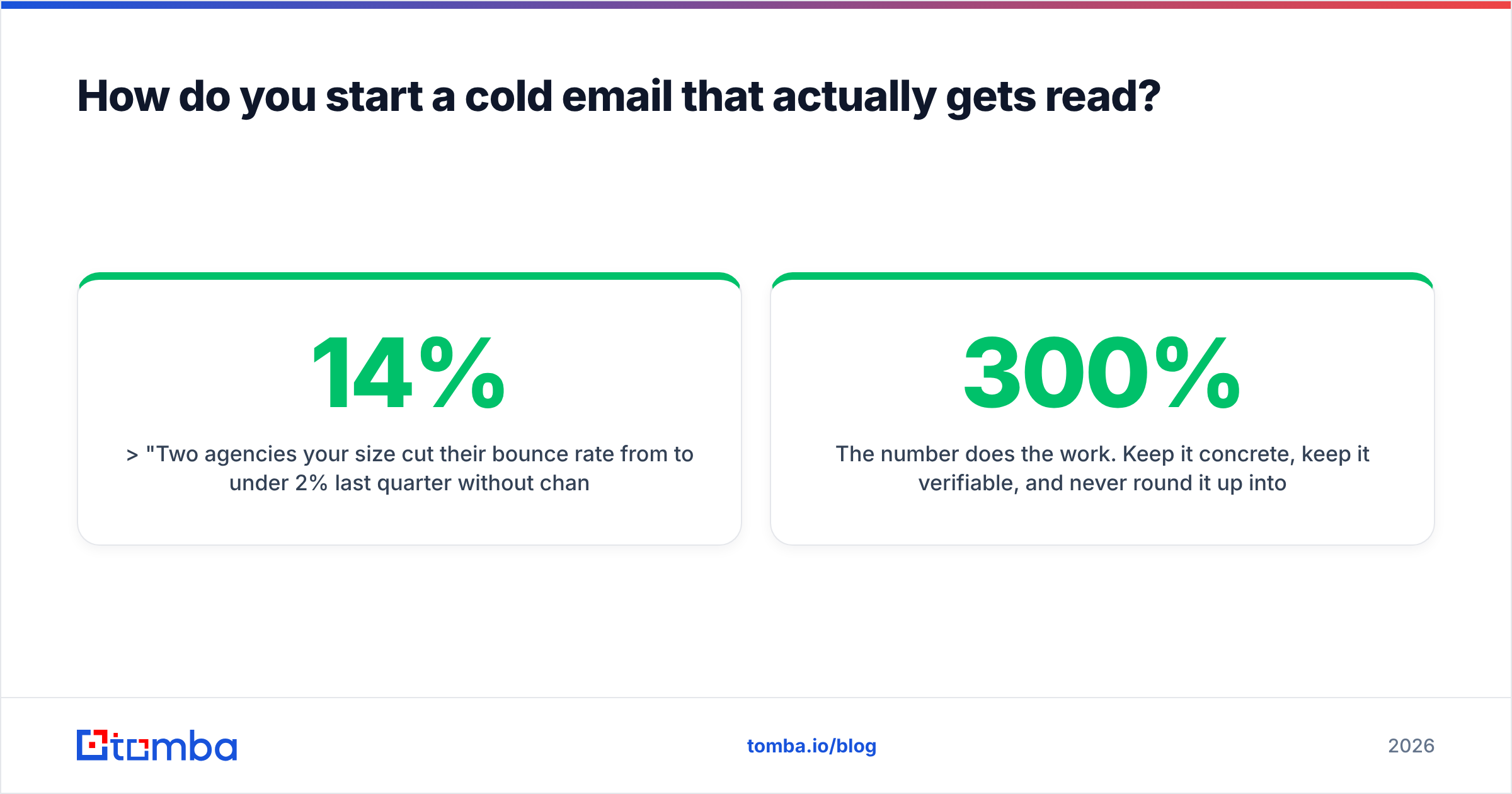
"Two agencies your size cut their bounce rate from 14% to under 2% last quarter without changing sending tools."
The number does the work. Keep it concrete, keep it verifiable, and never round it up into something that sounds invented. "300% more meetings" reads as fiction. "From 14% to 2%" reads as a spreadsheet someone actually looked at.
Structure 3: The direct permission ask#
You skip the setup entirely and respect their time out loud.
"Quick one — is reducing wasted SDR hours on data cleanup something you own, or should I be talking to someone in RevOps?"
This works especially well for senior titles, who read fast and appreciate not being courted. It also routes you to the right person when you've guessed wrong, which is a second win.
Structure 4: The mutual-context bridge#
You name a shared reference point that isn't fabricated.
"Your CTO and I both spoke at the same Postgres meetup in Lisbon — different rooms, same coffee."
Only use this when it's true. A false shared connection is the fastest way to lose a deal permanently.
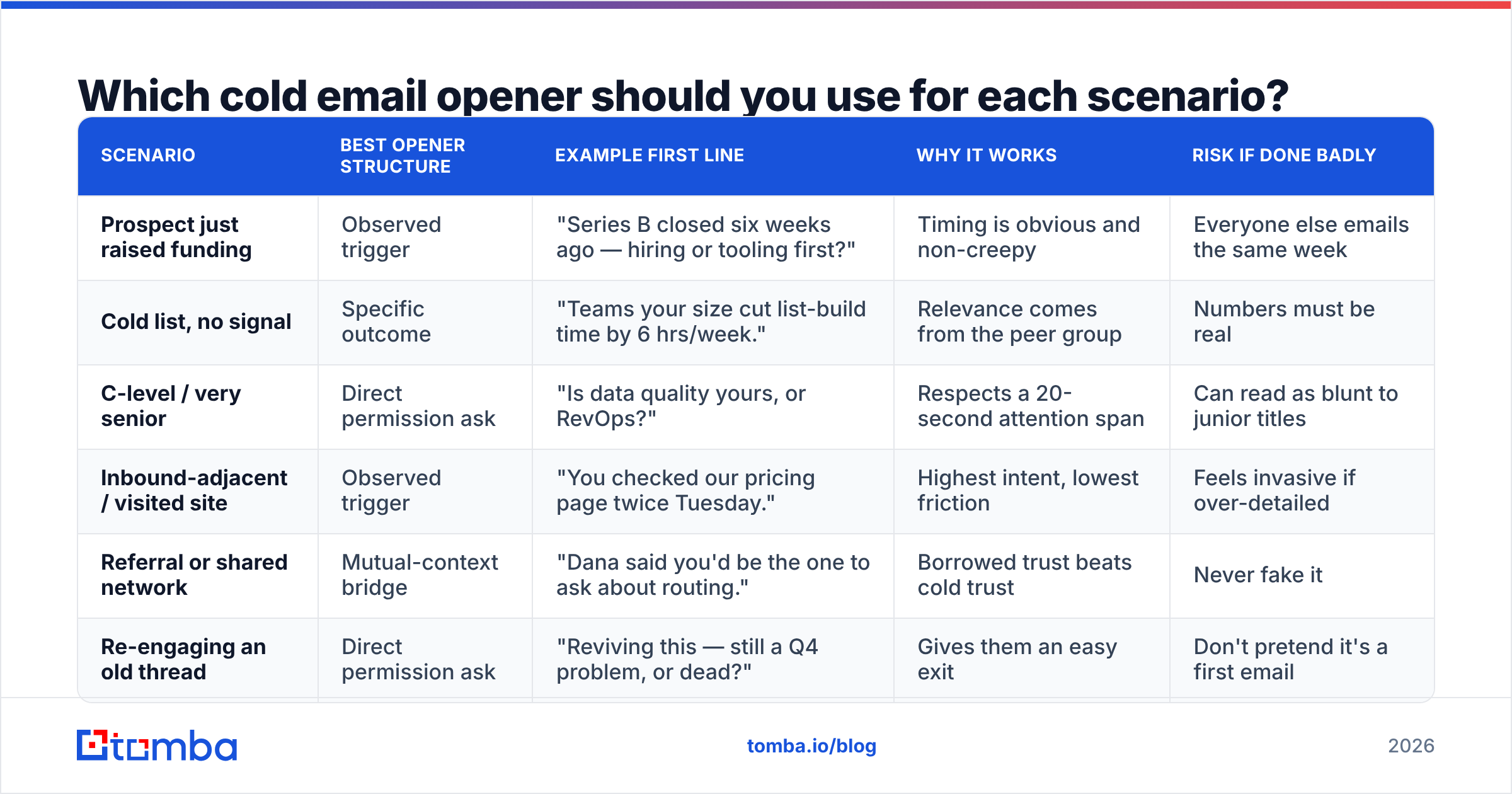
Which cold email opener should you use for each scenario?#
| Scenario | Best opener structure | Example first line | Why it works | Risk if done badly |
|---|---|---|---|---|
| Prospect just raised funding | Observed trigger | "Series B closed six weeks ago — hiring or tooling first?" | Timing is obvious and non-creepy | Everyone else emails the same week |
| Cold list, no signal | Specific outcome | "Teams your size cut list-build time by 6 hrs/week." | Relevance comes from the peer group | Numbers must be real |
| C-level / very senior | Direct permission ask | "Is data quality yours, or RevOps?" | Respects a 20-second attention span | Can read as blunt to junior titles |
| Inbound-adjacent / visited site | Observed trigger | "You checked our pricing page twice Tuesday." | Highest intent, lowest friction | Feels invasive if over-detailed |
| Referral or shared network | Mutual-context bridge | "Dana said you'd be the one to ask about routing." | Borrowed trust beats cold trust | Never fake it |
| Re-engaging an old thread | Direct permission ask | "Reviving this — still a Q4 problem, or dead?" | Gives them an easy exit | Don't pretend it's a first email |
What does the anatomy of a strong cold email opening look like?#
Four moving parts, in this order:
- The hook (one line, ≤ 12 words). The trigger, number, or question. Nothing else. This is your preview text — write it as if it will be read in isolation, because it will be.
- The relevance bridge (one sentence). Connects the hook to why you're writing. "Usually that means X" or "We see this most with teams that just X."
- The claim (one sentence, optional). What you do, framed as their outcome. Not your feature list.
- The ask (one question). Single, low-commitment, answerable with one word. "Worth a look?" beats "Do you have 30 minutes Thursday at 2pm ET or Friday at 10am ET?"
Total: 50 to 90 words. If the whole email doesn't fit on a phone screen without scrolling, cut the claim first.
Here it is assembled:
Subject: three SDR roles
You posted three SDR reqs last month.
Usually that means the current team is spending more time building lists than calling them.
We cut that step for teams your size — verified contacts in, manual research out.
Worth a look, or is list-building already solved on your side?
That's 58 words. It names something true about them, explains why it matters, states a benefit, and asks one question with a graceful "no" built in.
How do you personalize openers at scale without sounding like a robot?#
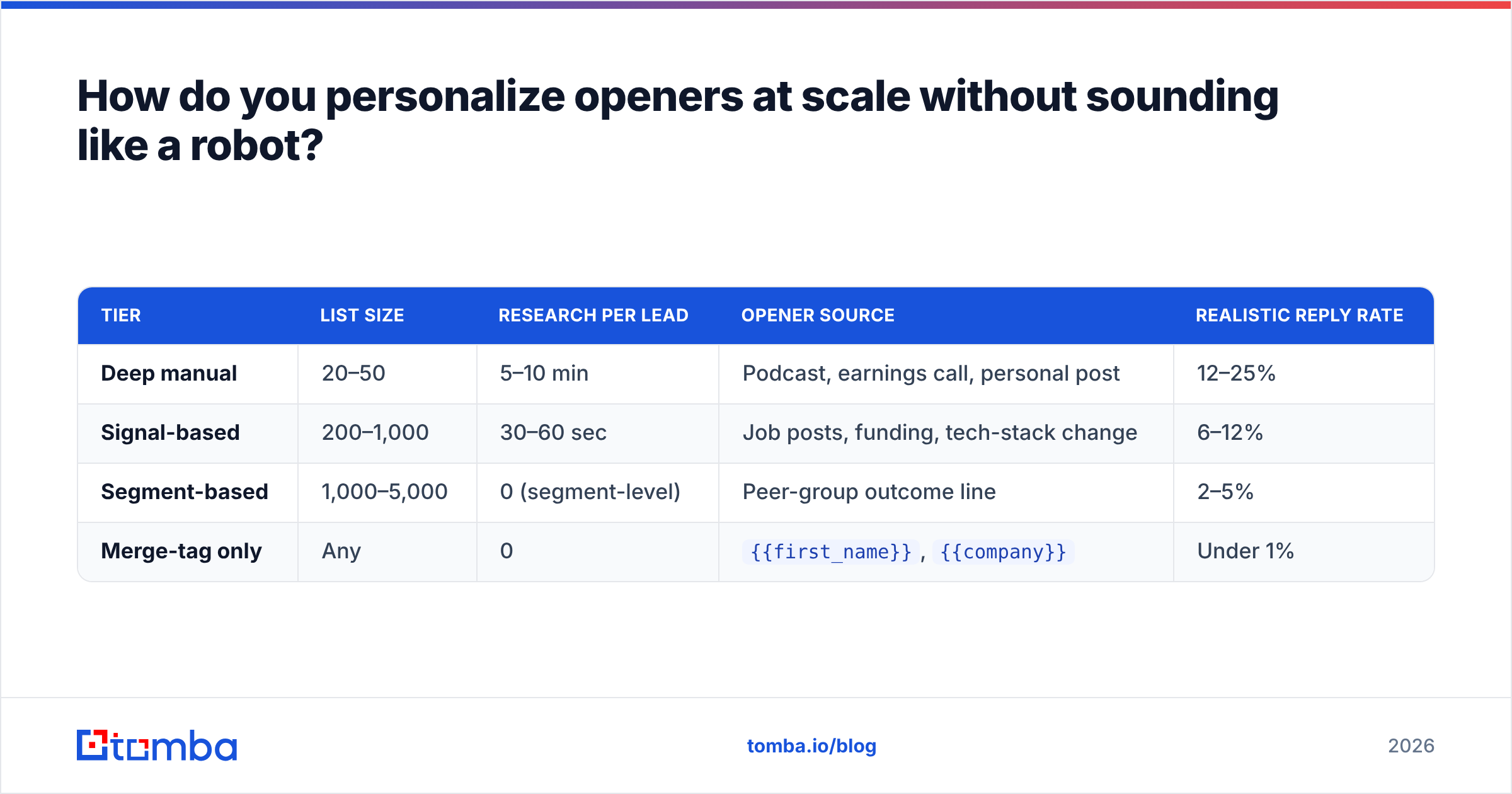
Pick a personalization tier that matches list size, then be honest about the tradeoff.
| Tier | List size | Research per lead | Opener source | Realistic reply rate |
|---|---|---|---|---|
| Deep manual | 20–50 | 5–10 min | Podcast, earnings call, personal post | 12–25% |
| Signal-based | 200–1,000 | 30–60 sec | Job posts, funding, tech-stack change | 6–12% |
| Segment-based | 1,000–5,000 | 0 (segment-level) | Peer-group outcome line | 2–5% |
| Merge-tag only | Any | 0 | {{first_name}}, {{company}} |
Under 1% |
The mistake most teams make is treating tier 4 as if it were tier 2. Inserting a company name into a generic sentence isn't personalization — the reader has seen that trick since 2012.
Signal-based is the sweet spot for most outbound teams. You pick two or three trigger types you can detect programmatically, write one opener template per trigger, and let the segmentation carry the relevance. That gets you within striking distance of manual reply rates at twenty times the volume.
A practical way to build this: use domain search to pull the right people at accounts showing your chosen trigger, then run everything through an email verifier before the first send. If you want to skip the guesswork on message length and tone entirely, tools like the cold email AI writer will draft the structure for you — just replace the generated hook with your real trigger.
Does a great opener matter if the email never lands?#
No. And this is the part that gets skipped.
An opening line is a conversion lever on messages that reach a human inbox. It does nothing for messages that bounce, get filtered, or hit an address that stopped existing eight months ago. Two failure points sit upstream of your copy:
- Bad addresses. Every hard bounce degrades sender reputation. Push bounce rate over roughly 2% and mailbox providers start routing your good sends to spam — including the ones with brilliant openers.
- Authentication gaps. Missing or broken SPF, DKIM, and DMARC records mean your mail gets treated as suspicious regardless of content. Google and Yahoo both tightened bulk-sender requirements, and the enforcement is not cosmetic. Their published guidance is worth reading directly — Google's sender guidelines spell out the thresholds.
So the honest sequencing is: fix deliverability first, then obsess over the opener. A 3% reply rate on a list that lands beats a theoretically perfect email that gets filtered. Independent reviews on G2 show the same pattern across the category — teams that clean data before scaling volume outperform teams that scale first.
How do you test cold email openers without wrecking your data?#
Test one variable. Openers are a single variable, but only if the rest of the email stays byte-identical.
- Sample size. Minimum 200 sends per variant before you read anything. Below that you're reading noise.
- Measure replies, not opens. Open tracking has been unreliable since Apple Mail Privacy Protection started pre-fetching images. Reply rate and positive-reply rate are the metrics that survive.
- Hold the send window constant. Comparing a Tuesday-morning variant against a Friday-afternoon variant tests the calendar, not the copy.
- Run three variants, not seven. More variants means smaller cells and slower conclusions.
- Kill decisively. If a variant is 40%+ behind after 400 sends, stop it. Don't wait for statistical elegance on a campaign that's already lost.
- Re-test quarterly. Openers decay. What worked in Q1 gets copied by competitors and becomes the new "I hope this finds you well" by Q4.
Log the winners somewhere your whole team can reach. A shared library of eight proven openers, tagged by trigger type, is worth more than any individual rep's instincts.
What's the fastest way to write a better opener right now?#
Take your last sent cold email. Delete every sentence before the first one that contains a fact about the recipient. If nothing is left, you don't have an opener — you have an introduction, and introductions belong in the signature.
Then ask three questions of your new first line:
- Could I send this exact sentence to a different prospect without editing? (If yes, it's padding.)
- Does it fit in a mobile preview pane, roughly 90 characters? (If no, cut it.)
- Does it make a claim about them, not about me? (If no, flip it.)
Three passes, two minutes, and most emails improve measurably.
Where should you go from here?#
Great openers are a data problem wearing a copywriting costume. The trigger you reference, the peer number you cite, the person you address — all of it depends on contact data that's current and correct. That's the layer to fix before you spend another afternoon rewriting sentences.
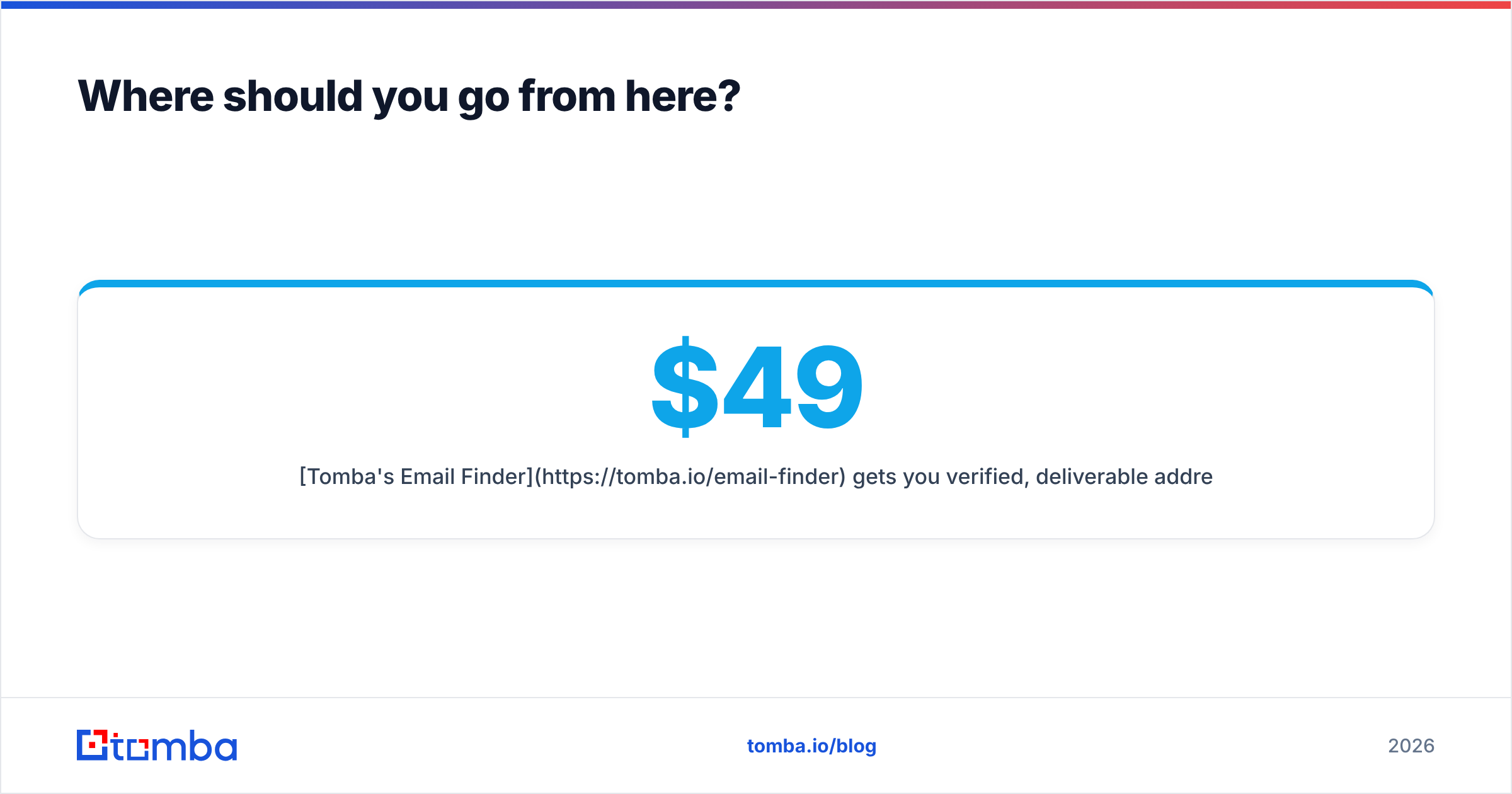
Tomba's Email Finder gets you verified, deliverable addresses for the people your trigger research actually points to — by name, by company, or by domain — so the openers you write reach a human instead of a bounce log. The free tier includes 25 searches a month, and paid plans start at $49/mo on Starter, $99/mo on Growth, and $249/mo on Pro; full Tomba pricing is on the site. Start with the free tier, verify a hundred addresses from your current list, and see how much of your reply-rate problem was never about the words at all.
Related guides#
// get started
Find, verify and enrich your first contacts today
Start on the free plan with 25 searches a month, then scale when your team is ready.
Free plan · No credit card required · GDPR & CCPA
Get the Tomba newsletter
Product and data updates
// about the author