How to Start a Lead Generation Company in 2026: Full Playbook
A practical, numbers-first guide to launching a lead generation company in 2026 — models, real startup costs, pricing, the data stack, and how to land your first five clients.
TL;DR
- A lead generation company sells qualified pipeline, not activity. Pick one delivery model — appointment setting, pay-per-lead, list building, or managed outbound — and refuse the other three for your first year.
- You can launch for $800–$2,500 in month one. The expensive parts are data, sending infrastructure, and your own time; software is the cheap part.
- Niche beats generalist by a wide margin. A narrow ICP makes your data cheaper, your copy better, and your case studies transferable.
- Retainers of $3,000–$8,000/month are the most survivable pricing model. Pure pay-per-lead looks attractive and quietly kills cash flow.
- The single biggest margin lever is data quality. Every bounced email costs you domain reputation, which costs you deliverability, which costs you the client.
What does a lead generation company actually sell?#
You are not selling leads. You are selling a predictable number of qualified conversations per month, at a cost lower than what the client would spend hiring an SDR.
That framing matters because it sets your pricing floor. A junior SDR in the US costs roughly $70,000–$95,000 fully loaded, plus tooling, plus a manager's attention. If you deliver 12–20 qualified meetings a month for $5,000, you are obviously cheaper than that. If you deliver 3 meetings for $5,000, you are not, and no amount of reporting will hide it.
The work itself breaks into four repeatable jobs:
- Define the ICP — firmographics, technographics, headcount bands, trigger events. Written down, not implied.
- Build the list — sourcing contacts that match the ICP, with verified emails and, where relevant, direct phone numbers.
- Run the outreach — email sequences, LinkedIn touches, calls, or some combination.
- Qualify and hand off — booking the meeting, confirming fit, and pushing the record into the client's CRM.
Most failed agencies are excellent at step 3 and sloppy at step 2. Sloppy data is the root cause of most "our campaigns stopped working" postmortems.
Which lead generation business model should you pick?#
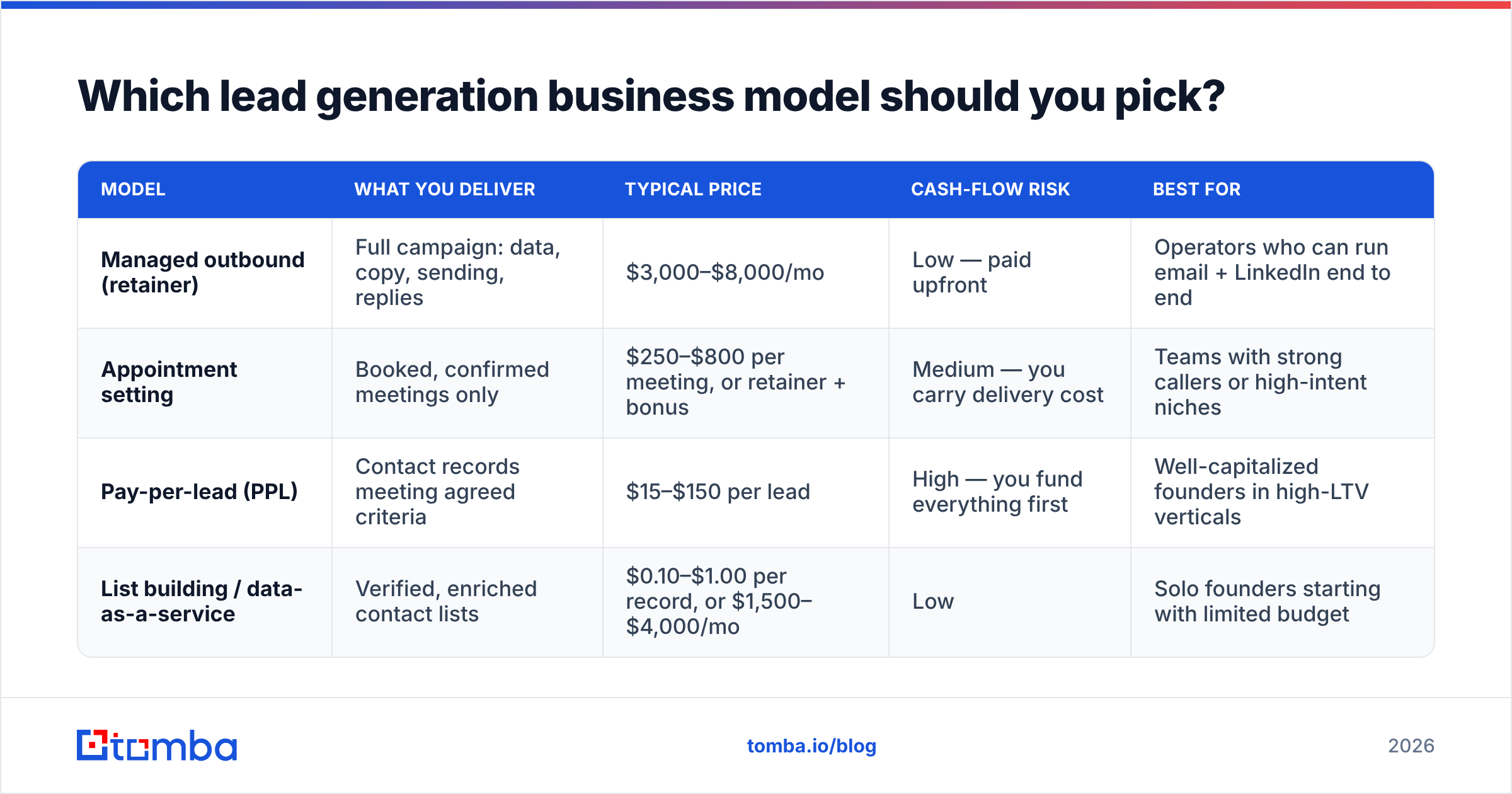
There are four viable models. They differ in cash-flow risk, how fast you can start, and how defensible they are.
| Model | What you deliver | Typical price | Cash-flow risk | Best for |
|---|---|---|---|---|
| Managed outbound (retainer) | Full campaign: data, copy, sending, replies | $3,000–$8,000/mo | Low — paid upfront | Operators who can run email + LinkedIn end to end |
| Appointment setting | Booked, confirmed meetings only | $250–$800 per meeting, or retainer + bonus | Medium — you carry delivery cost | Teams with strong callers or high-intent niches |
| Pay-per-lead (PPL) | Contact records meeting agreed criteria | $15–$150 per lead | High — you fund everything first | Well-capitalized founders in high-LTV verticals |
| List building / data-as-a-service | Verified, enriched contact lists | $0.10–$1.00 per record, or $1,500–$4,000/mo | Low | Solo founders starting with limited budget |
If you are bootstrapping, start with list building or managed outbound. Both get paid before you spend. Pay-per-lead is where new agencies most often die: you buy the data, burn the domains, run the campaign, and then argue with a client about whether a lead "counted."
A blended structure works well once you have proof: a base retainer that covers your costs, plus a per-meeting bonus that gives the client upside alignment. HubSpot's sales team has written extensively about how outbound teams structure comp and quotas, and the same logic applies to agency pricing — cover your fixed cost, then share the upside.

How do you choose a niche that actually pays?#
Score candidate niches on four things. If a niche fails two of them, drop it.
- Deal size — the client's average contract value should be at least $8,000. Below that, they cannot justify paying you $5,000/month for meetings.
- Reachability — can you find decision-makers by title and domain? Government buyers and hospital procurement are reachable in theory and miserable in practice.
- Repeatability — if you win one dental SaaS client, can you pitch the next four with the same case study? Horizontal "we serve everyone" positioning kills this.
- Competitive noise — check how many agencies already spam that ICP. If every VP of Engineering at a Series B gets 40 cold emails a day, your reply rate will reflect it.
Niches that consistently work for new agencies in 2026: vertical SaaS ($10k–$60k ACV), managed IT and MSPs, commercial construction and trades, logistics and freight brokerage, professional services (accounting, legal ops), and healthcare tech vendors selling to clinics rather than hospital systems.
A useful test before you commit: pull 200 contacts in the niche, verify them, and send 100 emails yourself. If you cannot get a 2%+ positive reply rate promoting your own service, you will struggle to sell it as a service.
What does it really cost to start a lead generation company?#
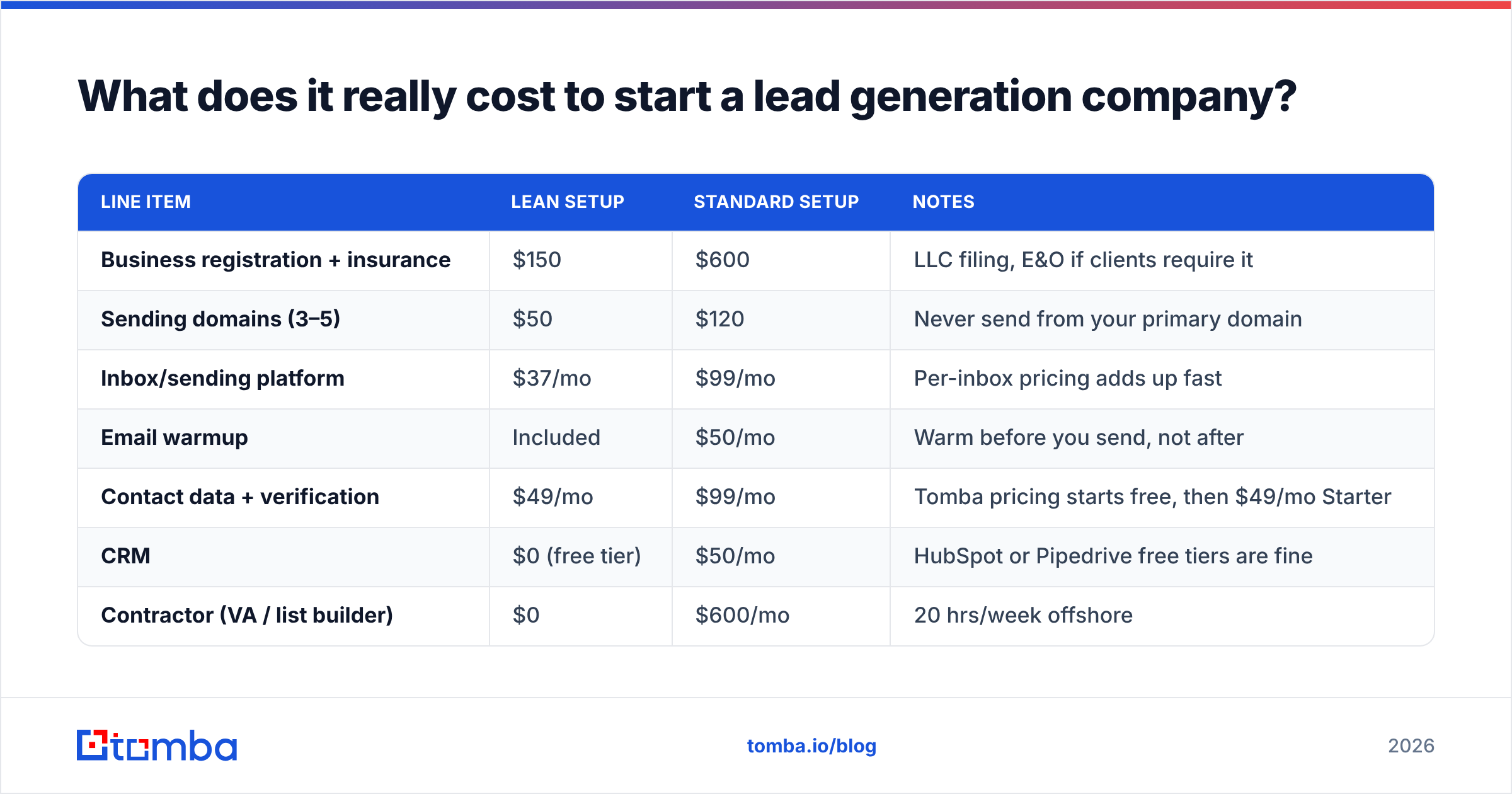
Less than people assume. Here is a realistic month-one budget for a solo founder plus a part-time contractor.
| Line item | Lean setup | Standard setup | Notes |
|---|---|---|---|
| Business registration + insurance | $150 | $600 | LLC filing, E&O if clients require it |
| Sending domains (3–5) | $50 | $120 | Never send from your primary domain |
| Inbox/sending platform | $37/mo | $99/mo | Per-inbox pricing adds up fast |
| Email warmup | Included | $50/mo | Warm before you send, not after |
| Contact data + verification | $49/mo | $99/mo | Tomba pricing starts free, then $49/mo Starter |
| CRM | $0 (free tier) | $50/mo | HubSpot or Pipedrive free tiers are fine |
| Contractor (VA / list builder) | $0 | $600/mo | 20 hrs/week offshore |
| Website + copy | $100 | $800 | One page and a calendar link is enough |
| Month-one total | ~$800 | ~$2,400 | Excluding your own time |
Two costs are easy to underestimate. The first is domain and inbox burn — you will retire domains, and each replacement needs 2–3 weeks of warmup before it produces revenue. The second is rework: bad data means rebuilding lists mid-campaign, which is unpaid labor.
Budget a 3-month runway before your first retainer clears. Most agencies sign client one somewhere between week 5 and week 11.
What tech stack do you need on day one?#
Keep it boring. Five categories, one tool each.
- Data sourcing — where contacts come from. An email finder that works by domain, name, or company covers 80% of B2B sourcing. Complement it with a bought database when you need volume; providers like BookYourData are a reasonable option for pre-built regional lists.
- Verification — non-negotiable. Run every address through an email verifier before it enters a sequence, and route catch-all domains through a dedicated catch-all check rather than guessing.
- Sending — a cold email platform with inbox rotation, warmup, and reply detection. Compare options on G2 rather than trusting affiliate blog rankings.
- CRM — even a free tier. You need one source of truth for what you delivered, or renewal conversations become arguments.
- Enrichment / automation — pulling firmographics, job changes, and phone numbers onto records. A bulk email finder plus a spreadsheet is fine at first; an API call from your workflow tool is better once you pass ~5,000 records a month.
For anything you plan to run repeatedly, wire it through an API instead of a UI. The Tomba API or an equivalent lets you build a list-building pipeline that a contractor can operate without touching a browser extension for four hours a day.
Skip, for now: intent data platforms, ABM suites, AI SDR products, and anything with a $2,000/month floor. They solve problems you do not have at zero clients.
How should you price and package the offer?#
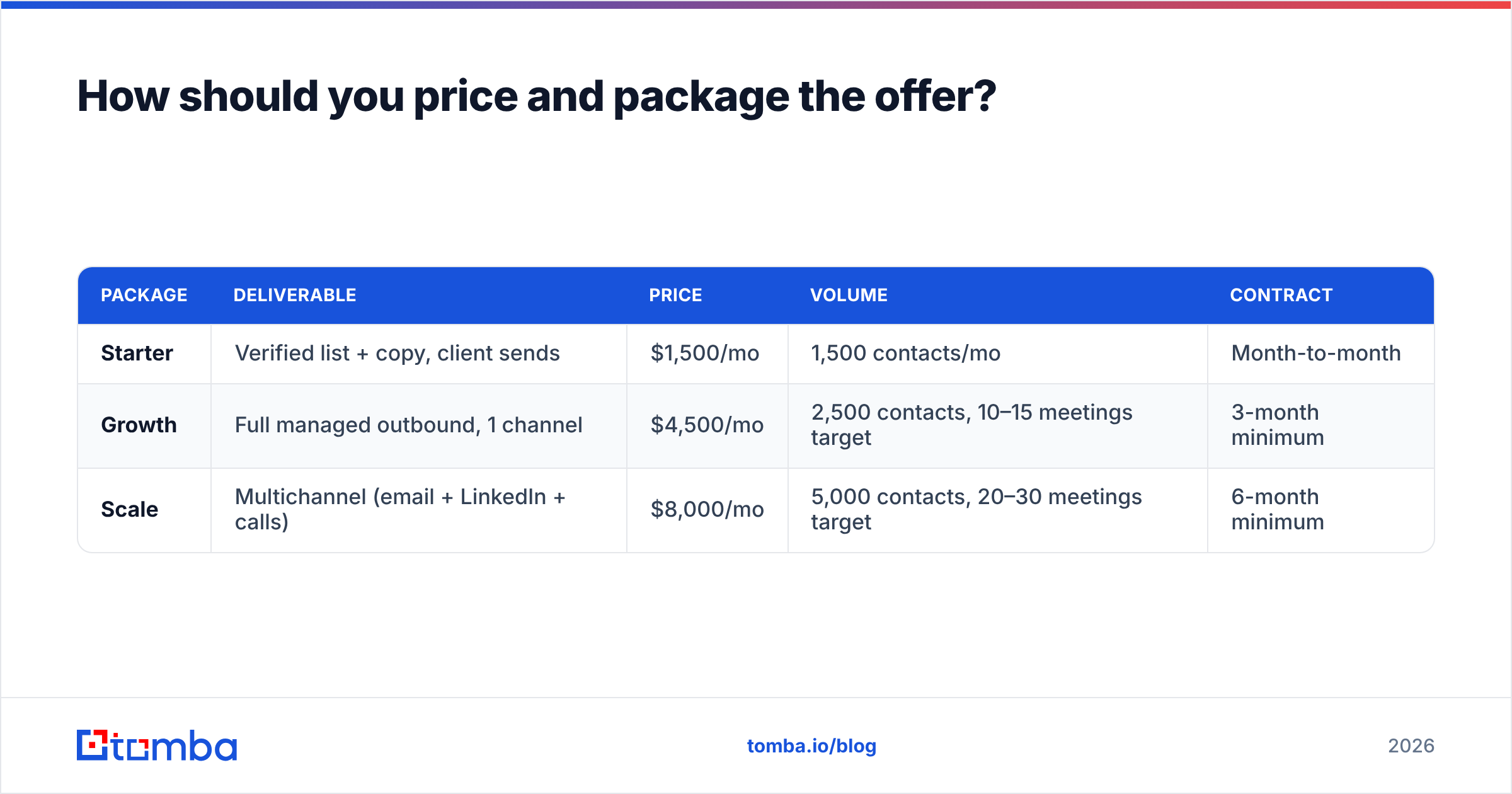
Three packages, priced so the middle one is obviously correct.
| Package | Deliverable | Price | Volume | Contract |
|---|---|---|---|---|
| Starter | Verified list + copy, client sends | $1,500/mo | 1,500 contacts/mo | Month-to-month |
| Growth | Full managed outbound, 1 channel | $4,500/mo | 2,500 contacts, 10–15 meetings target | 3-month minimum |
| Scale | Multichannel (email + LinkedIn + calls) | $8,000/mo | 5,000 contacts, 20–30 meetings target | 6-month minimum |
Rules that protect your margin:
- Charge a setup fee. $1,000–$2,500 covers domain purchase, warmup, ICP workshops, and copy. Without it, month one is a loss.
- Sell a minimum term. Cold outbound needs 6–10 weeks before results are readable. Month-to-month deals get cancelled in week 5, right before they work.
- Cap deliverables in writing. "Unlimited revisions" and "as many leads as possible" are how agencies end up working for $14/hour.
- Never guarantee a meeting count in month one. Guarantee process, volume, and reporting. Guarantee outcomes only after you have 90 days of data in that niche.
How do you land your first five clients?#
Use your own service on yourself. It is the only proof that costs nothing.
Build a list of 500 companies in your chosen niche that show clear outbound intent — hiring SDRs, recently funded, or already running paid search. Find the founder or VP of Sales, verify the address, and send a four-email sequence over 12 days. Offer something small and concrete: a free list of 100 verified contacts in their ICP, delivered before any call.
That free-sample offer converts far better than "can I book 15 minutes." It also demonstrates the exact thing you are selling, which shortens the sales cycle from weeks to days.
Three other channels that work early:
- Partner referrals. Marketing agencies, web design shops, and fractional CMOs all have clients asking for pipeline and no way to deliver it. Offer 10–15% recurring commission.
- Niche communities. Slack groups, trade associations, and industry subreddits — participate for a month before mentioning what you do.
- Your own LinkedIn. Post the actual numbers from your campaigns. Screenshots of reply rates outperform thought-leadership posts by a wide margin.

What metrics prove you are delivering?#
Report the same five numbers every week, in the same format. Clients cancel when they feel uninformed, not when results are slow.
- Contacts sourced and verified — with the bounce rate attached. Under 2% is healthy; above 5% means your data process is broken.
- Delivery rate — landing in the inbox, not the tab. Track it per sending domain.
- Open and reply rate — reply rate is the honest one. Open tracking is increasingly unreliable with privacy proxies.
- Positive reply rate — replies that express interest, divided by emails sent. Target 1–3%.
- Meetings booked and held — held matters more than booked. A 30% no-show rate is a qualification problem, not a scheduling problem.
Add cost-per-meeting once you have two months of data. It is the number that renews contracts, because it maps directly to the client's alternative: hiring someone.
What legal and compliance rules apply?#
Cold outreach is legal in most B2B contexts, but the rules differ by region and they are not optional.
- United States — the CAN-SPAM Act requires accurate headers, a real physical address, and a working opt-out honored within 10 business days.
- EU / UK — GDPR permits B2B outreach under legitimate interest, but you must document your basis, name your data source, and process deletion requests quickly. The UK adds PECR on top.
- Canada — CASL is consent-based and stricter than most. Get local advice before targeting Canadian lists at volume.
Practical requirements for your agency: a documented data-retention policy, a suppression list that spans every client campaign, a DPA template for EU clients, and a written record of where each contact came from. Keeping data sources traceable is not just compliance hygiene — it is what lets you answer "where did you get my address" without panic.
What mistakes kill new lead gen agencies?#
- Sending from the primary domain. One bad campaign and the client's own sales team stops reaching inboxes. Always use separate sending domains.
- Skipping verification to save $49. A 12% bounce rate torches domain reputation in under two weeks. The math never favors skipping this.
- Taking any client with a credit card. A client outside your niche costs 3x the effort and produces a case study you cannot reuse.
- Volume over relevance. 10,000 poorly matched contacts underperform 800 well-matched ones, and cost more to send to.
- No offer work. If the client's offer is weak, no sequence saves it. Charge for offer development or decline the engagement.
- Hiring before systemizing. Document the list-building SOP first. A contractor without an SOP produces expensive noise.
What does a realistic first-year timeline look like?#
Months 1–2: Pick the niche. Register the business. Buy and warm sending domains. Build your own 500-contact prospecting list and start outbound for yourself.
Months 3–4: Sign clients one and two, probably at a discount in exchange for a testimonial. Document every step you take as an SOP.
Months 5–7: Hire a part-time list builder. Move list building to an API-driven workflow. Raise prices for new clients.
Months 8–12: Three to six retainers, $15,000–$30,000 MRR, one contractor plus a part-time copywriter. Now — and only now — consider adding a second channel or a second niche.
Agencies that follow roughly this sequence tend to survive. The ones that try to serve four niches across three channels in month two do not.
Start with the data layer. Every part of this business — the campaigns, the reporting, the renewals — rests on whether the contacts you source are real and reachable. Tomba's Email Finder finds professional addresses by domain, name, or company, with verification built into the same workflow, so lists arrive clean instead of getting cleaned later. The free tier gives you 25 searches a month to test your niche before you spend anything; Starter is $49/month when you are ready to build client lists at volume.
Related guides#
Ready to find emails that actually work?
Join 150,000+ professionals who stopped guessing and started sending. Free credits on signup — no credit card required.
Get the Tomba newsletter
Practical outbound tactics and product updates — once every two weeks.
About the author