How to Start a Local Lead Generation Business in 2026
A local lead generation business sells qualified inbound calls and forms to service contractors. Here is the full build: niche selection, ranking, call tracking, pricing, and the outreach that lands your first three clients.
TL;DR
- A local lead generation business builds ranking assets (sites, GBP listings, ad accounts) in a service niche, then sells the calls and form fills to contractors who can't market themselves.
- The money is in boring, high-ticket trades: roofing, water damage restoration, commercial HVAC, personal injury law. A single restoration job is worth $3,000-$15,000, so a $250 lead is cheap for the buyer.
- Two revenue models dominate: rank-and-rent (flat monthly rent for the asset) and pay-per-lead (you bill per qualified call). Pay-per-lead earns more; rank-and-rent is easier to forecast.
- You need three systems from day one: a ranking asset, call tracking with recorded qualification, and an outbound pipeline to replace clients who churn.
- Budget 90-150 days and $1,500-$4,000 before the first invoice clears. Ads shorten that to ~30 days but eat your margin until organic catches up.
Most people who try local lead generation quit at month four. Not because ranking a plumber site in a mid-size metro is hard — it isn't — but because they build the asset first and only then go looking for someone to buy the leads. That order is backwards, and it's why the phone rings into a voicemail box nobody is paying for.
This walks the build in the order that actually pays: buyer first, niche second, asset third.
What is a local lead generation business?#
You own a marketing asset that ranks for local service intent — "emergency water extraction Tampa," "commercial roof repair Boise" — and you sell the resulting inquiries to a business that can service them. You are a wholesaler of demand.
Think of it like owning a billboard on the only highway into town. You don't fix roofs. You rent the attention of everyone who drives past looking for a roofer, and you rent it to whichever roofer pays best.
The four asset types, ranked by how quickly they produce and how defensible they are:
- Local SEO site + Google Business Profile — Slowest to start (60-120 days), highest margin once ranked, hardest for a client to take from you. This is the core play.
- Google Ads / LSA accounts you own — Live in 48 hours, but your margin is the spread between click cost and lead price. Good for cash flow while SEO matures.
- Facebook/Meta lead forms — Cheap leads, low intent. Works for niches with long consideration windows (solar, remodeling, med spa), fails for emergency services.
- Cold outbound as a lead source — You use a verified contact list to book appointments directly and sell them as booked calls. Highest price per lead, most labor.
Most durable operations run 1 and 2 together: ads fund the business while the organic asset compounds.

How is this different from being an agency?#
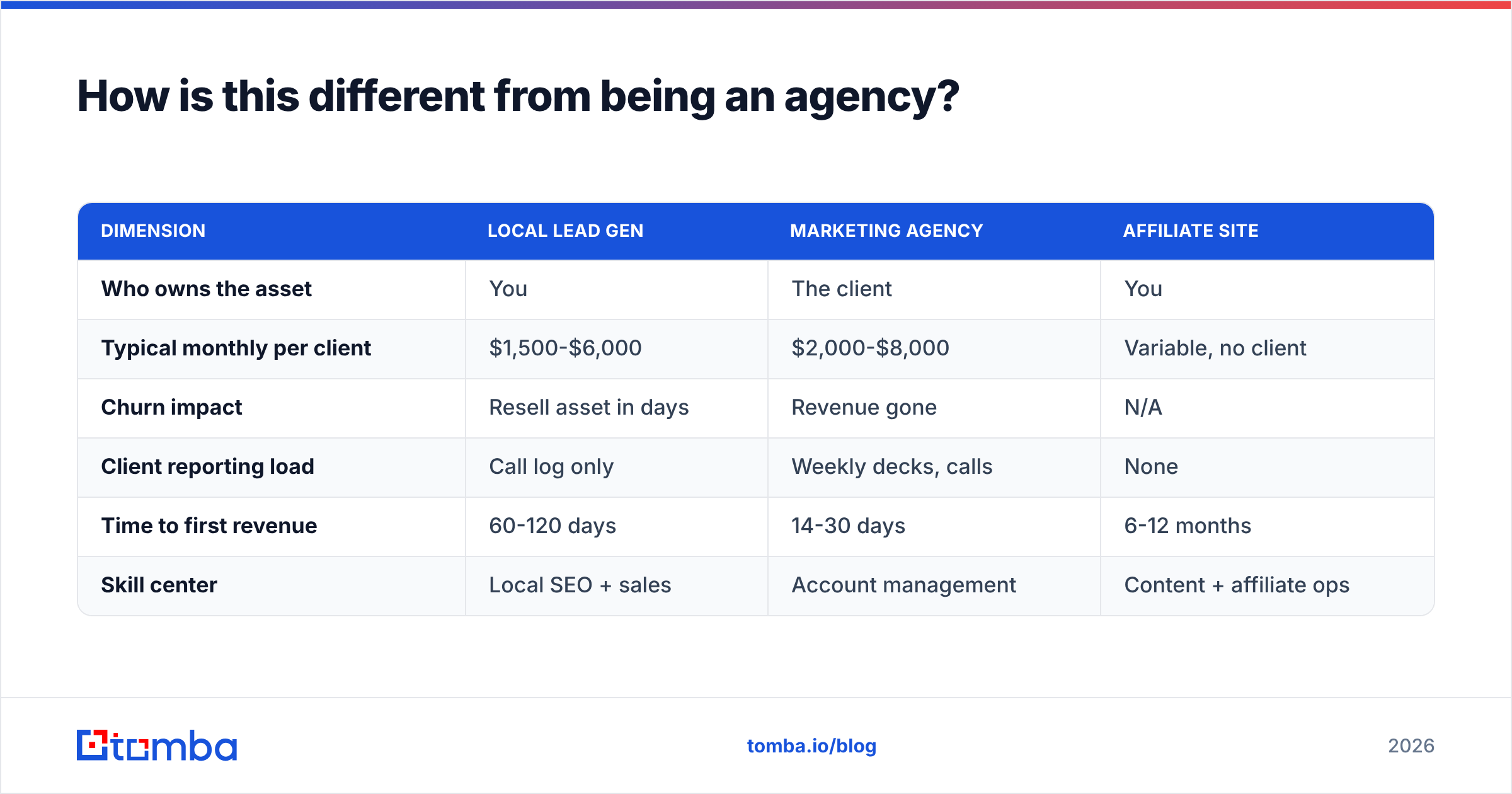
An agency sells labor and reports to a client who owns the asset. A local lead gen business sells outcomes and owns the asset. When the client leaves an agency, the agency loses everything. When a client leaves you, you sell the same phone number to their competitor by Friday.
| Dimension | Local lead gen | Marketing agency | Affiliate site |
|---|---|---|---|
| Who owns the asset | You | The client | You |
| Typical monthly per client | $1,500-$6,000 | $2,000-$8,000 | Variable, no client |
| Churn impact | Resell asset in days | Revenue gone | N/A |
| Client reporting load | Call log only | Weekly decks, calls | None |
| Time to first revenue | 60-120 days | 14-30 days | 6-12 months |
| Skill center | Local SEO + sales | Account management | Content + affiliate ops |
The reporting difference matters more than people expect. Agencies die from scope creep — "can you also look at our Instagram?" You send a call log and an invoice. That's the whole relationship.
Which niche should you pick?#
Pick on four variables, in this order: job value, urgency, buyer density, and competition.
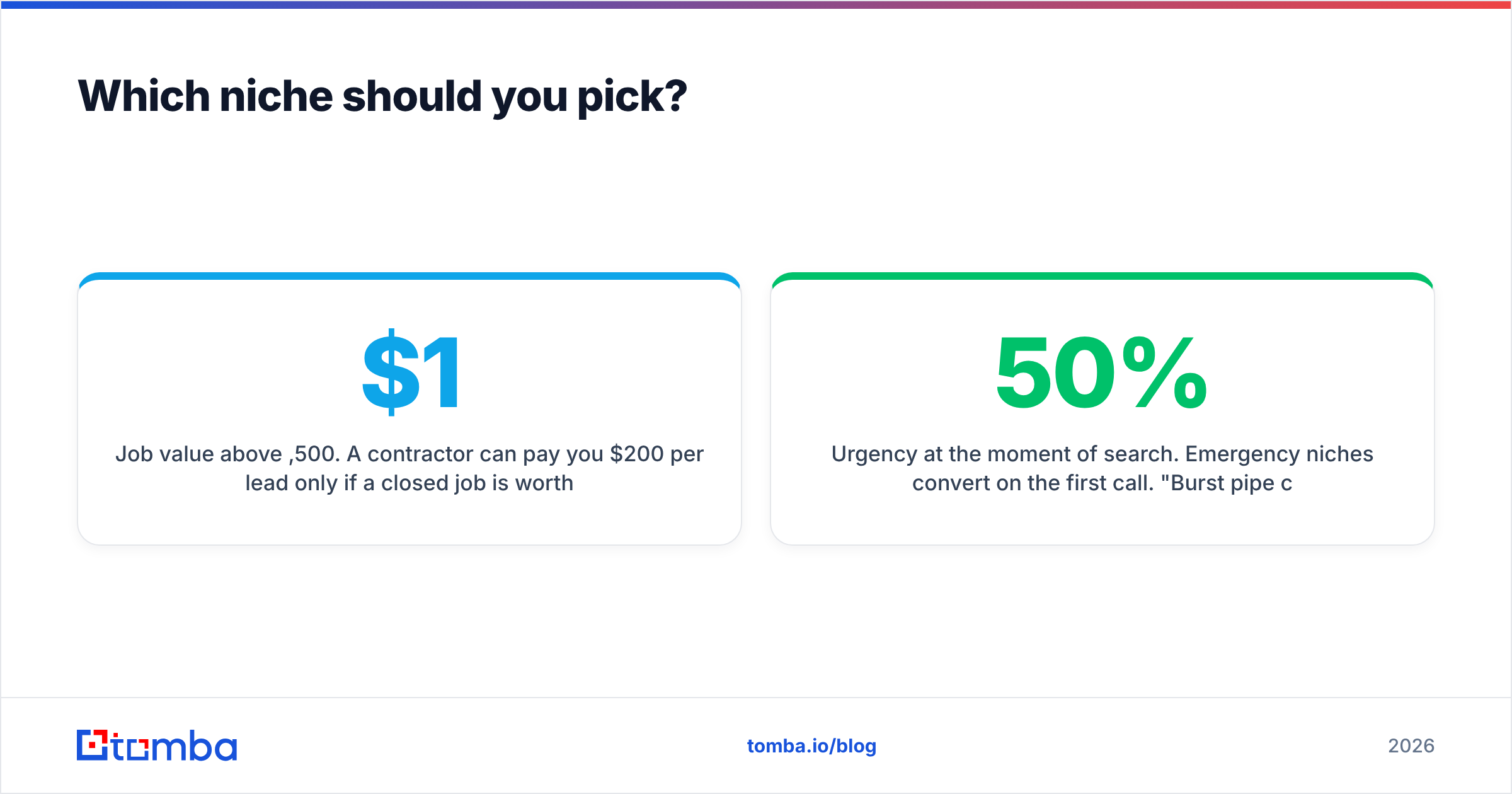
- Job value above $1,500. A contractor can pay you $200 per lead only if a closed job is worth thousands. Water damage restoration, roofing, foundation repair, commercial HVAC, tree removal, and legal all clear this bar. House cleaning and lawn care do not.
- Urgency at the moment of search. Emergency niches convert on the first call. "Burst pipe cleanup" closes at 30-50% from a phone lead; "kitchen remodel ideas" closes at 3%. Urgency is what lets you charge per lead instead of per click.
- Buyer density of 8+ in the metro. You need competitors to your first client, or you have no leverage on price and no backup when they churn. Check the map pack and the paid results — if only three companies show up, the market is too thin.
- Beatable competition. Search your target term. If the top three organic results are HomeAdvisor, Angi, and Yelp with no independent local site in the pack, that's an opportunity, not a wall — aggregator pages rank on domain strength, not local relevance, and a tight city-service page can outrank them.
Second-tier metros beat major ones early on. Ranking "roof repair Chattanooga" is a 90-day project. Ranking "roof repair Houston" is an 18-month one with a budget you don't have yet.
How do you find and validate the buyer before building?#
Build nothing until one contractor says the words "yes, I'd pay for that." This is the step nearly everyone skips.
Your validation sequence:
- List 25-40 contractors in the target niche and metro. Pull them from Google Maps, the state licensing board, and the local trade association directory. You want businesses with 10-100 reviews — big enough to handle volume, small enough that they don't have an in-house marketing hire.
- Get a real decision-maker contact. Owner or GM, not
info@. Use a domain search on each company site to see the actual email pattern and named contacts, then verify before you send — a 30% bounce rate on a 40-person list will get a new sending domain flagged in a week. - Ask a diagnostic question, not a pitch. "How many jobs a month could you take on right now if the calls existed?" tells you capacity, current lead spend, and whether they're already burned by a lead vendor. That last one matters — Angi and Thumbtack have salted a lot of these markets.
- Pre-sell a pilot. "I'll send you 10 qualified calls. First three are free, then $180 each, no contract." Getting a verbal yes from two contractors is your green light to build.
- Confirm capacity honestly. A three-truck roofing outfit can absorb maybe 25 leads a month. Selling 60 to them buys you an angry client and a refund request.
If you can't get two verbal yeses out of 40 conversations, the niche or the metro is wrong. Move before you spend a dollar on a domain.
For outbound at this scale, an email finder plus a bulk verify pass takes the list from 40 company URLs to 40 deliverable owner addresses in an afternoon. The free email checker is enough if you're testing a handful manually first.
How do you build the ranking asset?#
Assume 90 days. Four workstreams, run in parallel.
Google Business Profile. This is 60-70% of local pack visibility and the single hardest piece. You need a verifiable address in the service area — a genuine office, a co-working desk with mail service, or a partner arrangement. Do not fake it; Google's video verification has ended a lot of these businesses. Fill every field, pick the exact primary category ("Water Damage Restoration Service," not "Contractor"), and post weekly.
The site. A 12-25 page site: one page per service, one per suburb you're targeting, plus about, contact, and 3-5 supporting articles. Every page needs a unique H1, real local references (neighborhood names, county, local landmarks), and a click-to-call number above the fold on mobile. Speed matters — most local service searches happen on a phone in a hurry.
Citations and links. Consistent NAP (name, address, phone) across the top 40 directories, then chamber of commerce, local sponsorships, and supplier/vendor pages. Twenty relevant local links beat 200 generic ones. Google's own Search Essentials documentation is the actual rulebook here; most local SEO advice is a paraphrase of it.
Reviews. You need a review flow even though you don't do the work. This is where honest operators structure the deal as a co-branded partnership — the client services the job under the brand and requests the review. Set this up before you go live or the profile stalls at zero.
While SEO matures, run Google Ads on exact-match emergency terms. You'll lose money on the spread for 30-60 days. That's tuition, and it produces leads you can invoice from week two, which keeps your pilot client from wandering off.
How do you track and qualify leads?#
Everything you bill for must be recorded and defensible. Untracked leads mean billing arguments, and billing arguments mean churn.
The stack:
- Call tracking with recording — CallRail, CallTrackingMetrics, or WhatConverts. A unique number per asset, recorded, with a duration threshold.
- Form and chat capture — piped to the same dashboard so one report covers all lead types.
- A written qualification rule — agreed in advance. A billable lead is typically: in the service area, requesting a service you sell, over 60-90 seconds of talk time, and not a repeat caller inside 30 days. Everything else is free.
- A shared log — the client sees every call, every recording, every disposition. Transparency here is what makes a $200-per-lead price feel fair instead of extractive.
Set the duration threshold with the client and put it in the one-page agreement. Vagueness costs you money later; every dispute you win with a recording is a client you keep.
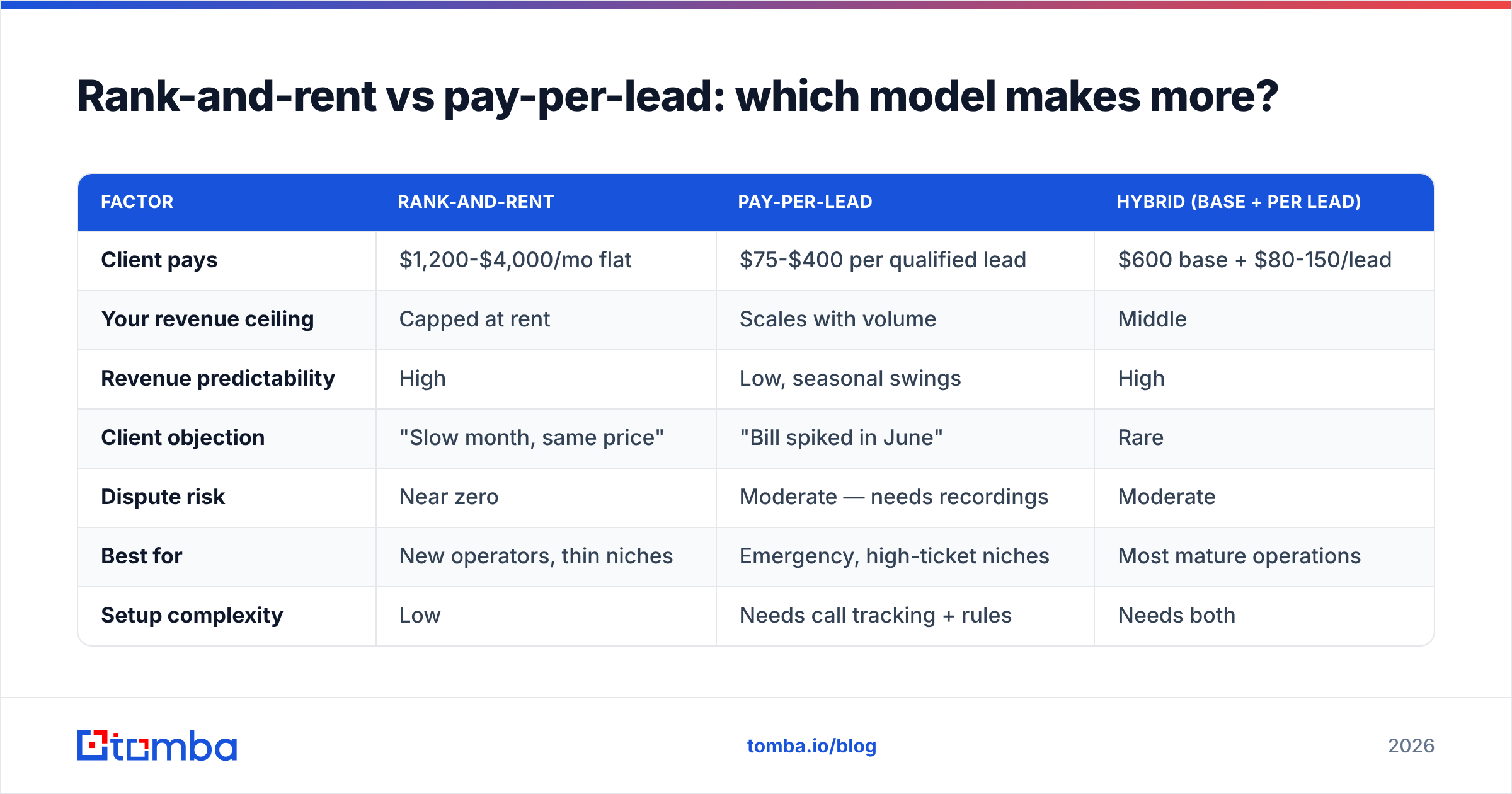
Rank-and-rent vs pay-per-lead: which model makes more?#
| Factor | Rank-and-rent | Pay-per-lead | Hybrid (base + per lead) |
|---|---|---|---|
| Client pays | $1,200-$4,000/mo flat | $75-$400 per qualified lead | $600 base + $80-150/lead |
| Your revenue ceiling | Capped at rent | Scales with volume | Middle |
| Revenue predictability | High | Low, seasonal swings | High |
| Client objection | "Slow month, same price" | "Bill spiked in June" | Rare |
| Dispute risk | Near zero | Moderate — needs recordings | Moderate |
| Best for | New operators, thin niches | Emergency, high-ticket niches | Most mature operations |
| Setup complexity | Low | Needs call tracking + rules | Needs both |
Start rank-and-rent on asset one so you learn the delivery side without arguing about lead quality. Switch to hybrid by asset three, when you have enough volume history to price the base correctly.
Pricing sanity check: your lead price should land at 8-15% of the client's average job value. On a $6,000 restoration job closing at 35%, a $250 lead costs them roughly $715 per acquired job — about 12% CAC. That's a deal they'll defend to their own accountant.
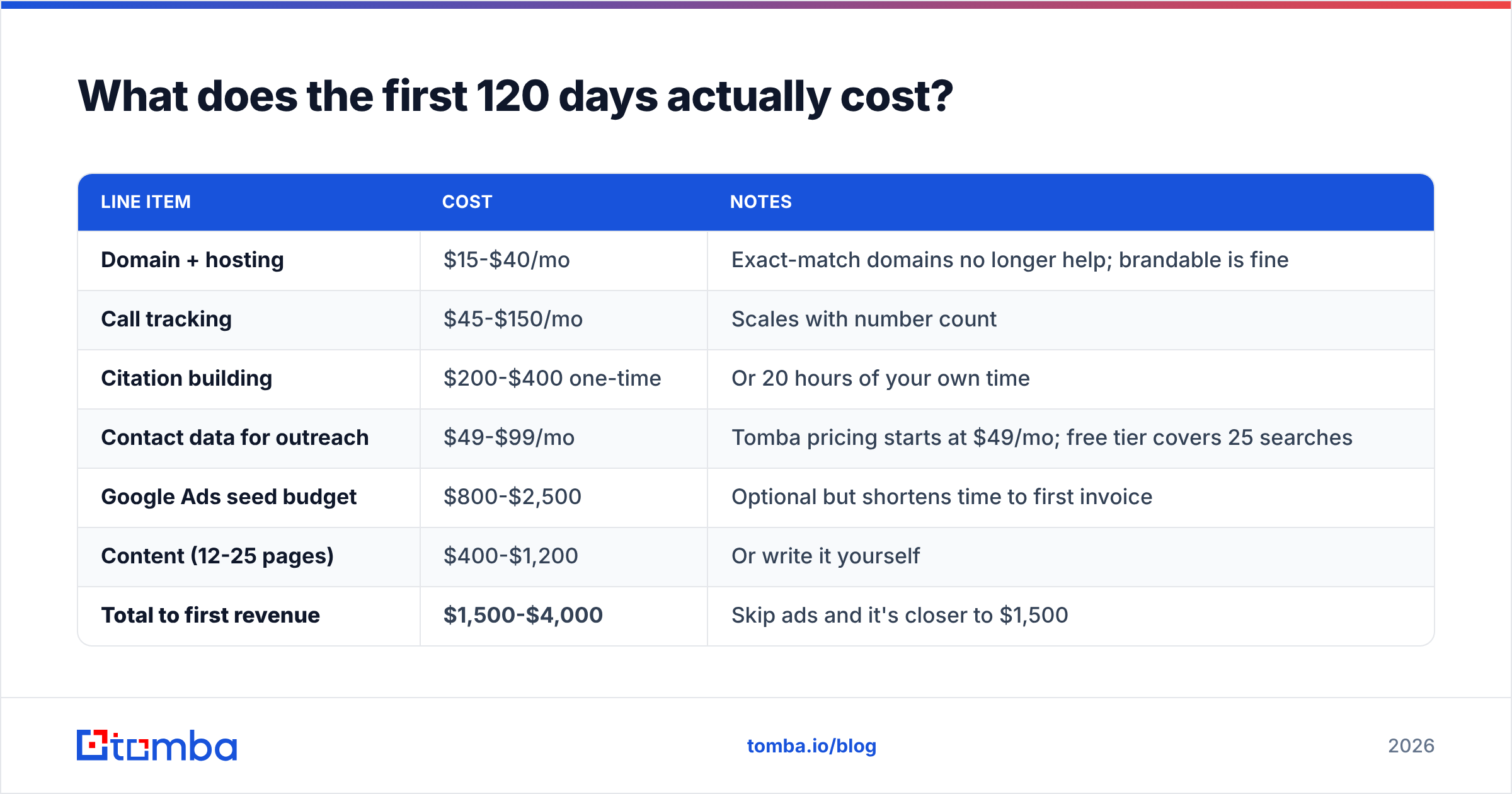
What does the first 120 days actually cost?#
| Line item | Cost | Notes |
|---|---|---|
| Domain + hosting | $15-$40/mo | Exact-match domains no longer help; brandable is fine |
| Call tracking | $45-$150/mo | Scales with number count |
| Citation building | $200-$400 one-time | Or 20 hours of your own time |
| Contact data for outreach | $49-$99/mo | Tomba pricing starts at $49/mo; free tier covers 25 searches |
| Google Ads seed budget | $800-$2,500 | Optional but shortens time to first invoice |
| Content (12-25 pages) | $400-$1,200 | Or write it yourself |
| Total to first revenue | $1,500-$4,000 | Skip ads and it's closer to $1,500 |
Compare that to buying leads from an aggregator — G2's category listings show what contractors currently pay per shared lead — and it's clear why exclusive leads command a premium. Shared leads go to four companies simultaneously. Yours go to one.
How do you keep the pipeline full after client one?#
One client is a hobby. The business starts at three, because that's when a single churn event stops being existential.
Run outbound continuously, not reactively:
- Build a rolling list. 50 new contractor contacts per week, per metro you operate in. Company site → owner name → verified email. A Chrome extension makes this fast while you're already browsing Maps results.
- Lead the email with proof, not features. "Ran 14 calls for a roofer in your zip last month, six booked. I have overflow — want them?" beats any pitch about your SEO process. Contractors don't care how it works.
- Add a phone step. Trades answer phones; they ignore inboxes. A verified B2B phone number alongside the email doubles connect rates in this vertical.
- Track deliverability like it's revenue. Contractor domains are often on shared hosts with weak DNS. Check your own SPF record and warm the sending domain before volume, or your best pitch never lands.
- Keep a waitlist per asset. When a client churns, you should be calling competitor number two the same week, not starting a search.
Also worth watching: the Local Search Ranking Factors survey is the best-documented view of what actually moves local rankings, and it's updated regularly by practitioners rather than guessed at.
What kills most local lead gen businesses?#
Five failure modes, in order of frequency:
- Building before selling. Six months of ranking work, then discovering the two roofers in town both already run their own ads.
- Single-client concentration. 100% of revenue from one contractor who decides to hire a nephew as marketing director.
- No qualification standard. Every invoice becomes a negotiation. Recordings and a written rule end this permanently.
- Overselling capacity. Twelve leads to a two-truck operation is a service; forty is a refund.
- Treating it as passive income. Rankings decay, Google updates, competitors hire agencies. Budget 5-10 hours a month per asset just to hold position.
The businesses that survive year two look less like SEO shops and more like sales organizations that happen to own their own inventory.
Start with the buyer list#
Before the domain, before the content plan, before you touch Ads: get 40 verified contractor decision-makers in your target metro and have 40 real conversations. That list is the only thing standing between a ranking asset that prints money and one that ranks for nobody who's buying.
Use the Tomba Email Finder to turn a Maps export of contractor websites into named, verified owner emails — the free tier covers 25 searches, which is enough to validate a niche before you commit a budget to it. Find the buyers first. Build the asset second.
Related guides#
// get started
Find, verify and enrich your first contacts today
Start on the free plan with 25 searches a month, then scale when your team is ready.
Free plan · No credit card required · GDPR & CCPA
Get the Tomba newsletter
Product and data updates
// about the author