How to Start a Sales Call: 7 Openers That Get You 5 Minutes
The first 15 seconds of a sales call decide the other 15 minutes. Here are seven tested openers, the exact words to use, and the three lines that get you hung up on.
TL;DR
- The first 15 seconds of a sales call are a permission negotiation, not a pitch. Your only job is to earn the next 60 seconds.
- Say your full name and company immediately. Concealing who you are triggers the hang-up reflex faster than any bad pitch.
- "Did I catch you at a bad time?" still works, but it is now so common that a straight "I know I'm interrupting — can I have 30 seconds?" outperforms it with senior buyers.
- Never open with "How are you today?" or a fake referral. Both signal scripted spam within two words.
- Half of a bad call starts before you dial: wrong number, wrong title, wrong company. Clean contact data does more for connect rates than any opener rewrite.
You can rewrite your opener a hundred times and still fail, because the call was doomed at the dial tone — you reached a person who left that company in 2024. That is the uncomfortable part of this topic. The words matter, and they matter second.
This guide covers both: exactly how to start a sales call once someone picks up, and what has to be true about your list before the phone rings.
Why do the first 15 seconds decide the whole sales call?#
Because the person who answered is running a two-second classification: known, useful, or spam. Nothing you say after that classification lands until you change it.
Think of it like a stranger stopping you on the sidewalk. You do not evaluate their argument. You evaluate whether to keep walking. Everything in a good opener exists to make the buyer stop walking — not to persuade them.
That means the opener has three jobs, in this order:
- Identify yourself honestly. Full name, company name, no mumbling. Ambiguity reads as a scam.
- Acknowledge the interruption. Buyers know it is a cold call. Pretending otherwise insults them.
- Ask for a small, specific amount of time. "30 seconds" is a contract. "A few minutes of your time" is a trap they have fallen into before.
- Give one reason you called them. Not your product category — the trigger that made their company the one you dialed.
Skip step one and you sound evasive. Skip step two and you sound robotic. Skip step three and they stay defensive the whole call. Skip step four and you are indistinguishable from the last six callers.
What are the 7 best ways to start a sales call?#
Each of these is a real, sayable line. Read them out loud before judging them — openers that look fine on a page often sound insane in a mouth.
1. The permission opener (highest ceiling, works on senior buyers)
"Hi Marcus, this is Dana Okafor from Tomba. I know I'm interrupting your afternoon — can I take 30 seconds to tell you why I called, and you can tell me to go away?"
Why it works: you name the interruption first, so they do not have to. The escape hatch ("tell me to go away") lowers pressure, and almost nobody takes it. Success here is close to what Gong's call analysis has repeatedly found — reps who name the intrusion outperform reps who paper over it.
2. The "bad time" opener (classic, still fine, now crowded)
"Hi Marcus, Dana from Tomba — did I catch you at a bad time?"
It is famous because it works: people love saying yes to a small negative. The problem in 2026 is saturation. If your prospect has taken three cold calls this week, they have heard it three times. Keep it in rotation, do not make it your only line.
3. The trigger opener (best for warm-ish accounts)
"Hi Marcus, Dana from Tomba. I'm calling because I saw Northwind opened two SDR roles in Austin last month — that usually means someone's rebuilding an outbound motion. Am I close?"
Specificity is the entire play. A named trigger proves a human did research. Ending on a question hands them the floor.
4. The direct-purpose opener (best for technical buyers)
"Hi Marcus, Dana from Tomba. This is a cold call. You can hang up, but will you give me 40 seconds first?"
Engineers, security leads, and finance buyers tend to respect it. The bluntness reads as respect for their time rather than a tactic.
5. The referral opener (only when real)
"Hi Marcus, Dana from Tomba. Priya Raman on your RevOps team suggested I talk to you about how you're sourcing contact data."
Powerful and radioactive. If Priya does not exist or never said that, you have burned the account and possibly the referrer. Never fake this.
6. The problem-first opener (best for a crowded category)
"Hi Marcus, Dana from Tomba. Quick question before I explain who I am: when your team exports a list from LinkedIn, who cleans the emails before they hit the sequence?"
Opening on an operational question skips the pitch entirely. It only works if the question is one they genuinely think about weekly.
7. The callback opener (best conversion rate of all seven)
"Hi Marcus, Dana from Tomba — you downloaded our deliverability benchmark on Tuesday and I said I'd follow up by phone. Two minutes?"
Not really cold. Included because if you have any inbound signal at all, this beats every other opener on this list. Use it whenever it is honest.
Which sales call openers actually convert?#
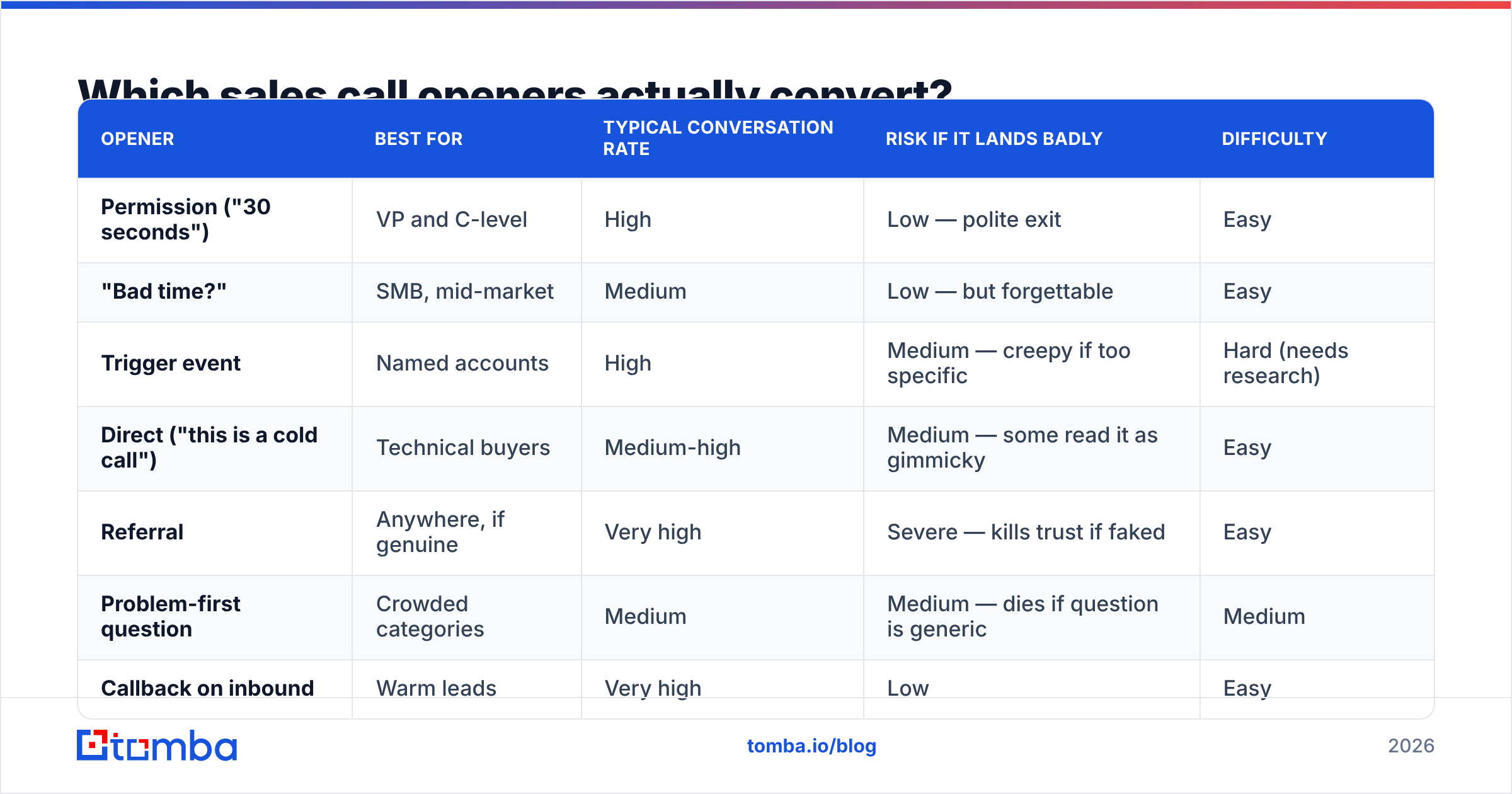
Here is how the seven compare on the dimensions that matter when you pick one for a specific segment. Directional benchmarks below reflect typical mid-market SaaS outbound patterns, not a controlled study — treat them as ordering, not gospel.
| Opener | Best for | Typical conversation rate | Risk if it lands badly | Difficulty |
|---|---|---|---|---|
| Permission ("30 seconds") | VP and C-level | High | Low — polite exit | Easy |
| "Bad time?" | SMB, mid-market | Medium | Low — but forgettable | Easy |
| Trigger event | Named accounts | High | Medium — creepy if too specific | Hard (needs research) |
| Direct ("this is a cold call") | Technical buyers | Medium-high | Medium — some read it as gimmicky | Easy |
| Referral | Anywhere, if genuine | Very high | Severe — kills trust if faked | Easy |
| Problem-first question | Crowded categories | Medium | Medium — dies if question is generic | Medium |
| Callback on inbound | Warm leads | Very high | Low | Easy |
Two patterns come out of that table. First, the openers with the highest ceilings — trigger and referral — are the ones that depend on information you gathered before dialing, not on delivery. Second, the low-risk openers are all short. Every opener that fails badly fails because it ran long before the buyer agreed to listen.
What should you never say in the first 10 seconds?#
Some lines are so heavily associated with spam that they end the call before your value prop arrives.
- "How are you doing today?" From a stranger, this is a tollbooth. Everyone recognizes it as the sound of a script starting.
- "Am I speaking with the person responsible for..." You just admitted you do not know who they are. Know the title before you dial.
- "I'll be quick" followed by 90 seconds. Breaking the time promise costs more than never making one.
- "We're the leading provider of..." Nobody has ever bought anything because a stranger self-described as leading.
- Mumbling your company name. If they cannot place who called, they cannot say yes. Say it clearly, then say it again at the end.
- Launching into features. Features are for after they have agreed to a conversation, not before.
There is also a structural mistake that outranks all of these: dialing a number that no longer belongs to your prospect. No opener survives a wrong number, and no coaching session fixes a stale list.
How does your contact data change the way a call starts?#
Direct dials change the opener; switchboard numbers change the whole call. If you reach a gatekeeper, your first 15 seconds are about getting routed, not about selling. If you reach the buyer directly, you can use every opener above.
That is why data quality is an opener decision, not just an ops decision. Three things determine which script you get to use:
- Number type. A verified direct dial lets you open with a trigger. A main line means you open with "Could you point me to whoever owns demand gen?"
- Title accuracy. Addressing someone by an outdated title ("still running SDR ops?") is instantly disqualifying when they were promoted eight months ago.
- Email/phone pairing. Multi-touch beats single-channel. If you emailed first, your opener becomes "I sent you a note Tuesday about X" — a much warmer start.
This is where a lot of teams quietly leak pipeline. Contact records decay fast; HubSpot's research on database decay puts the annual rot at roughly 22.5%, meaning a list you built last spring is meaningfully wrong today. Running numbers through a phone validator and confirming the person still sits where you think they do — via data enrichment against a live source — removes the failure mode that no script can fix.
If your team runs email and phone together, pair the phone finder with verified addresses so your call can reference an email the buyer actually received. That single change converts a cold opener into a callback opener — the highest-performing line on the list.
How do you handle the first objection after your opener?#
Expect one. The opener's success is measured by which objection you get, not by whether you get one.
"I'm not interested." Almost always reflexive — it arrives before they processed anything. Respond: "Totally fair, you don't know what this is yet. One sentence and then I'll let you go?" Roughly a third of reflexive brush-offs reopen.
"Send me an email." Usually a polite exit, occasionally real. Respond: "Happy to. So I don't send you something useless — are you more concerned about list accuracy or deliverability right now?" Their answer tells you if there is anything there.
"How did you get my number?" Answer honestly and immediately. "You're listed as VP of Sales at Northwind on your company site and LinkedIn; we source business contact data from public and partner sources." Evasion here converts curiosity into a complaint. Regulators care too — the FTC's telemarketing rules require honest identification, and legitimate B2B programs should be able to say where data came from without flinching.
"We already use [competitor]." Good news — budget exists. Respond: "Makes sense, they're solid. What made you pick them, and is there anything about it your team works around?" You are hunting for the workaround, not attacking the vendor.
Silence. Ask a closed question: "Are you okay to keep going for 30 seconds?" Silence usually means multitasking, not rejection.
How should you structure the 60 seconds after the opener?#
Once they grant time, the call has a shape. Do not improvise it.
- One-sentence context (10s). Why this company, this month. "You're hiring SDRs and using Outreach — that combination usually means list quality is the bottleneck."
- One-sentence relevance (10s). What similar teams do. Not a case study, a sentence.
- One diagnostic question (10s). "How are you sourcing contacts today — a tool, a scraper, or a VA?"
- Listen (20s). Genuinely. Their answer determines whether this is a real opportunity.
- One micro-commitment ask (10s). "Worth a 15-minute call Thursday to see if the numbers hold for your ICP?"
The mistake most reps make is stretching step two into a demo. The purpose of a cold call is a next call, not a sale. Anything past 90 seconds without a question is a monologue, and monologues get hung up on.
What tools make cold call openers easier to run at scale?#
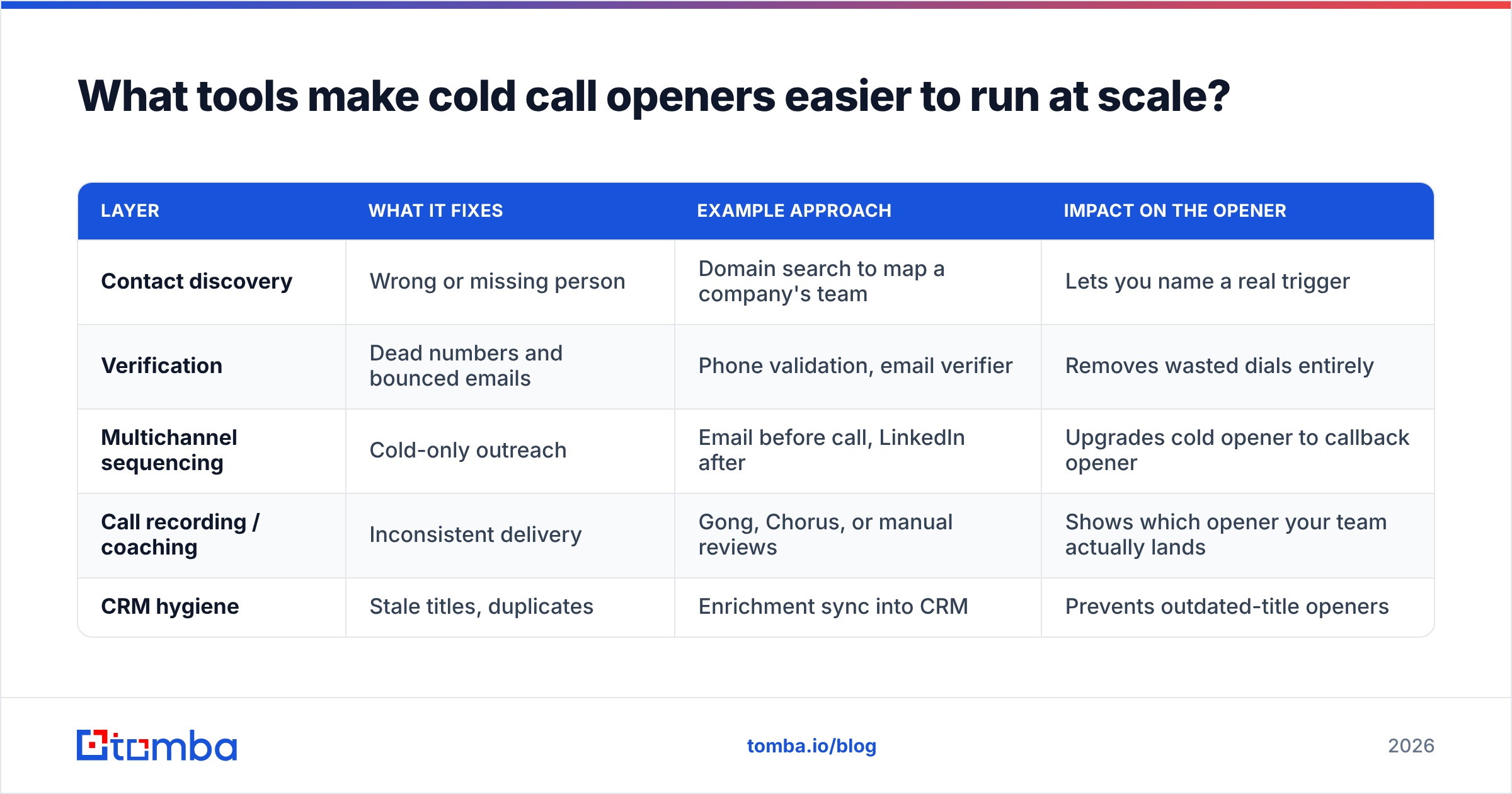
Openers are a rep skill; consistent inputs are a systems problem. Compare where each layer helps:
| Layer | What it fixes | Example approach | Impact on the opener |
|---|---|---|---|
| Contact discovery | Wrong or missing person | Domain search to map a company's team | Lets you name a real trigger |
| Verification | Dead numbers and bounced emails | Phone validation, email verifier | Removes wasted dials entirely |
| Multichannel sequencing | Cold-only outreach | Email before call, LinkedIn after | Upgrades cold opener to callback opener |
| Call recording / coaching | Inconsistent delivery | Gong, Chorus, or manual reviews | Shows which opener your team actually lands |
| CRM hygiene | Stale titles, duplicates | Enrichment sync into CRM | Prevents outdated-title openers |
You do not need all five to start. You need the first two. A rep with a mediocre opener and a clean list will outperform a great opener on a rotten one, every quarter, without exception.
For teams weighing vendors, independent review sites like G2's sales intelligence category are worth ten minutes before a trial — connect-rate complaints show up in reviews long before they show up in a sales deck. Peers in this space, including BookYourData, take a similar verified-data-first approach, and any of them beat scraping from a spreadsheet you inherited.
How do you practice openers without burning real prospects?#
Run three drills, weekly, in fifteen minutes total.
- The 15-second drill. Time yourself. If the ask for permission does not land inside 15 seconds, cut words until it does.
- The hostile partner drill. A teammate interrupts at second five with "Not interested." You have to recover without a script. Do it ten times.
- The recording review. Listen to five of your own calls at 1.5x. You will hear filler words you swear you do not use.
Track one number: percent of dials where you get past 60 seconds. Not meetings booked — that measures qualification and product fit too. Past-60-seconds isolates the opener. When that number rises, your first 15 seconds improved. When it stalls with a new script, the problem was never the script; check the list.
Ready to stop wasting openers on dead numbers?#
The best sales call opener in the world cannot rescue a call to someone who does not work there anymore. Start by fixing the input: build your call lists from verified, current contact data instead of exports that decayed months ago.
Tomba Email Finder gives you verified business contacts by name, company, or domain — so your reps dial real people at real companies with correct titles, and their opener gets the chance it deserves. Start free with 25 searches per month, or see Tomba pricing if you need bulk lists: Starter runs $49/mo, Growth $99/mo, and Pro $249/mo for teams running high-volume outbound.
Fix the list, then fix the first 15 seconds. In that order.
Related guides#
// get started
Find, verify and enrich your first contacts today
Start on the free plan with 25 searches a month, then scale when your team is ready.
Free plan · No credit card required · GDPR & CCPA
Get the Tomba newsletter
Product and data updates
// about the author