How to Start a Sales Conversation: 7 Openers That Work
Most sales conversations die in the first 10 seconds. Here are seven tested openers, a script framework, and the research workflow that makes cold outreach feel warm.
TL;DR
- The first 10 seconds decide everything. A sales conversation starts when the prospect chooses to keep listening — not when you finish your intro.
- Openers that reference a specific, observable trigger (funding, hiring, tech change, a post they wrote) beat generic pleasantries by a wide margin across every channel.
- Use a four-part structure: permission → relevance → tension → soft ask. It works on cold calls, cold email, LinkedIn DMs, and in-person conversations.
- Bad data kills good openers. If the email bounces or the name is wrong, the script never gets read. Verify contacts before you send.
- Budget three minutes of research per prospect. That is the honest break-even point between personalization and volume.
Why do most sales conversations die in the first 10 seconds?#
Because the prospect is running a fast, unconscious triage: is this person here for me, or here for their quota? Everything you say in the opening moments is evidence in that trial.
Think of it like a stranger stopping you on the street. If they lead with "Do you have a minute for a quick survey?" you keep walking. If they lead with "Hey, your bike's back tire is flat," you stop. The difference isn't charisma. It's whether the first sentence contains information that belongs to you.
Most sales openers fail one of three tests:
- Relevance — nothing in the first line proves you know who they are.
- Credibility — no reason to believe you can actually help.
- Low cost — the first ask is too big (a 30-minute demo) for a zero-trust relationship.
Fix all three and the conversation continues. Miss one and you get a polite deflection.
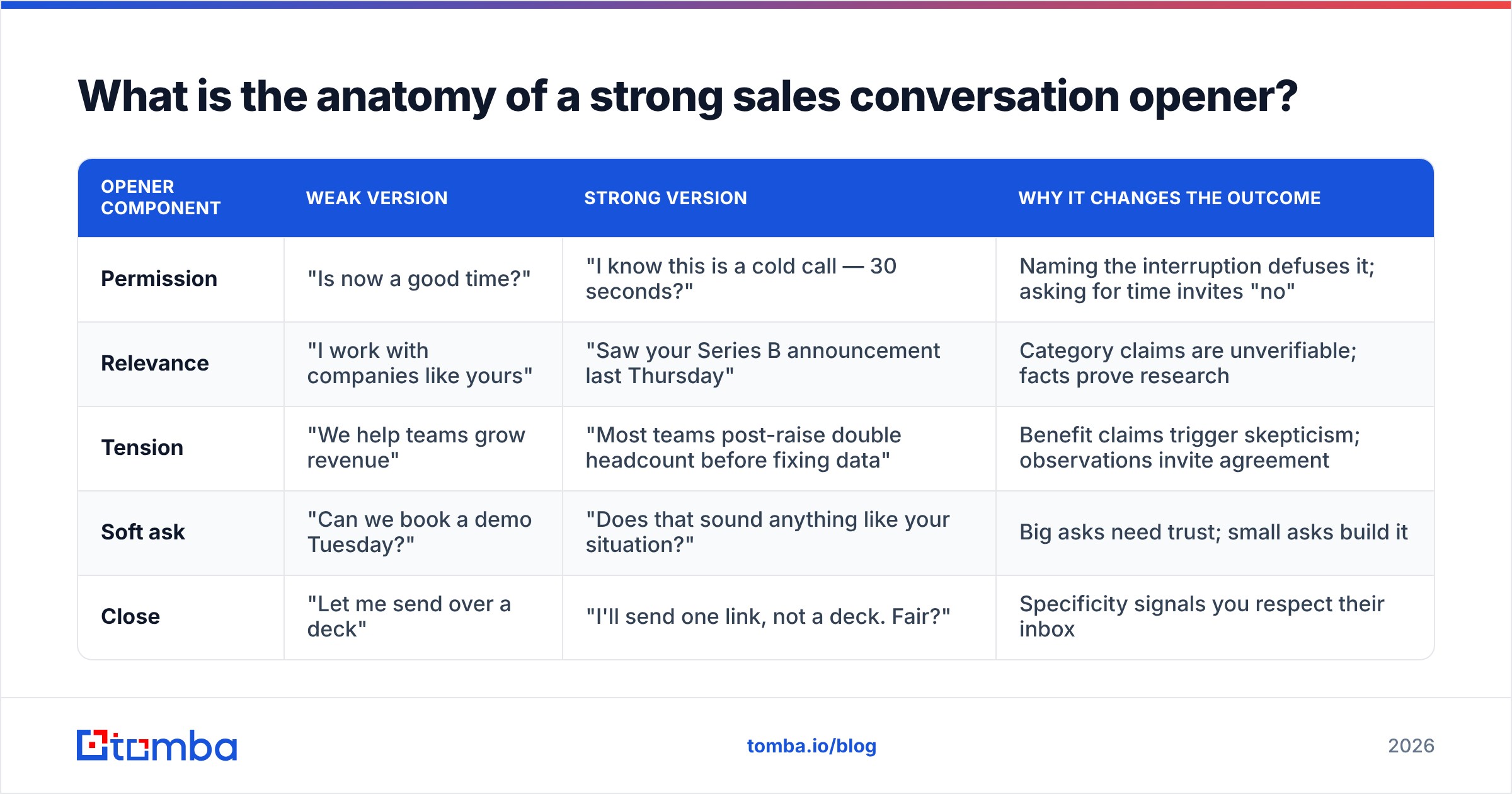
What is the anatomy of a strong sales conversation opener?#
Every opener that consistently works — regardless of channel — has four moving parts. Learn the parts and you can rebuild the script for any situation instead of memorizing lines.
- Permission — a half-second acknowledgment that you're interrupting. "I know I'm catching you cold." This lowers defenses more than any clever hook.
- Relevance — the specific, verifiable reason you picked this person. "I saw you're hiring three SDRs in Austin." Not a category. A fact.
- Tension — the problem your relevance point implies, stated as a question or observation, never as a pitch. "Usually when teams scale that fast, list quality is the first thing to slip."
- Soft ask — a request so small that "yes" costs nothing. "Worth 30 seconds, or should I get out of your way?"
That's it. Four beats, roughly 20 words each, under a minute spoken.
| Opener component | Weak version | Strong version | Why it changes the outcome |
|---|---|---|---|
| Permission | "Is now a good time?" | "I know this is a cold call — 30 seconds?" | Naming the interruption defuses it; asking for time invites "no" |
| Relevance | "I work with companies like yours" | "Saw your Series B announcement last Thursday" | Category claims are unverifiable; facts prove research |
| Tension | "We help teams grow revenue" | "Most teams post-raise double headcount before fixing data" | Benefit claims trigger skepticism; observations invite agreement |
| Soft ask | "Can we book a demo Tuesday?" | "Does that sound anything like your situation?" | Big asks need trust; small asks build it |
| Close | "Let me send over a deck" | "I'll send one link, not a deck. Fair?" | Specificity signals you respect their inbox |
Which sales conversation openers actually work in 2026?#
Here are seven openers worth stealing, with the situation each fits. Rewrite them in your own voice — copied scripts sound copied.
1. The observable trigger. "I noticed you rolled out a new pricing page last month — was that a self-serve push?" Best for: any prospect with a public digital footprint. Works because it's provably specific.
2. The permission-first cold call. "This is a cold call. You can hang up, but will you give me 30 seconds to say why I picked you?" Best for: outbound phone. It converts because honesty is now unusual enough to be interesting.
3. The peer reference. "Two other RevOps leads at Series-B fintechs told me the same thing this month — curious if it lands with you." Best for: crowded categories where social proof matters more than novelty.
4. The negative assumption. "You've probably already solved this, in which case ignore me." Best for: senior buyers. Gives them the dignity of competence and paradoxically increases replies.
5. The single-question email. One line, one question, no signature block essay. "Who owns lead data quality on your team now?" Best for: cold email where reply rate is the metric.
6. The content hook. "Your post on attribution modeling — the part about last-touch being a lie — I've been arguing that for two years." Best for: LinkedIn and social selling. Requires you actually read the thing.
7. The referral relay. "Priya in your marketing team suggested you're the right person for this." Best for: multi-threaded accounts. Only use when true — a fabricated referral ends the relationship permanently.
How do you research a prospect in three minutes?#
Three minutes is the honest budget. Longer and your volume collapses; shorter and your opener is generic. Here's a workflow that fits the window:
- Minute 1 — the company. Recent news, funding, job postings, and any pricing or product page changes. Job postings are the most underrated signal: what a company hires for tells you what it's about to spend on.
- Minute 2 — the person. Their last three LinkedIn posts, their job tenure, and whether they came from a competitor. Tenure under six months means they're building something; over four years means they own the status quo.
- Minute 3 — the contact route. Confirm the email exists and the phone number is live. This is where most reps skip a step and pay for it later.
That last minute matters more than reps assume. According to HubSpot's sales research, reps spend a large share of their week on non-selling admin — and re-finding bad contact data is a big slice of it. A verified contact record turns a great opener into a delivered great opener.
If you're working from a company domain rather than a name, domain search returns the published addresses and the company's email pattern in one call, which removes the guesswork of first.last@ versus flast@. When you're starting from a LinkedIn profile instead, a LinkedIn finder shortcuts the same step.
Is cold calling or cold email the better place to start?#
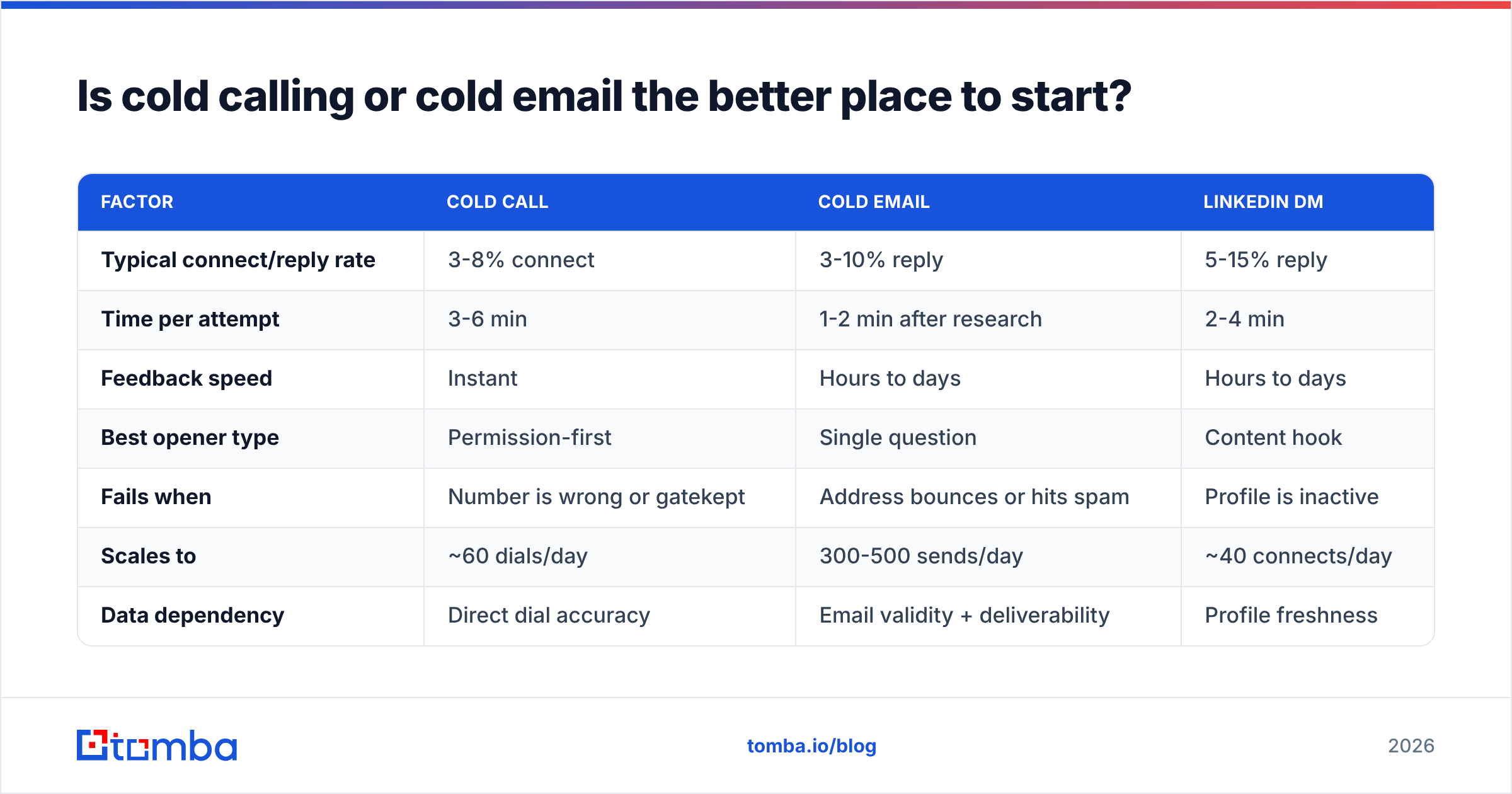
Neither wins outright. They fail differently, which is why the strongest sequences run both.
| Factor | Cold call | Cold email | LinkedIn DM |
|---|---|---|---|
| Typical connect/reply rate | 3-8% connect | 3-10% reply | 5-15% reply |
| Time per attempt | 3-6 min | 1-2 min after research | 2-4 min |
| Feedback speed | Instant | Hours to days | Hours to days |
| Best opener type | Permission-first | Single question | Content hook |
| Fails when | Number is wrong or gatekept | Address bounces or hits spam | Profile is inactive |
| Scales to | ~60 dials/day | 300-500 sends/day | ~40 connects/day |
| Data dependency | Direct dial accuracy | Email validity + deliverability | Profile freshness |
The practical read: use email for coverage, calls for conversion, and LinkedIn to warm both. A prospect who has seen your name in their feed answers the phone at a noticeably higher rate than a true cold dial.
Two rules keep the mix honest. First, never send more volume than your domain can carry — Google's bulk sender guidelines set hard expectations on spam rates and authentication, and violating them takes your whole domain down, not just one campaign. Second, don't dial a number you haven't validated; a phone validator run costs seconds and saves a dead six-minute attempt.
What should you say after the opener lands?#
The opener buys you 30 seconds. The next 90 decide whether you get a meeting. Most reps blow it by immediately pitching.
Instead, run a discovery ladder — three questions that climb from easy to consequential:
- Situation question (easy). "How is your team handling that today?" Costs the prospect nothing to answer and gets them talking.
- Consequence question (medium). "When the list is stale, who feels it first — the SDRs or marketing?" Makes the cost concrete without you asserting it.
- Priority question (hard). "Is that on the roadmap for this quarter, or is it a next-year problem?" This is your qualifying question. A candid "next year" is a good outcome — you just saved a month of chasing.
If all three land, ask for the meeting explicitly and propose one specific time. Vague closes ("I'll follow up next week") produce vague results. And whatever you promised in the opener — one link, not a deck — deliver exactly that. Small kept promises are how trust compounds in outbound.
How does data quality change your opener's performance?#
More than the script does. This is the uncomfortable part of the craft.
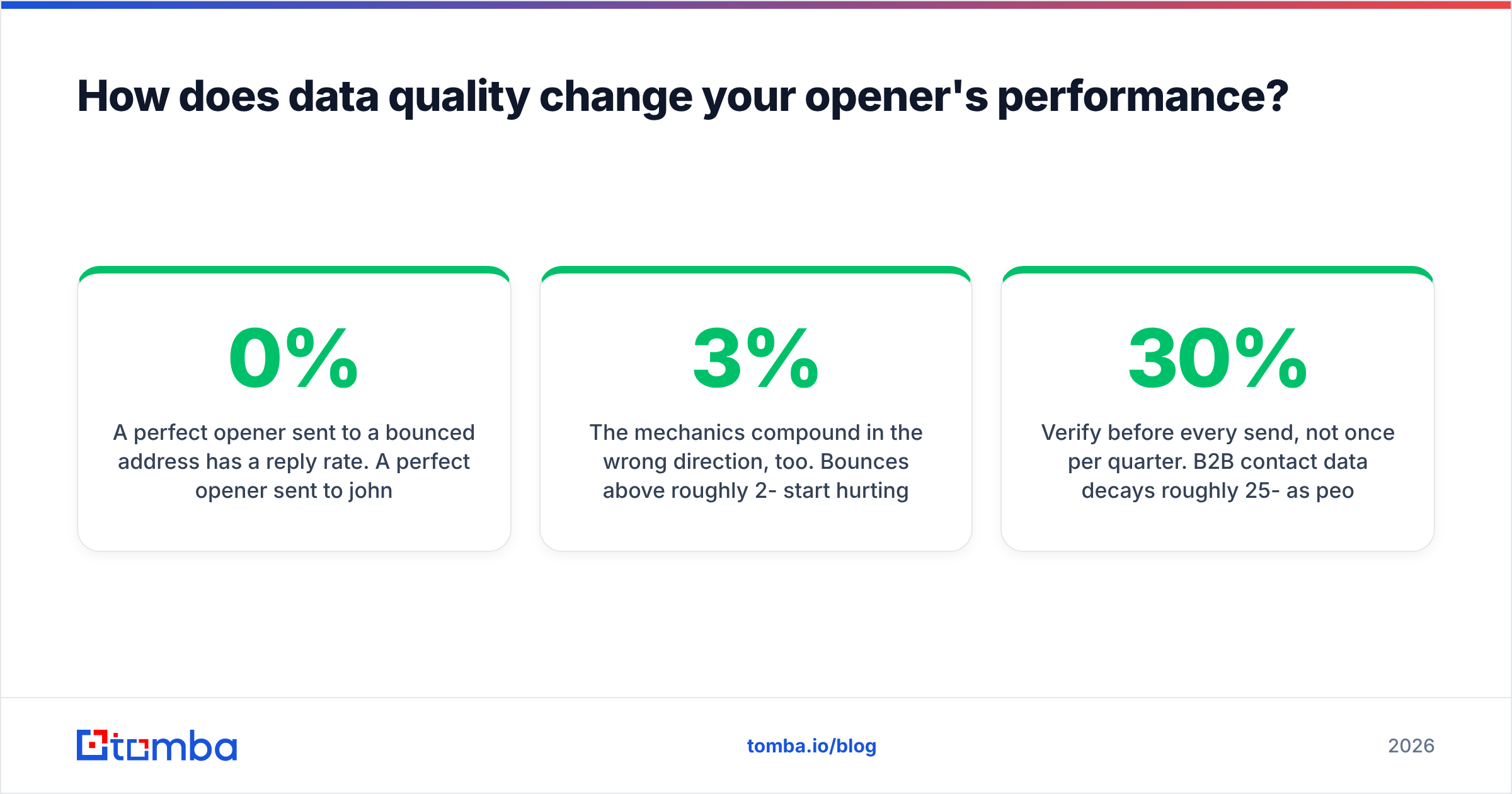
A perfect opener sent to a bounced address has a 0% reply rate. A perfect opener sent to john.smith@ when the company uses jsmith@ has the same. And an opener addressed to someone who left the company 14 months ago actively damages your credibility with whoever inherited the inbox.
The mechanics compound in the wrong direction, too. Bounces above roughly 2-3% start hurting your sender reputation, which means the next campaign — the one with the great opener — lands in spam for prospects whose addresses were fine. You end up paying for old sloppiness with new opportunities.
A workable hygiene routine:
- Verify before every send, not once per quarter. B2B contact data decays roughly 25-30% per year as people change jobs. An email verifier pass on the list right before send catches most of the drift.
- Handle catch-all domains separately. Many enterprise domains accept everything at the SMTP layer, which makes standard verification useless. Segment them and run a catch-all verifier instead of guessing.
- Deduplicate across sources. If a prospect gets the same opener from two reps in one week, your "personalized" outreach is exposed as automation.
- Log outcomes back to the record. Wrong-person replies are free data. Update the record instead of letting the next rep repeat the mistake.
Independent review sites like G2's sales intelligence category are useful for comparing how vendors handle exactly these edge cases — verification depth, catch-all handling, and refresh cadence differ far more between tools than marketing pages suggest. Tools like BookYourData, Apollo, and Tomba all approach the freshness problem differently, and the right pick depends on whether you need breadth, depth, or API-level control.
What mistakes should you avoid when starting a sales conversation?#
- "How are you today?" on a cold call. It signals script immediately and invites a hang-up.
- Fake personalization. "Love what you're doing at [Company]" is worse than no personalization, because it announces a mail merge.
- Leading with your company. The prospect has no reason to care who you are for at least 20 seconds.
- Asking for 15 minutes in line one. The ask size should match the trust level, and trust is zero.
- Over-researching. Spending 20 minutes on a prospect who isn't qualified is procrastination wearing a productivity costume. Qualify on firmographics first, personalize second.
- Ignoring the reply that isn't "yes." "Not now" is the most common real answer, and it's a scheduling instruction, not a rejection. Book the follow-up before you leave the thread.
How do you scale personalized openers without burning your week?#
Templatize the structure, personalize the variable. Your four-part opener stays fixed; only the relevance line changes per prospect. That's one sentence of real work per contact, not a whole email.
Then automate the parts that carry no judgment:
- Pull contacts and email patterns in batches rather than one at a time — a bulk email finder run against a target account list handles hundreds of prospects in one pass.
- Push verified records straight into your CRM so reps never copy-paste. Tomba's HubSpot integration and Salesforce connector both write enriched contacts directly to the record.
- Wire lookups into your own tooling with the Tomba API if you run a custom prospecting stack.
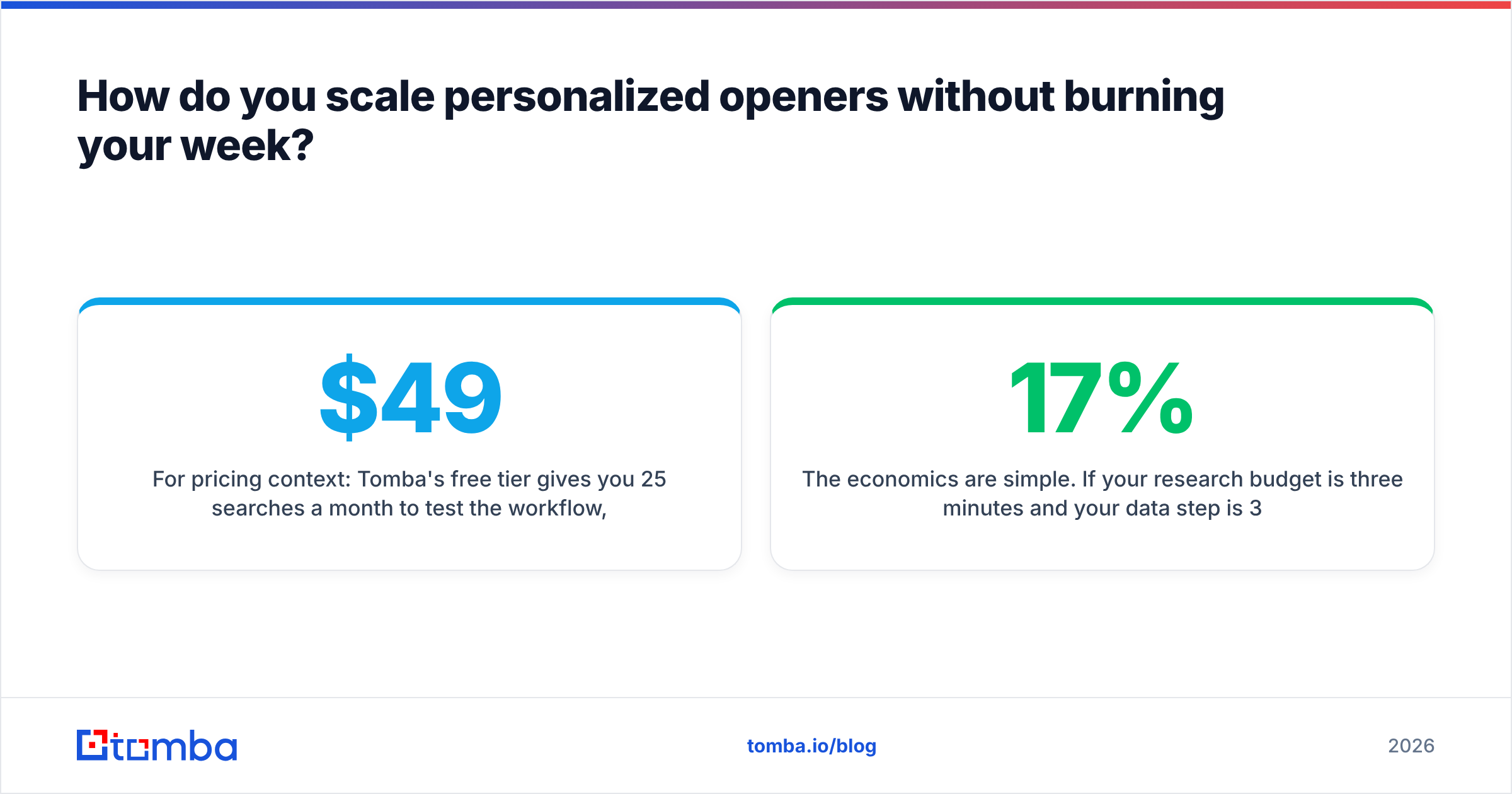
For pricing context: Tomba's free tier gives you 25 searches a month to test the workflow, Starter runs $49/mo, Growth $99/mo, and Pro $249/mo, with Enterprise priced on request. Full Tomba pricing breaks down credits per tier so you can size against your actual send volume.
The economics are simple. If your research budget is three minutes and your data step is 30 seconds of it, automation that removes the data step gives you back 17% of your prospecting hours — or lets you personalize 17% more deeply on the same clock.
Ready to start conversations that don't bounce?#
The best opener in the world is worthless against a dead address. Start with contact data you can trust, then spend your creative energy on the one sentence that proves you did the homework.
Tomba's Email Finder finds professional email addresses by domain, name, or company, with verification built into the same call — so the opener you spent three minutes crafting actually reaches a human. Start on the free tier at 25 searches a month, and scale up only when the conversations start landing.
Related guides#
// get started
Find, verify and enrich your first contacts today
Start on the free plan with 25 searches a month, then scale when your team is ready.
Free plan · No credit card required · GDPR & CCPA
Get the Tomba newsletter
Product and data updates
// about the author