How to Start a Sales Pitch Email: 7 Openers That Work
Your first two lines decide whether the rest of your pitch gets read. Here are seven tested sales pitch email openers, the data behind them, and the ones that quietly kill your reply rate.
TL;DR
- The first line of a sales pitch email is read in the inbox preview, before the recipient opens anything. Waste it on "I hope this email finds you well" and you've spent your only free impression.
- Openers that reference a specific, verifiable trigger (a hire, a funding round, a page on their site, a job posting) consistently beat generic personalization tokens like
{{first_name}}. - The strongest structure is: relevance signal → why you're writing → one-sentence value claim → single low-friction ask. Four lines, under 90 words.
- Never open with your company name, your title, or a compliment you can't defend. All three read as automated.
- None of this matters if the address bounces. Verified contact data is the precondition, not the polish — a great opener sent to a dead mailbox is a 0% reply rate with extra steps.
Why does the first line of a sales pitch email matter so much?#
Because it's doing two jobs at once, and most reps only plan for one.
Job one: the preview text. In Gmail, Outlook, and every mobile mail client, the first 40 to 90 characters of your body render right next to the subject line in the inbox list. Your recipient sees them before deciding to open. That means your opener is not the start of your email — it's the second half of your subject line.
Job two: the credibility check. Once the email is open, the reader spends roughly three seconds deciding whether this is a human who did homework or a sequence that found their address in a scraped list. That judgment is made almost entirely on the first sentence.
Think of it like a cold call. You don't get to deliver a pitch because you dialed — you get to deliver a pitch because your first eight words earned the next thirty seconds. Email is the same trade, just asynchronous.
The practical consequence: "Hi {{first_name}}, I hope you're doing well" burns both jobs simultaneously. It says nothing in the preview and it signals template in the body. It's the single most common opener in B2B outbound and it's functionally the same as starting with a blank line.
What are the components of a strong sales pitch email opener?#
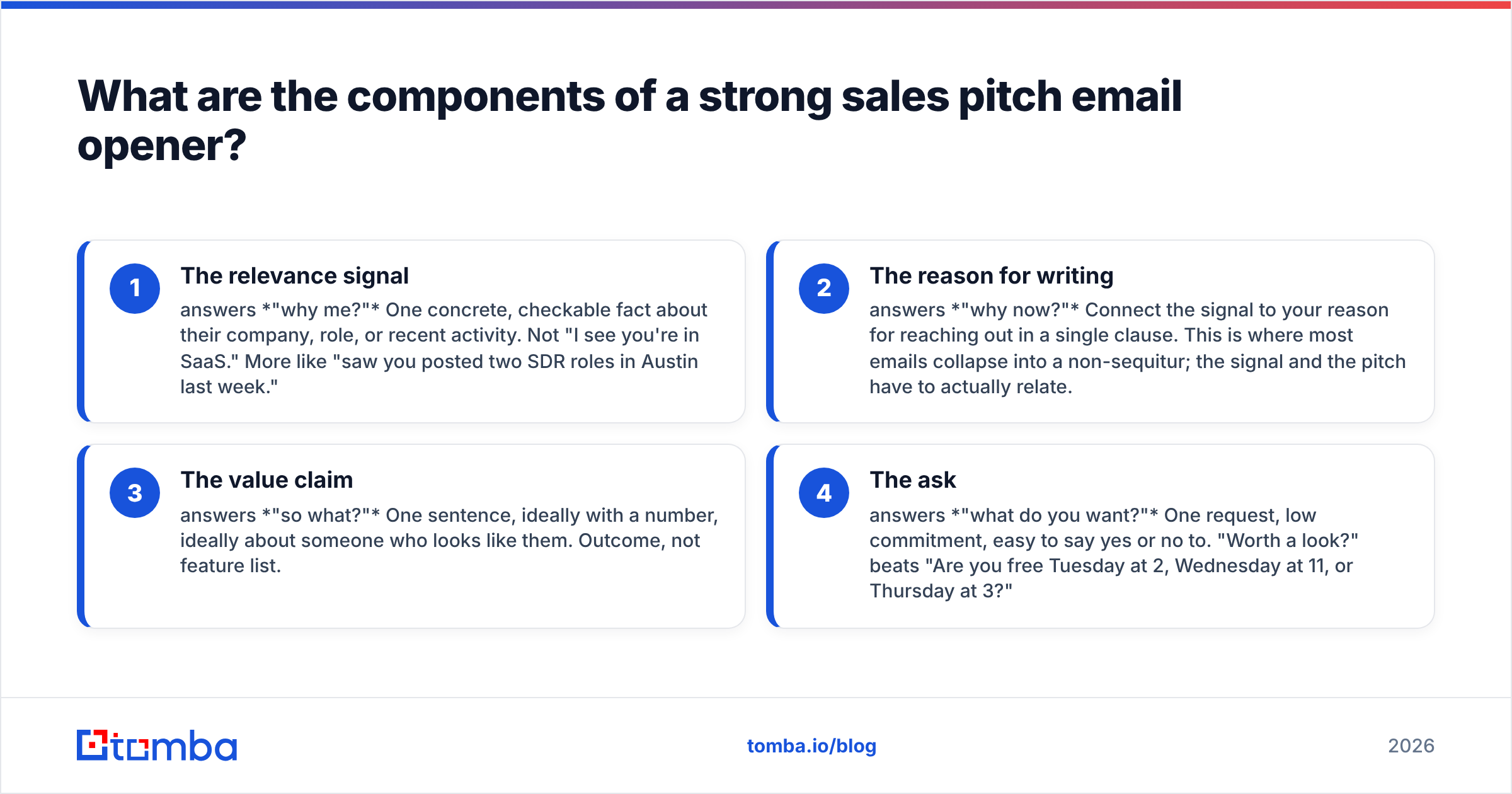
A working opener has four moving parts, in this order. Each one answers a question the reader is silently asking.
- The relevance signal — answers "why me?" One concrete, checkable fact about their company, role, or recent activity. Not "I see you're in SaaS." More like "saw you posted two SDR roles in Austin last week."
- The reason for writing — answers "why now?" Connect the signal to your reason for reaching out in a single clause. This is where most emails collapse into a non-sequitur; the signal and the pitch have to actually relate.
- The value claim — answers "so what?" One sentence, ideally with a number, ideally about someone who looks like them. Outcome, not feature list.
- The ask — answers "what do you want?" One request, low commitment, easy to say yes or no to. "Worth a look?" beats "Are you free Tuesday at 2, Wednesday at 11, or Thursday at 3?"
Cut anything that doesn't serve one of those four. Your title doesn't. Your company's founding year doesn't. The phrase "I wanted to reach out" doesn't — you're obviously reaching out, you sent an email.
Which sales pitch email openers actually get replies?#
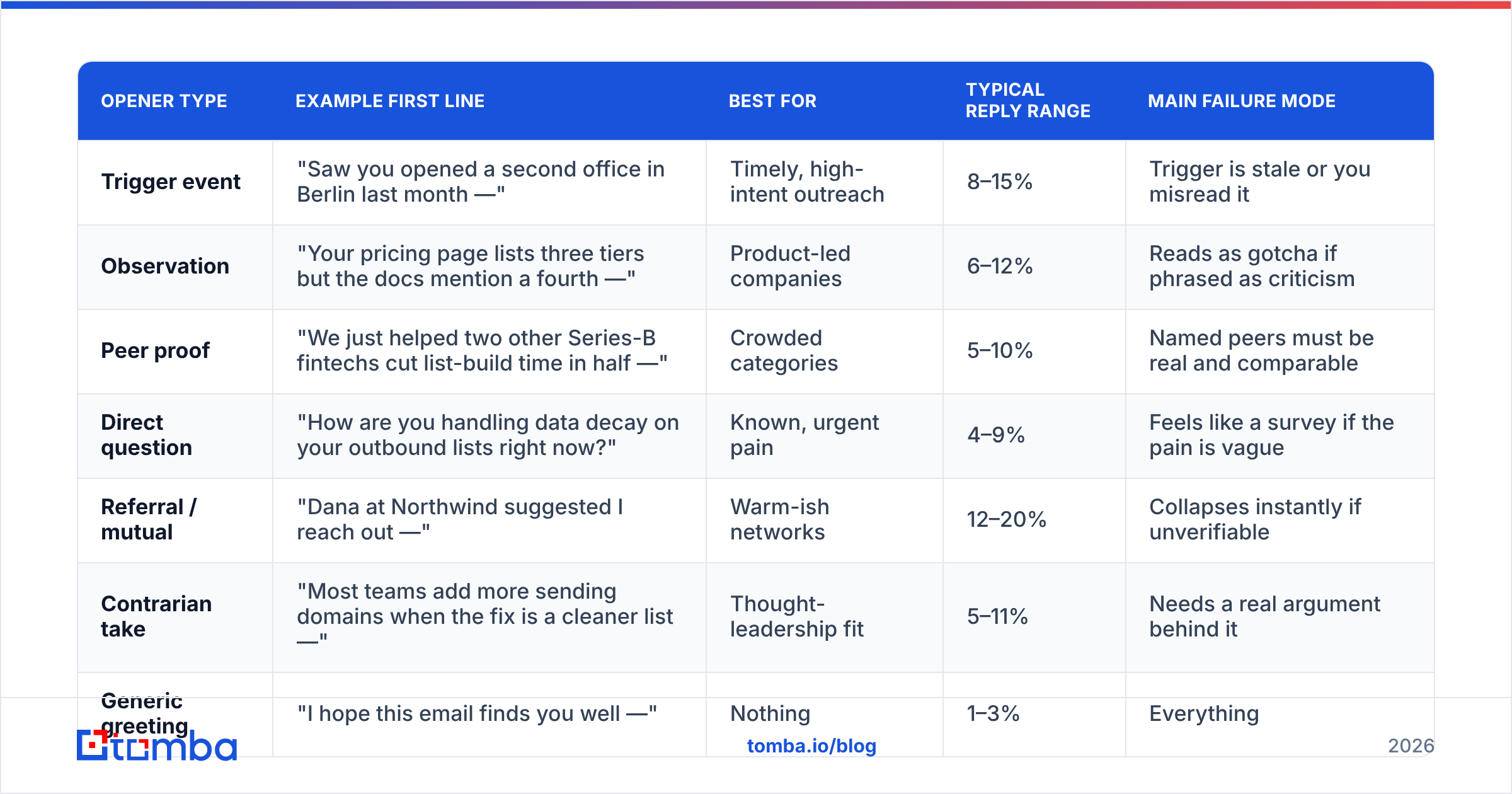
Here are seven opener patterns, what they're good for, and where they break. Reply-rate ranges below reflect commonly reported outbound benchmarks across B2B lists; treat them as directional, not as a promise — your ICP, offer, and list quality move these numbers more than the wording does.
| Opener type | Example first line | Best for | Typical reply range | Main failure mode |
|---|---|---|---|---|
| Trigger event | "Saw you opened a second office in Berlin last month —" | Timely, high-intent outreach | 8–15% | Trigger is stale or you misread it |
| Observation | "Your pricing page lists three tiers but the docs mention a fourth —" | Product-led companies | 6–12% | Reads as gotcha if phrased as criticism |
| Peer proof | "We just helped two other Series-B fintechs cut list-build time in half —" | Crowded categories | 5–10% | Named peers must be real and comparable |
| Direct question | "How are you handling data decay on your outbound lists right now?" | Known, urgent pain | 4–9% | Feels like a survey if the pain is vague |
| Referral / mutual | "Dana at Northwind suggested I reach out —" | Warm-ish networks | 12–20% | Collapses instantly if unverifiable |
| Contrarian take | "Most teams add more sending domains when the fix is a cleaner list —" | Thought-leadership fit | 5–11% | Needs a real argument behind it |
| Generic greeting | "I hope this email finds you well —" | Nothing | 1–3% | Everything |
Two notes on reading that table.
First, the referral opener wins by a wide margin and it's the least scalable. That's the permanent tension in outbound: relevance and volume trade against each other. Most teams resolve it badly by scaling the cheap opener. The better resolution is to scale the research, not the sentence — pull the trigger data programmatically so a specific first line costs you seconds instead of minutes.
Second, the observation opener is the most commonly botched. "I noticed your website loads slowly" is not an observation, it's an insult with a citation. Reframe as curiosity: "Noticed you're running HubSpot and Salesforce side by side — is the sync handling your enrichment fields, or is that manual?"
How do you personalize an opener without spending 20 minutes per lead?#
Set a research budget and enforce it. Ninety seconds per prospect for anything under a $20k deal size. Beyond that, the math stops working.
Inside that budget, pull from sources that are fast and structured:
- Job postings. A company hiring three enterprise AEs is scaling a motion. That's a reason to write, and it's public.
- Recent funding or leadership changes. New VP of Sales in seat under 90 days is the highest-intent buying signal in B2B, because new leaders rebuild stacks.
- Their own content. If your prospect published a post or spoke on a podcast, quote a specific line. Not "loved your post" — the actual claim they made. An author finder turns a byline into a contactable person in one step, which makes this angle practical at volume.
- Tech stack. Knowing they run a specific CRM or sending tool lets you write an opener that only makes sense for them. Check what a domain is actually running with a website tech stack lookup.
- Their domain's people graph. A domain search tells you who else sits in the function you're targeting, which is how you decide whether you're writing to the decision-maker or to the person who'll forward it.
The trick is templating the structure and varying only the signal. Your line two, three, and four can be identical across a hundred prospects. Line one carries all the personalization weight. That's a 15-second edit per lead, not a 20-minute one.

What openers should you never use?#
Some first lines are so common that they've become negative signals — the reader has been trained by thousands of previous emails to associate them with a pitch they didn't ask for.
- "I hope this email finds you well." Present in a large share of cold email and correlated with nothing good. It occupies your entire preview text with zero information.
- "My name is X and I'm the Y at Z." Your identity is in the From field and the signature. Leading with it says you think you're the interesting part of this email.
- "Quick question —" followed by a paragraph. If it were quick you'd have asked it. Readers have learned this is a bait line.
- "I know you're busy, so I'll keep this short." Then don't spend a sentence announcing it.
- "Congrats on the funding!" with nothing after it. Every single vendor sent that email the same week. If you use a funding trigger, you need a second clause that says something only you would say.
- False familiarity. "Following up on my last email" when there was no last email, or "as discussed" when nothing was discussed. This destroys trust permanently and, in some jurisdictions, edges toward deceptive commercial practice.
There's a deliverability dimension too. Openers stuffed with hype words, exclamation points, or all-caps urgency raise spam-filter scores before a human ever adjudicates. Run a draft through a spam checker before you commit a sequence to a few thousand sends. Your opener language and your email deliverability are more connected than most reps assume.
How do subject line and opener work together?#
They're one unit. Write them together or you'll write the same thing twice.
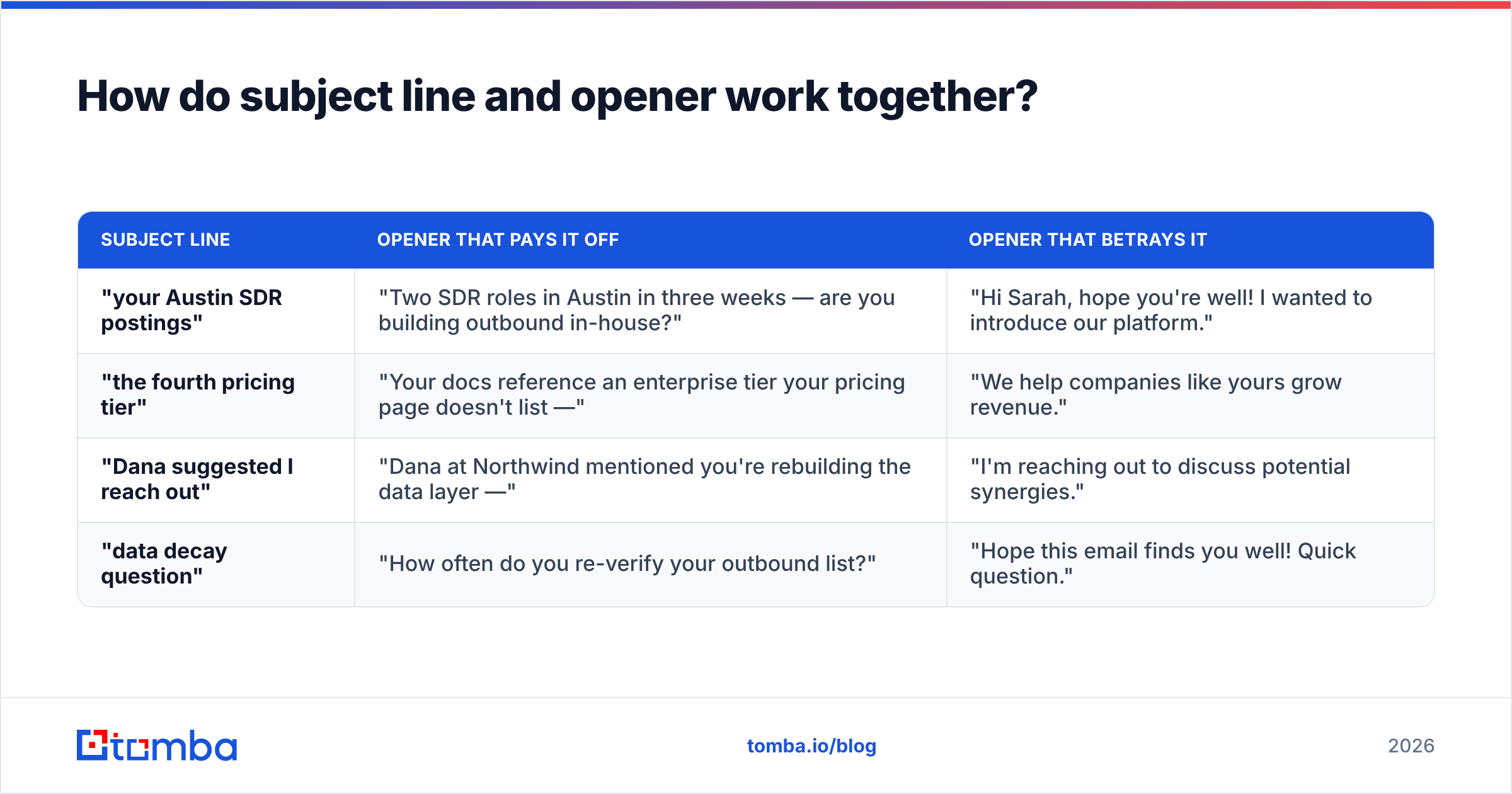
The pattern that works: the subject line creates a narrow, specific curiosity gap, and the opener immediately pays it off. If your subject is "your Austin SDR postings," your first line had better be about those postings. Mismatch between subject and opener is the fastest way to train a prospect to ignore your domain.
| Subject line | Opener that pays it off | Opener that betrays it |
|---|---|---|
| "your Austin SDR postings" | "Two SDR roles in Austin in three weeks — are you building outbound in-house?" | "Hi Sarah, hope you're well! I wanted to introduce our platform." |
| "the fourth pricing tier" | "Your docs reference an enterprise tier your pricing page doesn't list —" | "We help companies like yours grow revenue." |
| "Dana suggested I reach out" | "Dana at Northwind mentioned you're rebuilding the data layer —" | "I'm reaching out to discuss potential synergies." |
| "data decay question" | "How often do you re-verify your outbound list?" | "Hope this email finds you well! Quick question." |
Notice that the failing openers are interchangeable — you could swap any of them into any row and nothing would break. That interchangeability is the problem. If your opener would work for any prospect, it works for none of them.
If you're stuck on the subject side, a subject line generator is a reasonable way to produce variants fast, but treat its output as raw material. Rewrite it to match the specific opener you already drafted, not the other way around.
Does a great opener matter if your list is bad?#
No, and this is the part most "cold email tips" posts skip.
An opener multiplies your reply rate. It does not create one. If 22% of your addresses bounce — a normal decay rate for a list that's been sitting for a year, since B2B contact data goes stale as people change jobs — then a fifth of your best-written emails never reach a human at all. Worse, that bounce rate damages your sender reputation, which suppresses delivery for the addresses that were valid.
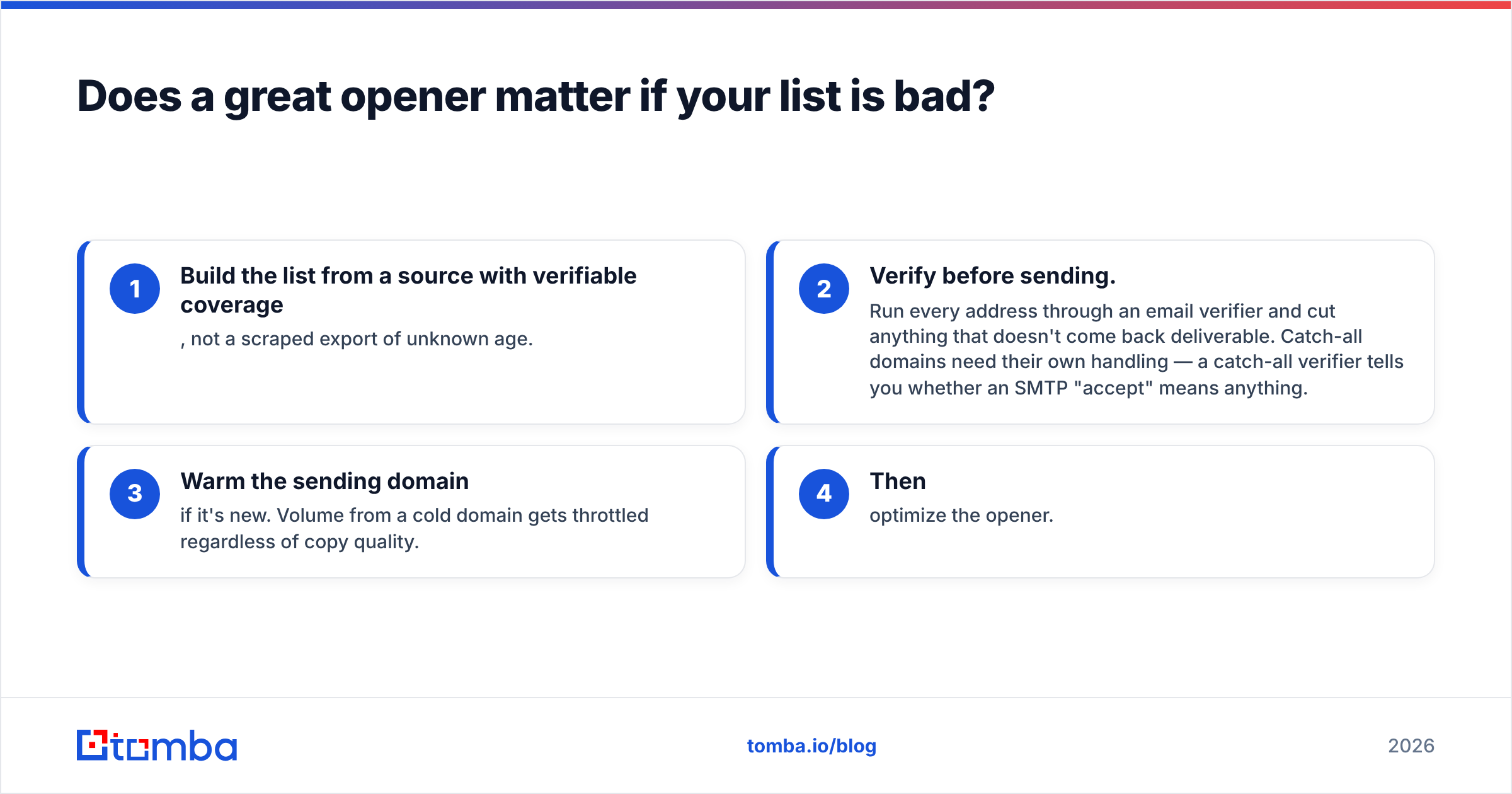
Order of operations that actually holds up:
- Build the list from a source with verifiable coverage, not a scraped export of unknown age.
- Verify before sending. Run every address through an email verifier and cut anything that doesn't come back deliverable. Catch-all domains need their own handling — a catch-all verifier tells you whether an SMTP "accept" means anything.
- Warm the sending domain if it's new. Volume from a cold domain gets throttled regardless of copy quality.
- Then optimize the opener.
Teams that invert this — perfecting copy on top of a decayed list — get confusing results, because copy tests on a broken list produce noise. You can't A/B your way out of a data problem. Industry buyer-review sites like G2 are full of reviews from teams who figured this out in the wrong order.
How should you structure the rest of the pitch after the opener?#
Keep the whole email under 125 words. Research from HubSpot and most large-scale outbound analyses points the same direction: shorter emails get more replies, and the effect is strongest on mobile, where the majority of first opens now happen.
A working skeleton:
- Line 1 (opener): the relevance signal. 12–20 words.
- Line 2 (bridge): why the signal made you write. One sentence.
- Line 3 (value): the outcome you produce, with a number and a comparable customer. One sentence.
- Line 4 (ask): a single, small request. "Worth fifteen minutes?" or "Want me to send the two-line version?"
No bullet lists. No attachments on the first touch. No calendar link in email one — it presumes a decision the reader hasn't made yet.
For the follow-up, do not restart with a new opener. Reply in-thread and add one new piece of information: a relevant case, a specific number, a different angle on the same trigger. "Just bumping this" adds nothing and trains the reader to ignore you. If you want templates to start from rather than a blank page, the cold email templates library is a reasonable baseline to modify — the value is in the structure, not the words, which you should replace.
How do you test and improve your openers?#
Test one variable at a time, with enough volume to mean something.
- Minimum sample. Don't call a winner under ~200 sends per variant. Below that you're reading noise.
- Test openers, not whole emails. Hold subject, body, and CTA constant. If you change three things and the reply rate moves, you've learned nothing actionable.
- Measure replies, not opens. Open tracking has been unreliable since Apple Mail Privacy Protection started prefetching images. Reply rate and meetings booked are the only metrics that survive.
- Segment before you conclude. An opener that wins with founders often loses with enterprise VPs. Aggregate results hide this.
- Retire winners on a schedule. Any opener that spreads through your industry stops working. "Congrats on the funding" was a strong opener once. Assume a 6–12 month shelf life on any pattern that gets copied.
Log everything in your CRM at the variant level so you can see which opener produced which pipeline, not just which one got replies. Replies from unqualified prospects are a cost, not a win.
Start with data you can trust#
The best opener in the world is a research problem before it's a writing problem. You need to know who the person is, what changed at their company recently, and whether their address is actually live — and you need that at a cost per lead that lets you send more than ten emails a day.
That's the gap Tomba Email Finder is built to close: find the right contact by name or domain, get the verification status attached, and pull the company context that makes a specific first line possible. The free tier gives you 25 searches a month to test your ICP without a card; paid plans start at $49/mo for Starter and $99/mo for Growth if you need volume — full Tomba pricing is public.
Write the opener that only makes sense for one person. Then make sure it arrives.
Related guides#
// get started
Find, verify and enrich your first contacts today
Start on the free plan with 25 searches a month, then scale when your team is ready.
Free plan · No credit card required · GDPR & CCPA
Get the Tomba newsletter
Product and data updates
// about the author