How to Start an Email: 12 Openers That Get Replies in 2026
Your first line decides whether the rest of the email gets read. Here are 12 tested email openers, the greetings to avoid, and a copy-paste framework for cold, warm, and follow-up emails.
TL;DR
- The greeting matters less than the first sentence after it. "Hi {FirstName}," is fine — what follows it decides whether you get read.
- Never open with "I hope this email finds you well" or "My name is X and I work at Y." Both burn your only high-attention line on zero information.
- The highest-reply openers do one of three things: reference a trigger event, state an observation about the recipient's business, or name a specific outcome.
- Cold, warm, and follow-up emails need structurally different openings — reusing one template across all three is why reply rates flatten.
- A perfect opener sent to a wrong or dead address still scores zero. Verify the address before you agonize over the first line.
Why does the first line of an email matter more than the subject?#
The subject line gets the open. The first line gets the read. Most inbox clients — Gmail, Outlook, Apple Mail — show a preview snippet of roughly 40 to 90 characters next to the subject, which means your opening sentence is competing for attention before the email is even opened.
That has a practical consequence: "Hi Sarah, I hope this email finds you well" renders in the preview as pure noise. You have spent your entire snippet on a phrase that carries no information. Compare it with "Hi Sarah, saw Northwind opened a second Austin office last month —" which tells the reader, from the inbox list view, that this message is about them.
The mechanics are simple. Attention decays fast. Research on email engagement consistently shows that readers decide within seconds whether to continue, and every filler word you spend at the top is a word you don't get back. The opener isn't a warm-up. It's the pitch.
Wait — that image needs a proper alt. Here it is:
What are the standard ways to start an email?#
There are two layers to any email opening: the salutation (the greeting line) and the opening sentence (the first line of body copy). People obsess over the first and ignore the second. That's backwards, but the salutation still sets register — too casual to a general counsel reads as sloppy, too formal to a startup founder reads as automated.
Here's how the common salutations map to context:
| Salutation | Register | Best for | Avoid when |
|---|---|---|---|
| Hi {FirstName}, | Neutral-friendly | Cold outreach, B2B SaaS, most US/UK business email | Formal legal, government, or first contact in Japan/Germany |
| Hello {FirstName}, | Neutral, slightly cooler | Recruiters, vendors, unknown seniority | You want warmth |
| Dear Dr./Ms. {LastName}, | Formal | Academia, healthcare, legal, government, applications | Startup founders, dev teams — reads stiff |
| Hey {FirstName}, | Casual | Warm leads, peers, existing threads, creator economy | C-suite cold outreach, non-native English recipients |
| {FirstName}, | Direct, no-greeting | Follow-ups inside an existing thread | First contact — reads abrupt |
| Hi team, / Hi all, | Group | Internal, multi-stakeholder threads | Anything you want a single owner to action |
Two rules that hold across all of them. First, use a comma after the name in business email, not a colon — the colon is a US formal-letter convention that now reads as a mail merge. Second, if you cannot confirm the person's first name spelling and gender-neutral form, drop the honorific entirely and use "Hi {FirstName}." Guessing "Mr." wrong costs more than omitting it.
How do you start a cold email so it doesn't get deleted?#
Lead with something only someone who researched them could write.
That's the whole rule. A cold email opener has one job: prove in under 15 words that this message was not blasted to 5,000 people. Everything else — value prop, social proof, CTA — comes after you've earned the second sentence.
The four opener patterns that consistently outperform:
- The trigger event. "Congrats on the Series B — saw the TechCrunch piece Tuesday." A funding round, a new hire, a product launch, an office opening, a conference talk. Trigger events work because they're time-bound and verifiable, and they signal you're paying attention right now, not scraping a list from 2023.
- The specific observation. "Your careers page lists four open SDR roles — looks like you're doubling the outbound team." This is stronger than a compliment because it implies a problem you can speak to. Observation beats flattery every time.
- The mutual context. "Ravi Menon suggested I reach out." Or "we both spoke at SaaStr last year." Referrals are still the single highest-converting opener in B2B. If you have one, use it in the first six words.
- The direct-outcome open. "We cut Acme's lead-research time from 6 hours a week to 40 minutes." Only works if the outcome is concrete, numeric, and relevant to their exact role. Vague versions ("we help companies grow") are worse than no opener at all.
And the four openers to retire:
- "I hope this email finds you well." The most-used sentence in B2B email is also the most-ignored. It's the verbal equivalent of clearing your throat.
- "My name is [Name] and I'm the [Title] at [Company]." Your signature already says this. You just spent your best line introducing yourself to someone who hasn't agreed to care yet.
- "I'm reaching out because…" Filler. Delete it and the sentence gets better: "I'm reaching out because you're hiring SDRs" → "You're hiring four SDRs."
- "Quick question —" followed by a paragraph that is not a quick question. Recipients have been burned by this enough times that it now reads as a tell.
One more constraint worth internalizing: personalization only pays if the underlying data is right. An opener that congratulates someone on a promotion they didn't get, or addresses them at a company they left in March, does more damage than a generic line. This is where contact hygiene and copywriting overlap — running your list through an email verifier before a campaign is not a deliverability chore, it's a copy problem. Stale data produces embarrassing openers.
How should you start a warm email or reply?#
Warm emails invert the rule. With a cold prospect, you earn attention. With a warm one, you already have it — so the opener's job shifts from proving relevance to reducing friction.
Three moves that work:
- Reference the last touchpoint, precisely. "Following up on the pricing question from our Thursday call" beats "just circling back." Specificity reminds them where you left off, so they don't have to scroll.
- Skip the greeting entirely inside an active thread. Once you're three messages deep, "Hi Sarah," on every reply reads robotic. Start with the substance.
- Answer before you ask. If they asked a question, the first sentence should contain the answer, not "thanks for reaching out!" Gratitude can go in sentence two.
For a reply to an inbound lead — someone who filled a form or downloaded something — the strongest opener names what they did: "You grabbed the deliverability checklist yesterday — here's the part most people skip." It confirms you know why they're in your inbox and gives them a reason to keep reading in the same breath.
What's the right way to start a follow-up email?#
Never restate the original email. That's the mistake that makes follow-ups feel like nagging.
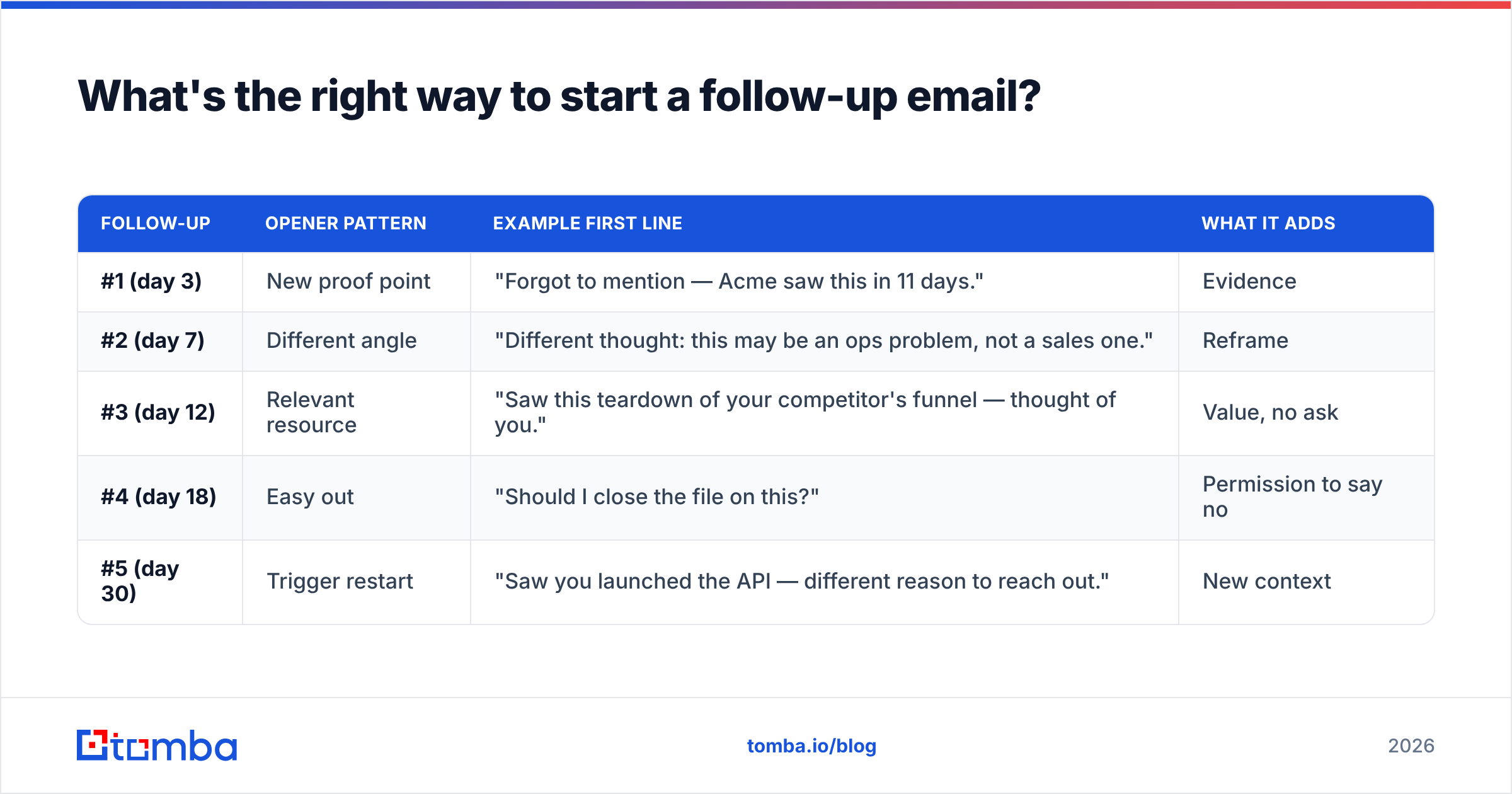
A follow-up opener should add something new: a fresh angle, a piece of proof, a relevant news item, or a genuinely easier ask. Structure the sequence so each opener stands on its own:
| Follow-up | Opener pattern | Example first line | What it adds |
|---|---|---|---|
| #1 (day 3) | New proof point | "Forgot to mention — Acme saw this in 11 days." | Evidence |
| #2 (day 7) | Different angle | "Different thought: this may be an ops problem, not a sales one." | Reframe |
| #3 (day 12) | Relevant resource | "Saw this teardown of your competitor's funnel — thought of you." | Value, no ask |
| #4 (day 18) | Easy out | "Should I close the file on this?" | Permission to say no |
| #5 (day 30) | Trigger restart | "Saw you launched the API — different reason to reach out." | New context |
The "should I close the file on this?" pattern deserves a note. It reliably produces replies because it's the only email in the sequence that's easy to answer — a one-word "yes" ends it. Plenty of those replies turn into "no, actually, bad timing — ping me in Q2," which is a qualified lead you would not otherwise have gotten. It works precisely because it doesn't pretend to be a quick question.
How do you personalize the first line at scale?#
Personalization at volume is a data problem wearing a copywriting costume.
The workflow that actually scales looks like this:
- Segment before you write. Ten segments of 50 contacts each will outperform one blast of 500, because each segment gets an opener written for a shared trigger — same industry, same funding stage, same tech stack, same job posting pattern.
- Build a variable that is not a name. "{{FirstName}}" is table stakes and everyone knows the trick. Build a custom column —
{{recent_trigger}},{{open_roles}},{{tech_detected}}— and write the opener around it. A website tech stack checker or a scan of their careers page fills these columns fast. - Write three opener variants per segment, not per person. Per-person writing doesn't scale past about 40 emails a day. Per-segment writing does, and the reply-rate delta between the two is smaller than most people assume.
- Verify the contact before the send. An opener referencing a role they no longer hold is worse than no personalization. Enriching contacts with current title and company through data enrichment keeps openers factually correct.
- Test the first line, not just the subject. Most teams A/B test subject lines and never touch the opener. Since the opener shows in the preview pane, it's arguably the higher-leverage test.
There's a hard ceiling worth naming: hyper-personalization has diminishing returns past a point. Referencing someone's marathon time from their LinkedIn banner reads as surveillance, not research. The safe boundary is professional-public — things they published, announced, or posted in a business context. Anything from a personal account crosses a line most buyers notice.
Do email openers change by region and seniority?#
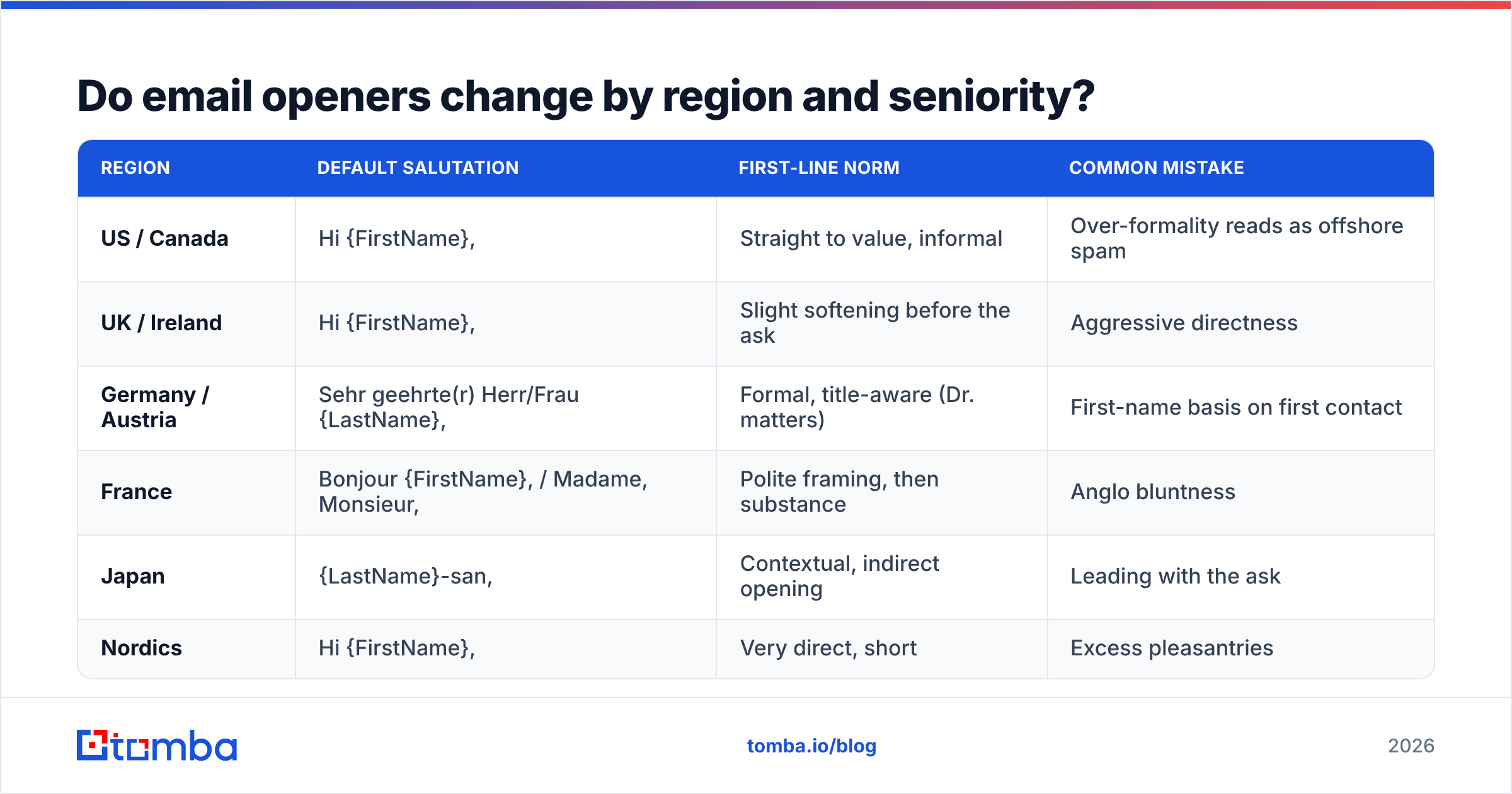
Yes, and getting it wrong is one of the quieter reasons campaigns underperform in EMEA and APAC.
| Region | Default salutation | First-line norm | Common mistake |
|---|---|---|---|
| US / Canada | Hi {FirstName}, | Straight to value, informal | Over-formality reads as offshore spam |
| UK / Ireland | Hi {FirstName}, | Slight softening before the ask | Aggressive directness |
| Germany / Austria | Sehr geehrte(r) Herr/Frau {LastName}, | Formal, title-aware (Dr. matters) | First-name basis on first contact |
| France | Bonjour {FirstName}, / Madame, Monsieur, | Polite framing, then substance | Anglo bluntness |
| Japan | {LastName}-san, | Contextual, indirect opening | Leading with the ask |
| Nordics | Hi {FirstName}, | Very direct, short | Excess pleasantries |
Seniority shifts things too. A VP or C-level recipient reads on mobile between meetings and needs the point in line one. An individual contributor has more time but less authority — with them, an opener that acknowledges their day-to-day work ("you're probably the one stitching these lists together manually") lands better than a strategic outcome claim.
What does a complete, well-started email look like?#
Here are three you can adapt. Note that in each, the opener does one job and hands off cleanly.
Cold, trigger-based:
Hi Priya,
Saw Lumen posted three RevOps roles this week — usually means the data stack is outgrowing the team.
We help ops teams at that exact stage cut list-building from days to hours. Ravi at Northwind went from 6 hours a week of manual research to about 40 minutes.
Worth 15 minutes next Tuesday or Wednesday?
— Marco
Warm, post-demo follow-up:
Priya,
Following up on the API rate-limit question from Thursday — the answer is 15 requests/second on Growth, and it's burstable to 30.
That was the last open item on your side. Want me to put together the pilot scope?
— Marco
Re-engagement after silence:
Hi Priya,
Different reason to reach out: you shipped the public API last month, which changes the integration story we discussed in March.
Two-minute version attached. If the timing's still wrong, say the word and I'll close the file.
— Marco
None of these open with a throat-clear. Each first line contains information the recipient can verify about their own world.
For a broader library of frameworks you can adapt rather than write from scratch, the cold email templates collection is a reasonable starting point, and running drafts through a spam checker before send catches openers that trip filters — "free," "guarantee," and excessive exclamation marks in the first 100 characters are still weighted heavily.
What tools help you write and validate the opening?#
A short, honest map of what's useful at each stage:
- Research the trigger. Google Alerts for company names, LinkedIn company pages, and the target's own careers page. Free, and better than most paid signal tools for small volumes.
- Confirm the human. Job titles rot at roughly 20–30% per year in tech. Confirm the person still holds the role before referencing it.
- Confirm the address. A bounced email never had an opener problem. Verification comes first.
- Check the send-side basics. Even a perfect opener fails if you land in spam. HubSpot's research on email marketing benchmarks is a useful sanity check on what normal open and reply rates actually look like before you blame your copy.
- Read peer reviews before buying anything. G2's sales-engagement category is the least-bad public source for comparing outreach tooling.
The sequencing matters more than the specific tools. Data quality first, copy second. Teams routinely spend a week workshopping openers on a list where 18% of the addresses are invalid, which caps the ceiling before a single word is written.
Common questions about starting an email#
Is "Dear" outdated in business email? In US/UK B2B, largely yes — it now reads as either a formal letter or a template. It remains correct for legal, academic, government, and formal applications, and in several European and Asian business cultures.
Should you use the recipient's name in the first line? Once, in the salutation. Repeating it in the body ("So, Sarah, here's the thing…") is a known sales tell and reads as manipulative.
How long should the opening sentence be? Under 15 words. It needs to survive the mobile preview pane, which truncates aggressively.
Is it okay to start with a question? Yes, if it's a real question they can answer in one line. "Are you the right person for outbound tooling at Lumen?" works. "Do you want more leads?" doesn't.
Should you mention where you got their email? Only if the source is flattering or a referral. "Ravi suggested I reach out" — always. "I found you on a list" — never.
Get the address right before you get the words right#
The best opener in the world scores zero against an address that bounces. Before you spend another afternoon rewriting first lines, make sure the list underneath them is real: current addresses, current titles, current companies.
That's what the Tomba Email Finder is built for — find verified professional email addresses by name, domain, or company, so the openers you write actually reach a human who can reply to them. The free tier includes 25 searches a month, and paid plans start at $49/mo on Starter, with Growth at $99/mo and Pro at $249/mo; full Tomba pricing is public. Fix the data layer first, then go win the first line.
Related guides#
// get started
Find, verify and enrich your first contacts today
Start on the free plan with 25 searches a month, then scale when your team is ready.
Free plan · No credit card required · GDPR & CCPA
// about the author