How to Start Off a Cold Call: Openers That Actually Work
The first 8 seconds of a cold call decide everything. Here are the openers that beat the permission-based script, the data behind them, and the exact lines to steal.
TL;DR
- The first 8 seconds decide the call. Your opener has one job: buy 30 more seconds, not book the meeting.
- "How have you been?" (the false-familiarity opener) still tests highest in most connect-rate studies, but it burns trust with senior buyers. Use it selectively.
- Permission-based openers ("Did I catch you at a bad time?") are safe but capped — they invite a "yes, it is" exit.
- The strongest opener in 2026 is a research-anchored pattern interrupt: name yourself, name the reason, hand over control in under 12 words.
- None of it matters if the number is wrong. Bad contact data kills more cold calls than bad scripts do — verify phone numbers before dialing.
Why does the first 8 seconds matter so much?#
Because cold calling is a rejection funnel, and the opener is the widest part of it.
Think of it like a bouncer at a club door. You don't get to explain your whole night's plan. You get one look, one line, and either you're in or you're on the sidewalk. The prospect isn't evaluating your product in those 8 seconds — they're running a single subconscious query: is this a threat to my next ten minutes?
Every cold call opener that works does the same thing: it defuses that threat fast enough that the buyer's pattern-matching brain ("salesperson, hang up") doesn't fire before your second sentence lands.
That's why the mechanics matter more than the words. Three things happen in those 8 seconds:
- Voice recognition — the prospect decides whether you sound human or scripted. Tone does 70% of the work here; the words do 30%.
- Category assignment — you get sorted into "someone I know," "someone with a reason," or "telemarketer." Only the third gets hung up on reflexively.
- Control transfer — either you keep talking (bad) or you hand them a decision (good). Handing over control early reads as confidence, not weakness.
What are the main cold call opening types?#
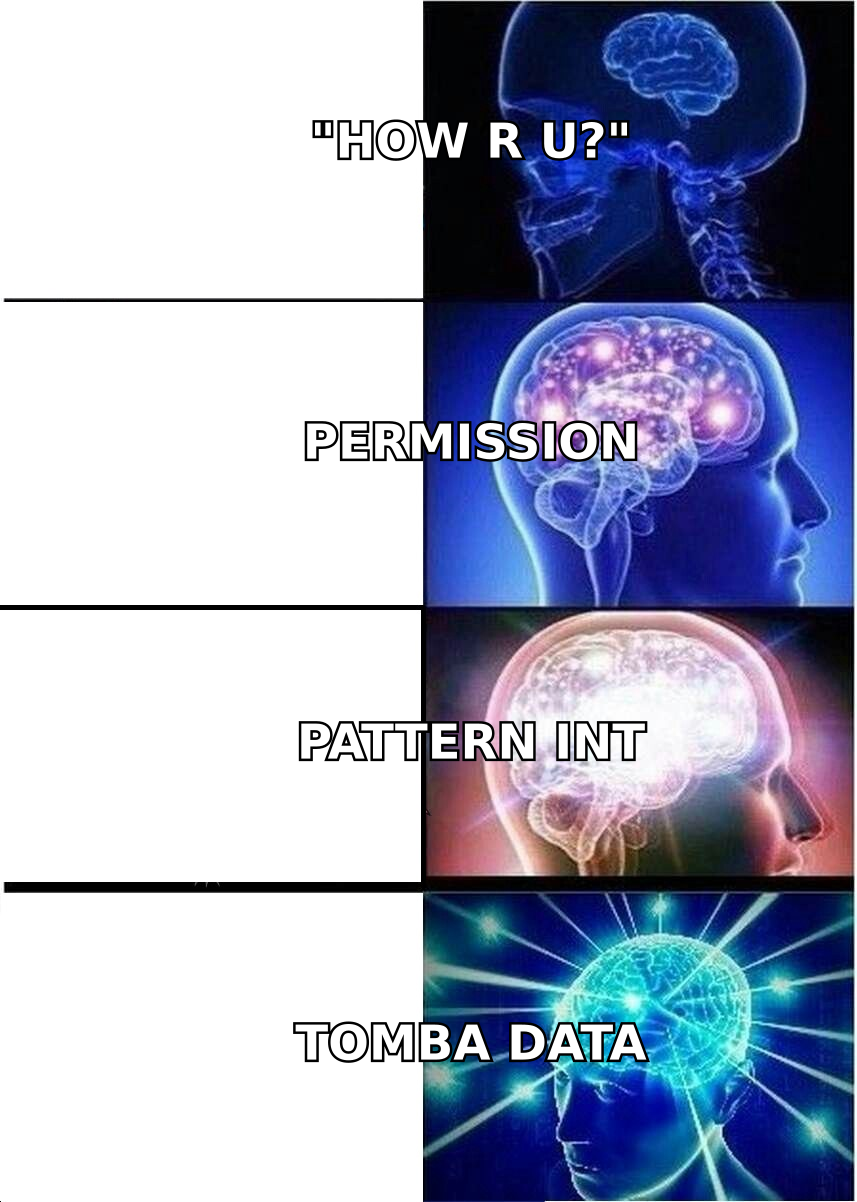
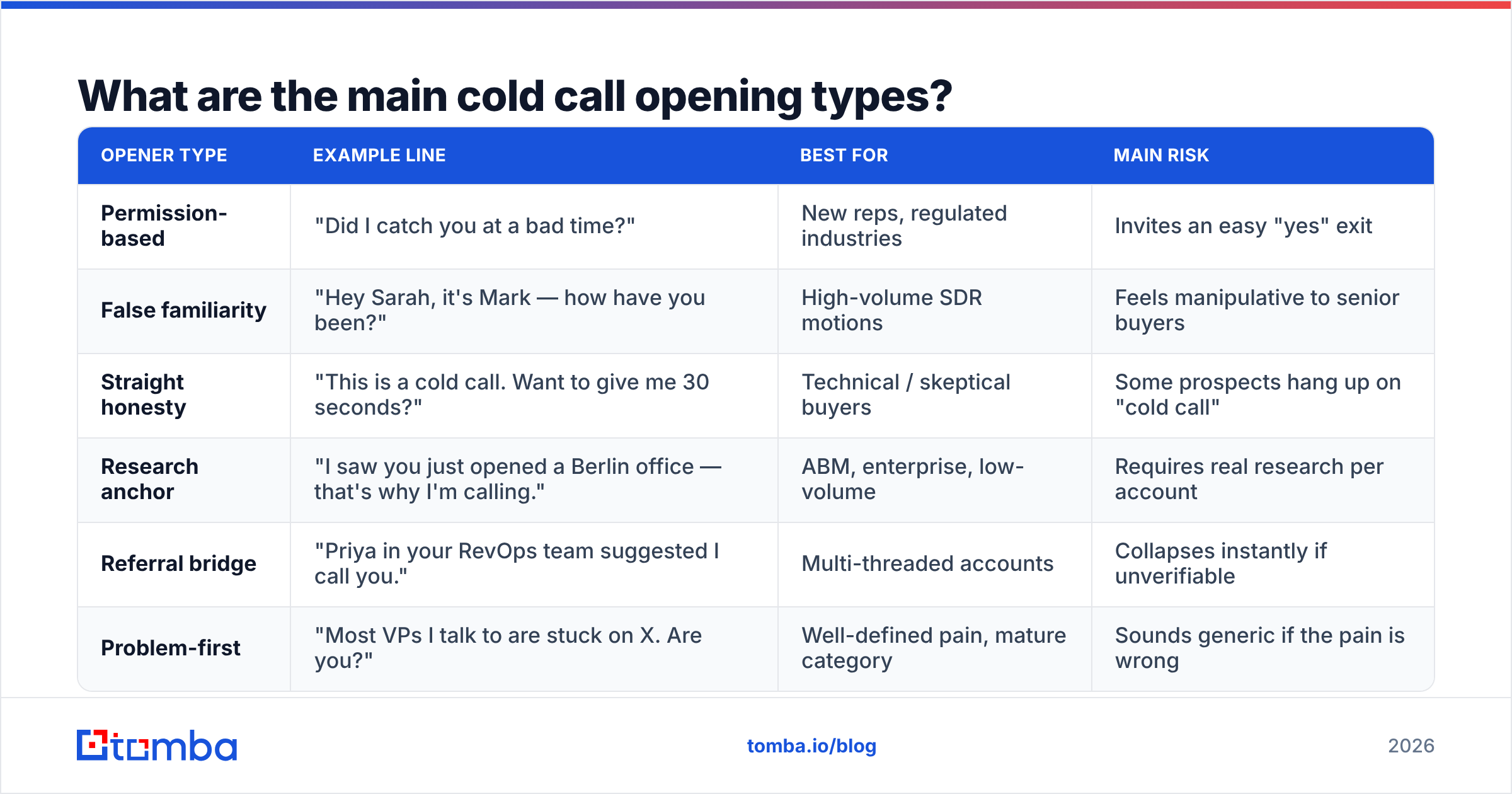
There are six openers that show up repeatedly in real dial data. Each has a distinct risk profile.
| Opener type | Example line | Best for | Main risk |
|---|---|---|---|
| Permission-based | "Did I catch you at a bad time?" | New reps, regulated industries | Invites an easy "yes" exit |
| False familiarity | "Hey Sarah, it's Mark — how have you been?" | High-volume SDR motions | Feels manipulative to senior buyers |
| Straight honesty | "This is a cold call. Want to give me 30 seconds?" | Technical / skeptical buyers | Some prospects hang up on "cold call" |
| Research anchor | "I saw you just opened a Berlin office — that's why I'm calling." | ABM, enterprise, low-volume | Requires real research per account |
| Referral bridge | "Priya in your RevOps team suggested I call you." | Multi-threaded accounts | Collapses instantly if unverifiable |
| Problem-first | "Most VPs I talk to are stuck on X. Are you?" | Well-defined pain, mature category | Sounds generic if the pain is wrong |
The permission-based opener is the default taught in most onboarding decks, and it's fine — but understand what it does. It converts the call into a yes/no gate before you've earned anything. Gong's research on sales conversation data has repeatedly shown that openers referencing the prospect's own context outperform generic permission requests, because they answer the "why me, why now" question before it's asked.
The false-familiarity opener performs well on raw connect metrics and poorly on brand. If your ICP is a director-level buyer who takes 40 cold calls a quarter, they've heard it. If your ICP is an ops manager at a 30-person company, it may genuinely work. Know which you're selling to.
How do you actually structure a cold call opening?#
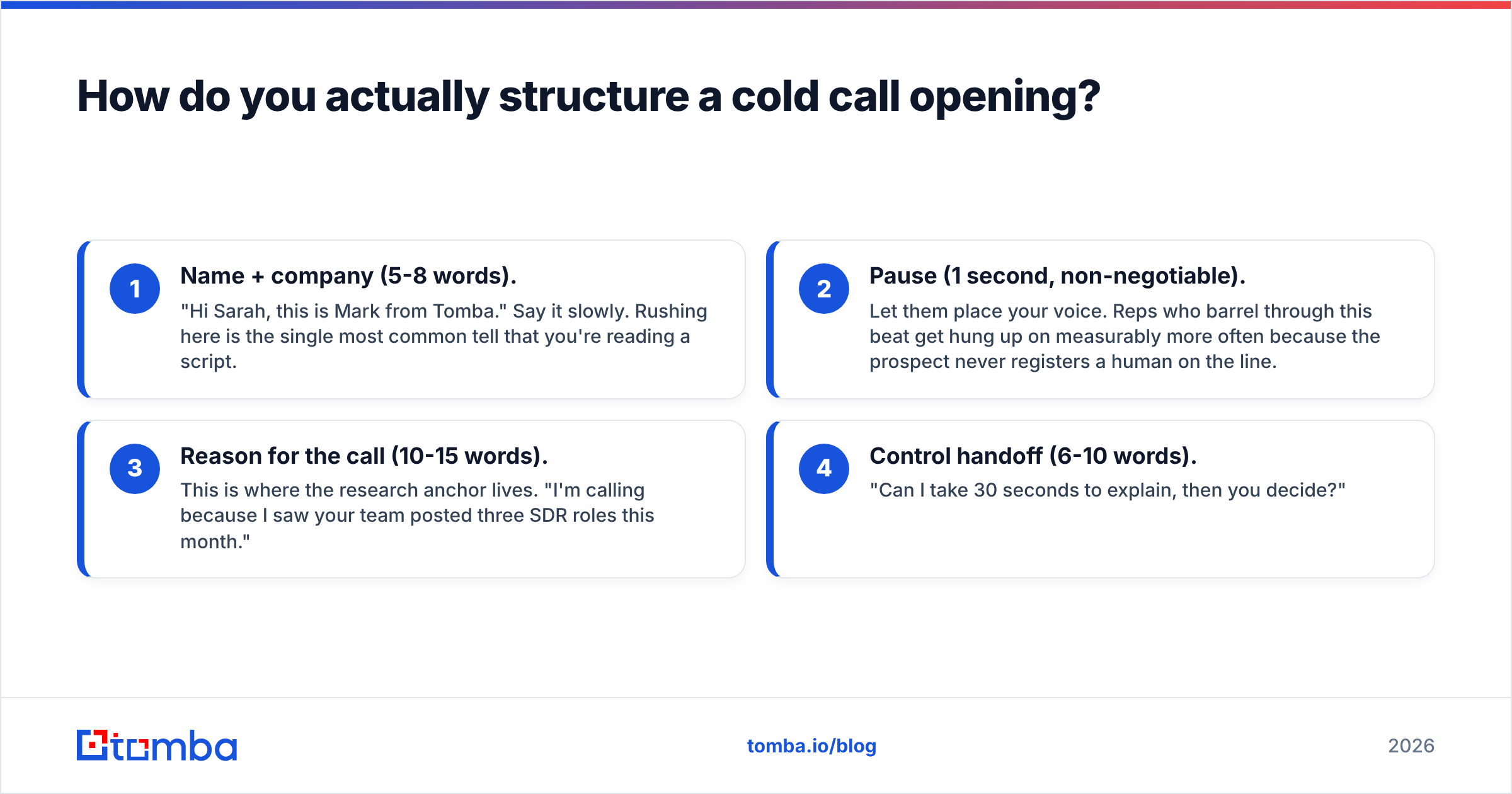
Use a four-beat structure. Every beat has a word budget.
- Name + company (5-8 words). "Hi Sarah, this is Mark from Tomba." Say it slowly. Rushing here is the single most common tell that you're reading a script.
- Pause (1 second, non-negotiable). Let them place your voice. Reps who barrel through this beat get hung up on measurably more often because the prospect never registers a human on the line.
- Reason for the call (10-15 words). This is where the research anchor lives. "I'm calling because I saw your team posted three SDR roles this month."
- Control handoff (6-10 words). "Can I take 30 seconds to explain, then you decide?"
Total: under 40 words, roughly 15 seconds of speech. If your opener runs longer than that, you're pitching, not opening.
A worked example that combines beats 3 and 4:
"Hi Sarah — Mark from Tomba. (pause) I'll be upfront, this is a cold call. I saw your team's hiring three SDRs this quarter, which usually means someone's about to inherit a data problem. Worth 30 seconds?"
That's 42 words. It names the call for what it is, proves research, connects the research to a plausible pain, and ends on a question that's easy to say yes to. The honesty framing ("I'll be upfront") is doing heavy lifting — it front-runs the objection the buyer was already forming.
What should you never say in the first 10 seconds?#
Cut these. All of them cost you calls:
- "How are you doing today?" from an unknown number. It reads as a script marker, not politeness. If you want the warmth, earn it with a name and a reason first.
- "I'm reaching out because…" — three wasted words. Say the reason.
- "Is now a good time?" as your entire opener. Without a reason attached, it's just asking permission to be a stranger.
- Your job title. Nobody has ever booked a meeting because the caller was a "Senior Enterprise Account Executive."
- A feature list. "We're an AI-powered revenue intelligence platform that…" is a hang-up in nine words.
- Uptalk on your own name. Ending "this is Mark from Tomba?" like a question signals you don't believe you belong on the call.
Does the data behind the number matter more than the script?#
Yes — and this is the part most cold-calling advice skips.
You can have a perfect opener and still fail if you're dialing a disconnected number, reaching a gatekeeper's line instead of the direct dial, or calling someone who left the company eight months ago. Reps routinely blame their script for what is actually a data problem.
Run the math. If your list is 60% accurate, a 20-point improvement in opener performance moves your meeting count less than a 20-point improvement in phone-number accuracy. Data quality compounds through every downstream step; script quality only affects the calls that connect.
Practical checks before a calling block:
- Verify the direct dial, not the switchboard. A phone validator pass on your list removes disconnected and reassigned numbers before you waste dial time on them.
- Confirm the person still works there. Job changes are the top cause of stale B2B records. A quick data enrichment refresh catches most of them.
- Have the email ready as fallback. Roughly two-thirds of dials go to voicemail. A same-day follow-up email referencing your voicemail lifts the second-dial connect rate meaningfully — pull it with an email finder so you're not guessing at the format.
- Segment by time zone before you dial, not during. Nothing burns a calling block faster than realizing your best accounts are three hours behind.
How do you handle the first objection?#
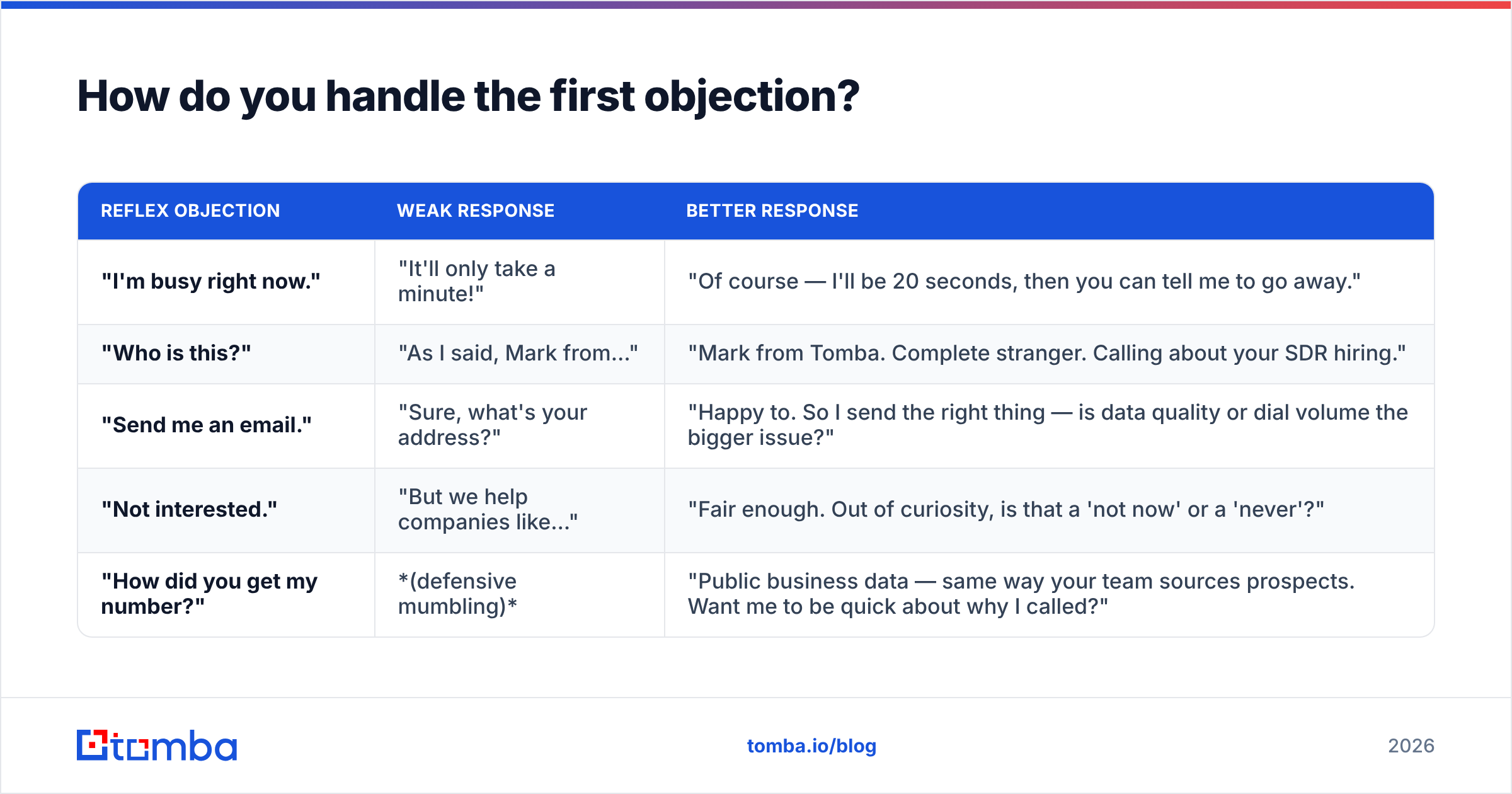
The first objection is almost never a real objection. It's a reflex. Treat it that way.
| Reflex objection | Weak response | Better response |
|---|---|---|
| "I'm busy right now." | "It'll only take a minute!" | "Of course — I'll be 20 seconds, then you can tell me to go away." |
| "Who is this?" | "As I said, Mark from…" | "Mark from Tomba. Complete stranger. Calling about your SDR hiring." |
| "Send me an email." | "Sure, what's your address?" | "Happy to. So I send the right thing — is data quality or dial volume the bigger issue?" |
| "Not interested." | "But we help companies like…" | "Fair enough. Out of curiosity, is that a 'not now' or a 'never'?" |
| "How did you get my number?" | (defensive mumbling) | "Public business data — same way your team sources prospects. Want me to be quick about why I called?" |
The pattern across all five: acknowledge, compress, redirect to a question. You never argue with a reflex. You give it somewhere to go.
That last one matters more every year. Buyers ask about data provenance now, and answering it cleanly signals legitimacy. If you can't explain where your list came from, that's a sourcing problem worth fixing — reputable providers publish their data sources openly.
How should you practice cold call openers?#
Not by reading them. By recording them.
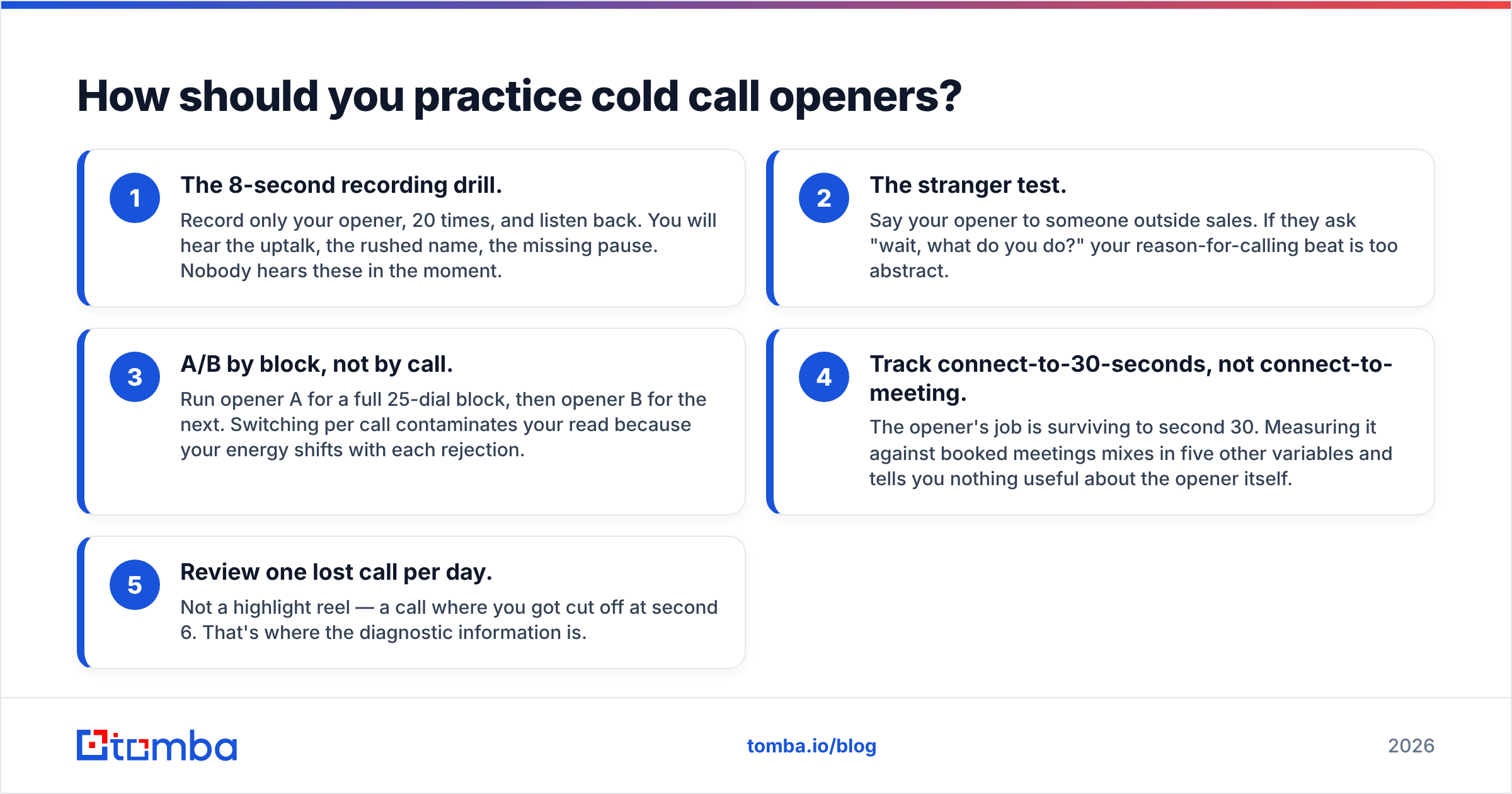
Three drills that produce measurable improvement inside two weeks:
- The 8-second recording drill. Record only your opener, 20 times, and listen back. You will hear the uptalk, the rushed name, the missing pause. Nobody hears these in the moment.
- The stranger test. Say your opener to someone outside sales. If they ask "wait, what do you do?" your reason-for-calling beat is too abstract.
- A/B by block, not by call. Run opener A for a full 25-dial block, then opener B for the next. Switching per call contaminates your read because your energy shifts with each rejection.
- Track connect-to-30-seconds, not connect-to-meeting. The opener's job is surviving to second 30. Measuring it against booked meetings mixes in five other variables and tells you nothing useful about the opener itself.
- Review one lost call per day. Not a highlight reel — a call where you got cut off at second 6. That's where the diagnostic information is.
For teams, pair this with a shared objection-handling doc so reps aren't independently reinventing responses to "send me an email." And measure your team's response rate across channels — if calls are underperforming but email replies are strong, the problem may be list segmentation rather than delivery.
Which opener should you actually pick?#
Pick by ICP seniority and call volume:
- High volume, mid-market, junior-to-mid buyers: permission-based or false familiarity. Volume forgives imperfection; you need lines that work without per-account research.
- Low volume, enterprise, senior buyers: research anchor or straight honesty. These buyers have pattern-matched every trick. Being direct is the differentiator.
- Multi-threaded accounts where you've already talked to someone: referral bridge, always. It's the highest-converting opener available and it costs nothing but a name.
- Mature categories with a well-known pain: problem-first. Only works when the pain is genuinely universal in your segment; otherwise you sound like every other vendor.
There's no universally best cold call opener. There's a best opener for your list, your seniority mix, and how much research time each account justifies. Test two, measure connect-to-30-seconds, keep the winner, and retire the loser. Then do it again next quarter, because what works decays as buyers get exposed to it.
For a broader view of how phone outreach fits alongside email and LinkedIn, HubSpot's sales research library and peer reviews on G2's sales engagement category are both worth a scan before you commit a quarter to any single channel.
Get the numbers right before you get the script right#
The best opener in the world fails against a disconnected line. Before your next calling block, run your list through Tomba's phone finder to pull verified direct dials, and pair it with the Tomba Email Finder so every voicemail has a same-day email follow-up ready to go. The free tier covers 25 searches a month if you want to test the data quality on your own accounts first; paid plans start at $49/mo, with full Tomba pricing laid out by volume. Fix the list, then obsess over the first 8 seconds.
Related guides#
// get started
Find, verify and enrich your first contacts today
Start on the free plan with 25 searches a month, then scale when your team is ready.
Free plan · No credit card required · GDPR & CCPA
Get the Tomba newsletter
Product and data updates
// about the author