How To Use Intent Data To Book More B2B Meetings in 2026
Intent data tells you which accounts are researching your category right now. Here is the practical workflow for turning those signals into contacts, sequences, and booked meetings — without wasting budget.
TL;DR
- Intent data is behavioral evidence that an account is researching your category — content consumption, review-site activity, competitor page visits, and first-party website behavior.
- The signal is worthless on its own. Value comes from the chain: signal → account qualification → contact discovery → verified email → timed message.
- First-party intent (your own site, docs, pricing page) converts far better than third-party topic surges. Start there before you spend $25k on a data subscription.
- Most teams fail at step three: they buy a surge list and have no reliable way to reach the actual humans on that account.
- A realistic starter stack costs under $150/month. Enterprise intent platforms start around $25,000/year and only pay back at high ACV.
What is intent data, exactly?#
Intent data is a record of behavior that suggests an account is actively evaluating a purchase. Think of it like a bookstore owner watching which shelf a customer keeps returning to. The customer hasn't said anything, but three visits to the same section tells you more than a survey ever would.
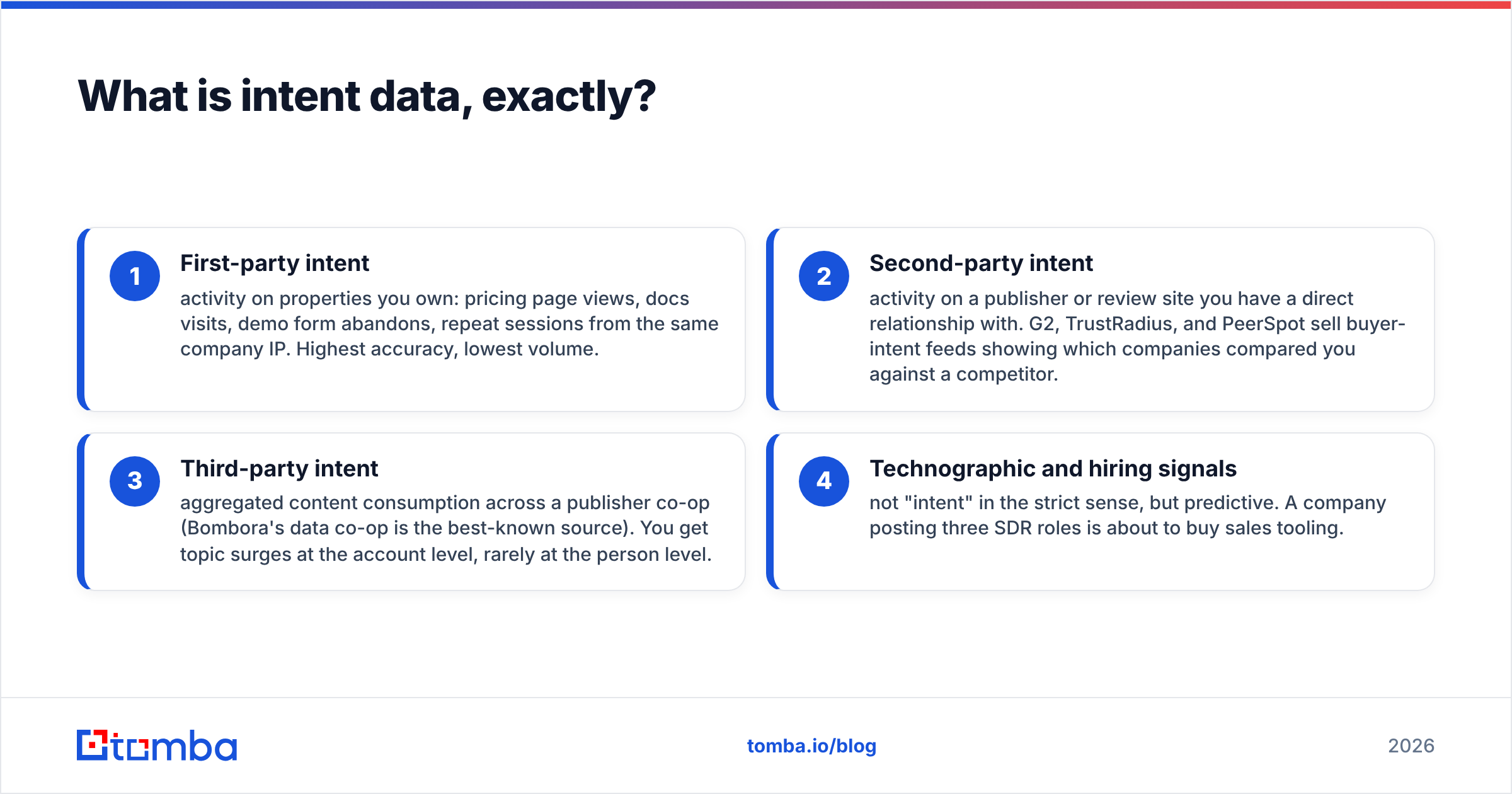
In B2B, that behavior gets captured in three distinct layers, and mixing them up is the most common reason intent programs fail.
- First-party intent — activity on properties you own: pricing page views, docs visits, demo form abandons, repeat sessions from the same company IP. Highest accuracy, lowest volume.
- Second-party intent — activity on a publisher or review site you have a direct relationship with. G2, TrustRadius, and PeerSpot sell buyer-intent feeds showing which companies compared you against a competitor.
- Third-party intent — aggregated content consumption across a publisher co-op (Bombora's data co-op is the best-known source). You get topic surges at the account level, rarely at the person level.
- Technographic and hiring signals — not "intent" in the strict sense, but predictive. A company posting three SDR roles is about to buy sales tooling.
The practical hierarchy matters: first-party beats second-party beats third-party, roughly by an order of magnitude in conversion. A visitor who read your pricing page twice this week is a fundamentally different prospect from an account that showed a "CRM software" topic surge in a co-op dataset.

How do you actually use intent data, step by step?#
Here is the six-step workflow that survives contact with a real pipeline. Skipping any step is where most programs leak.
Step 1 — Define the signal that means something. Not "researched sales software." Pick 3-5 topics that only a real buyer would research. If you sell email infrastructure, "SPF record configuration" is a buying signal; "email marketing" is noise. Write them down before you look at any dashboard.
Step 2 — Set a surge threshold, not a binary flag. Intent vendors report a baseline and a spike. Only act on accounts that are meaningfully above their own historical baseline — typically the vendor's 60+ or 70+ composite score. Below that you are chasing normal browsing.
Step 3 — Qualify the account against ICP before you spend a credit. Employee count, industry, geography, tech stack. An intent surge from a company that can never buy is a distraction with a score attached. Filter hard here; expect to discard 50-70% of a raw surge list.
Step 4 — Find the humans. This is where programs stall. Account-level intent gives you a company domain, not a buyer. You need to map the domain to 2-4 real people in the relevant function. A domain search returns the email patterns and named contacts on that domain in one call, which turns an anonymous surge into an actual outreach list.
Step 5 — Verify before you send. Surge lists are often 30-60 days stale in terms of personnel. Run every address through an email verifier before it enters a sequence. Bouncing a cold domain on a "high intent" list is the fastest way to burn the sender reputation you need for the next campaign.
Step 6 — Time the message to the signal, and reference the category, not the surveillance. Reach out within 72 hours of the spike. Do not say "I saw you were researching X" — it reads as creepy and, with third-party data, it is often simply wrong at the individual level.
What does a working intent stack cost?#
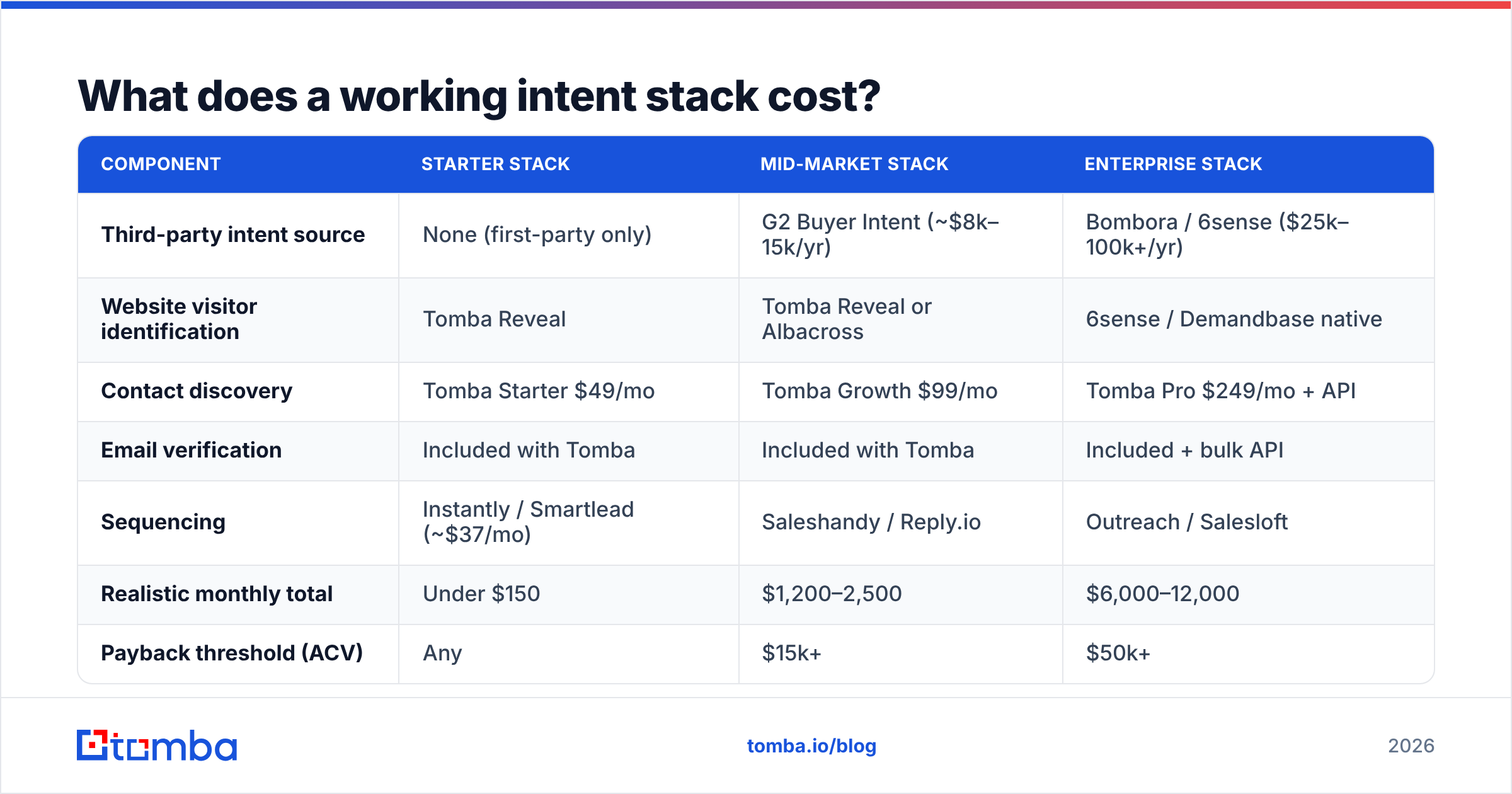
You have three realistic tiers. The gap between them is enormous, and plenty of teams overbuy at tier three when tier one would have covered 80% of the value.
| Component | Starter stack | Mid-market stack | Enterprise stack |
|---|---|---|---|
| Third-party intent source | None (first-party only) | G2 Buyer Intent (~$8k–15k/yr) | Bombora / 6sense ($25k–100k+/yr) |
| Website visitor identification | Tomba Reveal | Tomba Reveal or Albacross | 6sense / Demandbase native |
| Contact discovery | Tomba Starter $49/mo | Tomba Growth $99/mo | Tomba Pro $249/mo + API |
| Email verification | Included with Tomba | Included with Tomba | Included + bulk API |
| Sequencing | Instantly / Smartlead (~$37/mo) | Saleshandy / Reply.io | Outreach / Salesloft |
| Realistic monthly total | Under $150 | $1,200–2,500 | $6,000–12,000 |
| Payback threshold (ACV) | Any | $15k+ | $50k+ |
| Time to first meeting | 1–2 weeks | 4–6 weeks | 8–12 weeks |
The honest read: if your average contract value is under $15,000, third-party intent subscriptions rarely pay for themselves. Your money is better spent on identifying and working the traffic already hitting your site, then enriching those accounts properly. Tomba pricing starts at a free tier with 25 searches per month, which is enough to test the workflow on a handful of surging accounts before you commit budget anywhere.
Which intent data providers should you compare?#
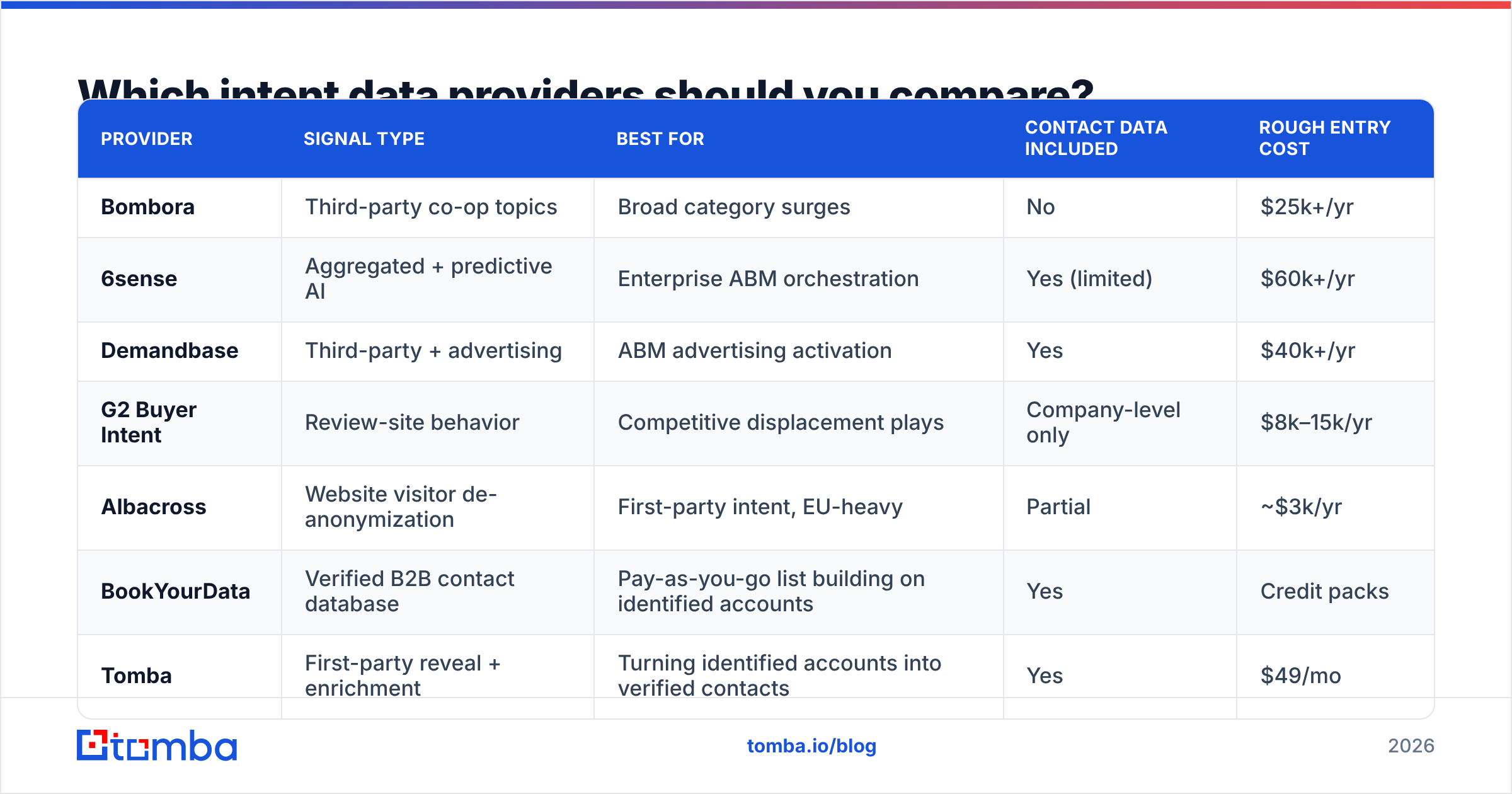
The market splits into pure intent aggregators, ABM platforms with intent bundled in, and review-site feeds. They are not interchangeable.
| Provider | Signal type | Best for | Contact data included | Rough entry cost |
|---|---|---|---|---|
| Bombora | Third-party co-op topics | Broad category surges | No | $25k+/yr |
| 6sense | Aggregated + predictive AI | Enterprise ABM orchestration | Yes (limited) | $60k+/yr |
| Demandbase | Third-party + advertising | ABM advertising activation | Yes | $40k+/yr |
| G2 Buyer Intent | Review-site behavior | Competitive displacement plays | Company-level only | $8k–15k/yr |
| Albacross | Website visitor de-anonymization | First-party intent, EU-heavy | Partial | ~$3k/yr |
| BookYourData | Verified B2B contact database | Pay-as-you-go list building on identified accounts | Yes | Credit packs |
| Tomba | First-party reveal + enrichment | Turning identified accounts into verified contacts | Yes | $49/mo |
A note on category confusion: Bombora and 6sense sell you who is in market. Tomba and BookYourData sell you how to reach them. You need both halves. Buying a surge feed with no contact layer is like getting a guest list with no phone numbers — worth reviewing on G2 before you sign anything, since the review-level detail on data freshness varies wildly between vendors.
How do you turn an anonymous website visitor into a contact?#
First-party intent is the highest-yield signal you own, and most teams throw 97% of it away because the traffic is anonymous.
The chain works like this:
- Identify the company behind the session using reverse-IP and firmographic matching — website visitor reveal resolves anonymous traffic to a company domain.
- Score the visit. A pricing page view plus a docs visit plus a return session inside seven days is a real signal. One bounce off a blog post is not.
- Map the buying committee. For a qualifying account, pull the 3-5 roles that matter using an email finder against the domain and the job titles in your ICP.
- Verify and enrich. Confirm deliverability, then add seniority, location, and LinkedIn profile so the message can be specific.
- Route to the right motion. High-score accounts go to an SDR for a personalized touch. Medium-score accounts go into a nurture sequence. Low-score accounts go nowhere — resist the urge to sequence everything.

That last discipline is what separates a program that lifts reply rates from one that just increases send volume. HubSpot's research on sales outreach consistently shows that relevance beats volume, and intent data is only useful insofar as it makes each message more relevant.
Is intent data accurate enough to trust?#
Partly. You should hold two things in mind at once: third-party intent is directionally useful and individually unreliable.
Where it holds up: account-level topic surges do correlate with buying cycles. Aggregated across hundreds of accounts, a surge list will out-convert a cold ICP list. Vendors typically claim 2-4x lift in meeting rates, and independent buyer reviews on G2 broadly support a lift in that range for enterprise ACVs.
Where it breaks down:
- IP resolution decay. Remote work shattered the office-IP-to-company mapping that most reverse-IP vendors depend on. Coverage is materially worse than the 2019 benchmarks vendors still quote.
- Co-op attribution. A "surge" may be one intern reading three articles, or it may be a genuine buying committee. You cannot tell from the score.
- Latency. Third-party feeds often report weekly. A signal you act on Friday may be nine days old.
- Contact staleness. The account is right; the person left. This is the single biggest failure mode, and it is why verification is non-optional before a send.
- Privacy constraints. GDPR and similar regimes limit what can be tracked and stored for EU-based individuals. Check your vendor's lawful basis before you deploy in Europe. The ICO's guidance on legitimate interests is the reference point for UK and EU processing.
Treat intent as a prioritization layer, not a truth layer. It reorders your list; it does not qualify your list.
What does a good intent-triggered email look like?#
Short, category-relevant, and silent about the surveillance. Compare:
Bad: "Hi Sarah — I noticed your team has been researching data enrichment tools this week."
Better: "Hi Sarah — most RevOps leads at Series B companies hit the same wall around 40k records: the CRM enrichment stops matching. If that's on your list this quarter, happy to share how three similar teams solved it."
The second version uses the intent signal to pick the topic and the timing without claiming knowledge you cannot defend. If your third-party data was wrong, the second email is still a reasonable cold email. The first one is embarrassing.
Keep it to 90 words, one ask, one link. Pair it with a phone finder lookup for high-score accounts so the SDR can multi-thread instead of relying on a single channel.
What KPIs prove the program is working?#
Track these four, weekly, and compare intent-sourced against your control cohort:
- Contact-to-meeting rate on intent accounts vs. matched ICP accounts. If the lift is under 1.5x, your signal definitions are too broad.
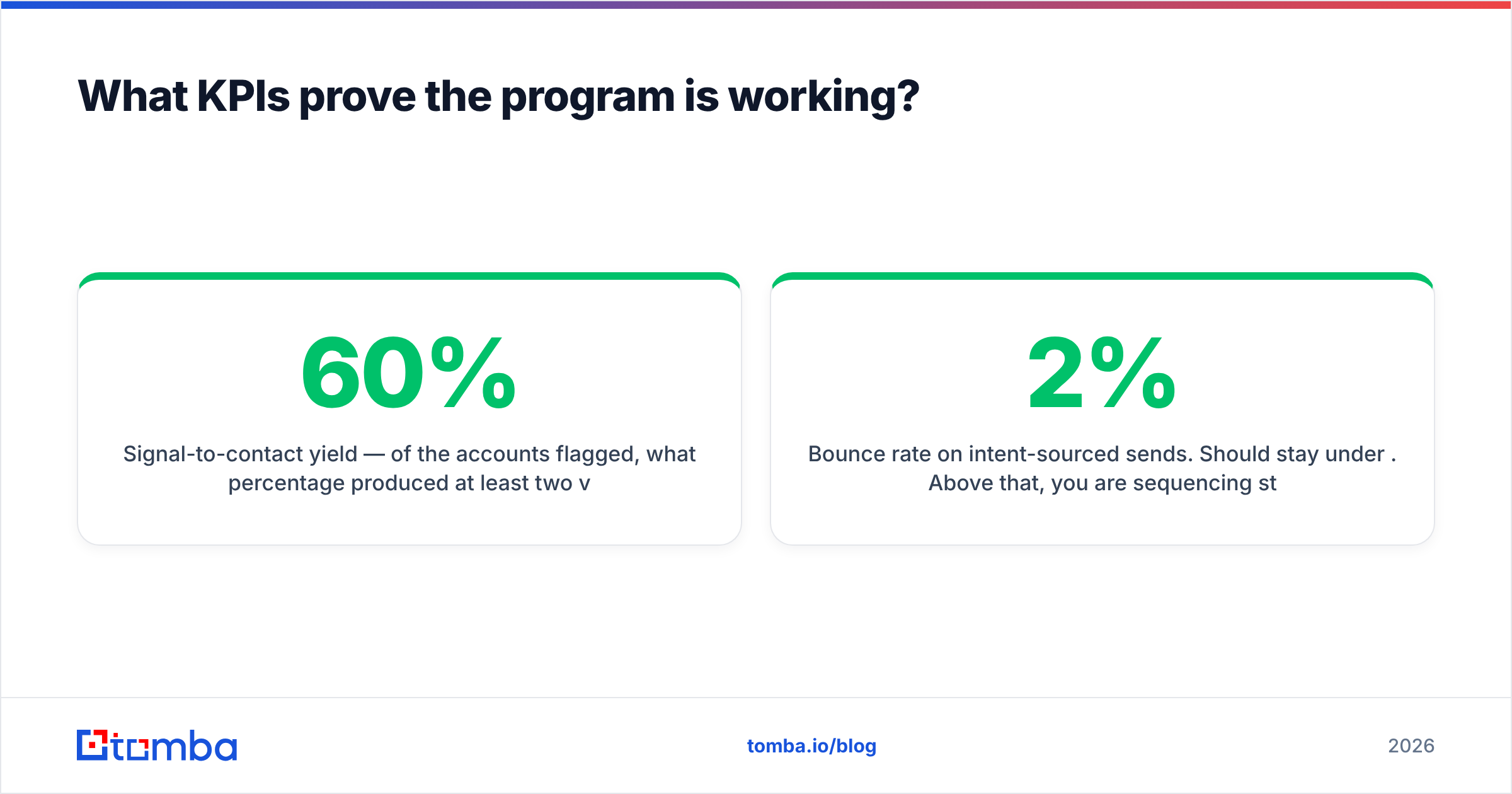
- Signal-to-contact yield — of the accounts flagged, what percentage produced at least two verified, deliverable contacts? Under 60% means your enrichment layer is the bottleneck, not your intent source.
- Time-to-touch from signal to first send. Target under 72 hours. Beyond seven days the lift largely disappears.
- Bounce rate on intent-sourced sends. Should stay under 2%. Above that, you are sequencing stale records and damaging email deliverability for every other campaign on that domain.
Run the comparison for at least six weeks before you judge. Intent programs look terrible in week two because the SDR muscle memory hasn't formed yet.
Should you build this now or wait?#
Build the first-party half now, regardless of company size. It costs almost nothing, uses traffic you already paid for, and teaches your team the workflow.
Wait on third-party subscriptions until you can answer yes to all three: your ACV clears $15k, you have an SDR who can act on a signal within 72 hours, and you already have a reliable contact-discovery and verification layer in place. Buying a surge feed without step four and five is buying a map with no roads.
Start with the signal you own, resolve it to real people, and verify before you send. The Tomba Email Finder handles the middle of that chain — turning a surging domain into named, verified, deliverable contacts — and the free tier gives you 25 searches a month to test the workflow on your own traffic before any budget conversation. If it works at 25 searches, it will work at 25,000.
Related guides#
// get started
Find, verify and enrich your first contacts today
Start on the free plan with 25 searches a month, then scale when your team is ready.
Free plan · No credit card required · GDPR & CCPA
// about the author