How to Use Social Proof in B2B Sales: A 2026 Playbook
Logos on a deck do nothing. Here's how to collect, match, and place social proof across B2B outbound so it actually moves deals — with a proof-type comparison table and real placement rules.
TL;DR
- Social proof works in B2B only when the proof is matched — same industry, same company size, same job title, same problem. A generic logo wall converts worse than no proof at all.
- The six proof types are not interchangeable. Peer case studies and named metrics outperform review badges and customer counts by a wide margin in first-touch outbound.
- Placement beats volume. One relevant proof point in the second sentence of a cold email beats four crammed into a signature block.
- Proof needs clean targeting data to be matched at all. If you can't tell whether a prospect is a 40-person agency or a 4,000-person bank, you can't pick the right story.
- Build a proof library indexed by segment, then let your sequence pull from it — not the other way round.
What Is Social Proof in a B2B Context?#
Social proof is evidence that people like your buyer already made this decision and survived it. In B2C, that's a five-star rating and 12,000 reviews. In B2B, it's narrower and harder: your buyer isn't spending $40 of their own money, they're spending $60,000 of company money and staking their internal credibility on it.
Think of it like hiring a contractor for your kitchen. You don't care that 4,000 people hired them. You care that they did a kitchen exactly like yours, in a building exactly like yours, and the owner will take your call. That specificity is the whole game in B2B.
The psychology is well documented — Cialdini's original framing of social proof as one of six persuasion principles still holds up, and you can read the core research summary on Wikipedia. What changed for B2B in 2026 is the noise floor. Buyers see hundreds of "trusted by 500+ companies" claims a month. Undifferentiated proof is now background static.
Three things separate proof that works from proof that decorates:
- Proximity — the referenced customer resembles the prospect on industry, headcount, and stack.
- Specificity — a number, a timeframe, and a named outcome instead of "great results."
- Verifiability — the buyer could check it. A named company and a linkable case study beat an anonymous "a leading fintech."
Which Types of Social Proof Actually Convert in B2B?#
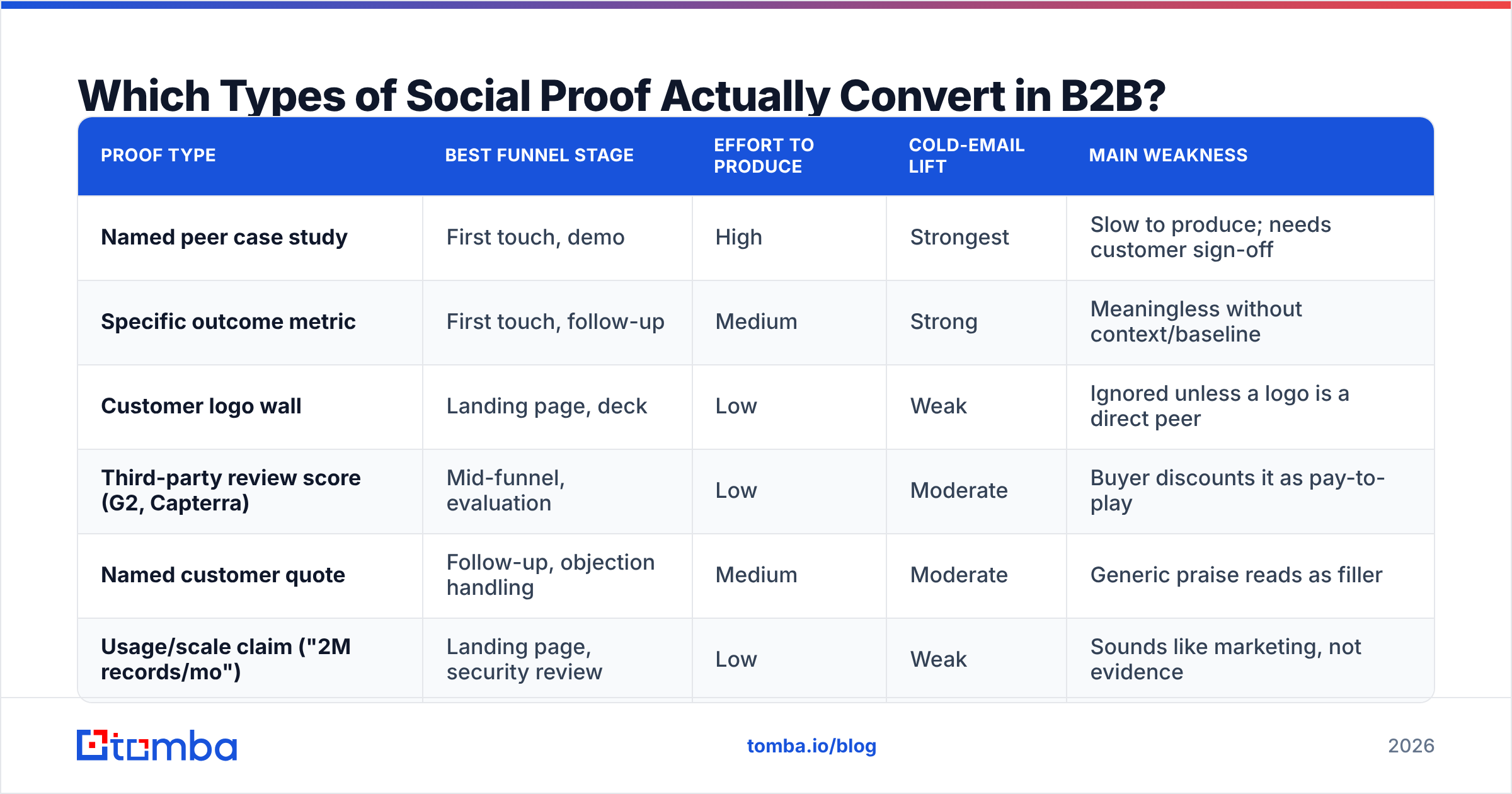
Not all proof carries the same weight, and the ranking flips depending on where you are in the funnel. Here's how the six main types compare.
| Proof type | Best funnel stage | Effort to produce | Cold-email lift | Main weakness |
|---|---|---|---|---|
| Named peer case study | First touch, demo | High | Strongest | Slow to produce; needs customer sign-off |
| Specific outcome metric | First touch, follow-up | Medium | Strong | Meaningless without context/baseline |
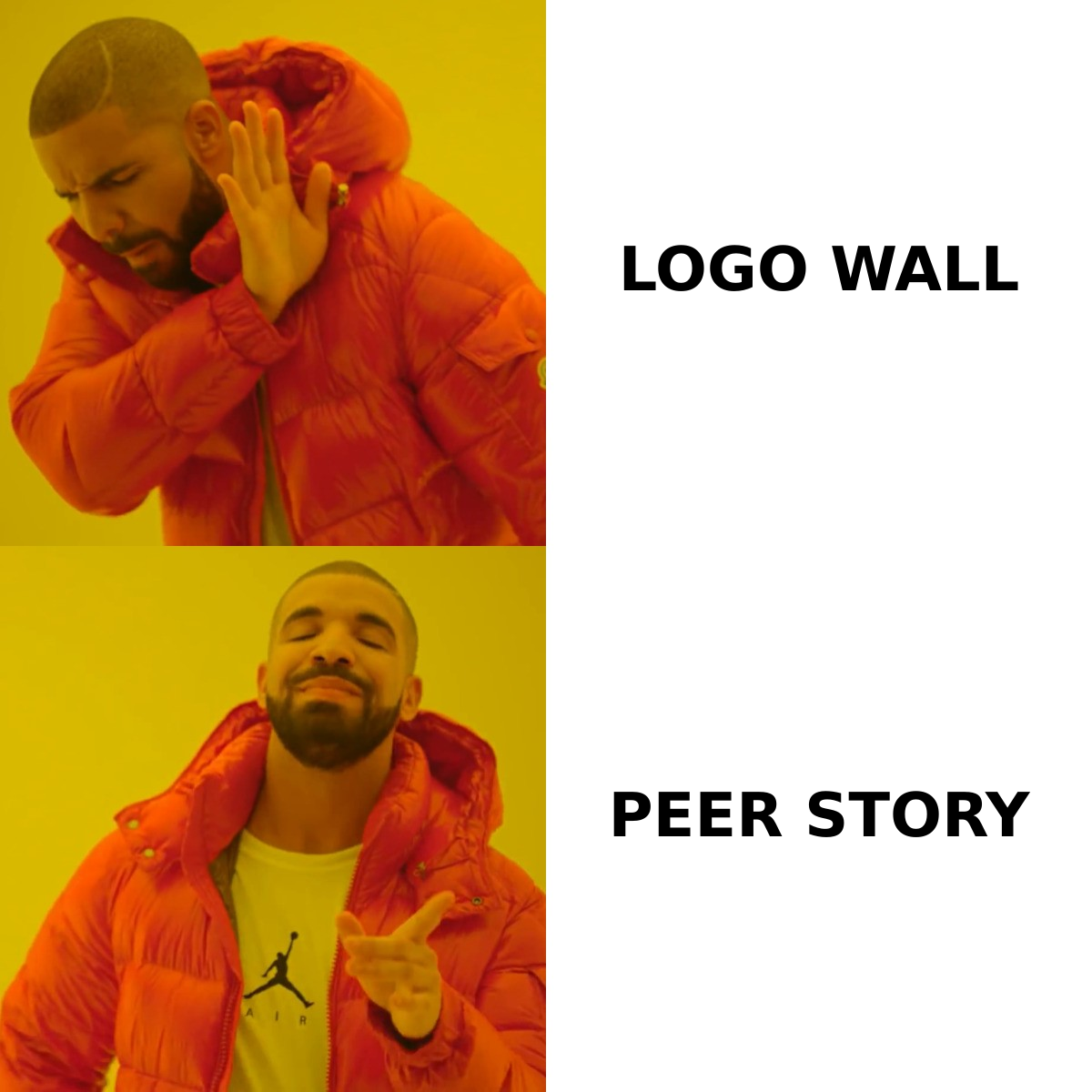
| Customer logo wall | Landing page, deck | Low | Weak | Ignored unless a logo is a direct peer |
| Third-party review score (G2, Capterra) | Mid-funnel, evaluation | Low | Moderate | Buyer discounts it as pay-to-play |
| Named customer quote | Follow-up, objection handling | Medium | Moderate | Generic praise reads as filler |
| Usage/scale claim ("2M records/mo") | Landing page, security review | Low | Weak | Sounds like marketing, not evidence |
The pattern: proof that requires effort to fabricate is proof buyers believe. A logo takes ten seconds to paste into a deck, and buyers know it. A quantified story about a named 60-person logistics company with a job title attached takes work, and it reads that way.
Third-party review platforms sit in an interesting middle position. A G2 category grid placement doesn't win a cold reply, but it absolutely gets referenced in the internal debate after your demo, when your champion has to defend the choice to a skeptical VP. Treat review-site proof as ammunition for someone else's meeting, not for your opener.
Placeholder: screenshot of a G2 category grid showing quadrant placement and review count
How Do You Match Proof to the Right Prospect?#
Matching is a data problem before it's a copywriting problem. You cannot reference "the other three Series B fintechs in your position" if your CRM row says nothing but firstname, lastname, email.
Work backwards from the proof library. For each case study or metric you own, tag it with:
- Industry vertical — not "tech," but "vertical SaaS for dental practices."
- Headcount band — 1–50, 51–250, 251–1000, 1000+. Buyers self-identify strongly by band.
- Buyer job title — a story that landed with a Head of Demand Gen rarely lands with a CTO.
- Trigger situation — "post-funding, hiring 12 SDRs" or "migrating off a legacy CRM."
- Named quantified outcome — "cut list-building time from 6 hours to 40 minutes per week."
- Permission level — publicly nameable, nameable in private, or anonymized only.
Then enrich your prospect records against the same five axes. This is where most proof programs quietly die: the library exists, the tagging exists, and the outbound list has no firmographic depth to match against. Running your list through data enrichment before a sequence launches gives you company size, industry, and tech stack fields the personalization tokens can actually key off.
A working match rule looks like this: if headcount is 51–250 and industry is agency and title contains "founder," use the Redpoint Studios story. That's a lookup table, not creative writing, and it's why proof libraries scale while one-off personalization doesn't.
Placeholder: screenshot of a CRM record showing enriched firmographic fields (industry, headcount, tech stack) used as personalization tokens
Where Should Social Proof Go in a Cold Email?#
Second sentence. Almost always second sentence.
The first sentence earns the read by naming the prospect's situation. The second sentence proves you've solved that situation before, for someone like them. Everything after that is logistics.
Here's the anatomy that consistently outperforms the "hope this finds you well" opener:
- Line 1 — the observed trigger. "Saw you're hiring three AEs in Manchester this quarter."
- Line 2 — the matched proof. "When Beacon Logistics scaled from 4 to 9 reps, their list-building time was the bottleneck — they cut it from 6 hours a week to about 40 minutes."
- Line 3 — the mechanism, one clause. "Mostly by pulling verified contacts straight into the CRM instead of scraping by hand."
- Line 4 — a low-friction ask. "Worth a 10-minute look at how they set it up?"
Notice what's absent: no logo list, no "trusted by 500+ teams," no award badge in the signature. In a cold email you get one proof point. Spend it on the closest peer you have.
Follow-ups can carry a different proof type — that's the useful trick. Touch one uses the peer story. Touch three uses the hard metric. Touch five uses the third-party review or an analyst mention. You're not repeating yourself, you're rotating the evidence class, which gives a non-responder a genuinely new reason to reply. HubSpot's sales research library has consistently found multi-touch sequences outperform single sends, and rotating proof is a cleaner way to fill those touches than "just bumping this up."
One caveat on volume: proof that can't be checked reads as noise. If you claim a metric, be ready to send the case study link on request. If you name a company, make sure that company agreed to be named. A prospect who Googles your reference and finds nothing has learned something about you, and it isn't good.
What Are the Most Common Social Proof Mistakes?#
Five failure modes account for most of the damage.
The enterprise logo trap. You put Salesforce and Adobe on your homepage. A 30-person startup sees them and concludes you're too expensive and too heavy for them. Big logos repel small buyers as often as they attract them. Segment your logo walls by landing page if you sell across bands.
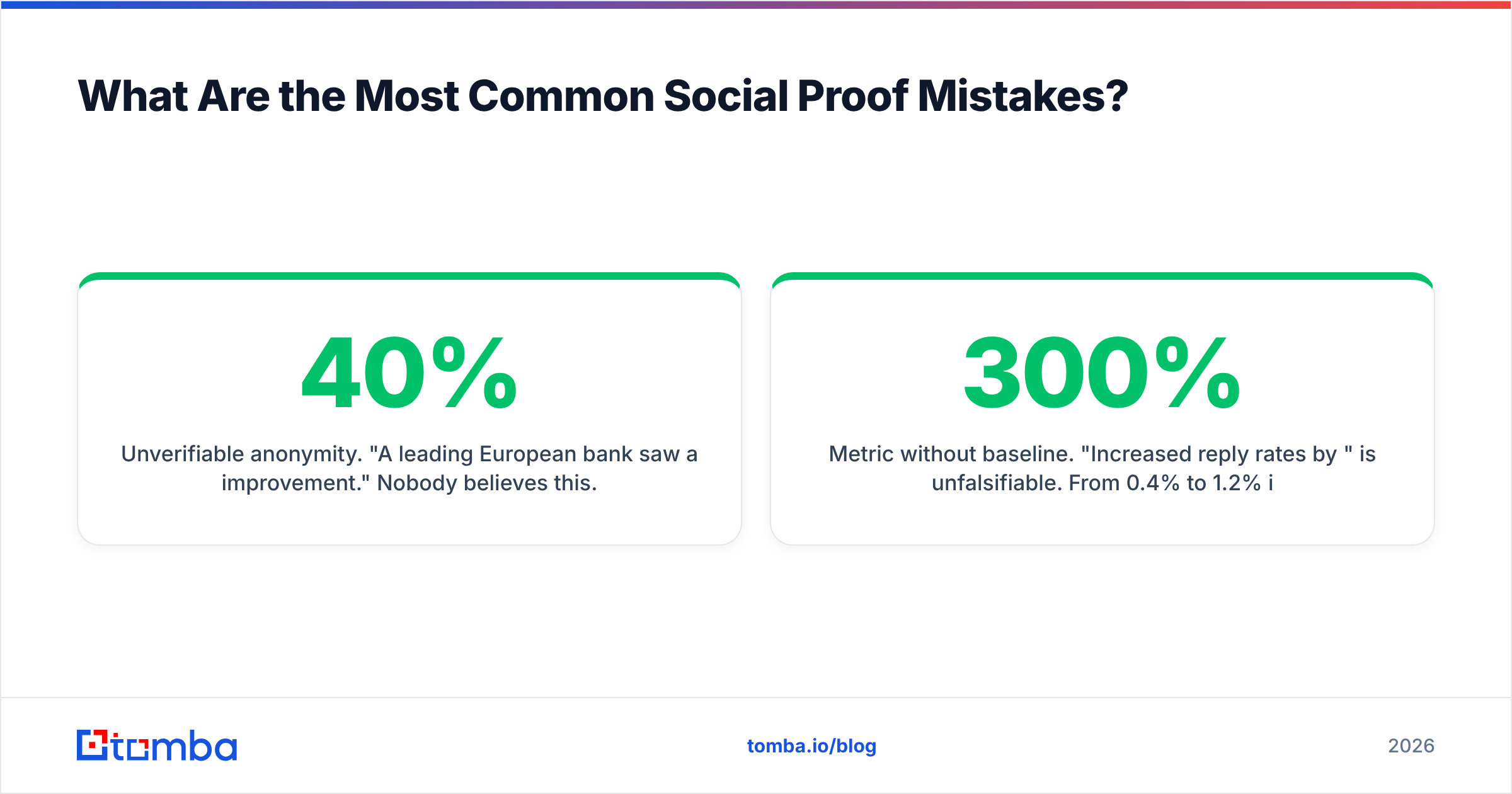
Unverifiable anonymity. "A leading European bank saw a 40% improvement." Nobody believes this. If legal won't let you name the customer, name the shape instead: "a 2,000-person retail bank in the DACH region, name under NDA — happy to walk through the setup on a call."
Metric without baseline. "Increased reply rates by 300%" is unfalsifiable. From 0.4% to 1.2% is a real claim, and the honesty of a small starting number reads as more credible than the big multiplier.
Proof in the wrong stage. Security certifications and uptime stats belong in procurement, not in a first cold email. Peer stories belong at first touch, not buried on page 14 of a proposal.
Stale proof. A 2022 case study cited in 2026 raises the question of what you've done since. Refresh the library annually, and put a date on every asset so reps can see what's aging.
There's a sixth, subtler mistake: treating competitor comparison as social proof. Telling a prospect "customers switch to us from BookYourData" isn't proof, it's a claim about a peer vendor — and it invites the buyer to go evaluate that peer rather than you. Compare on capabilities when asked, but build your proof around your own customers' outcomes, not somebody else's churn.
How Do You Build a Reusable Proof Library?#
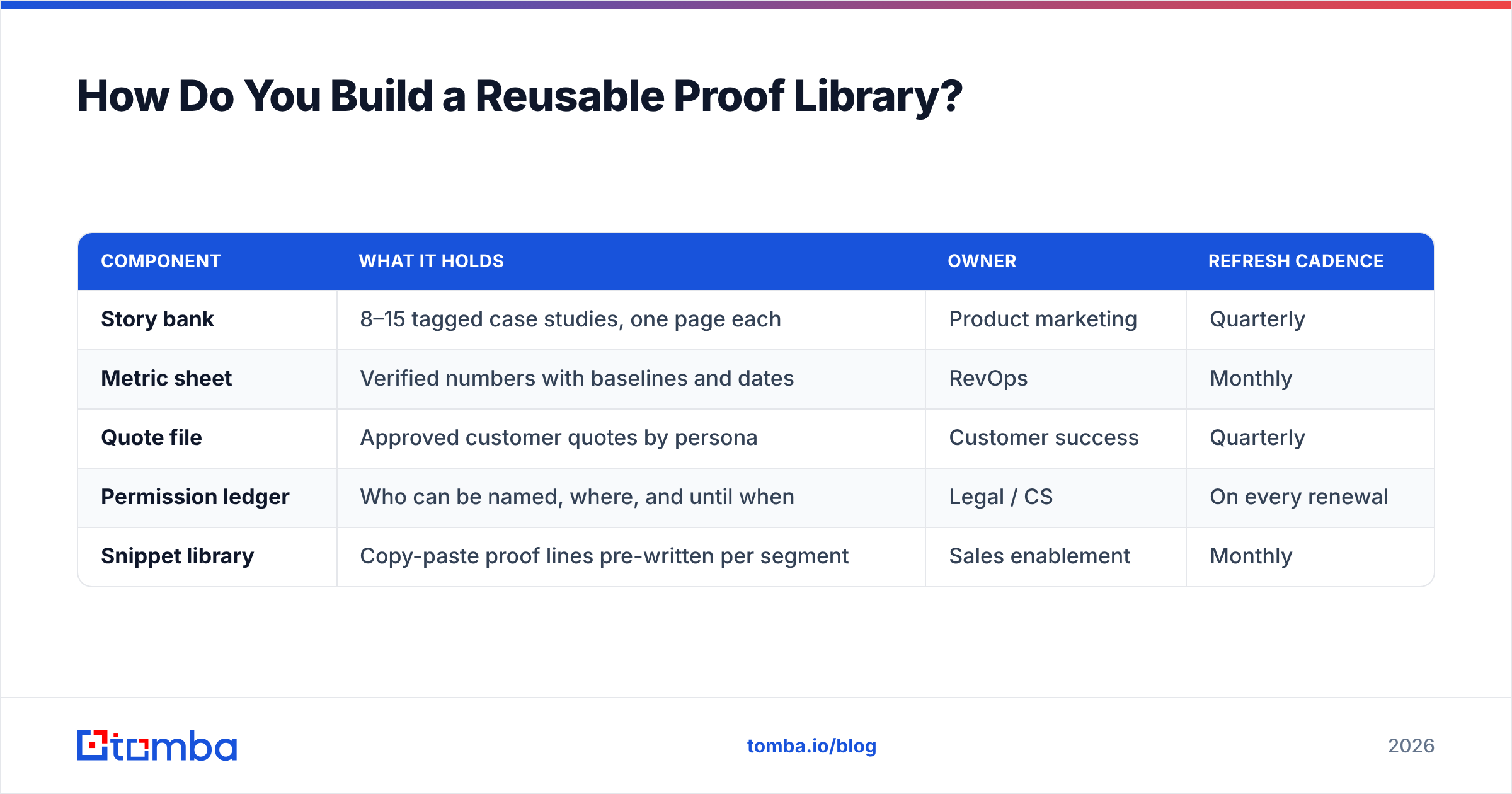
Treat it as an asset with an owner, a refresh cadence, and a schema. Here's a workable structure for a team of any size.
| Component | What it holds | Owner | Refresh cadence |
|---|---|---|---|
| Story bank | 8–15 tagged case studies, one page each | Product marketing | Quarterly |
| Metric sheet | Verified numbers with baselines and dates | RevOps | Monthly |
| Quote file | Approved customer quotes by persona | Customer success | Quarterly |
| Permission ledger | Who can be named, where, and until when | Legal / CS | On every renewal |
| Snippet library | Copy-paste proof lines pre-written per segment | Sales enablement | Monthly |
The snippet library is the piece teams skip, and it's the one that decides whether any of this gets used. Reps will not read a 12-page case study before writing an email. They will paste a pre-approved 22-word line that already contains the company, the number, and the timeframe.
Getting there takes three steps:
- Interview five customers per segment. Ask what the before-state cost them in hours or dollars. That's your baseline.
- Write each story to one page, then to one sentence. The sentence is what actually ships.
- Wire the segment tags into your sequencing tool so the right snippet fires on the right list.
If your outbound lists come from scraping and manual research, this whole system stalls at step three — you'll have snippets and no reliable segment field to trigger them. Building lists through domain search and running them through an email verifier before launch keeps the firmographic fields consistent enough for rule-based proof matching, and keeps bounce rates from eating the deliverability you need for the sequence to land at all. Bad data doesn't just waste sends; it makes personalization tokens misfire, and a mismatched proof point ("as a fellow healthcare company…" sent to a law firm) is worse than no proof.
For measurement, don't track "does the email with proof do better." Track proof type against reply rate per segment. After 400–500 sends you'll usually see one proof class clearly outperforming for a given persona, and that's the one you scale. Forrester's ongoing B2B buying research is a decent external calibration point for how buying groups weigh peer evidence, but your own segment data will beat any benchmark.
What Does Good Social Proof Look Like Across Channels?#
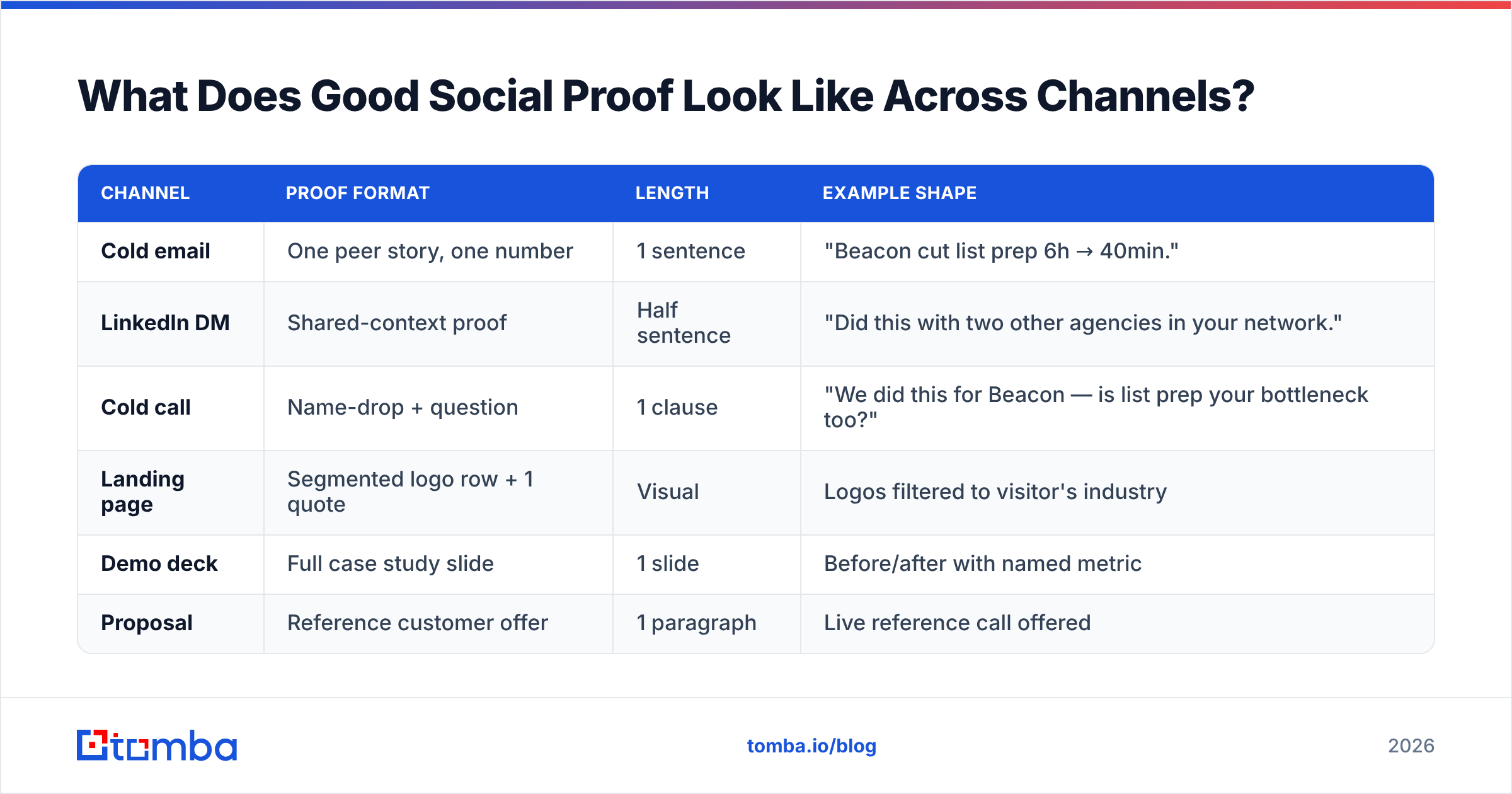
The same story compresses differently depending on where it runs.
| Channel | Proof format | Length | Example shape |
|---|---|---|---|
| Cold email | One peer story, one number | 1 sentence | "Beacon cut list prep 6h → 40min." |
| LinkedIn DM | Shared-context proof | Half sentence | "Did this with two other agencies in your network." |
| Cold call | Name-drop + question | 1 clause | "We did this for Beacon — is list prep your bottleneck too?" |
| Landing page | Segmented logo row + 1 quote | Visual | Logos filtered to visitor's industry |
| Demo deck | Full case study slide | 1 slide | Before/after with named metric |
| Proposal | Reference customer offer | 1 paragraph | Live reference call offered |
The call version is the hardest and the most valuable. On a cold call you have about eight seconds, and a name-drop of a genuine peer is the fastest credibility instrument available. It only works if the name is real and relevant — bluffing a peer relationship on a call in a small vertical will end the relationship permanently.
For LinkedIn, the proof that travels best is second-degree: mutual connections, shared communities, customers the prospect already follows. That's less a copywriting exercise than a research one, and it's why LinkedIn outreach programs that map network overlap before sending consistently beat ones that just spray connection requests.
Where Should You Start This Week?#
Pick your top segment by revenue. Find the one customer in it whose before/after you can quantify honestly. Write that story as a single 22-word sentence with a company name, a number, and a timeframe. Put it in the second sentence of your next 100 cold emails and measure the reply delta against your control.
That's it. One story, one segment, one measurable test. Teams that try to build the whole library first usually never ship any of it.
The constraint most teams hit isn't the story — it's the list. Matched proof requires you to know who you're writing to before you write, which means verified contacts with real firmographic fields attached. The Tomba Email Finder builds those lists by domain, name, or company, with verification built in so your segment tags stay reliable and your proof snippets fire on the right people. Start on the free tier at 25 searches a month to test the workflow, then scale up — Tomba pricing runs $49/mo for Starter, $99/mo for Growth, and $249/mo for Pro when your sequences outgrow the free allowance.
Related guides#
// get started
Find, verify and enrich your first contacts today
Start on the free plan with 25 searches a month, then scale when your team is ready.
Free plan · No credit card required · GDPR & CCPA
Get the Tomba newsletter
Product and data updates
// about the author