How to Win Clients in 2026: A 7-Step System That Closes
Winning clients is not a personality trait. It is a repeatable sequence: pick a narrow segment, build a verified list, lead with a specific problem, and follow up longer than your competitors do. Here is the full system with benchmarks.
TL;DR
- Winning clients is a sequence, not a talent: narrow segment → verified contact data → problem-first message → multi-touch follow-up → proof-backed proposal → referral loop.
- Most outreach fails at step two. Unverified contact data quietly kills 20–35% of a cold list before anyone reads a word you wrote.
- Referrals and warm intros still convert best, but they don't scale on demand. Cold email plus LinkedIn is the only pair that scales predictably at small budgets.
- Follow-up is the cheapest lever you have. The gap between two touches and six touches is usually a 2–3x difference in booked meetings.
- Track meetings booked per 100 verified contacts, not emails sent. Volume metrics hide broken targeting.
What does "winning clients" actually mean in 2026?#
It means converting a stranger who has a budget into a stranger who has a calendar invite, and then into a signed contract. Everything else — the branding, the case studies, the pricing page — supports that transition or it does not matter.
The reason this feels harder now is not that buyers stopped buying. It is that the median B2B buyer sees more outreach than ever and screens it faster. Gartner's sales research has consistently found that buyers spend only a small slice of their purchase journey with any single vendor's sales rep. You are not competing for a decision. You are competing for the seven seconds before the decision to keep reading.
So the practical question of how to win clients breaks into two smaller ones:
- Are you reaching people who could plausibly buy this month?
- Does your first message earn the second one?
Steps three through seven only matter once those two are true.
Why do most client-acquisition efforts fail?#
They fail in predictable places, and almost never at the "closing" stage everyone worries about.
- Segment too broad. "B2B SaaS companies" is not a segment. "Series A B2B SaaS companies with 3–8 SDRs and no RevOps hire" is. Broad segments force generic messaging, and generic messaging gets deleted.
- Bad contact data. You built a list from a scrape, sent 400 emails, got 90 bounces, and torched your sending domain in week one. This is the single most common self-inflicted wound.
- Pitch-first messaging. Opening with what you sell instead of what breaks for them. The buyer has to translate your capability into their problem, and they won't do that work for you.
- One-and-done follow-up. Sending once and calling the prospect "not interested" when they were simply in a meeting.
- No proof. Claims without numbers, logos, or a named outcome read as noise.

Fix the data and the segment first. Every downstream improvement — better copy, better offers, better calls — multiplies against a bigger base when the list is right.
What is the 7-step system for winning clients?#
This is the core loop. Run it end to end for one narrow segment before you widen anything.
- Define one segment you can name in a sentence. Industry, company size band, one trigger (recent funding, new hire in a specific role, a tech they just adopted). If you cannot describe the trigger, you do not have a segment yet.
- Build a list of 50–150 named humans, not companies. Titles that own the pain and can approve spend. For agencies and consultancies, that is usually a VP or director, not a C-level at anything above 200 headcount.
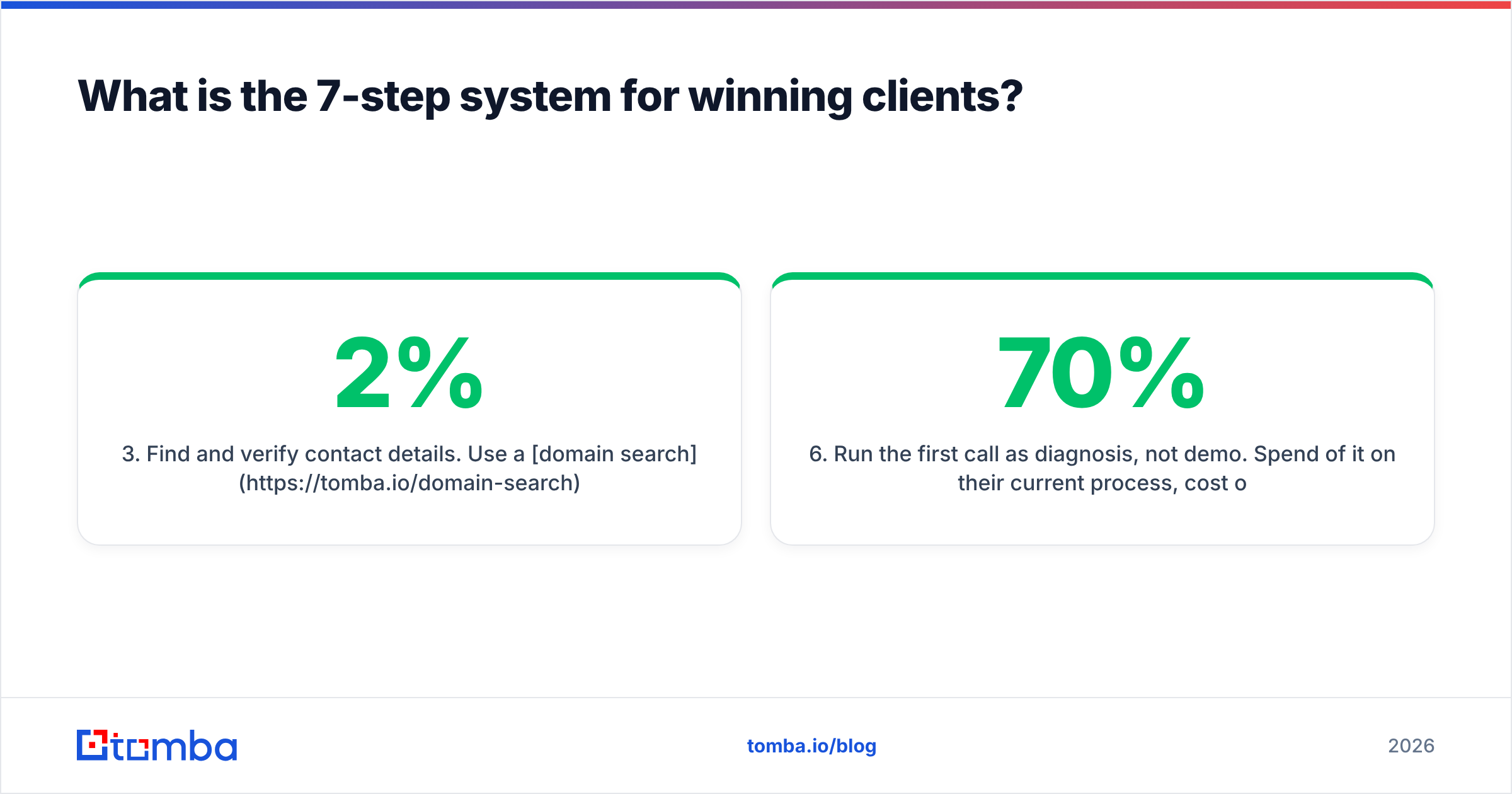
- Find and verify contact details. Use a domain search to pull the company's people and email pattern, then run every address through an email verifier before it enters your sequence. Target under 2% bounce rate. Anything above 5% and you are damaging deliverability for future campaigns.
- Write a problem-first first touch. Three to five sentences. Name a specific, observable situation at their company. Ask one low-friction question. No attachments, no calendar link in email one.
- Sequence 5–7 touches across two channels. Email, LinkedIn, and a call if the deal size justifies it. Space them 3–4 days apart, vary the angle each time — do not resend the same pitch louder.
- Run the first call as diagnosis, not demo. Spend 70% of it on their current process, cost of the problem, and who else has to say yes. You are qualifying, not performing.
- Send a proposal that mirrors their words. Restate the problem in their language, scope narrowly, give two options, and set an expiry date that is real.
Most people who ask how to win clients are looking for a better version of step four. The leverage is almost always in steps one through three.
Which channel wins clients fastest?#
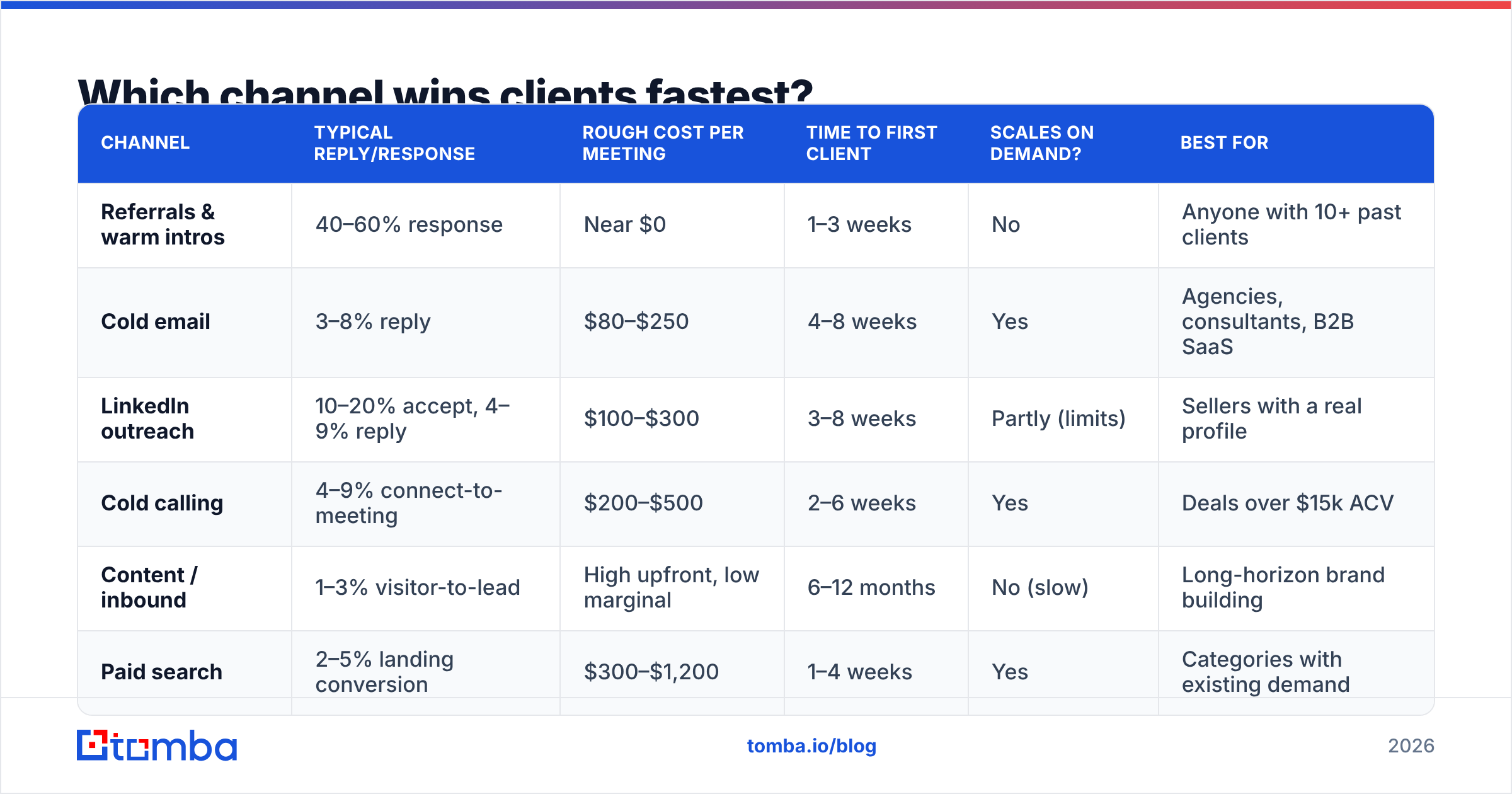
Depends on what you already have. Here is how the main channels compare for a small team with no existing audience.
| Channel | Typical reply/response | Rough cost per meeting | Time to first client | Scales on demand? | Best for |
|---|---|---|---|---|---|
| Referrals & warm intros | 40–60% response | Near $0 | 1–3 weeks | No | Anyone with 10+ past clients |
| Cold email | 3–8% reply | $80–$250 | 4–8 weeks | Yes | Agencies, consultants, B2B SaaS |
| LinkedIn outreach | 10–20% accept, 4–9% reply | $100–$300 | 3–8 weeks | Partly (limits) | Sellers with a real profile |
| Cold calling | 4–9% connect-to-meeting | $200–$500 | 2–6 weeks | Yes | Deals over $15k ACV |
| Content / inbound | 1–3% visitor-to-lead | High upfront, low marginal | 6–12 months | No (slow) | Long-horizon brand building |
| Paid search | 2–5% landing conversion | $300–$1,200 | 1–4 weeks | Yes | Categories with existing demand |
Two things stand out. First, referrals are the highest-converting channel and also the one you cannot turn on when the pipeline is empty — which is exactly when you need it. Second, cold email is the only line in that table where a solo operator can go from zero to booked meetings in under two months on a budget under $200. That is why it remains the default answer for how to win clients from a standing start.
The honest caveat: cold email's economics collapse if your data is bad. A 6% reply rate on a clean list of 300 is 18 conversations. The same campaign on a 30%-invalid list is 12 conversations and a burned domain.
How do you build a target list that actually converts?#
Work backwards from the trigger.
Start with a list of companies that recently did something that creates your problem. Funding rounds, a new VP hire, a job posting for a role you'd replace, a website migration, a G2 review complaining about a competitor. G2's category pages are a surprisingly good source for finding companies actively evaluating tools in your space.
Then find the humans:
- Identify the right title, not the right name. Decide on 2–3 target titles per account before you look anyone up.
- Pull contacts by domain. An email finder resolves first name + last name + domain into a deliverable address, and returns a confidence score you can filter on.
- Verify everything, including catch-alls. Catch-all domains accept any address at the SMTP layer, so standard verification returns "unknown." A dedicated catch-all verifier is the difference between guessing and knowing on roughly 15–20% of B2B domains.
- Deduplicate before import. Same person, two domains, two sequences. Nothing kills credibility faster than two reps from the same company emailing the same prospect in one week.
- Cap the list. 150 verified, well-researched contacts beat 2,000 scraped ones. You can personalize 150. You cannot personalize 2,000.
If you'd rather buy than build, prebuilt list providers like BookYourData offer verified, pay-as-you-go B2B contacts and can be a fast way to test a new segment before you commit to ongoing enrichment. The workflow still holds either way: verify what you buy, then narrow before you send.

What should your first outreach message actually say?#
Four parts, in this order, under 100 words total.
Observation. Something true and specific about them. "You posted two SDR roles in Boston last month" beats "I noticed your impressive growth."
Implication. The problem that observation usually signals. "Teams hiring SDRs before a RevOps hire usually end up with three overlapping data tools."
Evidence. One line of proof with a number. "We consolidated that for a 40-person team and cut their tooling spend 31%."
Ask. One question, easy to answer. "Worth a look at how you're handling it now?" Not "Do you have 15 minutes Tuesday at 2?"
The mistake to avoid: personalization theater. Referencing someone's podcast appearance and then pivoting into a generic pitch is worse than no personalization, because it signals effort spent in the wrong place. Personalize the problem, not the greeting.
For follow-ups, change the angle each time rather than the wording. Touch two: a relevant case study. Touch three: a specific question about their current stack. Touch four: a resource with no ask attached. Touch five: the polite close-out ("Should I assume this isn't a priority this quarter?") — which, counterintuitively, is often the highest-replying message in the sequence.
Watch your response rate per touch number. If touch one underperforms, the problem is targeting. If touches two through five underperform, the problem is that you're repeating yourself.
How do you pitch and price without discounting?#
Anchor on the cost of the status quo before you name a price. If a client is losing $18k a quarter to manual data entry, a $6k engagement is a rounding error. If you name $6k first, it is an expense.
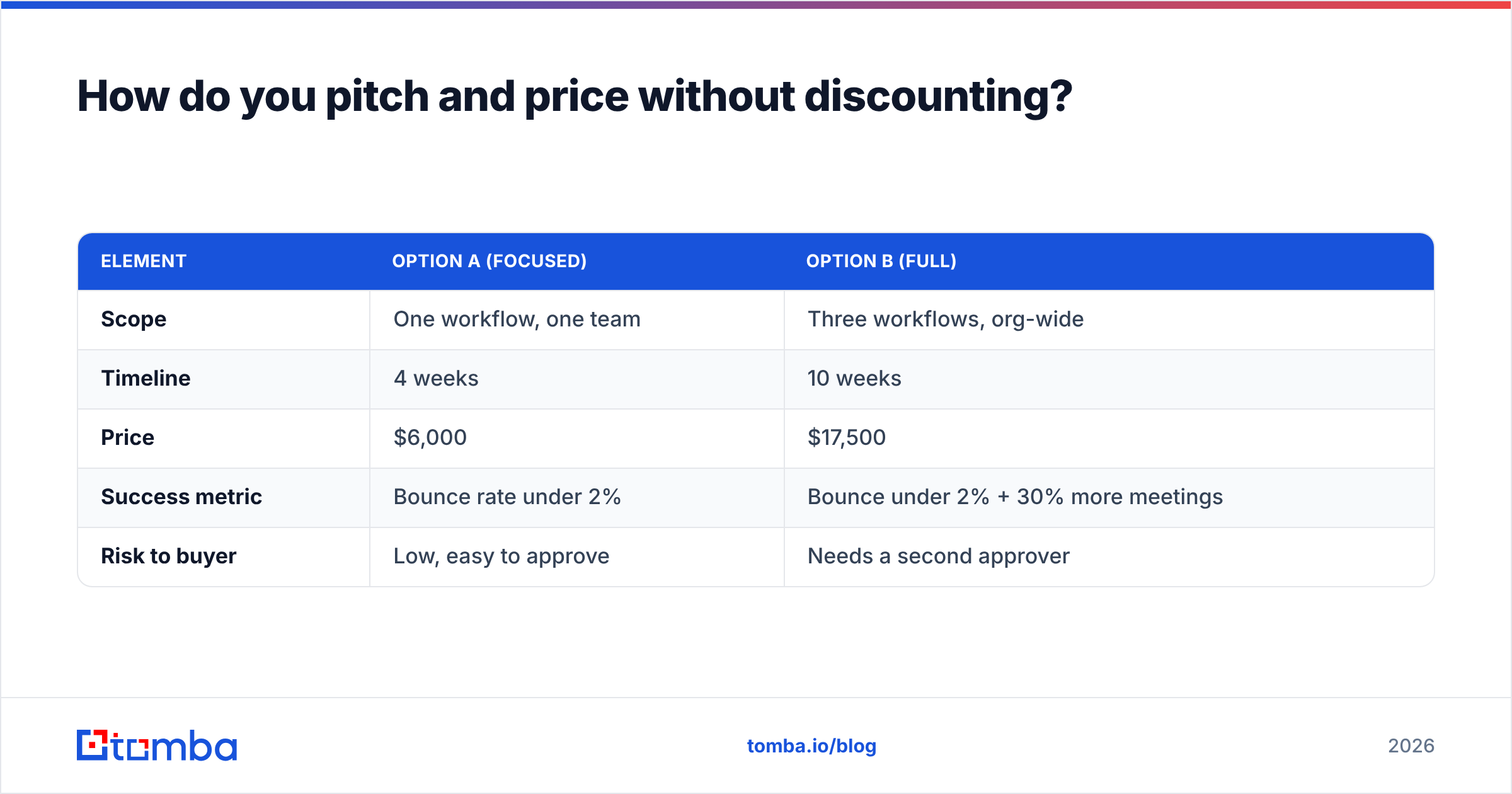
Then give exactly two options, not three or five:
| Element | Option A (Focused) | Option B (Full) |
|---|---|---|
| Scope | One workflow, one team | Three workflows, org-wide |
| Timeline | 4 weeks | 10 weeks |
| Price | $6,000 | $17,500 |
| Success metric | Bounce rate under 2% | Bounce under 2% + 30% more meetings |
| Risk to buyer | Low, easy to approve | Needs a second approver |
Two options turn "should we do this?" into "which one?" — a much easier internal conversation. And naming the second approver in the proposal itself ("Option B likely needs your CFO; happy to join that call") removes the most common silent deal-killer.
Never discount to close. Reduce scope to match the budget instead. A discount tells the buyer your first number was fiction; a scope reduction tells them your pricing is principled.
How do you turn one client into three?#
The referral ask has a shelf life, and most people miss it. Ask at the moment of a delivered result, not at the end of the engagement.
Concretely: when you hit the milestone you promised, send a short note that (a) restates the result with the number, (b) asks who else in their network has the same problem, and (c) offers to write the intro email for them so the cost of helping you is near zero.
Run this on every account and referrals stop being luck. Also worth doing: a quarterly check-in with every past client, no agenda, no pitch. Roughly a third of re-engagements come from someone who changed jobs and brought you into the new company. HubSpot's sales research has repeatedly shown referred prospects convert at materially higher rates than cold ones — the constraint is that most teams never systematize the ask.
What tools do you actually need?#
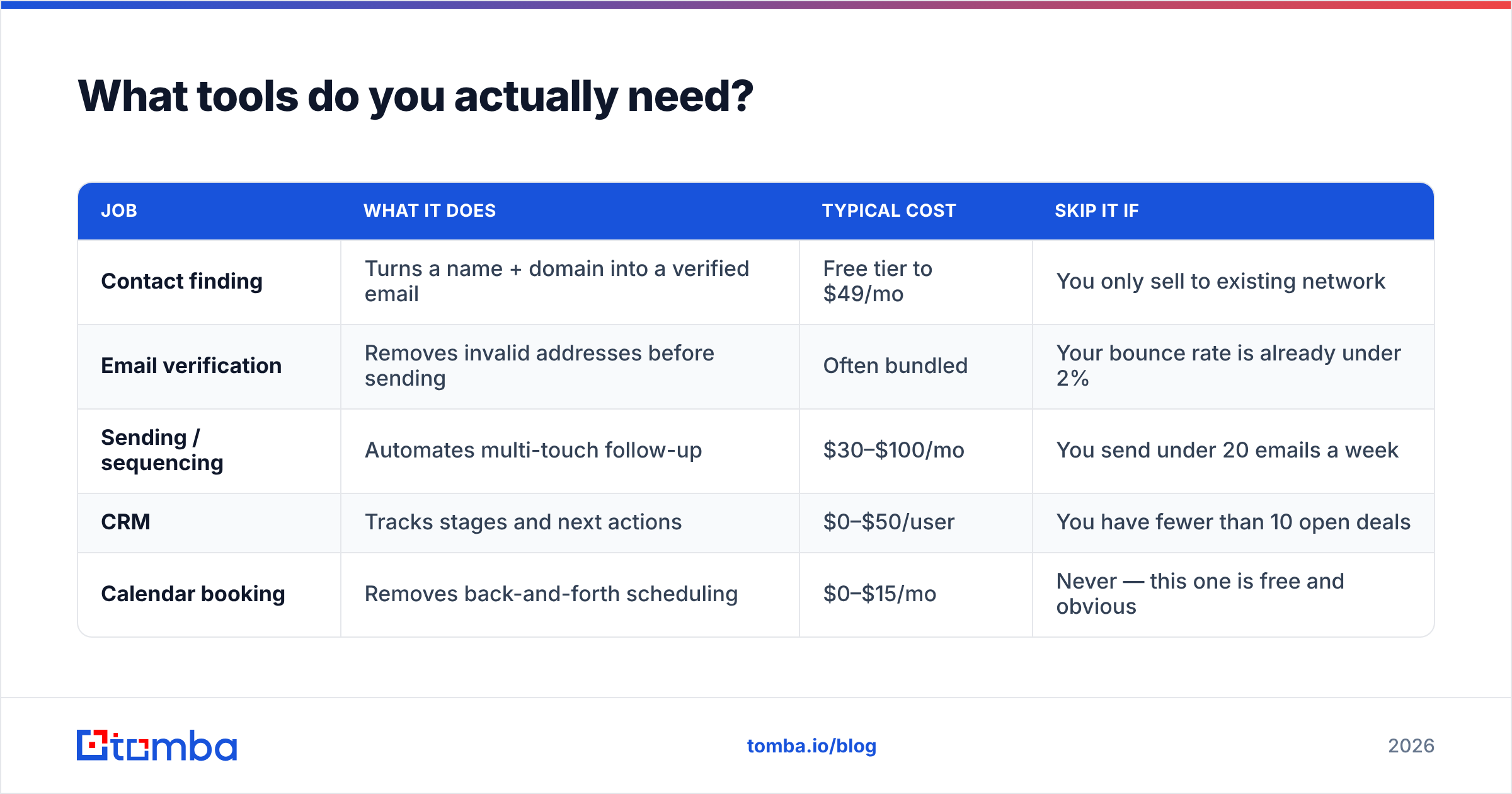
Fewer than you think. Here is a minimum viable stack for a team of one to five.
| Job | What it does | Typical cost | Skip it if |
|---|---|---|---|
| Contact finding | Turns a name + domain into a verified email | Free tier to $49/mo | You only sell to existing network |
| Email verification | Removes invalid addresses before sending | Often bundled | Your bounce rate is already under 2% |
| Sending / sequencing | Automates multi-touch follow-up | $30–$100/mo | You send under 20 emails a week |
| CRM | Tracks stages and next actions | $0–$50/user | You have fewer than 10 open deals |
| Calendar booking | Removes back-and-forth scheduling | $0–$15/mo | Never — this one is free and obvious |
On the data side, Tomba pricing starts with a free tier at 25 searches per month, which is enough to validate a segment before spending anything. Starter is $49/mo, Growth $99/mo, and Pro $249/mo — with email finding, verification, domain search, and catch-all checks in the same account rather than split across three subscriptions and three bounce rates.
The stack is not what wins clients. But a broken data layer will cap everything above it, no matter how good your copy gets.
How do you know it's working?#
Measure three numbers weekly, and ignore the rest:
- Verified contacts added. Input volume. If this drops, everything downstream drops in three weeks.
- Meetings booked per 100 verified contacts. The real efficiency metric. Under 2 means your targeting or first touch is broken. Over 5 means widen the segment.
- Meeting-to-proposal rate. Under 40% usually means you're booking unqualified calls — tighten the criteria in your first message.
Review monthly, not daily. Outbound has enough noise that a bad week means nothing and a bad month means something.
Start with the list, not the pitch#
If you take one thing from this: the fastest improvement available to almost every team asking how to win clients is not a better script. It is a smaller, cleaner, verified list of people who have the problem you solve, contacted six times instead of once.
Build that list with the Tomba Email Finder — search by domain, name, or company, get a confidence score on every result, and verify before you send so your first campaign lands in inboxes instead of spam folders. Start on the free tier at 25 searches a month, run one narrow segment end to end, and let the numbers tell you what to scale.
Related guides#
// get started
Find, verify and enrich your first contacts today
Start on the free plan with 25 searches a month, then scale when your team is ready.
Free plan · No credit card required · GDPR & CCPA
Get the Tomba newsletter
Product and data updates
// about the author