How to Win More Deals in 2026: A 7-Step Sales Playbook
Most reps chase more meetings when their real problem is a leaky middle funnel. Here are seven concrete moves — qualification, multithreading, mutual action plans — that raise win rate without adding a single hour of prospecting.
TL;DR
- Winning more deals is usually a middle-funnel problem, not a top-funnel one. A rep at a 18% win rate who gets to 27% adds 50% more revenue with zero extra pipeline.
- The four highest-leverage fixes: disqualify faster, multithread to 4+ contacts, run a written mutual action plan, and control the next step in every single meeting.
- Single-threaded deals lose. Enterprise buying groups now average 6–10 people; if you only know one of them, you're betting your quota on one person's job security.
- Track win rate by stage exit, not just closed-won. Where deals actually die tells you which behavior to fix.
- Your CRM notes are a leading indicator. If a deal record has one contact, no economic buyer, and no documented next step, it's already lost — you just haven't logged it yet.
Why do most reps focus on the wrong number?#
Because activity is easy to measure and win rate is uncomfortable to look at.
Think of your pipeline like a restaurant kitchen. Most struggling restaurants respond to bad revenue by putting more flyers on windshields — more people through the door. But if 40% of orders come back to the kitchen, the flyers just create more angry customers faster. The fix is the kitchen, not the flyers.
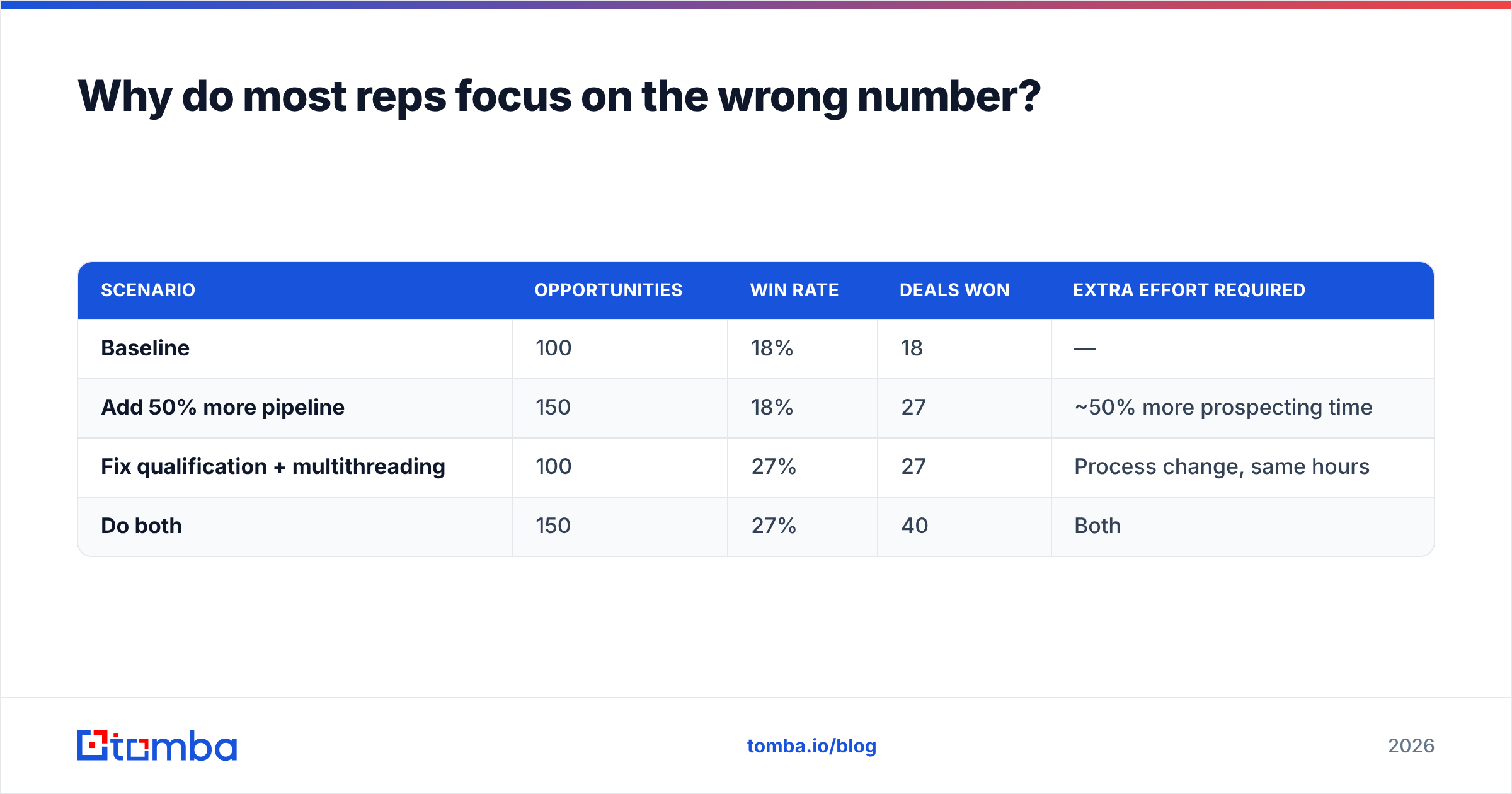
Sales works the same way. If you close 18 of every 100 qualified opportunities, adding 30 more opportunities gets you five more deals and a lot more work. Moving to a 27% win rate on your existing 100 opportunities gets you nine more deals and no extra prospecting hours.
Here's the math nobody puts on the board:
| Scenario | Opportunities | Win rate | Deals won | Extra effort required |
|---|---|---|---|---|
| Baseline | 100 | 18% | 18 | — |
| Add 50% more pipeline | 150 | 18% | 27 | ~50% more prospecting time |
| Fix qualification + multithreading | 100 | 27% | 27 | Process change, same hours |
| Do both | 150 | 27% | 40 | Both |
Same outcome in rows 2 and 3. One costs you 15 extra hours a week of cold outreach; the other costs you a discipline change. Most teams pick the expensive one because it feels like work.
What actually causes deals to be lost?#
Not price. Price is what buyers say when they don't want to explain the real reason.
Across public benchmark data — Gartner's research on B2B buying is the most widely cited — the dominant loss reason in complex deals is "no decision." The buying group stalls, the champion goes quiet, priorities shift, and the opportunity rots in Stage 3 until someone marks it closed-lost in a quarter-end cleanup.
The four repeatable causes:
- No economic buyer contact. You've been talking to the person who feels the pain, not the person who signs. When budget review comes, you have no advocate in the room where the decision happens.
- No documented business case. The champion can't repeat your value proposition internally in one sentence, so it doesn't survive the internal pitch.
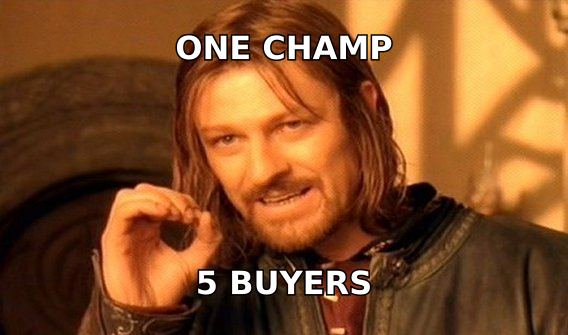
- Single-threaded relationships. Your one contact changes roles, goes on leave, or gets overruled. The deal dies with their calendar invite.
- Vague next steps. "I'll follow up next week" is not a next step. A calendared meeting with a named agenda and named attendees is a next step.
Every one of those is a behavior you control. None require a better product, a lower price, or a bigger marketing budget.
How do you qualify hard enough to raise win rate?#
You disqualify earlier, and you write down what you learned.
Qualification frameworks — MEDDIC, BANT, SPICED — all do the same job: force you to name the things you don't know. The framework matters less than the honesty. Pick one and enforce it as a stage gate, meaning a deal literally cannot move to the next stage until the fields are filled.
A workable gate for a mid-market motion:
- Metric — What number improves, by how much, measured how? "Reduce onboarding time" fails. "Cut onboarding from 14 days to 5, tracked in their ops dashboard" passes.
- Economic buyer — Named, title confirmed, and you've had at least one direct interaction (email counts; a forwarded intro does not).
- Decision process — You can describe, in order, who reviews the contract after your champion says yes. Legal? Security? Procurement? A board?
- Identified pain with a deadline — Pain without a deadline is a hobby. Ask "what happens if you do nothing until next fiscal year?" If the answer is "not much," you have a nurture, not a deal.
- Competition and status quo — Include "doing nothing" as a named competitor, because it wins more often than any vendor does.
The uncomfortable part: applying this shrinks your pipeline on paper. That's the point. A forecast built from 22 real deals beats a forecast built from 60 hopeful ones, and your manager stops asking you about deals you already know are dead.
Is multithreading really worth the extra work?#
Yes, and it's the single highest-ROI habit on this list.
Buying groups have grown. Depending on deal size, you're facing anywhere from three to ten people with veto power. A deal with one contact isn't a deal — it's a friendship with a calendar link.
Practical multithreading, in order of effort:
- Ask your champion directly. "Who else needs to be comfortable with this before it moves?" Then: "Would it help if I put together a short brief for them, or would you rather introduce us?" Champions almost always pick one.
- Attend with peers. Bring your solutions engineer to meet their technical lead. Peer-to-peer conversations produce information your champion filters out.
- Go around, carefully. If the champion stalls for three weeks, a polite direct note to the VP referencing the shared project is not rude — it's how enterprise deals actually move. Frame it as continuity, not escalation.
- Map before you need it. Build the org chart in Stage 2, not Stage 5 when the deal is stuck.
That last one is where tooling earns its keep. Finding a director of ops' verified work email at 2pm on a Tuesday shouldn't take twenty minutes of LinkedIn scrolling. A domain search returns the company's confirmed contacts and email pattern in one query, and running each new name through an email verifier before you send keeps your bounce rate from wrecking your sender reputation while you expand into the account.
One rule: multithreading is not spamming five people with the same pitch. Each contact gets a message tied to their stake. The CFO cares about payback period. The ops lead cares about migration effort. The security reviewer cares about SOC 2. Same deal, three different first paragraphs.
What does a mutual action plan look like?#
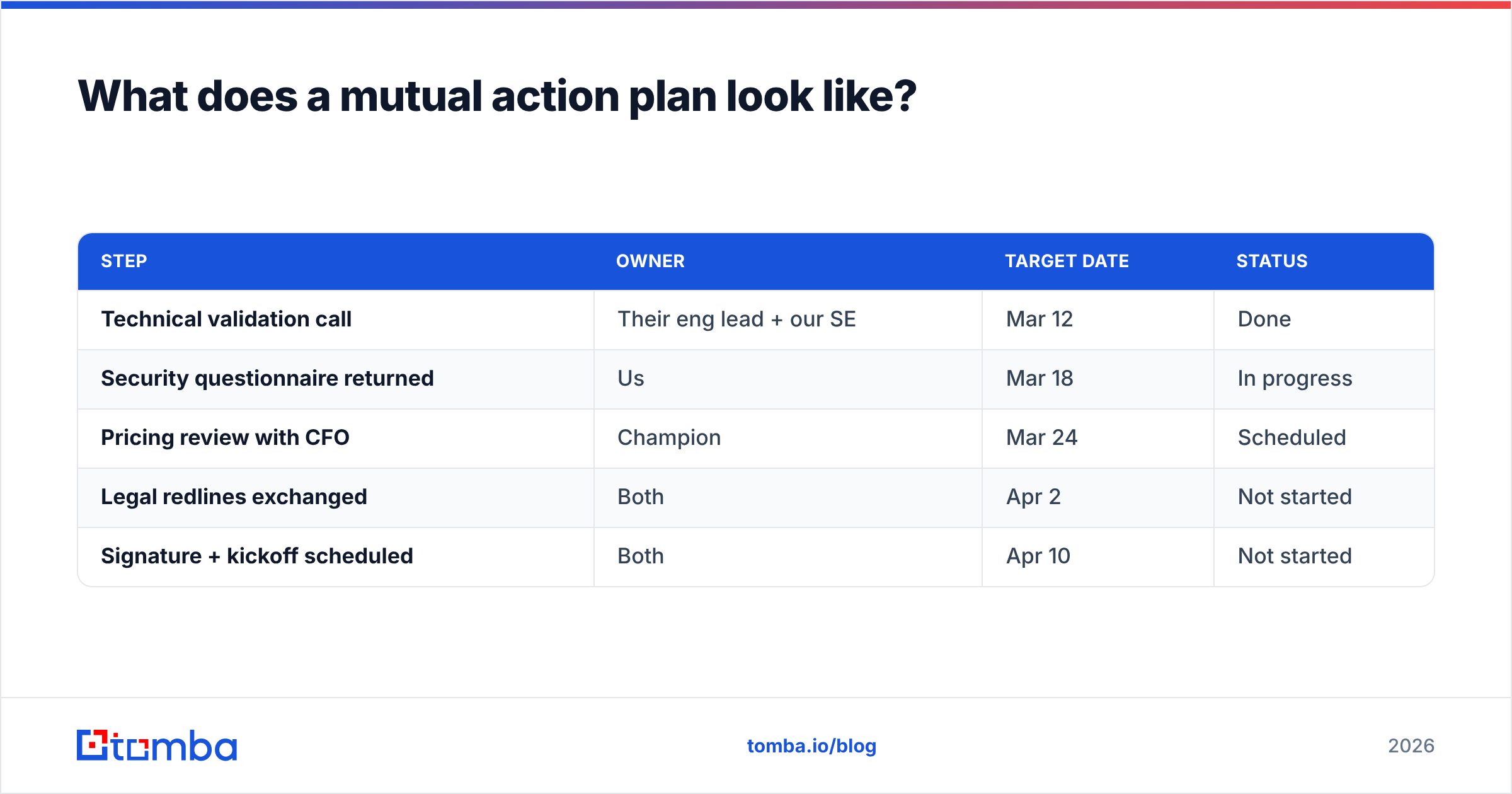
A shared, dated, written document that both sides edit. Nothing fancier than that.
Think of it as a wedding planning spreadsheet. Nobody enjoys building it, but the alternative is two families showing up on different Saturdays.
A minimum viable version:
| Step | Owner | Target date | Status |
|---|---|---|---|
| Technical validation call | Their eng lead + our SE | Mar 12 | Done |
| Security questionnaire returned | Us | Mar 18 | In progress |
| Pricing review with CFO | Champion | Mar 24 | Scheduled |
| Legal redlines exchanged | Both | Apr 2 | Not started |
| Signature + kickoff scheduled | Both | Apr 10 | Not started |
Three things this does that a verbal agreement can't:
- It surfaces hidden steps. The moment you ask "who signs after legal?", you discover the procurement process nobody mentioned.
- It creates mutual accountability. When your champion misses a date, the document — not you — points it out.
- It's a forecast input. A deal with a mutual action plan the buyer has actually edited closes at a dramatically different rate than one where you sent a plan and heard nothing back. Silence on the document is the earliest reliable signal a deal is dead.
Send it after the second meeting, not the seventh. If the buyer refuses to engage with it, you've learned something valuable for free.
How do you stop deals from stalling after a good demo?#
Control the next step before the current meeting ends.
The most expensive five minutes in sales is the end of a call that goes well. Everyone's happy, the demo landed, and you say "I'll send over some materials and follow up next week." You have just converted a warm buyer into a cold email thread.
Replace it with a close-the-meeting script:
- Recap the decision, not the demo. "So the thing you're deciding is whether cutting onboarding to five days is worth $X this quarter — is that right?"
- Name the next milestone. "The logical next step is getting your security lead a look at our SOC 2 report."
- Book it live. "I've got Thursday 2pm or Friday 10am — which works? I'll send the invite before we hang up."
- Confirm attendees. "Should we include Priya, or does she come in later?"
That takes ninety seconds and eliminates the most common failure mode in B2B sales, which is not rejection but drift.

Between meetings, the follow-up email does one job: make it easy for your champion to sell internally. Attach a one-page business case they can forward without editing. Not a deck. A page. If they have to rewrite your material to use it, they won't use it.
Which metrics should you actually track?#
Stage-level conversion, not just the headline win rate. The headline number tells you that you have a problem; stage conversion tells you where it lives.
| Metric | What it reveals | Healthy signal | Fix if broken |
|---|---|---|---|
| Discovery → Demo rate | Whether you're qualifying real pain | 60%+ | Tighten discovery questions |
| Demo → Proposal rate | Whether the demo maps to their metric | 50%+ | Stop feature-dumping; demo their workflow |
| Proposal → Closed-won | Pricing, legal, and champion strength | 35%+ | Multithread earlier; MAP sooner |
| Avg. contacts per won deal | Multithreading discipline | 4+ | Map the org chart in Stage 2 |
| Deals with no activity in 14 days | Pipeline hygiene | <10% | Force a next-step field in CRM |
| No-decision loss rate | Business case strength | <25% of losses | Build urgency around a deadline |
Compare won deals against lost deals on contact count alone. On most teams the gap is stark and immediately actionable — won deals routinely carry two to three times the contacts of lost ones. That single comparison, which takes ten minutes to run in your CRM, usually convinces skeptical reps faster than any training session.
Also track your response rate on multithreaded outreach separately from cold outreach. Warm expansion inside an active account should convert several times better than cold. If it doesn't, your messaging to secondary stakeholders is generic.
How should you handle pricing pushback?#
Delay the discount and defend the value — but do it with a structure, not with stubbornness.
When a buyer says "it's too expensive," they're saying one of three things: I don't see the value, I don't have budget authority, or I'm testing you. Diagnose before you respond:
- "Too expensive compared to what?" Reveals whether you're up against a competitor, an internal build, or nothing at all.
- "If price weren't a factor, would you move forward this quarter?" Separates a pricing objection from a hidden objection. If the answer is no, price was never the issue.
- "What budget range were you working with?" Often reveals the champion doesn't control the budget — which means you have a multithreading problem, not a pricing one.
If you do discount, trade for something: a longer term, a case study, an earlier start date, a referral to a sister division. Unilateral discounts train buyers to wait for them and quietly tell your champion the original number was fiction.
Comparison shopping is normal and healthy — buyers checking your category on G2 are doing their job. Help them do it well by being explicit about where you're a fit and where you're not. Reps who volunteer a disqualifying limitation early are, counterintuitively, the ones who get trusted on everything else.
What should you do differently starting Monday?#
Pick two changes, not seven. Behavior change fails when it's a list.
The two with the fastest payback:
- Audit every open deal for contact count. Any deal with fewer than three named contacts gets a multithreading plan this week. Use data enrichment to fill in the org chart around your existing champion so you're not starting from a blank LinkedIn search.
- Add a mutual action plan to every deal past discovery. Even a five-row table in a shared doc. Watch which buyers engage with it — that's your real forecast.
Then, at end of month, run the stage-conversion table above and see which number moved. If none did, you changed the artifacts but not the conversations. Go back to the close-the-meeting script.
Winning more deals is not a mystery and it isn't a personality trait. It's a small set of habits — qualify honestly, know everyone in the room, write the plan down, and never end a meeting without the next one booked — applied consistently on deals you already have.
Build the account map before the deal stalls. Multithreading only works if you can reach the other four people in the buying group, and hunting for verified work emails one profile at a time is where most reps quit. Tomba Email Finder returns verified professional emails by name and domain, so you can map an entire buying committee in minutes instead of an afternoon. The free tier gives you 25 searches a month to test it against accounts you already know; paid plans start at $49/mo on Tomba pricing when you're ready to scale it across the team.
Related guides#
// get started
Find, verify and enrich your first contacts today
Start on the free plan with 25 searches a month, then scale when your team is ready.
Free plan · No credit card required · GDPR & CCPA
Get the Tomba newsletter
Product and data updates
// about the author