How to Write a Cold Calling Script That Books Real Meetings
Most cold calling scripts fail in the first seven seconds. Here's a line-by-line framework for writing one that survives the opener, handles the brush-off, and books a meeting.
TL;DR
- A cold calling script is not a word-for-word recital. It's a decision tree: an opener, a permission ask, a one-sentence reason, a discovery question, and three pre-written brush-off responses.
- The first seven seconds decide the call. Lead with a pattern interrupt and a name, not "How are you today?"
- Write the objection handling before you write the pitch. You will hear "not interested" more often than you hear "tell me more."
- Your script is only as good as the number you dialed. Wrong-number rates above 15% mean your data problem is bigger than your copy problem.
- Test one variable per 50 calls. Openers first, then the reason statement, then the close.
What Is a Cold Calling Script, Really?#
A cold calling script is a written decision tree that gives you a default line for every branch a stranger can push the conversation down. That's it. It is not a monologue you read at someone.
Think of it like a pilot's checklist. Pilots don't read the checklist because they forgot how to fly. They read it because under pressure, humans skip steps. Cold calling is pressure — you have a hostile stranger, a seven-second window, and adrenaline. The script exists so the adrenaline doesn't delete your reason for calling.
The reps who sound "natural" on the phone are almost always the ones running the tightest script. They've said the same 40 words 900 times, so the words come out with the cadence of a normal sentence. The reps who sound robotic are usually the ones improvising and mentally hunting for the next thing to say.
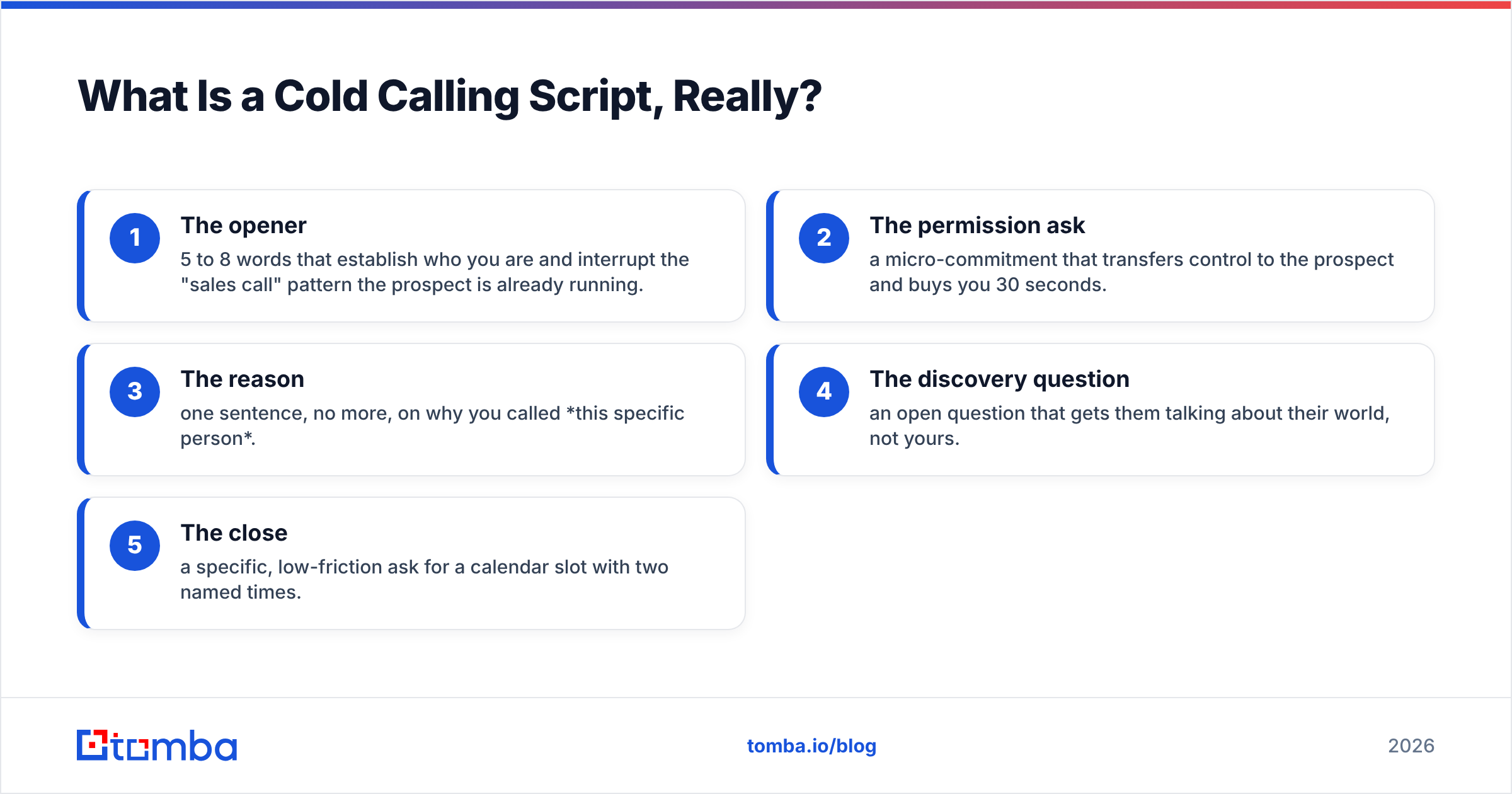
A working script has five components, in this order:
- The opener — 5 to 8 words that establish who you are and interrupt the "sales call" pattern the prospect is already running.
- The permission ask — a micro-commitment that transfers control to the prospect and buys you 30 seconds.
- The reason — one sentence, no more, on why you called this specific person.
- The discovery question — an open question that gets them talking about their world, not yours.
- The close — a specific, low-friction ask for a calendar slot with two named times.
Everything else — objection handling, voicemail, gatekeeper navigation — is a branch off one of those five.
Why Do Most Cold Calling Scripts Fail?#
They fail because they're written in the order the seller thinks, not the order the buyer listens.
The typical bad script opens with a company introduction ("Hi, I'm Dave from Acme, we're a leading provider of..."), moves to a value proposition paragraph, and only reaches a question after 45 seconds. By second 12 the prospect has categorized you and is looking for the exit line.
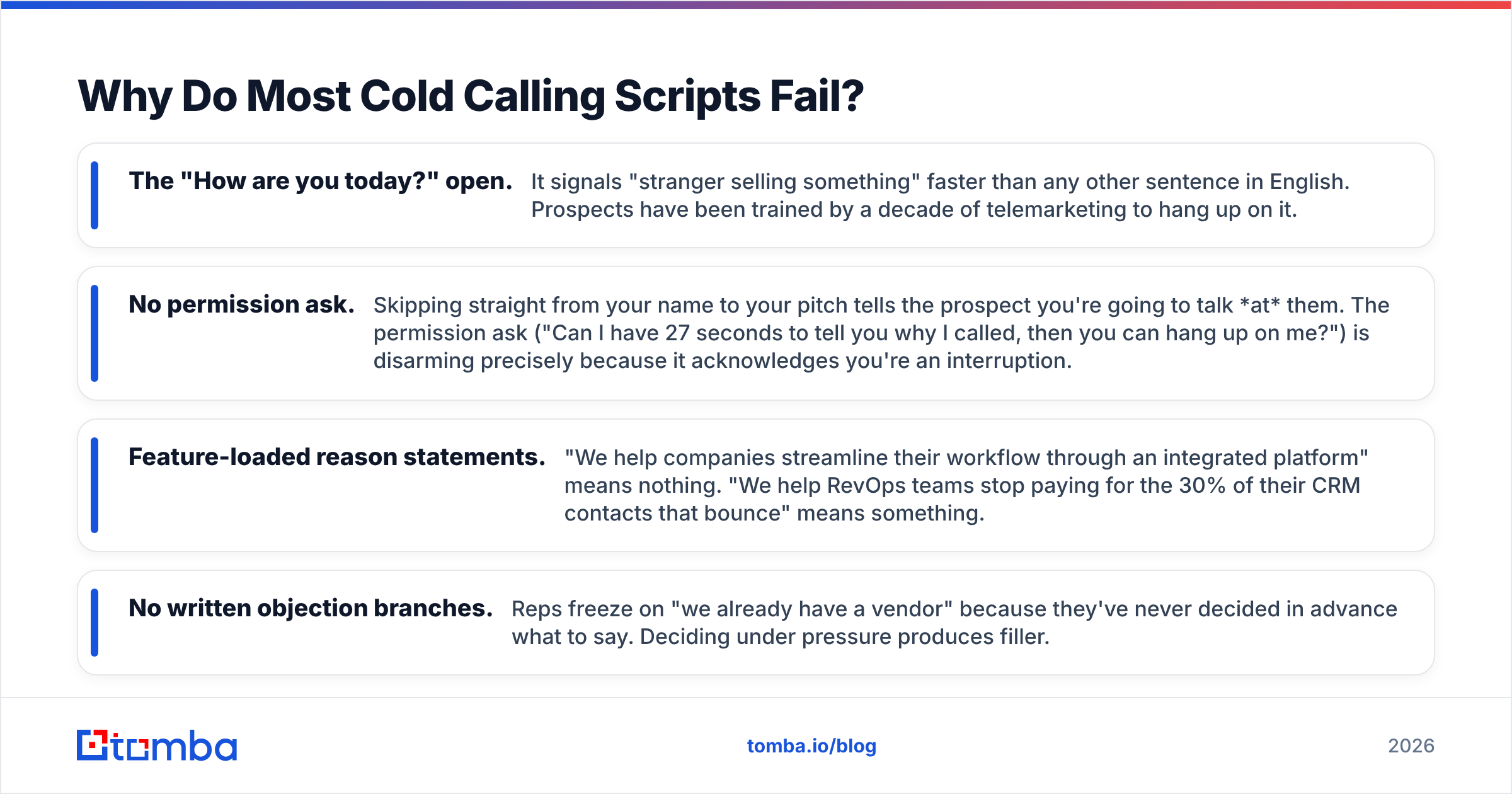
Four specific failure modes show up over and over:
- The "How are you today?" open. It signals "stranger selling something" faster than any other sentence in English. Prospects have been trained by a decade of telemarketing to hang up on it.
- No permission ask. Skipping straight from your name to your pitch tells the prospect you're going to talk at them. The permission ask ("Can I have 27 seconds to tell you why I called, then you can hang up on me?") is disarming precisely because it acknowledges you're an interruption.
- Feature-loaded reason statements. "We help companies streamline their workflow through an integrated platform" means nothing. "We help RevOps teams stop paying for the 30% of their CRM contacts that bounce" means something.
- No written objection branches. Reps freeze on "we already have a vendor" because they've never decided in advance what to say. Deciding under pressure produces filler.
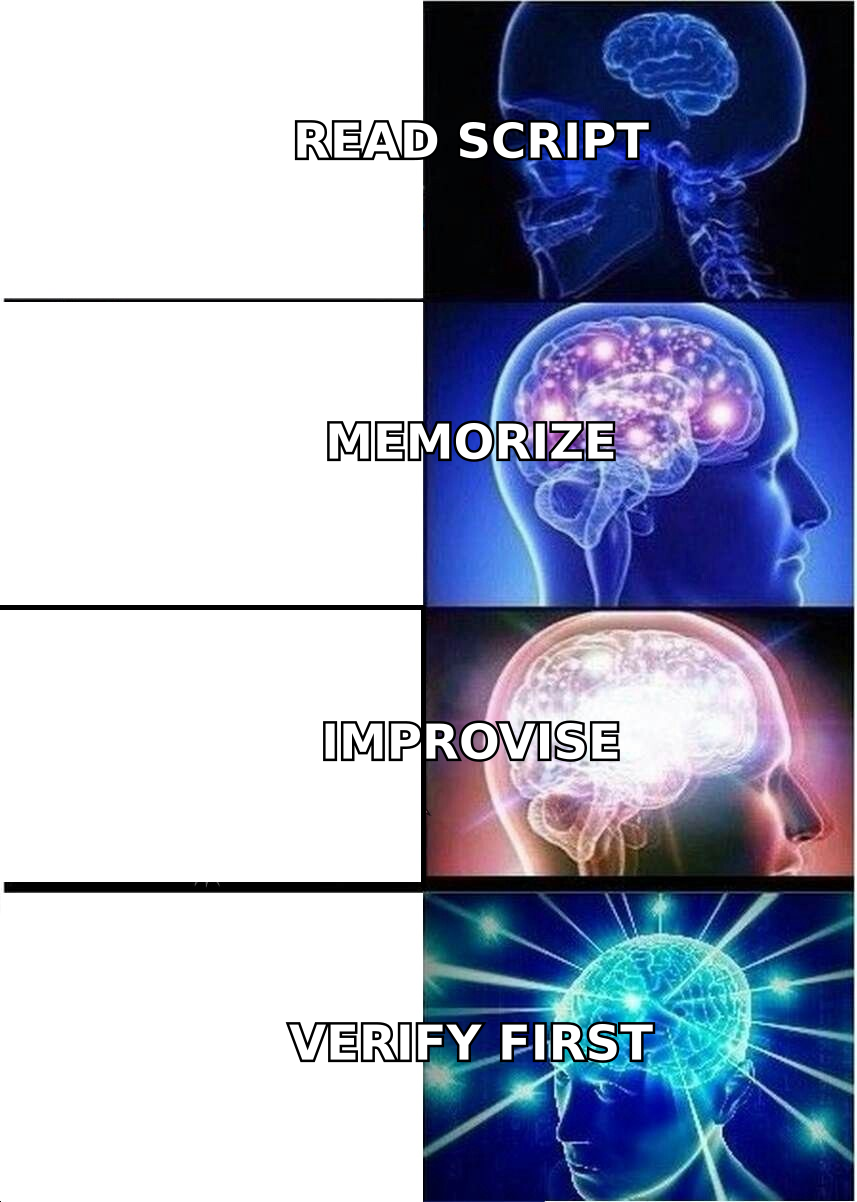
There's a fifth failure that has nothing to do with copy: you're calling numbers that don't belong to the person on your list. If 1 in 5 dials reaches a wrong extension or a disconnected line, no amount of script rewriting saves your connect rate. Run your list through a phone validator before you write a single line, so you're measuring the script and not the data.
How Do You Write the Opener?#
Write the opener last, test it first. It's the highest-leverage 8 words in the whole script and the only part you should A/B test formally.
Three opener patterns that consistently outperform the generic greeting:
The permission-based opener.
"Hi Sarah, it's Mark calling from Tomba — I know I'm an interruption. Can I have 30 seconds to say why, and then you decide if I keep going?"
This works because it's honest about the interruption. Most prospects grant the 30 seconds simply because nobody else asks.
The direct-reason opener.
"Sarah? Mark from Tomba. I'm calling because I saw your team posted three SDR roles last month — that usually means someone's about to inherit a data problem. Bad time?"
The "bad time?" at the end is deliberate. Asking permission to be interrupted reads as confident, not weak.
The referral-adjacent opener.
"Hi Sarah — Mark from Tomba. Your ops lead Jamie mentioned your team was pulling contact lists manually. Is that still how it works?"
Only use this one if it's true. Fabricated referrals kill deals at exactly the moment they're worth the most.
Whichever pattern you pick, three mechanical rules apply. Say their first name in the first three words — it triggers attention. Drop your last name and your title; nobody cares yet. And speak roughly 10% slower than feels natural, because adrenaline already pushed you 20% faster than you think.
What Should Go In the Body of the Script?#
The body is one reason sentence, one question, and then you shut up.
Your reason sentence should follow this shape: [Specific trigger I observed] + [problem that usually follows] + [what we do about it]. Keep it under 20 words spoken.
Weak: "We're a lead intelligence platform that helps sales teams find and verify B2B contact data at scale."
Strong: "You hired four SDRs this quarter. Teams that size usually burn 20% of their sends on stale emails — that's what we fix."
Then a single open question and silence. Silence is the hardest skill on the phone and the one that separates a conversation from a pitch. Count to three after they stop talking; most prospects fill the gap with the real objection.
Good discovery questions for a first call are narrow, not broad. "What's your biggest challenge?" is a question nobody answers honestly to a stranger. "How is your team sourcing contact data right now — in-house list building or a vendor?" is answerable in one breath, and the answer routes the rest of your call.
Which Script Structure Fits Your Motion?#
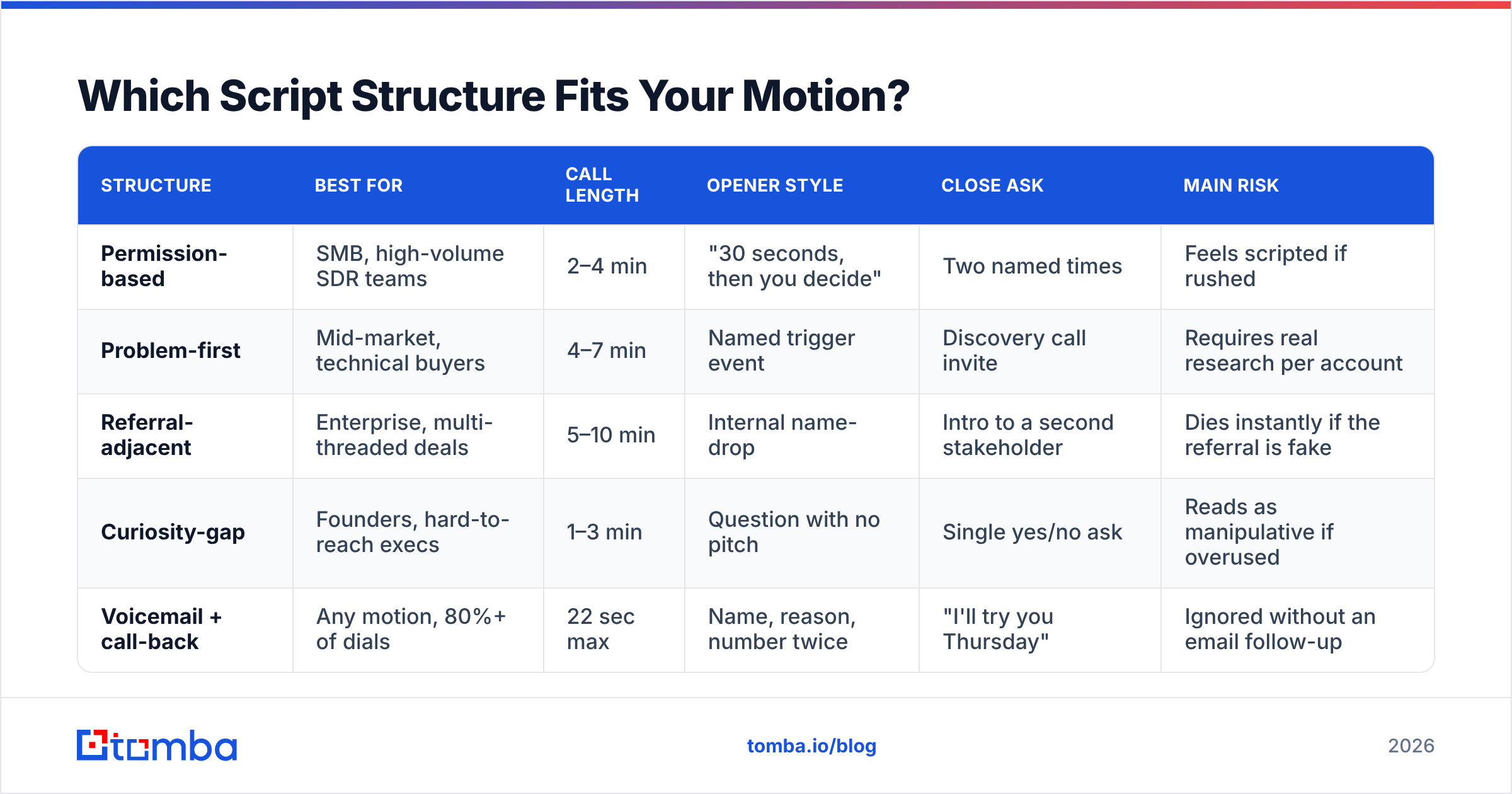
Not every call needs the same architecture. Match the structure to the deal size and the buyer.
| Structure | Best for | Call length | Opener style | Close ask | Main risk |
|---|---|---|---|---|---|
| Permission-based | SMB, high-volume SDR teams | 2–4 min | "30 seconds, then you decide" | Two named times | Feels scripted if rushed |
| Problem-first | Mid-market, technical buyers | 4–7 min | Named trigger event | Discovery call invite | Requires real research per account |
| Referral-adjacent | Enterprise, multi-threaded deals | 5–10 min | Internal name-drop | Intro to a second stakeholder | Dies instantly if the referral is fake |
| Curiosity-gap | Founders, hard-to-reach execs | 1–3 min | Question with no pitch | Single yes/no ask | Reads as manipulative if overused |
| Voicemail + call-back | Any motion, 80%+ of dials | 22 sec max | Name, reason, number twice | "I'll try you Thursday" | Ignored without an email follow-up |
Most teams should build the permission-based version first because it's the most forgiving of a mediocre delivery, then layer a problem-first variant for named accounts once they've got 200 calls of feedback.
How Do You Handle Objections Without Freezing?#
Write the objection responses before the pitch. You will hear four objections for every one conversation.
The pattern that works for nearly all of them is acknowledge → reframe → ask. Never argue, never say "actually," never repeat the pitch louder.
- "I'm not interested." → "Totally fair, you don't know me yet. Most people say that before they hear the reason. Give me 20 seconds and if it's still a no, I'll never call again?"
- "We already use [competitor]." → "Good, that means you've already solved the sourcing part. Most teams using them still run a second verification pass — is that how you handle bounces, or do you skip it?"
- "Send me an email." → "Happy to. So I don't send you something useless — is the priority right now data coverage, or accuracy on the contacts you already have?"
- "I don't have time." → "Understood. Are you the right person for contact data decisions, or should I be talking to someone else on the team? Then I'll get off the phone."
- "How did you get my number?" → "Fair question — we source business contact data from public and partner sources. Your direct is listed under your company's ops team. Want me to take you off the list?"
Note that four of those five end in a question. An objection response that ends in a statement hands the prospect a natural place to hang up. A question keeps the ball in play.
Answer the "how did you get my number" question honestly. Under GDPR and similar regimes, prospects have a right to know your source and to opt out — the ICO's guidance on direct marketing is worth 20 minutes of your time before you build a calling list. Being able to answer it cleanly also signals that you're not running a scraped list, which changes the tone of the rest of the call.
What Does a Full Script Look Like?#
Here's a complete, annotated script for a RevOps buyer. Adapt the specifics; keep the skeleton.
Opener (7 sec)
"Hi Sarah, it's Mark from Tomba. I know this is out of the blue — can I take 30 seconds to explain why I called, then you tell me if it's worth continuing?"
Wait for the yes. Don't talk over it.
Reason (12 sec)
"You added three SDRs last quarter. At that headcount, most teams start seeing 15 to 20 percent of their outbound bounce because the list isn't getting verified before it goes out. That's the specific thing we fix."
Discovery (open the floor)
"How are you handling contact data today — building in-house, or buying from a provider?"
Then silence. Three full seconds minimum.
Bridge (after their answer)
"That tracks with what I hear from teams your size. The part that usually breaks is [restate their exact words back to them]."
Close (specific, two options)
"Here's what I'd suggest: 15 minutes, I'll show you what your current list looks like when it's run through verification. Thursday at 10, or Friday at 2?"
Voicemail variant (22 sec)
"Sarah, Mark from Tomba, 555-0142. Calling about outbound bounce rates for teams that just scaled their SDR headcount. That's 555-0142. I'll try you again Thursday morning."
The voicemail matters more than reps think — research from Gartner on B2B buying behavior consistently shows buyers spend the majority of their journey researching independently, so a voicemail that plants a specific problem and a name often gets returned as an inbound email days later.
How Do You Test and Improve the Script?#
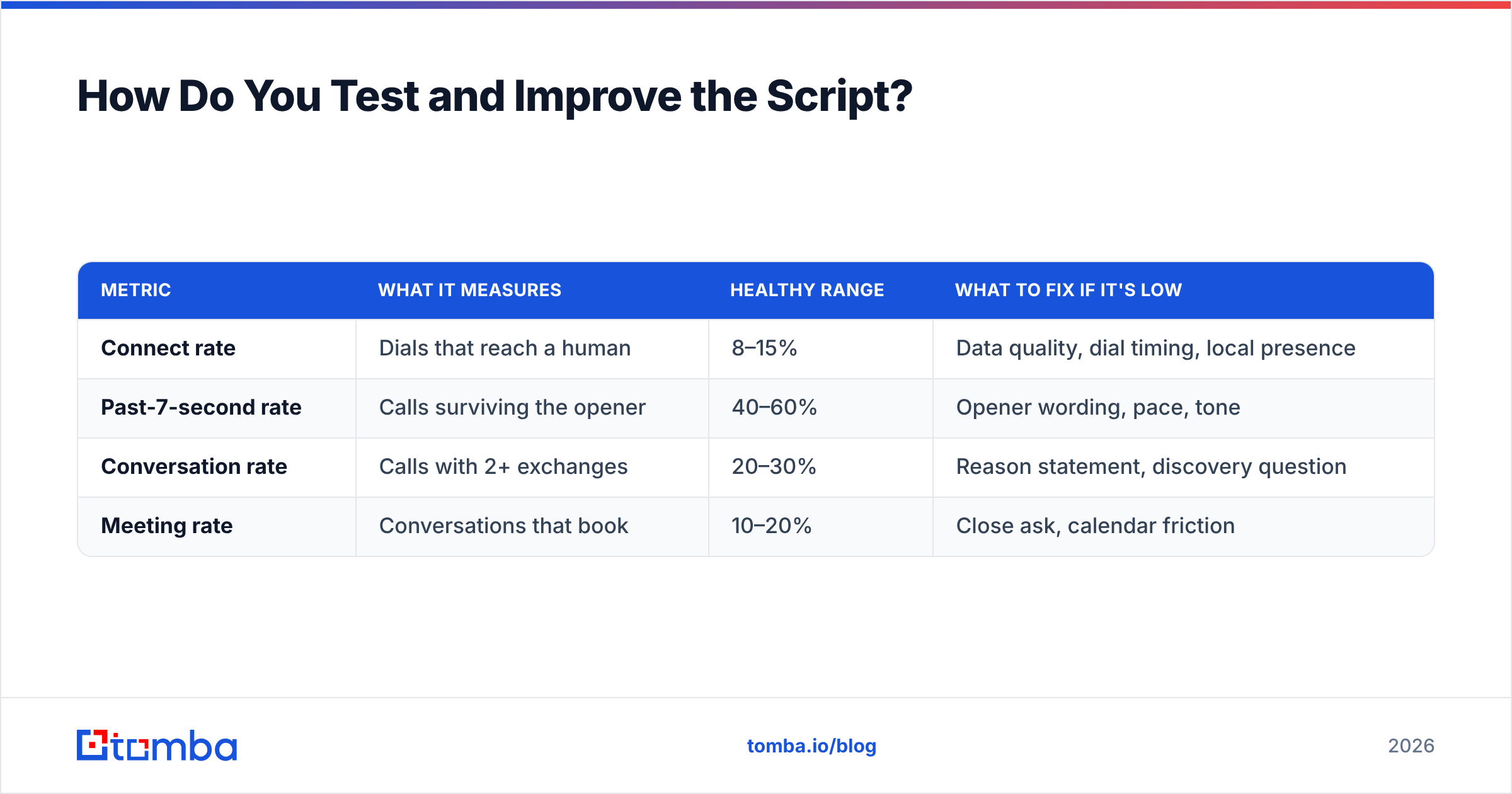
Change one variable per 50 calls, and track four numbers.
| Metric | What it measures | Healthy range | What to fix if it's low |
|---|---|---|---|
| Connect rate | Dials that reach a human | 8–15% | Data quality, dial timing, local presence |
| Past-7-second rate | Calls surviving the opener | 40–60% | Opener wording, pace, tone |
| Conversation rate | Calls with 2+ exchanges | 20–30% | Reason statement, discovery question |
| Meeting rate | Conversations that book | 10–20% | Close ask, calendar friction |
The past-7-second rate is the one nobody tracks and everybody should. It isolates the opener from everything else. If 70% of your connects hang up inside seven seconds, rewriting your close is pointless.
Record your calls — with consent where required — and listen to the first 15 seconds of ten of them back to back. You'll hear filler words you didn't know you said, and you'll hear exactly where your pace runs away from you.
A practical improvement loop:
- Week 1 — Run the baseline script on 200 dials. Record all four metrics.
- Week 2 — Change only the opener. Two variants, 100 dials each. Keep the winner.
- Week 3 — Change only the reason sentence. Same split.
- Week 4 — Change only the close ask. Same split.
- Week 5 — Re-baseline the whole script against week 1 and document the delta.
- Ongoing — Re-test the opener quarterly. Openers decay as they spread across your market.
How Does Data Quality Change Your Script Performance?#
It changes everything upstream of the script, which is why script-only optimization plateaus fast.
If your list has the right company but the wrong contact, your opener is perfect and irrelevant — you're pitching an office manager on RevOps tooling. If the direct dial routes to a main switchboard, you're spending your call block on gatekeepers instead of buyers. Neither of those is a copywriting problem.
Before a calling sprint, three checks are worth the hour:
- Title accuracy. Confirm the person still holds the role your list claims. Titles go stale within months, and calling someone by a job they left is an instant credibility loss.
- Number type. Direct dial versus switchboard versus mobile changes your opener. A mobile connect gets a shorter, more casual opener than a desk line.
- Email as a fallback. Every dial should have a verified email attached so the voicemail has a follow-up. Run your list through an email verifier so the post-call email actually lands.
For teams building lists from scratch, pairing a phone finder with data enrichment removes most of the "wrong person" problem before you touch the phone. And if you're calling into accounts you found by domain rather than by name, domain search surfaces the full contact map so you can pick the right title rather than dialing whoever appeared first in a scrape.
There's also a sequencing argument. Multichannel plays — call, email, LinkedIn touch — outperform phone-only, and HubSpot's sales research has consistently shown that persistence across channels drives most booked meetings. Your script should assume the prospect has already seen your name somewhere.
Common Mistakes to Avoid#
- Reading verbatim. Internalize the beats, not the words. If you sound like you're reading, you are.
- Pitching before permission. The permission ask isn't optional politeness — it's the mechanism that buys your next 30 seconds.
- Asking for "just 15 minutes to learn about your business." That's a request for a favor. Offer something specific instead.
- Vague closes. "Does sometime next week work?" creates work for the prospect. Name two slots.
- Skipping the voicemail. Most dials go to voicemail. A script that has no voicemail branch wastes 80% of your call block.
- One script for every persona. A CFO and an SDR manager care about different problems. Same skeleton, different reason sentence.
Ready to Fix the Half of the Problem Your Script Can't Touch?#
A great script on a bad list produces the same result as a bad script on a bad list: no meetings. Before your next calling block, make sure the names, titles, and numbers in front of you are real.
Start with Tomba Email Finder to build a verified contact base for the accounts you're calling into, then attach direct dials and enrichment on top. The free tier gives you 25 searches a month to test the workflow, and paid plans start at $49/mo — check Tomba pricing for the tier that matches your call volume. Get the data right, then spend your energy on the seven seconds that actually matter.
Related guides#
// get started
Find, verify and enrich your first contacts today
Start on the free plan with 25 searches a month, then scale when your team is ready.
Free plan · No credit card required · GDPR & CCPA
Get the Tomba newsletter
Product and data updates
// about the author