How to Write a Follow-Up Email: 7 Examples That Get Replies
Most follow-ups die because they add nothing new. Here are 7 follow-up email examples, the timing behind each touch, and the data checks that keep them out of spam.
TL;DR
- A follow-up email works when it adds something the first email didn't: a new proof point, a new angle, or a smaller ask. "Just checking in" adds nothing and gets deleted.
- Send 3–5 follow-ups spread over 2–3 weeks, not 8 over 8 days. Spacing beats volume for both reply rate and inbox placement.
- Keep every follow-up under 90 words, single-CTA, and threaded to the original message unless the subject line has clearly gone stale.
- Half of "no reply" cases are not rejection — they're bad addresses, catch-all domains, and spam filtering. Verify before you blame your copy.
- Use the seven follow up email examples below as skeletons, then swap in one specific detail per prospect. Specificity, not word count, drives replies.
What is a follow-up email, and why do most of them fail?#
A follow-up email is any message you send after an initial email that went unanswered — or after a call, demo, meeting, application, or invoice. Think of it like knocking on a door a second time. The first knock might not have been heard. The second knock is fine. The eighth knock, five minutes apart, is when someone calls the police.
Most follow-ups fail for three reasons, in this order:
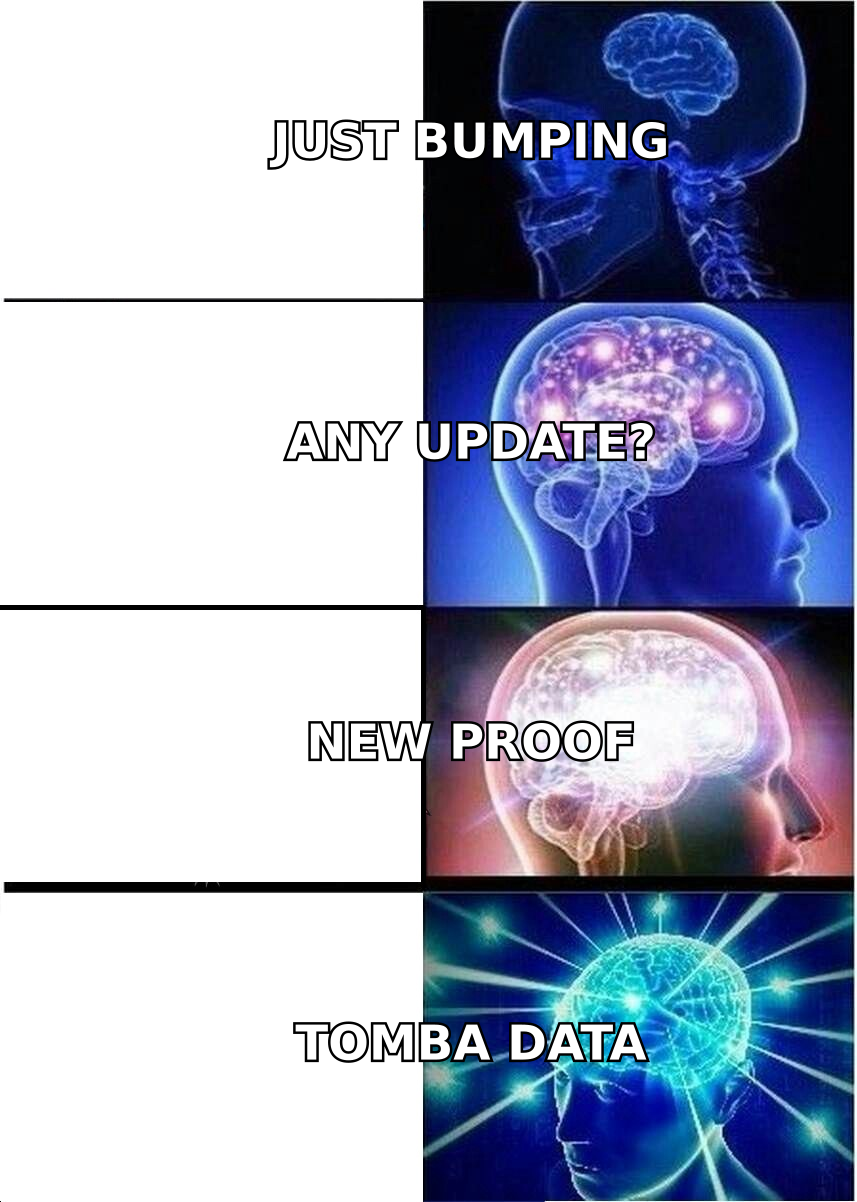
- They carry no new information. "Bumping this to the top of your inbox" asks the reader to do work while giving them nothing. If the original email wasn't compelling, repeating its existence doesn't help.
- They arrive too fast and too often. Sending five emails inside a week reads as automation, and it trains the recipient to filter your domain.
- They never land. Bounces, catch-all black holes, and spam placement look identical to being ignored. You can't fix copy that was never read.
The fix for the first two is craft. The fix for the third is data hygiene, which is why a follow-up sequence is only as good as the list feeding it.
What does the structure of a good follow-up email look like?#
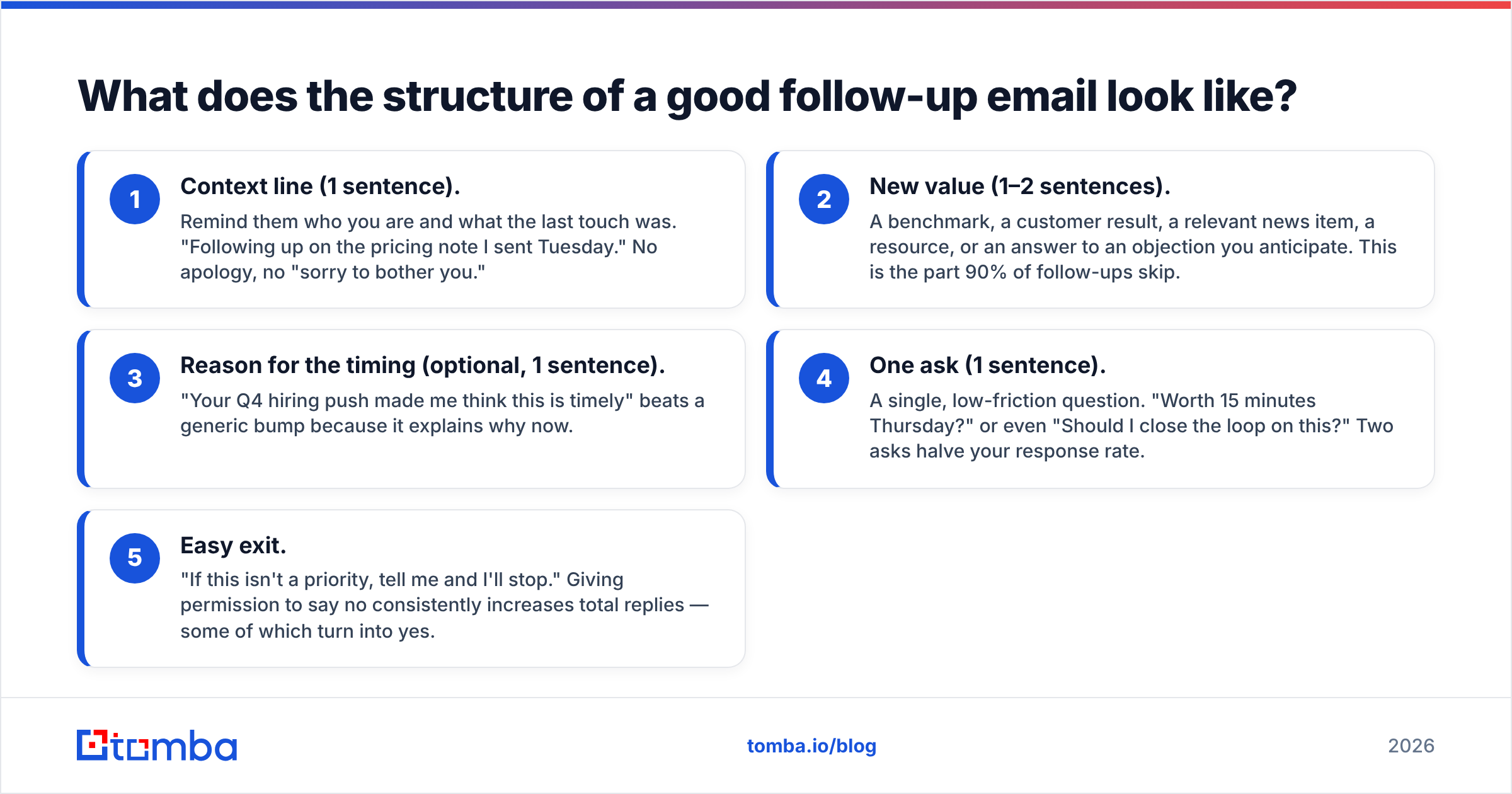
Every follow-up that earns a reply carries the same five parts. Keep them in this order and you can write a decent follow-up in under two minutes.
- Context line (1 sentence). Remind them who you are and what the last touch was. "Following up on the pricing note I sent Tuesday." No apology, no "sorry to bother you."
- New value (1–2 sentences). A benchmark, a customer result, a relevant news item, a resource, or an answer to an objection you anticipate. This is the part 90% of follow-ups skip.
- Reason for the timing (optional, 1 sentence). "Your Q4 hiring push made me think this is timely" beats a generic bump because it explains why now.
- One ask (1 sentence). A single, low-friction question. "Worth 15 minutes Thursday?" or even "Should I close the loop on this?" Two asks halve your response rate.
- Easy exit. "If this isn't a priority, tell me and I'll stop." Giving permission to say no consistently increases total replies — some of which turn into yes.
Total length: 50–90 words. If your follow-up is longer than your first email, you've inverted the pyramid.
How do you write a follow-up email step by step?#
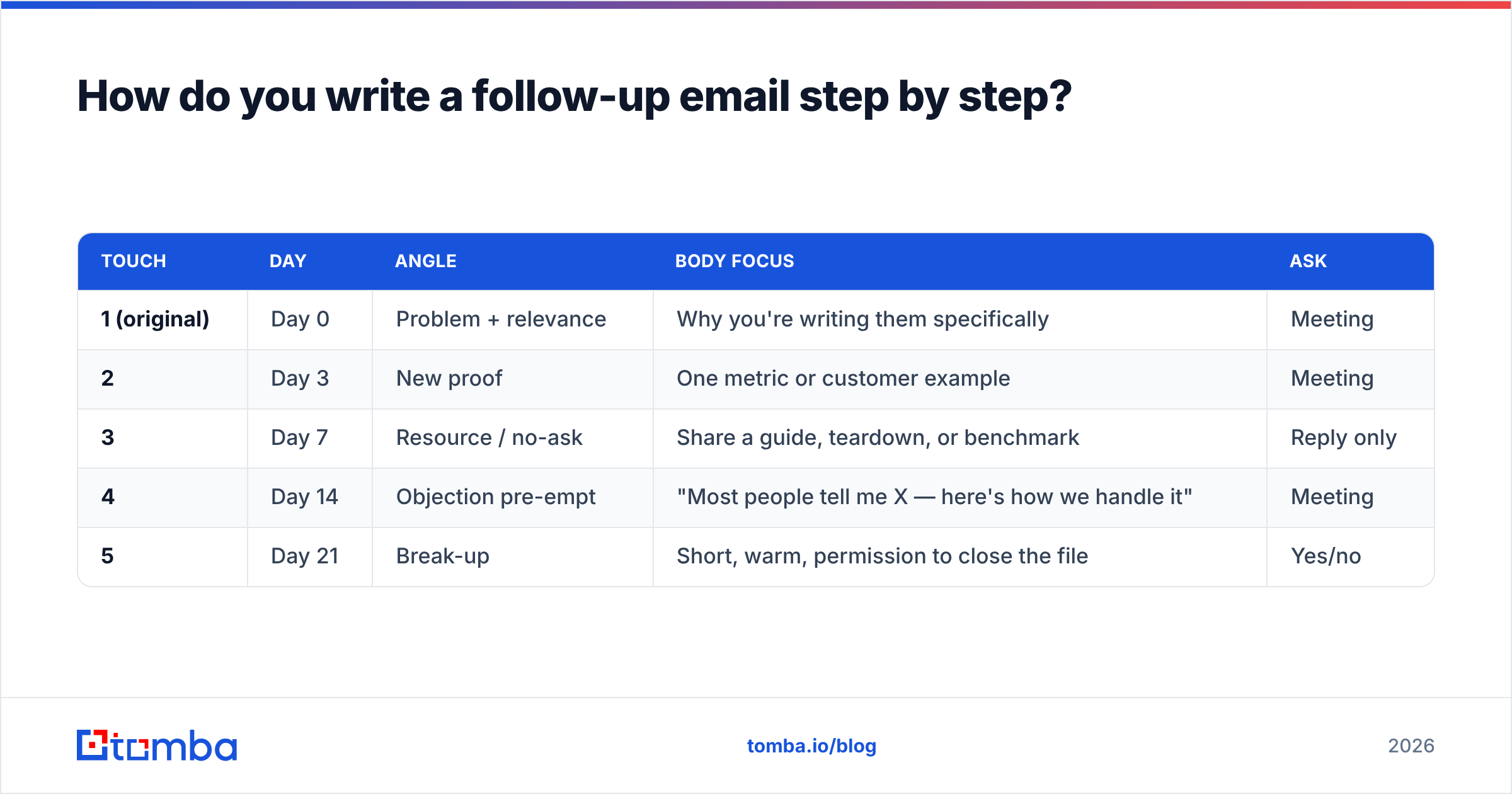
Here is the working sequence, mapped to timing, angle, and what actually goes in the body.
| Touch | Day | Angle | Body focus | Ask |
|---|---|---|---|---|
| 1 (original) | Day 0 | Problem + relevance | Why you're writing them specifically | Meeting |
| 2 | Day 3 | New proof | One metric or customer example | Meeting |
| 3 | Day 7 | Resource / no-ask | Share a guide, teardown, or benchmark | Reply only |
| 4 | Day 14 | Objection pre-empt | "Most people tell me X — here's how we handle it" | Meeting |
| 5 | Day 21 | Break-up | Short, warm, permission to close the file | Yes/no |
A few rules that hold across the table:
- Thread the first two follow-ups. Reply to your own sent message so the recipient sees the original underneath. Switch to a fresh subject line at touch 4 if the thread is dead.
- Change the angle, not just the wording. Touch 3 restating touch 2 in new adjectives is still touch 2.
- Never send two follow-ups in the same 48 hours. Ever.
- Cut the sequence the moment you get any human reply, including "not now." Manual takes over from there.
What are 7 follow-up email examples you can copy?#
Each of these is a real skeleton. The bracketed parts are the only things you should be rewriting per prospect.
1. The no-reply bump (Day 3, threaded)
Subject: re: [original subject]
Hi [First name] — following up on the note below.
Since I sent it, [company in their space] cut [specific metric] by [number] using the same approach. Happy to walk you through the setup in 15 minutes.
Worth a look, or is this off your radar for the quarter?
2. The post-demo recap (within 4 hours of the call)
Subject: Recap + next steps from today
Hi [First name] — good talking today. Three things you flagged:
- [Objection or requirement]
- [Objection or requirement]
- [Objection or requirement]
I've attached the [doc] that covers #2. On #3, the answer is [one line].
Next step on my side is [action] by [day]. Does [day/time] work to close out #1 with [stakeholder]?
3. The value-add, no-ask (Day 7)
Subject: Thought this was relevant to [their initiative]
Hi [First name] — no ask here. [Competitor or peer company] published [thing] last week and it lines up with what you're building on [initiative]. Link below.
Still happy to talk when the timing is better.
4. The objection pre-empt (Day 14)
Subject: The switching-cost question
Hi [First name] — when I talk to [their role] at [company type], the blocker is usually migration effort, not price.
For context: [customer] moved 40,000 records in a single afternoon and kept their existing CRM fields intact.
If migration is the sticking point for you too, I can send the two-page runbook. Want it?
5. The break-up (Day 21)
Subject: Closing the file?
Hi [First name] — I've sent a few notes about [topic] and haven't heard back, which usually means it isn't a priority right now. Totally fair.
I'll close the file unless you tell me otherwise. If it's worth revisiting in [quarter], say "later" and I'll ping you then.
6. The trigger-event restart (any time)
Subject: Saw the [funding round / new hire / product launch]
Hi [First name] — congrats on [event]. Last time we spoke, [reason it wasn't a fit] was the blocker. [Event] usually changes that math because [one specific reason].
Reopen the conversation?
7. The unpaid-invoice follow-up (Day 7 past due)
Subject: Invoice [number] — 7 days past due
Hi [First name] — invoice [number] for [amount] was due on [date] and I don't see it processed yet. Copy attached.
If it's stuck in approvals, tell me who to chase and I'll take it off your plate. If it's already sent, ignore this and thank you.
Notice what none of them do: apologize for following up, use "just," or ask two questions. If you want more skeletons across the whole sequence, our cold email templates library is organized by scenario rather than by industry.
How many follow-ups should you send, and how long should you wait?#
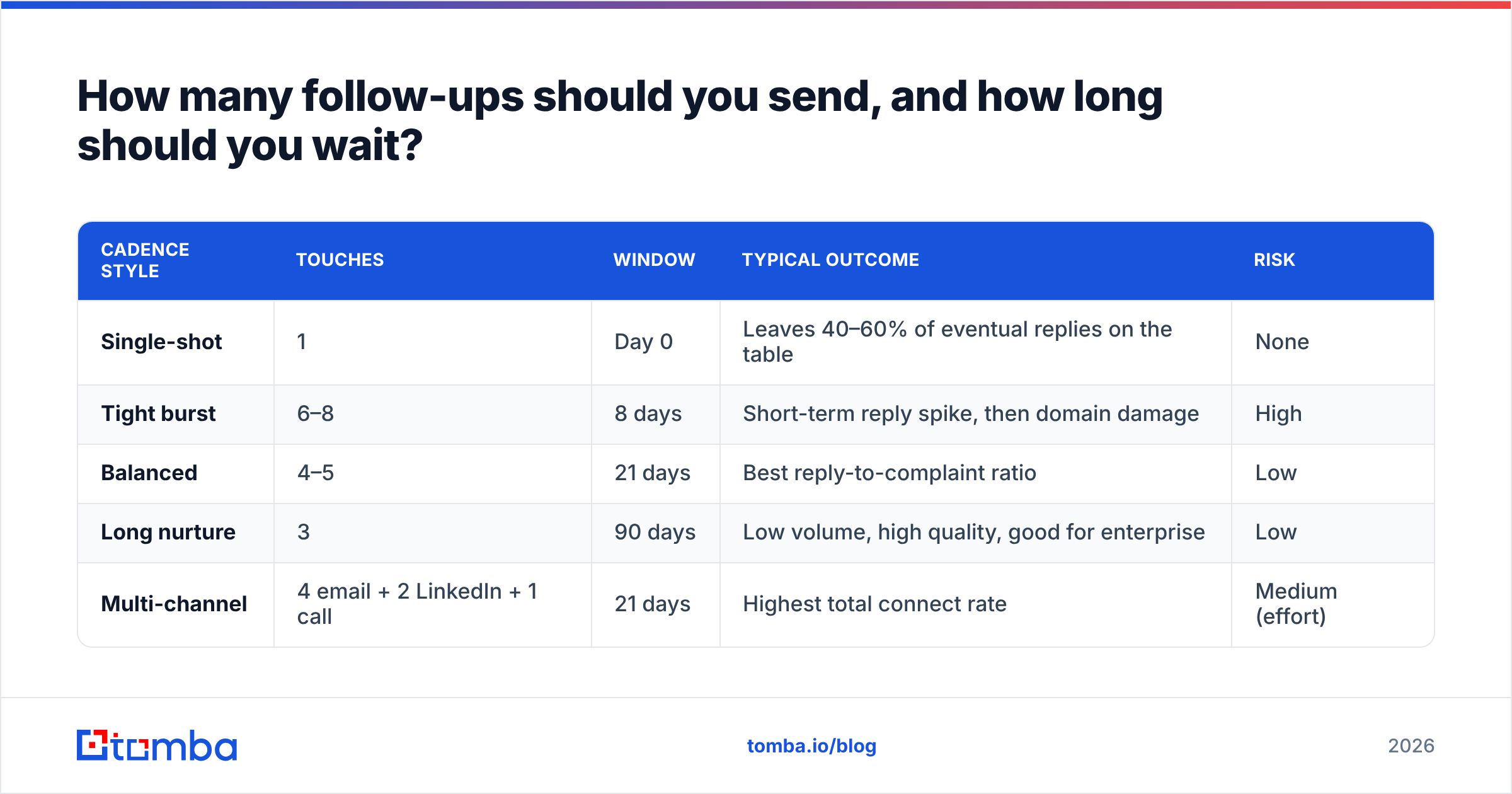
Three to five total touches over two to three weeks is the range where most teams see reply rates hold and complaint rates stay flat. Push past six and you're mostly harvesting unsubscribes and spam reports.
| Cadence style | Touches | Window | Typical outcome | Risk |
|---|---|---|---|---|
| Single-shot | 1 | Day 0 | Leaves 40–60% of eventual replies on the table | None |
| Tight burst | 6–8 | 8 days | Short-term reply spike, then domain damage | High |
| Balanced | 4–5 | 21 days | Best reply-to-complaint ratio | Low |
| Long nurture | 3 | 90 days | Low volume, high quality, good for enterprise | Low |
| Multi-channel | 4 email + 2 LinkedIn + 1 call | 21 days | Highest total connect rate | Medium (effort) |
Google's bulk sender guidelines put a hard ceiling on this: keep spam complaints under 0.3% or your delivery degrades across the board. A tight burst is the fastest way to breach that. Spacing isn't politeness — it's infrastructure protection. If you want the mechanics of inbox placement, start with email deliverability and work backwards to your cadence.
Should you follow up by email, LinkedIn, or phone?#
Email carries the sequence; the other channels break ties. A LinkedIn view or comment before touch 3 raises the odds your next email gets opened, because the name is now familiar. A single call between touch 3 and touch 4 catches the people who never read cold email at all.
Practical split for a 21-day cycle: four emails, two LinkedIn touches (one profile view, one comment or connection note), one call. Don't announce the cross-channel move — "I also messaged you on LinkedIn" reads like surveillance. Directories like G2's sales engagement category are useful when you're picking tooling to run the multi-channel side, but the sequencing logic above stays the same regardless of platform.
Why do good follow-up emails still get no reply?#
Because a meaningful share of them are never delivered or never seen. Before you rewrite your copy for the fourth time, rule out the boring causes:
- The address is wrong. Pattern-guessed addresses (
first.last@) fail on a big chunk of domains. Run addresses through an email verifier before the sequence starts, not after it fails. - The domain is catch-all. Catch-all servers accept everything, so a "delivered" status means nothing. A catch-all verifier separates real mailboxes from black holes.
- The person left. B2B contact data decays roughly 25–30% per year. A follow-up to someone who changed jobs in March is a follow-up to nobody.
- You're in the promotions tab or spam. Heavy formatting, tracking pixels on every touch, and multiple links push you there. Strip the third follow-up down to plain text.
- The ask is too big. "30 minutes to discuss your roadmap" from a stranger at touch 2 is a big ask. "Should I send the one-pager?" is not.
Sales orgs that treat this as a data problem rather than a copy problem see the difference quickly. HubSpot's sales resources make the same point from the process side: pipeline hygiene and outreach quality are the same problem viewed from two ends. Track your response rate per touch, not just per sequence — that's where you'll see which follow-up is actually carrying the load.
What subject lines work best for follow-ups?#
Two options beat everything else:
re: [original subject]for touches 2 and 3. It preserves thread context and reads like continuation, not solicitation.- A fresh, concrete subject for touches 4 and 5, tied to the new angle: "The switching-cost question," "Closing the file?", "Saw the Series B." Four words or fewer, no title case, no brackets, no emoji.
Avoid fake-reply tricks ("re:" on a thread that never existed) — they burn trust the moment the recipient scrolls. If you're testing variants, a subject line tester will catch length and spam-trigger problems before you send.
How do you know a follow-up sequence is working?#
Judge it at three checkpoints, not one:
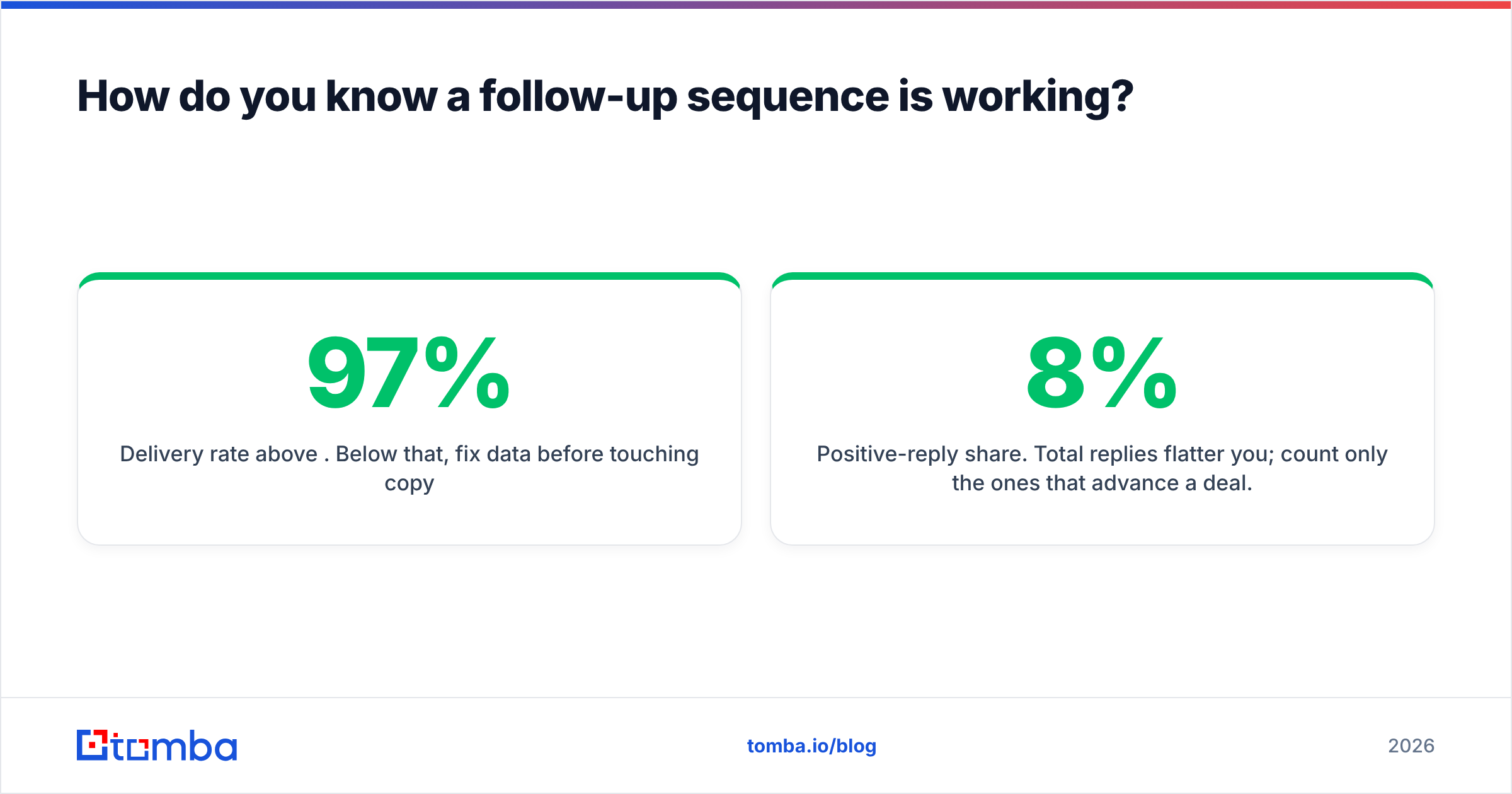
- Delivery rate above 97%. Below that, fix data before touching copy.
- Reply rate by touch. If touch 2 out-replies touch 1 by a wide margin, your first email is under-baked. If touches 4 and 5 produce nothing but unsubscribes, cut the sequence to three.
- Positive-reply share. Total replies flatter you; count only the ones that advance a deal. A sequence with 8% replies where half are "remove me" is worse than one at 5% that's all human interest.
Review those numbers monthly. Rewrite one touch at a time so you know what moved.
Start with addresses that actually land#
Follow-up copy is the second problem. The first is whether the message reaches a real inbox owned by a person who still works there. Use the Tomba Email Finder to source verified professional addresses by name or domain, and check them before touch 1 rather than after touch 5. The free tier covers 25 searches a month, and paid plans start at $49/mo — full Tomba pricing is on the site. Get the list right, then let the seven examples above do their job.
Related guides#
// get started
Find, verify and enrich your first contacts today
Start on the free plan with 25 searches a month, then scale when your team is ready.
Free plan · No credit card required · GDPR & CCPA
// about the author