How to Write a Follow-Up Email: Samples That Get Replies
Most follow-ups die because of timing and thin context, not bad wording. Here are seven follow-up email samples for the moments that matter, the cadence behind them, and the point where you should stop sending.
TL;DR
- A follow-up email is not a reminder. It is a second attempt at relevance — every send must carry information the previous one did not.
- The highest-performing structure is five parts: context line, new value, one specific ask, easy exit, short signature. Under 120 words.
- Three to five follow-ups spaced over 14–21 days captures most of the available replies. Beyond that, reply rates flatten and spam complaints rise.
- "Just checking in" and "bumping this to the top of your inbox" are the two lowest-yield openers in B2B outbound. Replace them with a reason.
- Before you blame your copy, verify your list. A follow-up sent to a dead or catch-all address is a bounce, not a rejection.
Follow-up emails carry most of the pipeline in B2B outbound. The first email starts the conversation; emails two through five are where the replies actually land. Yet the follow-up is usually the least-considered message a rep sends — written in twenty seconds, scheduled three days out, and phrased as an apology for existing.
This guide gives you a working follow up email sample for seven common scenarios, the cadence that sits underneath them, and the decision rules for when to stop.
What is a follow-up email, and why do most of them fail?#
A follow-up email is any message sent after an initial contact attempt that has not received a response — or after a meeting, demo, proposal, or event where the next step was left open.
Most fail for four reasons, in this order of frequency:
- No new information. The message restates the first email in shorter form. The recipient already declined to act on the full version; the abridged version gives them less reason, not more.
- A vague ask. "Let me know your thoughts" requires the reader to design their own next step. "Are you the right person for procurement decisions on this, or should I speak with someone in ops?" requires a one-word answer.
- Wrong timing. Sending 24 hours after the first email reads as pressure. Sending 14 days later means the original context is gone.
- Bad data underneath. If the address is invalid, catch-all, or belongs to someone who left the company, no amount of copywriting fixes it. Run your list through an email verifier before you blame the message.
Research from HubSpot's sales blog has long shown that a meaningful share of closed deals involve five or more touches, while the majority of reps stop after one or two. The gap between those two numbers is the entire argument for a follow-up sequence.
What does a good follow-up email look like?#
Every effective follow-up shares the same five-part skeleton. Keep the whole thing under 120 words — follow-ups are read on phones, between meetings.
- Context line (one sentence). Remind them who you are and what the prior touchpoint was. "Following up on the note I sent Tuesday about your SDR onboarding time."
- New value (one to two sentences). A customer result, a relevant benchmark, a competitor move, an article, a screenshot. This is the part everyone skips and the part that earns the reply.
- One specific ask. A binary question or a concrete time proposal. Never two asks in one email.
- Easy exit. "If this is not a priority this quarter, tell me and I will close the loop." Permission to say no raises reply rate because it lowers the cost of replying.
- Signature. Name, company, one link. No banner images, no legal footers, no quote of the day.
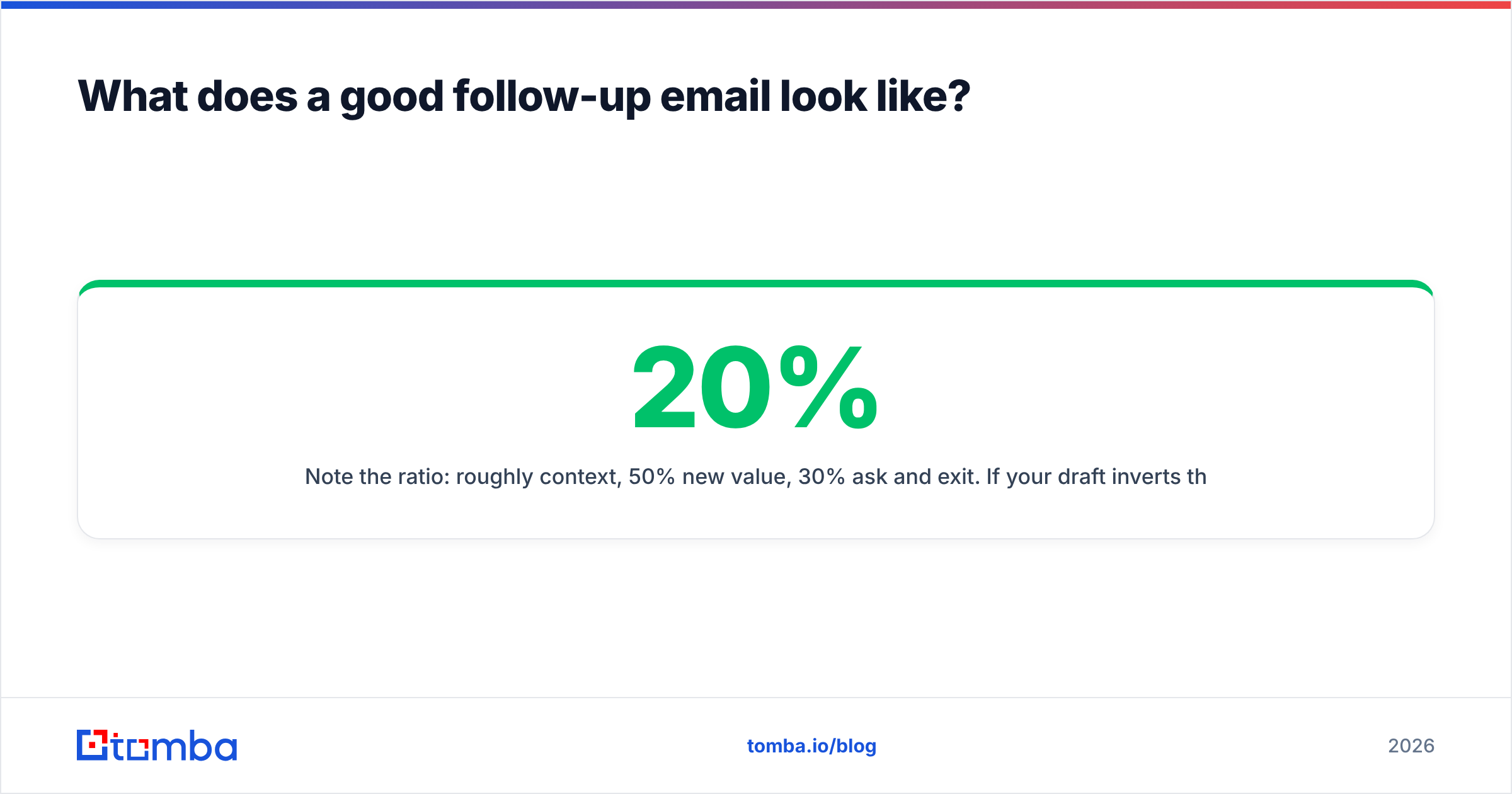
Note the ratio: roughly 20% context, 50% new value, 30% ask and exit. If your draft inverts that — mostly context, little value — it is a bump, not a follow-up.
How many follow-ups should you send, and when?#
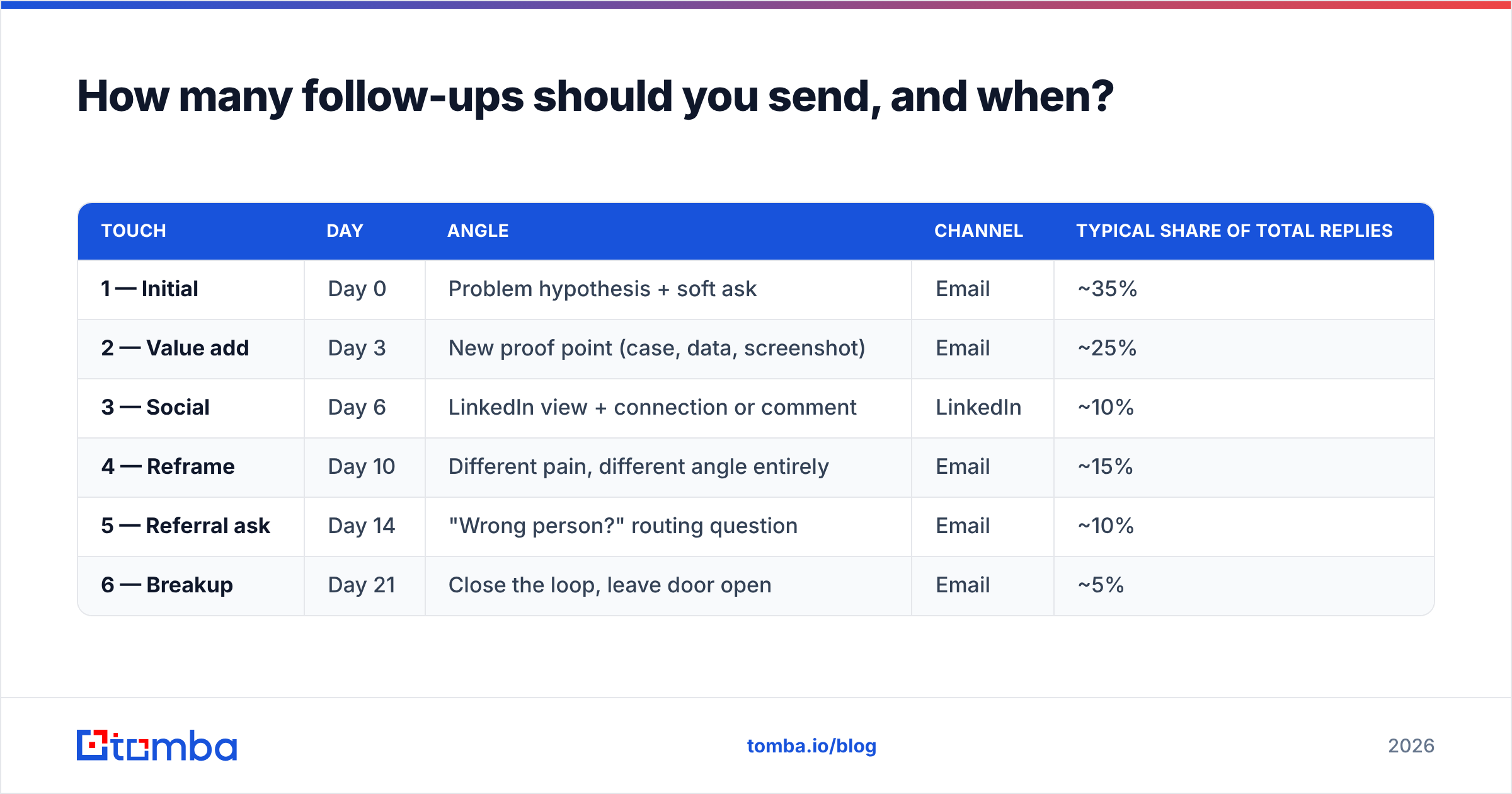
This cadence works for cold B2B outbound to a warm-ish ICP. Compress it for inbound leads, extend it for enterprise cycles.
| Touch | Day | Angle | Channel | Typical share of total replies |
|---|---|---|---|---|
| 1 — Initial | Day 0 | Problem hypothesis + soft ask | ~35% | |
| 2 — Value add | Day 3 | New proof point (case, data, screenshot) | ~25% | |
| 3 — Social | Day 6 | LinkedIn view + connection or comment | ~10% | |
| 4 — Reframe | Day 10 | Different pain, different angle entirely | ~15% | |
| 5 — Referral ask | Day 14 | "Wrong person?" routing question | ~10% | |
| 6 — Breakup | Day 21 | Close the loop, leave door open | ~5% |
Two rules govern the table. First, no two consecutive touches use the same angle — repetition trains the reader to ignore your sender name. Second, the interval widens as the sequence progresses; tightening it looks desperate and increases unsubscribes and complaints, which feed directly into your sender reputation.
What are the best follow-up email samples for each scenario?#
Each follow up email sample below is written to be edited, not copied verbatim. Swap the bracketed parts and cut anything that does not apply to your buyer.
1. After a cold email with no reply (touch 2)#
Subject: re: [their company] onboarding time
Hi [First name],
Following up on Tuesday's note about ramp time for new SDRs.
One data point that might be more useful than my pitch: [similar company] cut their ramp from 11 weeks to 6 by moving territory research off reps and into an enrichment step. Their VP wrote it up here: [link].
Worth 15 minutes to see whether the same math applies to your team?
If ramp time is not on your list this quarter, say so and I will stop here.
[Name]
2. After a demo (no next step booked)#
Subject: the two things you flagged on Thursday
Hi [First name],
Thanks for Thursday. You raised two blockers: CRM sync latency and per-seat cost at 40 users.
I checked both. Sync runs on a 5-minute interval, not hourly — screenshot attached. On pricing, the 40-seat tier lands at [figure], which is under the number you mentioned.
Does Tuesday 10:00 or Wednesday 14:00 work for a 20-minute call with [their technical stakeholder]?
[Name]
3. After sending a proposal#
Subject: proposal — anything blocking sign-off?
Hi [First name],
Checking on the proposal from the 4th, specifically whether anything in it is blocking internal sign-off.
Common ones at this stage: security review timing, the 12-month term, or someone in finance who has not seen it yet. If it is one of those, I can send the SOC 2 pack or a month-to-month variant today.
Which is it?
[Name]
4. After a networking event or conference#
Subject: the RevOps hiring problem you mentioned at [event]
Hi [First name],
We spoke at [event] near the [specific location] — you mentioned you were two RevOps hires behind plan.
I found the benchmark report I mentioned: [link]. Page 14 has the compensation bands you were asking about.
No ask attached. If it is useful and you want to talk about how teams cover the gap without hiring, I am happy to.
[Name]
5. The referral / routing follow-up (touch 5)#
Subject: wrong person?
Hi [First name],
I have sent a few notes about [topic] and have not heard back, which usually means one of two things: it is not a priority, or it is not your area.
If it is the second, who on your team owns [specific function]? One name is all I need and I will leave you alone.
[Name]
6. The breakup email (touch 6)#
Subject: closing your file
Hi [First name],
I am closing the loop on this one — you have enough in your inbox without me adding to it.
If [problem] moves up the list in Q[next quarter], reply to this email and I will pick it back up with whatever is current then.
Good luck with [specific initiative they mentioned or announced].
[Name]
7. After a job interview#
Subject: thank you — [role] interview
Hi [First name],
Thank you for the time yesterday. The part about [specific challenge discussed] stuck with me.
I went back and put together a rough 30-day plan for how I would approach it: [link or two-bullet summary]. It may be premature, but it is the fastest way to show how I think.
Happy to answer anything else the panel raised.
[Name]
Which follow-up template should you use for your situation?#
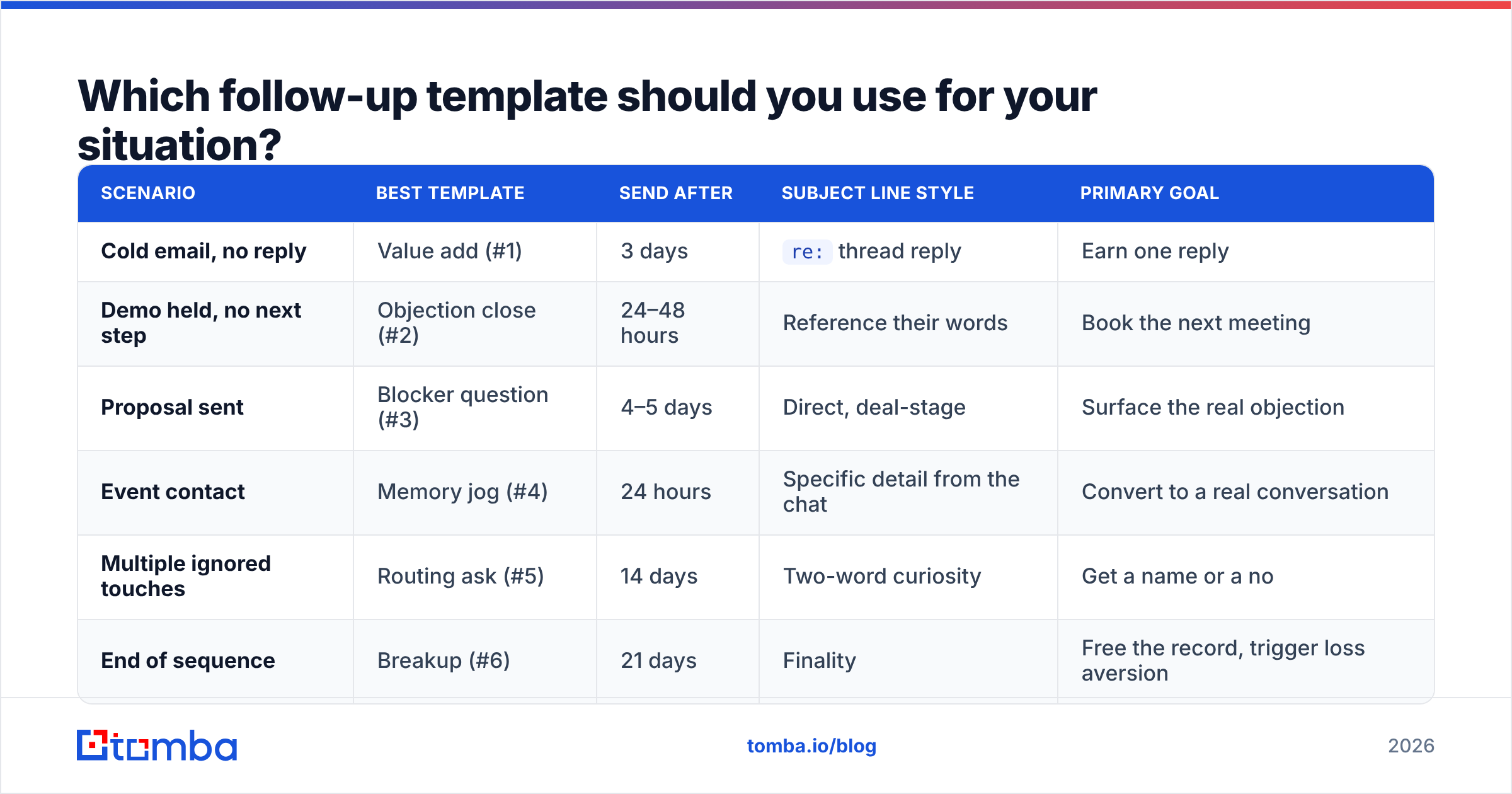
| Scenario | Best template | Send after | Subject line style | Primary goal |
|---|---|---|---|---|
| Cold email, no reply | Value add (#1) | 3 days | re: thread reply |
Earn one reply |
| Demo held, no next step | Objection close (#2) | 24–48 hours | Reference their words | Book the next meeting |
| Proposal sent | Blocker question (#3) | 4–5 days | Direct, deal-stage | Surface the real objection |
| Event contact | Memory jog (#4) | 24 hours | Specific detail from the chat | Convert to a real conversation |
| Multiple ignored touches | Routing ask (#5) | 14 days | Two-word curiosity | Get a name or a no |
| End of sequence | Breakup (#6) | 21 days | Finality | Free the record, trigger loss aversion |
If you want a wider starting library rather than these six, the cold email templates collection covers first-touch structures you can pair with the follow-ups above.
How do you write follow-up subject lines that get opened?#
Three patterns outperform everything else, and one common pattern actively hurts.
- Thread continuation (
re:on the original). Keeps the conversation in one place and inherits the original context. Best for touches 2 and 3. - Two to four words, lowercase. "wrong person?", "closing your file", "quick question on sync". Reads like internal mail, not marketing mail.
- Their words, quoted back. "the 40-seat number" or "your Q3 migration". Proves you listened.
- Avoid: "Following up" and "Checking in." These are the most-used follow-up subject lines in B2B, which means they compete with every other rep in the inbox and get pattern-matched into oblivion.
Run candidates through a subject line tester before a large send. Length, spam-trigger words, and mobile truncation all show up there faster than in an A/B test you have to wait five days to read.
What kills follow-up emails before they get read?#
Copy is downstream of delivery. Three technical failures account for most silent sequences:
- Invalid and catch-all addresses. Hard bounces above roughly 2–3% put your domain in trouble with mailbox providers, and every subsequent touch in the sequence compounds the damage. Verify before the first send, not after touch four.
- No warmup on a new domain. A fresh sending domain pushing 200 emails a day will land in spam regardless of how good your samples are.
- Sequence-wide identical footers, links, and images. Repetition across a six-touch sequence to the same recipient is a strong spam signal.
Guidance from mailbox providers and analyst coverage of outbound tooling on G2 consistently points the same direction: list hygiene moves reply rate more than copy edits, because a clean list changes whether the email arrives at all. If you want the mechanics, the email deliverability primer covers authentication and reputation in more depth.
When should you stop following up?#
Stop at six touches, or earlier if any of these fire:
- They explicitly say no or "not now" — move them to a nurture date, not another sequence.
- Two or more emails hard bounce — the contact record is stale; re-enrich it rather than resending.
- Zero opens across the full sequence — this is a delivery problem, not an interest problem. Fix the list.
- They open every email and never reply — try a different channel (phone, LinkedIn) before adding a seventh email.
Analyst frameworks on buyer engagement, including Gartner's sales research, consistently note that B2B buying groups spend the majority of their cycle away from vendors entirely. That is the honest reading of silence: usually it means "not now," not "never." The breakup email exists precisely to convert that into a datable "later."
Frequently asked questions#
How long should a follow-up email be? 50–120 words. Anything longer will be skimmed for the ask, so lead with it.
Should I follow up in the same thread or start a new one? Same thread for touches 2 and 3, a new thread with a fresh angle for touches 4 and 5. Threads accumulate the psychological weight of being ignored; a new subject resets it.
Is it acceptable to follow up on the same day? Only if the trigger is real — they opened your proposal, replied to a colleague, or a deadline moved. Otherwise wait 3 days minimum.
How many follow-ups is too many? Six emails over three weeks is the practical ceiling for cold outbound. Warm and inbound leads tolerate more because they initiated contact.
Put the sequence on a clean list#
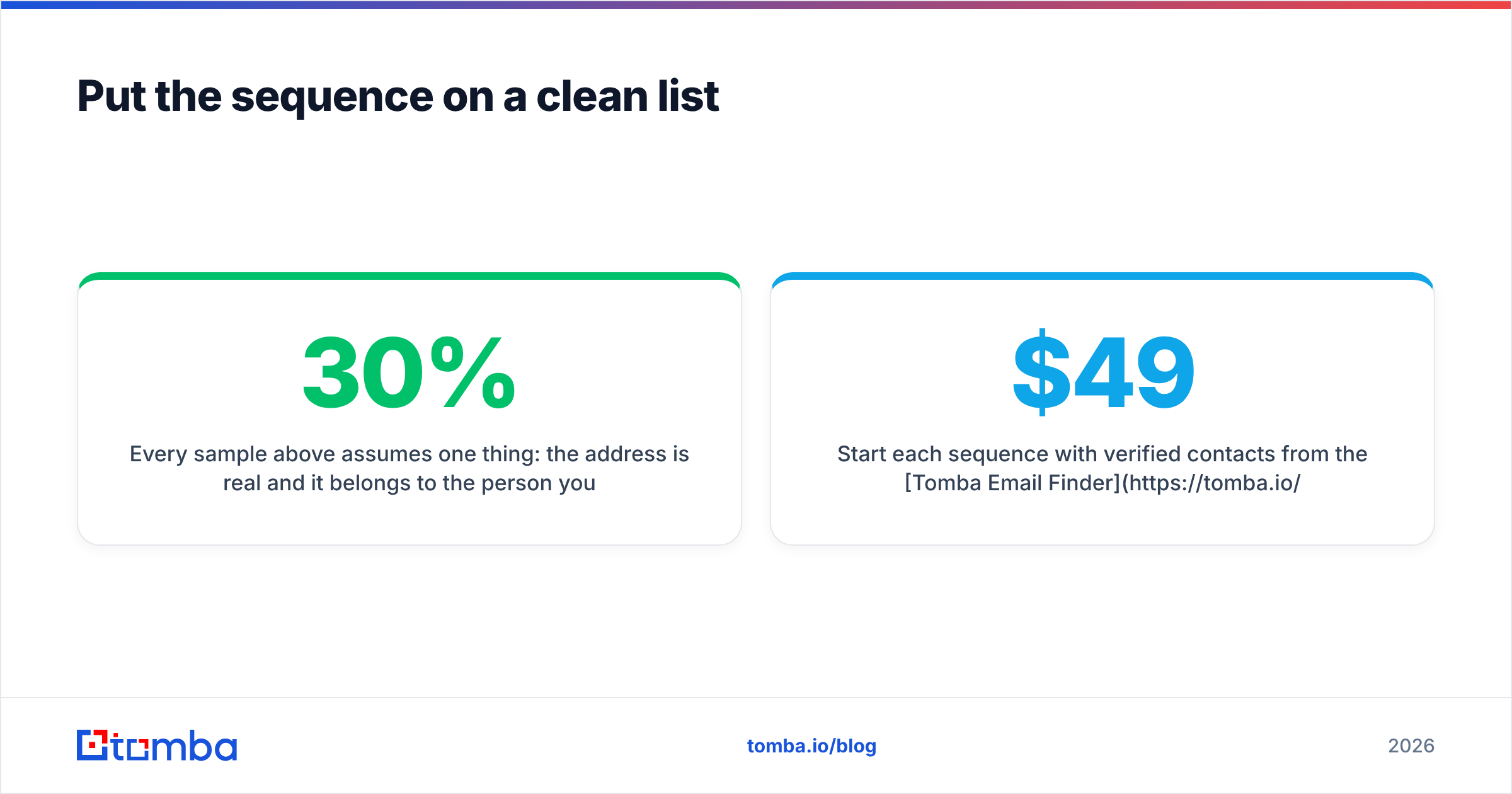
Every sample above assumes one thing: the address is real and it belongs to the person you think it belongs to. That assumption breaks constantly — B2B contact data decays roughly 25–30% per year as people change roles and companies.
Start each sequence with verified contacts from the Tomba Email Finder. You get 25 free searches per month to test your list quality before committing; paid plans begin at $49/month on Starter, with Growth at $99/month for teams running multi-thousand-contact sequences. Full breakdown on the Tomba pricing page.
Write the follow-ups. Verify the addresses. Then let the cadence do its job.
Related guides#
// get started
Find, verify and enrich your first contacts today
Start on the free plan with 25 searches a month, then scale when your team is ready.
Free plan · No credit card required · GDPR & CCPA
Get the Tomba newsletter
Product and data updates
// about the author