How to Write a Follow Up Email Subject Line That Gets Opens
Most follow-up subject lines fail because they apologize, nag, or say nothing. Here is how to write a follow up email subject line that gets opened: seven patterns that work in 2026, plus six to retire.
Most follow-ups die at the subject line. The reader sees no new value, so the message gets skipped. Here is how to write a follow up email subject line that earns the open: seven patterns that work, six to retire, and one threading rule that matters more than the words.
TL;DR
- The biggest lever is not the words. It is whether you reply in the existing thread (subject stays,
Re:prepends) or start a fresh subject. Threading wins for follow-ups 2 and 3. A fresh subject wins for the breakup and the re-engagement. - Short beats clever. Subject lines of 1–5 words beat 8+ word lines on mobile, where roughly two-thirds of B2B email is first previewed.
- Never apologize in the subject. "Sorry to bother you," "just circling back," and "checking in" signal low value before the email is opened.
- The four subject-line jobs that work: reference something specific, add new information, ask a closed question, or close the loop.
- Subject lines only matter if the address is real. A 12% bounce rate hurts inbox placement more than a bad subject line ever will. Verify before you send.
Why do most follow-up subject lines fail?#
Because they announce that the email contains nothing new.
"Just checking in," "following up," and "any update?" all say the same thing: I want something, and I brought nothing to trade for it. That is a fair reason to skip. Your prospect is not annoyed by the follow-up. They are sorting a queue, and a subject line with no new information sinks to the bottom of it.
The second failure is volume. Most reps write follow-up 2 as a shorter version of follow-up 1, then follow-up 3 as a shorter version of follow-up 2. By email four they send a two-line message with the subject "?" and call it persistence. There is no new argument, so there is no new reason to open.
The third failure is invisible: the address was wrong. No subject line can save an email that hard-bounced or landed in spam because your domain's bounce rate crossed 5%. Fix the sends before you fix the copy. Run your list through an email verifier and treat anything above a 3% bounce rate as a data problem, not a copy problem.
How to write a follow up email subject line that gets opened#
Four things decide it, roughly in order of weight:
- Sender recognition. If your first email registered at all, your name does more work than any subject line. That is why the sender field beats the subject on follow-ups 2 and 3.
- Thread position. A reply inside the original thread keeps the original subject and sits next to context the reader already saw. A new subject line arrives cold, with no history.
- Specificity. A subject that names their company, a competitor, a number, or a date they mentioned beats a generic hook. It proves the email was not blasted.
- Length on mobile. iOS Mail shows about 35–40 characters of the subject in portrait. Gmail's mobile app shows a bit more. Past that, the words are invisible at the moment of the decision.
Everything else — emoji, personalization tokens, curiosity gaps — is a rounding error next to those four.
Should you reply in the thread or write a new subject line?#
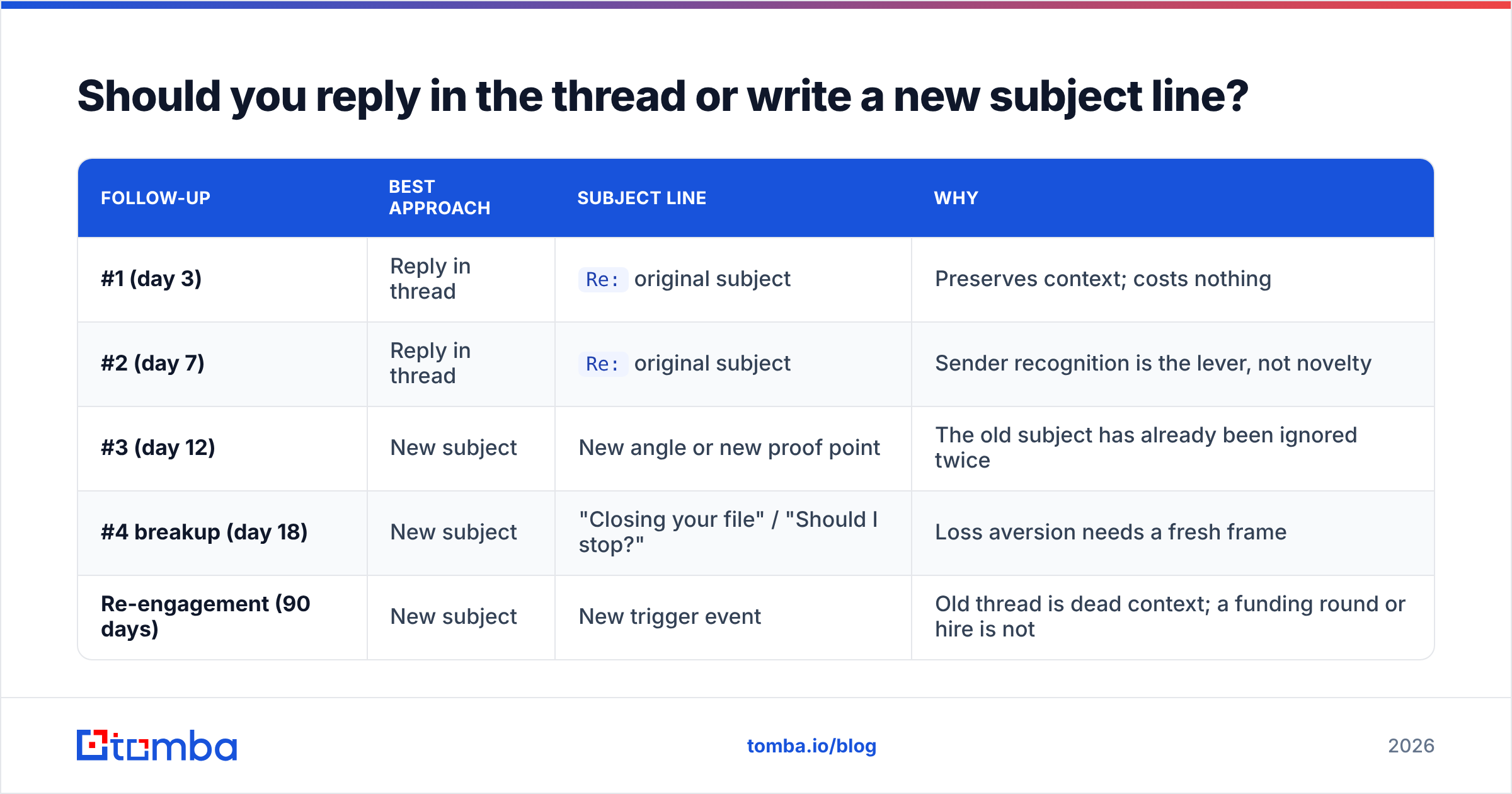
Reply in the thread by default. Break the thread deliberately.
| Follow-up | Best approach | Subject line | Why |
|---|---|---|---|
| #1 (day 3) | Reply in thread | Re: original subject |
Preserves context; costs nothing |
| #2 (day 7) | Reply in thread | Re: original subject |
Sender recognition is the lever, not novelty |
| #3 (day 12) | New subject | New angle or new proof point | The old subject has already been ignored twice |
| #4 breakup (day 18) | New subject | "Closing your file" / "Should I stop?" | Loss aversion needs a fresh frame |
| Re-engagement (90 days) | New subject | New trigger event | Old thread is dead context; a funding round or hire is not |
The thread wins early for a mechanical reason. Gmail and Outlook both collapse threads, so your follow-up sits attached to a message the reader already chose to keep. You inherit the small credibility the first email earned. A new subject on day three throws that away and asks the inbox to judge you from scratch.
Breaking the thread later is just as mechanical. After two ignores, that subject line has a record of being skipped, and the reader's eye slides past it. A new subject with a genuinely new angle resets the pattern.
What are the seven follow-up subject line patterns that work?#
Each pattern does one of the four jobs: reference, inform, ask, or close. Most of how to write a follow up email subject line is picking the right job for the touch.
1. The specific reference
Your Q3 hiring push · The Shopify migration · That 40-person SDR team
Names something only a researched sender would know. It works best on follow-up 1 or 3. The bar is simple: it must be true and checkable. If you are guessing at their tech stack, skip this one.
2. The new-information line
One more number on churn · Found the benchmark you'd want · New: 2026 pricing data
Signals that this email has something the last one did not. It is the most honest pattern, because it forces you to add value in the body. If you cannot fill it, do not send it.
3. The closed question
Wrong person? · Still a priority? · Worth 15 minutes?
Three to four words, answerable with one. Closed questions get replies because the cost of replying is a single word. "Wrong person?" does especially well. It offers a graceful exit, and that exit often turns into a referral.
4. The one-word subject
Thoughts? · Timing? · Bandwidth?
Maximum mobile visibility, zero pretense. Use it once per sequence, never twice. A second one-word subject reads as lazy rather than direct.
5. The breakup
Closing your file · Last one from me · Should I stop emailing?
Loss aversion, and it works. Breakup emails often beat every other email in the sequence on reply rate. The catch is that you have to mean it. Sending "last one from me" and then emailing again teaches the reader that nothing you write is true.
6. The trigger event
Congrats on the Series B · Saw the Austin office news · Re: your VP Sales hire
Use it only when a real event happened. It is the strongest pattern available and the hardest to scale. Save it for top-tier accounts, not a 5,000-contact blast.
7. The forward-style
Fwd: [original subject] — used honestly, meaning you are forwarding your own earlier message with a one-line note on top.
High open rate, and one-time-use per prospect. A fake Fwd: on an email that was never forwarded is deceptive. It costs more in trust than it gains in opens. Use the real version or skip it.
Want a starting bank of these to adapt? The cold email templates library covers the body copy that has to follow each subject. The subject line generator will spin variants when you are stuck on angle five.
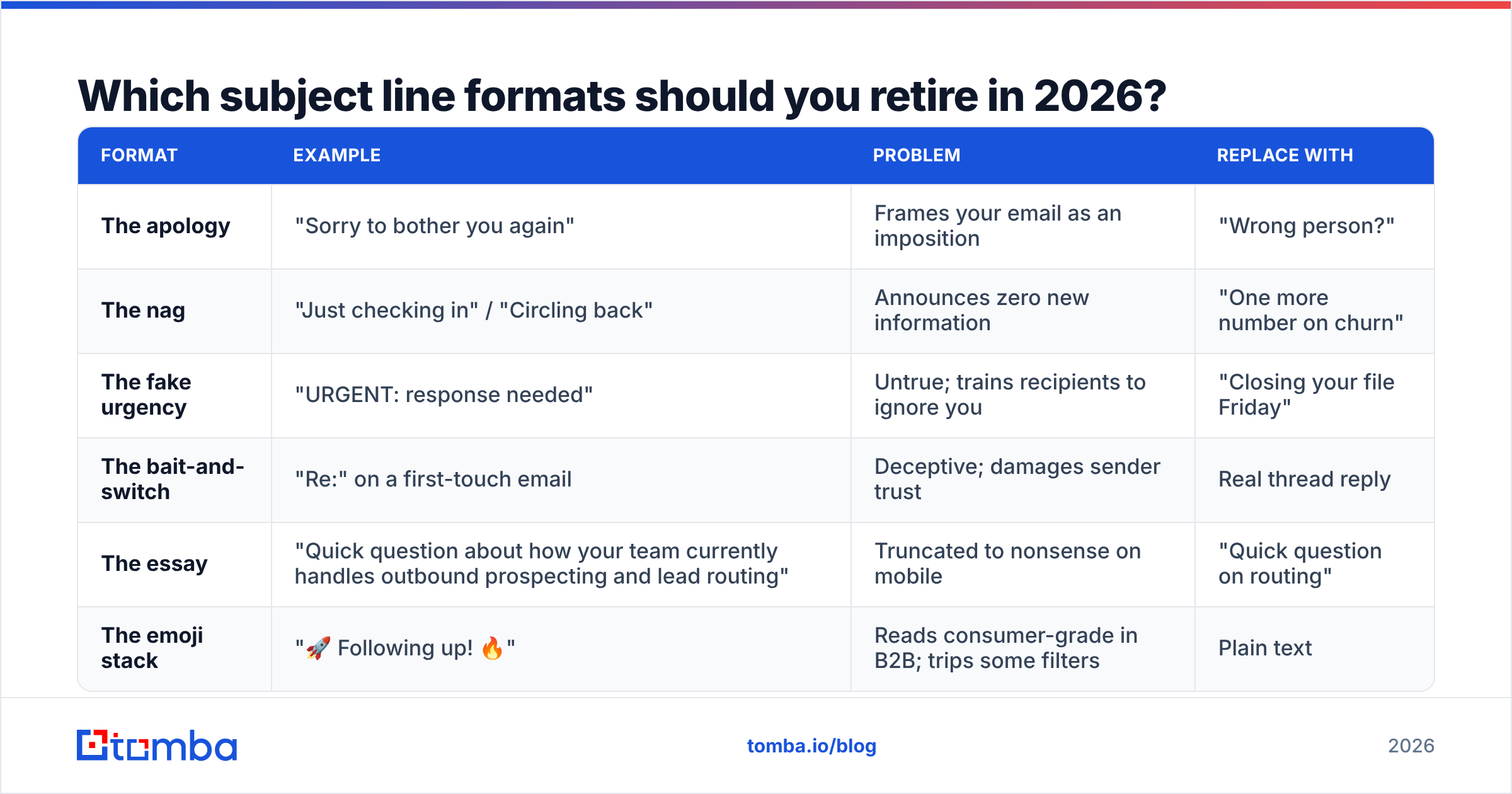
Which subject line formats should you retire in 2026?#
| Format | Example | Problem | Replace with |
|---|---|---|---|
| The apology | "Sorry to bother you again" | Frames your email as an imposition | "Wrong person?" |
| The nag | "Just checking in" / "Circling back" | Announces zero new information | "One more number on churn" |
| The fake urgency | "URGENT: response needed" | Untrue; trains recipients to ignore you | "Closing your file Friday" |
| The bait-and-switch | "Re:" on a first-touch email | Deceptive; damages sender trust | Real thread reply |
| The essay | "Quick question about how your team currently handles outbound prospecting and lead routing" | Truncated to nonsense on mobile | "Quick question on routing" |
| The emoji stack | "🚀 Following up! 🔥" | Reads consumer-grade in B2B; trips some filters | Plain text |
All six share one flaw. They optimize for the open at the expense of what happens after. A subject line that wins the open and loses the reply is a net loss, because it burns a contact you can only pitch once.
How long should a follow-up subject line be?#
Shorter than your first email's subject. Aim for 3–6 words, or 30–45 characters.
The reason is context. Your first subject line has to explain why a stranger should care. Your follow-up subject only has to reopen a message from a sender they already know. The explaining already happened. A long follow-up subject usually means the writer is re-pitching in the subject line because the body has nothing new.
Two practical constraints:
- Mobile truncation. Roughly 35–40 characters survive on an iPhone in portrait. Front-load the meaningful word.
- Preview text. Most clients show 40–90 characters of body text next to the subject. Treat that as a second subject line. A strong subject followed by "Hi {{FirstName}}, I hope this email finds you well" wastes half your space.
Test the render before you commit a sequence. Run drafts through a spam checker and a subject line tester. You do not want to find the truncation point after 800 sends.
Does personalization in the subject line still work?#
Partially. First-name tokens have decayed. Specific-fact personalization has not.
Hi Sarah, quick follow-up reads as merge-field automation because it is merge-field automation. Recipients have been trained on it since roughly 2015. Company names are slightly better, but still cheap. Anyone can scrape a company name.
What still moves numbers is personalization that implies a human spent time: a project they announced, a job they posted, a podcast they appeared on, a metric from their earnings call. According to HubSpot's research on email marketing, the real lift now sits in personalization that goes past the first name. That gap has widened as basic tokens became universal.
The scaling problem is real. Fact-level personalization takes 3–8 minutes per prospect to research by hand. The usual fix is tiering: full research on your top 50 accounts, pattern-based subject lines on the next 500, and nothing below that. If you are building the top tier, an author finder surfaces the byline behind a company blog post, which is both a research hook and a contact. Data enrichment fills in role, seniority, and company detail, so your reference lines are accurate rather than plausible.
How do you test follow-up subject lines properly?#
Most subject-line "tests" are not tests. Two variants across 60 sends tells you nothing. At that volume, the margin of error is wider than the gap you are measuring.
A workable protocol:
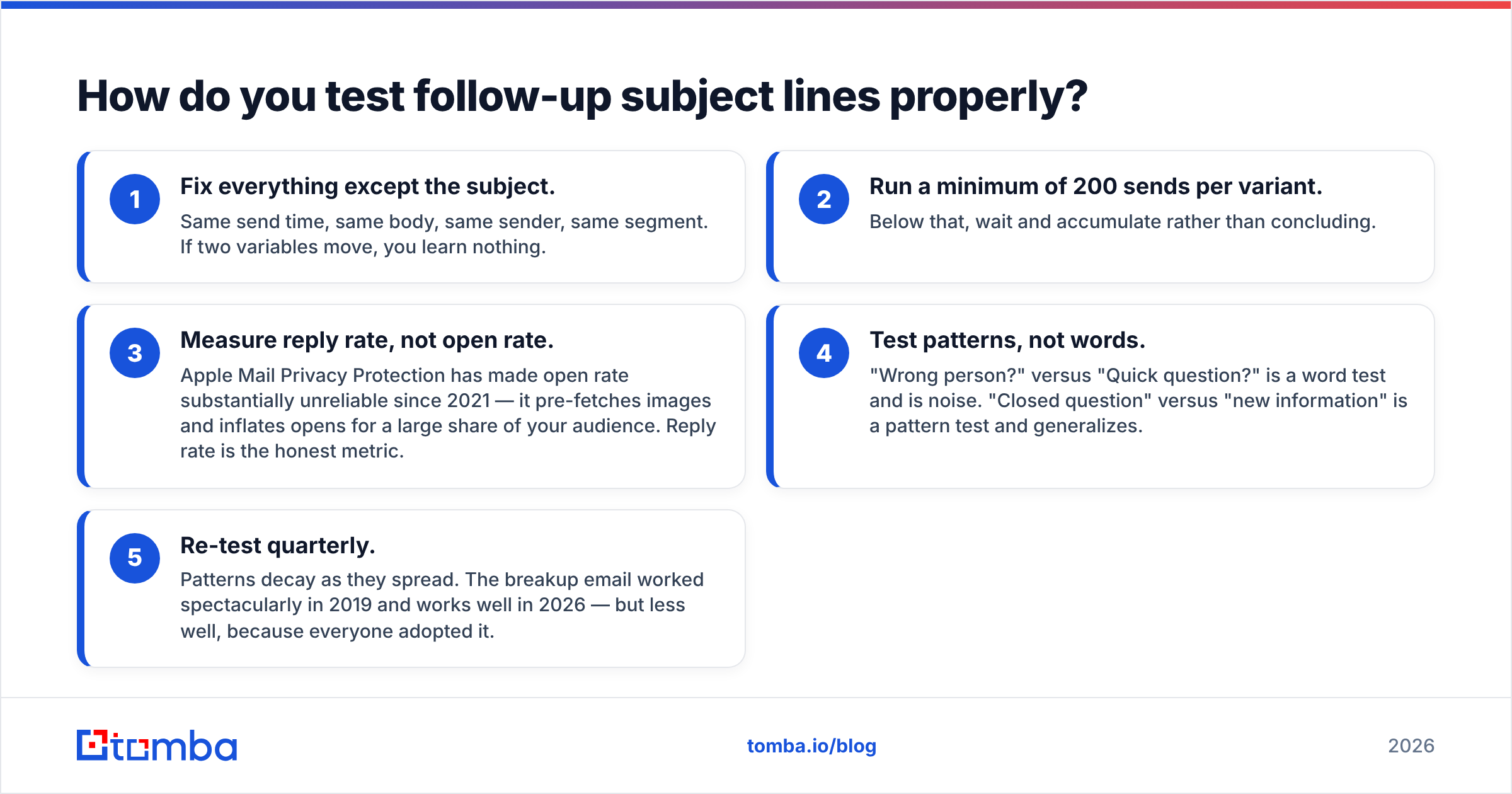
- Fix everything except the subject. Same send time, same body, same sender, same segment. If two variables move, you learn nothing.
- Run at least 200 sends per variant. Below that, wait and accumulate rather than conclude.
- Measure reply rate, not open rate. Apple Mail Privacy Protection has made open rate unreliable since 2021. It pre-fetches images and inflates opens for a large share of your list. Reply rate is the honest metric.
- Test patterns, not words. "Wrong person?" versus "Quick question?" is a word test, and it is noise. "Closed question" versus "new information" is a pattern test, and it generalizes.
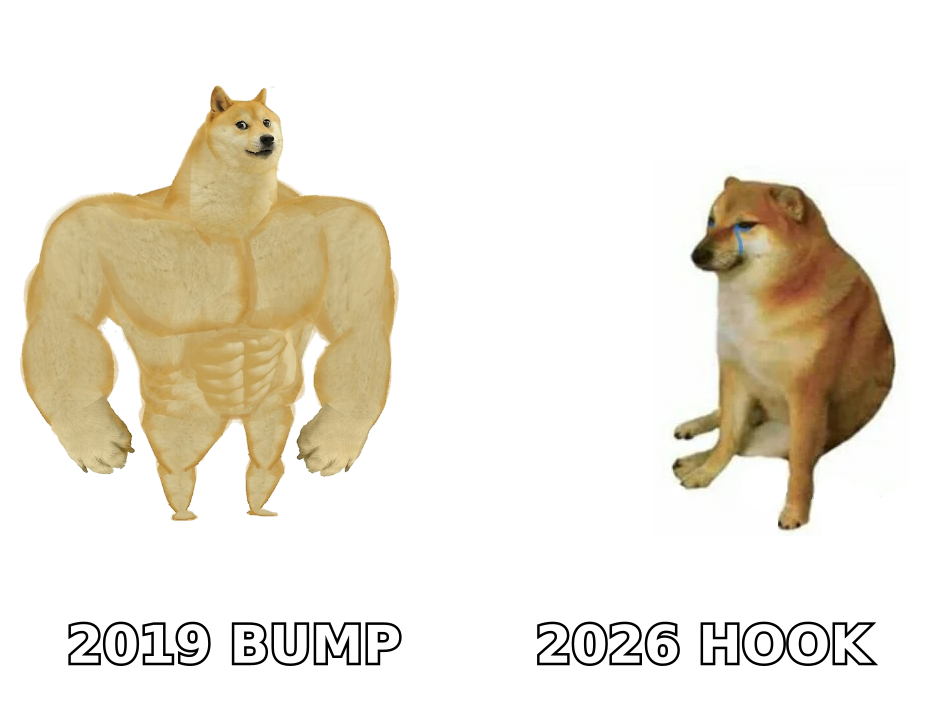
- Re-test quarterly. Patterns decay as they spread. The breakup email worked spectacularly in 2019 and still works in 2026, but less well, because everyone adopted it.
Build in one more control: strip your bounce data out before you compare. If variant A drew a segment with 9% invalid addresses, its numbers reflect list quality, not copy. Clean the lists first. A bulk email finder run plus verification gives you a comparable denominator across variants.
What does a full follow-up sequence look like?#
Here is a five-touch sequence with the subject-line logic attached:
| Day | Subject | Pattern | Body job |
|---|---|---|---|
| 0 | "Question about {{specific process}}" | Specific reference | The pitch, one ask |
| 3 | Re: (thread reply) |
Threaded | Add one new proof point |
| 7 | Re: (thread reply) |
Threaded | Different angle, shorter |
| 12 | "Wrong person?" | Closed question | Two lines, referral ask |
| 18 | "Closing your file" | Breakup | Genuine exit, easy re-open |
Two rules govern the whole thing. First, every email must carry something the last one did not: a case study, a number, a different use case, a referral request. If you cannot write the new thing, the sequence is over. Second, the subject line must be honest about what is inside. A breakup subject on an email that is not a breakup is a one-time trick with a long tail of damage.
For deeper mechanics on what happens after the open, response rate benchmarks are a useful sanity check. They tell you whether your problem is the subject, the body, or the list. If opens look fine but replies are near zero, the subject line is almost never the cause.
Where does deliverability fit into this?#
Underneath everything. A subject line is a multiplier on a number that deliverability sets.
If 20% of your sends never reach the inbox, your best subject line only reaches 80% of your intended audience. Worse, the causes compound. Bad addresses raise your bounce rate. A high bounce rate hurts your domain reputation. Poor reputation pushes more mail to spam, which drops engagement, which pushes still more mail to spam. No subject line outruns that loop.
The practical order is: verify the list, warm the domain, set SPF/DKIM/DMARC, cap daily volume per mailbox, then optimize copy. Skipping to step four is the most common reason a well-written sequence underperforms. Reviews in G2's email deliverability category make the same point from the vendor side. Most of those tools exist because list hygiene, not copy, is the real limit for most senders.
The bottom line#
Follow-up subject lines are a small lever on a large machine. That is most of how to write a follow up email subject line: thread when threading helps, break the thread when it stops helping, stay under six words, never apologize, and never fake a Re:. Get those right and you capture most of the available gain. The rest comes from the body and the list, not from cleverer words.
Start with the list. If you write sequences against addresses you scraped or guessed, you are testing copy against noise. Use the Tomba Email Finder to build a verified contact list from a domain or a name. Then run your follow-up patterns against a denominator you can trust. The free tier covers 25 searches a month, so you can check accuracy on your own accounts first. Paid plans start at $49/mo on Tomba pricing if you need volume.
Write fewer follow-ups. Make each one carry something new. The subject line is just the receipt.
Related guides#
// get started
Find, verify and enrich your first contacts today
Start on the free plan with 25 searches a month, then scale when your team is ready.
Free plan · No credit card required · GDPR & CCPA
// about the author