How to Write a Professional Email Offering Services (2026)
A service-offer email lives or dies in the first 12 words. Here is the exact structure, five copy-paste templates, and the send checklist that gets replies instead of silence.
TL;DR
- Knowing how to write a professional email offering services starts with one shift: it is not a pitch, it is a relevance proof. Lead with a specific observation about their business, not your company history.
- The winning structure is six parts: subject line, opening observation, problem framing, one-sentence offer, proof, low-friction ask. Total: 90–150 words.
- Never attach a deck or a rate card in the first email. Both crater reply rates because they signal "I want a meeting more than you want a solution."
- Verify the address before you send. About 1 in 5 B2B email addresses goes stale each year. Bounces on a cold domain hurt your sending reputation faster than bad copy does.
- Follow up 3–4 times over 12 days. Most replies to service offers land on touches 2 and 3, not touch 1.
What Is a Professional Email Offering Services?#
A service-offer email is a cold or warm outreach message where you propose paid work to someone who did not ask for it. Freelancers, agencies, consultants, and B2B vendors all send them. The category includes the introductory agency pitch, the freelancer's "I noticed you're hiring for this" note, and the consultant's targeted diagnostic offer.
What separates it from generic cold email is the burden of proof. When you ask for a demo, the reader risks 30 minutes. When you offer services, you ask them to think about spending money — often a lot of it — with someone they have never met. That raises the bar on every line.
Three things determine whether your email gets a reply:
- Deliverability — did it reach the inbox at all, or did it bounce, spam-folder, or hit a dead address?
- Relevance — does the first sentence prove you looked at their specific situation?
- Friction — is the ask small enough that saying yes costs them almost nothing?
Most people obsess over line 3 (the copy) and ignore line 1 entirely. That is backwards. A brilliantly written email to an address that no longer exists converts at exactly zero percent.
How to Write a Professional Email Offering Services in Six Parts#
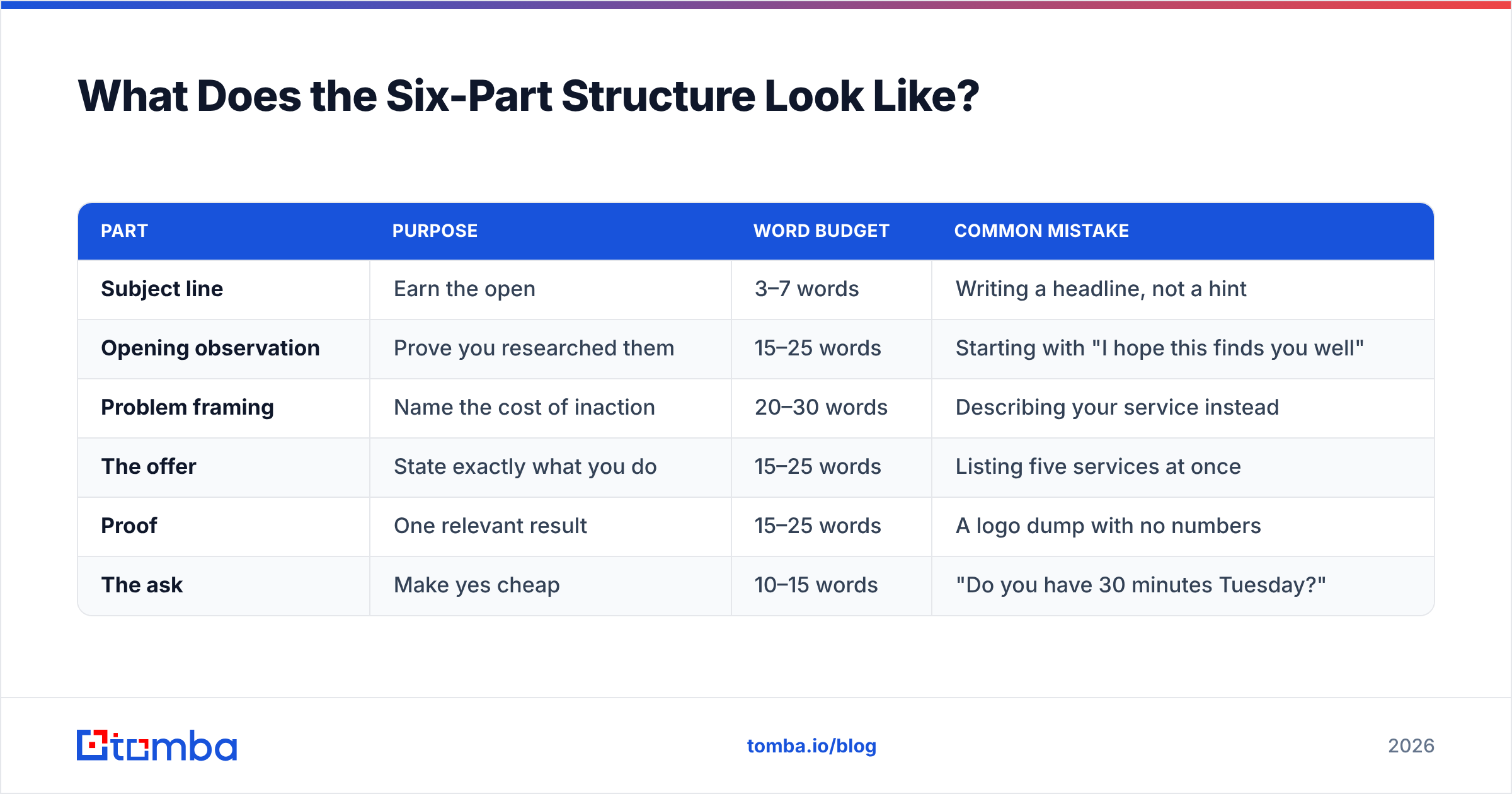
Every high-performing service offer email I have taken apart follows the same skeleton. Here it is, with the word budget for each part.
| Part | Purpose | Word budget | Common mistake |
|---|---|---|---|
| Subject line | Earn the open | 3–7 words | Writing a headline, not a hint |
| Opening observation | Prove you researched them | 15–25 words | Starting with "I hope this finds you well" |
| Problem framing | Name the cost of inaction | 20–30 words | Describing your service instead |
| The offer | State exactly what you do | 15–25 words | Listing five services at once |
| Proof | One relevant result | 15–25 words | A logo dump with no numbers |
| The ask | Make yes cheap | 10–15 words | "Do you have 30 minutes Tuesday?" |
Total: 90–150 words. If your draft is over 200, you have written a brochure.
Part 1 — The subject line#
Subject lines for service offers should read like an internal note from a colleague, not a marketing headline. Lowercase often beats title case. Length matters: 3–7 words fits fully in the mobile preview.
Patterns that work:
quick question about {specific page/product}{their company} + {specific outcome}noticed your {observable thing}re: {topic they published about}— only if it's honest and they published something
Patterns that die: "Partnership Opportunity," "Boost Your Revenue by 300%," anything with an exclamation mark, anything with "FREE."
Part 2 — The opening observation#
This is the single highest-leverage sentence in the email. It must be something you could only write about them.
Weak: "I came across your website and was impressed by what you're building." Strong: "Your pricing page lists three tiers but the checkout only offers annual billing — is that intentional?"
The strong version proves you spent 90 seconds on their site. That earns the next four sentences.
Part 3 — Problem framing#
Connect the observation to a cost. Not a hypothetical cost — a plausible, specific one. "Teams your size usually leak 20–30% of trial signups at that step" is credible. "You're losing millions" is not.
Part 4 — The offer#
One sentence. One service. If you are a full-service agency, pick the wedge service that matches the observation and lead with it. The rest of your capabilities can come up on the call.
Part 5 — Proof#
One result, ideally with a number and a comparable company profile. "We rebuilt checkout for a 40-person SaaS in the same space and annual conversion went from 11% to 17%" beats a wall of client logos.
Part 6 — The ask#
The ask should cost the reader less than the value of reading your email. Three ascending levels of friction:
- Lowest: a yes/no question. "Worth a look?"
- Medium: a specific micro-commitment. "Want me to send the two-line teardown?"
- Highest: a calendar request. Save this for reply 2, not touch 1.
Which Templates Actually Work in 2026?#
Here are five you can adapt. Replace every bracket — templates sent unmodified are obvious and get flagged.
Template 1 — The observation-first pitch (freelancer/consultant)#
Subject: noticed your careers page
Hi {First name},
You've had a Senior Content Marketer role open since {month} — third time I've seen it reposted.
Usually that means the work is piling up while the search runs. That's the gap I fill: I ship the content calendar and the first six pieces so the new hire inherits a running program instead of a backlog.
Did this for {Company} during a five-month search — organic signups held flat instead of dropping.
Want me to send a two-week plan for your current calendar?
{Your name}
Template 2 — The teardown offer (agency)#
Subject: {Company} checkout — 3 things
Hi {First name},
Walked through your signup flow this morning. Three friction points, one of which is probably costing you double-digit trial conversion.
I recorded a four-minute Loom walking through each. No pitch in it — it's the same audit we do at the start of every engagement.
Want the link?
{Your name}
Template 3 — The trigger-event pitch#
Subject: congrats on the Series A
Hi {First name},
Saw the {amount} round last week. Congratulations.
The usual next six months: headcount doubles, and RevOps becomes the bottleneck because nobody owned it when there were eight people.
We build the CRM + routing + reporting layer for post-Series-A teams — {Company A} and {Company B} both in the last year, both live in under five weeks.
Is that on your roadmap for Q4, or already handled?
{Your name}
Template 4 — The referral-adjacent warm open#
Subject: {Mutual contact} suggested I reach out
Hi {First name},
{Mutual contact} mentioned you're rebuilding the onboarding sequence at {Company}.
That's most of what I do — lifecycle email for B2B SaaS, usually 4–6 week projects. Last one lifted activation 22% for a team with a similar ICP.
Happy to send the sequence map I used there so you can steal from it either way.
Useful?
{Your name}
Template 5 — The re-engagement offer#
Subject: picking this back up?
Hi {First name},
We spoke in {month} about {specific project}. You said the budget was locked until the new fiscal year — that started last month, so figured I'd check.
Same offer, same scope. I've since added {new capability}, which would cut the timeline by about two weeks.
Still relevant, or has the priority shifted?
{Your name}
Use a subject line tester before you commit to any of these at scale. Small wording changes move open rates more than most people expect.
How Do You Make Sure the Email Actually Arrives?#
This is where most service-offer campaigns quietly fail. You can write the best pitch of your career and still see a 0.4% reply rate. Half your list bounced, and your domain reputation tanked on day two.
Three checks before any send:
- Verify every address. Run the list through an email verifier and drop anything marked invalid or risky. A bounce rate above 3% is where mailbox providers start throttling you. Above 5% and you are in real trouble.
- Check your authentication. SPF, DKIM, and DMARC all need to pass. Google and Yahoo made bulk-sender authentication mandatory in 2024, and enforcement has only tightened since. Their sender guidelines are the source of truth here.
- Warm the domain. A brand-new sending domain that fires 500 cold emails on day one will land in spam, whatever the copy looks like. Ramp over 3–4 weeks.
Handle catch-all domains separately. Catch-all servers accept every address at the domain, so a standard verifier cannot confirm whether the mailbox exists. A dedicated catch-all verifier uses pattern confidence and secondary signals to flag which catch-all addresses are safe to send to. That is worth doing: catch-all domains are common at mid-market and enterprise companies, which is exactly where service offers are worth the most.
For sourcing the addresses in the first place, a domain search pulls the known contacts and email pattern at a target company. That is usually faster than guessing formats one at a time.

What Should You Never Put in a Service Offer Email?#
Most advice on how to write a professional email offering services tells you what to put in. This is the subtraction list — the things that reliably kill reply rates:
- Attachments in touch 1. PDFs and decks trigger spam filters and signal effort you're asking the reader to reciprocate.
- Your company's founding story. Nobody has ever hired a vendor because the vendor was founded in 2019 by two friends who met at university.
- More than one call to action. "Reply, or book a call, or check out our case studies" splits attention and gets you none of the three.
- Fake personalization. Merge-tag artifacts like "Hi {First_Name}," or "I loved your post about [TOPIC]" are worse than no personalization at all.
- Pricing. Unless you're productized and price is your differentiator, a number in email one anchors the conversation before you've established value.
- "Just following up." It adds nothing. Every follow-up should carry a new piece of information.
How Many Follow-Ups Should You Send?#
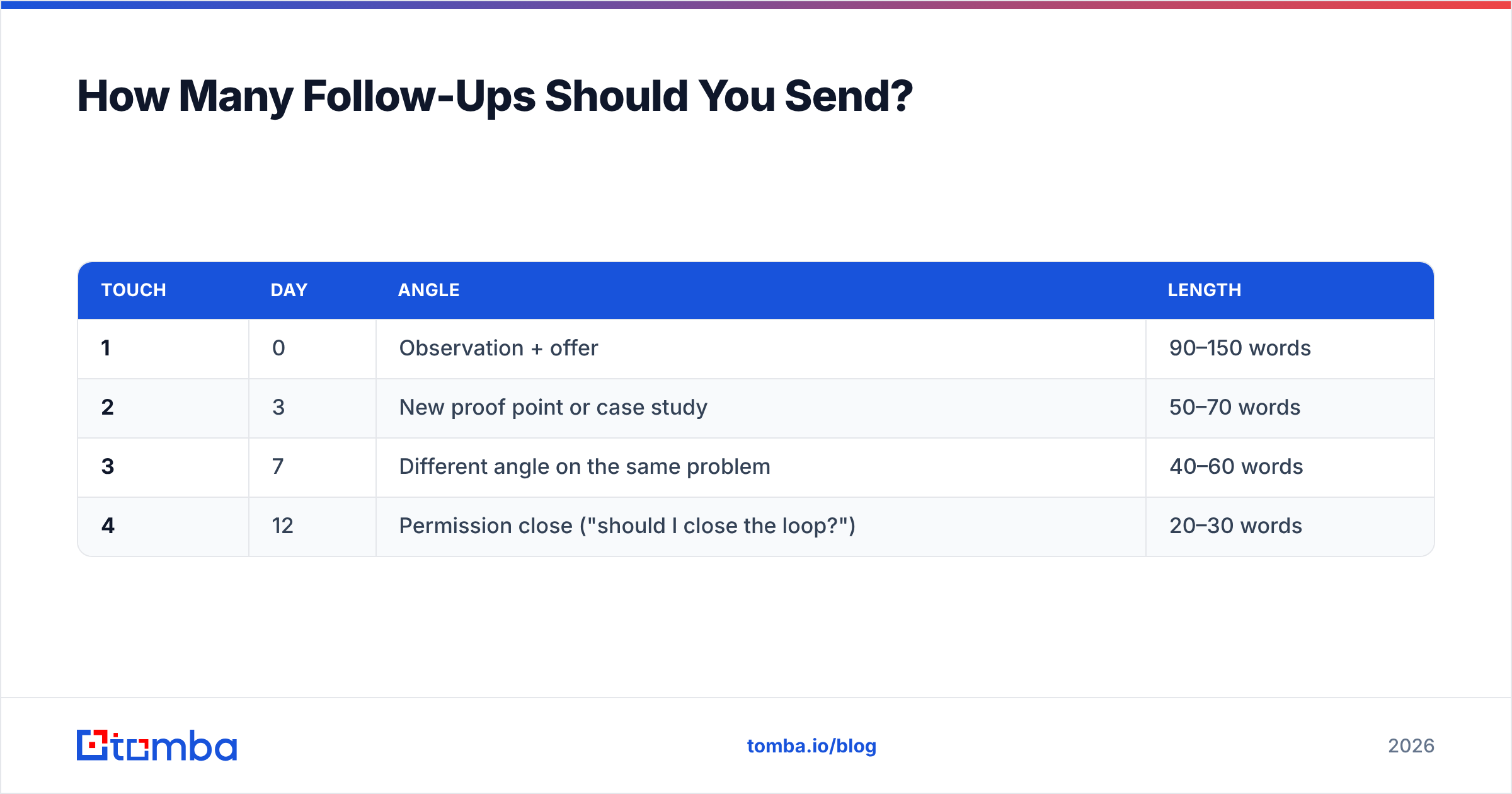
Three to four, spread over about 12 days, then stop. The pattern that works:
| Touch | Day | Angle | Length |
|---|---|---|---|
| 1 | 0 | Observation + offer | 90–150 words |
| 2 | 3 | New proof point or case study | 50–70 words |
| 3 | 7 | Different angle on the same problem | 40–60 words |
| 4 | 12 | Permission close ("should I close the loop?") | 20–30 words |
Each follow-up should be shorter than the last and carry something new — a relevant result, a resource, a different framing. Do not reply to your own thread with "bumping this to the top of your inbox."
The permission close on touch 4 works better than most people expect. Try this: "Sounds like this isn't a priority right now — want me to close the file, or check back next quarter?" It gives the reader an easy out. A surprising share of them answer "check back" instead of taking it.
What Tools Do You Need for This?#
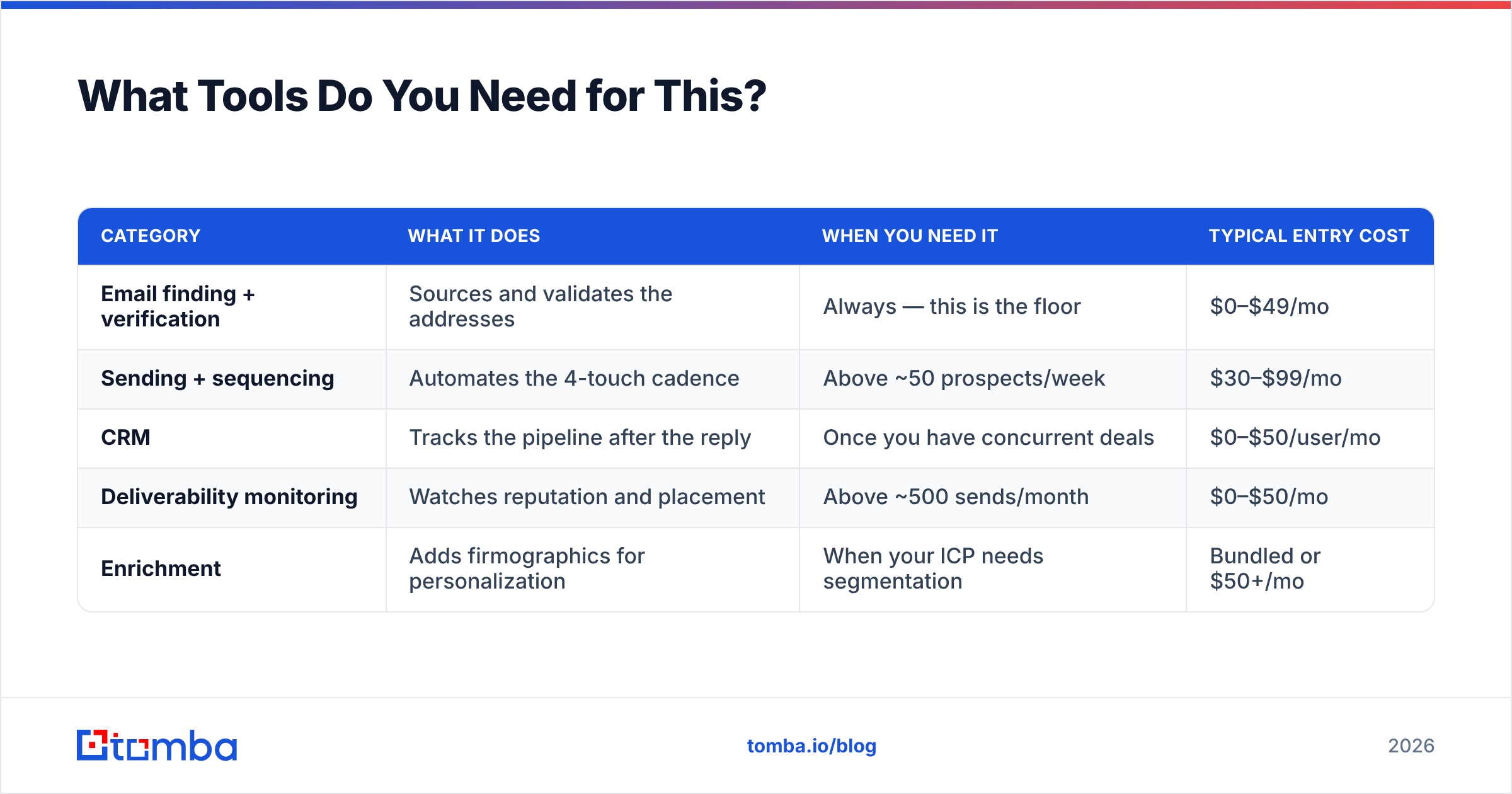
You need less than the market wants to sell you. Here is the honest breakdown of the three categories, and what you can skip.
| Category | What it does | When you need it | Typical entry cost |
|---|---|---|---|
| Email finding + verification | Sources and validates the addresses | Always — this is the floor | $0–$49/mo |
| Sending + sequencing | Automates the 4-touch cadence | Above ~50 prospects/week | $30–$99/mo |
| CRM | Tracks the pipeline after the reply | Once you have concurrent deals | $0–$50/user/mo |
| Deliverability monitoring | Watches reputation and placement | Above ~500 sends/month | $0–$50/mo |
| Enrichment | Adds firmographics for personalization | When your ICP needs segmentation | Bundled or $50+/mo |
If you are a solo consultant sending 30 emails a week, you need category one and a spreadsheet. Everything else is premature.
On category one specifically, the market splits into three groups. Pure verifiers (ZeroBounce, NeverBounce, Bouncer) clean lists but do not find addresses. Pure finders locate addresses but push verification onto you. Combined platforms do both. Tomba, BookYourData, Hunter, and Findymail all sit here, with different tradeoffs on database coverage versus real-time lookup. BookYourData leans toward pre-built, pay-per-record lists, which suits buyers who want a bulk file without a subscription. Tomba leans toward real-time lookup plus verification. Its free tier covers 25 searches a month, and pricing starts at $49/mo on Starter, $99/mo on Growth, and $249/mo on Pro.
Whichever you pick, judge it on bounce rate in your own segment, not on a vendor-published accuracy figure. Run 100 addresses in your actual ICP through two tools and compare what your ESP reports back. That test takes an afternoon and tells you more than any comparison article — including this one. G2's lead intelligence category is a reasonable starting shortlist if you want peer reviews before you test.
How Do You Scale This Without It Becoming Spam?#
The tension in service-offer email is simple. The thing that makes it work — genuine research — is the thing that does not scale. Three ways to resolve it:
- Narrow the ICP until research is fast. Say every prospect is a Shopify store doing $2–10M with a specific app installed. Your "observation" sentence then writes itself from two data points instead of ten minutes of browsing.
- Batch the research, not the writing. Spend an hour collecting one specific observation per prospect into a spreadsheet column. Then merge that column, not a generic variable.
- Cap the volume honestly. Fifty deeply researched emails a week will beat 500 templated ones on revenue, not just on reply rate. It will also keep your domain alive.
Use bulk lead generation to handle the mechanical part. It finds and verifies the addresses across your whole target list at once, so your human hours go into the observation column instead of into looking up email formats.
Frequently Asked Questions#
How long should a service offer email be? 90–150 words for the first touch. Follow-ups get progressively shorter, ending at 20–30 words.
Should I send from a personal or company domain?
A subdomain of your company domain (e.g. mail.yourcompany.com) protects your primary domain's reputation while still looking legitimate. Never send cold volume from your main transactional domain.
What's a good reply rate for service offers? For a well-targeted list with real personalization, 8–15% is realistic. Under 3% means the targeting or the deliverability is broken, not the copy.
Is it legal to send cold service offers? In the US, CAN-SPAM permits it with a valid physical address and a working opt-out. In the EU and UK, GDPR and PECR require a legitimate-interest basis and B2B-only targeting. Check the rules for the jurisdiction you're sending into.
Start With the List, Not the Copy#
The best-written service offer email in the world converts at zero if it lands on a dead address or in a spam folder. That is the part most guides on how to write a professional email offering services skip. Fix the foundation first: source accurate contacts, verify them, authenticate your domain. Then spend your effort on the observation sentence that earns the reply.
Tomba Email Finder handles the first two steps. Find the decision-maker's address by domain, name, or company, with verification built into the same lookup, so you are not stitching two tools together. The free tier gives you 25 searches a month to test it against your own ICP before you commit to a plan. Build the list right, and the copy advice in this post has something to work with.
Related guides#
// get started
Find, verify and enrich your first contacts today
Start on the free plan with 25 searches a month, then scale when your team is ready.
Free plan · No credit card required · GDPR & CCPA
// about the author