How to Write a Sales Proposal That Actually Closes Deals
Most sales proposals lose the deal before anyone reads page three. Here is the 9-section structure, the pricing layout, and the follow-up sequence that turn a proposal into a signature.
TL;DR
- A sales proposal is not a brochure. It is a decision document written for the person who has to defend the purchase internally.
- Nine sections do the work: cover, executive summary, problem statement, proposed solution, scope, timeline, pricing, proof, and terms with a signature block.
- Put the executive summary and the price on the first two pages. Buyers skip to price anyway — make them read your framing first.
- Present three pricing options, not one. Anchored choice beats a single take-it-or-leave-it number in almost every B2B deal.
- Proposals go stale in days, not weeks. Send within 24 hours of the discovery call, set an explicit validity date, and follow up on a fixed cadence.
What is a sales proposal, and what is it actually for?#
A sales proposal is the document that converts a conversation into a commitment. Think of it like a mortgage application packet: nobody enjoys reading it, but every page exists because someone downstream needs it to say yes.
That downstream reader is the point. The rep you talked to on the call is rarely the person who signs. Your proposal gets forwarded to a VP, a finance lead, or a procurement analyst who never heard your pitch, has no context, and will spend about four minutes on it. Everything in the document has to survive being read cold by a stranger.
That reframing changes what you write. You stop writing "why we're great" and start writing "here is the problem, here is what it costs you, here is what we do about it, here is what it costs to fix, here is proof it works." A proposal is an argument with a price attached.
Three formats show up in B2B:
- Formally solicited — a response to an RFP with a mandated structure. Follow their outline exactly; deviating is the fastest way to get disqualified.
- Informally solicited — the buyer asked you to "send something over" after a call. This is most B2B SaaS and services work, and it's where structure gives you the biggest edge.
- Unsolicited — sent cold. Rarely closes on its own; treat it as a conversation starter with a scope attached, not a contract.
The rest of this guide is aimed at the informally solicited proposal, because that is where most deals are actually won or lost.
What are the 9 sections every sales proposal needs?#
Here is the structure. Order matters more than length.
- Cover page — client name and logo, your company, proposal title, date, and validity period. Nothing else. If the buyer's name is misspelled here, nothing after it matters.
- Executive summary — 150 to 250 words restating their problem in their own words, then your outcome in one sentence. Written last, read first.
- Problem statement — the pain quantified. Not "your outreach is inefficient" but "your two SDRs spend roughly nine hours a week manually sourcing contacts, at a fully-loaded cost of about $2,300/month."
- Proposed solution — what you will actually do, mapped one-to-one against the problems above. Every capability you list should trace back to a stated pain.
- Scope of work — deliverables, explicitly bounded. Include an "out of scope" subsection. It prevents the two most expensive words in services: "I assumed."
- Timeline and milestones — phases with dates or week numbers, plus what you need from them and when. Buyers underestimate their own bottlenecks.
- Pricing — three tiers, total cost of ownership, payment terms. Details below.
- Proof — one relevant case study with a number, two or three logos from their industry, and a short "why us" that names a real differentiator, not "our people."
- Terms and signature block — validity date, payment schedule, cancellation terms, and a signature field on the page the buyer is already on. Never make them hunt for where to sign.
Length target: 6 to 12 pages for a typical mid-market deal. Enterprise RFPs run longer because they must. If your proposal for a $15,000 engagement is 40 pages, you are hiding weak positioning behind volume, and the buyer knows it.
How should you structure the pricing section?#
Give three options. This is the single highest-leverage change most sellers can make.
A single price forces a binary yes/no judgment. Three options quietly change the buyer's internal question from "should we do this?" to "which of these should we do?" — which is a much better question to be arguing about.
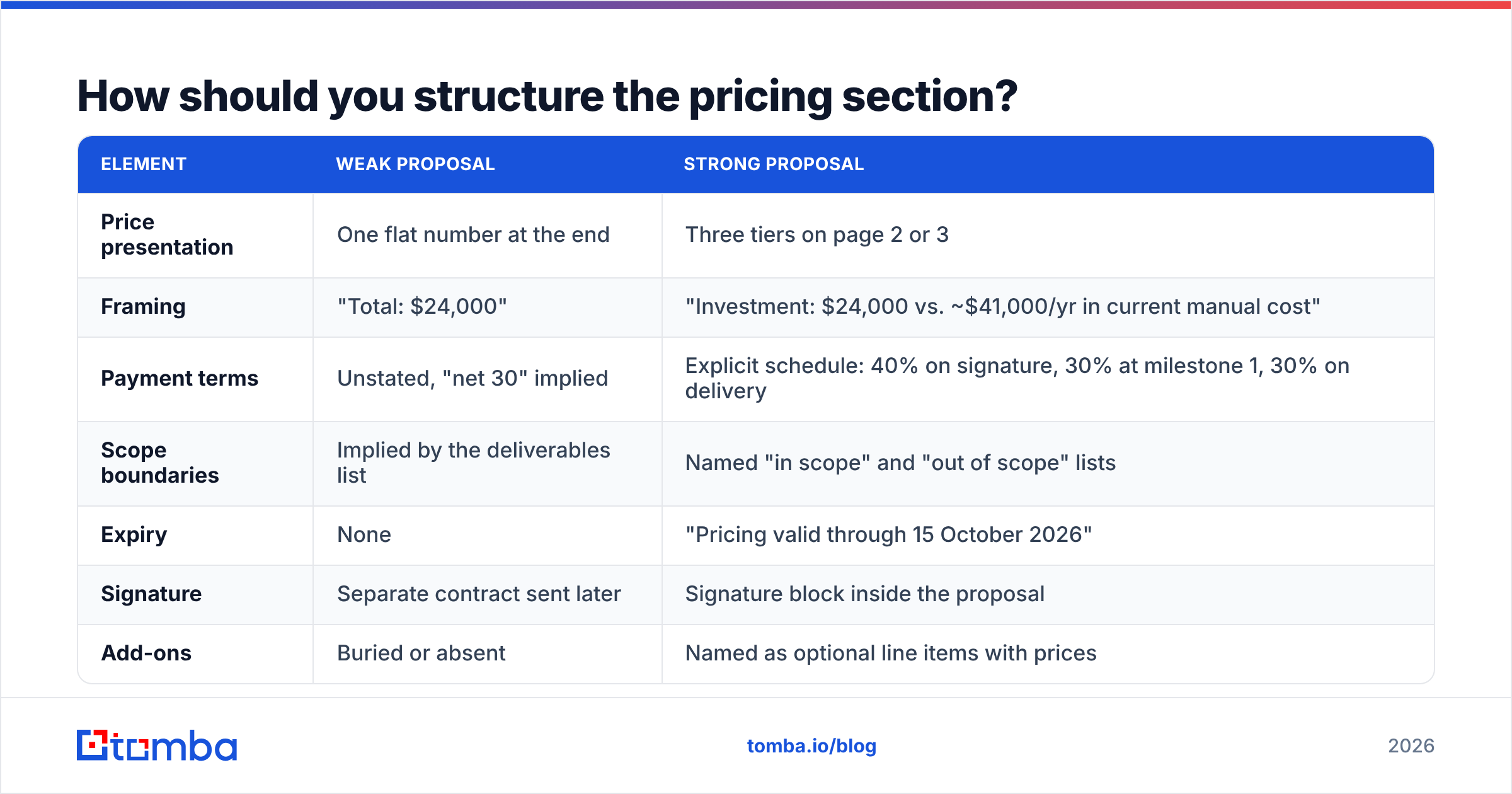
| Element | Weak proposal | Strong proposal |
|---|---|---|
| Price presentation | One flat number at the end | Three tiers on page 2 or 3 |
| Framing | "Total: $24,000" | "Investment: $24,000 vs. ~$41,000/yr in current manual cost" |
| Payment terms | Unstated, "net 30" implied | Explicit schedule: 40% on signature, 30% at milestone 1, 30% on delivery |
| Scope boundaries | Implied by the deliverables list | Named "in scope" and "out of scope" lists |
| Expiry | None | "Pricing valid through 15 October 2026" |
| Signature | Separate contract sent later | Signature block inside the proposal |
| Add-ons | Buried or absent | Named as optional line items with prices |
Structure the tiers so the middle one is what you actually want to sell. The low tier should be genuinely usable but visibly limited — it exists to make the middle tier look complete. The high tier exists to make the middle tier look reasonable and to catch the occasional buyer with budget you didn't know about.
Anchor against the cost of doing nothing. If the buyer currently loses roughly $41,000 a year to a manual process, a $24,000 engagement reads as a return, not an expense. If you can't quantify the status quo, your discovery call wasn't deep enough — go back and ask before you write.
One more thing on price placement: put it early. Every seller's instinct is to bury the number after the value narrative. Buyers defeat this instinctly by scrolling straight to it. When they find price on page 9 after skimming, they read it stripped of all your framing. Put it on page 2 or 3, immediately after the executive summary, with the value anchor sitting right next to it.
How do you write the executive summary?#
Write it last, and write it about them.
The test: if you swapped in a competitor's logo, would the summary still make sense? If yes, you wrote a company description, not an executive summary. Rewrite it.
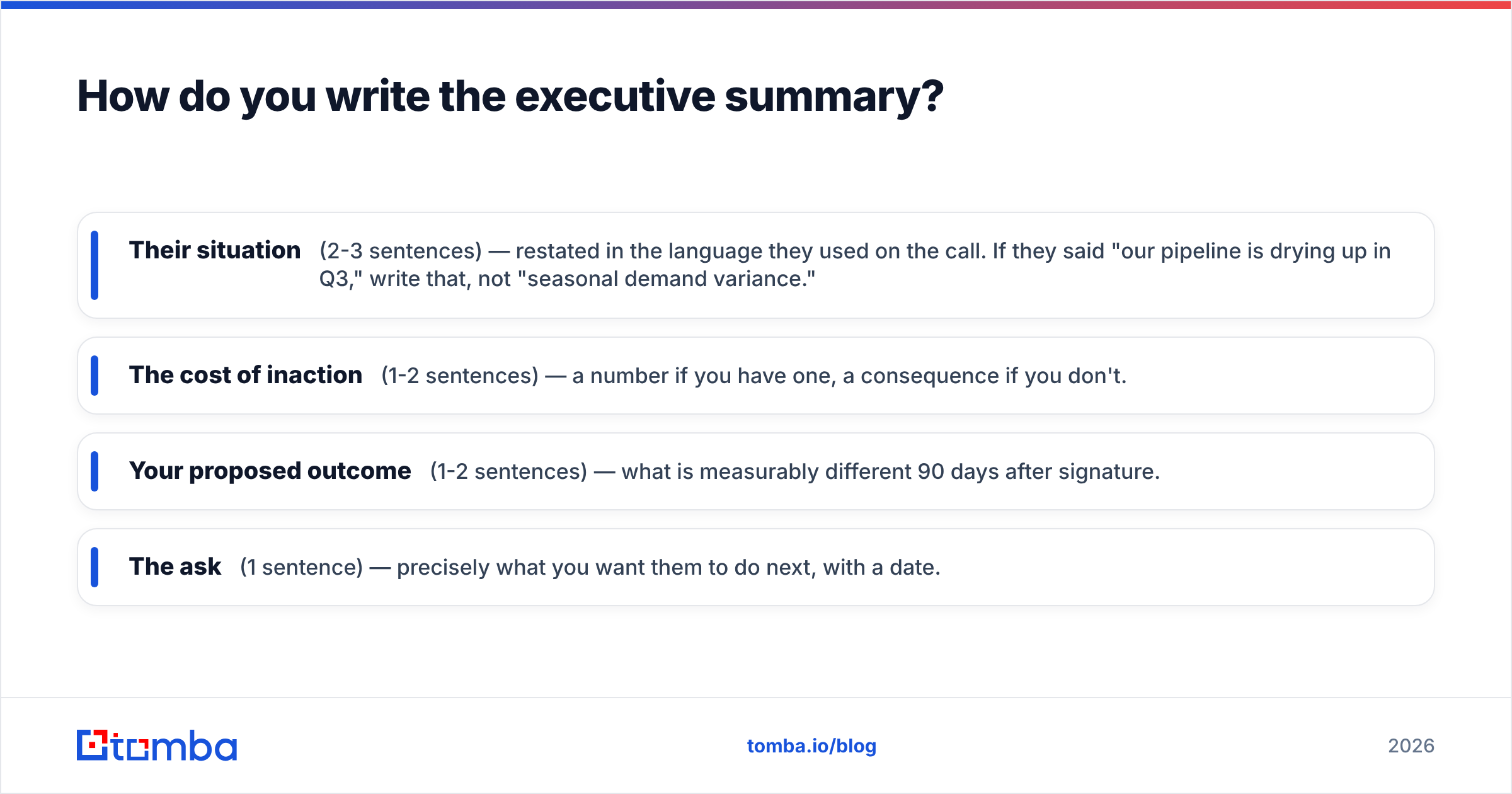
A working four-part shape:
- Their situation (2-3 sentences) — restated in the language they used on the call. If they said "our pipeline is drying up in Q3," write that, not "seasonal demand variance."
- The cost of inaction (1-2 sentences) — a number if you have one, a consequence if you don't.
- Your proposed outcome (1-2 sentences) — what is measurably different 90 days after signature.
- The ask (1 sentence) — precisely what you want them to do next, with a date.
Keep it under 250 words. This section gets forwarded on its own more than any other part of the document. Write it so it survives being detached from everything around it.
Language rules that matter more than they should: use their terminology, not yours. If they call their buyers "members," don't write "customers." If their internal term for the problem is "the handoff mess," use it. Mirroring vocabulary signals you were listening, and it makes the document feel like it was written for one company instead of assembled from a template.
What separates a proposal that closes from one that stalls?#
Speed, specificity, and a named next step.
Speed. Send within 24 hours of the call while your conversation is still the most recent thing in the buyer's memory. A proposal that arrives on day six competes against five days of other priorities. If you can't produce a full document that fast, send a one-page scope summary the same day and the full proposal within 48 hours.
Specificity. Numbers beat adjectives everywhere. "Reduce time-to-first-contact" is a claim. "Reduce time-to-first-contact from 6 days to under 24 hours, measured from lead creation" is a commitment you can be held to — and buyers sign commitments, not claims.
A named next step. End with one action, one owner, one date: "Sign by 15 October and we start onboarding the week of 20 October." Not "let us know your thoughts." Ambiguity at the end of a proposal is where deals go to sit.
Two things reliably kill otherwise-good proposals:
- Sending to the wrong person. If your champion isn't the economic buyer, your document has to travel, and travelling documents lose context. Ask directly: "Who else needs to see this, and what do they care about?" Then write a version of the executive summary aimed at that person.
- No follow-up cadence. According to HubSpot's sales research, the majority of deals require multiple follow-up touches after the initial proposal, yet most reps stop after one or two. Silence after sending is not respect for the buyer's time; it is abdication.
How do you follow up on a sales proposal without being annoying?#
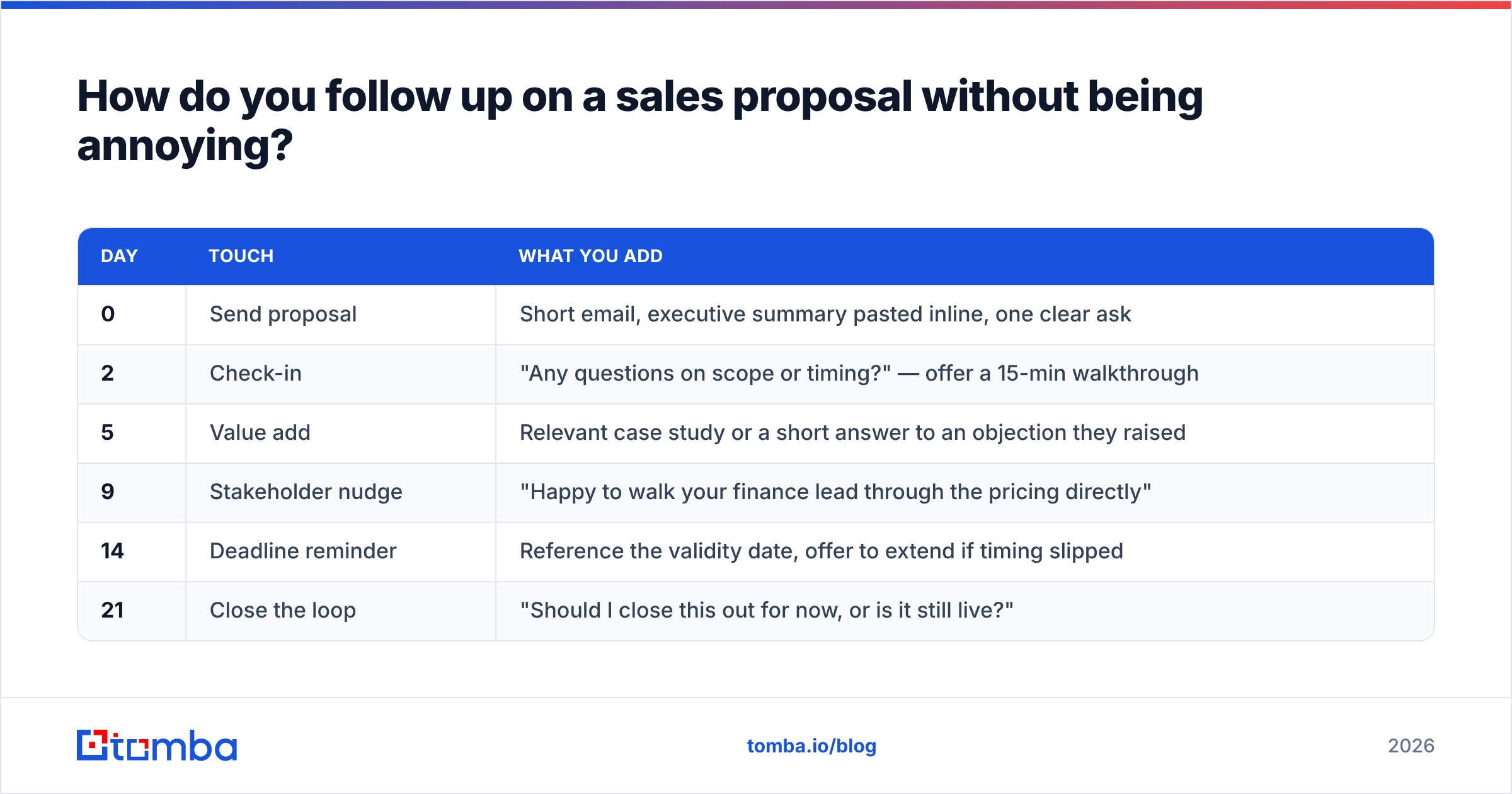
Run a fixed cadence and make every touch add something.
| Day | Touch | What you add |
|---|---|---|
| 0 | Send proposal | Short email, executive summary pasted inline, one clear ask |
| 2 | Check-in | "Any questions on scope or timing?" — offer a 15-min walkthrough |
| 5 | Value add | Relevant case study or a short answer to an objection they raised |
| 9 | Stakeholder nudge | "Happy to walk your finance lead through the pricing directly" |
| 14 | Deadline reminder | Reference the validity date, offer to extend if timing slipped |
| 21 | Close the loop | "Should I close this out for now, or is it still live?" |
That last one works better than almost anything else in the sequence. Giving the buyer explicit permission to say no gets a response rate that softer nudges never match — and a clean no beats an indefinite maybe for your forecast accuracy.
Paste the executive summary directly into the email body. Attachments get opened at a much lower rate than inline text, especially on mobile, and especially when forwarded. The attachment is for the finance team; the inline summary is for the person deciding whether to forward it at all.
If the proposal has to reach a stakeholder you've never met, you need their contact details, and "ask my champion to forward it" is a coin flip. This is where a decent email finder earns its keep: pull the CFO or VP Ops address directly, then send them a version written for their concerns rather than hoping the document survives the relay. Run new addresses through an email verifier first so your carefully-timed follow-up doesn't bounce into a spam folder at the exact moment the deal is live.
Should you use a proposal template or write from scratch?#
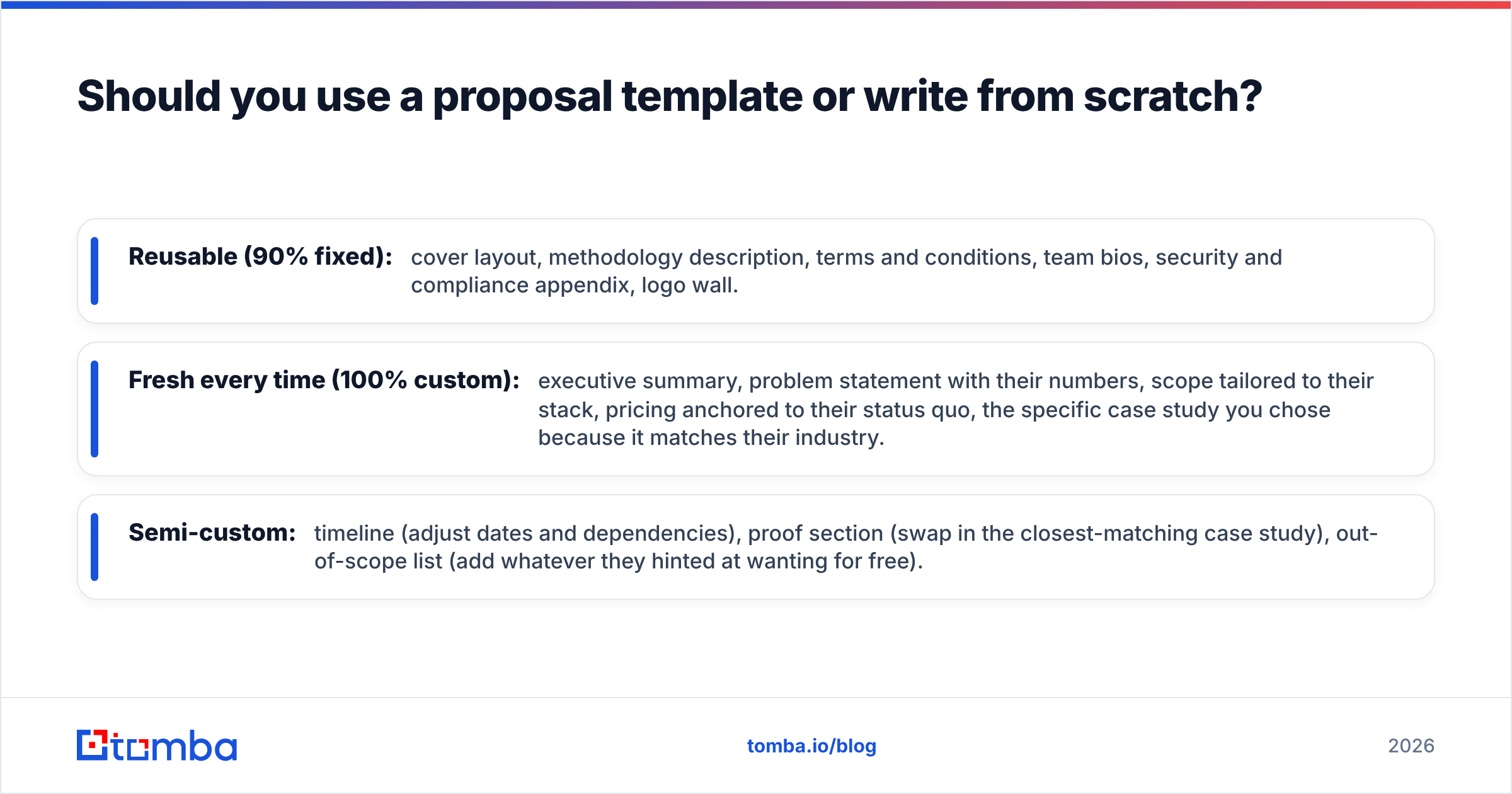
Use a template for the skeleton, write the argument from scratch. The cover page, terms, scope formatting, and signature block should be identical across every proposal you send — reinventing those wastes hours and introduces errors. The executive summary, problem statement, and pricing anchor must be written fresh every time.
A practical split:
- Reusable (90% fixed): cover layout, methodology description, terms and conditions, team bios, security and compliance appendix, logo wall.
- Fresh every time (100% custom): executive summary, problem statement with their numbers, scope tailored to their stack, pricing anchored to their status quo, the specific case study you chose because it matches their industry.
- Semi-custom: timeline (adjust dates and dependencies), proof section (swap in the closest-matching case study), out-of-scope list (add whatever they hinted at wanting for free).
Tooling choice matters less than people think. Proposal software like PandaDoc or Proposify adds e-signature, view analytics, and template locking, which is genuinely useful once you're sending more than a handful a month — the "who opened it, which page did they linger on" data is a real signal for follow-up timing. Below that volume, a well-built document template and any e-signature service will do fine. Check current user reviews on G2 before committing to an annual contract; this category churns.
Where tooling does pay off is upstream of the proposal entirely. If your CRM record is missing the economic buyer, or your contact data is 18 months stale, no amount of proposal polish fixes it. Clean contact enrichment before the discovery call means you walk in knowing who signs, which means you write the proposal for the right reader the first time.
What should you never put in a sales proposal?#
- Unbounded scope. "Ongoing support as needed" is a promise you will resent in month four. Bound it: "up to 8 support hours per month; additional hours billed at $150."
- Legal boilerplate you haven't read. If you can't explain a clause in one sentence, it doesn't belong in a document with your name on it.
- Competitor bashing. It reads as insecurity and invites the buyer to go research the competitor you just named.
- Placeholder text. "[CLIENT NAME]" surviving into a sent proposal has killed more deals than bad pricing. Search for brackets before sending. Every time.
- A price with no context. A number floating alone gets compared against the cheapest quote in the stack. A number sitting next to the cost of the status quo gets compared against doing nothing.
- More than one call to action. "Sign here, or book a call, or reply with questions, or forward to your team" produces exactly zero of those actions.
Where does Tomba fit in the proposal workflow?#
Proposals close when they reach the person with signing authority, quickly, with their name spelled correctly. That is a data problem before it is a writing problem.
Tomba's Email Finder gets you the verified address of the VP, CFO, or procurement lead your champion was going to "loop in eventually," so you can send a version of the executive summary written for their priorities instead of hoping yours survives a forward. Domain search maps every decision-maker at the account before your discovery call, and verification keeps your day-2 and day-9 follow-ups out of the bounce pile at the exact moment the deal is warm.
The free tier covers 25 searches a month if you want to test it against a live deal; paid plans start at $49/month, with full Tomba pricing laid out per tier. Write the proposal well — then make sure it lands in front of the person who signs it.
Related guides#
// get started
Find, verify and enrich your first contacts today
Start on the free plan with 25 searches a month, then scale when your team is ready.
Free plan · No credit card required · GDPR & CCPA
// about the author