How to Write an Elevator Pitch That Books B2B Meetings
Most elevator pitches fail because they describe the company instead of the buyer's problem. Here's a 5-part framework, three worked examples, and the delivery mistakes that kill deals in the first 10 seconds.
TL;DR
- An elevator pitch is not a company description. It is a 20-30 second answer to "why should this specific person keep listening?" — problem first, proof second, ask last.
- The five-part frame that consistently works: who you help → the problem → what changes → proof → the ask. Everything else is decoration.
- Write three versions: a 10-second one-liner, a 30-second standard, and a 60-second version for when someone leans in. Most reps only have the 60 and use it everywhere.
- Say it out loud and time it. If you can't deliver it in one breath per sentence, it's written for the page, not the ear.
- A great pitch delivered to the wrong contact still fails. Targeting and reachability do more for meeting rates than word choice does.
What is an elevator pitch, actually?#
An elevator pitch is a short, spoken explanation of what you do that earns you the next 60 seconds. That's the whole job. It is not meant to close, explain your architecture, or list your integrations.
Think of it like a movie trailer. A trailer doesn't summarize the plot — it creates a specific, unresolved tension and then stops. Your pitch works the same way: name a problem the listener recognizes, hint that it's solvable, and stop talking so they can ask the next question.
The name comes from the mythical scenario of pitching an investor during a short elevator ride, but in 2026 the format shows up almost everywhere except elevators:
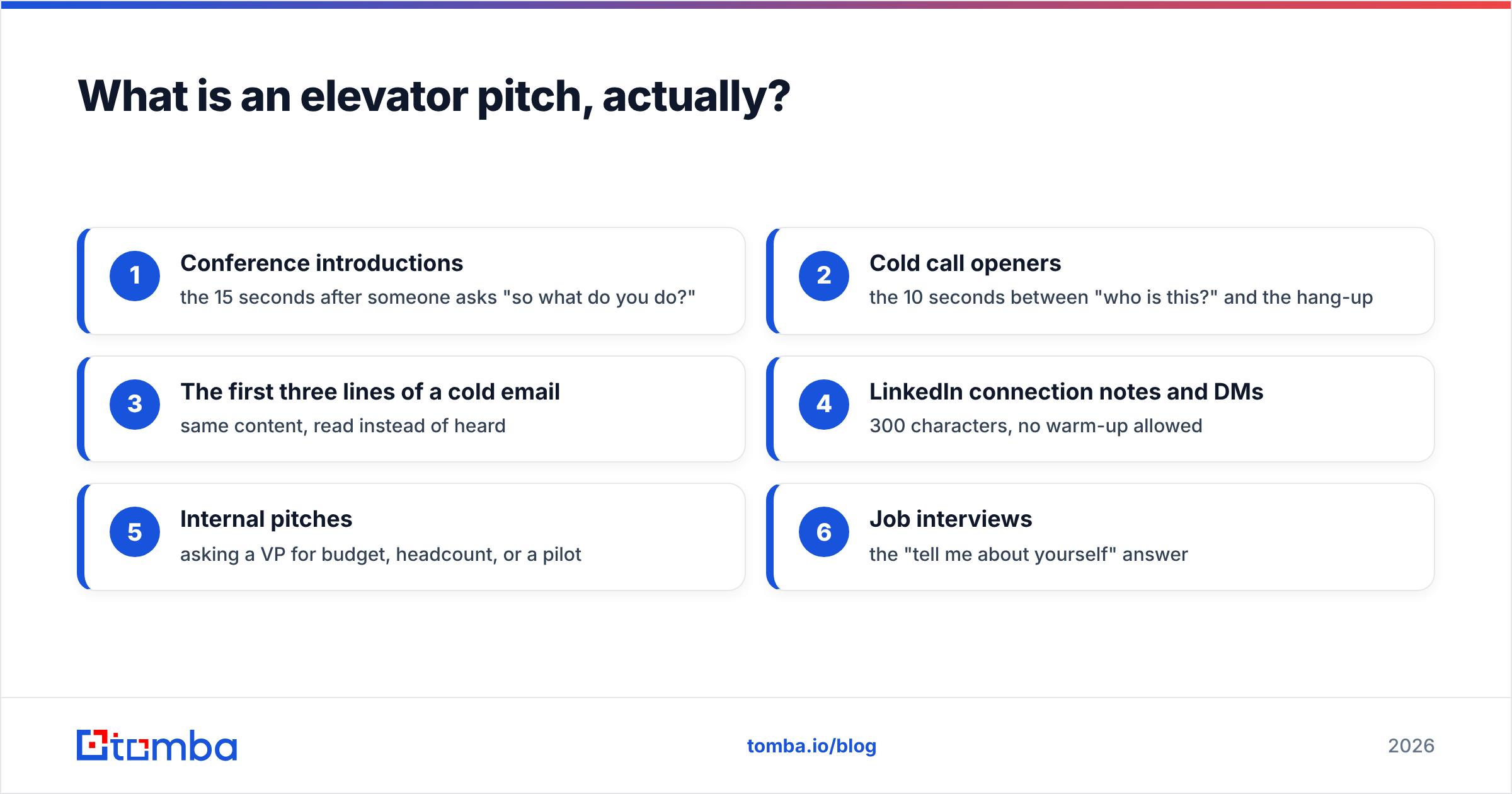
- Conference introductions — the 15 seconds after someone asks "so what do you do?"
- Cold call openers — the 10 seconds between "who is this?" and the hang-up
- The first three lines of a cold email — same content, read instead of heard
- LinkedIn connection notes and DMs — 300 characters, no warm-up allowed
- Internal pitches — asking a VP for budget, headcount, or a pilot
- Job interviews — the "tell me about yourself" answer
Same skeleton, different runtime. If you nail the 30-second version, you can compress or expand it for any of these.
Why do most elevator pitches fail?#
They fail because they're written from the inside out. The founder or rep starts with the product, describes its category, lists features, and hopes the listener does the translation work into their own world. Nobody does that translation work. They nod and change the subject.
Here are the three failure patterns you'll recognize instantly:
The résumé pitch. "I'm a senior account executive at Northwind Data, we're a Series B company building next-generation infrastructure for modern revenue teams." Zero information. The listener now knows your job title and nothing about whether you're relevant to them.
The feature dump. "We do intent data, enrichment, sequencing, dialer, and a Chrome extension." Every one of your competitors says this. Feature parity claims don't differentiate — they blend you into the category.
The vague-outcome pitch. "We help companies grow faster and unlock efficiency." Unfalsifiable. If a claim can't be wrong, it doesn't persuade anyone.
The fix in all three cases is the same: lead with a problem statement so specific that a wrong-fit listener disqualifies themselves in the first sentence. That's a feature, not a bug. A pitch that everyone politely agrees with is a pitch that books nothing.
How do you write an elevator pitch in 5 steps?#
Work through these in order. Write ugly first drafts — you'll cut 40% of the words in step 5 anyway.
Step 1 — Name the specific person you help. Not "businesses." Not "sales teams." Something like "outbound SDR managers at Series A-to-C SaaS companies" or "recruiters placing engineers in regulated industries." Specificity signals that you've seen this problem before, which is the fastest trust shortcut available.
Step 2 — State the problem in their language. Use the phrasing they'd use complaining to a colleague, not the phrasing your marketing team uses on the homepage. "Half your list bounces and your domain gets flagged" beats "suboptimal data hygiene impacting deliverability." Steal the exact wording from your last five discovery calls or from G2 reviews of your competitors.
Step 3 — Describe what changes, not what you built. The listener does not care that you have a waterfall enrichment engine. They care that their reps stop spending two hours a day on manual list-building. Frame the delta: before-state → after-state.
Step 4 — Add one piece of proof. One. A named customer, a number, or a mechanism. "We do this for 40 recruiting agencies" or "our bounce rate on verified sends is under 2%." Three proof points sound defensive; one sounds confident.
Step 5 — End with a small ask. Not "can I get 30 minutes on your calendar." Something lighter: "Is list quality actually a problem on your team, or have you already solved it?" A question hands the conversation back and gives you information either way.
Here's how those steps map to sentence-level output:
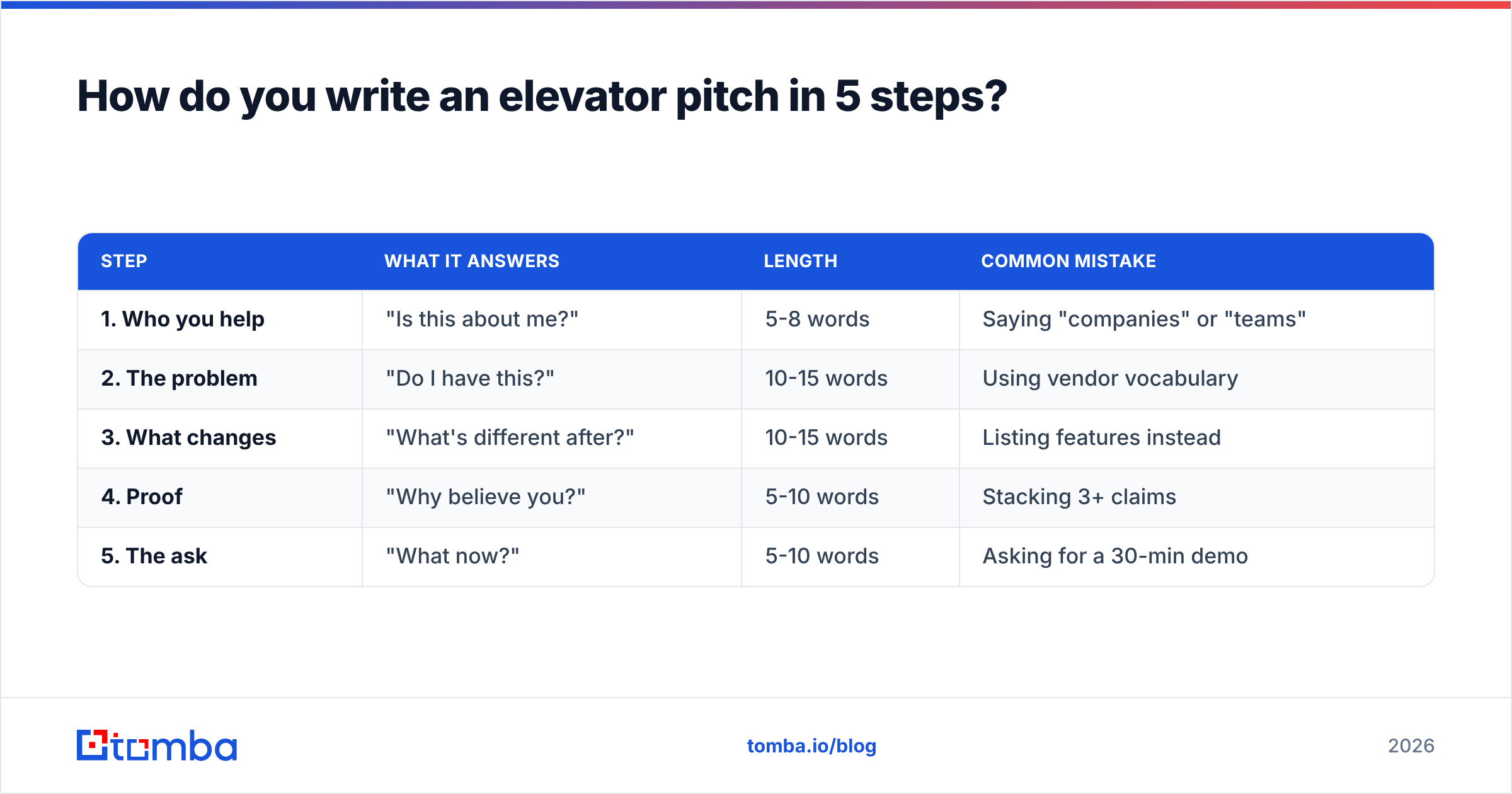
| Step | What it answers | Length | Common mistake |
|---|---|---|---|
| 1. Who you help | "Is this about me?" | 5-8 words | Saying "companies" or "teams" |
| 2. The problem | "Do I have this?" | 10-15 words | Using vendor vocabulary |
| 3. What changes | "What's different after?" | 10-15 words | Listing features instead |
| 4. Proof | "Why believe you?" | 5-10 words | Stacking 3+ claims |
| 5. The ask | "What now?" | 5-10 words | Asking for a 30-min demo |
Total target: 55-75 spoken words. That lands between 22 and 30 seconds at a natural pace.
What does a good elevator pitch look like in practice?#
Three worked examples, same framework, different contexts.
Example A — B2B SaaS AE at a networking event.
"I work with SDR managers at Series B SaaS companies. Most of them tell me their reps burn two hours a day building lists by hand, and half those emails still bounce. We hand them a verified list every morning instead — about 40 teams run this way now. Is list-building eating your reps' mornings, or have you outsourced it?"
68 words. Problem is concrete, proof is one number, ask is a question.
Example B — Freelance designer.
"I redesign checkout flows for DTC brands doing over five million a year. Usually they're losing people on mobile between cart and payment and can't tell where. I rebuild that flow and instrument it — last one lifted completed checkouts eleven percent. Do you know your mobile cart abandon rate off the top of your head?"
That last question is a trap in the best sense. If they don't know it, you've just created the gap. If they do know it and it's bad, you're in.
Example C — Internal pitch to a VP.
"Our AE ramp time is 4.5 months and the industry median is under three. The bottleneck is that new reps spend their first six weeks doing manual research instead of talking to buyers. I want to run a 60-day pilot with automated prospecting on one pod and measure ramp. Can I have 15 minutes Thursday to walk through the numbers?"
Note that the internal version ends with a real calendar ask — you already have permission to be in the room, so the soft question isn't necessary.
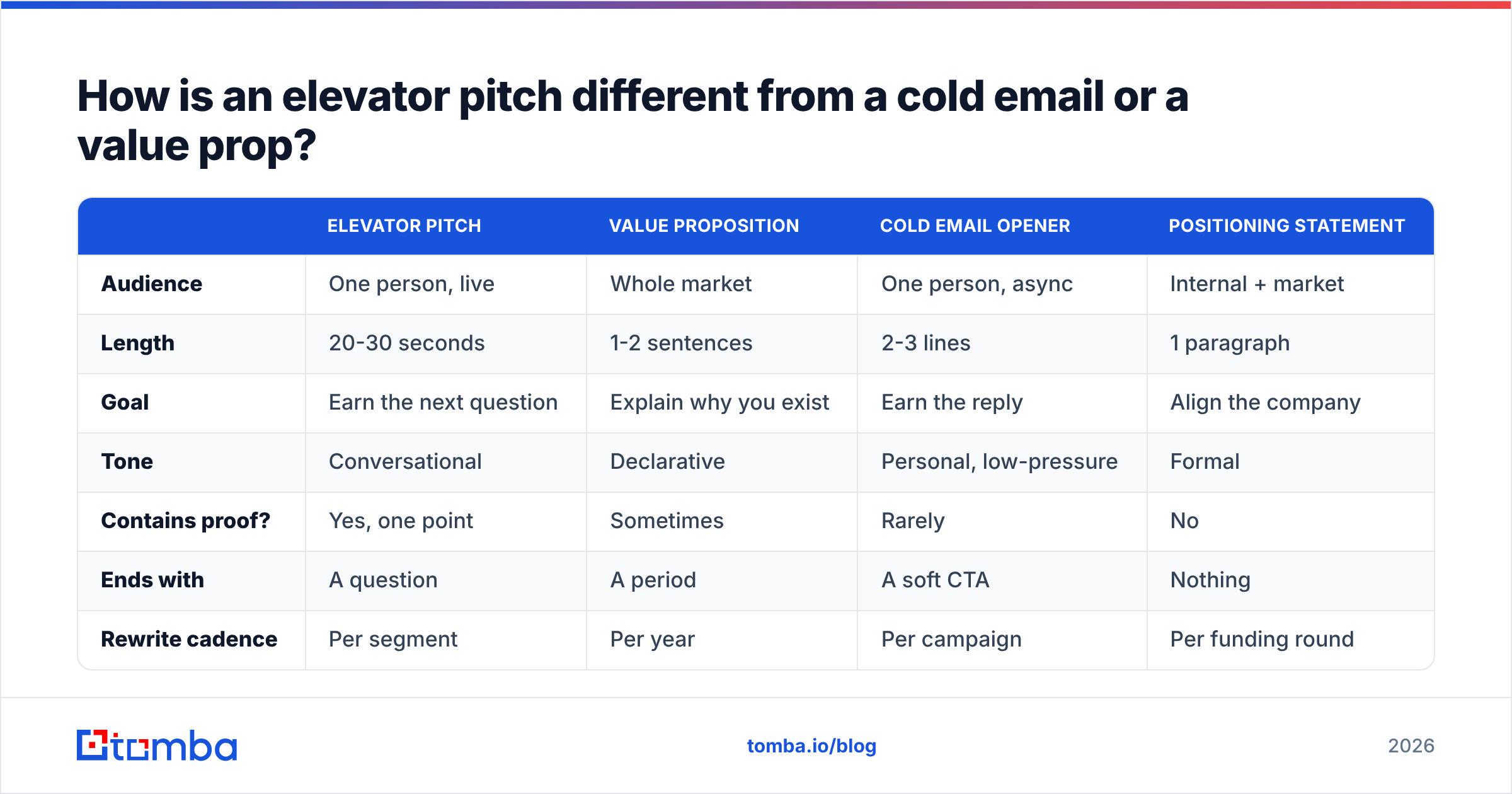
How is an elevator pitch different from a cold email or a value prop?#
People use these three terms interchangeably and then wonder why their messaging is muddled. They're different artifacts with different jobs.
| Elevator pitch | Value proposition | Cold email opener | Positioning statement | |
|---|---|---|---|---|
| Audience | One person, live | Whole market | One person, async | Internal + market |
| Length | 20-30 seconds | 1-2 sentences | 2-3 lines | 1 paragraph |
| Goal | Earn the next question | Explain why you exist | Earn the reply | Align the company |
| Tone | Conversational | Declarative | Personal, low-pressure | Formal |
| Contains proof? | Yes, one point | Sometimes | Rarely | No |
| Ends with | A question | A period | A soft CTA | Nothing |
| Rewrite cadence | Per segment | Per year | Per campaign | Per funding round |
The practical takeaway: your value prop is the raw material, and your elevator pitch is the spoken adaptation of it for one specific listener. Don't read your positioning statement out loud at a conference. It will sound exactly like what it is.
If you're adapting the pitch into written outbound, the compression is brutal — you get roughly two lines before someone decides. Steps 1 and 2 survive; step 4 usually gets cut. A subject line generator can help you test how the problem statement reads as a five-word hook before you commit to a whole sequence.
How do you deliver it without sounding rehearsed?#
Writing is half the work. Delivery is where most decent pitches die.
Time it out loud, not on the page. Read your draft into your phone's voice recorder. Anything over 30 seconds gets cut. Anything you stumble over gets rewritten — a phrase you can't say smoothly is a phrase your listener can't parse smoothly either.
Build three lengths. The 10-second version is steps 1 and 2 only. The 30-second version is the full frame. The 60-second version adds a mini customer story between steps 3 and 4. Know which one you're using before you open your mouth.
Vary it by 10% every time. A pitch delivered identically twice in the same room sounds like a script, and scripts kill trust. Keep the structure fixed and let the wording drift.
Stop talking after the ask. The silence after your question feels enormous to you and normal to them. Reps who fill it with "…but anyway, we also do X" undo the entire pitch. Ask, then wait.
Read the room and cut. If the listener's eyes drift after your problem statement, skip proof and go straight to the question. Getting a real answer to "is this a problem for you?" is worth more than finishing your paragraph.

How do you know your pitch is working?#
Track it like you'd track any other conversion asset. Three signals, in order of usefulness:
- Follow-up question rate. After you deliver it, how often does the listener ask a question versus saying "cool, nice to meet you"? This is the single best leading indicator. Target: more than half.
- Disqualification speed. A good pitch produces fast, honest "not us" responses. If nobody ever tells you they're not a fit, your problem statement is too broad.
- Meeting conversion. The lagging metric. Slower to read but it's the one that pays. Compare your response rate before and after a pitch rewrite, holding the target list constant.
The "holding the target list constant" part matters more than people expect. In practice, teams rewrite the pitch and change the list at the same time, then can't attribute the lift to either. Change one variable at a time.
It's also worth being blunt about the ceiling here: a perfect 30-second pitch delivered to a contact who doesn't own the problem still fails. HubSpot's ongoing sales research consistently finds that prospecting effectiveness tracks more closely with targeting and contact quality than with message polish. Buyer-behavior work from Gartner points the same direction — the modern buying group is large and distributed, so reaching the wrong two people inside a nine-person committee produces silence no matter how sharp your wording is.
That's why pitch work and list work are the same project. Before you obsess over the third sentence, make sure the person hearing it has budget authority over the problem you just named. Pulling accurate contacts by role via domain search and running the list through an email verifier before you send does more for reply rate than any amount of wordsmithing.
What about AI-generated pitches?#
They're a decent first draft and a terrible final draft.
What LLMs are genuinely good at: generating 20 problem-statement variations in your buyer's vocabulary, compressing a rambling paragraph to 30 words, and stress-testing whether a claim is falsifiable. Feed a model your last five call transcripts and ask it to extract the exact phrases prospects used to describe the pain. That's real leverage.
What they're bad at: the proof point and the ask. Generated proof is either vague ("trusted by leading companies") or invented, and invented proof will end a conversation permanently the moment someone checks. Generated asks default to "would you be open to a quick 15-minute call," which is the most-ignored sentence in B2B.
Practical rule: let AI draft steps 1-3, write steps 4-5 yourself, then read the whole thing aloud and rewrite anything that sounds like it came off a landing page. If you want a starting point for the written adaptation, a cold email AI draft is a reasonable scaffold — just don't ship it unedited.
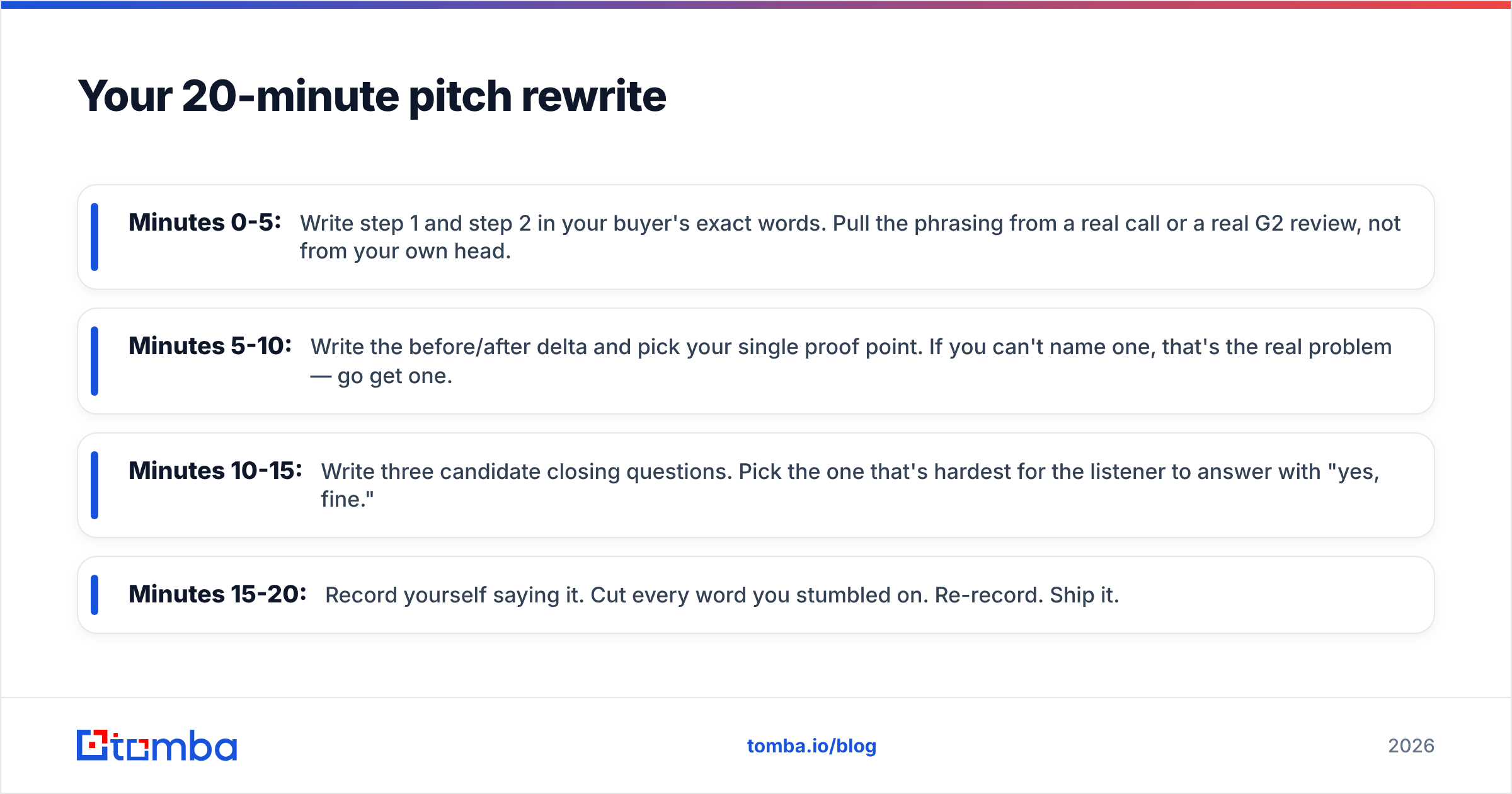
Your 20-minute pitch rewrite#
Set a timer. Twenty minutes is genuinely enough for a first working version.
- Minutes 0-5: Write step 1 and step 2 in your buyer's exact words. Pull the phrasing from a real call or a real G2 review, not from your own head.
- Minutes 5-10: Write the before/after delta and pick your single proof point. If you can't name one, that's the real problem — go get one.
- Minutes 10-15: Write three candidate closing questions. Pick the one that's hardest for the listener to answer with "yes, fine."
- Minutes 15-20: Record yourself saying it. Cut every word you stumbled on. Re-record. Ship it.
Then use it 20 times before you judge it. Pitches don't fail in the first three deliveries because they're wrong; they fail because you haven't found your rhythm yet.
Get the pitch in front of people who can act on it#
A tight elevator pitch multiplies whatever reach you already have — it doesn't create reach on its own. If you're rewriting your pitch this quarter, spend the same hour making sure your target list is real: right roles, right companies, deliverable addresses.
Use the Tomba Email Finder to pull verified, role-matched contacts at the companies whose problem you just learned to name in one sentence. The free tier covers 25 searches a month so you can test your rewritten pitch against a real list before committing; paid plans start at $49/mo on Starter, with Growth at $99/mo when volume picks up — full Tomba pricing is public. Write the pitch once, then point it at people who actually own the problem.
Related guides#
// get started
Find, verify and enrich your first contacts today
Start on the free plan with 25 searches a month, then scale when your team is ready.
Free plan · No credit card required · GDPR & CCPA
// about the author