How To Write an Email After a Business Meeting (2026 Guide)
The meeting went well. Then nothing happened. Here's the exact structure, timing, and six copy-paste templates for the email you send after a business meeting — plus the mistakes that quietly kill replies.
TL;DR
- Send the email within 24 hours. After 48 hours, the meeting is a memory instead of momentum, and your reply rate drops off a cliff.
- Every good post-meeting email does four jobs: confirm what was agreed, restate the problem in their words, deliver one thing of value, and propose a specific next step with a date.
- The subject line should reference the meeting, not sell. "Recap: pricing + Q1 rollout" beats "Great meeting you!" every time.
- Different meetings need different emails. A discovery call, a demo, a conference intro, and an internal stakeholder meeting each require a different structure — templates below.
- If the email bounces, none of the craft matters. Verify the address you scribbled down before you hit send.
You had a good meeting. Everyone nodded. Someone said "let's keep this moving." Then three weeks passed and the deal quietly died.
That gap is almost never a product problem. It's a follow-up problem. The email you send after a business meeting is the only artifact that survives the conversation — it's what gets forwarded to the person who wasn't in the room, what gets pasted into a Slack thread, and what your contact skims when they finally get back to you in ten days. Write it badly and the meeting evaporates. Write it well and you've built a paper trail that closes for you.
Here's exactly how to do it.
Why does the email after a business meeting matter more than the meeting?#
Because you are not the only person your contact met that week.
A B2B buying committee now averages six to ten people, and most of them were not on your call. Your champion has to re-sell your conversation internally, usually from memory, usually badly, usually in a two-line Slack message. Your follow-up email is the script that makes that easier. Research from Gartner's sales practice has consistently found that the hardest part of a modern B2B deal isn't convincing the person in front of you — it's the internal consensus-building that happens after you leave.
There's a second reason: memory decay. Twenty-four hours after a meeting, your contact remembers the vibe and maybe two facts. Forty-eight hours later, they remember the vibe. Your email is what freezes the specifics — the number they quoted, the deadline they mentioned, the objection they half-raised — before those details blur.
And a third: accountability. A meeting where nobody wrote anything down produces no obligations. The moment you send "Here's what we agreed, here's what I owe you by Thursday, here's what you owe me," you've converted a nice conversation into a small contract.
When should you send a follow-up email after a business meeting?#
Same day if you can. Within 24 hours, always. The only exception is a Friday afternoon meeting, where Monday morning at 8am often outperforms a Friday 6pm send that lands under a weekend of noise.
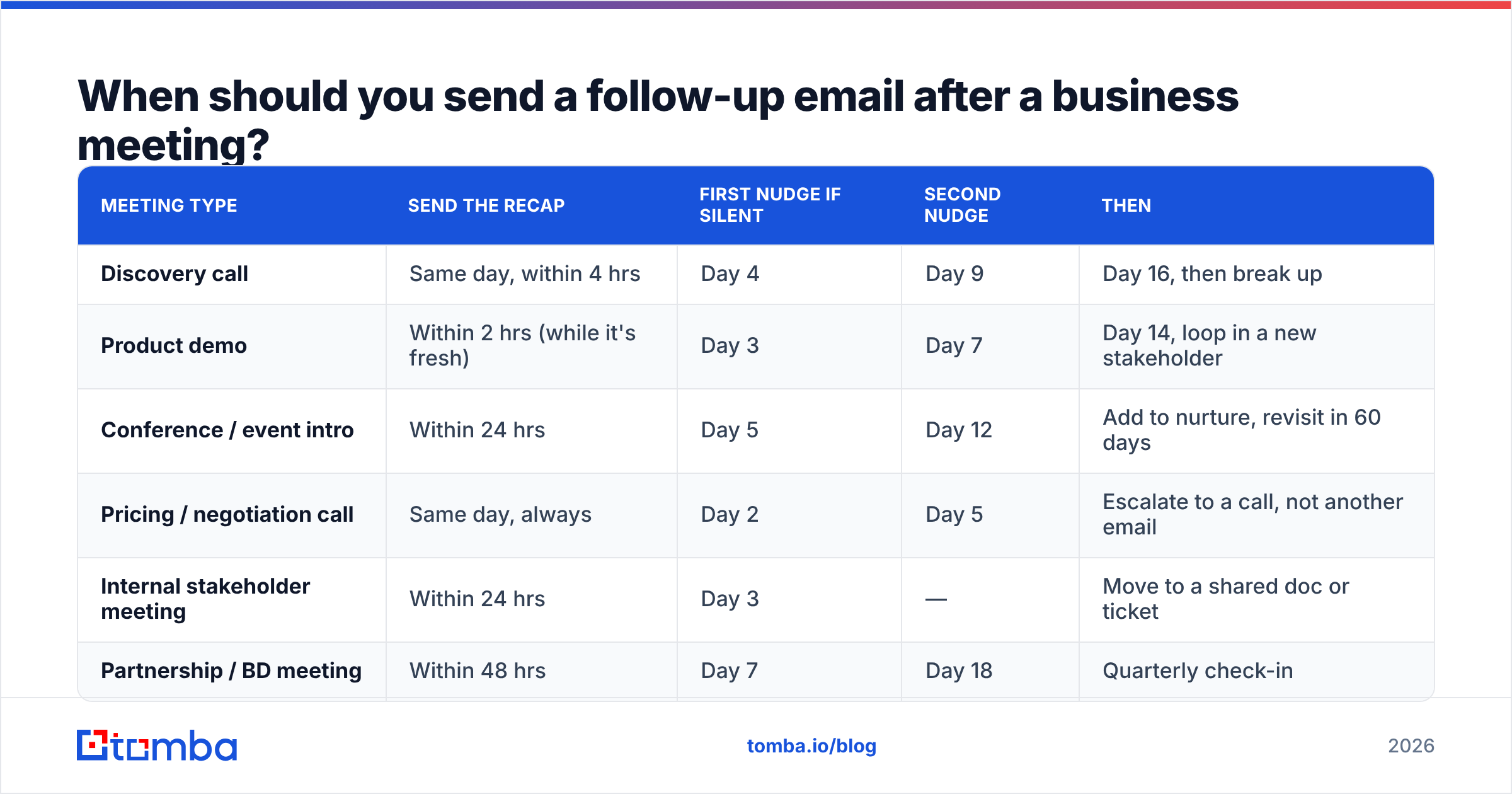
Here's a realistic timing map depending on the meeting type:
| Meeting type | Send the recap | First nudge if silent | Second nudge | Then |
|---|---|---|---|---|
| Discovery call | Same day, within 4 hrs | Day 4 | Day 9 | Day 16, then break up |
| Product demo | Within 2 hrs (while it's fresh) | Day 3 | Day 7 | Day 14, loop in a new stakeholder |
| Conference / event intro | Within 24 hrs | Day 5 | Day 12 | Add to nurture, revisit in 60 days |
| Pricing / negotiation call | Same day, always | Day 2 | Day 5 | Escalate to a call, not another email |
| Internal stakeholder meeting | Within 24 hrs | Day 3 | — | Move to a shared doc or ticket |
| Partnership / BD meeting | Within 48 hrs | Day 7 | Day 18 | Quarterly check-in |
Two things to notice. First, the higher the intent of the meeting, the tighter the follow-up cadence — a pricing call goes cold in days, a partnership chat can breathe for weeks. Second, nudges have a floor. Three unanswered emails is a signal, not a challenge. Change the channel or change the person.
What are the six parts of a post-meeting email?#
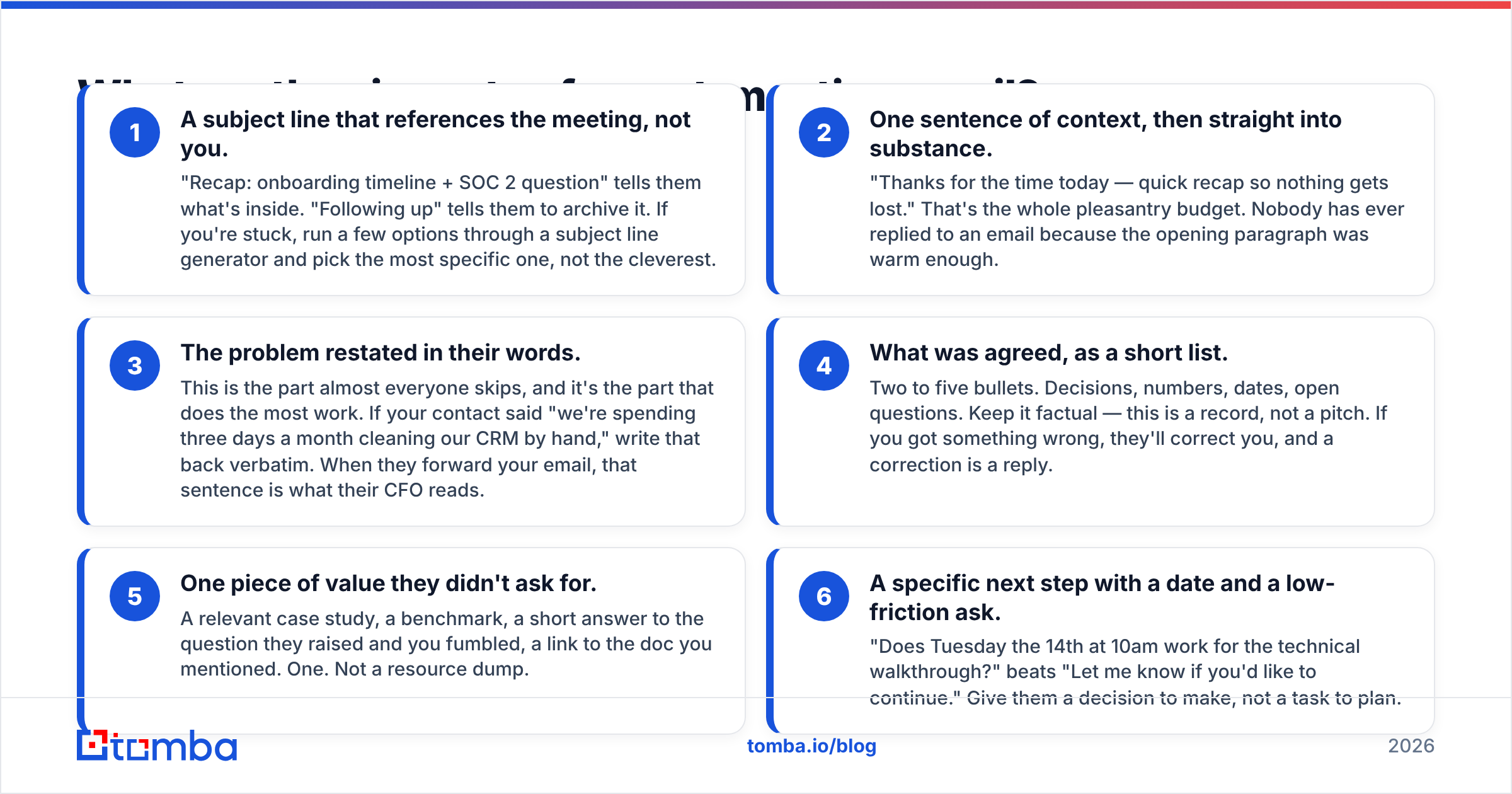
Every strong post-meeting email contains the same six components, in roughly this order. Skip one and the email gets weaker in a predictable way.
A subject line that references the meeting, not you. "Recap: onboarding timeline + SOC 2 question" tells them what's inside. "Following up" tells them to archive it. If you're stuck, run a few options through a subject line generator and pick the most specific one, not the cleverest.
One sentence of context, then straight into substance. "Thanks for the time today — quick recap so nothing gets lost." That's the whole pleasantry budget. Nobody has ever replied to an email because the opening paragraph was warm enough.
The problem restated in their words. This is the part almost everyone skips, and it's the part that does the most work. If your contact said "we're spending three days a month cleaning our CRM by hand," write that back verbatim. When they forward your email, that sentence is what their CFO reads.
What was agreed, as a short list. Two to five bullets. Decisions, numbers, dates, open questions. Keep it factual — this is a record, not a pitch. If you got something wrong, they'll correct you, and a correction is a reply.
One piece of value they didn't ask for. A relevant case study, a benchmark, a short answer to the question they raised and you fumbled, a link to the doc you mentioned. One. Not a resource dump.
A specific next step with a date and a low-friction ask. "Does Tuesday the 14th at 10am work for the technical walkthrough?" beats "Let me know if you'd like to continue." Give them a decision to make, not a task to plan.
That's the skeleton. Under 200 words is the target. If your recap is running past 300, you're writing a document, not an email — put the document in a link.
How do you write the subject line?#
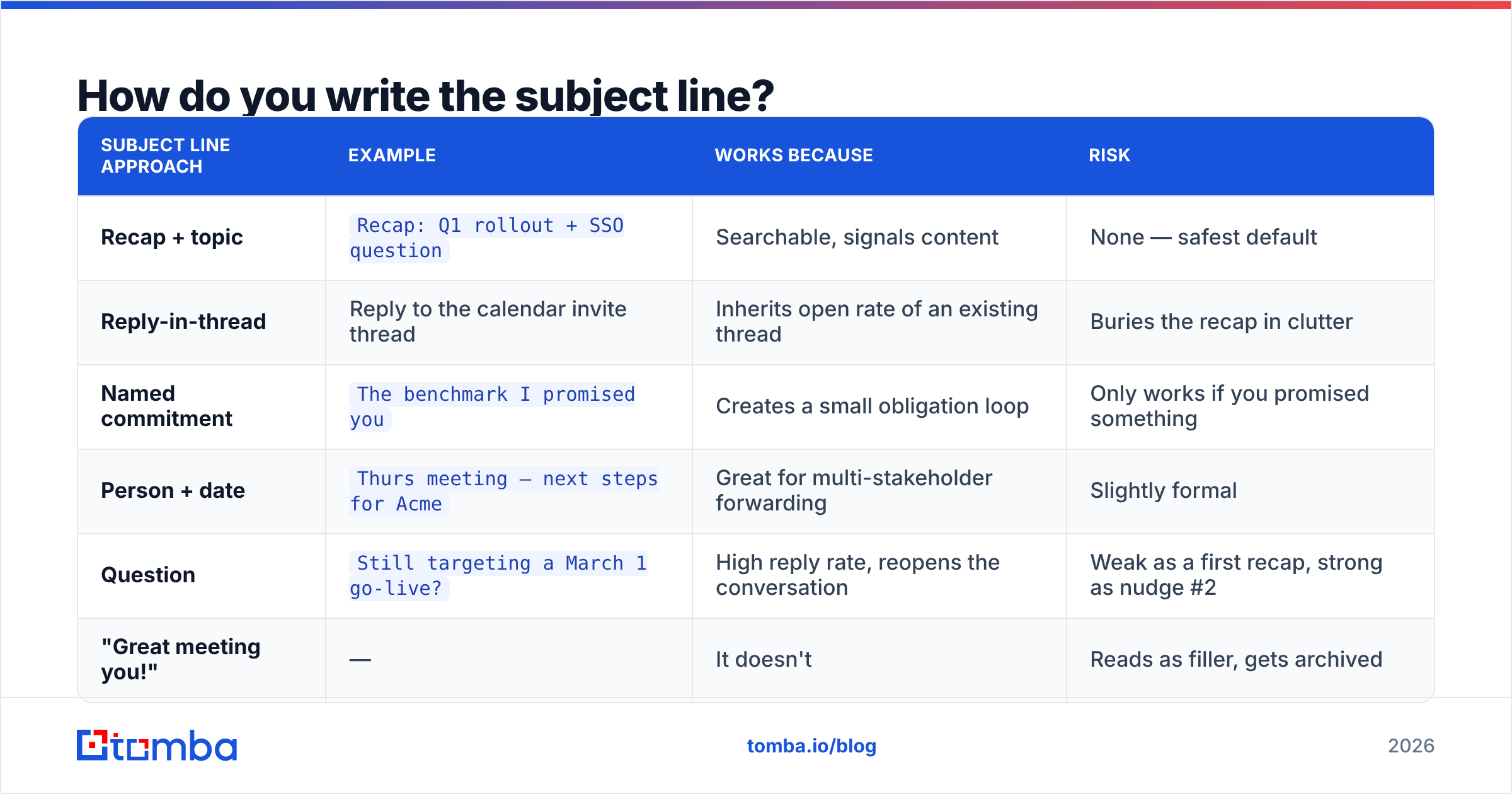
Treat the subject line as an index entry, not a headline. Your contact will search for this email in six weeks. Make it findable.
| Subject line approach | Example | Works because | Risk |
|---|---|---|---|
| Recap + topic | Recap: Q1 rollout + SSO question |
Searchable, signals content | None — safest default |
| Reply-in-thread | Reply to the calendar invite thread | Inherits open rate of an existing thread | Buries the recap in clutter |
| Named commitment | The benchmark I promised you |
Creates a small obligation loop | Only works if you promised something |
| Person + date | Thurs meeting — next steps for Acme |
Great for multi-stakeholder forwarding | Slightly formal |
| Question | Still targeting a March 1 go-live? |
High reply rate, reopens the conversation | Weak as a first recap, strong as nudge #2 |
| "Great meeting you!" | — | It doesn't | Reads as filler, gets archived |
One practical note: if the meeting came from a calendar invite, replying inside that existing thread often outperforms a fresh email, because the thread already has the recipient's attention and won't be filtered as a new sender. Save the fresh subject line for your first nudge.
What should you write after different meeting types?#
Here are six templates. Adapt them; don't paste them raw. The specifics you insert are the entire value.
1. After a discovery call
Subject: Recap: manual CRM cleanup + March timeline
Hi Dana — thanks for walking me through how the ops team works today.
What I heard: your two SDRs lose roughly three days a month deduping records by hand, and that gets worse when you add the EMEA territory in March.
What we agreed:
• You'll pull last quarter's bounce numbers
• I'll send the pricing breakdown for 5 vs 10 seats
• Neither happens until legal clears the DPA
One thing you didn't ask for: [link] — how a team your size cut the same task to two hours a week.
Worth a 30-minute technical session with your ops lead? I have Tues 14th, 10am or 2pm.
— Marco
2. After a product demo
Lead with the specific feature they reacted to, not the feature you're proudest of. "You paused on the bulk verification screen — here's a two-minute clip of that exact workflow with your data volumes plugged in."
3. After a conference or event introduction
Assume they met forty people. Anchor with a detail only the two of you share: "We talked about the terrible coffee at the Amsterdam booth and your migration off Salesforce." Then one sentence of relevance, then a soft ask. No pitch. Event follow-ups convert on the second touch, not the first.
4. After a pricing or negotiation call
Put the numbers in writing, including anything you conceded, and state what expires when. Ambiguity here costs deals. End with a decision date, not a nudge: "If the 12-month term works, I'll have the order form over by Thursday."
5. After an internal stakeholder meeting
Owners and dates in a table. Nothing else. Internal recaps that read like prose get skimmed and ignored.
6. After a meeting that went badly
Don't pretend it didn't. "It sounds like the timeline doesn't work on your side this quarter — should I check back in September, or is this a no for now?" A clean exit preserves the relationship and occasionally rescues the deal. The HubSpot sales blog has good data on why explicit "break-up" emails outperform indefinite nudging.
What mistakes kill post-meeting emails?#
The gratitude essay. Three paragraphs of appreciation before any content. Your reader is scanning on a phone between meetings. Get to the substance in sentence two.
The resource dump. Five attachments and four links means zero clicks. Pick one asset. If you genuinely have five useful things, that's a follow-up sequence, not a single email.
The vague close. "Let me know your thoughts" is a task with no deadline, which means it never gets done. Every post-meeting email needs exactly one specific ask.
Writing what you wish they'd said. If you inflate their level of interest in the recap, your contact has to either correct you or disengage. Most disengage. Write the meeting that actually happened.
Talking about your product instead of their problem. The recap is not a second demo. You already demoed. Now you're documenting.
Sending to the wrong address. Astonishingly common after conferences and multi-person calls, where you're working from a handwritten note, a badge scan, or a name someone said out loud. Which brings us to the boring thing that decides whether any of this matters.
How do you make sure the email actually reaches them?#
You can write the best recap of your career and still get nothing, because the address is wrong, the message hit spam, or the person who actually decides was never on the thread.
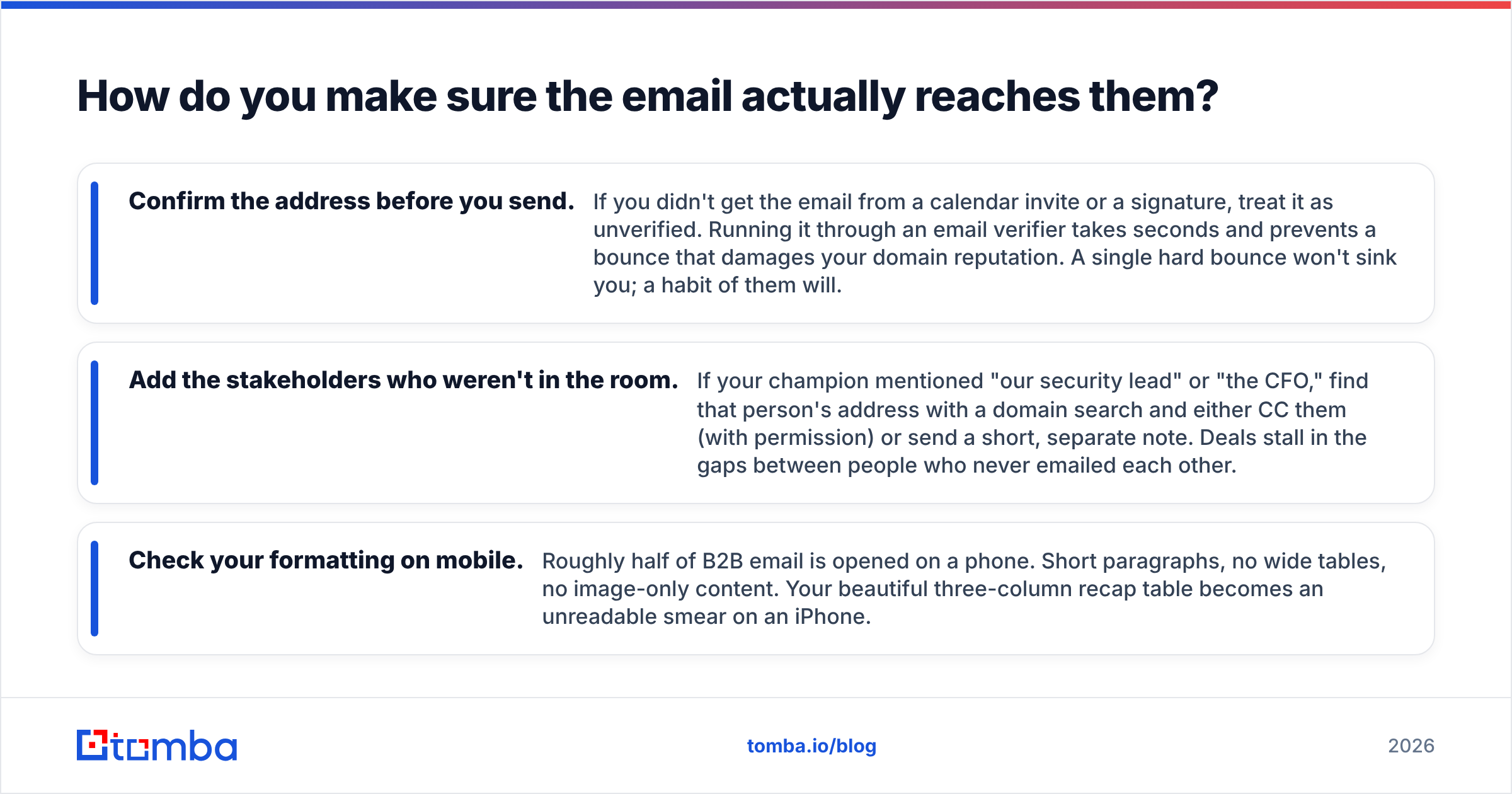
Three checks worth building into your routine:
- Confirm the address before you send. If you didn't get the email from a calendar invite or a signature, treat it as unverified. Running it through an email verifier takes seconds and prevents a bounce that damages your domain reputation. A single hard bounce won't sink you; a habit of them will.
- Add the stakeholders who weren't in the room. If your champion mentioned "our security lead" or "the CFO," find that person's address with a domain search and either CC them (with permission) or send a short, separate note. Deals stall in the gaps between people who never emailed each other.
- Check your formatting on mobile. Roughly half of B2B email is opened on a phone. Short paragraphs, no wide tables, no image-only content. Your beautiful three-column recap table becomes an unreadable smear on an iPhone.
If you're building a repeatable follow-up motion rather than writing one-offs, keep a small library of structures you can adapt — our free email templates collection covers recaps, nudges, and break-ups, and improving your baseline response rate by even two points compounds fast across a full pipeline.
What does a good post-meeting email actually look like in practice?#
Short. Factual. Specific. Ending in a question with a date in it.
The template that consistently outperforms is barely a template at all: one line of thanks, one line restating their problem in their language, three bullets of what was agreed, one useful link, one concrete proposal for the next step. Under 150 words. Sent the same day.
Everything else — the clever subject line, the well-designed signature, the case study PDF — is a rounding error next to timing and specificity. Send it fast, write down what they actually said, and ask for one thing.
Ready to stop losing deals in the gap after the meeting?#
Great follow-up starts with reaching the right inbox. If half your post-meeting emails go to a guessed address, a stale contact, or the one person in the account who can't sign anything, the writing advice above never gets a chance to work.
Tomba Email Finder finds verified professional addresses by name, company, or domain — so the recap you spent fifteen minutes writing actually lands in front of the person who decides, plus the stakeholders who weren't in the room. The free tier includes 25 searches a month, and paid plans start at $49/mo. Check Tomba pricing if you're scaling this across a team.
Write the email today. Send it before the meeting turns into a memory.
Related guides#
// get started
Find, verify and enrich your first contacts today
Start on the free plan with 25 searches a month, then scale when your team is ready.
Free plan · No credit card required · GDPR & CCPA
// about the author