How to Write an Escalation Email for No Response (2026)
Silence is not always rejection — sometimes it is a bad address, a wrong contact, or a stalled internal approval. Here is how to escalate after no response without torching the deal, with timing rules and four copy-paste templates.
TL;DR
- An escalation email is not a louder follow-up. It changes something structural — the recipient, the stakes, or the decision you are asking for — instead of repeating the same ask in a new font.
- Before you escalate, rule out the boring causes of silence: a wrong or dead address, a spam-foldered thread, or a contact who left the company. Roughly a fifth of B2B contact data decays every year, and "no response" is frequently "no delivery."
- Escalate on a schedule, not on emotion. Three unanswered touches over 10–14 business days is the usual trigger point for moving up or sideways.
- Name the cost of inaction, give one deadline, and offer a graceful exit. Escalations that read as threats get replies once and never again.
- Use the four templates below — peer nudge, manager escalation, vendor/SLA escalation, and internal escalation — and adapt the timing table to your sales cycle.
What is an escalation email, and when is it justified?#
An escalation email is a message that deliberately raises the level of a stalled thread — by adding a new person, invoking a deadline or contract term, or reframing the ask so that ignoring it now has a visible cost.
Think of it like a hotel front desk. The first three times you call about the broken AC, you talk to the same clerk. The fourth time, you ask for the duty manager. You are not shouting; you are moving the request to someone with the authority and the incentive to close it. That is escalation.
It is justified when all three of these are true:
- You have made a reasonable number of good-faith attempts. Two touches is not a stall. Three to four spaced touches over two weeks is.
- The other side has an obligation or a stated interest. They asked for the proposal, signed an SLA, promised a decision date, or opened a support ticket. Escalating a fully cold prospect is not escalation — it is spam with extra steps.
- Delay is now costing someone something concrete. A renewal date, a project start, an outage, a pricing window, an implementation slot.
If you cannot point to all three, what you actually need is a better follow-up or a breakup email — not an escalation.
Why did they not respond in the first place?#
Diagnose before you escalate. Escalating past a person who never received your email is the fastest way to look incompetent to their boss.
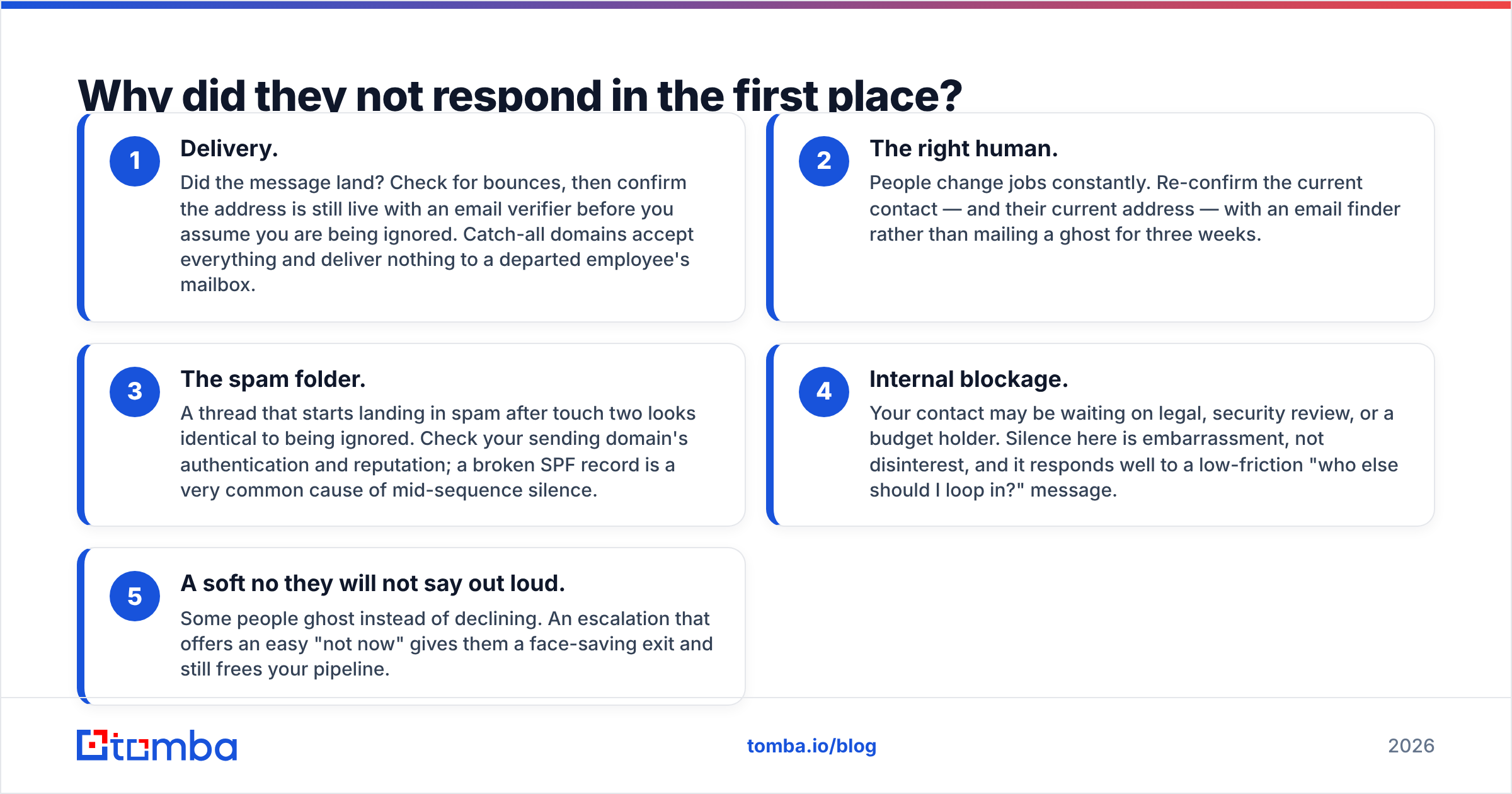
Run these five checks first:
- Delivery. Did the message land? Check for bounces, then confirm the address is still live with an email verifier before you assume you are being ignored. Catch-all domains accept everything and deliver nothing to a departed employee's mailbox.
- The right human. People change jobs constantly. Re-confirm the current contact — and their current address — with an email finder rather than mailing a ghost for three weeks.
- The spam folder. A thread that starts landing in spam after touch two looks identical to being ignored. Check your sending domain's authentication and reputation; a broken SPF record is a very common cause of mid-sequence silence.
- Internal blockage. Your contact may be waiting on legal, security review, or a budget holder. Silence here is embarrassment, not disinterest, and it responds well to a low-friction "who else should I loop in?" message.
- A soft no they will not say out loud. Some people ghost instead of declining. An escalation that offers an easy "not now" gives them a face-saving exit and still frees your pipeline.

Only after these five checks does escalation make sense. Otherwise you are turning a data problem into a relationship problem.
Is an escalation email different from a follow-up or a breakup email?#
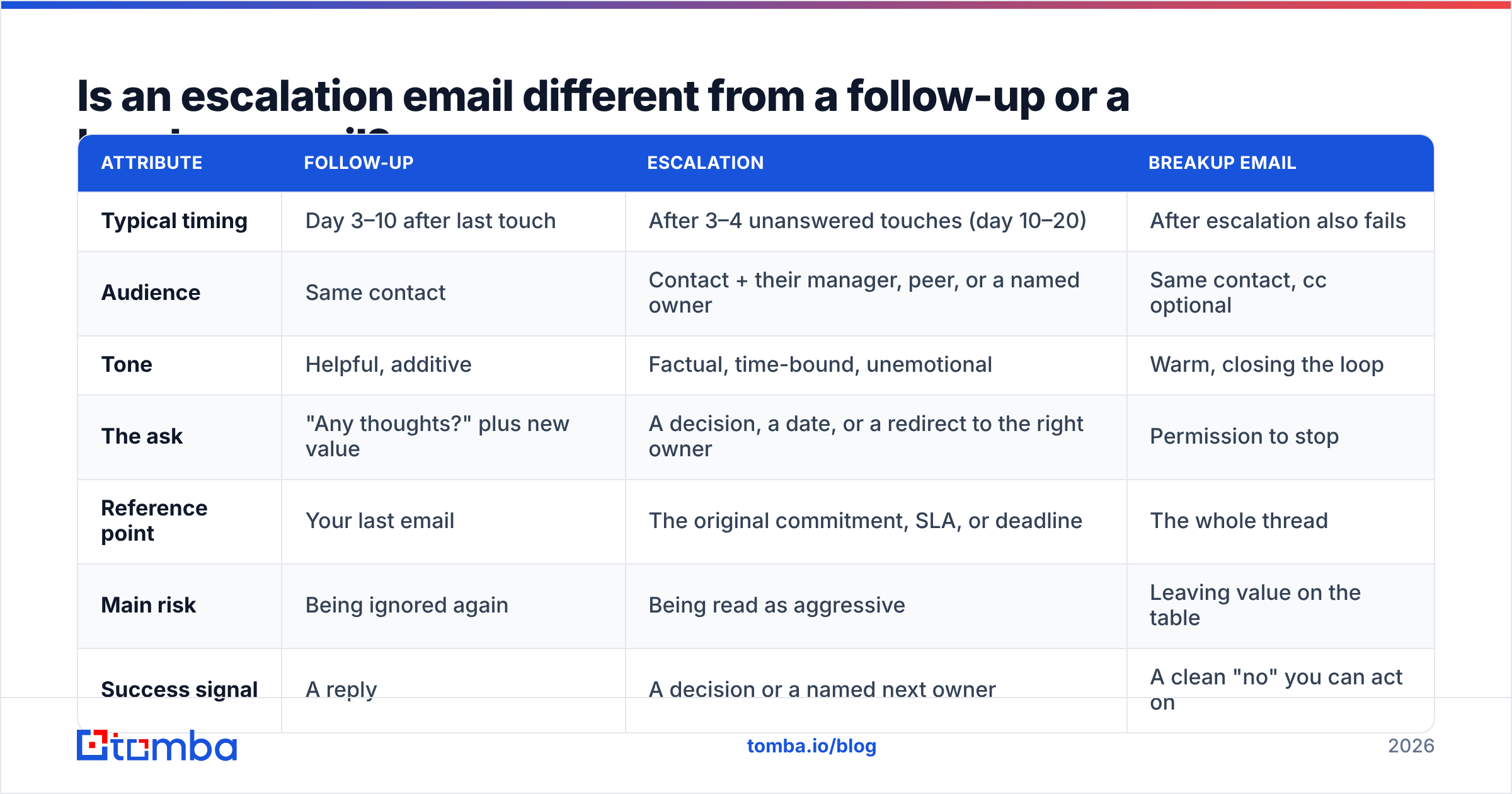
Yes, and mixing them up is why most escalations fail. They have different audiences, different tones, and different asks.
| Attribute | Follow-up | Escalation | Breakup email |
|---|---|---|---|
| Typical timing | Day 3–10 after last touch | After 3–4 unanswered touches (day 10–20) | After escalation also fails |
| Audience | Same contact | Contact + their manager, peer, or a named owner | Same contact, cc optional |
| Tone | Helpful, additive | Factual, time-bound, unemotional | Warm, closing the loop |
| The ask | "Any thoughts?" plus new value | A decision, a date, or a redirect to the right owner | Permission to stop |
| Reference point | Your last email | The original commitment, SLA, or deadline | The whole thread |
| Main risk | Being ignored again | Being read as aggressive | Leaving value on the table |
| Success signal | A reply | A decision or a named next owner | A clean "no" you can act on |
The practical rule: a follow-up adds value, an escalation adds consequence, and a breakup email removes pressure. Never send all three energies in one message.
How do you write an escalation email for no response, step by step?#
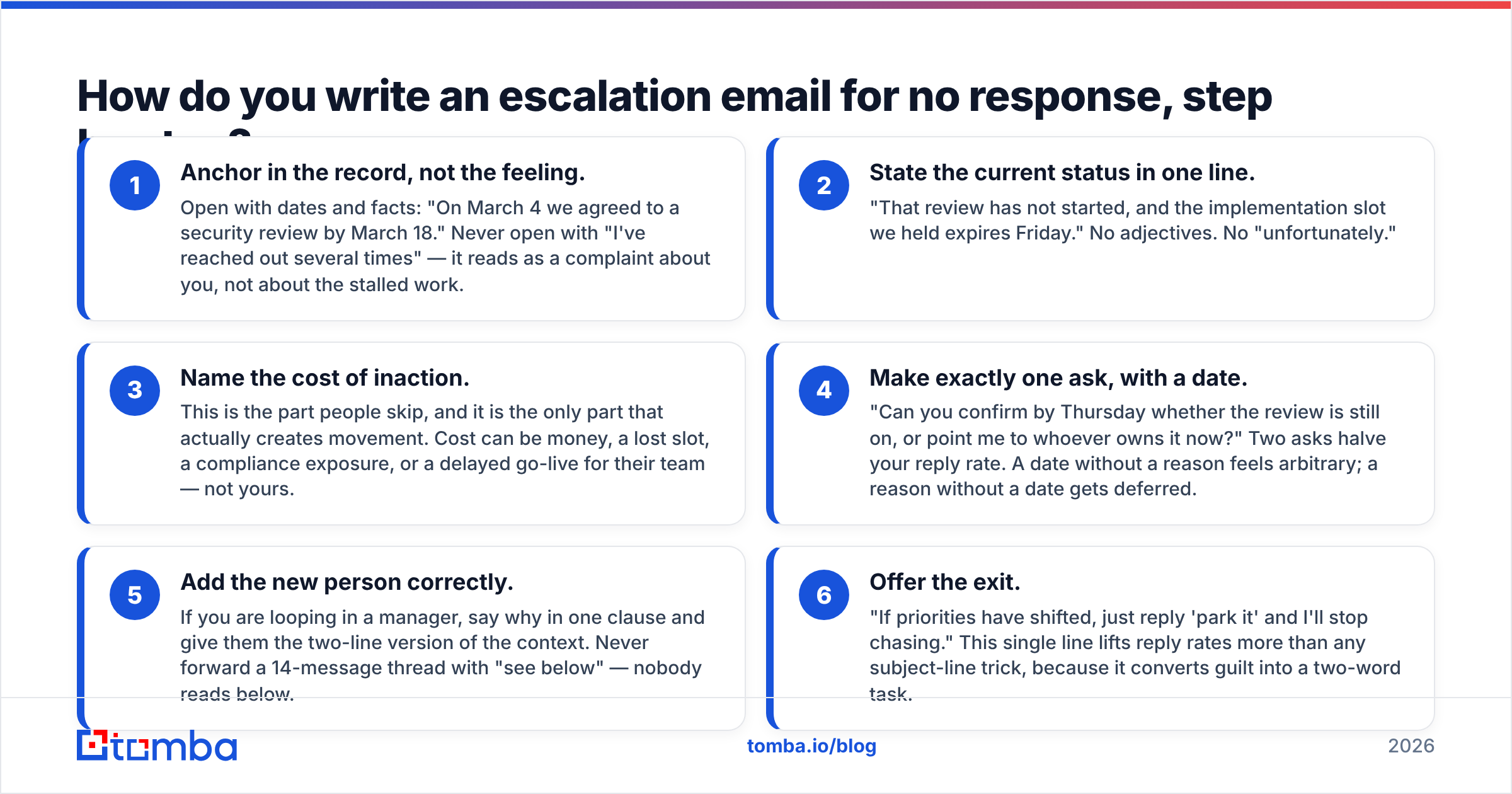
Six moves, in order. Each one takes a sentence — the whole email should fit on a phone screen.
- Anchor in the record, not the feeling. Open with dates and facts: "On March 4 we agreed to a security review by March 18." Never open with "I've reached out several times" — it reads as a complaint about you, not about the stalled work.
- State the current status in one line. "That review has not started, and the implementation slot we held expires Friday." No adjectives. No "unfortunately."
- Name the cost of inaction. This is the part people skip, and it is the only part that actually creates movement. Cost can be money, a lost slot, a compliance exposure, or a delayed go-live for their team — not yours.
- Make exactly one ask, with a date. "Can you confirm by Thursday whether the review is still on, or point me to whoever owns it now?" Two asks halve your reply rate. A date without a reason feels arbitrary; a reason without a date gets deferred.
- Add the new person correctly. If you are looping in a manager, say why in one clause and give them the two-line version of the context. Never forward a 14-message thread with "see below" — nobody reads below.
- Offer the exit. "If priorities have shifted, just reply 'park it' and I'll stop chasing." This single line lifts reply rates more than any subject-line trick, because it converts guilt into a two-word task.
On subject lines: change it. Replying inside a dead thread with "RE: RE: RE:" signals more of the same. Use something that names the decision — "Decision needed: security review slot (expires Fri)" — and test the wording with a subject line tester if you send escalations at volume.
What does a good escalation email actually look like?#
Four templates covering the situations that come up most. Keep them under 120 words each.
1. Peer-level nudge (before you escalate upward)
Subject: Still holding the March 18 slot?
Hi Dana,
On March 4 we scheduled the security review for March 18. I haven't been able to confirm it, and the implementation slot we reserved releases this Friday.
Two options: confirm the 18th, or tell me who owns the review now and I'll take it off your plate.
If this has been deprioritized, reply "park it" and I'll close it out cleanly.
Thanks,
Sam
2. Manager escalation (loop in one level up)
Subject: Need a decision owner for the Acme security review
Hi Priya,
Adding you for visibility — happy to be redirected if this isn't yours.
Context in two lines: Acme committed to a security review by March 18 as the last step before implementation. I've followed up three times since March 4 without a confirmation, and the build slot expires Friday.
Could you point me to the right owner, or confirm we should push the start date to April? Either answer works — I just need one by Thursday.
Thanks,
Sam
3. Vendor or SLA escalation (you are the customer)
Subject: Ticket 88214 — 9 days open against a 48-hour SLA
Hi team,
Ticket 88214 was opened on March 2 and is now 9 business days old against the 48-hour response SLA in our contract (section 4.2).
The failing sync is blocking invoice generation for 3,400 accounts.
I need either a fix ETA or a named escalation owner by end of day tomorrow. If neither is possible, let me know and I'll route this through our account manager.
Thanks,
Sam
4. Internal escalation (your own organization)
Subject: Blocked on legal sign-off — need a call by Wed
Hi Marcus,
The Acme MSA has been with legal since March 1. Close date is March 31 and the customer's fiscal year ends the same week.
If we can't get sign-off by Wednesday, I'd rather tell them now than in the last 48 hours.
Can you either unblock it or tell me the realistic date? Happy to jump on a 10-minute call.
Sam
Note what none of these do: apologize for existing, list every prior attempt, or use bold red "URGENT." The urgency lives in the facts.
When should you escalate, and to whom?#
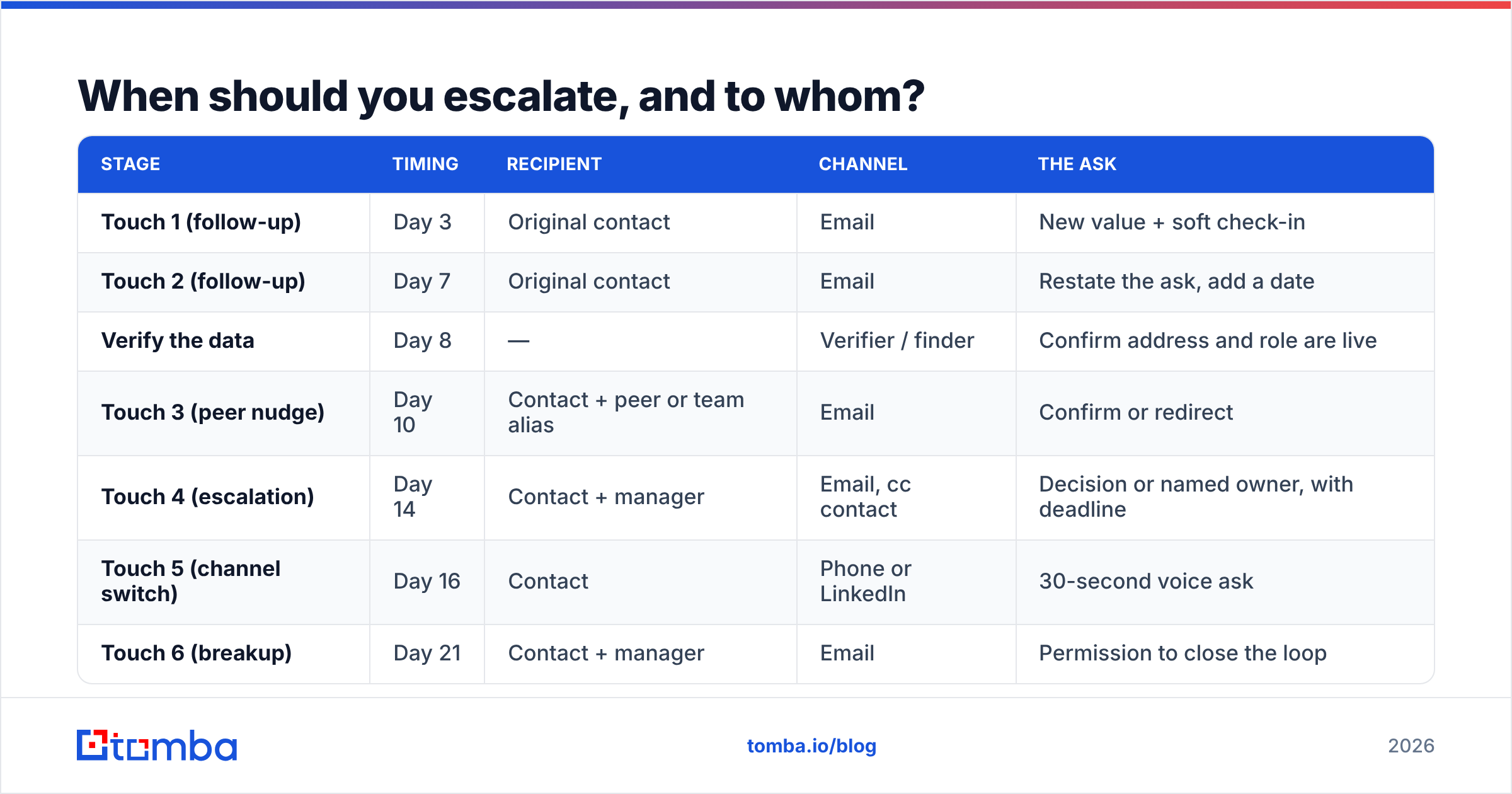
Escalate on a clock. Reps who escalate by mood escalate too early with hot accounts and never with quiet ones. This ladder works for a typical 30–60 day B2B cycle — compress it for support tickets, stretch it for enterprise.
| Stage | Timing | Recipient | Channel | The ask |
|---|---|---|---|---|
| Touch 1 (follow-up) | Day 3 | Original contact | New value + soft check-in | |
| Touch 2 (follow-up) | Day 7 | Original contact | Restate the ask, add a date | |
| Verify the data | Day 8 | — | Verifier / finder | Confirm address and role are live |
| Touch 3 (peer nudge) | Day 10 | Contact + peer or team alias | Confirm or redirect | |
| Touch 4 (escalation) | Day 14 | Contact + manager | Email, cc contact | Decision or named owner, with deadline |
| Touch 5 (channel switch) | Day 16 | Contact | Phone or LinkedIn | 30-second voice ask |
| Touch 6 (breakup) | Day 21 | Contact + manager | Permission to close the loop |
Two rules that protect the relationship:
- Never blind-cc a manager. Always visibly cc the original contact. Going behind someone's back is remembered long after the deal closes; going above them in the open is normal business.
- Never skip two levels. Jumping from an analyst to a VP reads as a complaint about the analyst, and the VP will simply forward it back down — with your name attached to a bad first impression.
Enterprise buying groups now involve six to ten stakeholders on a typical purchase, which is exactly why "who owns this now?" is a more productive escalation ask than "please respond." Gartner's sales research has been making this point for years: the bottleneck is usually internal consensus, not interest.
How do you escalate without damaging the relationship?#
Assume competence and overload, never malice. Nearly every stalled thread has a mundane explanation, and your email should read as if you already believe that.
Concrete guardrails:
- Cap escalations at one per stall. Escalating twice to two different managers in the same week is how you get blacklisted at an account.
- Give the contact a win. "You've been the only person moving this forward" costs you nothing and buys real goodwill when their manager is reading.
- Keep the paper trail neutral. Write every escalation as if the CEO of that company will read it, because sometimes they do. No sarcasm, no "as I mentioned previously," no passive aggression dressed as politeness.
- Escalate the problem, not the person. "The review hasn't started" is a status. "Dana hasn't done the review" is an accusation.
- Fix the pipeline problem too. If more than a quarter of your threads need escalation, your qualification is off — you are pitching people who cannot buy. Better data enrichment at the top beats better escalation copy at the bottom every time.
For a broader library of message structures to adapt, HubSpot's sales blog keeps a solid running set, and it is worth reading escalation alongside standard follow-up cadence rather than as a separate discipline. If you want the underlying etiquette principles, the email etiquette overview on Wikipedia is a surprisingly good sanity check on tone.
What are the most common escalation email mistakes?#
- The résumé of grievances. Listing all six prior emails. The recipient does not care about your effort; they care about the decision.
- Two asks in one email. "Can you confirm the review and also introduce me to procurement?" Pick the blocking one.
- A deadline with no reason. "By Friday" is arbitrary. "By Friday, because the build slot releases then" is a fact.
- Escalating a bounce. If the address was dead, you just told a VP that your data is bad. Verify first.
- No exit ramp. Without a "park it" option, ambivalent buyers stay silent forever, and silent buyers clog forecasts.
- Escalating on day 4. Patience is a differentiator. Most competitors either give up at touch two or spam until they are blocked.
Where should you start?#
Start by proving the silence is real. Before you write a single escalation, confirm the person still works there, still holds the role, and still receives mail at that address — then escalate with dates, one ask, and a graceful exit.
That first step is the one most teams skip. Tomba's Email Finder confirms the current professional address for a contact by name and domain, and pairs with verification so you know a non-reply is a decision and not a dead mailbox. The free tier covers 25 searches a month; paid plans start at $49/mo, with details on the Tomba pricing page. Get the address right, and your escalation email stops being a guess.
Related guides#
Ready to find emails that actually work?
Join 150,000+ professionals who stopped guessing and started sending. Free credits on signup — no credit card required.
Get the Tomba newsletter
Practical outbound tactics and product updates — once every two weeks.
About the author