How to Write a Follow Up Email After No Response in 2026
Most replies come from follow-ups, not first sends. Here are the exact timing windows, templates, and sequence structures that pull answers out of silent inboxes.
TL;DR
- Most positive replies to cold and warm outreach arrive on the second through fourth touch, not the first — quitting after one send throws away the majority of your pipeline.
- The winning structure is: new information + one specific ask + an easy exit. "Just following up" is not new information.
- Space follow-ups on a widening curve — roughly day 3, day 7, day 14, day 30 — instead of hammering the same inbox every 48 hours.
- Silence usually means bad timing, wrong contact, or a dead address. Verify the email before you assume the person is ignoring you.
- Six copy-paste templates below, mapped to the exact situation that caused the silence.
Why does no one reply to your first email?#
Because the first email almost never lands at the right moment. Conclusion first: a non-reply is a scheduling problem far more often than it's a rejection.
Think of a follow-up like knocking on a neighbor's door. The first knock happens while they're in the shower. That doesn't mean they hate you — it means the knock and their availability didn't overlap. The second and third knocks are what actually get the door opened.
The three real causes of silence, in order of frequency:
- Timing collision. Your email arrived during a board meeting, a quarter close, or a vacation. It got buried under 60 other messages by lunch.
- Zero perceived cost to ignoring you. Nothing in the email created urgency, curiosity, or a one-second decision. Delete was the path of least resistance.
- The email never arrived. Bounced, filtered to spam, or sent to an address that stopped existing two job changes ago.
That third cause is the one people skip. If a meaningful slice of your list is invalid, you're not writing bad follow-ups — you're writing good follow-ups to nobody. Run your list through an email verifier before you blame your copy. A 12% invalid rate looks exactly like a 12% "everyone ignored me" rate in your dashboard, and only one of those is fixable with better writing.

How do you write a follow up email after no response?#
Four parts, in this order. Skip any one and reply rate drops.
- A context anchor (one line). Remind them what the thread is, without a guilt trip. "Following up on the note about your Q3 hiring bottleneck" beats "Just circling back on my last email."
- New information. This is the whole ballgame. Every follow-up must earn its place in the inbox by adding something: a case study from their competitor, a stat about their industry, a new feature, a relevant news item about their funding round. If you have nothing new, you don't have a follow-up — you have a bump.
- One specific, tiny ask. Not "let me know your thoughts." Instead: "Worth a 12-minute call Thursday at 2pm ET?" or "Are you the right person for this, or should I talk to someone on the ops side?" Binary questions get answered; open-ended ones get postponed.
- A frictionless exit. "If this isn't a priority right now, just reply 'not now' and I'll close the loop." Giving permission to say no dramatically increases the odds of getting any response — and a fast no is worth more than a slow maybe.
Keep the whole thing under 90 words. Follow-ups should get shorter as the sequence progresses, not longer. Your fourth email should be readable in the notification preview.
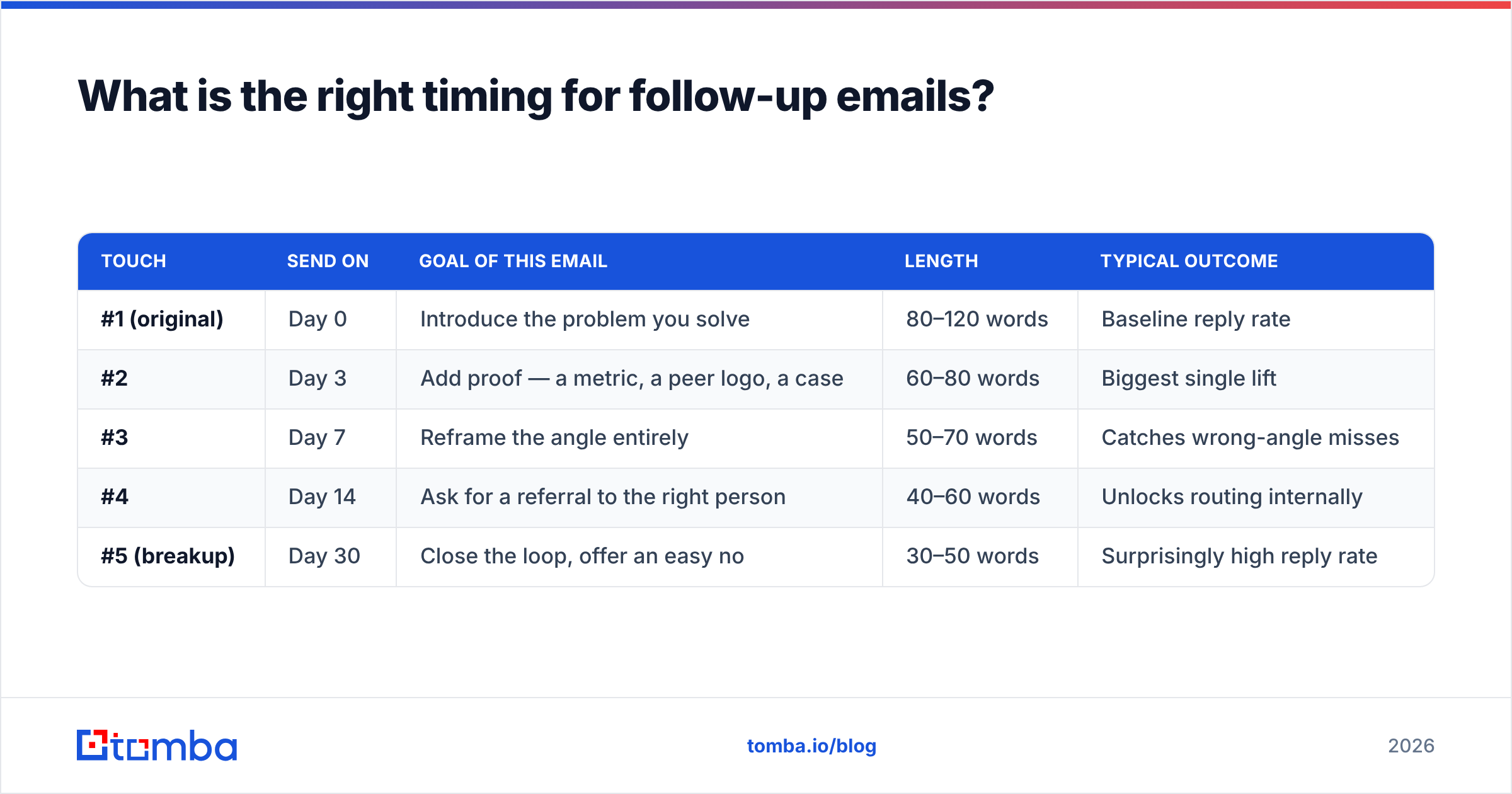
What is the right timing for follow-up emails?#
Widen the gaps as you go. Sending on days 1, 2, 3, 4 reads as desperation; sending on days 3, 7, 14, 30 reads as persistence.
| Touch | Send on | Goal of this email | Length | Typical outcome |
|---|---|---|---|---|
| #1 (original) | Day 0 | Introduce the problem you solve | 80–120 words | Baseline reply rate |
| #2 | Day 3 | Add proof — a metric, a peer logo, a case | 60–80 words | Biggest single lift |
| #3 | Day 7 | Reframe the angle entirely | 50–70 words | Catches wrong-angle misses |
| #4 | Day 14 | Ask for a referral to the right person | 40–60 words | Unlocks routing internally |
| #5 (breakup) | Day 30 | Close the loop, offer an easy no | 30–50 words | Surprisingly high reply rate |
Two timing rules that matter more than the exact days:
- Reply in-thread for touches 2 and 3, then start a fresh thread for 4 and 5. In-thread keeps context; a new subject line escapes a thread they've already mentally archived.
- Send Tuesday through Thursday, 7–9am in the recipient's timezone. Monday inboxes are triage mode. Friday afternoon is a graveyard. HubSpot's send-time research has held roughly consistent on this for years — check their email marketing benchmarks for the current numbers.
How many follow-ups is too many?#
Between five and seven touches over 30–45 days is the practical ceiling for cold outreach. Past that, incremental reply rate collapses while spam complaint rate keeps climbing — and complaints damage your sender reputation across every future campaign, not just this one.
For warm contexts — someone who requested a demo, a candidate mid-interview, a client who went quiet — three follow-ups is usually the limit before you switch channels. Pick up the phone, send a LinkedIn message, or ask a mutual contact to make an introduction. Channel-switching beats email touch #6 nearly every time.
The signal you should actually watch: complaint rate over 0.1% or bounce rate over 3%. Either one means stop the sequence and fix the list before you fix the copy.
What are the best follow-up email templates?#
Six templates, each mapped to a specific reason the thread went quiet. Swap the brackets and cut anything that doesn't apply.
1. The value-add bump (day 3)
Subject: re: [original subject]
Hi [Name] — one more data point since my last note. [Competitor/peer company] cut their [specific metric] by [number] after fixing [problem]. Rough numbers suggest a similar gap on your side.
Worth 12 minutes Thursday to see if the math holds?
2. The angle reframe (day 7)
Subject: different angle on [topic]
Hi [Name] — I may have led with the wrong thing. My last note was about [original angle], but most teams your size tell me the real pain is [second angle].
If that's closer to your world, I'll send a two-line summary instead of asking for a call. Want it?
3. The referral ask (day 14)
Subject: wrong person?
Hi [Name] — I've likely got the wrong contact. Who on your team owns [function]? Happy to take it off your plate and reach out to them directly.
4. The trigger-event restart
Subject: congrats on [event]
Hi [Name] — saw the [funding round / new hire / product launch]. Usually that means [specific downstream problem] shows up within a quarter.
If that's already on your radar, ignore this. If not, I've got a 3-minute rundown of how [peer company] handled it.
5. The post-meeting silence
Subject: still a fit?
Hi [Name] — after our call on [date] I sent over [proposal/pricing]. Haven't heard back, which usually means one of three things: budget shifted, priorities changed, or you're waiting on someone internally.
Which one is it? Any of the three is fine — I just want to know whether to keep your slot open.
6. The breakup (day 30)
Subject: closing the loop
Hi [Name] — I'll stop here so I'm not cluttering your inbox. If [problem] moves up your list in Q4, reply to this and I'll pick it back up.
Either way, good luck with [specific thing they're working on].
Template six consistently outperforms expectations. Removing the pressure is what makes people respond — a surprising share of replies to breakup emails are "wait, don't go."
If you want a wider starting library, Tomba's free cold email templates collection covers adjacent sequences, and the subject line generator is useful for the fresh-thread touches where the subject has to carry the open on its own.
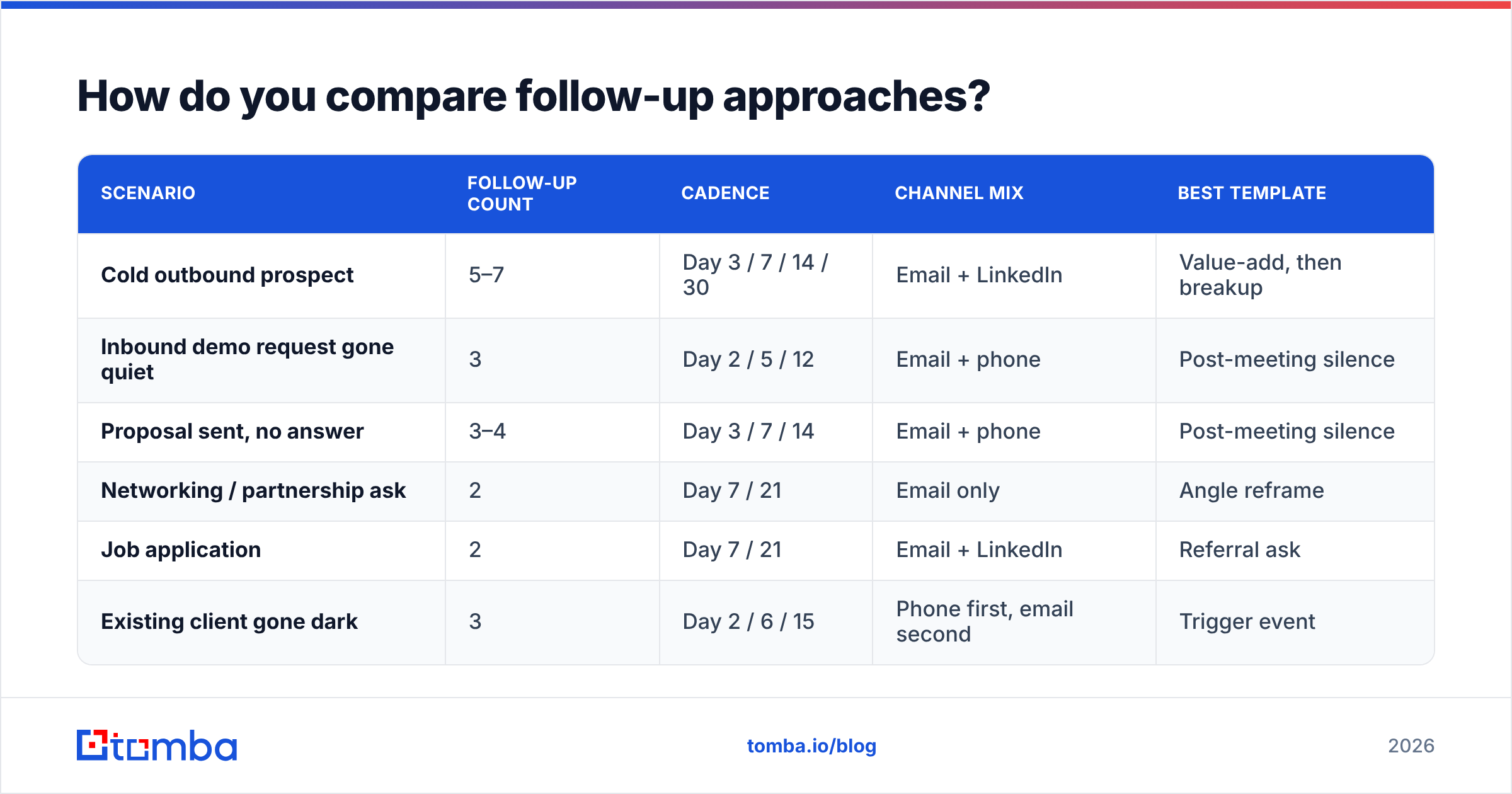
How do you compare follow-up approaches?#
Not every silent thread deserves the same treatment. Match the tactic to the relationship.
| Scenario | Follow-up count | Cadence | Channel mix | Best template |
|---|---|---|---|---|
| Cold outbound prospect | 5–7 | Day 3 / 7 / 14 / 30 | Email + LinkedIn | Value-add, then breakup |
| Inbound demo request gone quiet | 3 | Day 2 / 5 / 12 | Email + phone | Post-meeting silence |
| Proposal sent, no answer | 3–4 | Day 3 / 7 / 14 | Email + phone | Post-meeting silence |
| Networking / partnership ask | 2 | Day 7 / 21 | Email only | Angle reframe |
| Job application | 2 | Day 7 / 21 | Email + LinkedIn | Referral ask |
| Existing client gone dark | 3 | Day 2 / 6 / 15 | Phone first, email second | Trigger event |
The pattern: the warmer the relationship, the fewer emails and the faster you should switch to a live channel. Cold prospects are the only group where a long email-only sequence makes sense, because they have no obligation to you and the sequence itself is what builds recognition.
What kills follow-up reply rates?#
Six mistakes, ranked by how much damage they do.
- "Just checking in" / "bumping this to the top of your inbox." Zero new information. It signals that your time is worth less than theirs, and it trains them to ignore your name in the sender column.
- Guilt framing. "I noticed you haven't responded" makes the reader defensive. They owe you nothing.
- Attaching a deck to touch #2. A 4MB PDF from an unknown sender is both a spam signal and an ask for 20 minutes of unpaid work.
- Multiple questions in one email. Every additional question raises the cognitive cost of replying. One question, one decision.
- Sending to unverified addresses. Hard bounces compound. Two or three percent is survivable; past that, mailbox providers start throttling your domain and even your good sends stop landing. This is the fastest way to turn a copy problem into a deliverability problem.
- Identical sequences for every persona. A VP of Engineering and a CFO do not respond to the same proof. Segment at least by function.
The verification point deserves emphasis because it's invisible in most reporting. If you're running sequences at volume, bulk verify before launch and re-verify anything older than 90 days. B2B contact data decays at roughly 25–30% per year as people change roles — a list you built last spring is meaningfully wrong by now. Vendors including ZoomInfo and BookYourData publish similar decay figures, and the consensus range hasn't moved much in a decade.
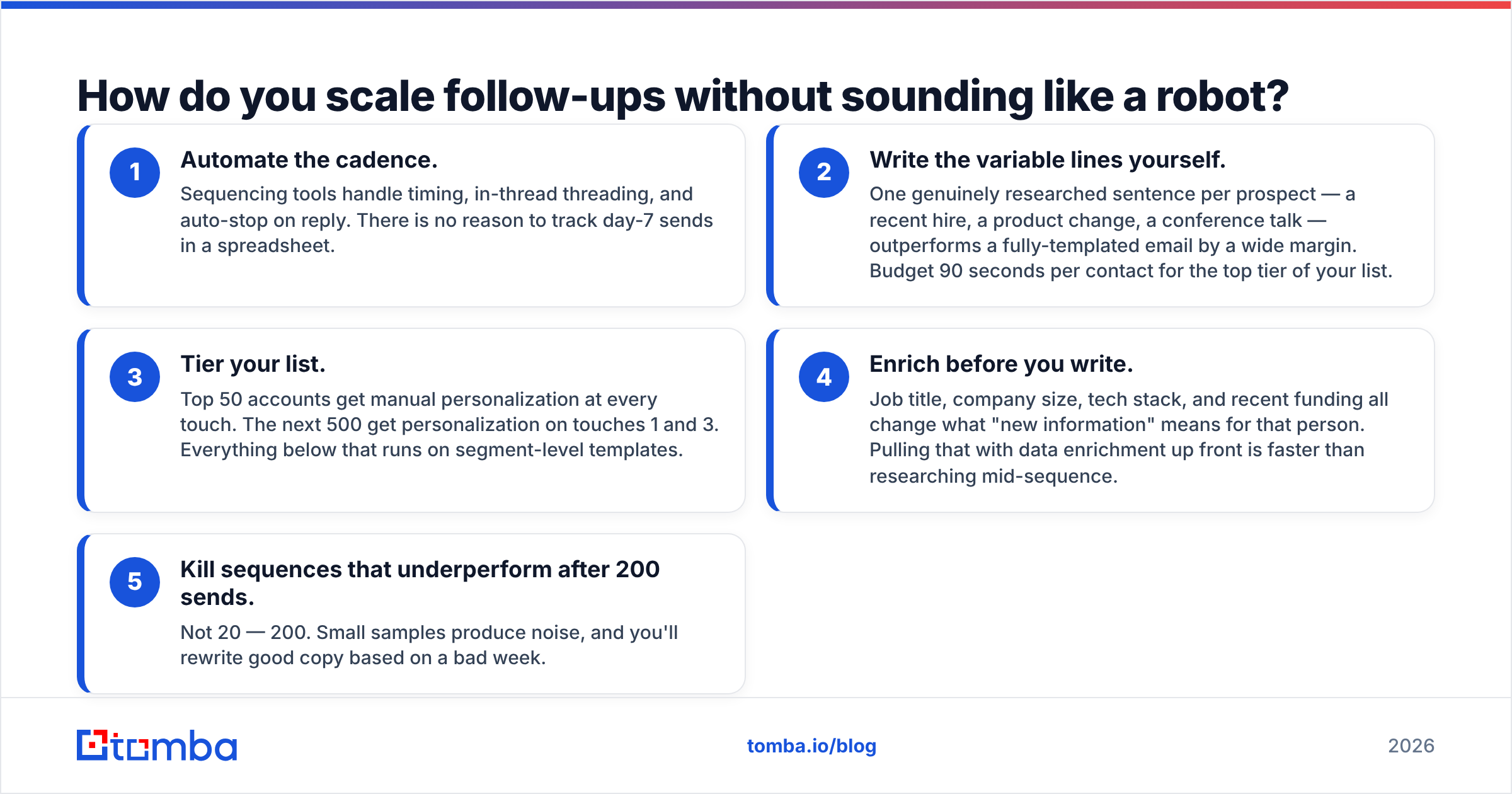
How do you scale follow-ups without sounding like a robot?#
Automate the sending, keep the thinking manual.
Practical split that works for most teams:
- Automate the cadence. Sequencing tools handle timing, in-thread threading, and auto-stop on reply. There is no reason to track day-7 sends in a spreadsheet.
- Write the variable lines yourself. One genuinely researched sentence per prospect — a recent hire, a product change, a conference talk — outperforms a fully-templated email by a wide margin. Budget 90 seconds per contact for the top tier of your list.
- Tier your list. Top 50 accounts get manual personalization at every touch. The next 500 get personalization on touches 1 and 3. Everything below that runs on segment-level templates.
- Enrich before you write. Job title, company size, tech stack, and recent funding all change what "new information" means for that person. Pulling that with data enrichment up front is faster than researching mid-sequence.
- Kill sequences that underperform after 200 sends. Not 20 — 200. Small samples produce noise, and you'll rewrite good copy based on a bad week.
One structural tip: write the whole sequence before you send touch #1. Writing follow-ups reactively, days later, is how you end up with "just checking in." When all five emails exist on day zero, each one is forced to say something different.
Ready to fix the silence at the source?#
Better follow-ups only pay off if the address is real and the person still works there. Start by verifying your list, then layer the cadence and templates above on top.
Tomba's Email Finder finds and verifies professional addresses by name, domain, or company, so your sequence reaches actual inboxes instead of bouncing into a reputation problem. The free tier includes 25 searches per month; paid plans start at $49/mo on Starter, with Growth at $99/mo and Pro at $249/mo — full breakdown on the Tomba pricing page. Verify first, follow up second, and the silence starts turning into replies.
Related guides#
Ready to find emails that actually work?
Join 150,000+ professionals who stopped guessing and started sending. Free credits on signup — no credit card required.
Get the Tomba newsletter
Practical outbound tactics and product updates — once every two weeks.
About the author