How to Write Short Emails That Actually Get Replies
Most cold emails die from bloat, not bad targeting. Here are six specific cuts, target word counts by email type, and before-and-after rewrites that turn 190-word essays into 65-word messages people actually answer.
TL;DR
- The sweet spot for a cold outreach email is 50-125 words. Past ~150 words, reply rates fall off a cliff because the message stops fitting on a phone screen.
- Short does not mean vague. Every short email that works still contains four things: a reason you wrote, a reason they should care, proof, and one ask.
- Six cuts get almost any draft under 100 words: kill the warm-up, kill the credentials paragraph, kill the second ask, kill hedges, kill adjectives, kill the "looking forward" close.
- Length targets differ by email type — a follow-up should be shorter than a first touch, and a reply to an inbound lead can be shorter still.
- Brevity only works when the one personalized line is accurate. Bad data plus a short email reads as spam; good data plus a short email reads as a colleague.
Why do short emails get more replies?#
Because the reader is deciding in about two seconds whether to deal with you now, deal with you later, or never.
Think of your inbox like airport security. Every message is a bag on the belt. The person scanning has a queue behind you and no interest in your life story — they want to know what's in the bag and whether it's their problem. A 40-word email is a clear plastic pouch. A 220-word email is a duffel bag with a broken zipper, and it gets pushed aside "for later," which means never.
Three mechanics drive this:
Screen real estate. A phone shows roughly 90-120 words above the fold in Gmail's mobile app. If your ask sits below that line, the reader has to scroll to find out what you want. Most won't.
Cognitive cost. Long emails signal "this will take effort to answer." Even a friendly prospect will triage a 250-word message into the "when I have time" pile.
Reply symmetry. People match the effort of what they received. Send four paragraphs and you implicitly ask for four paragraphs back. Send three sentences and a yes/no question, and a one-word reply feels acceptable — which is exactly what you want. Getting a "sure, Thursday works" is a win; you can improve your response rate enormously just by making the cheapest possible reply also a useful one.
HubSpot's sales research has been making this point for years across millions of tracked emails: shorter messages consistently outperform long ones for first-touch outreach, and the difference is not small. You can dig into their sales email data if you want the raw numbers.
What counts as a short email in 2026?#
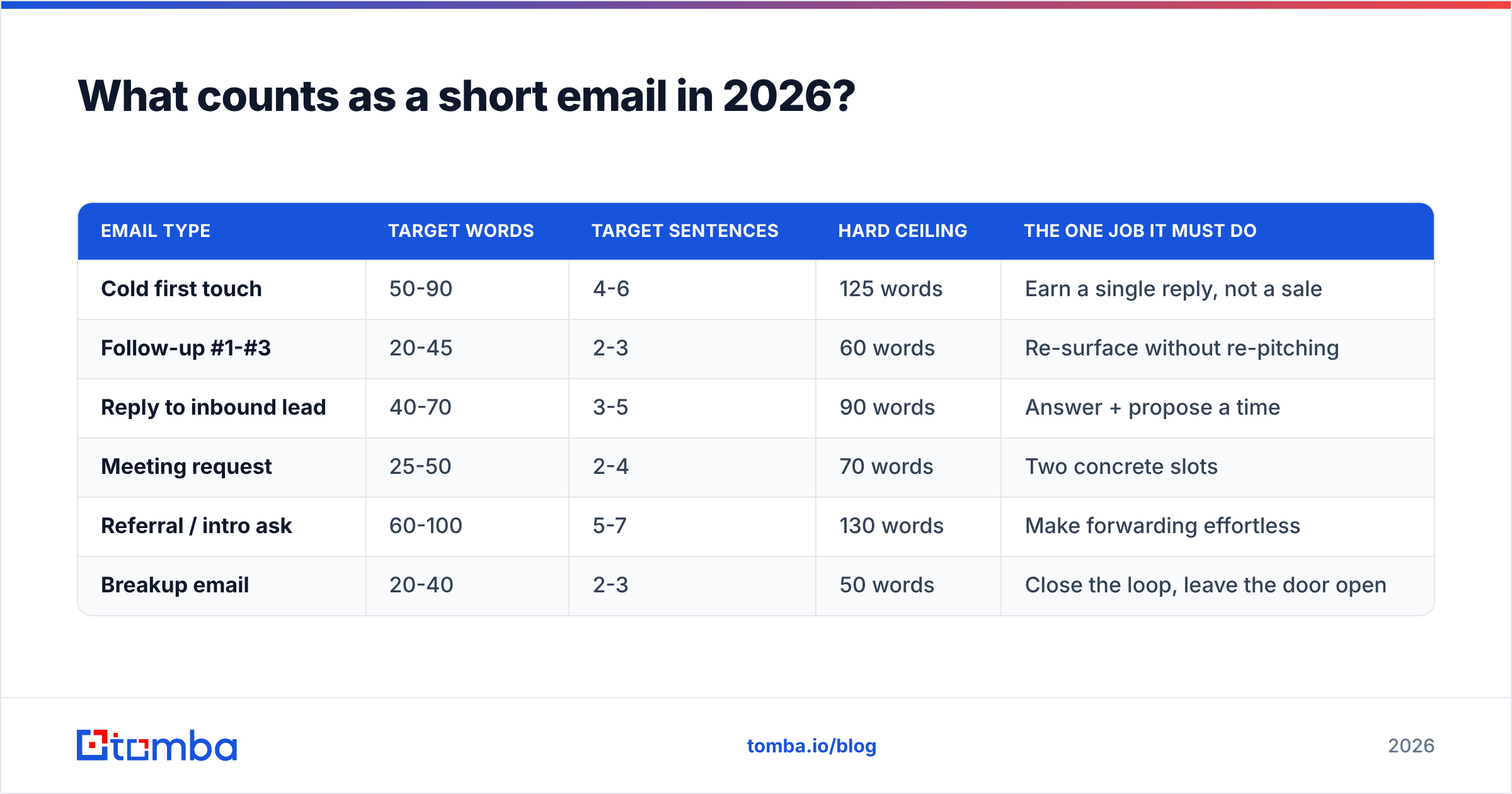
"Short" is relative to the job the email is doing. A first-touch cold email and a contract follow-up have different floors. Here's the working range I'd hold teams to:
| Email type | Target words | Target sentences | Hard ceiling | The one job it must do |
|---|---|---|---|---|
| Cold first touch | 50-90 | 4-6 | 125 words | Earn a single reply, not a sale |
| Follow-up #1-#3 | 20-45 | 2-3 | 60 words | Re-surface without re-pitching |
| Reply to inbound lead | 40-70 | 3-5 | 90 words | Answer + propose a time |
| Meeting request | 25-50 | 2-4 | 70 words | Two concrete slots |
| Referral / intro ask | 60-100 | 5-7 | 130 words | Make forwarding effortless |
| Breakup email | 20-40 | 2-3 | 50 words | Close the loop, leave the door open |
Two things to notice. First, follow-ups should get shorter, not longer — the instinct to "add more value" by stacking a case study onto email #3 is the single most common mistake I see in sequences. Second, the intro ask is the one place you're allowed extra words, because you're writing something the recipient will forward verbatim. Make their job copy-paste easy.
How do you write a short email in six cuts?#
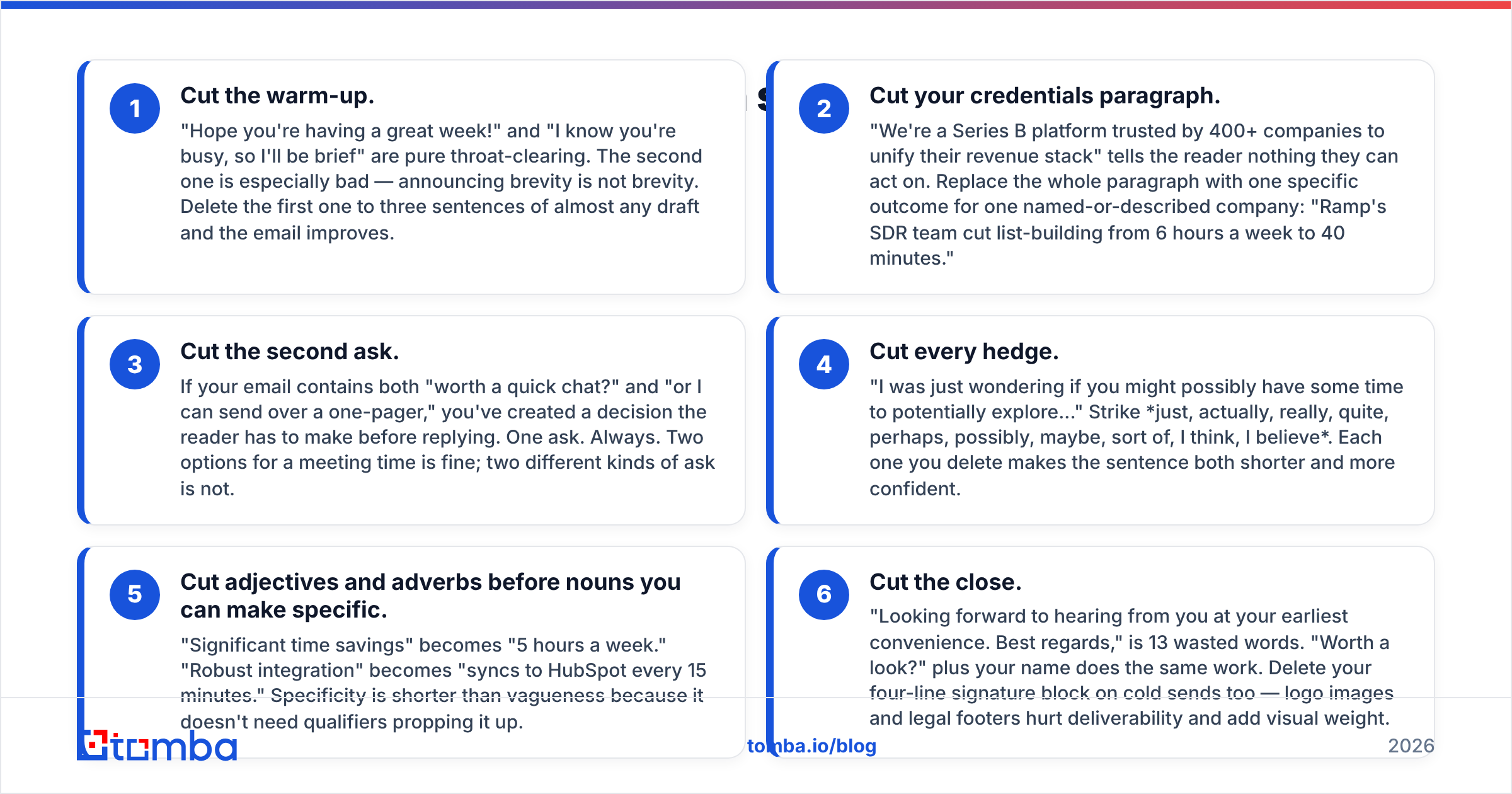
Don't try to write short. Write long, then cut. Editing beats drafting, every time. Run your draft through these six passes in order:
Cut the warm-up. "Hope you're having a great week!" and "I know you're busy, so I'll be brief" are pure throat-clearing. The second one is especially bad — announcing brevity is not brevity. Delete the first one to three sentences of almost any draft and the email improves.
Cut your credentials paragraph. "We're a Series B platform trusted by 400+ companies to unify their revenue stack" tells the reader nothing they can act on. Replace the whole paragraph with one specific outcome for one named-or-described company: "Ramp's SDR team cut list-building from 6 hours a week to 40 minutes."
Cut the second ask. If your email contains both "worth a quick chat?" and "or I can send over a one-pager," you've created a decision the reader has to make before replying. One ask. Always. Two options for a meeting time is fine; two different kinds of ask is not.
Cut every hedge. "I was just wondering if you might possibly have some time to potentially explore..." Strike just, actually, really, quite, perhaps, possibly, maybe, sort of, I think, I believe. Each one you delete makes the sentence both shorter and more confident.
Cut adjectives and adverbs before nouns you can make specific. "Significant time savings" becomes "5 hours a week." "Robust integration" becomes "syncs to HubSpot every 15 minutes." Specificity is shorter than vagueness because it doesn't need qualifiers propping it up.
Cut the close. "Looking forward to hearing from you at your earliest convenience. Best regards," is 13 wasted words. "Worth a look?" plus your name does the same work. Delete your four-line signature block on cold sends too — logo images and legal footers hurt deliverability and add visual weight.
Apply all six and a 200-word draft lands around 60-70 words without losing a single piece of information the reader needed.
What does the rewrite actually look like?#
Here's a real-shaped before-and-after. The "before" is the kind of thing a sequence builder spits out.
Before (187 words):
Hi Sarah,
I hope this email finds you well and that your week is off to a great start! My name is Alex and I'm a Senior Account Executive here at Acme, a leading provider of revenue intelligence software trusted by over 500 high-growth B2B companies worldwide.
I was doing some research on Northwind and I was really impressed by the significant growth your team has achieved recently — congratulations on the recent funding round! I noticed that you're currently hiring for several SDR roles, which suggests you may be scaling your outbound motion significantly.
Many of our clients in the fintech space have struggled with similar challenges around pipeline visibility and forecasting accuracy before working with us, and we've been able to help them achieve substantial improvements in their close rates and overall sales efficiency.
Would you possibly be open to a brief 15-30 minute introductory call sometime in the next couple of weeks to explore whether there might be a potential fit? Alternatively, I'd be more than happy to send over some materials for you to review at your convenience.
Looking forward to hearing from you!
After (58 words):
Hi Sarah,
You're hiring five SDRs this quarter. That usually means forecasting gets messy around month four.
Two fintechs your size — Brex and Mercury — hit that wall last year and fixed it by scoring pipeline at the account level instead of the rep level. Close rates moved 8 points in a quarter.
Worth 15 minutes on Thursday?
Alex
Same information density. Actually more specificity. The rewrite keeps the observation (hiring SDRs), adds a consequence the reader recognizes, gives proof with a number, and asks once with a day attached. What it drops: the greeting ritual, the company boilerplate, the flattery, the hedging, and the second ask.
Notice the after version never says "I hope this finds you well," never says "leading provider," and never uses the word "solution." If you struggle to generate these openers, running a first draft through a cold email AI and then applying the six cuts by hand is faster than staring at a blank compose window — but the cuts have to be manual. Generators pad.
Does shorter always beat longer?#
No, and pretending otherwise is how people write 15-word emails that read like ransom notes.
Short loses in four situations:
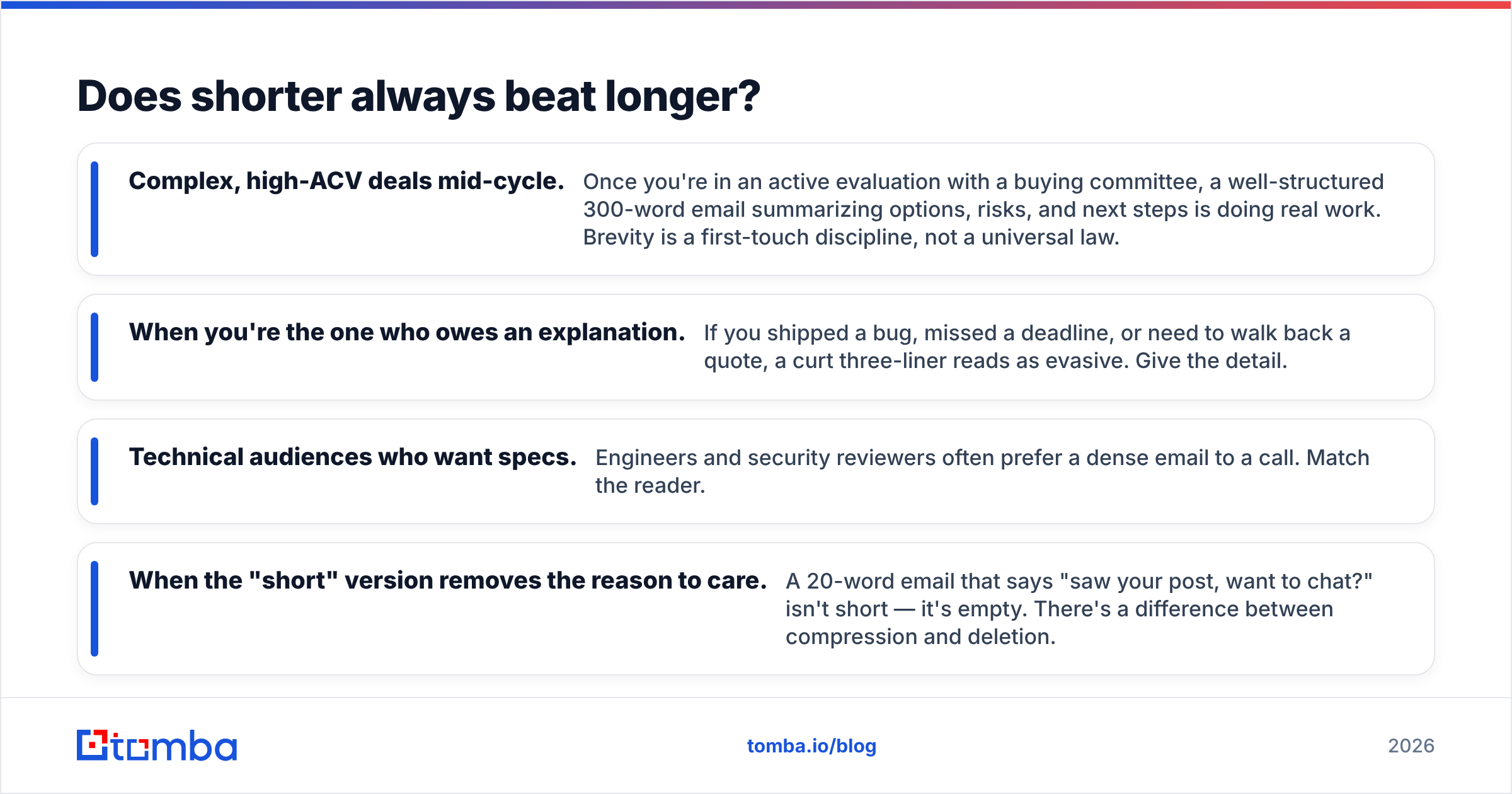
- Complex, high-ACV deals mid-cycle. Once you're in an active evaluation with a buying committee, a well-structured 300-word email summarizing options, risks, and next steps is doing real work. Brevity is a first-touch discipline, not a universal law.
- When you're the one who owes an explanation. If you shipped a bug, missed a deadline, or need to walk back a quote, a curt three-liner reads as evasive. Give the detail.
- Technical audiences who want specs. Engineers and security reviewers often prefer a dense email to a call. Match the reader.
- When the "short" version removes the reason to care. A 20-word email that says "saw your post, want to chat?" isn't short — it's empty. There's a difference between compression and deletion.
The honest framing: your goal is the shortest email that still contains a reason. If you cut so far that the recipient can't tell why you specifically wrote to them specifically, you've gone past the optimum. Readability scores help here — aim for a Flesch-Kincaid grade level around 5-7, which is roughly "short sentences, plain words," not "no content."
How do the main approaches to shortening emails compare?#
Teams usually reach for one of four methods. They are not equivalent.
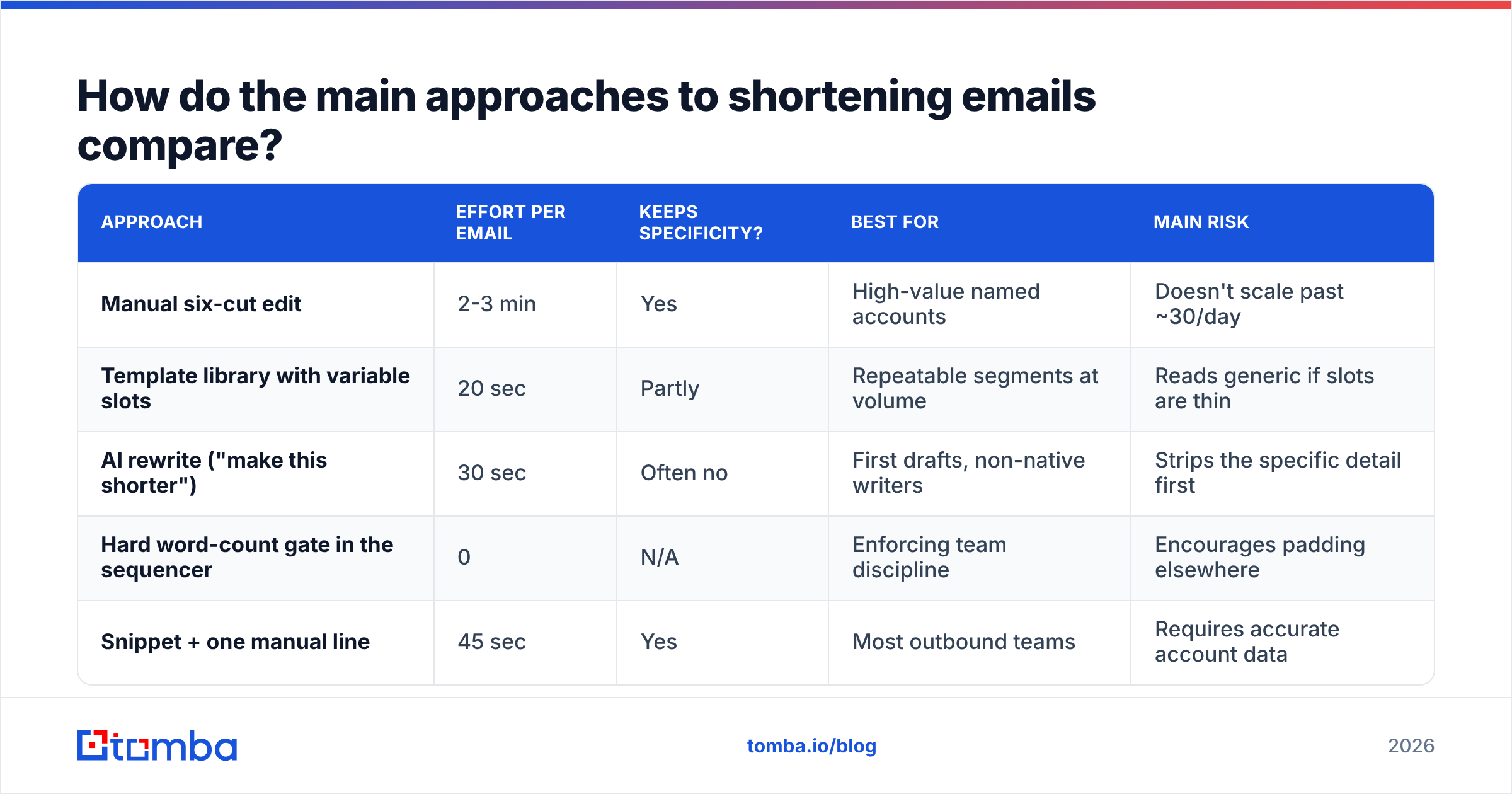
| Approach | Effort per email | Keeps specificity? | Best for | Main risk |
|---|---|---|---|---|
| Manual six-cut edit | 2-3 min | Yes | High-value named accounts | Doesn't scale past ~30/day |
| Template library with variable slots | 20 sec | Partly | Repeatable segments at volume | Reads generic if slots are thin |
| AI rewrite ("make this shorter") | 30 sec | Often no | First drafts, non-native writers | Strips the specific detail first |
| Hard word-count gate in the sequencer | 0 | N/A | Enforcing team discipline | Encourages padding elsewhere |
| Snippet + one manual line | 45 sec | Yes | Most outbound teams | Requires accurate account data |
The last row is the one most good teams converge on: a tight, tested skeleton of 40-50 words that never changes, plus one genuinely researched sentence written by a human. That hybrid keeps volume high and specificity real. A starting library of cold email templates saves you from re-deriving the skeleton every time; the personalized line is the part you should never automate blindly.
One more lever most people ignore: the subject line counts toward perceived length. A 60-word body under a 9-word subject line feels long. Keep subjects to 2-4 words, lowercase, no colons — "quick question about Q3 hiring" beats "Acme x Northwind: Exploring a Strategic Partnership Opportunity." If you're stuck, a subject line generator gives you variants to test, but the rule stands regardless of how you generate them.
How do you keep short emails from feeling generic?#
This is the real trade-off, and it's a data problem more than a writing problem.
A long email can hide weak research behind volume. A short email cannot. When you only have 60 words, one of them had better be a fact about the recipient that nobody else in their inbox has. That means the quality of your contact and company data directly sets the ceiling on how short you can go.
Three things to get right before you shorten anything:
Get the right person, not the right-ish person. A perfect 55-word email to the wrong title is worse than a mediocre one to the right title. Verify the role and the address before you spend effort on copy — bounces on a short, signature-free email look especially spammy to filters.
Have one true, checkable detail. Hiring posts, funding, a product launch, a conference talk, a changed pricing page, a new integration. One is enough. Two is showing off.
Know the account context, not just the person. Headcount, tech stack, and growth stage let you write "that usually means X breaks around month four" — the consequence sentence that makes short emails land. Pulling that from a data enrichment step before you write beats guessing.
Gartner's research on B2B buying consistently shows buyers spend a small fraction of their time with any single vendor. You can read their B2B buyer studies for the underlying behavior. The practical takeaway is the same as the mechanical one: you get a sliver of attention, so spend it on the sentence that proves you did homework — not on your company description.
What's the checklist before you hit send?#
Run this in under 30 seconds:
- Is the ask visible without scrolling on a phone?
- Is there exactly one ask?
- Can you point to one sentence that could only have been written to this person?
- Did you delete every instance of just, really, actually, quite, hope this finds you well?
- Is the subject line four words or fewer?
- Would you reply to this in under 10 seconds if you received it?
If the last one is a no, cut another 20 words and try again.
Start with the data, then cut the words#
Short emails are a two-part discipline: ruthless editing on the copy side, and accurate contacts on the data side. The editing you can learn in an afternoon with the six cuts above. The data is the part that quietly caps your results — because the one specific line that makes a 58-word email work only exists if you know who you're writing to and that the address is real.
That's where Tomba Email Finder fits: find verified professional addresses by domain, name, or company, so the person on the other end of your newly-tightened email actually exists and actually opens it. Free tier gives you 25 searches a month to test the workflow; Starter is $49/mo and Growth is $99/mo if you're running real volume. See the full Tomba pricing breakdown, then go delete some adjectives.
Related guides#
// get started
Find, verify and enrich your first contacts today
Start on the free plan with 25 searches a month, then scale when your team is ready.
Free plan · No credit card required · GDPR & CCPA
// about the author