Hubforce Alternatives: 7 Better B2B Data Tools for 2026
Hubforce bundles prospecting, contact data, and outreach into one subscription — but bundles get expensive fast. Here are 7 Hubforce alternatives compared on price, data quality, and the exact team each one fits.
TL;DR
- Hubforce sits in the "all-in-one GTM platform" bucket: contact data, list building, and outreach bundled into one seat-based subscription with quote-based enterprise pricing. Most teams that leave do so for cost predictability, not missing features.
- If you mainly need accurate work emails on demand, a focused finder-and-verifier stack (Tomba, Hunter) costs a fraction of a bundle and plugs into the CRM you already pay for.
- If you need a huge searchable database plus sequencing in one login, Apollo is the closest like-for-like swap.
- If you want zero subscription and a one-time list purchase, BookYourData's credit model is the cleanest fit.
- Verify before you send, whatever you pick. Bounce rate is a function of your verification layer, not your vendor's marketing page.
What is Hubforce, and who is it for?#
Hubforce is positioned as a consolidated B2B go-to-market platform — the category that promises to replace three or four line items (a data provider, a list builder, an enrichment tool, and a sequencer) with a single subscription. The pitch is familiar and genuinely appealing: one contract, one vendor relationship, one place your reps log in.
Two honest caveats before you compare anything. First, Hubforce publishes limited pricing detail publicly and leans on quote-based plans, so anything you read online about "the real cost" is secondhand — get a written quote with credit limits, seat minimums, and overage rates spelled out. Second, bundled platforms are evaluated as a whole, which hides the fact that most of them are strong in one module and merely adequate in the rest. Your job when shopping for Hubforce alternatives is to figure out which module you actually depend on.
That single question — which module am I really paying for? — determines whether you need a replacement platform or just a replacement component.

Why do teams look for Hubforce alternatives?#
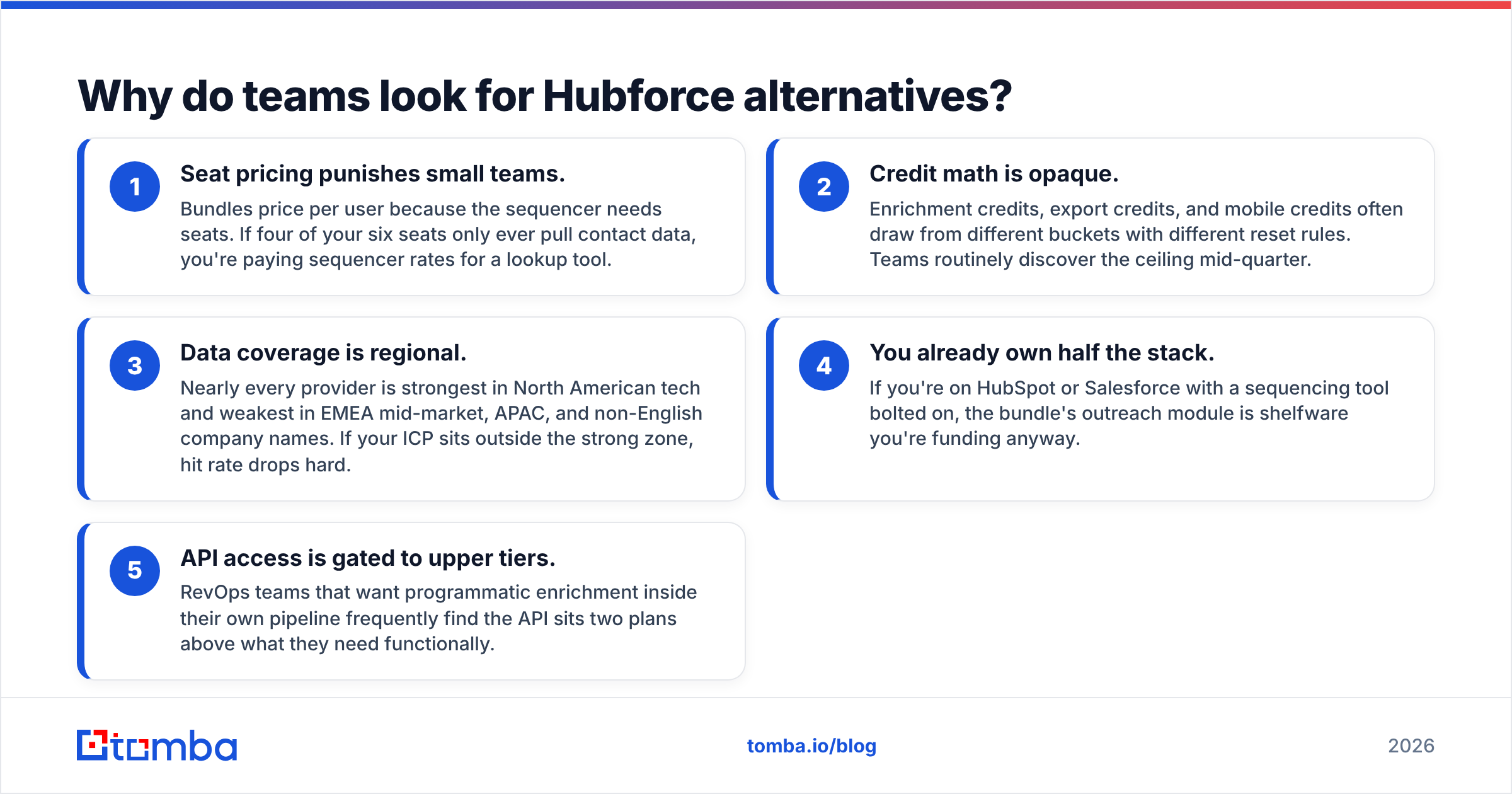
Across G2 reviews and vendor-switch conversations, the reasons an all-in-one platform gets replaced cluster into five recurring complaints. None of them are exotic:
- Seat pricing punishes small teams. Bundles price per user because the sequencer needs seats. If four of your six seats only ever pull contact data, you're paying sequencer rates for a lookup tool.
- Credit math is opaque. Enrichment credits, export credits, and mobile credits often draw from different buckets with different reset rules. Teams routinely discover the ceiling mid-quarter.
- Data coverage is regional. Nearly every provider is strongest in North American tech and weakest in EMEA mid-market, APAC, and non-English company names. If your ICP sits outside the strong zone, hit rate drops hard.
- You already own half the stack. If you're on HubSpot or Salesforce with a sequencing tool bolted on, the bundle's outreach module is shelfware you're funding anyway.
- API access is gated to upper tiers. RevOps teams that want programmatic enrichment inside their own pipeline frequently find the API sits two plans above what they need functionally.
If two or more of those apply, a focused tool plus your existing CRM is usually cheaper and faster than another bundle.
How should you evaluate a Hubforce alternative?#
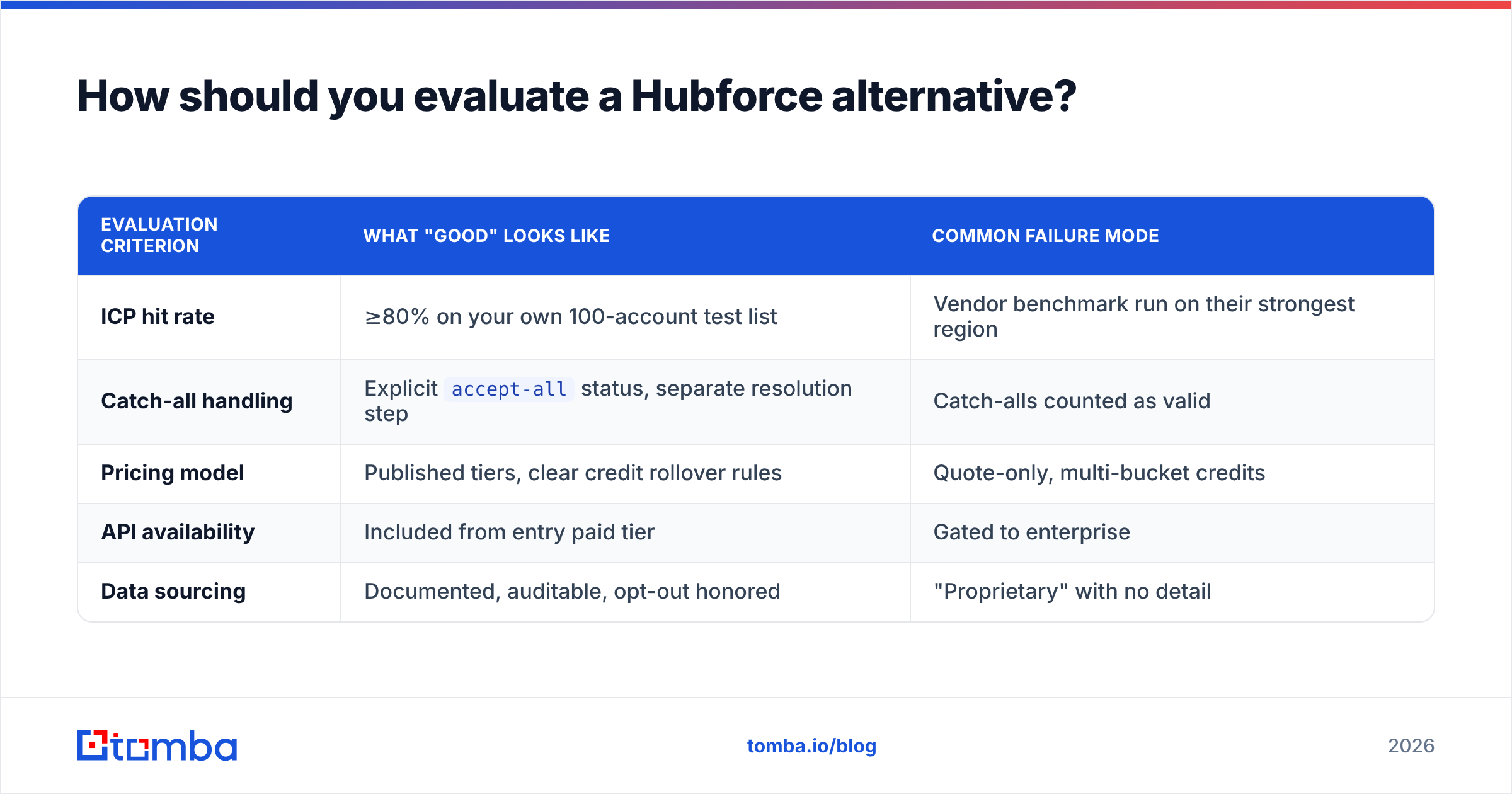
Run every candidate through the same five checks. Do it with your own list, not the vendor's demo list — demo lists are curated.
- Hit rate on your ICP. Pull 100 real target accounts, run them through each tool's free tier or trial, and count verified results. A tool with 92% coverage in US SaaS and 40% in German manufacturing is not "92% accurate" for you.
- Verification depth. Ask specifically how catch-all domains are handled. Roughly a fifth of B2B domains accept all mail, and a provider that returns those as "valid" is quietly inflating its accuracy number. A dedicated catch-all verifier resolves what a generic SMTP ping cannot.
- True cost per usable contact. Divide monthly cost by verified, deliverable contacts you actually exported — not credits granted. This is the only number that compares bundles to point tools fairly.
- API and workflow access. Check which plan unlocks the API, what the rate limits are, and whether bulk jobs are included or metered separately.
- Compliance posture. GDPR/CCPA handling, opt-out processing, and documented sourcing. Ask where the data comes from and get it in writing.
| Evaluation criterion | What "good" looks like | Common failure mode |
|---|---|---|
| ICP hit rate | ≥80% on your own 100-account test list | Vendor benchmark run on their strongest region |
| Catch-all handling | Explicit accept-all status, separate resolution step |
Catch-alls counted as valid |
| Pricing model | Published tiers, clear credit rollover rules | Quote-only, multi-bucket credits |
| API availability | Included from entry paid tier | Gated to enterprise |
| Data sourcing | Documented, auditable, opt-out honored | "Proprietary" with no detail |
Which Hubforce alternatives are worth comparing in 2026?#
Here are the seven that come up most often in replacement shortlists, with the team each one actually fits. Prices are list rates at the time of writing — always confirm on the vendor's own pricing page before you budget.
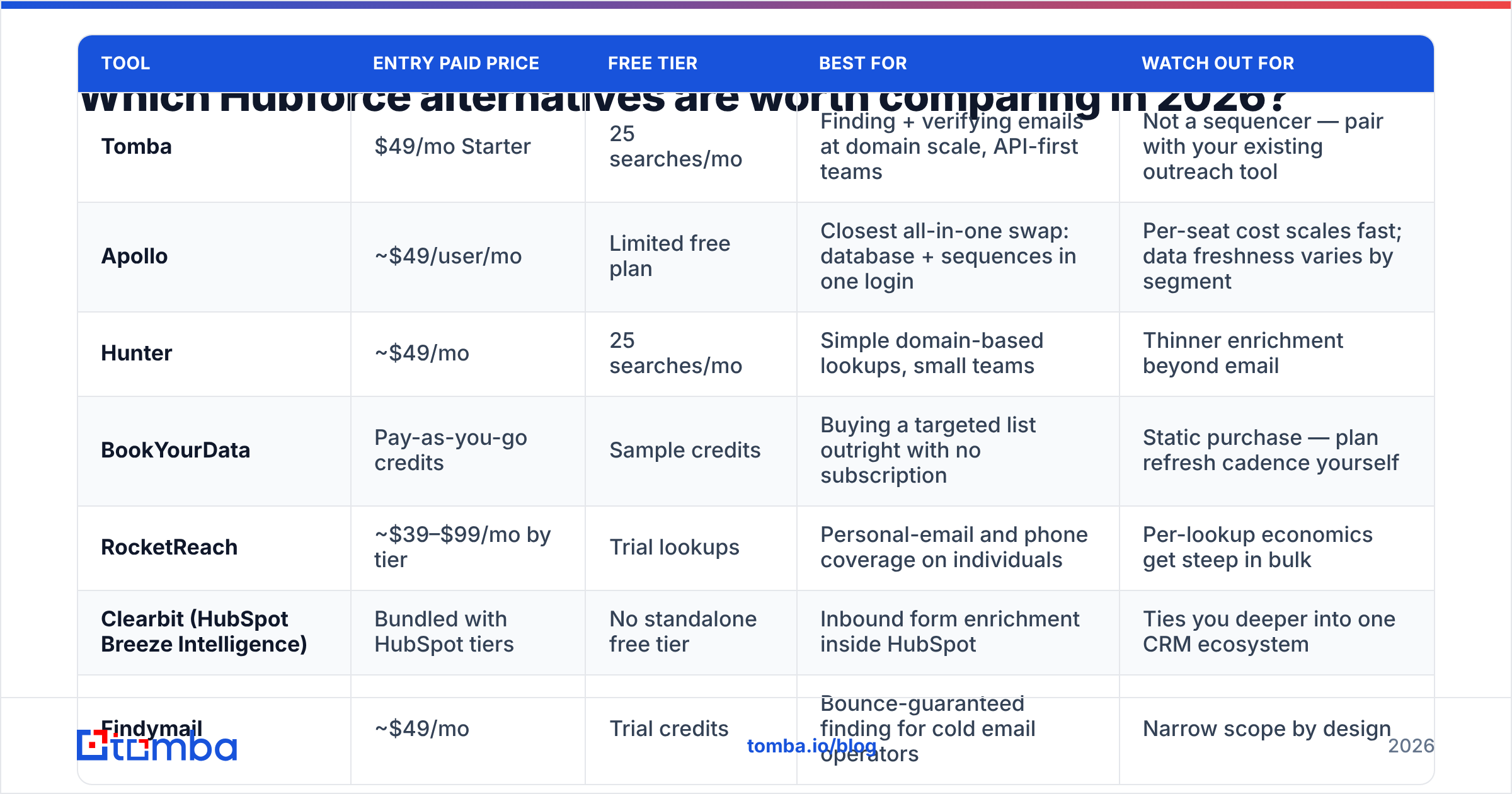
| Tool | Entry paid price | Free tier | Best for | Watch out for |
|---|---|---|---|---|
| Tomba | $49/mo Starter | 25 searches/mo | Finding + verifying emails at domain scale, API-first teams | Not a sequencer — pair with your existing outreach tool |
| Apollo | ~$49/user/mo | Limited free plan | Closest all-in-one swap: database + sequences in one login | Per-seat cost scales fast; data freshness varies by segment |
| Hunter | ~$49/mo | 25 searches/mo | Simple domain-based lookups, small teams | Thinner enrichment beyond email |
| BookYourData | Pay-as-you-go credits | Sample credits | Buying a targeted list outright with no subscription | Static purchase — plan refresh cadence yourself |
| RocketReach | ~$39–$99/mo by tier | Trial lookups | Personal-email and phone coverage on individuals | Per-lookup economics get steep in bulk |
| Clearbit (HubSpot Breeze Intelligence) | Bundled with HubSpot tiers | No standalone free tier | Inbound form enrichment inside HubSpot | Ties you deeper into one CRM ecosystem |
| Findymail | ~$49/mo | Trial credits | Bounce-guaranteed finding for cold email operators | Narrow scope by design |
Tomba — the focused finder-and-verifier#
If your dependence on Hubforce is really "we need reliable work emails," this is the cheapest honest swap. Tomba's email finder resolves names and domains to verified addresses, domain search returns every discoverable address at a company with role and department context, and the email verifier runs the deliverability check before anything reaches your sequencer. Plans run Free (25 searches/mo), Starter $49/mo, Growth $99/mo, Pro $249/mo, with enterprise custom — full Tomba pricing is public, which matters when you're escaping a quote-only contract. The Tomba API is available on paid plans rather than reserved for enterprise, which is the single most common reason RevOps teams pick it over a bundle.
The trade-off is honest: Tomba does not send your emails. You keep your sequencer.
Apollo — the like-for-like bundle#
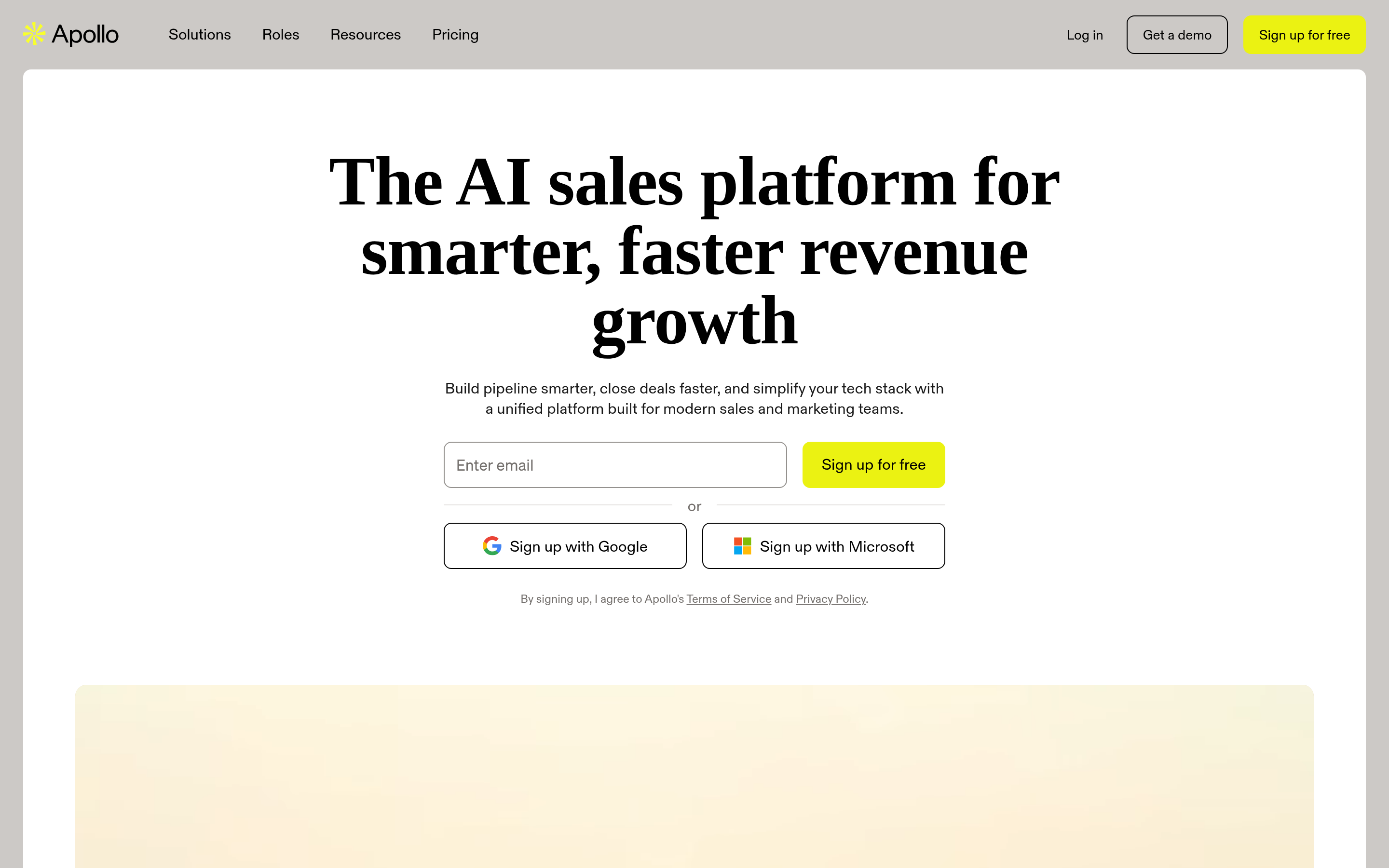
Apollo is the most direct structural replacement: a large contact database, filters, sequences, and basic dialing in one product. If you liked Hubforce's shape and just want better economics or a bigger database, start here. Budget realistically for seats, and test coverage on your non-US segments before committing annually. If you go the other direction later, there's a well-trodden path to an Apollo alternative stack.
Hunter — the minimalist#
Hunter does domain-based email discovery cleanly and has done it for a decade. For a two-person founding team sending 200 emails a month, it's plenty. For a RevOps team wanting enrichment fields, phone data, and high-volume bulk jobs, you'll outgrow it.
BookYourData — buy the list, skip the subscription#
BookYourData takes a different and refreshingly transparent approach: you filter a targeted B2B list, pay per credit, and own the export. There's no seat count and no monthly floor, which makes it a strong fit for one-off campaign launches, event follow-up lists, or teams whose prospecting is bursty rather than continuous. It's a genuinely different purchasing model from a platform subscription, and for the right use case it's the more rational one. Plan how you'll refresh the data yourself — any purchased list decays at roughly 2-3% per month as people change jobs.
RocketReach, Clearbit, and Findymail#
RocketReach earns its place when you need personal emails and mobile numbers on named individuals — recruiting and executive search lean on it heavily. Clearbit, now folded into HubSpot as Breeze Intelligence, is the right answer only if you're already deep in HubSpot and your primary need is enriching inbound form fills. Findymail is a narrower cold-email-operator tool with a bounce guarantee. Each is a component, not a platform — which is exactly the point.

Is an unbundled stack actually cheaper than Hubforce?#
Usually yes, and the reason is structural rather than clever: bundles charge per seat because the outreach module needs seats, while data tools can charge per lookup.
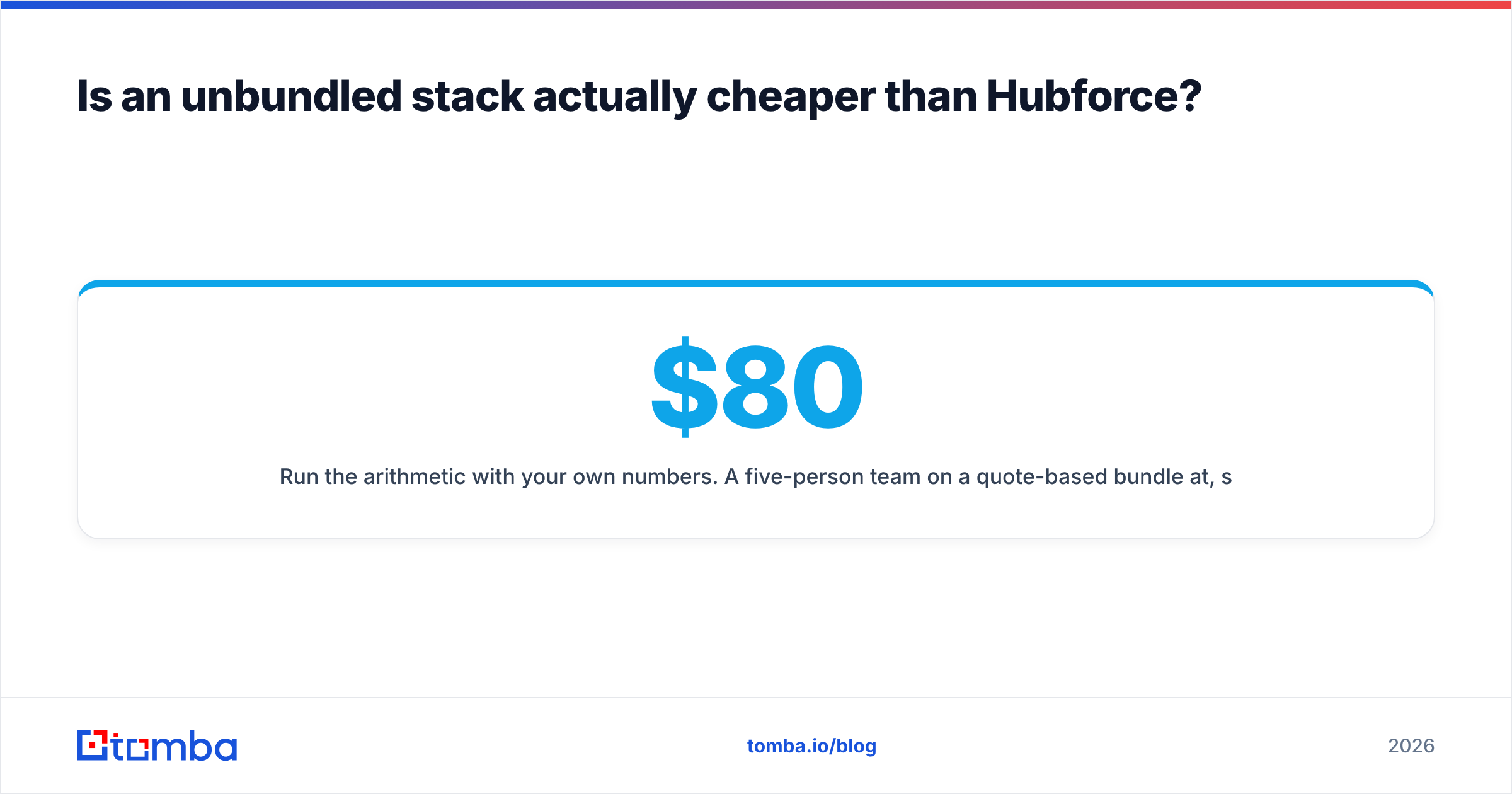
Run the arithmetic with your own numbers. A five-person team on a quote-based bundle at, say, $80-$150 per seat per month lands somewhere between $4,800 and $9,000 a year before overages. The same team running a $99/mo data layer plus a sequencer they already own lands near $1,200 plus the sequencer they were paying for anyway. The bundle wins only if the sequencer is genuinely replacing a separate line item and the data coverage is at least equal.
Two rules keep the unbundled version from turning into chaos:
- One system of record. Everything lands in the CRM. Tools write to it; nothing else stores state.
- One enrichment entry point. Pick a single API or bulk email finder job that does lookups, and route all requests through it. Two teams enriching the same accounts through two tools is how you double your spend without noticing.
How do you migrate off Hubforce without breaking pipeline?#
Run the switch in parallel for one full sales cycle. Nobody regrets the overlap month; plenty of teams regret the cold cutover.
- Export everything first. Contacts, sequences, activity history, custom fields, and notes. Confirm the export includes the fields you actually filter on, not just name and email.
- Benchmark on 100 real accounts. Run the same list through the incumbent and each candidate. Compare verified hit rate and cost per usable contact, not raw match counts.
- Re-verify the entire imported list. Data that sat in a platform for a year has decayed. A full verification pass before your first send protects your sender reputation — this is the step teams skip and then blame the new vendor for.
- Rebuild sequences natively. Don't try to import cadence logic across platforms. Copy the content, rebuild the timing.
- Keep the old contract running 30 days past cutover. Cheap insurance against a field you forgot to export.
What's the right pick for your team?#
- Small team, need emails, already have a sequencer: Tomba Starter or Growth. Lowest total cost, public pricing, API included.
- You want one login for everything: Apollo. Accept per-seat economics as the price of consolidation.
- Bursty, campaign-based prospecting: BookYourData credits. No subscription to justify in quiet months.
- Recruiting or exec search: RocketReach for personal-contact coverage.
- HubSpot-native inbound motion: Breeze Intelligence, and skip the standalone data vendor entirely.
For an independent read on where each of these sits by category and review volume, the G2 lead intelligence category is a reasonable sanity check against vendor claims — just weight recent reviews heavily, since data products change faster than review pages do.
Ready to test a leaner stack?#
Start with the piece that carries the most risk: the data. Run 25 of your real target accounts through the Tomba Email Finder on the free tier, verify the results, and compare the hit rate against what Hubforce returns for the same list. If the numbers hold, you'll have your answer before you've spent a dollar — and if they don't, you've lost twenty minutes instead of an annual contract.
Related guides#
// get started
Find, verify and enrich your first contacts today
Start on the free plan with 25 searches a month, then scale when your team is ready.
Free plan · No credit card required · GDPR & CCPA
// about the author