HubSpot Sales Pitch: How to Build One That Closes in 2026
A teardown of the HubSpot sales pitch structure — the discovery questions, the value framing, the objection handling — plus a copy-ready template and the data work that has to happen before you pitch anyone.
TL;DR
- The "HubSpot sales pitch" means two different things: the pitch HubSpot's own reps use to sell HubSpot, and the pitch framework HubSpot teaches in its sales methodology content. This guide covers both, because the second one is what you can actually steal.
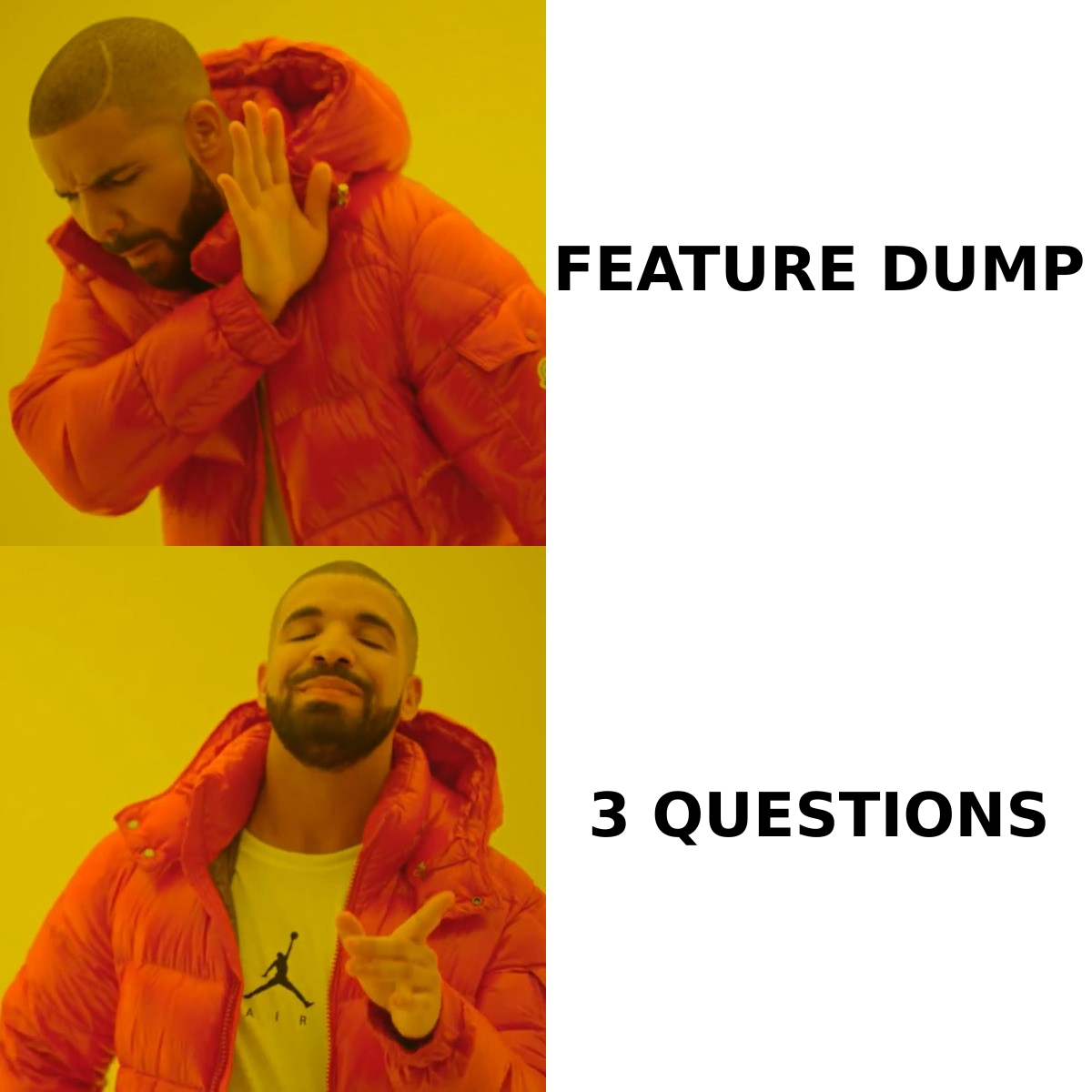
- The structure that works is short: a one-sentence context hook, three diagnostic questions, a problem restatement in the buyer's words, one quantified outcome, and a small next step. Roughly 8–10 minutes of talking, not 30.
- Feature dumps lose. HubSpot's own inbound framing — help first, sell second — is the reason their reps get second meetings, not the product tour.
- The pitch fails before it starts if your contact data is wrong. A perfect script sent to a bounced address closes nothing.
- Use the templates and objection scripts below verbatim, then rewrite them in your own voice within two weeks. Scripts are scaffolding, not furniture.
What is the HubSpot sales pitch, exactly?#
A HubSpot sales pitch is a short, structured conversation that leads with the buyer's problem and earns a specific next step — not a product walkthrough.
That definition matters because most people searching for this phrase want one of two things. Either they are a HubSpot rep or partner who needs the actual pitch used to sell HubSpot CRM, or they are a salesperson who noticed that HubSpot publishes a lot of pitch frameworks and wants the good one. The two overlap more than you'd think, because HubSpot sells the way it teaches.
Think of it like a doctor's appointment. A bad doctor walks in and starts listing the drugs in the cabinet. A good doctor asks where it hurts, how long it's been hurting, what you've already tried, and only then names a treatment. The HubSpot pitch structure is the second consultation. Everything in it is designed to delay the product mention until the buyer has said out loud what they want fixed.
The pitch has four jobs, in order:
- Earn the right to ask questions. One sentence of relevant context — a trigger event, a shared connection, a number from their industry. Not your company's founding story.
- Diagnose out loud. Three to five questions that make the buyer articulate the cost of the status quo. If they don't say it, they don't believe it.
- Reframe, then quantify. Repeat the problem back using their vocabulary, then attach a number to it. "You said reps lose about six hours a week on manual entry" is a pitch. "Our automation saves time" is noise.
- Ask for something small. A 20-minute technical call. A trial with two seats. A shared doc. Never "so what do you think?"

How does HubSpot's own pitch actually work?#
HubSpot's inside sales motion is built on inbound qualification, which changes the pitch shape. Their reps usually talk to someone who already downloaded something, so the opening line references that action instead of manufacturing rapport.
The sequence their reps run looks close to this:
- Connect call (10–15 min). Confirm the trigger, confirm the role, confirm there's a real problem. No demo. The only goal is booking the exploratory call.
- Exploratory call (30–45 min). Deep discovery using GPCT — Goals, Plans, Challenges, Timeline — plus budget and authority folded in as GPCTBA/C&I. This is where the real pitch lives.
- Demo (30–60 min). Tailored to exactly the three challenges named in exploratory. Anything else gets skipped, even if it's impressive.
- Close call. Pricing, seats, contract length, implementation timeline.
The GPCT framework is the part worth copying regardless of what you sell. You can read HubSpot's own explanation of it on the HubSpot sales blog, and it's worth noting how much of their published methodology mirrors what their reps do internally — that consistency is unusual.
What HubSpot's reps do not do, generally: open with a feature list, send a 40-slide deck before a call, or pitch the full platform to a five-person company. Their qualification is aggressive enough that a lot of prospects get disqualified on the connect call, which is a feature.
Is the HubSpot pitch better than a traditional sales pitch?#
For inbound and mid-market deals, yes. For pure cold outbound into enterprise, it needs modification — the connect call assumes a trigger event you may not have.
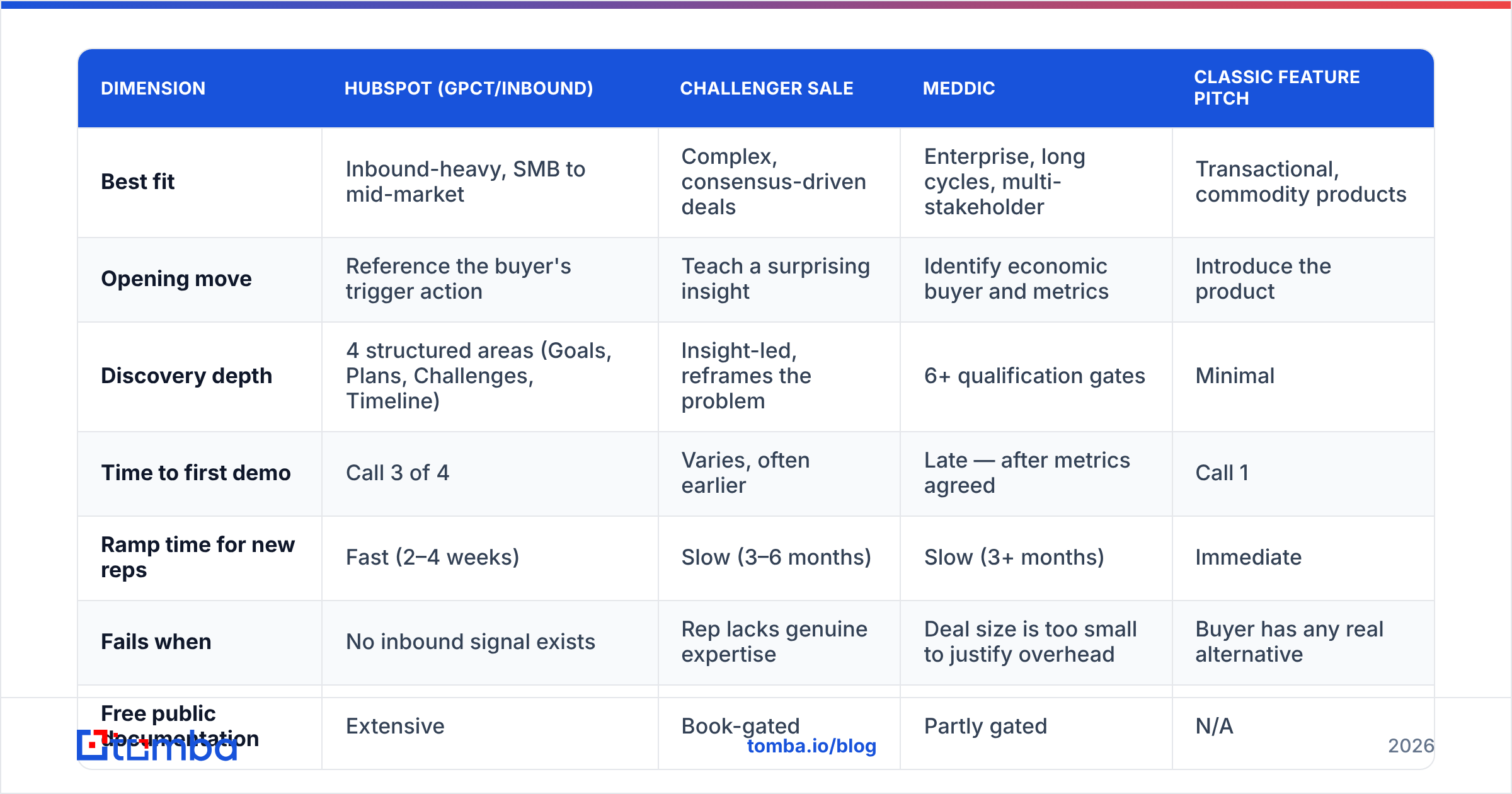
Here's how the common frameworks stack up on the dimensions that matter when you're choosing one for your team:
| Dimension | HubSpot (GPCT/inbound) | Challenger Sale | MEDDIC | Classic feature pitch |
|---|---|---|---|---|
| Best fit | Inbound-heavy, SMB to mid-market | Complex, consensus-driven deals | Enterprise, long cycles, multi-stakeholder | Transactional, commodity products |
| Opening move | Reference the buyer's trigger action | Teach a surprising insight | Identify economic buyer and metrics | Introduce the product |
| Discovery depth | 4 structured areas (Goals, Plans, Challenges, Timeline) | Insight-led, reframes the problem | 6+ qualification gates | Minimal |
| Time to first demo | Call 3 of 4 | Varies, often earlier | Late — after metrics agreed | Call 1 |
| Ramp time for new reps | Fast (2–4 weeks) | Slow (3–6 months) | Slow (3+ months) | Immediate |
| Fails when | No inbound signal exists | Rep lacks genuine expertise | Deal size is too small to justify overhead | Buyer has any real alternative |
| Free public documentation | Extensive | Book-gated | Partly gated | N/A |
The honest read: HubSpot's framework wins on ramp speed and accessibility. A new rep can run a decent GPCT call in their third week. MEDDIC produces better forecast accuracy on six-figure deals but takes a quarter to internalize. Most teams under 30 reps should start with the HubSpot structure and layer MEDDIC-style qualification gates on top once deal sizes justify it. Reviews on G2 tend to echo this — teams praise the speed of onboarding more than the depth of the methodology.
What does a HubSpot sales pitch template look like?#
Below is a pitch you can run on a first call today. Replace the bracketed parts. Total speaking time on your side: under four minutes across the whole call.
Opening (20 seconds). "Hi [Name] — I saw [specific trigger: you're hiring three SDRs / you just launched in DACH / you downloaded the pipeline template]. I work with [similar company type] on [narrow problem]. Before I assume anything applies to you, can I ask three quick questions?"
Diagnostic block (the buyer talks for 10+ minutes).
- Goals — "What number are you personally accountable for this quarter?"
- Plans — "What's the current plan to hit it? What's already in motion?"
- Challenges — "What's the part of that plan you're least confident about?"
- Timeline — "If nothing changes, when does this become a real problem?"
Reframe (30 seconds). "So if I've got this right: you need [their number] by [their date], the plan depends on [their plan], and the weak point is [their words, not yours]. Is that fair, or did I miss something?"
That last clause — "or did I miss something" — is the highest-leverage sentence in the whole pitch. It invites correction, and corrections are where the real objection lives.
Value statement (45 seconds). "The teams we work with that had that exact gap typically [specific outcome with a number]. For example, [one-sentence customer story, same industry, same role]. I don't know yet whether that maps to your setup."
Next step (15 seconds). "Two options. I can send you a two-page breakdown of how [company] handled it, or we can put 25 minutes on the calendar with your ops person to look at your actual pipeline data. Which is more useful?"
Giving two next steps instead of one converts noticeably better than a single ask, because the buyer chooses instead of consenting.
Why do most sales pitches fail before the first sentence?#
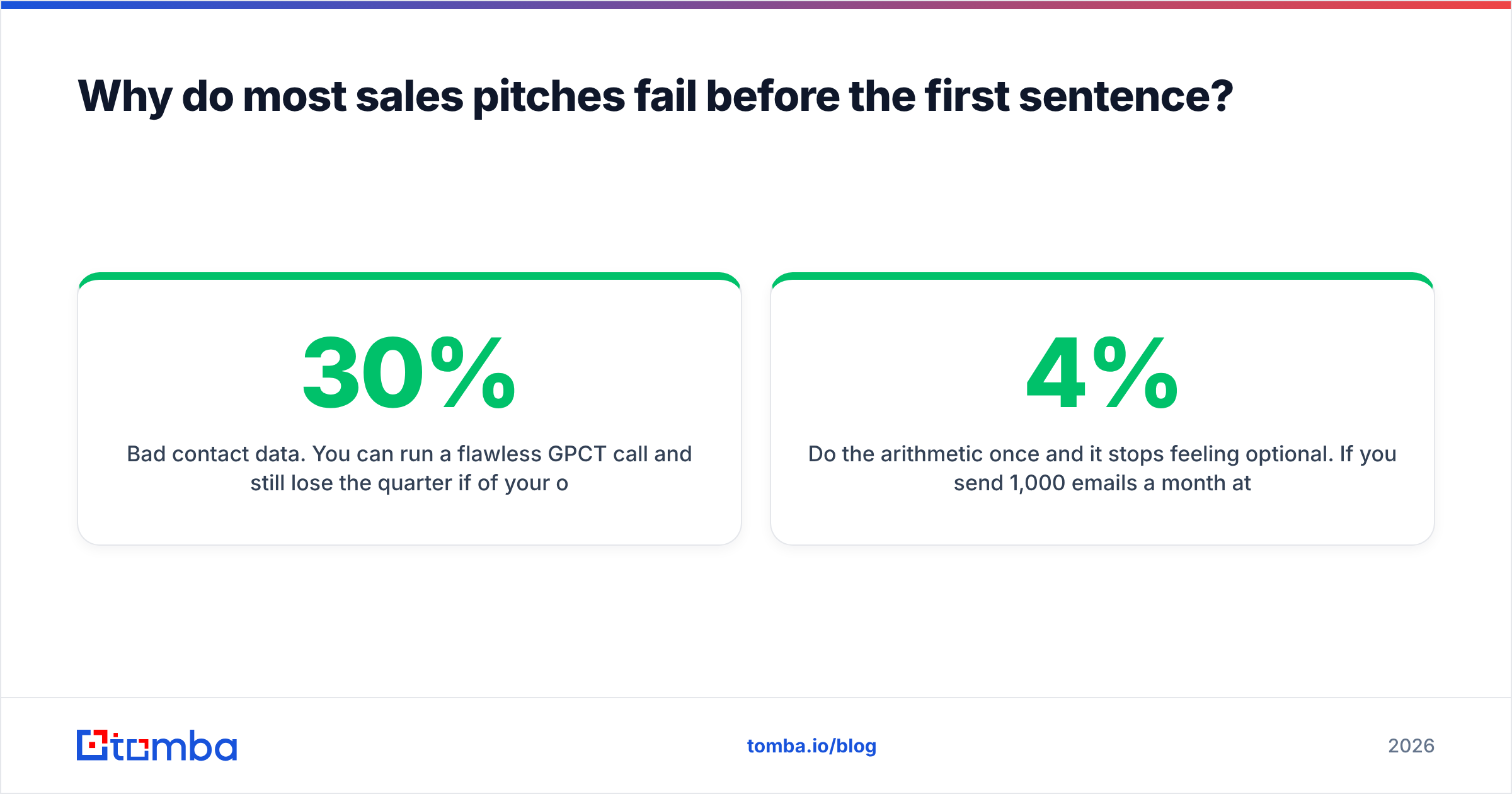
Bad contact data. You can run a flawless GPCT call and still lose the quarter if 30% of your outreach never arrives or lands on someone who left the company 14 months ago.
This is the unglamorous half of pitching that nobody blogs about. A pitch is a conversation, and a conversation requires a real person at a reachable address. The failure modes stack:
- Bounces. Every hard bounce damages your sender reputation, which quietly reduces inbox placement for the messages that were going to convert.
- Wrong role. Pitching a GPCT-style discovery to someone with no budget authority burns your one shot at that account.
- Stale titles. Someone promoted out of the role two years ago gets a pitch about a problem they no longer own.
- Catch-all domains. The address doesn't bounce, but nobody reads it. Worst case, because it looks like delivery.
Fixing this is mechanical. Run your list through an email verifier before any sequence goes out, use a catch-all verifier for the domains that come back ambiguous, and enrich the rows that are missing a title or a company size so your opening line has something real in it. Data enrichment is what turns "Hi there, I wanted to reach out" into "I saw you're hiring three SDRs."
Do the arithmetic once and it stops feeling optional. If you send 1,000 emails a month at a 4% reply rate, that's 40 conversations. Cut your bounce and wrong-contact rate from 25% to 5% and the same 1,000 sends produce roughly 48 conversations. Eight extra pitches a month, from a data hygiene step that takes an afternoon — no change to the script, no change to the rep.
How do you handle the four objections that kill HubSpot-style pitches?#
Objections are data, not resistance. Each one tells you which part of the diagnostic block you rushed.
"We're already using [competitor]." Wrong response: attack the competitor. Right response: "Good — that means you've already solved [problem X]. What's the part it doesn't cover?" You're not displacing a tool, you're finding the gap it leaves. If there's no gap, disqualify and move on. Two minutes saved is two minutes earned.
"Send me some information." This usually means you failed to make the problem urgent. "Happy to. So I send the right thing — is the piece you're weighing [option A] or [option B]?" If they can't answer, there's no active project and you should schedule a check-in for next quarter rather than pretending you have a deal.
"It's too expensive." Almost never about price. It's about unproven value. "Compared to what?" is the shortest useful reply in sales. Then: "If this returned [their number] in [their timeline], would the price still be the issue?" You're separating budget objections from value objections, which need completely different responses.
"I need to talk to my team." Fine — but don't hand off blind. "Makes sense. Who else is affected by [problem]? I'd rather give you something that answers their questions than have you defend this alone." Then you build the internal-champion material for them. This is where most mid-market deals are actually won.
For a longer treatment of consensus-driven buying, Gartner's research on B2B buying groups is the standard reference — their finding that a typical purchase involves six to ten stakeholders reframes why the "talk to my team" objection is the norm rather than a stall.
What tools do you need behind the pitch?#
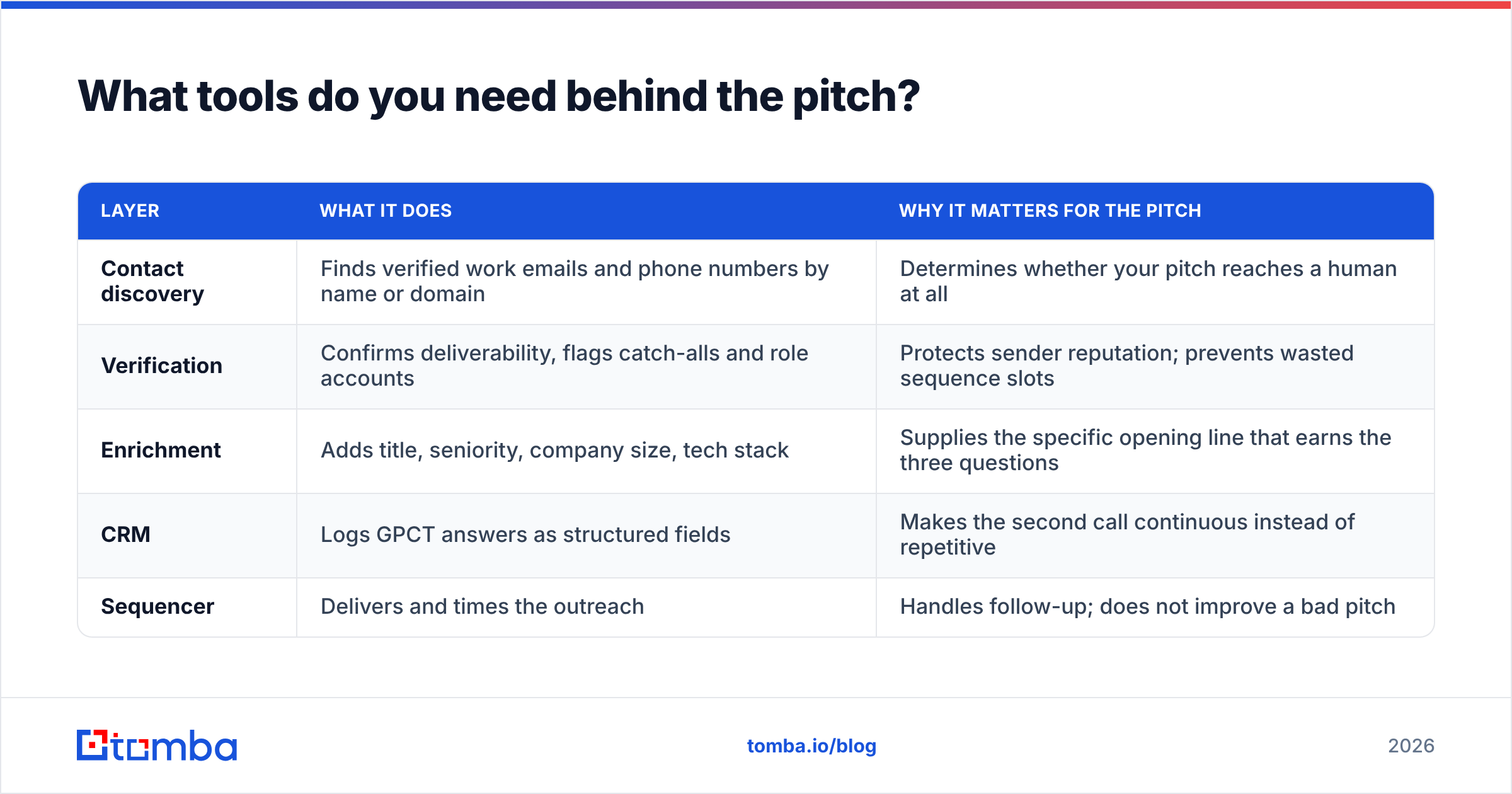
Less than vendors want you to believe. The stack behind a good pitch has three jobs: find the right person, confirm they're reachable, and remember what was said.
| Layer | What it does | Why it matters for the pitch |
|---|---|---|
| Contact discovery | Finds verified work emails and phone numbers by name or domain | Determines whether your pitch reaches a human at all |
| Verification | Confirms deliverability, flags catch-alls and role accounts | Protects sender reputation; prevents wasted sequence slots |
| Enrichment | Adds title, seniority, company size, tech stack | Supplies the specific opening line that earns the three questions |
| CRM | Logs GPCT answers as structured fields | Makes the second call continuous instead of repetitive |
| Sequencer | Delivers and times the outreach | Handles follow-up; does not improve a bad pitch |
Two notes on this table. First, the CRM point is underrated: if your GPCT answers live in a free-text notes field, nobody can coach off them and your manager can't see pattern-level objections. Put Goals, Plans, Challenges, and Timeline in four discrete fields. HubSpot's own CRM does this out of the box, which is not an accident.
Second, the sequencer is last for a reason. Teams routinely buy a sequencing tool to fix a pitch problem, then wonder why volume went up and meetings didn't. Automation multiplies whatever you already have, including zero.
For discovery and verification, tools like Tomba, Findymail, and BookYourData all serve slightly different needs — BookYourData leans toward pre-built, pay-as-you-go list purchasing when you want a finished dataset, while a domain search approach fits better when you're building account lists yourself and want to see every contact at a target company before choosing who to pitch. Match the tool to whether you're buying a list or building one.
How do you practice the pitch without burning real accounts?#
Record yourself, transcribe it, and count your talk ratio. Anything above 45% on a discovery call is a problem.
A practical drill sequence:
- Week 1 — read it. Run the template verbatim on low-stakes accounts. It will feel stiff. Ship it anyway.
- Week 2 — cut it. Remove every sentence that didn't produce a buyer response. Most reps cut 40% of their opening.
- Week 3 — vary the diagnostic. Swap in industry-specific versions of question three, the "least confident" question. This is the one that earns the meeting.
- Week 4 — pressure-test objections. Have a colleague run the four objections above back to back, with no warmup. If your answer takes more than 15 seconds, it's not ready.
- Ongoing — review one lost deal a week. Find the exact moment the pitch became a monologue. There's almost always one.
The teams that improve fastest aren't the ones with the best script. They're the ones who review calls weekly and change one thing. A pitch is a living document, and the version you use in month six should look meaningfully different from the one you started with — same skeleton, better questions.
The prep step that makes the pitch work#
Your pitch is only as good as the person hearing it. Before you run the GPCT structure on a single account, build the list properly: identify the right title, get a verified work email, and enrich the row with enough context to write an opening line that isn't generic.
Tomba's Email Finder does the first part — find professional email addresses by domain, name, or company, with verification built into the same workflow so you're not stitching two tools together. The free tier gives you 25 searches a month to test whether the data holds up on your specific accounts, and paid plans start at $49/mo on Starter, $99/mo on Growth, and $249/mo on Pro; full Tomba pricing is on the site. Build the list first, then run the pitch. In that order.
Related guides#
// get started
Find, verify and enrich your first contacts today
Start on the free plan with 25 searches a month, then scale when your team is ready.
Free plan · No credit card required · GDPR & CCPA
Get the Tomba newsletter
Product and data updates
// about the author