HubSpot vs SharpSpring: Which CRM Wins in 2026?
HubSpot and SharpSpring (now Constant Contact Lead Gen & CRM) target the same buyer from opposite ends. Here's the honest pricing, feature, and data-quality breakdown before you sign a year.
HubSpot vs SharpSpring comes down to one question: do you want a full platform, or a cheaper automation engine with unlimited seats? This guide compares both on real prices, contact limits, and data quality. Short version: HubSpot fits in-house teams. SharpSpring fits agencies.
TL;DR
- HubSpot is the broader platform. Better UX, a genuinely usable free CRM, and 1,700+ integrations. The catch: Marketing Hub Professional starts at $890/month, and contact tiers climb fast.
- SharpSpring (rebranded as Constant Contact Lead Gen & CRM) is the agency-first option: flat-ish pricing around $449–$1,299/month, unlimited users, and white-label rebilling that HubSpot simply doesn't offer.
- Choose HubSpot if you're an in-house revenue team that will use sales, service, and marketing in one place. Choose SharpSpring if you run several client accounts, or you need unlimited seats without per-seat math.
- Neither one finds you contacts. Both charge you by contact record. So importing an unverified list is the single most expensive mistake you can make.
- Pair either platform with a dedicated email finder and email verifier. Then you only pay to store records that can actually receive mail.
What Are HubSpot and SharpSpring, Exactly?#
HubSpot started as an inbound marketing tool in 2006. It now spans five hubs: Marketing, Sales, Service, Content, and Operations. The free CRM is real, not a trial. That's why HubSpot has a bigger install base than almost anyone in mid-market B2B. You can run a pipeline, log emails, and build forms without paying a dollar. The cost arrives when you need automation, custom reports, or more than a couple of paid seats.
SharpSpring launched in 2014 with the opposite pitch. It offered most of what HubSpot Marketing Hub does, at roughly a third of the price, with agency rebilling baked in. Constant Contact acquired it in 2021, and it now ships as Constant Contact Lead Gen & CRM. The SharpSpring name still owns the search volume, which is why you're reading this. The roadmap, though, now sits inside Constant Contact.
That deal matters for your decision. SharpSpring's pace of new features slowed after the acquisition. HubSpot ships changes weekly. Sign a 12-month contract in 2026 and you're partly betting on which roadmap keeps moving.
HubSpot vs SharpSpring: How Do They Compare Head-to-Head?#
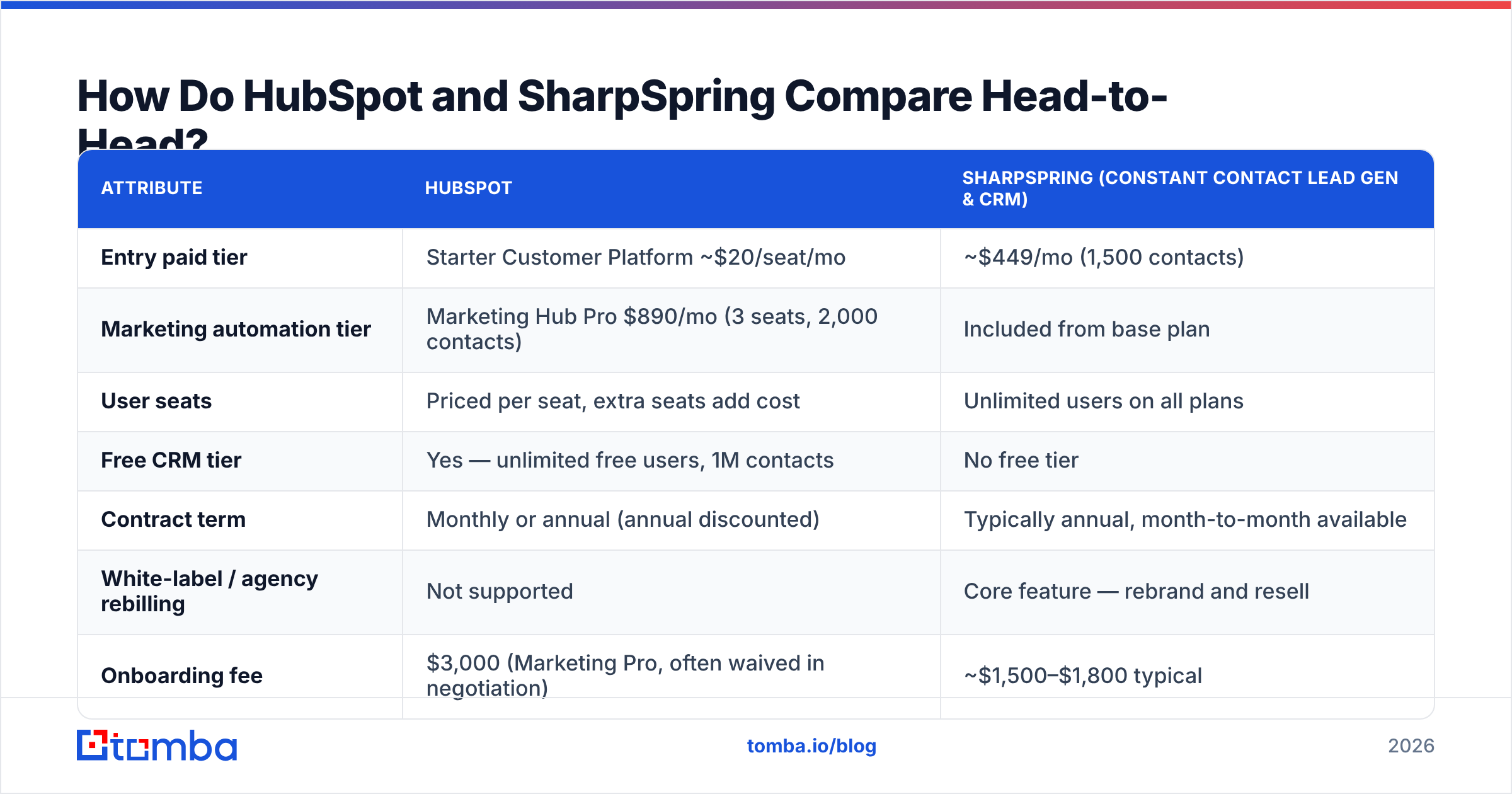
Here's the practical breakdown. Prices reflect published list rates as of early 2026. Both vendors negotiate, and both push annual prepay discounts.
| Attribute | HubSpot | SharpSpring (Constant Contact Lead Gen & CRM) |
|---|---|---|
| Entry paid tier | Starter Customer Platform ~$20/seat/mo | ~$449/mo (1,500 contacts) |
| Marketing automation tier | Marketing Hub Pro $890/mo (3 seats, 2,000 contacts) | Included from base plan |
| User seats | Priced per seat, extra seats add cost | Unlimited users on all plans |
| Free CRM tier | Yes — unlimited free users, 1M contacts | No free tier |
| Contract term | Monthly or annual (annual discounted) | Typically annual, month-to-month available |
| White-label / agency rebilling | Not supported | Core feature — rebrand and resell |
| Onboarding fee | $3,000 (Marketing Pro, often waived in negotiation) | ~$1,500–$1,800 typical |
| Native integrations | 1,700+ in App Marketplace | ~50 native + Zapier |
| CRM depth | Full sales + service hubs, custom objects | Solid CRM, lighter service tooling |
| Reporting | Custom report builder, attribution on Pro+ | Campaign + funnel reporting, less flexible |
| Learning curve | Gentle; best-in-class UX | Steeper; interface feels dated |
The pattern is clear. HubSpot charges more and gives you a platform. SharpSpring charges less and gives you a marketing automation engine with a CRM attached.
Which One Is Actually Cheaper at Scale?#
Cheaper depends on your seat count and contact volume. The two vendors punish you on opposite axes.
Run the math on a 12-person team with 25,000 marketing contacts:
- HubSpot Marketing Hub Pro — $890/mo base covers 2,000 contacts. Extra contacts bill in blocks of 5,000. At 25,000 contacts, expect $1,400–$1,800/mo before Sales Hub seats.
- HubSpot Sales Hub Pro — roughly $100/seat/mo. Twelve seats adds ~$1,200/mo.
- SharpSpring — the 25,000-contact tier lands near $1,299/mo, and all twelve users are included at no extra cost.
- Hidden costs on both — onboarding fees, data migration, and the API overage charges nobody reads about until month three.
So SharpSpring wins on raw list price for a mid-sized team. HubSpot wins when much of your team only needs the free CRM and read access. That's a common shape at companies where marketing is small and sales is big.
The variable nobody prices correctly is contact hygiene. Both platforms bill on stored contacts. Say 30% of your 25,000 records are dead, role-based, or catch-all addresses. You now pay monthly rent on data that will never convert. That's why teams increasingly run a bulk verify pass before import rather than after.
Is HubSpot's Automation Better Than SharpSpring's?#
Different, not strictly better. HubSpot's workflow builder is easier to learn and harder to break. SharpSpring's is more permissive. In trained hands, it's faster for complex branching.
Where HubSpot pulls ahead:
- Custom objects on Enterprise let you model non-standard data (properties, vehicles, courses) natively, instead of hacking it into contact fields.
- Sequences and snippets in Sales Hub are genuinely good for 1:1 rep outreach, not just batch marketing sends.
- Attribution reporting across the full funnel is available without bolting on a third tool.
- Ecosystem depth — if a tool exists in B2B SaaS, it probably has a native HubSpot integration.
Where SharpSpring pulls ahead:
- Dynamic landing pages with behavior-based content swapping ship in the base plan. HubSpot gates smart content behind Pro.
- Unlimited users means you can give every client contact a login without a budget conversation.
- Shopping-cart abandonment and lead scoring are included rather than tier-gated.
- Agency dashboard — one login, many client instances, with rebilling. HubSpot's Partner tooling doesn't replicate this.
If your automation needs stop at 'send the right email after someone downloads the guide,' both handle it. Building lifecycle programs across five product lines? HubSpot's structure holds up better as complexity grows.
What About Data Quality and Deliverability?#
Most HubSpot vs SharpSpring comparisons skip this section. It's the one that decides whether either platform earns its cost.
Neither HubSpot nor SharpSpring is a data provider. HubSpot retired much of its old contact-enrichment functionality. It now sells Breeze Intelligence credits as a paid add-on. SharpSpring never had strong enrichment. Both expect you to arrive with contacts.
That creates a predictable failure loop:
- Team buys a list or scrapes one to fill the CRM.
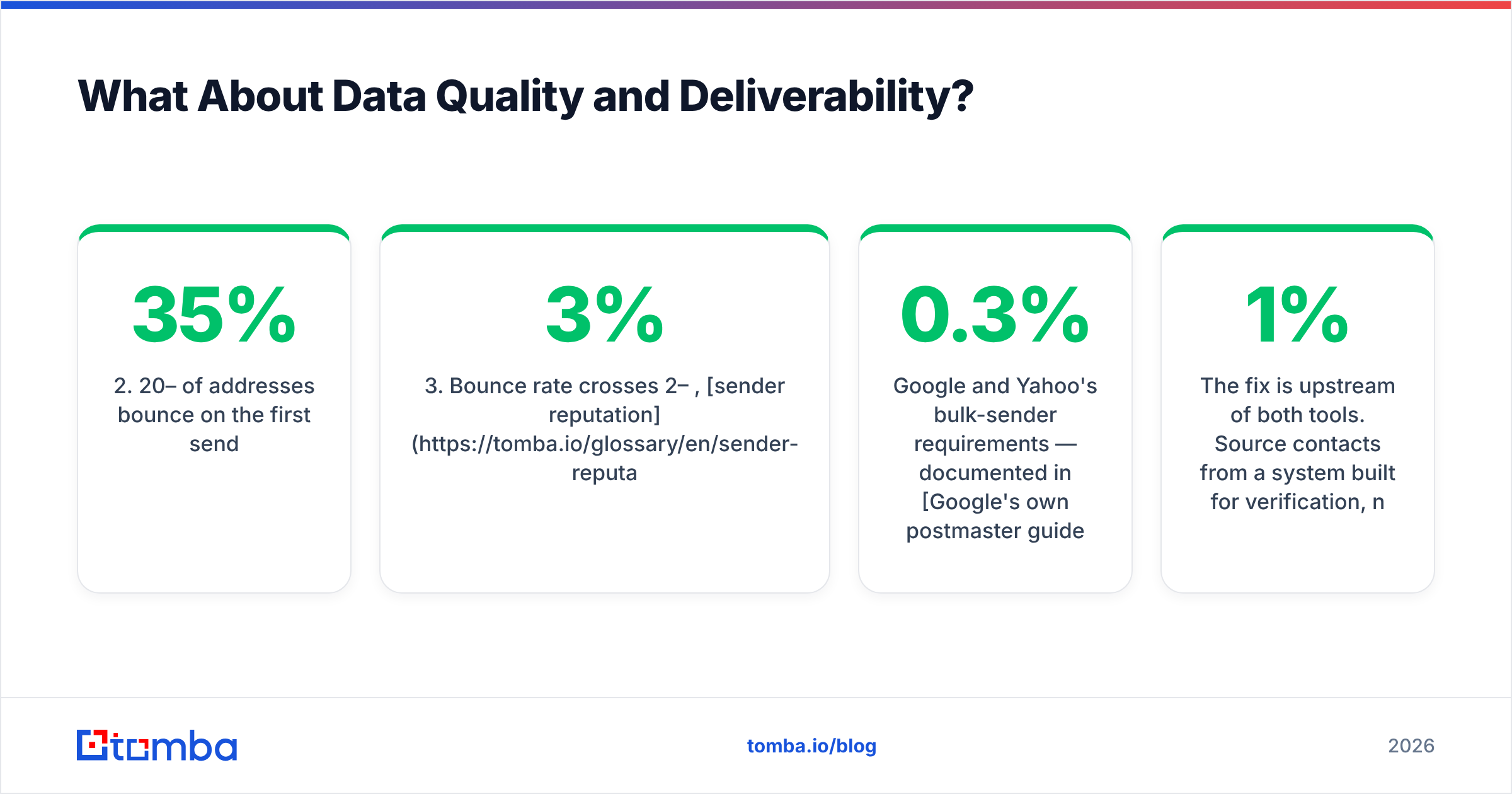
- 20–35% of addresses bounce on the first send.
- Bounce rate crosses 2–3%, and sender reputation drops.
- Inbox placement falls, reply rates crater, and the CRM looks like the problem.
Google and Yahoo set bulk-sender rules for anyone mailing at volume. Google's own postmaster guidelines cap spam complaints at 0.3%. A dirty list blows past that fast. No amount of HubSpot workflow polish rescues you afterward.
The fix sits upstream of both tools. Source contacts from a system built for verification, not storage. Run a domain search to pull the right people at a target account. Confirm each address with an email verifier. Then push only the valid records into whichever CRM you picked. Your contact tier stays lean and your bounce rate stays under 1%.
Which Platform Fits Which Team?#
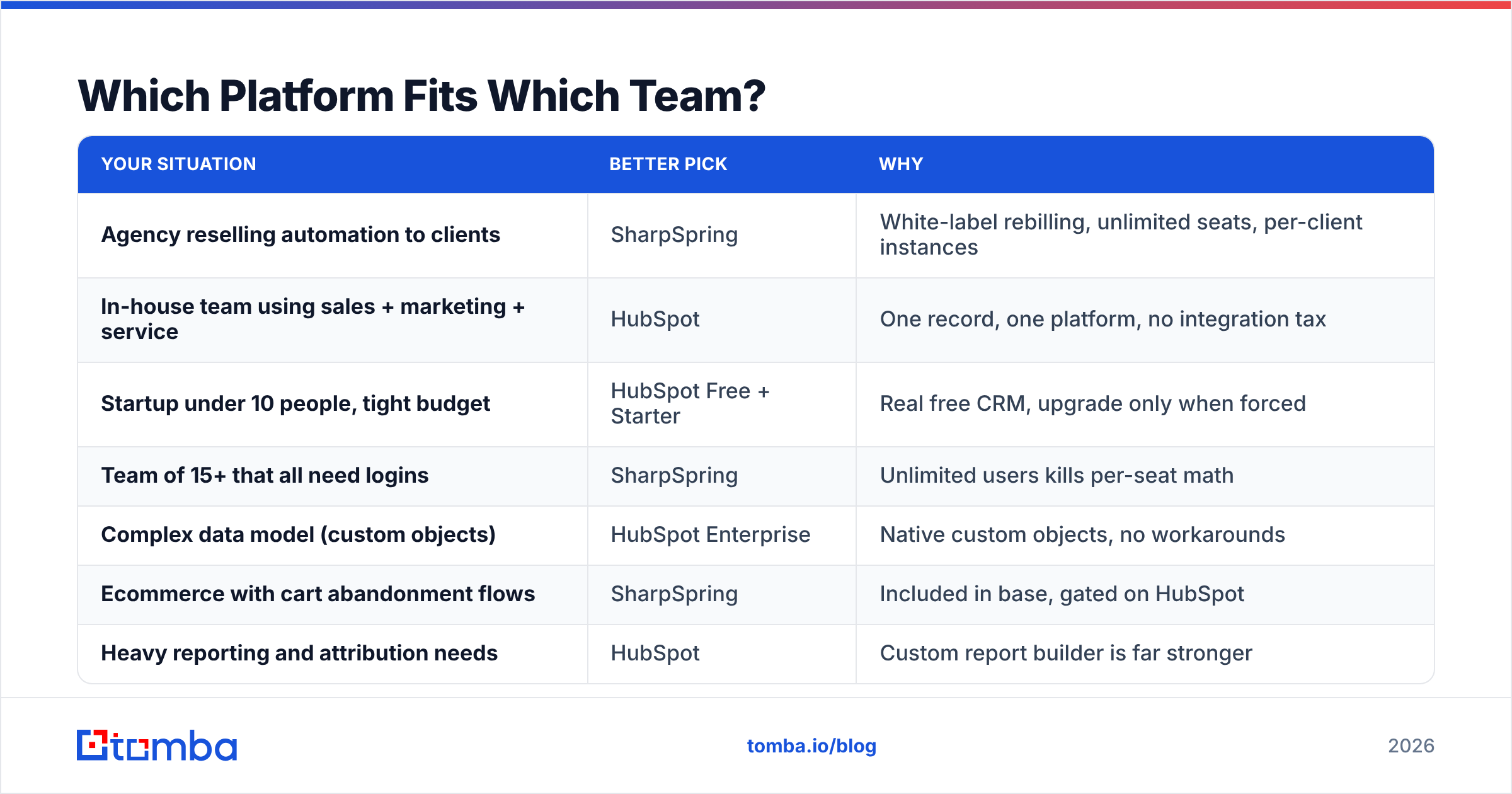
Use this as the decision shortcut:
| Your situation | Better pick | Why |
|---|---|---|
| Agency reselling automation to clients | SharpSpring | White-label rebilling, unlimited seats, per-client instances |
| In-house team using sales + marketing + service | HubSpot | One record, one platform, no integration tax |
| Startup under 10 people, tight budget | HubSpot Free + Starter | Real free CRM, upgrade only when forced |
| Team of 15+ that all need logins | SharpSpring | Unlimited users kills per-seat math |
| Complex data model (custom objects) | HubSpot Enterprise | Native custom objects, no workarounds |
| Ecommerce with cart abandonment flows | SharpSpring | Included in base, gated on HubSpot |
| Heavy reporting and attribution needs | HubSpot | Custom report builder is far stronger |
Two more considerations that don't fit a table:
Exit cost. HubSpot's data export is simple and well documented. SharpSpring exports work too, but the migration ecosystem is thinner. Fewer consultants have done it, so budget extra time if you ever leave.
Support. HubSpot's paid tiers include phone and chat with reasonable response times, and the HubSpot knowledge base is excellent. SharpSpring support under Constant Contact has drawn mixed reviews on G2 since the acquisition. Check recent reviews rather than 2022-era ones.
What Are the Alternatives Worth Considering?#
If neither fits, three directions are worth a look before you commit:
- ActiveCampaign — sits between the two on price and automation power, strongest for ecommerce-adjacent B2B.
- Pipedrive — sales-first, cheap, minimal marketing automation. Pair it with a separate ESP. Tomba has a native Pipedrive integration if you go this route.
- Zoho CRM Plus — the value play, especially if you're already in the Zoho ecosystem. Rougher UX, unbeatable price per feature.
There's also the unbundled approach, popular since 2024: a light CRM, a dedicated sending tool, and a separate prospecting layer. It costs less than either platform's Pro tier, and each part is easy to replace. The trade-off is that you own the integration work.
How Should You Build the Contact Layer Underneath?#
Whichever CRM wins, the contact-acquisition layer should sit outside it. Here's the workflow that keeps costs predictable:
- Identify target accounts — build the account list from your ICP, not from a bought database dump.
- Find the right people — use domain search to surface decision-makers by role and seniority at each account.
- Verify before import — run every address through verification. Catch-all domains need a catch-all verifier rather than standard SMTP checks.
- Enrich what survives — add job title, company size, and social profiles via data enrichment so your segmentation actually works.
- Push only valid records — sync clean contacts into HubSpot or SharpSpring, so your billable contact count tracks real prospects.
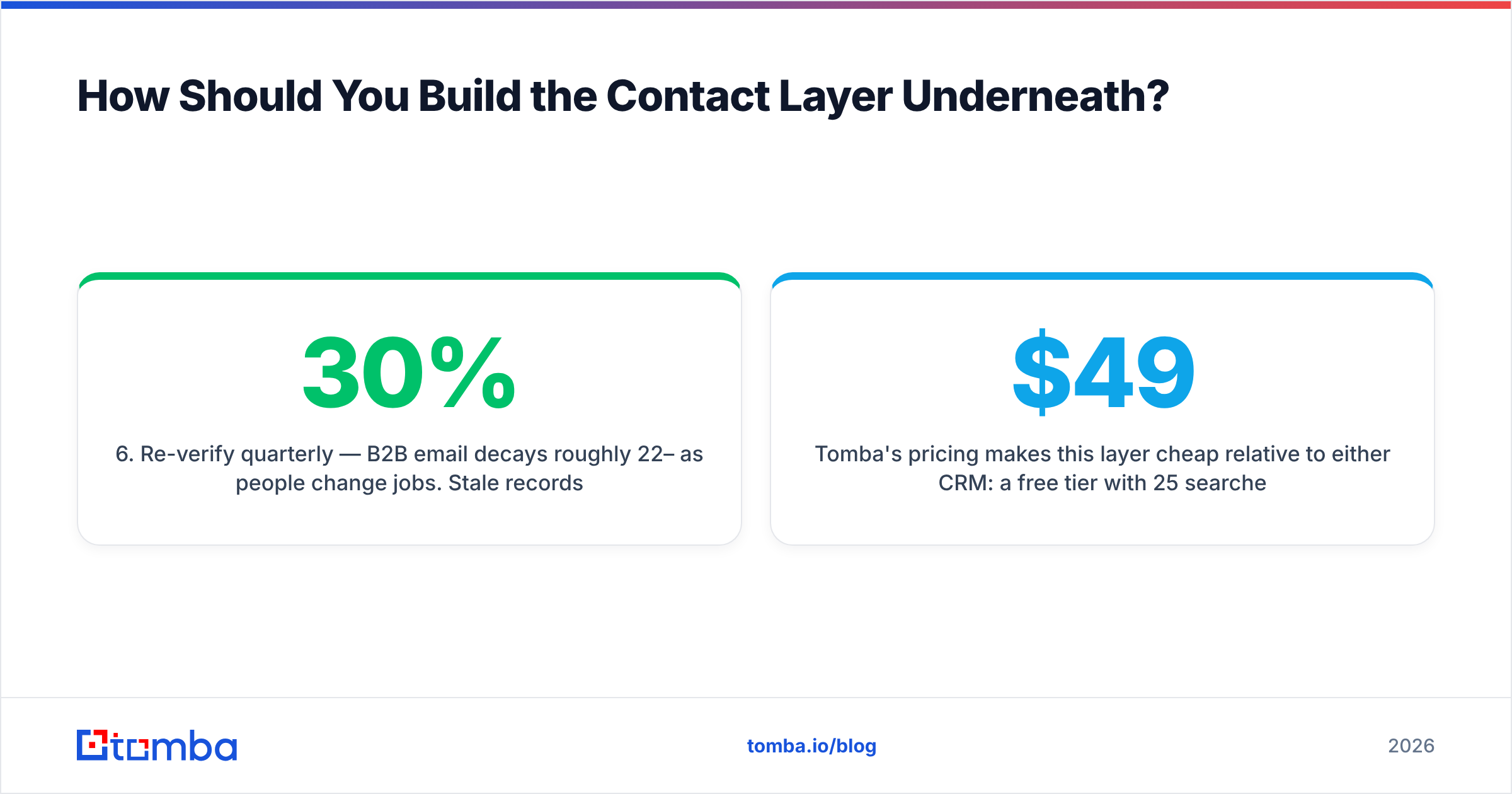
- Re-verify quarterly — B2B email decays roughly 22–30% per year as people change jobs. Stale records cost you tier space and sender reputation.
Tomba's pricing keeps this layer cheap next to either CRM. The free tier includes 25 searches a month. Starter is $49/mo, Growth $99/mo, and Pro $249/mo. Full Tomba pricing is public, with no seat negotiations. Against HubSpot's contact-tier overages, upstream verification usually pays for itself in the first billing cycle.
The Verdict#
Pick HubSpot if you're an in-house B2B team that will genuinely use more than one hub. The platform premium buys you a unified record, better reporting, and an ecosystem that removes integration headaches. Start on the free CRM. Add Sales Hub Starter. Move up to Marketing Pro only when a specific workflow forces you.
Pick SharpSpring if you're an agency, or a large team hitting per-seat pain. Unlimited users and white-label rebilling are structural wins HubSpot won't match. The automation depth is enough for most mid-market programs. Just go in knowing the roadmap now runs on Constant Contact's timeline.
Pick neither yet if your list isn't clean. Both platforms bill on contacts. Migrate 40,000 records where a third bounce, and you overpay for software while wrecking your own deliverability.
The HubSpot vs SharpSpring choice matters less than the data you feed it. Before you migrate a single contact, know which addresses are real. The Tomba Email Finder locates verified professional emails by domain, name, or company. Every result shows its source, so the records landing in your CRM are ones you can actually reach. Start free with 25 searches, or scale to Starter at $49/month when your pipeline demands it. Clean data in, predictable CRM bills out.
Related guides#
// get started
Find, verify and enrich your first contacts today
Start on the free plan with 25 searches a month, then scale when your team is ready.
Free plan · No credit card required · GDPR & CCPA
// about the author