Humanbot Pricing 2026: Reviews, Pros and Cons Explained
Humanbot sells a low one-time price and then routes you through a stack of upsells. Here is what each tier actually unlocks, what reviewers praise, where it breaks down, and who should skip it.
TL;DR
- Humanbot is sold as a one-time "lifetime" AI chatbot deal, not a monthly SaaS subscription. The headline price is the entry point, not the total.
- The real Humanbot pricing story is the funnel: a low front-end license followed by a stack of one-time offers (OTOs) that unlock commercial rights, unlimited bots, agency features, and reseller access.
- Pros: cheap to test, no recurring bill, decent multilingual and website-training features, reasonable for solo operators and agencies selling simple chatbots.
- Cons: feature gating across upsells, thin support and roadmap guarantees compared with funded SaaS, and no real B2B data layer behind the conversations.
- A chatbot captures interest. It does not tell you who the visitor is or how to reach the rest of their buying committee — that is a separate data problem.
What is Humanbot, and who is it actually for?#
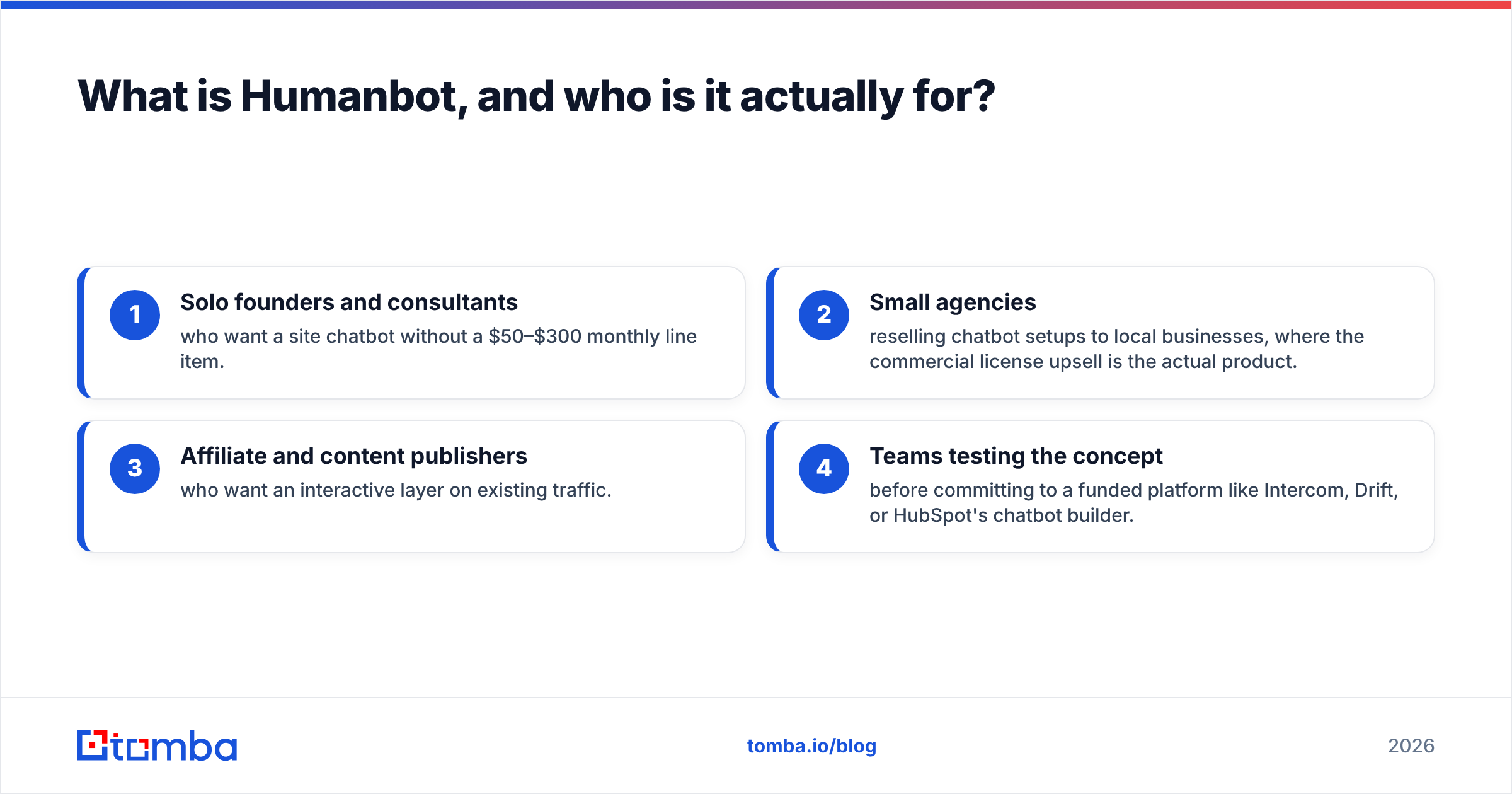
Humanbot is an AI chatbot builder marketed as a "human-like" conversational assistant you train on your own content. You point it at a website URL, a PDF, or a text corpus, it ingests that material, and it answers visitor questions in natural language across multiple languages. The pitch is that it replaces a support rep and a lead-capture form at the same time, with a talking avatar layer on top.
It is distributed the way most lifetime-deal software is distributed: a launch page, a countdown timer, a low one-time price, and a checkout flow that presents several upgrade offers before you reach the dashboard. You can see the current structure on the official Humanbot site. That distribution model matters more than any single feature, because it determines what you actually get for the price you think you paid.
The realistic buyer profile is narrow and worth naming up front:
- Solo founders and consultants who want a site chatbot without a $50–$300 monthly line item.
- Small agencies reselling chatbot setups to local businesses, where the commercial license upsell is the actual product.
- Affiliate and content publishers who want an interactive layer on existing traffic.
- Teams testing the concept before committing to a funded platform like Intercom, Drift, or HubSpot's chatbot builder.
If you are a funded B2B team with a real revenue operations stack, security review process, and an SLA requirement, this category is not built for you. That is not a knock on Humanbot specifically — it applies to every lifetime-deal chatbot on the market.
How does Humanbot pricing actually work?#
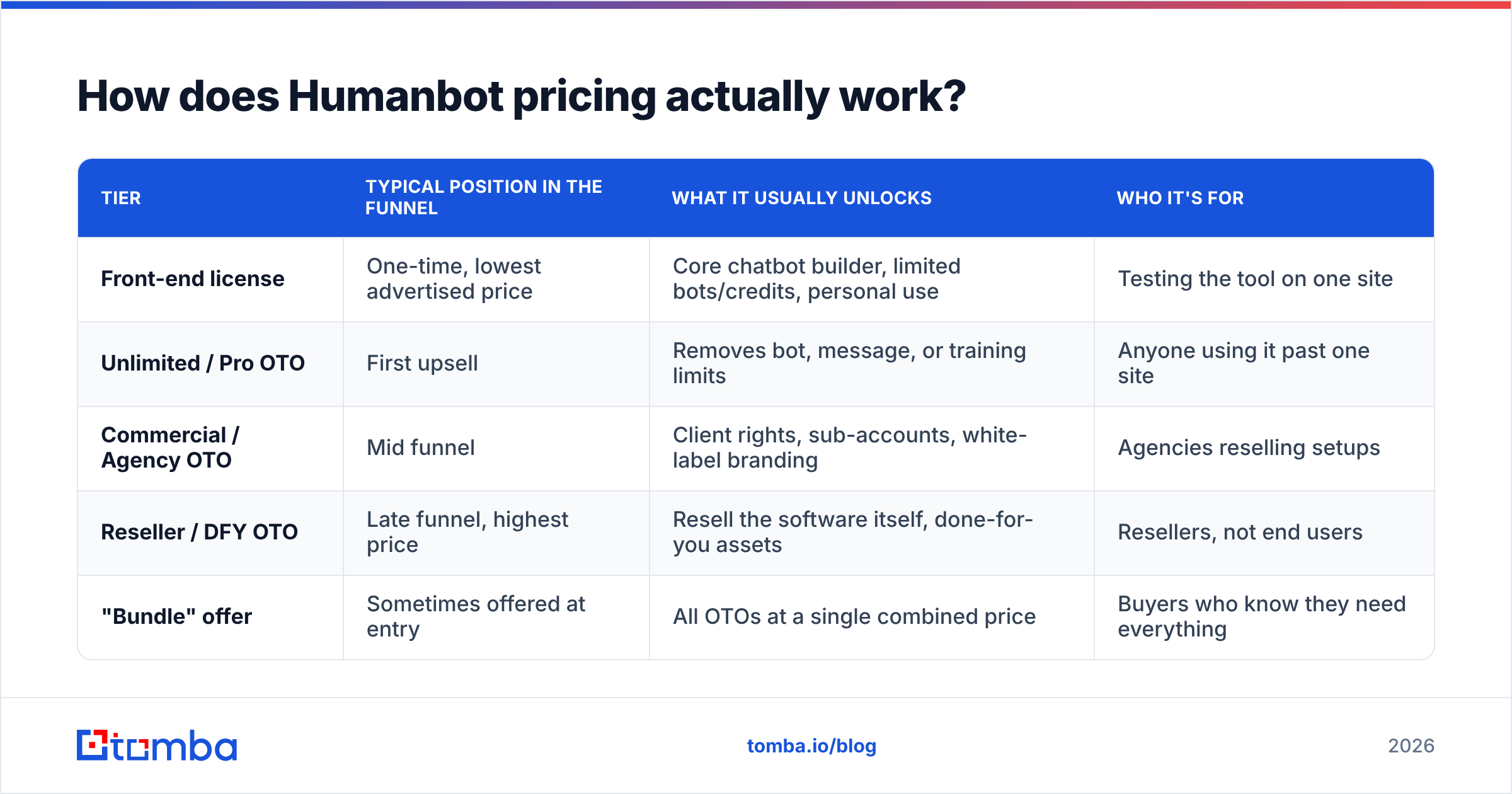
Humanbot pricing follows the standard launch-funnel shape rather than published SaaS tiers. Prices rotate with launch windows, early-bird timers, and coupon codes, so treat the structure below as the shape of the offer rather than a quote. Verify the live numbers on the vendor's own checkout before you buy.
| Tier | Typical position in the funnel | What it usually unlocks | Who it's for |
|---|---|---|---|
| Front-end license | One-time, lowest advertised price | Core chatbot builder, limited bots/credits, personal use | Testing the tool on one site |
| Unlimited / Pro OTO | First upsell | Removes bot, message, or training limits | Anyone using it past one site |
| Commercial / Agency OTO | Mid funnel | Client rights, sub-accounts, white-label branding | Agencies reselling setups |
| Reseller / DFY OTO | Late funnel, highest price | Resell the software itself, done-for-you assets | Resellers, not end users |
| "Bundle" offer | Sometimes offered at entry | All OTOs at a single combined price | Buyers who know they need everything |
Three things follow from that table.
First, the advertised price is a floor, not a ceiling. Nearly every review that reports satisfaction with Humanbot describes buying at least the unlimited tier. Budget for the front-end plus one or two upgrades, then decide whether the total still beats a subscription.
Second, "lifetime" means the vendor's lifetime, not yours. A one-time purchase transfers platform risk to you. If the company stops shipping, there is no refund mechanism for the years you expected to get.
Third, AI usage costs are real and recurring for the vendor. Any tool selling unlimited LLM-backed conversations for a one-time fee is either capping usage somewhere, routing to cheap models, or requiring you to bring your own API key. Check which one applies before you assume "unlimited" is literal.
What do Humanbot reviews say — the honest pros?#
Reading past the affiliate-review layer (most "Humanbot review" pages are written by people earning commission on the exact upsells they recommend), a few consistent positives emerge. Cross-check them against neutral sources like the G2 chatbot software category and Capterra's chatbot listings, where lifetime-deal tools rarely appear at all — which is itself a data point.
- Setup is genuinely fast. Training on a URL and getting a working widget on a page is a same-afternoon task, not a two-week implementation.
- No recurring bill. For a consultant running five client sites, avoiding five monthly subscriptions is a real margin difference.
- Multilingual handling is a strength. Content-trained bots answering in the visitor's language is not trivial to get right, and this is the feature reviewers mention most often.
- The agency license has a clear business case. If you sell chatbot installs at $500–$1,500 per client, the commercial upsell pays for itself on the first deal.
- Low risk to evaluate. At the front-end price, testing the concept costs less than one month of a mid-market alternative.
What are the cons buyers report most often?#
- Feature gating is aggressive. Capabilities that feel like table stakes — unlimited bots, removing vendor branding, client sub-accounts — sit behind separate purchases. The tool you saw in the demo video is usually the fully-upgraded stack.
- Support depth is limited. Lifetime-deal economics do not fund a 24/7 support org. Expect ticket queues and community forums, not a named CSM.
- Roadmap risk. There is no contractual commitment to model upgrades. When the underlying LLM generation changes, whether you get the improvement is the vendor's decision.
- Integration surface is thin. Native connections to CRMs, warehouses, and enrichment providers are far more limited than a platform tool's. Most workflows route through webhooks or a Zapier integration-style middleman.
- Compliance posture. If your buyers ask for SOC 2 reports, DPAs, or data-residency guarantees, this category generally cannot answer.
- The conversation data goes nowhere useful by default. A visitor chats, gives an email, and that record sits in a dashboard export instead of enriched and routed into your pipeline.
How does Humanbot compare to subscription chatbot tools?#
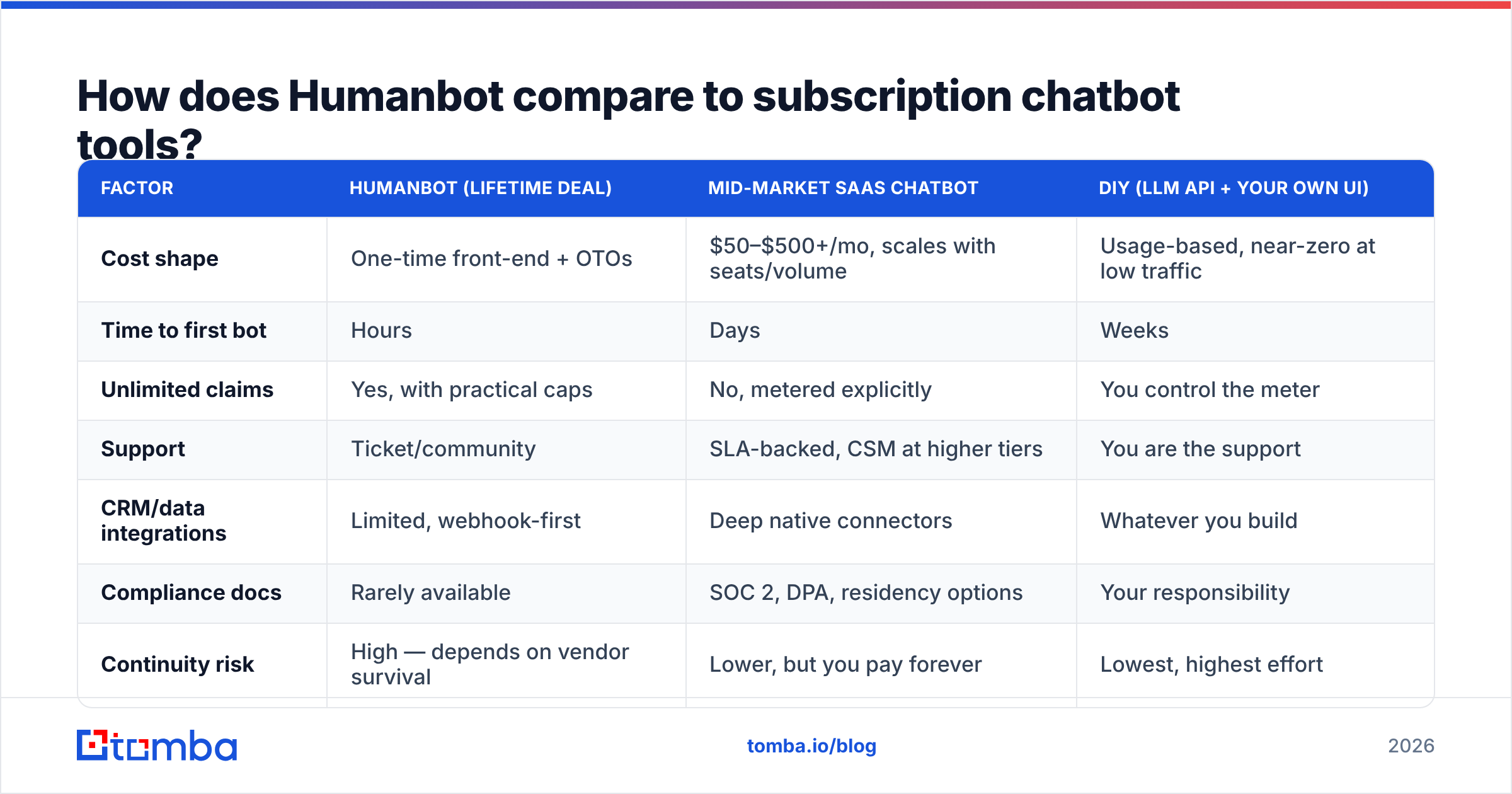
The honest comparison is not "which tool is better" but "which cost structure matches your situation." A one-time purchase wins on cash flow and loses on continuity.
| Factor | Humanbot (lifetime deal) | Mid-market SaaS chatbot | DIY (LLM API + your own UI) |
|---|---|---|---|
| Cost shape | One-time front-end + OTOs | $50–$500+/mo, scales with seats/volume | Usage-based, near-zero at low traffic |
| Time to first bot | Hours | Days | Weeks |
| Unlimited claims | Yes, with practical caps | No, metered explicitly | You control the meter |
| Support | Ticket/community | SLA-backed, CSM at higher tiers | You are the support |
| CRM/data integrations | Limited, webhook-first | Deep native connectors | Whatever you build |
| Compliance docs | Rarely available | SOC 2, DPA, residency options | Your responsibility |
| Continuity risk | High — depends on vendor survival | Lower, but you pay forever | Lowest, highest effort |
| Best fit | Solo operators, agencies, tests | Funded teams with a support burden | Engineering-led teams |
Run the arithmetic before you decide. If a subscription competitor costs $99/month and Humanbot's fully-loaded stack lands somewhere in the low hundreds one-time, the deal pays back inside a quarter — if the product still exists in two years and if the capped features cover your actual usage. Both conditions are on you to verify.
Is Humanbot worth it in 2026?#
Buy it if: you are a solo operator or small agency, you want a site chatbot without a recurring bill, you have read the funnel and budgeted for the unlimited plus commercial tiers, and the worst case — the tool goes dark in 18 months — is an acceptable loss.
Skip it if: your buyers ask security questions, you need native CRM sync into a real CRM workflow, your support volume justifies an SLA, or you are counting on the vendor to keep pace with model releases for the next five years.
Wait if: you have not yet proven that chatbot traffic converts on your site at all. A chatbot amplifies existing traffic. It does not create it. Buying conversion tooling before you have volume to convert is the most common way this purchase gets wasted.
What does a chatbot not solve for B2B pipeline?#
This is the part most Humanbot reviews skip, and it matters more than the pricing table.
A chatbot is a reactive channel. It only works on people who already found you, already stayed on the page, and already decided to type. Every B2B site loses the overwhelming majority of its traffic anonymously — visitors who read the pricing page, evaluated you, and left without touching the widget.
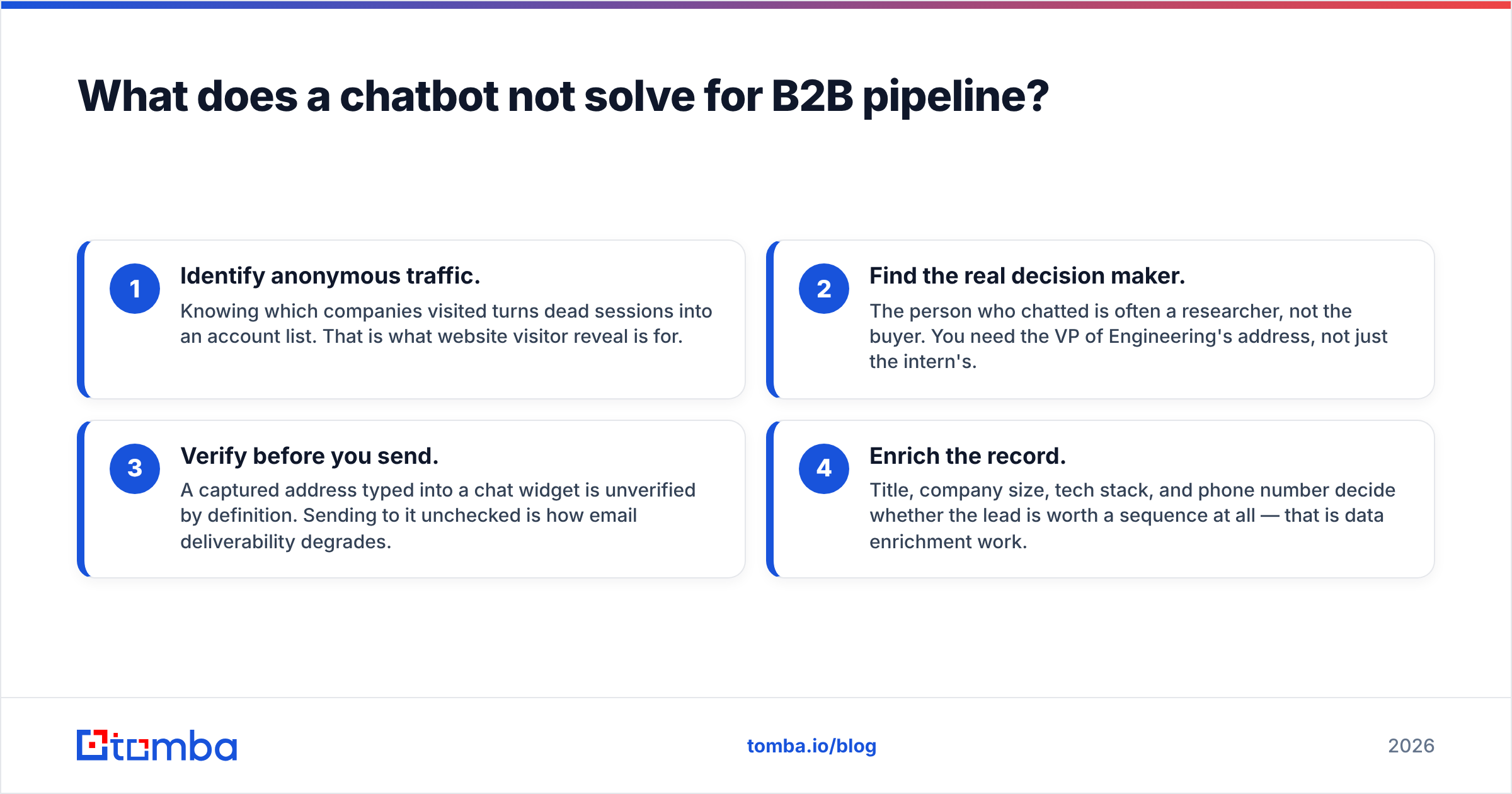
That gap is a data problem, not a conversation problem. Four things need to happen after the chat ends, and no chatbot does them:
- Identify anonymous traffic. Knowing which companies visited turns dead sessions into an account list. That is what website visitor reveal is for.
- Find the real decision maker. The person who chatted is often a researcher, not the buyer. You need the VP of Engineering's address, not just the intern's.
- Verify before you send. A captured address typed into a chat widget is unverified by definition. Sending to it unchecked is how email deliverability degrades.
- Enrich the record. Title, company size, tech stack, and phone number decide whether the lead is worth a sequence at all — that is data enrichment work.
Those four steps are what convert chatbot interest into a pipeline. Buying a cheaper chatbot does not move you closer to any of them.
Frequently asked questions#
Is Humanbot a subscription? No, it is sold as one-time purchases with optional upsells. Some add-ons in this category carry their own recurring costs, so read each checkout page.
Does the front-end license include commercial rights? Usually not. Client and white-label rights are typically a separate upsell. If you intend to resell, price that in from the start.
Is "unlimited" really unlimited? Practically, no. There is always a fair-use ceiling, a model-tier limit, or a bring-your-own-key requirement behind an unlimited claim on a one-time-fee AI product.
Can I get a refund? Lifetime deals in this category typically carry a 30-day money-back window. Confirm the exact terms on the checkout page, and test the tool inside that window rather than after.
What is the biggest hidden cost? Your time. Training, tuning, and maintaining a bot that answers correctly is ongoing work regardless of what you paid for the license.
Turn chatbot conversations into a real pipeline#
Whatever you decide about Humanbot pricing, the chatbot is the last five percent of the funnel. The other ninety-five percent is knowing who your buyers are and reaching them before they need a widget.
That is where Tomba's Email Finder fits. Feed it a company domain or a name, and it returns verified professional addresses with confidence scores, so the account that showed intent on your site becomes a contactable buying committee instead of a line in an analytics report. Start on the free tier at 25 searches per month, or move to Starter at $49/mo when the volume justifies it — full Tomba pricing is public, with no upsell funnel between you and the feature you came for.
Related guides#
// get started
Find, verify and enrich your first contacts today
Start on the free plan with 25 searches a month, then scale when your team is ready.
Free plan · No credit card required · GDPR & CCPA
Get the Tomba newsletter
Product and data updates
// about the author