Hunter and Farmer Sales Model: Roles, Comp, and Fit
Splitting your team into hunters and farmers sounds tidy on a slide. In practice it breaks down at handoff. Here's when the model earns its keep, when it costs you revenue, and how to staff it.
TL;DR
- The hunter and farmer sales model splits selling into two jobs: hunters open new logos, farmers expand and retain existing accounts. It works because the skills, cadence, and psychology genuinely differ.
- It pays off when your average contract value is high enough to fund two headcounts per account, and when expansion revenue is a real number — not a rounding error.
- It fails at the handoff. Most broken implementations lose the deal context between signature and onboarding, and churn shows up 9 months later looking like a "product problem."
- Compensation is where the model lives or dies: hunters need steep new-logo accelerators, farmers need net revenue retention and expansion quota, not a diluted blend of both.
- Under roughly $15K ACV or with fewer than ~8 reps, a single full-cycle AE almost always beats a split — the coordination tax eats the specialization gain.
What is the hunter and farmer sales model?#
The hunter and farmer sales model is a role-specialization framework that divides a sales team into two functions: hunters, who acquire net-new customers, and farmers, who grow and retain the accounts already signed.
The everyday analogy is literal. A hunter walks into unfamiliar terrain, tolerates long stretches of nothing, and gets paid for the kill. A farmer works the same field year after year, watching soil quality and yield, and gets paid for the harvest compounding. Ask a hunter to weed a field for eleven months and they quit. Ask a farmer to sit in a cold-call block for four hours and they'll find something else to do.
Technically, it is a division of labor applied to the revenue lifecycle. The hunter owns the funnel from prospect identification through closed-won. The farmer owns the account from onboarding through renewal, upsell, and cross-sell. Somewhere between those two sits a handoff — and that handoff is the entire ballgame.
The model dates back to field-sales organizations in the 1980s and 1990s, long before SaaS. It survived because the underlying observation holds: the behavioral profile that thrives on rejection-heavy net-new work is rarely the same profile that thrives on patient relationship compounding.
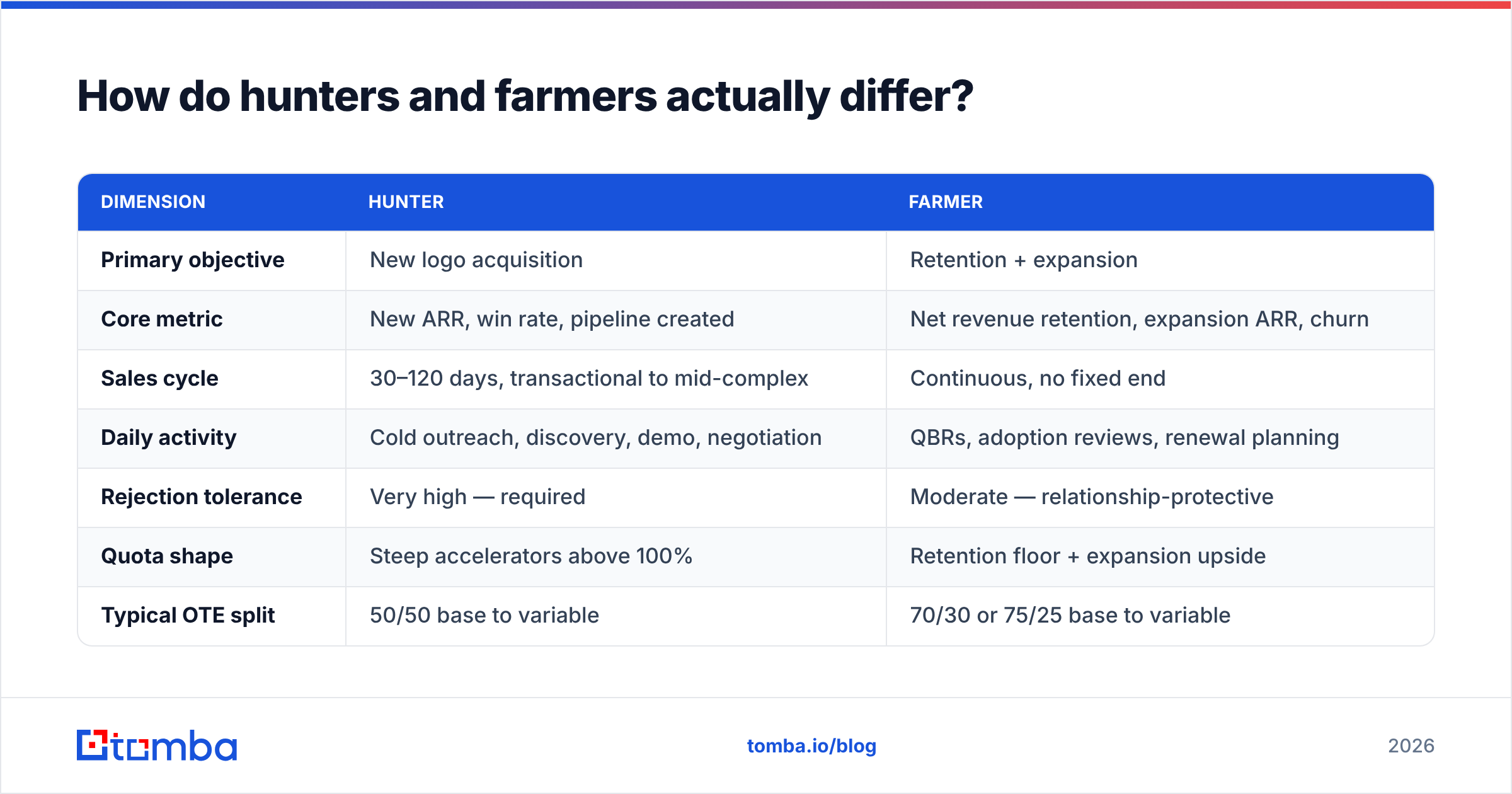
How do hunters and farmers actually differ?#
The differences are not cosmetic. They run through activity mix, metrics, tooling, and personality.
| Dimension | Hunter | Farmer |
|---|---|---|
| Primary objective | New logo acquisition | Retention + expansion |
| Core metric | New ARR, win rate, pipeline created | Net revenue retention, expansion ARR, churn |
| Sales cycle | 30–120 days, transactional to mid-complex | Continuous, no fixed end |
| Daily activity | Cold outreach, discovery, demo, negotiation | QBRs, adoption reviews, renewal planning |
| Rejection tolerance | Very high — required | Moderate — relationship-protective |
| Quota shape | Steep accelerators above 100% | Retention floor + expansion upside |
| Typical OTE split | 50/50 base to variable | 70/30 or 75/25 base to variable |
| Data need | Fresh contact data, intent signals, org charts | Usage data, stakeholder maps, support history |
| Tenure risk | Burnout at 18–24 months | Complacency after 24+ months |
Two rows deserve unpacking.
The OTE split. Hunters carry more variable comp because their output is discrete and attributable — a logo either closed or it didn't. Farmers carry more base because retention is partly a product and support outcome they don't fully control. Paying a farmer 50/50 on renewals punishes them for engineering's bugs.
The data need. Hunters live or die on contact quality. A hunter working a stale list burns 40% of their week on bounces and wrong numbers. Farmers need a different dataset entirely — product usage, ticket volume, champion turnover. Buying one data stack for both roles is a common and expensive mistake.
Is the hunter and farmer sales model still relevant in 2026?#
Yes, but the boundaries have moved twice.
The first shift was Customer Success. Between roughly 2014 and 2020, most B2B SaaS companies split the farmer role again — CSM owns adoption and health, Account Manager owns commercial expansion. That gave you a three-role model, not two. Plenty of orgs run it well, and plenty discover they've created two people who both think renewal is the other one's job.
The second shift is AI-assisted prospecting. A meaningful chunk of what the classic hunter did manually — list building, research, first-touch personalization — is now automated or semi-automated. That has not eliminated the hunter role. It has raised the bar on what a hunter is expected to do with the hours freed up: multithreading, executive conversations, competitive displacement.
What has genuinely eroded is the pure hunter — the rep who does nothing but cold outbound. In most modern orgs, SDRs handle the top of the funnel and the "hunter" AE handles qualified opportunities from first meeting onward. When people say hunter today, they usually mean new-business AE, not a rep dialing from a blank page.
Gartner's B2B sales research has tracked this consistently: buyers now spend the majority of their journey in independent research, which shrinks the window where a hunter's persuasion actually applies and increases the value of getting to the right person early. That makes contact accuracy a hunter's most leveraged input, not their most boring one.
When should you split roles — and when shouldn't you?#
Use these five gates. If you fail two or more, stay full-cycle.
- ACV above $15,000. Below that, gross margin per account rarely funds two quota-carrying humans plus their tooling. Full-cycle AEs win on unit economics.
- Expansion is at least 20% of new ARR. If your existing base contributes almost nothing incremental, you don't have a farming job — you have a renewals admin task that ops can automate.
- Team size of 8+ reps. Below eight, you can't build two functioning sub-teams with their own managers, rituals, and benches. You get two lonely specialists instead.
- Sales cycle over 30 days. Very fast transactional cycles don't benefit from specialization; the context transfer costs more than the specialization saves.
- Multi-stakeholder accounts. If your product lands with one buyer and never expands beyond them, there is no field to farm.
Companies that split too early usually report the same symptom: hunters complain that farmers sit on warm expansion signals, farmers complain that hunters oversell to close, and both blame the CRM. That is not a tooling problem. It is a premature-specialization problem.
What kills the model? The handoff#
Ask any RevOps leader where hunter-farmer implementations break and you'll hear the same answer: the transition from closed-won to onboarding.
Here's the failure sequence. The hunter closes a deal on a specific promise — a use case, an integration, a timeline. That promise lives in the hunter's head and in three Slack DMs. The account transfers. The farmer inherits a logo, an ARR number, and a Salesforce record with four fields filled in. Ninety days later the customer says "this isn't what we bought," and nobody can reconstruct what was actually sold.
Fixing it takes three things, none of which are software:
- A mandatory handoff document with the buying committee map, the stated success criteria, the objections that were overcome, and the promises made — including the ones that were slightly generous.
- A joint call with hunter, farmer, and customer in the same room within 10 business days of signature. The hunter's presence signals continuity; their absence signals abandonment.
- A clawback window. If an account churns inside 6–9 months, part of the hunter's commission is at risk. This single mechanism does more for handoff quality than any process document.
The clawback is contentious and worth defending. Without it, the hunter's incentive ends at signature, which means their incentive to sell honestly ends at signature too. With it, hunters start qualifying out of bad-fit deals on their own — which is exactly the behavior you wanted and could never coach into them.
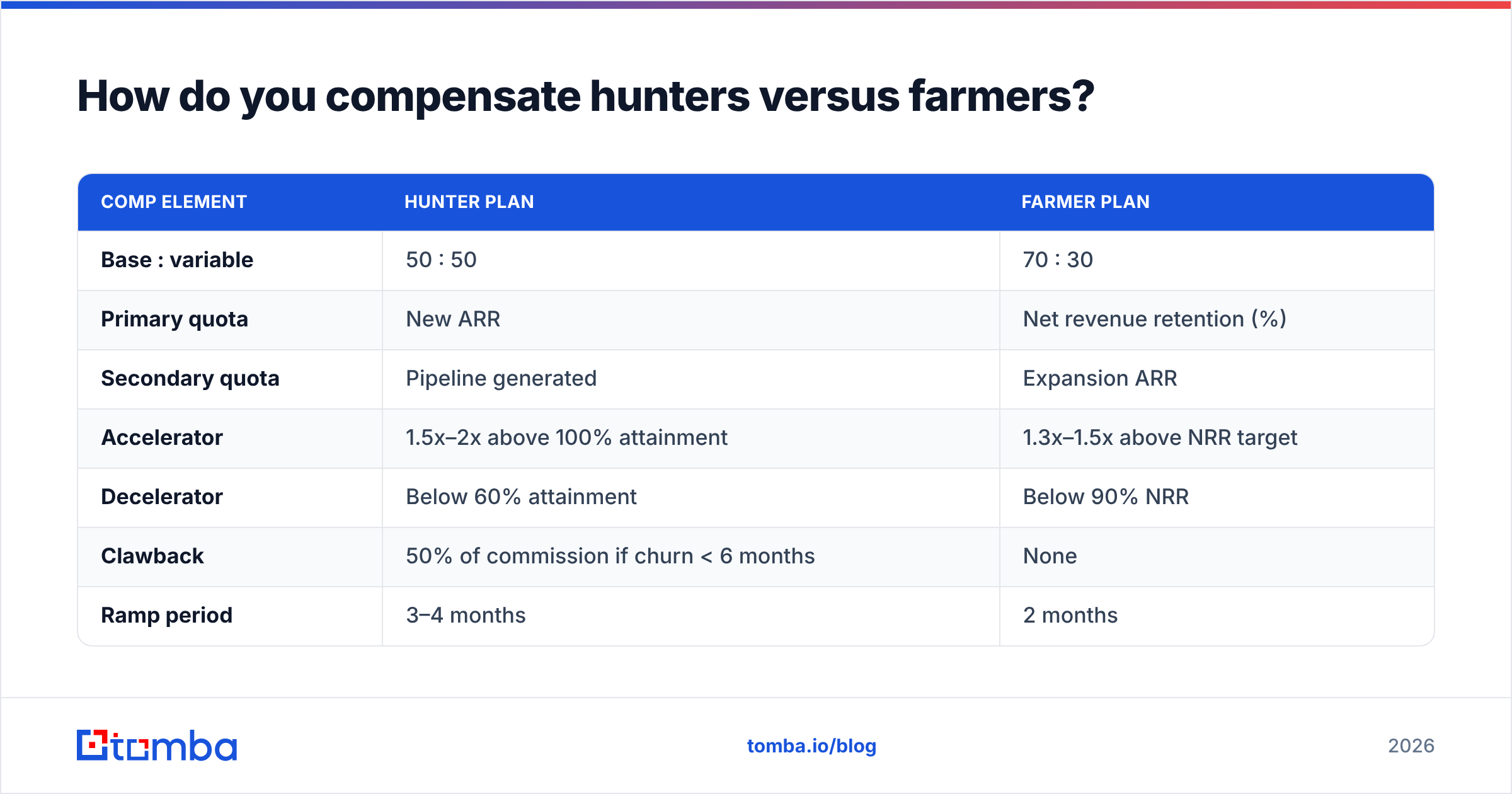
How do you compensate hunters versus farmers?#
Compensation design is where most hunter-farmer models quietly die. The temptation is to build one plan with two variants. Resist it.
| Comp element | Hunter plan | Farmer plan |
|---|---|---|
| Base : variable | 50 : 50 | 70 : 30 |
| Primary quota | New ARR | Net revenue retention (%) |
| Secondary quota | Pipeline generated | Expansion ARR |
| Accelerator | 1.5x–2x above 100% attainment | 1.3x–1.5x above NRR target |
| Decelerator | Below 60% attainment | Below 90% NRR |
| Clawback | 50% of commission if churn < 6 months | None |
| Ramp period | 3–4 months | 2 months |
| Territory basis | Named accounts or vertical | Book of business, capped at 25–40 accounts |
Three design notes:
Cap the farmer's book. A farmer with 90 accounts is a support queue, not a seller. Somewhere between 25 and 40 accounts is the practical ceiling for genuine expansion work at mid-market ACVs; enterprise farmers may carry 8–12.
Don't pay farmers on renewals alone. Renewal is table stakes. If you pay meaningfully for renewals, you've paid someone to maintain the status quo. Pay for retention as a gate and expansion as the upside.
Give hunters a floor, not just a ceiling. New-business roles have variance built in. A hunter who does everything right can still have a dead quarter because two deals slipped. A guaranteed floor during ramp and a rolling 2-quarter attainment view reduce the churn you'd otherwise eat at month 14.
For benchmarking, both G2's sales software category data and HubSpot's sales research publish comp and quota-attainment surveys worth checking against your own numbers before you set targets from intuition.
What does each role need from the data stack?#
The tooling divergence is sharper than most teams plan for.
- Hunters need reach and freshness. Their bottleneck is getting a verified, current contact for the right person at the right company. Every bounced email is a wasted slot in a finite daily send budget, and a bad send pattern degrades email deliverability for the whole domain. This is why an email finder paired with an email verifier sits at the front of most hunter stacks — accuracy at the top of the funnel compounds through every downstream metric.
- Hunters need account mapping. Multithreading requires knowing who else sits in the buying committee. Domain search is the workhorse here: give it a company domain, get back the people and the email pattern, and you've built a stakeholder map in minutes instead of an afternoon on LinkedIn.
- Farmers need usage and health signals. Product analytics, support ticket trends, license utilization. None of that comes from a prospecting tool — it comes from your own product instrumentation piped into the CRM.
- Farmers need champion-change alerts. The single biggest predictor of churn is the champion leaving. Farmers need to know within days, not at renewal.
- Both need a clean CRM. The handoff document is worthless if it lives outside the system of record. Whatever you use, the handoff fields should be required on stage change to Closed-Won.
One practical note on hunter tooling: buy for verified coverage in your specific market, not headline database size. A 500-million-contact database that is 30% accurate in your niche is worse than a smaller source that is 95% accurate in it. Run a sample of 200 known-good contacts through any vendor before you commit — and check pricing details against your actual monthly search volume, since per-credit costs diverge fast at scale.
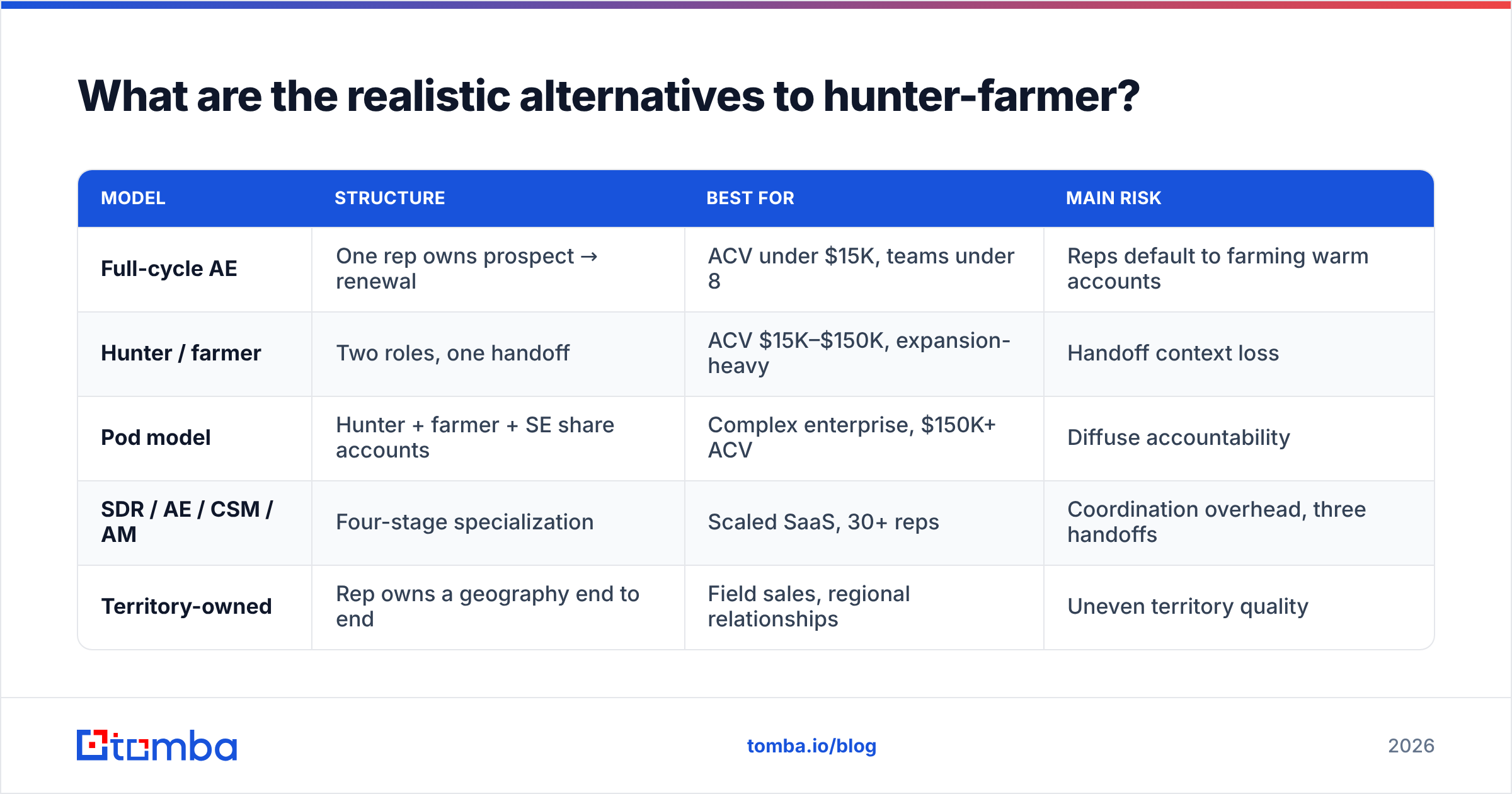
What are the realistic alternatives to hunter-farmer?#
The split is not the only option, and it's not always the best one.
| Model | Structure | Best for | Main risk |
|---|---|---|---|
| Full-cycle AE | One rep owns prospect → renewal | ACV under $15K, teams under 8 | Reps default to farming warm accounts |
| Hunter / farmer | Two roles, one handoff | ACV $15K–$150K, expansion-heavy | Handoff context loss |
| Pod model | Hunter + farmer + SE share accounts | Complex enterprise, $150K+ ACV | Diffuse accountability |
| SDR / AE / CSM / AM | Four-stage specialization | Scaled SaaS, 30+ reps | Coordination overhead, three handoffs |
| Territory-owned | Rep owns a geography end to end | Field sales, regional relationships | Uneven territory quality |
The pod model deserves attention as the pragmatic middle ground. Instead of a clean transfer, the hunter stays attached to the account at reduced involvement for the first two renewals, while the farmer leads. The hunter gets a smaller trailing commission on expansion. It costs more in headcount efficiency and buys you continuity — worth it when a single account represents 2% or more of total ARR.
The other honest answer: many teams that "run hunter-farmer" actually run full-cycle AEs with an account-management function bolted on for the top 20 accounts. That hybrid is fine. It just shouldn't be described as a clean split on the org chart, because that description leads people to design comp plans for a structure that doesn't exist.
How do you roll it out without breaking the quarter?#
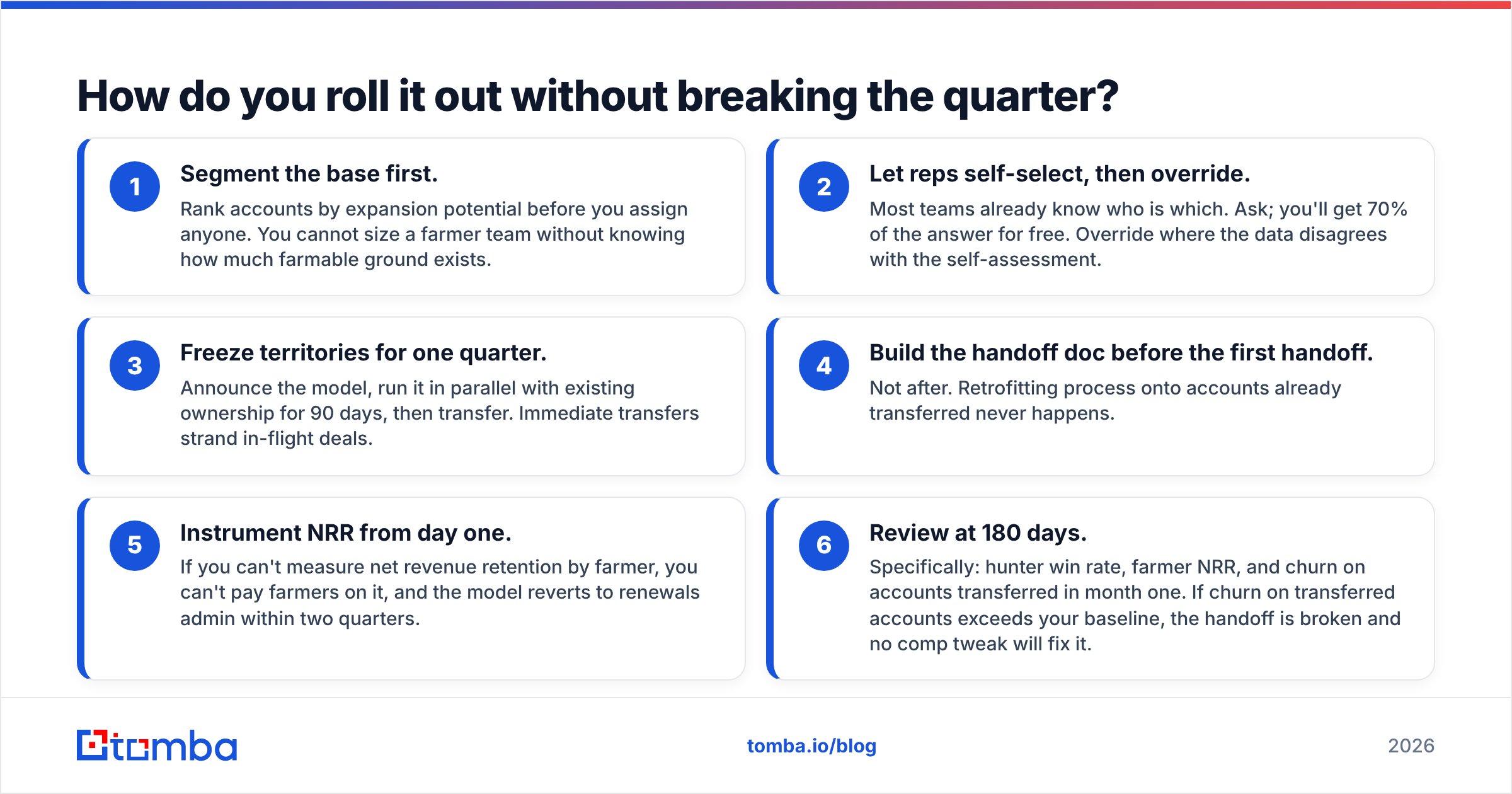
Sequence matters. A rushed split can cost you a full quarter of pipeline.
- Segment the base first. Rank accounts by expansion potential before you assign anyone. You cannot size a farmer team without knowing how much farmable ground exists.
- Let reps self-select, then override. Most teams already know who is which. Ask; you'll get 70% of the answer for free. Override where the data disagrees with the self-assessment.
- Freeze territories for one quarter. Announce the model, run it in parallel with existing ownership for 90 days, then transfer. Immediate transfers strand in-flight deals.
- Build the handoff doc before the first handoff. Not after. Retrofitting process onto accounts already transferred never happens.
- Instrument NRR from day one. If you can't measure net revenue retention by farmer, you can't pay farmers on it, and the model reverts to renewals admin within two quarters.
- Review at 180 days. Specifically: hunter win rate, farmer NRR, and churn on accounts transferred in month one. If churn on transferred accounts exceeds your baseline, the handoff is broken and no comp tweak will fix it.
One more thing worth saying plainly: the model is a means, not an identity. Reps who describe themselves as "a hunter" for their entire career often plateau, because the skills that make someone great at year-one acquisition — pace, volume, comfort with rejection — are not the skills that make someone great at $500K enterprise deals. Treat the label as a description of a current role, not a permanent personality type, and your internal mobility gets a lot healthier.
The short version#
Split when the math supports two humans per account and expansion is genuinely material. Don't split for org-chart aesthetics. Design two separate comp plans, not one plan with two flavors. And put more design effort into the handoff than into anything else — it's the only part of the model that has no natural owner and therefore no natural defender.
If you're standing up a hunter team, the constraint you'll hit first is contact quality. Bad data doesn't announce itself; it shows up as low connect rates, rising bounce rates, and reps who look like they're underperforming when they're actually working a broken list. Start your hunters on the Tomba Email Finder — the free tier gives you 25 searches a month to test coverage in your own market before spending anything, and paid plans start at $49/mo. Verify a sample of contacts you already know are correct, measure the hit rate in your specific vertical, and only then scale the seat count. Fix the input before you tune the process.
Related guides#
// get started
Find, verify and enrich your first contacts today
Start on the free plan with 25 searches a month, then scale when your team is ready.
Free plan · No credit card required · GDPR & CCPA
Get the Tomba newsletter
Product and data updates
// about the author