Hunter Mentality Sales: How Top Reps Build Pipeline in 2026
Hunter reps consistently outbook farmers on net-new pipeline — but not because they are louder. Here is the actual operating system behind hunter mentality sales, and the tooling that makes it repeatable.
TL;DR
- Hunter mentality sales is an operating system, not a personality trait: fixed prospecting blocks, self-sourced lists, and a bias toward starting conversations rather than managing them.
- The single biggest predictor of hunter performance is not call volume — it's the quality of the contact data feeding the activity. Bad data turns 100 dials into 100 wrong numbers.
- Hunters and farmers optimize different metrics. Hunters own net-new meetings and pipeline created; farmers own retention, expansion, and NRR. Grading one with the other's scorecard breaks both.
- A workable hunter week looks like: 10-12 hours of blocked prospecting, 40-60 verified new contacts per day, multi-channel sequencing, and a hard rule that no lead enters a sequence unverified.
- You can build hunter behavior into a team through territory design, comp structure, and tooling — you rarely hire your way into it at scale.
What is hunter mentality sales?#
Hunter mentality sales is the discipline of self-sourcing net-new revenue: finding accounts nobody handed you, identifying the right person inside them, and starting a conversation from zero. A hunter treats an empty pipeline as an emergency and a full calendar of internal meetings as a warning sign.
The useful analogy is fishing versus farming. A farmer tends a field they already own — they water, weed, and harvest the same acreage year after year, and their skill shows up in yield per acre. A hunter walks into territory with no fence around it and has to find the animal before anything else happens. Neither is superior. They are different jobs with different failure modes.
Where most teams get this wrong is treating "hunter" as a vibe — the aggressive rep who dials a lot and talks over objections. That's a caricature. The hunters who consistently hit 140% of quota in 2026 are quieter and far more systematic than the stereotype. They protect calendar blocks with religious intensity, they build their own lists rather than waiting on marketing, and they run a personal scorecard that no manager asked for.
The four behaviors that actually define a hunter#
- Self-sourced pipeline over inbound dependency. A hunter's number does not move when marketing has a bad month. They target 60-80% of pipeline from outbound they built themselves.
- Protected prospecting blocks. Two hours, same time, every day, phone on do-not-disturb. Not "when I have time" — hunters never have time.
- Rejection metabolism. Not immunity to rejection, but a fast recovery cycle. A hunter logs the no and dials the next number within 90 seconds.
- Data discipline before activity. The hunter verifies contact data before sequencing, because they treat their sending domain and their time as finite assets.
- Ruthless account triage. Hunters kill dead accounts early. Farmers nurture; hunters cut and redeploy the hours.
Is hunter mentality better than farmer mentality?#
No — and the framing is the problem. The right question is which motion your revenue model actually requires this quarter.
A company with 92% gross retention and a large installed base gets more incremental revenue from expansion than from net-new logos. A company at $2M ARR with 40 customers has nothing to farm. Most teams need both, structurally separated, with separate scorecards.
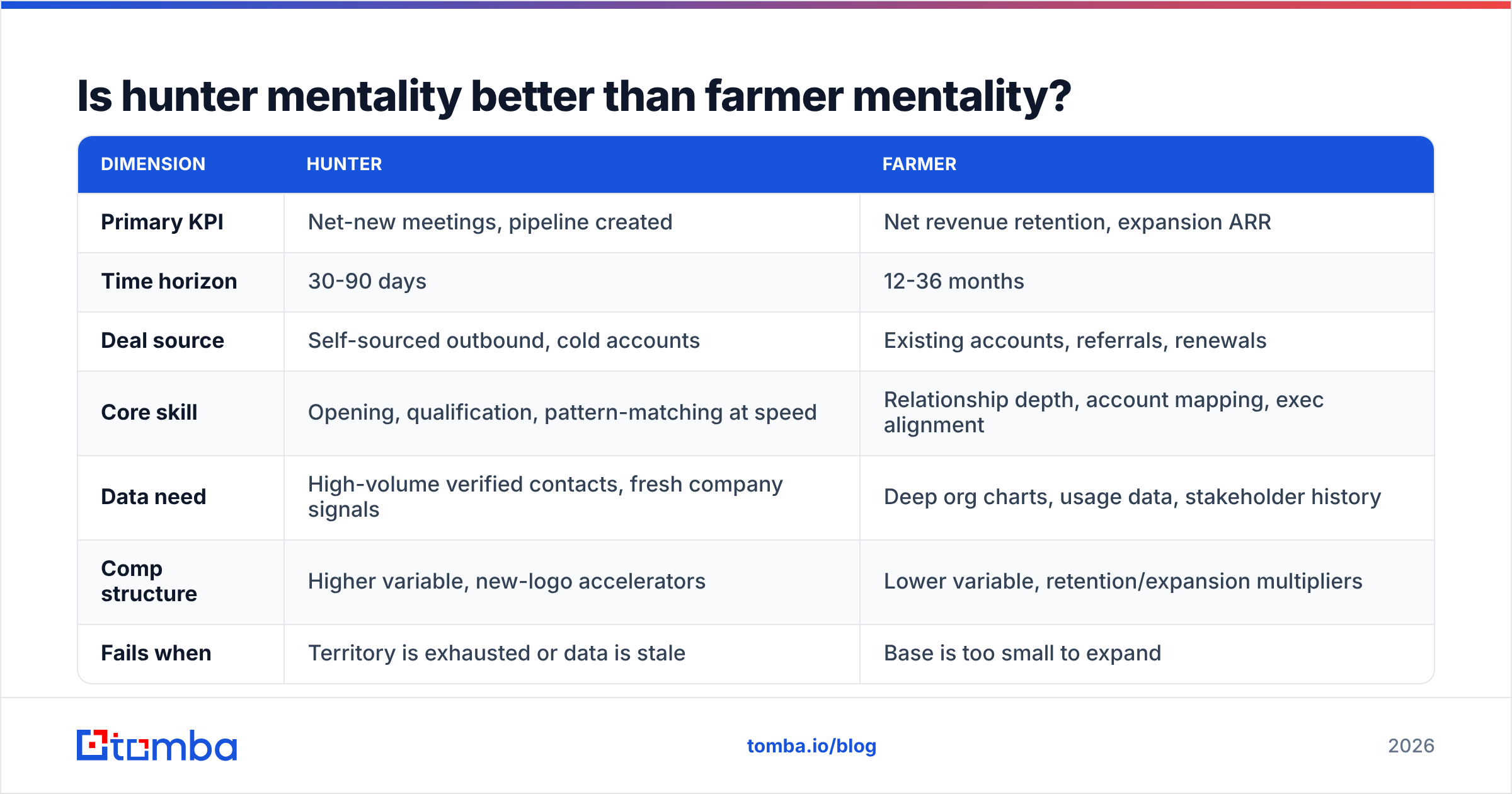
| Dimension | Hunter | Farmer |
|---|---|---|
| Primary KPI | Net-new meetings, pipeline created | Net revenue retention, expansion ARR |
| Time horizon | 30-90 days | 12-36 months |
| Deal source | Self-sourced outbound, cold accounts | Existing accounts, referrals, renewals |
| Core skill | Opening, qualification, pattern-matching at speed | Relationship depth, account mapping, exec alignment |
| Data need | High-volume verified contacts, fresh company signals | Deep org charts, usage data, stakeholder history |
| Comp structure | Higher variable, new-logo accelerators | Lower variable, retention/expansion multipliers |
| Fails when | Territory is exhausted or data is stale | Base is too small to expand |
| Typical tooling | Email finder, dialer, sequencer, intent data | CRM, product analytics, QBR tooling |
The mistake I see most often in RevOps reviews: a team runs a single AE role that owns both motions, then wonders why net-new pipeline collapses. It collapses because farming is comfortable and hunting is not. Given a choice between calling a stranger and emailing a happy customer about an upsell, every human picks the customer. That's not a character flaw — it's incentive design. If you want hunter behavior, you have to structurally protect it, usually by splitting the role.
How do you build a hunter's week?#
Start from the calendar, not the motivation. Hunter mentality sales is mostly a scheduling problem wearing a psychology costume.
Here's a working template used by outbound teams hitting 12-18 net-new meetings per rep per month:
Monday — Build day. Three hours of list building and research. Pull the account list, find the decision-makers, verify the contacts, enrich with firmographic and technographic signals. No calls. The output is a validated list of 200-250 contacts for the week.
Tuesday through Thursday — Attack days. Two 90-minute blocks per day. Block one is phones (highest connect rates land 8-10am and 4-5:30pm in the prospect's timezone). Block two is personalized email and LinkedIn touches. Nothing else goes on the calendar during these blocks — no internal syncs, no pipeline reviews, no "quick chats."
Friday — Convert and clean. Follow-ups on the week's replies, CRM hygiene, and a personal retro: which segment replied, which message landed, which list source was garbage.
The template matters less than the fact that it's fixed. Variable prospecting time always trends toward zero, because there is always something more urgent than talking to a stranger who doesn't know you exist.
What volume is realistic?#
Numbers that hold up across most B2B mid-market motions in 2026:
- 40-60 new verified contacts entered per day per full-time hunter
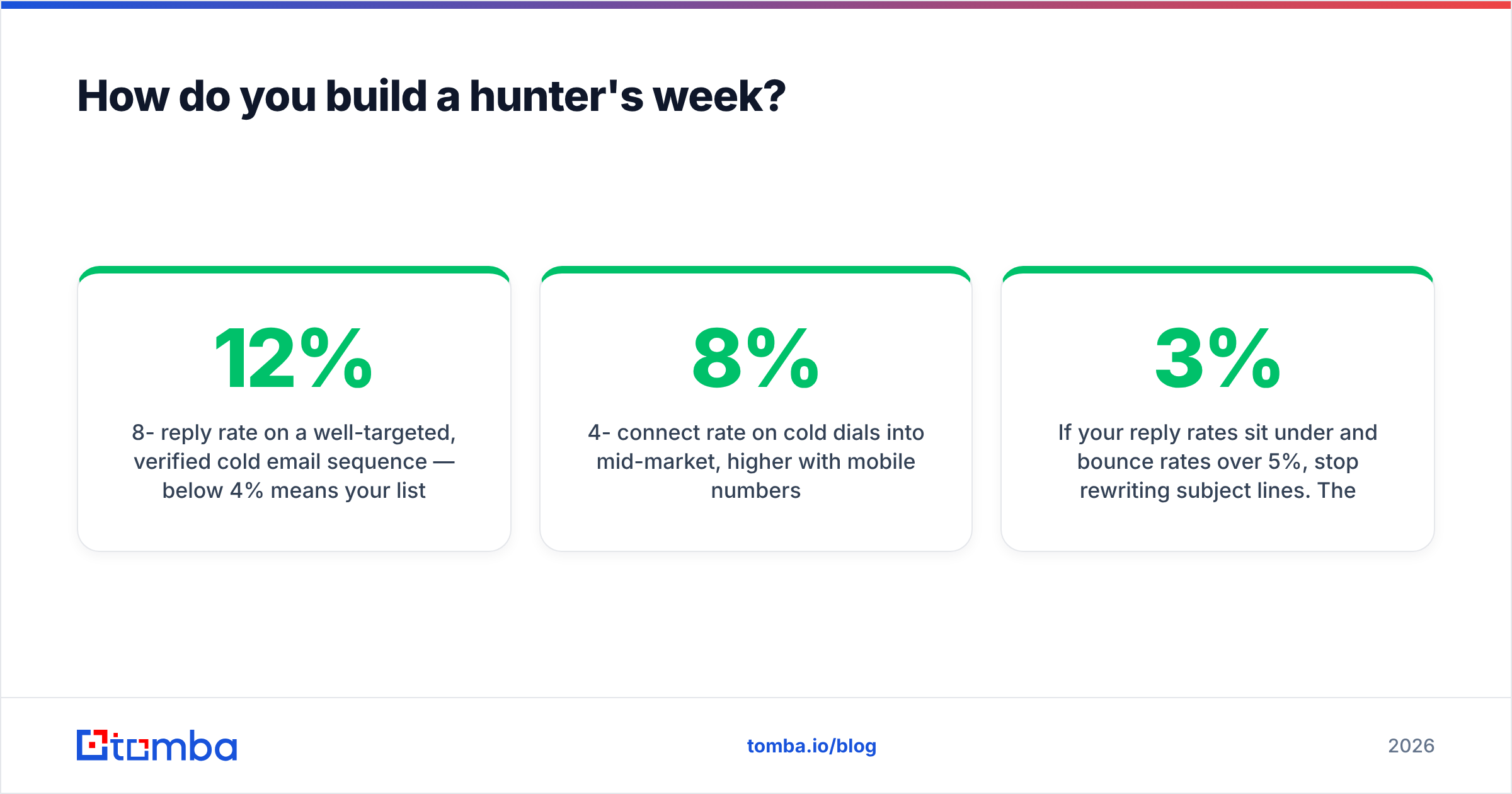
- 8-12% reply rate on a well-targeted, verified cold email sequence — below 4% means your list or your targeting is broken, not your copy
- 4-8% connect rate on cold dials into mid-market, higher with mobile numbers
- 1 meeting per 90-120 touches across channels as a healthy blended average
If your reply rates sit under 3% and bounce rates over 5%, stop rewriting subject lines. The problem is upstream in the data.
Why does data quality decide whether hunting works?#
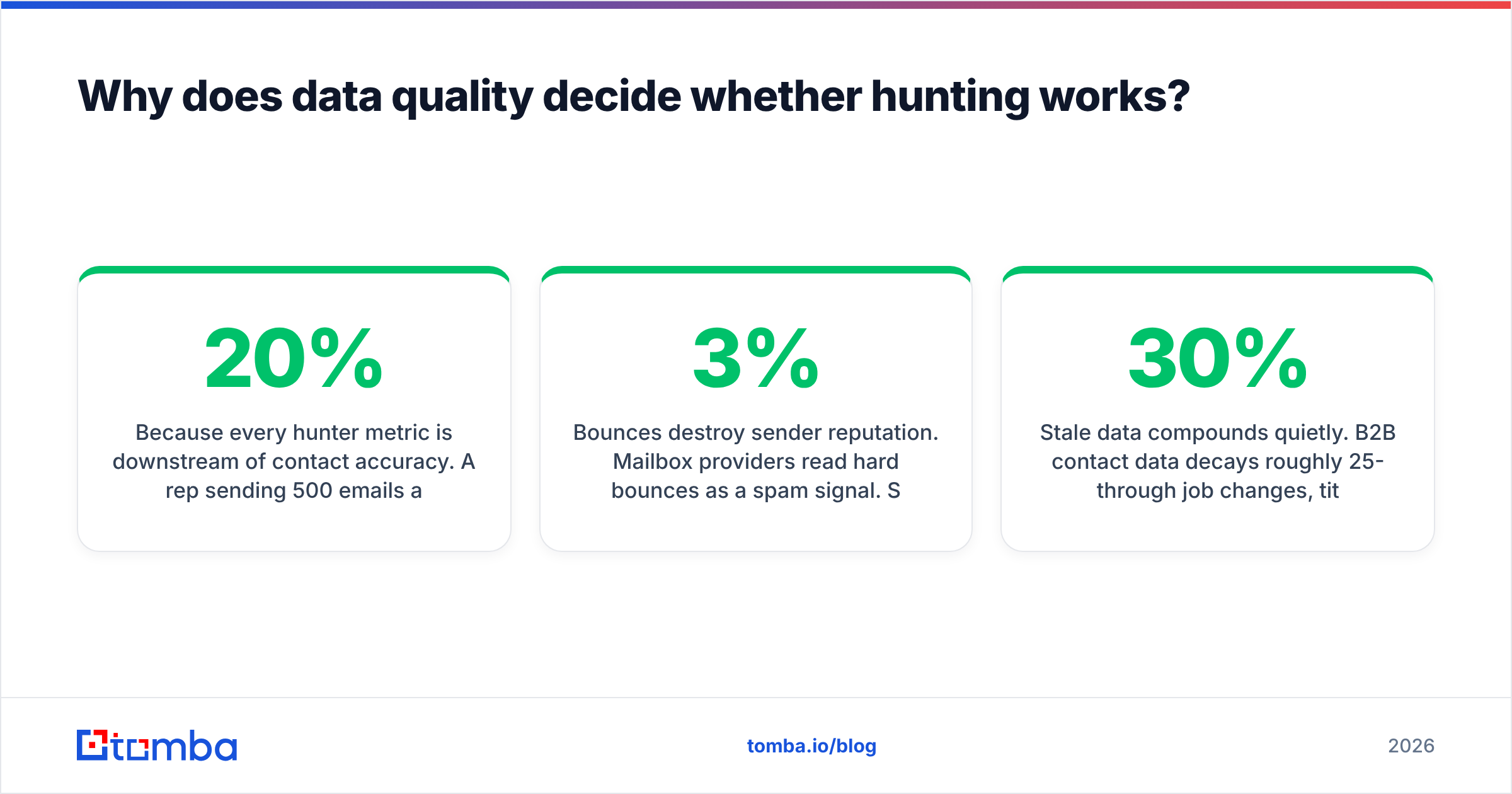
Because every hunter metric is downstream of contact accuracy. A rep sending 500 emails a week into a list with 20% invalid addresses isn't running an 80%-efficient program — they're running a program that's actively damaging their sending domain while wasting a fifth of their week.
Three failure modes to watch:
Bounces destroy sender reputation. Mailbox providers read hard bounces as a spam signal. Sustained bounce rates over 2-3% degrade inbox placement for your entire domain, including the emails that would have converted. Google and Yahoo's bulk sender requirements pushed the tolerated spam-complaint rate to 0.3%, and bounce-heavy lists correlate directly with complaints. Read the Google bulk sender guidelines if you haven't — they set the practical floor for email deliverability in 2026.
Wrong-persona contacts inflate activity and deflate results. Finding "an email at the company" is not prospecting. Finding the person who owns the budget line your product touches is.
Stale data compounds quietly. B2B contact data decays roughly 25-30% per year through job changes, title moves, and company changes. A list built 14 months ago is closer to fiction than data.
The practical fix is boring: verify before you send, re-verify quarterly, and use a tool that returns a confidence score rather than a guess. Tomba's email verifier runs SMTP-level checks and flags catch-all domains explicitly, which matters because a catch-all domain accepts everything and tells you nothing — you need a catch-all verifier to resolve those separately rather than gambling your domain reputation on them.
For list building itself, domain search is the fastest path from an account list to a contact list: feed it a company domain, get back the verified addresses and the company's email pattern, then filter by department and seniority.
What does a hunter's tech stack look like in 2026?#
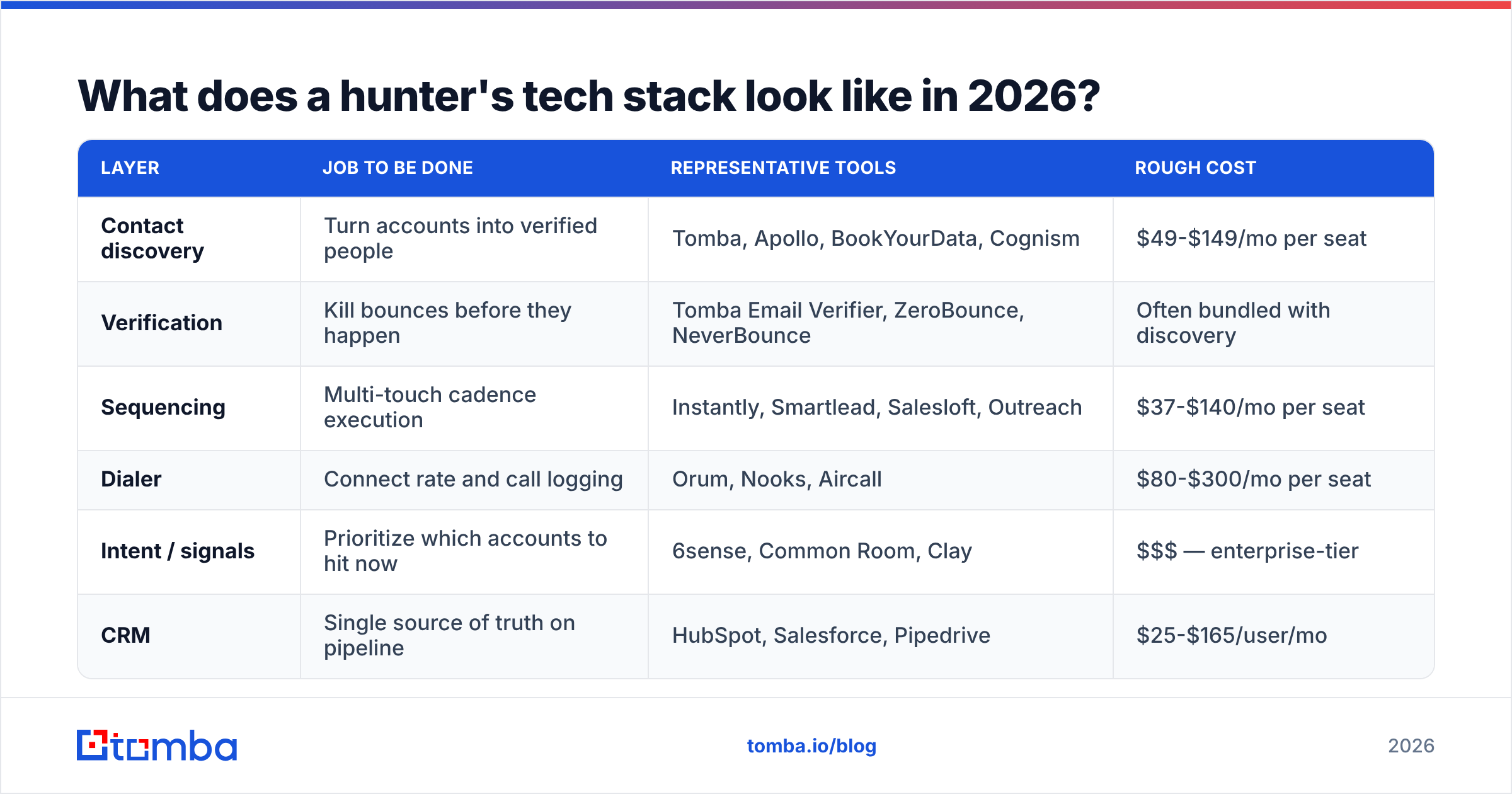
Lean. The most common failure I see is a hunter carrying 11 tools and using three. Here's the honest breakdown of what earns its seat.
| Layer | Job to be done | Representative tools | Rough cost |
|---|---|---|---|
| Contact discovery | Turn accounts into verified people | Tomba, Apollo, BookYourData, Cognism | $49-$149/mo per seat |
| Verification | Kill bounces before they happen | Tomba Email Verifier, ZeroBounce, NeverBounce | Often bundled with discovery |
| Sequencing | Multi-touch cadence execution | Instantly, Smartlead, Salesloft, Outreach | $37-$140/mo per seat |
| Dialer | Connect rate and call logging | Orum, Nooks, Aircall | $80-$300/mo per seat |
| Intent / signals | Prioritize which accounts to hit now | 6sense, Common Room, Clay | $$$ — enterprise-tier |
| CRM | Single source of truth on pipeline | HubSpot, Salesforce, Pipedrive | $25-$165/user/mo |
A few practical notes on that table. Discovery and verification should ideally live in one place — every hop between systems is a place where data goes stale or gets lost. Tomba pricing starts with a free tier at 25 searches a month, then $49/mo for Starter and $99/mo for Growth, with verification credits included rather than sold as a separate line. BookYourData takes a different and legitimate approach — prepaid, pay-as-you-go lists with a bounce guarantee, which suits teams that want a large one-time list rather than an ongoing search workflow. Both models work; pick based on whether your hunting is continuous or campaign-shaped.
Intent data is the most over-bought layer on this list. If you have fewer than 500 target accounts, you don't need a six-figure intent platform — you need to actually work the 500. Buy intent when your territory is genuinely too large to cover manually, not before.

How do you develop hunter mentality in an existing team?#
You mostly can't coach it in. You can design it in.
Split the role. The cleanest lever available. Separate net-new acquisition from account management, with different titles, different quotas, and different comp plans. Reps self-select, and the ones who stay in the hunter seat want to be there. Salesforce's research on sales productivity consistently shows specialization outperforming generalist AE models at scale.
Pay for the behavior you want. If new-logo revenue and renewal revenue pay identically, you will get renewals. Put an accelerator on net-new logos — 1.3-1.5x on the new-business component is a common structure — and the behavior follows the money within one quarter.
Make the pipeline number the leading metric. Managers who review closed-won in Monday's meeting get farming. Managers who review pipeline created last week get hunting. Whatever you inspect on Monday morning is what the team optimizes.
Remove the excuses. The most common one is "I don't have anyone to call." That excuse dies when a rep can go from a target account list to verified contacts in minutes. Give the team a bulk email finder and a Chrome extension and the "no leads" objection stops being credible.
Protect the blocks yourself. If a manager books over a rep's prospecting time, the block is dead within two weeks. Leadership has to treat those hours as immovable, including their own meetings.
The hunter scorecard worth running#
- Pipeline created per week — the only truly leading indicator
- Verified contacts added per week — measures list-building discipline, not busywork
- Meetings booked from self-sourced accounts — separates hunting from inbound catching
- Reply-to-meeting conversion — measures message quality independent of volume
- Bounce rate per campaign — an early warning system for data rot
Track these five and you will know within two weeks whether a rep's problem is effort, targeting, message, or data. Most managers guess at that and coach the wrong variable for a quarter.
What are the real limits of hunter mentality?#
Three, and they're worth naming honestly.
Burnout is a genuine risk. Sustained cold outreach carries real psychological load. Teams that run hunters at maximum intensity without rotation see 30-40% annual attrition in SDR/BDR seats, which is expensive when ramp is 90 days. Build in variety: campaign themes, event-driven outreach, occasional inbound rotations.
Not every market rewards it. In markets with fewer than a few hundred viable accounts, aggressive volume outreach burns the territory. Those markets reward account-based patience and referral depth. Hunting a small pond with a net empties it.
Hunter behavior without targeting rigor is just noise. Volume applied to a bad ICP produces bounces, complaints, and a wrecked domain. The hunter's edge comes from picking the right animal, not from running faster in every direction.
The version of hunter mentality worth building is the disciplined one: fixed hours, verified data, tight ICP, fast triage, and a scorecard that measures pipeline created rather than activity performed. That's a system anyone can install. The mythical "born closer" is not.
Where to start this week#
Pick one thing. Block two hours tomorrow and Thursday, build a list of 100 accounts in your best-fit segment, and find the verified decision-maker contact at each one. Then send. The gap between reps who hit 140% and reps who hit 60% is almost never talent — it's whether those two hours happened.
If your bottleneck is the list rather than the calendar, start with the Tomba Email Finder. Feed it a name and a company domain, get back a verified professional address with a confidence score, and skip the part of hunting where you guess at firstname.lastname@ and hope. The free tier covers 25 searches a month if you want to test the accuracy on accounts you already know before committing to a plan.
Related guides#
// get started
Find, verify and enrich your first contacts today
Start on the free plan with 25 searches a month, then scale when your team is ready.
Free plan · No credit card required · GDPR & CCPA
// about the author