Hunter Reviews 2026: Accuracy, Pricing, and Real Limits
An independent look at Hunter.io in 2026 — how accurate the finder actually is, what the credit system costs you at scale, the three complaints that show up in almost every review, and when a cheaper tool wins.
TL;DR
- Hunter is the most recognizable email finder on the market, and it earns that reputation on interface quality and domain-level coverage — not on raw hit rate.
- Accuracy is solid on mid-size and enterprise domains with public web footprints, and noticeably weaker on small companies, catch-all domains, and non-US markets.
- The credit model is where most buyers get burned: a "search" and a "verification" draw from separate pools, and bulk work eats them faster than the plan page suggests.
- At $49/mo, Hunter's Starter tier is priced identically to Tomba but ships fewer monthly lookups and no catch-all resolution.
- Buy Hunter if you want the cleanest UI and a light monthly volume. Skip it if you run bulk enrichment, API-first workflows, or heavy catch-all territory.
What is Hunter and who actually uses it?#
Hunter (hunter.io) is an email-finding and verification platform built around one core idea: given a company domain, return the professional email addresses associated with it, plus a confidence score for each. It launched in 2015 out of France and has since become the default answer when someone asks "how do I find someone's work email?"
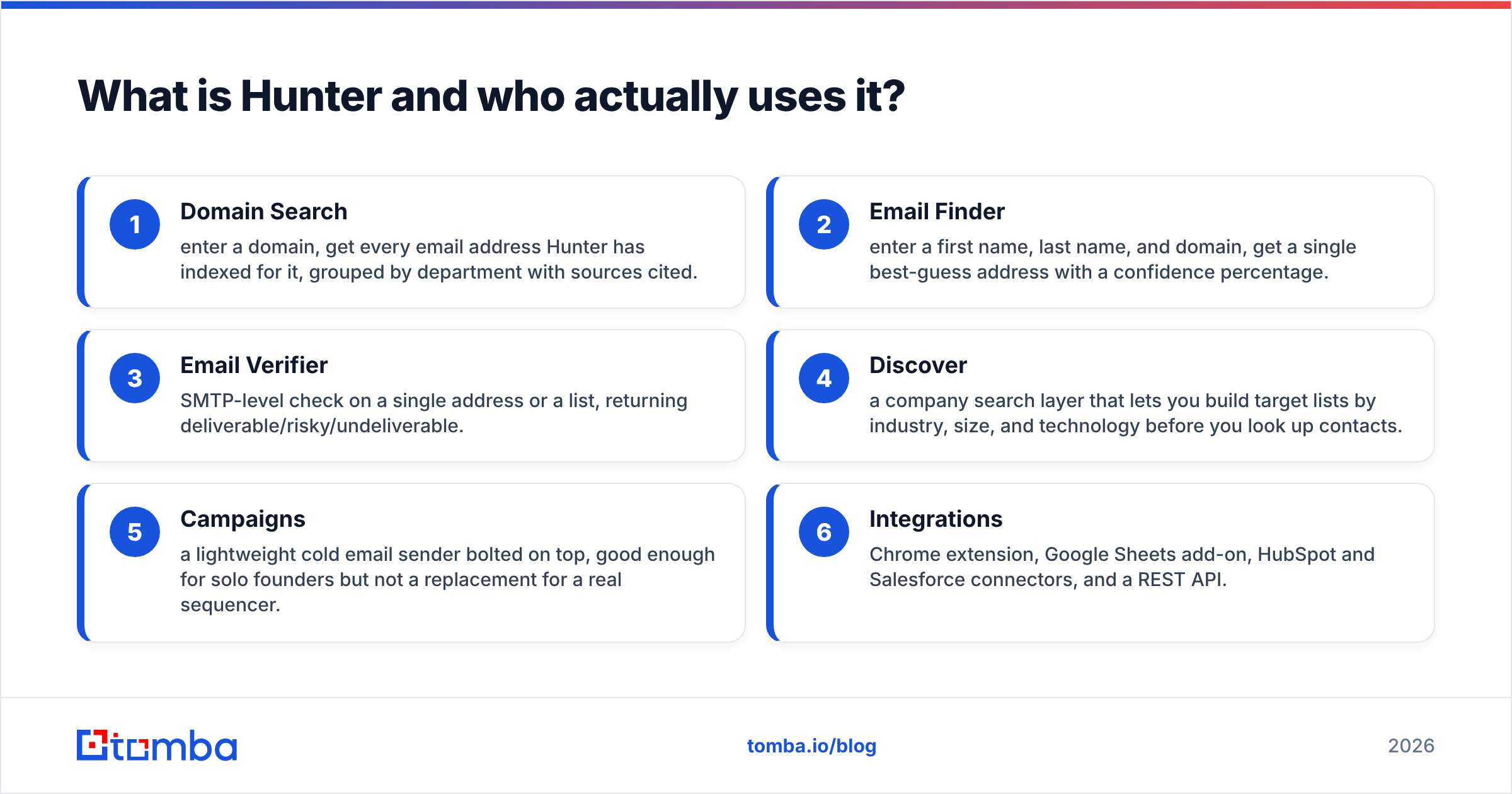
The product surface is broader than most people realize:
- Domain Search — enter a domain, get every email address Hunter has indexed for it, grouped by department with sources cited.
- Email Finder — enter a first name, last name, and domain, get a single best-guess address with a confidence percentage.
- Email Verifier — SMTP-level check on a single address or a list, returning deliverable/risky/undeliverable.
- Discover — a company search layer that lets you build target lists by industry, size, and technology before you look up contacts.
- Campaigns — a lightweight cold email sender bolted on top, good enough for solo founders but not a replacement for a real sequencer.
- Integrations — Chrome extension, Google Sheets add-on, HubSpot and Salesforce connectors, and a REST API.
The typical Hunter buyer is a founder, a marketer, or a one-to-three-person sales team doing under a thousand lookups a month. That's the sweet spot the product was designed for, and most positive Hunter reviews come from exactly that profile. Reviews turn sour predictably as volume climbs.
How accurate is Hunter's email finder?#
Hunter's accuracy depends almost entirely on how much of a company's email pattern is publicly discoverable. Hunter is fundamentally a web-crawl-plus-pattern-inference engine: it scrapes public pages, press releases, GitHub commits, and author bylines, infers the company's email format, then applies that format to the name you asked about.
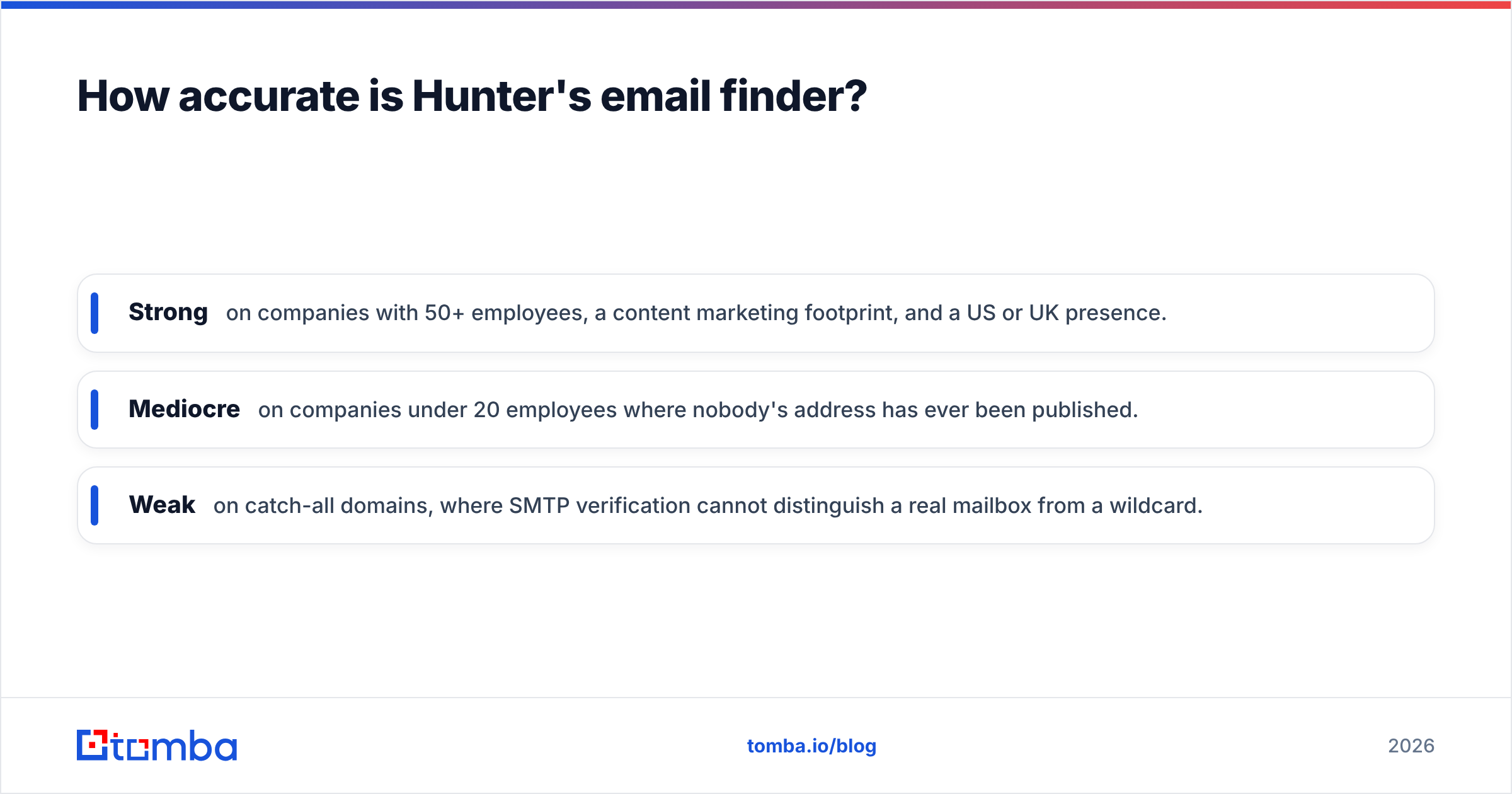
That architecture produces a very specific accuracy shape:
- Strong on companies with 50+ employees, a content marketing footprint, and a US or UK presence.
- Mediocre on companies under 20 employees where nobody's address has ever been published.
- Weak on catch-all domains, where SMTP verification cannot distinguish a real mailbox from a wildcard.
The confidence score is genuinely useful and more honest than most competitors' — Hunter will tell you it's 68% sure rather than pretending. But a 68% address still burns a send, and at scale those sends compound into sender reputation damage.

The practical gap between tools isn't the headline accuracy number — every vendor claims something in the nineties. It's the coverage number: what percentage of your input list returns any address at all. Hunter tends to return fewer results but flag them more honestly. Tools with a heavier waterfall approach return more addresses at the cost of more guesses. Neither is universally better; it depends on whether your bottleneck is list size or bounce rate.
One thing worth crediting: Hunter shows you the sources for every address — the URLs where it found the pattern evidence. That transparency is rare and it's the single best reason to trust a Hunter result over a black-box competitor's.
What does Hunter cost in 2026?#
Hunter's pricing is transparent and published, which is more than you can say for a lot of the category. Verify current numbers on hunter.io/pricing before you commit, since tiers shift.
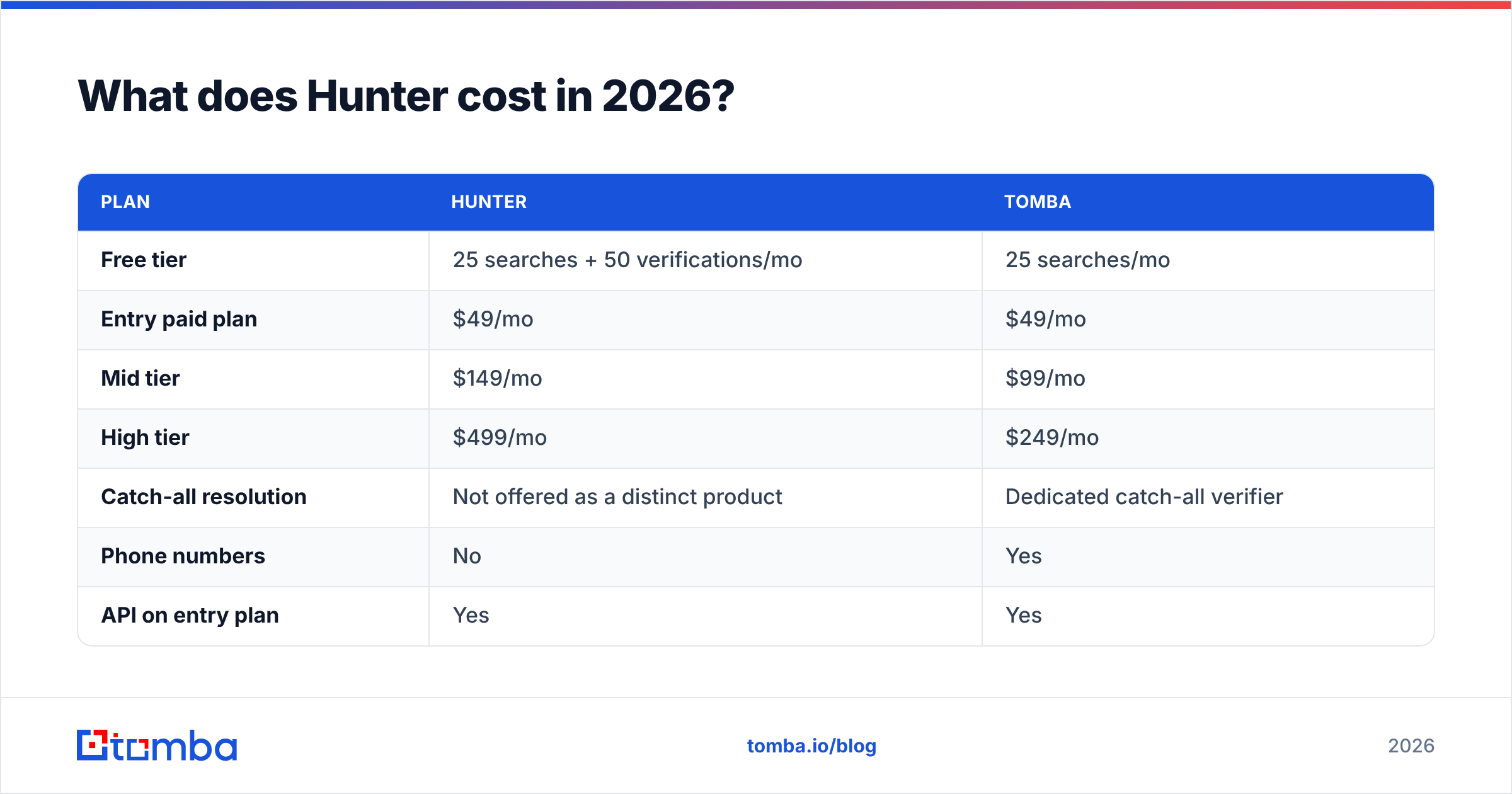
The structure that trips people up: searches and verifications are separate credit pools. A domain search that returns 40 addresses costs one search credit. Verifying those 40 addresses costs 40 verification credits. Teams budget for the first number and get surprised by the second.
| Plan | Hunter | Tomba |
|---|---|---|
| Free tier | 25 searches + 50 verifications/mo | 25 searches/mo |
| Entry paid plan | $49/mo | $49/mo |
| Mid tier | $149/mo | $99/mo |
| High tier | $499/mo | $249/mo |
| Catch-all resolution | Not offered as a distinct product | Dedicated catch-all verifier |
| Phone numbers | No | Yes |
| API on entry plan | Yes | Yes |
| Credit rollover | No | No |
The gap widens as you scale. At the entry tier the two are functionally comparable on price; by the third tier Hunter costs roughly double for a similar volume band. If you are a solo user who does 200 lookups a month, this is irrelevant. If you're running a three-SDR team pushing 10,000 monthly enrichments, it's a five-figure annual difference.
Annual billing knocks roughly 30% off Hunter's monthly rate, which is the single easiest saving available and the one most buyers forget to ask about.
How does Hunter compare to the main alternatives?#
Hunter competes in three distinct lanes and performs differently in each.
Against pure email finders (Tomba, Findymail, Snov.io), Hunter wins on interface polish and source transparency, and loses on price-per-lookup at volume and on catch-all handling. Tomba's email finder and domain search cover the same core job with a more generous per-dollar allowance and a separate catch-all product, which matters more than it sounds — catch-all domains are somewhere between 20% and 30% of B2B domains depending on your market.
Against data platforms (Apollo, ZoomInfo, Clearbit), Hunter isn't really competing. Those tools sell a contact database with intent signals, org charts, and dialers attached. Hunter sells a precise lookup. If you need firmographic filtering and a prospecting workspace, Hunter will feel thin — that's a scope difference, not a quality failure.
Against verified-list vendors (BookYourData and similar), the comparison is philosophical. Hunter finds addresses on demand from live web signals; list vendors sell pre-verified contacts you download and own. BookYourData does the second job well and with a straightforward pay-as-you-go model, which suits buyers who want a defined list rather than a subscription. Hunter suits buyers who want to look up specific people as they encounter them. Plenty of teams run both.

Independent user sentiment is worth reading directly rather than through any vendor's summary — the Hunter listing on G2 has enough volume to be meaningful, and the complaint clusters there match what we found.

What do real Hunter reviews complain about?#
Three complaints appear over and over across review sites, Reddit threads, and support forums. None of them are dealbreakers on their own; together they define who should look elsewhere.
1. Credits disappear faster than expected. The split search/verification pools are the main culprit. A single bulk enrichment run of 1,000 rows can consume a full Starter month if you verify everything. Hunter's own docs explain this clearly — most buyers just don't read them before subscribing.
2. Coverage drops off outside North America and Western Europe. If your ICP is in APAC, LATAM, or the Gulf, expect materially lower hit rates. This is true of nearly every finder built on English-language web crawls, but Hunter's marketing doesn't caveat it.
3. Catch-all domains return "risky" and stop there. Hunter marks them and moves on. That's honest, but it leaves you holding an unusable segment. Tools that attempt catch-all resolution give you a probability instead of a shrug — worth having when a third of your list is affected. If catch-alls are a significant share of your target market, run them through a dedicated catch-all finder rather than accepting the "risky" label as final.
A fourth, milder complaint: Campaigns is a starter feature, not a product. It sends email and tracks opens. It does not do the branching logic, inbox rotation, or deliverability tooling that a dedicated sequencer does. Treat it as a bonus, never as a reason to buy.
What does Hunter do better than everyone else?#
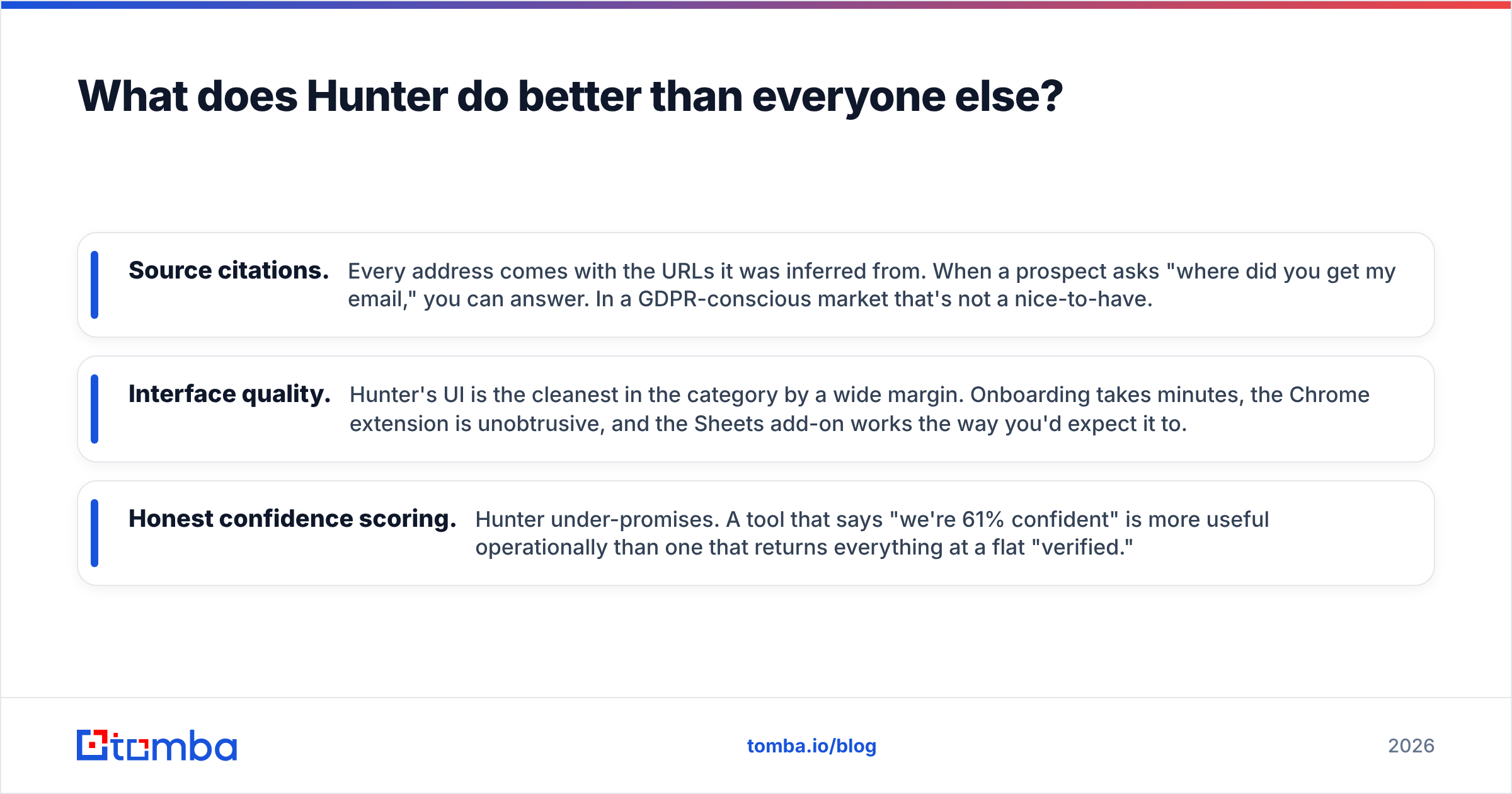
Credit where it's due. Three things Hunter genuinely leads on:
- Source citations. Every address comes with the URLs it was inferred from. When a prospect asks "where did you get my email," you can answer. In a GDPR-conscious market that's not a nice-to-have.
- Interface quality. Hunter's UI is the cleanest in the category by a wide margin. Onboarding takes minutes, the Chrome extension is unobtrusive, and the Sheets add-on works the way you'd expect it to.
- Honest confidence scoring. Hunter under-promises. A tool that says "we're 61% confident" is more useful operationally than one that returns everything at a flat "verified."
If your evaluation criteria are "which tool will my non-technical marketer actually use without training," Hunter wins that question outright.
Who should use Hunter — and who should not?#
Use Hunter if:
- You do under ~1,000 lookups per month.
- Your targets are mid-size or larger companies in English-speaking markets.
- You value source transparency and a clean interface over cost-per-lookup.
- You want one tool for finding, verifying, and light sending without a stack.
Look elsewhere if:
- You run bulk enrichment jobs and need a predictable per-record cost. A bulk email finder with a single credit pool avoids the split-budget problem entirely.
- You need catch-all resolution rather than a "risky" flag.
- You're building on top of an API and want phone numbers, enrichment, and verification from one vendor. Compare the Tomba API surface before committing.
- Your ICP sits outside Hunter's crawl-heavy geographies.
Is Hunter worth it in 2026?#
Verdict: yes for light users, no for scaled outbound.
Hunter is a well-built, honestly-marketed product that has aged better than most of its 2015 cohort. Nothing in these Hunter reviews suggests it's a bad tool — it's a specific tool, priced for a specific user, and the mismatch between that user and the average B2B sales team is where the negative reviews come from.
The decision comes down to one question: is your bottleneck finding the right person or processing volume? Hunter is excellent at the first and expensive at the second. If you're doing careful, low-volume, research-driven outreach, the $49 tier is money well spent and the source citations alone justify it.
If you're feeding a sequencer 5,000 contacts a month, the math stops working around the mid tier, and you should be comparing per-lookup cost across at least three vendors before you renew. Run the same 200-row test list through each one, measure coverage and bounce rate side by side, and let the numbers pick.
Testing the alternative takes ten minutes. Drop a list of names and domains into the Tomba Email Finder and run the identical list through Hunter. Compare coverage, compare confidence scores, compare what each costs you at your real monthly volume — not the volume on the pricing page. The free tier gives you 25 searches, which is enough to settle the question with your own data instead of someone else's benchmark.
Related guides#
Ready to find emails that actually work?
Join 150,000+ professionals who stopped guessing and started sending. Free credits on signup — no credit card required.
Get the Tomba newsletter
Practical outbound tactics and product updates — once every two weeks.
About the author