Hunter vs Farmer Sales: Which Role Your Team Needs in 2026
Hunters open logos. Farmers grow them. Most teams hire the wrong one first and blame the rep. Here is how the two roles actually differ on comp, metrics, tooling, and when a hybrid quietly beats both.
TL;DR
- A hunter wins net-new logos; a farmer expands and retains the ones you already have. They use different skills, different metrics, and should never share a quota sheet.
- Hunters are measured on meetings booked, new-logo ARR, and pipeline created. Farmers are measured on net revenue retention, expansion ARR, and churn.
- Hire hunters first only if your logo count is small and your product sells in one call. If your net revenue retention is under 100%, a farmer pays back faster than another hunter.
- The "hybrid full-cycle AE" works below roughly $3M ARR and breaks above it, because prospecting always loses to inbound firefighting when both live in one calendar.
- Tooling splits cleanly: hunters need contact data and sequencing; farmers need usage signals, CRM hygiene, and exec-relationship mapping.
What is the hunter vs farmer sales model?#
The split is old and it survives because it maps to two genuinely different jobs. A hunter finds and closes accounts that have never bought from you. A farmer takes accounts that already bought and makes them bigger, stickier, and more referenceable.
Think of a restaurant. The hunter is the person outside handing menus to strangers on the sidewalk — high rejection, high energy, wins on volume and nerve. The farmer is the host who remembers your table, your order, and upgrades you to the tasting menu on your fourth visit. Both put money in the till. Neither is good at the other's job for long.
Technically, the distinction is about where revenue comes from. Hunters generate first-dollar revenue from cold or semi-cold demand. Farmers generate second-dollar-onward revenue from an installed base. Everything downstream — comp, activity metrics, tooling, hiring profile — follows from that one difference.
The confusion in 2026 comes from title inflation. "Account Executive" now covers both. "Account Manager" sometimes means renewals-only and sometimes means a quota-carrying expansion seller. Before you argue about which role you need, define the revenue source, not the title.
How do hunters and farmers actually differ?#
Here is the honest side-by-side. Numbers are typical ranges for B2B SaaS with a $15k–$60k average contract value; adjust for your motion.
| Dimension | Hunter | Farmer |
|---|---|---|
| Primary goal | New-logo ARR | Net revenue retention + expansion ARR |
| Typical quota | $600k–$900k new ARR | $1.5M–$3M book, 110–125% NRR target |
| Base/variable split | 50/50 | 70/30 or 75/25 |
| Sales cycle owned | 30–90 days, one-and-done | Continuous, 12–36 months |
| Core daily activity | Prospecting, discovery, demos | QBRs, usage reviews, exec alignment |
| Rejection tolerance needed | Very high | Moderate |
| Key leading indicator | Meetings booked / week | Product adoption depth |
| Key lagging indicator | Closed-won new logos | Gross + net retention |
| Fails when | Territory is saturated | Product has no expansion vector |
| Tooling center of gravity | Contact data + sequencer | CRM + product analytics |
Two rows deserve emphasis.
Comp split. If you pay a farmer 50/50, you have built a hunter who happens to own existing accounts — and they will chase the easiest expansion instead of doing the unglamorous retention work that protects the base. If you pay a hunter 75/25, you have removed the thing that makes hunters tolerate a 4% cold reply rate.
Failure mode. Hunters fail on territory design more often than on skill. Farmers fail on product more often than on skill. Diagnose the system before you performance-manage the person.

Which role should you hire first?#
Start from your retention number, not your ambition.
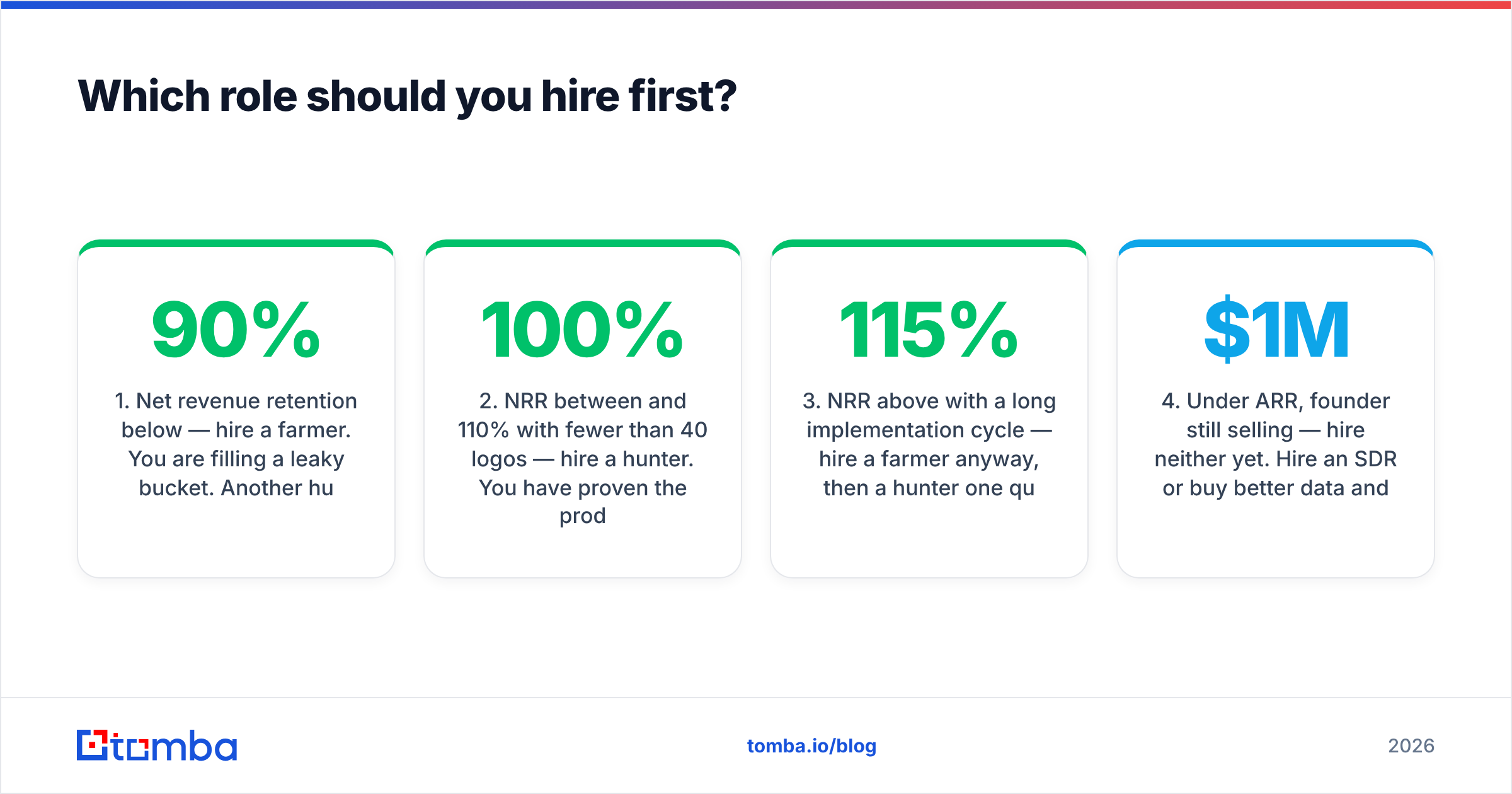
- Net revenue retention below 90% — hire a farmer. You are filling a leaky bucket. Another hunter just pours water in faster while the hole widens, and you will burn cash on acquisition that churns inside 14 months.
- NRR between 100% and 110% with fewer than 40 logos — hire a hunter. You have proven the product holds, and your ceiling is now distribution. This is the one clear case where net-new headcount is the highest-ROI hire on the board.
- NRR above 115% with a long implementation cycle — hire a farmer anyway, then a hunter one quarter later. Strong expansion means every logo you land compounds; protect the compounding first.
- Under $1M ARR, founder still selling — hire neither yet. Hire an SDR or buy better data and keep the founder closing. Founder-led selling outperforms a first AE until the messaging is repeatable.
- Enterprise motion, ACV above $100k — split the roles on day one. The discovery-to-close skill set and the post-sale governance skill set share almost nothing at that deal size.
- PLG motion with self-serve conversion — farmer-first, almost always. Your acquisition is the product; your gap is converting free usage into paid expansion.
A blunt heuristic: if you can name the ten accounts that would double your revenue by growing, you need a farmer. If you cannot name ten accounts worth having, you need a hunter.
Is the hybrid full-cycle rep a good idea?#
Sometimes — and it expires faster than most founders expect.
The hybrid works when three conditions hold at once: fewer than roughly 60 total accounts, sales cycles under 45 days, and an ACV low enough that a single rep can hold both a prospecting block and a customer book without either collapsing. In practice that caps out somewhere around $3M ARR.
Above that, the hybrid quietly fails in a predictable order. Inbound and existing-customer requests arrive with deadlines. Prospecting does not. So prospecting gets deferred, then deferred again, and by month four the rep's pipeline is entirely inbound and the team has no idea it lost its outbound engine until a slow quarter exposes it.
If you must run hybrid, protect the hunting time structurally rather than culturally. Block mornings for outbound, route all support requests away from the rep, and measure pipeline created weekly — not monthly, weekly — because that is the number that decays first and silently.
Research on sales specialization is fairly consistent here. HubSpot's sales benchmark data and Salesforce's State of Sales both point the same direction: reps who split attention across acquisition and account management spend a shrinking share of the week on actual selling.
What tools does each role need?#
The stacks overlap less than vendors want you to believe.
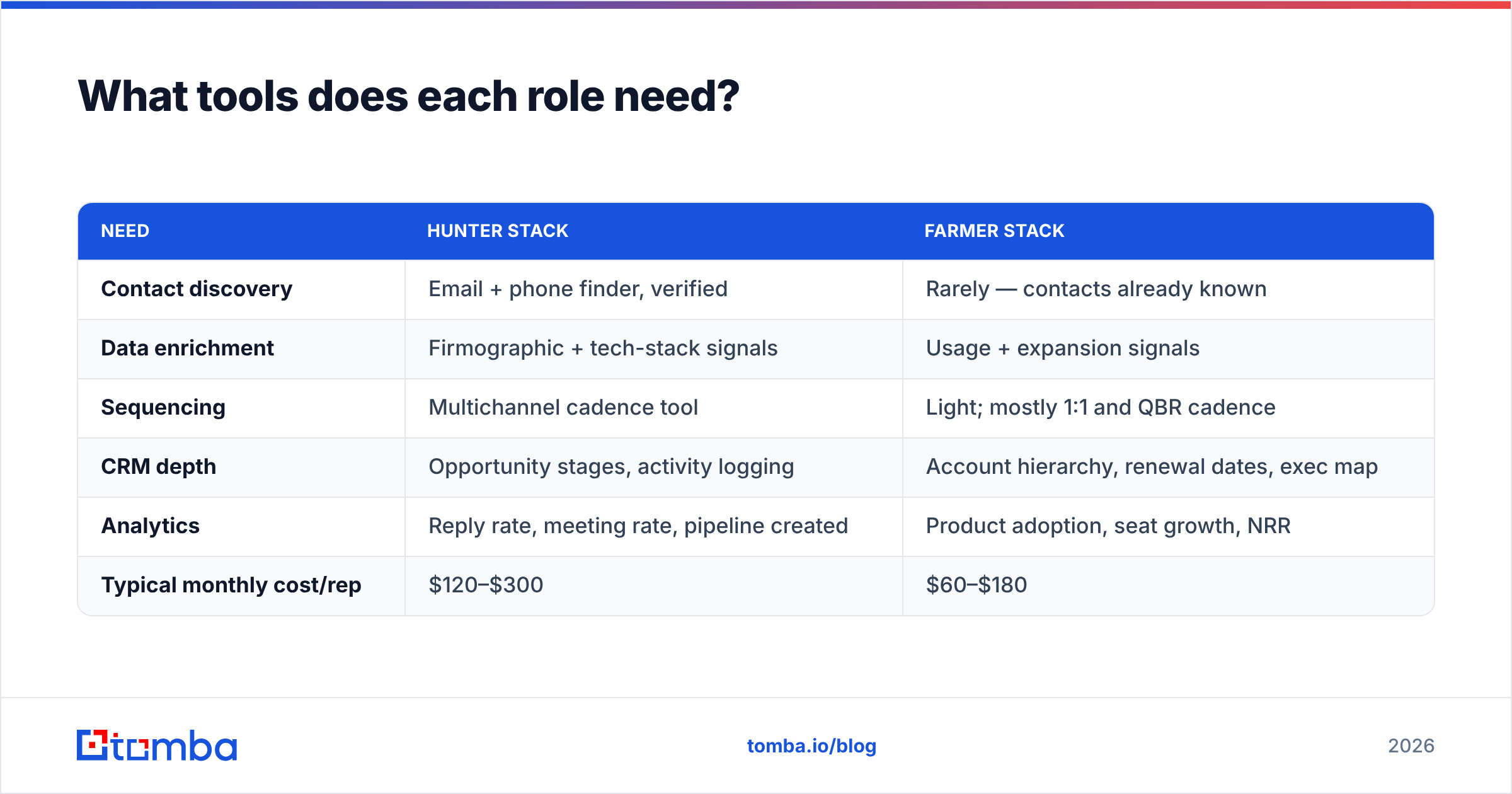
| Need | Hunter stack | Farmer stack |
|---|---|---|
| Contact discovery | Email + phone finder, verified | Rarely — contacts already known |
| Data enrichment | Firmographic + tech-stack signals | Usage + expansion signals |
| Sequencing | Multichannel cadence tool | Light; mostly 1:1 and QBR cadence |
| CRM depth | Opportunity stages, activity logging | Account hierarchy, renewal dates, exec map |
| Analytics | Reply rate, meeting rate, pipeline created | Product adoption, seat growth, NRR |
| Typical monthly cost/rep | $120–$300 | $60–$180 |
A hunter's entire output is capped by data quality. If 25% of the emails in a sequence bounce, the domain reputation damage costs more than the wasted sends — and it hits every rep on the same domain. That is why hunter stacks start with an email finder and an email verifier before they start with a sequencer. Order matters: verified contacts into a mediocre sequencer beat unverified contacts into a great one, every time.
For territory building, domain search is the workhorse — you hand it a target company and get the mapped contact set for that domain, rather than assembling names one at a time from LinkedIn tabs. For teams working a defined account list, bulk email finder runs the whole list in one pass.
Farmers need almost none of that. What they need is a clean CRM with accurate renewal dates and a product-usage feed. The most common farmer tooling mistake is buying prospecting software for a team that never prospects.

How should you compensate each role?#
Comp is where most hunter-vs-farmer designs quietly break.
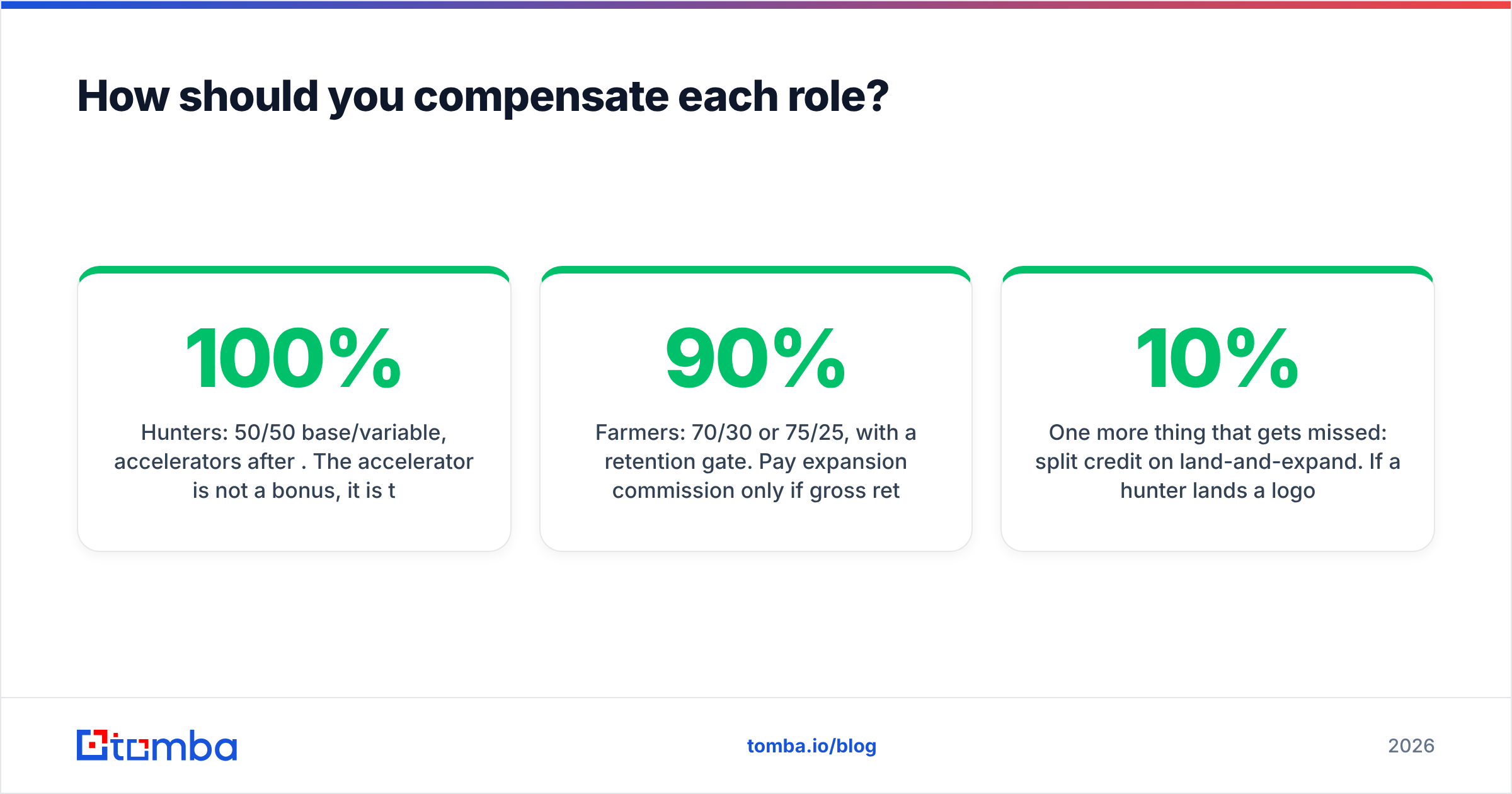
Hunters: 50/50 base/variable, accelerators after 100%. The accelerator is not a bonus, it is the whole point. A hunter who hits 140% should earn disproportionately, because the marginal deal above quota is your cheapest revenue. Cap the accelerator and your best hunter sandbags Q4 into Q1.
Farmers: 70/30 or 75/25, with a retention gate. Pay expansion commission only if gross retention on the book clears a floor — typically 90%. Without the gate, a farmer can hit expansion quota while losing two logos, and you have paid a bonus for shrinking revenue.
Ramp differs too. A hunter ramps in one to two sales cycles; you know within about five months whether it works. A farmer takes two to three quarters before you can read the signal, because retention is a lagging metric by definition. Firing a farmer at 90 days tells you nothing except that you wasted a hire.
One more thing that gets missed: split credit on land-and-expand. If a hunter lands a logo in Q1 and the farmer triples it in Q3, and only the farmer is paid on the expansion, hunters will stop caring about account fit and start closing anything with a pulse. A small trailing kicker to the originating hunter — 10% of first-year expansion — fixes the incentive cheaply.
What metrics should each role be reviewed on?#
Keep the scoreboards genuinely separate. Shared dashboards create shared excuses.
Hunter weekly review:
- New contacts added to sequence (leading, controllable)
- Response rate by segment, not blended
- Meetings booked and meetings held (the gap between them is a qualification problem)
- Pipeline created, as a multiple of quota — 3x minimum
- Bounce rate on sends, which should sit under 2%
Farmer monthly review:
- Net revenue retention on the assigned book
- Gross retention, tracked separately — a healthy NRR can hide real logo loss
- Product adoption depth (seats or feature usage per account)
- Executive relationship coverage: how many accounts have a named champion above the buyer
- Time to first expansion conversation after onboarding
The hunter list is weekly because outbound decays fast and you can course-correct inside a week. The farmer list is monthly because retention is slow-moving and weekly noise produces bad decisions. Reviewing a farmer weekly is like weighing yourself hourly.
If your team uses shared reporting, sales automation helps here mainly by making the leading indicators automatic — a hunter should never manually count sequenced contacts, and a farmer should never manually assemble a usage report before a QBR.
Is the hunter/farmer split still relevant in 2026?#
Mostly yes, with one real change: the hunter's job has narrowed and gotten harder.
Cold email volume has risen while inbox filtering has tightened. The 2024 Google and Yahoo bulk-sender requirements — authentication, easy unsubscribe, a spam-complaint ceiling — permanently raised the floor for outbound hygiene. A hunter in 2026 is not measured on sends; they are measured on whether their sends land at all, which makes email deliverability part of the hunting job rather than an ops afterthought.
The farmer's job has changed less, but the stakes have risen. When acquisition gets more expensive, retention becomes a larger share of enterprise value. Analyst coverage from Gartner has been pointing at this for several cycles: buying groups are larger, cycles are longer, and the cost to replace a churned logo keeps climbing relative to the cost of keeping it.
What has genuinely died is the third role many teams invented — the "farmer who also prospects into their own base." That is just a farmer with a distracting side quest. Expansion prospecting into existing accounts is a farmer activity and should be measured as expansion, not as new pipeline.
So: keep the split, sharpen the hunter's data requirements, and gate the farmer's comp on retention. The model is fine. The execution is usually where it goes wrong.
How do you transition a rep from hunter to farmer (or back)?#
Carefully, and rarely.
Moving a farmer to hunting works about a third of the time. The failure point is almost always rejection tolerance — a good farmer has spent years in warm conversations and finds a 3% reply rate genuinely demoralizing, no matter how well they understand it intellectually.
Moving a hunter to farming works more often, maybe half the time, but it produces a specific problem: hunters get bored between expansion events and start manufacturing urgency in accounts that do not need it. That damages trust in the exact accounts you assigned them to protect.
If you must transition someone, give them a 90-day trial with a real quota and a real fallback role. Ambiguity here is unkind to everyone. And do not transition someone as a retention tactic for a rep you are otherwise ready to lose — you will lose them anyway, six months later, from a role they were worse at.
The bottom line#
Hunter versus farmer is not a personality quiz. It is a question about where your next dollar comes from and what it costs to get it. Check your net revenue retention first; that number tells you which role to fund before any hiring debate starts. Then separate the comp, separate the scoreboards, and give each role tooling that matches its actual job.
If the answer is "we need more new logos," the constraint is usually data before it is headcount. A hunter working from stale or unverified contacts burns a quarter proving nothing. Start with the Tomba Email Finder to build verified, deliverable target lists by domain and name, and check Tomba pricing — the free tier gives you 25 searches a month to validate your list quality before committing, with Starter at $49/mo and Growth at $99/mo when you scale the territory.
Fix the data, then hire the hunter. In that order.
Related guides#
// get started
Find, verify and enrich your first contacts today
Start on the free plan with 25 searches a month, then scale when your team is ready.
Free plan · No credit card required · GDPR & CCPA
// about the author