Hunter vs Influno: Which Email Finder Wins in 2026?
Hunter vs Influno is a specialist against a bundle. Hunter is the category veteran. Influno is the cheaper all-in-one challenger. We compared accuracy, pricing, verification depth, and API quality to show which one fits your outbound motion in 2026.
Hunter vs Influno comes down to one question: do you want the best finder, or the fewest tools? Hunter is the specialist. Influno is the bundle. This guide compares both on accuracy, price, and API depth, then shows where a third option beats them.
TL;DR
- Hunter is the best-known email finder on the market. The UI is clean, brand-domain coverage is strong, and the free tier is the easiest way to test a finder. Past a few thousand lookups, it is also the priciest per credit.
- Influno bundles finding, verifying, and sending in one subscription. Solo founders get real value from that. The finder itself is thinner on long-tail domains than Hunter's.
- No tool wins on every axis. In the Hunter vs Influno split, Hunter takes data confidence and API maturity. Influno takes convenience and price per seat.
- If you need volume with verified accuracy, both get costly fast. A dedicated finder like Tomba at $49/mo Starter usually lands more contacts per dollar.
- Pick by workflow, not by logo: one tool for finding and sending (Influno), best-in-class discovery (Hunter), or top credit efficiency (Tomba).
Hunter vs Influno: what are these tools?#
Hunter is a domain-first email discovery platform. You give it a company domain. It returns the addresses it has seen publicly on that domain, the email pattern it detected, and a confidence score for each address. It launched in 2015, and most SDRs have used it at least once. Its public site runs a free tier and a popular Chrome extension.
Influno is newer, and it sells a full outbound stack: find contacts, verify them, then send sequences from the same dashboard. Read it less as "a better Hunter" and more as "Hunter plus a light sending tool, sold as one product." That framing shapes the whole Hunter vs Influno debate. You are not just comparing finders. You are comparing a specialist against a bundle.
Here is the everyday analogy. Hunter is a good chef's knife. Influno is a decent Swiss Army knife. Both cut. One cuts better. One saves you from carrying three tools.

Hunter vs Influno on features and price#
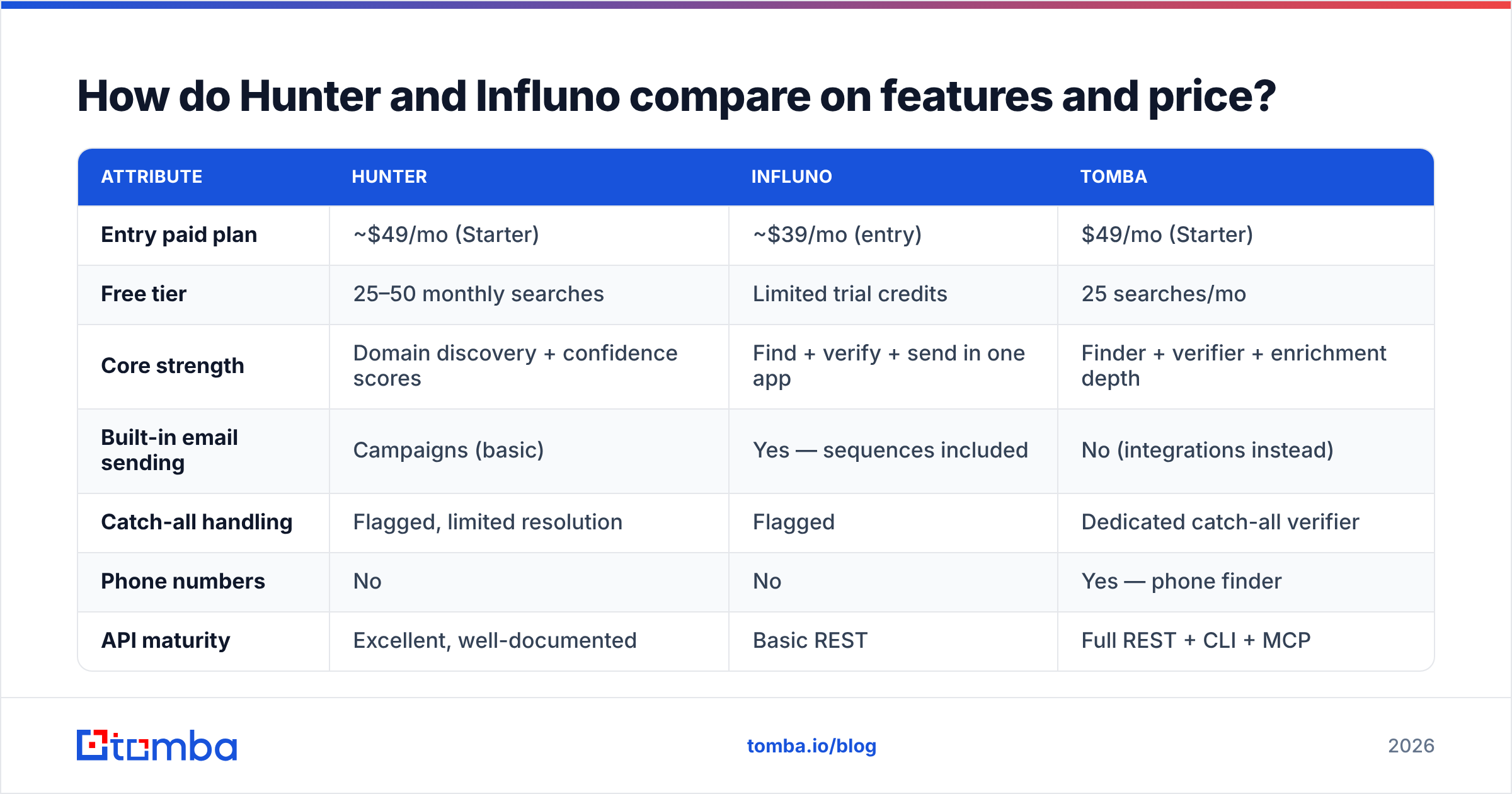
Here is the head-to-head on the things that change your cost per meeting. Pricing reflects public plans as of early 2026. Confirm on each vendor's page before you buy.
| Attribute | Hunter | Influno | Tomba |
|---|---|---|---|
| Entry paid plan | ~$49/mo (Starter) | ~$39/mo (entry) | $49/mo (Starter) |
| Free tier | 25–50 monthly searches | Limited trial credits | 25 searches/mo |
| Core strength | Domain discovery + confidence scores | Find + verify + send in one app | Finder + verifier + enrichment depth |
| Built-in email sending | Campaigns (basic) | Yes — sequences included | No (integrations instead) |
| Catch-all handling | Flagged, limited resolution | Flagged | Dedicated catch-all verifier |
| Phone numbers | No | No | Yes — phone finder |
| API maturity | Excellent, well-documented | Basic REST | Full REST + CLI + MCP |
| Best for | Teams that value data confidence | Solo founders wanting one bill | Volume prospecting on a budget |
Two things stand out. First, the entry price gap is small. It widens at volume, where Hunter's credit costs climb fast. Second, Influno's included sending only saves money if you would otherwise buy a sequencer. If you already run Instantly, Smartlead, or HubSpot sequences, you pay twice for a feature you will not use.
Which one finds more valid emails?#
Hunter wins on well-indexed domains in most tests. Influno wins on price per valid contact. Neither result is a blowout.
The mechanics explain why. Hunter's index leans on public web sources: bylines, contact pages, press releases, GitHub commits. Coverage is excellent for companies with a public footprint. Think SaaS vendors, agencies, media companies, or anyone with a team page. Coverage is weak for a 12-person manufacturing firm in Ohio with one info@ address on its site.
Influno leans on pattern inference plus SMTP checks. Once it knows the format is first.last@, it builds the address and tests it. That yields more raw hits on low-footprint domains. It also yields more addresses that deliver but do nothing — a real mailbox nobody reads.

Here is the rule set for any finder bake-off, including Hunter vs Influno:
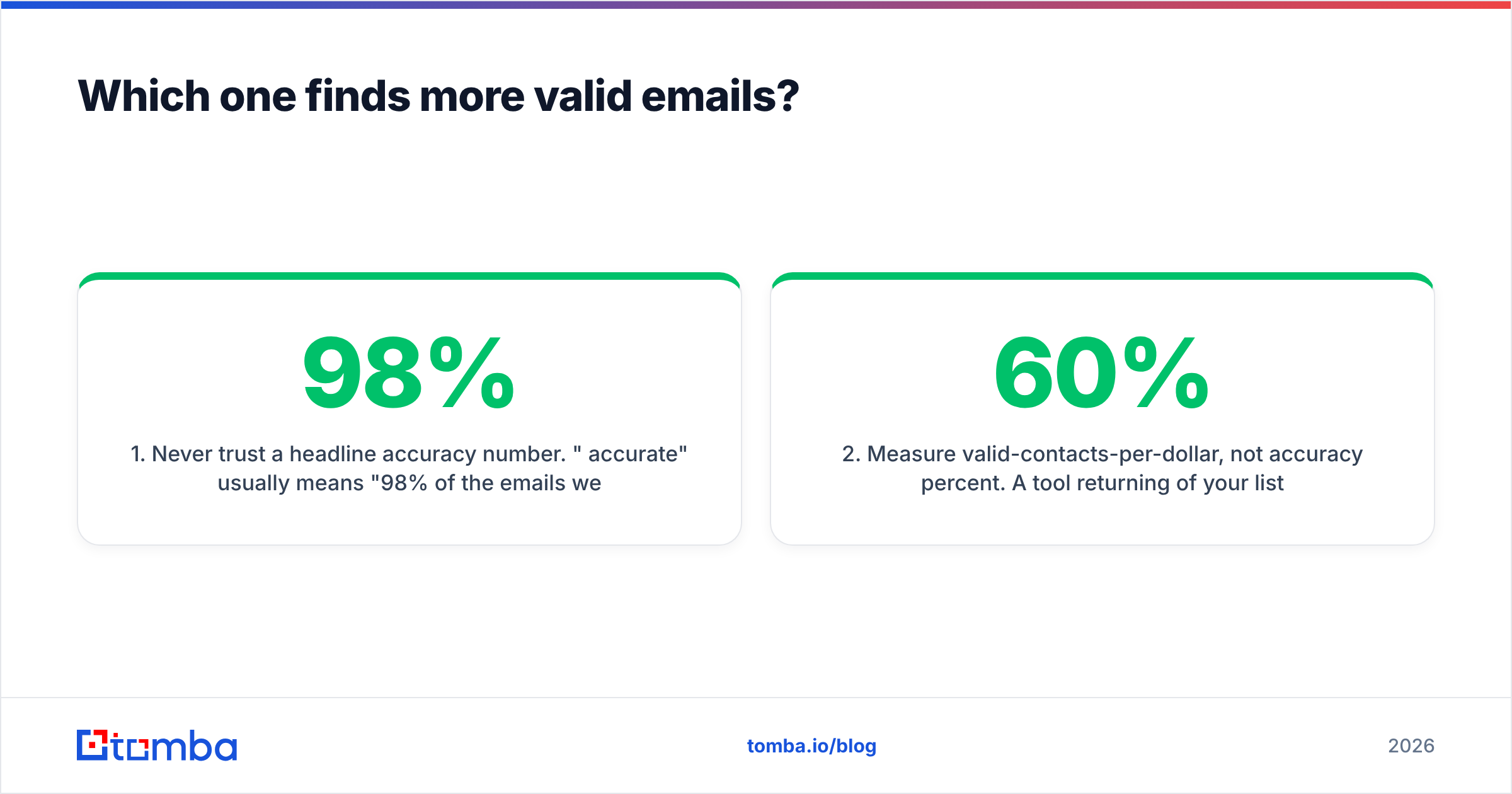
- Never trust a headline accuracy number. "98% accurate" usually means "98% of the emails we chose to return." It hides everything the tool could not find. Coverage and accuracy trade off against each other.
- Measure valid contacts per dollar, not accuracy percent. A tool that returns 60% of your list at 95% valid beats one that returns 30% at 99% valid.
- Run the same 100-row list through both. Same companies, same roles, same day. Anything else is anecdote.
- Check what happens on catch-all domains. About a fifth of B2B domains accept every address. The label a tool uses — risky, unknown, or valid — swings your accuracy number by double digits.
- Count credits burned on failures. Some tools charge for a search that returns nothing. Over 10,000 rows, that adds up.
Want a baseline before you spend credits? Run a sample through a free email checker first.
Is Influno's all-in-one bundle worth it?#
It depends on one thing: do you already own a sender?
Influno sells consolidation. One login, one bill, one place where a found contact becomes a sequenced contact. A founder sending 200 to 500 emails a week saves real time. That setup also costs less than Hunter plus a separate sequencer.
The trade-off shows up at team scale. Bundled senders tend to lag specialists on the details that decide whether mail lands. That list includes inbox rotation, per-domain throttling, warmup, reply detection, and bounce-driven pausing. If email deliverability matters to you, a bundled sender is a step down. Google and Yahoo tightened their bulk-sender rules in 2024, as Google's sender guidelines spell out. The gap got wider, not smaller.
So the Hunter vs Influno bundle math is simple. Influno is a good deal when it replaces two subscriptions. It is a poor deal when it replaces one and duplicates another.
Where does Hunter stop making sense?#
At volume, and at data depth.
Hunter's credit pricing suits teams that do careful, targeted outreach. Think 500 to 2,000 contacts a month, hand-checked. Push toward 20,000 lookups a month and the invoice grows faster than the pipeline. That is the top reason teams start hunting for a Hunter alternative.
The second ceiling is enrichment. Hunter gives you an email and a confidence score. It does not give you a phone number, a LinkedIn URL, headcount, tech stack, or funding data. Most good sequences in 2026 run on more than one channel. So you bolt Hunter onto a second data vendor, and the tool sprawl comes right back.

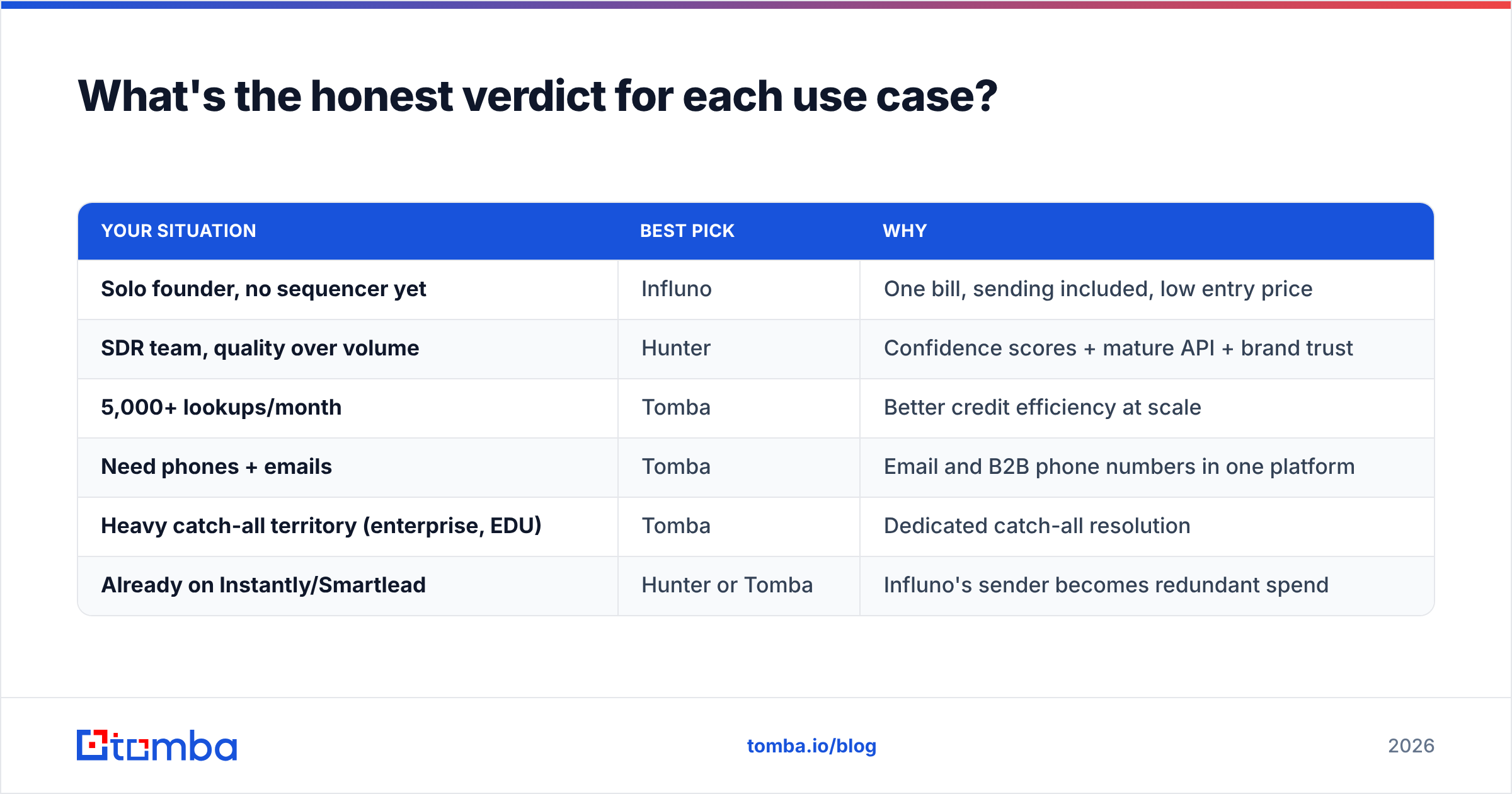
Hunter vs Influno: the verdict by use case#
| Your situation | Best pick | Why |
|---|---|---|
| Solo founder, no sequencer yet | Influno | One bill, sending included, low entry price |
| SDR team, quality over volume | Hunter | Confidence scores + mature API + brand trust |
| 5,000+ lookups/month | Tomba | Better credit efficiency at scale |
| Need phones + emails | Tomba | Email and B2B phone numbers in one platform |
| Heavy catch-all territory (enterprise, EDU) | Tomba | Dedicated catch-all resolution |
| Already on Instantly/Smartlead | Hunter or Tomba | Influno's sender becomes redundant spend |

This category is bigger than two names. Providers like BookYourData come at the problem from the database side. You buy pre-built, verified contact lists instead of looking up contacts one at a time.
That model has real advantages: no search-credit anxiety, instant volume, and clear pay-per-record pricing. A stable, well-defined ICP can beat any finder on time to first send. An ICP that shifts month to month favors a finder's flexibility.
How should you run the comparison yourself?#
Skip the reviews. Run a bake-off. It takes an afternoon.
- Build one test list of 100 contacts. Pull them from a source you can check yourself. Conference attendees, article authors, or closed-won accounts all work.
- Run the same list through each tool on the same day. Record found or not found, the address returned, and the tool's own confidence label.
- Verify every address with a neutral third party. Grading a tool's finder with its own verifier is circular. Use an independent email verifier instead.
- Compute the metric that matters: verified-valid contacts ÷ credits spent. Count the credits burned on empty results.
- Send 50 real emails from each set. Compare hard-bounce rates after 72 hours. Data claims live or die at the bounce report.
- Check the API before you commit. Spend 30 minutes in each vendor's docs if your workflow is programmatic. A clean email finder API saves more hours in a year than a 3% accuracy edge saves replies.
Above a few hundred rows, run this in batch. A bulk email finder job gives a cleaner cost comparison than clicking through a UI. It also mirrors how you will use the tool in production.
Does either tool solve the catch-all problem?#
Only partly. This is where most Hunter vs Influno comparisons get lazy.
A catch-all domain accepts mail at any address. Standard SMTP checks return "valid" for asdfgh@company.com. Hunter and Influno both flag catch-alls, which is table stakes. Neither one resolves them. On 15% to 20% of B2B domains, you get a shrug instead of an answer.
That shrug costs money. Treat flagged catch-alls as valid and your bounce rate climbs, which hurts sender reputation. Treat them as invalid and you drop many of your best enterprise targets. Large companies run catch-all setups far more often than small ones.
Resolving them takes extra signals: past send outcomes, pattern confidence across the domain, and cross-source checks. Tools with real catch-all verification give you a usable answer on that segment. Detection alone does not. If your ICP skews enterprise, this one feature can outweigh the rest of the comparison.
Hunter vs Influno: which should you choose?#
Conclusion first. Choose Hunter for data confidence and API quality. Choose Influno for one tool and one bill. Choose a dedicated volume finder if your cost per verified contact is the real problem.
Hunter earned its name. The confidence scoring is honest. The docs are good. The extension is the smoothest in the category. You pay a premium for that, and at scale the premium compounds.
Influno is a fair consolidation play for small teams. Just go in clear-eyed. The sending half is adequate, not excellent. The finder trades some precision for coverage. If you already pay for a specialist sequencer, most of the bundle's value disappears.
Some readers finish the Hunter vs Influno comparison and think, "both get expensive at my volume." That is the signal to look at a specialist finder built for scale.
That is where Tomba fits. The Tomba Email Finder starts free at 25 searches a month. Paid plans run $49/mo Starter, $99/mo Growth, and $249/mo Pro. Verification, domain search, catch-all resolution, phone lookup, and enrichment all draw on the same credit pool. They are not separate line items.
Run your own 100-row bake-off on the free tiers. Compare verified-valid contacts per dollar across Hunter vs Influno and Tomba, then let the numbers pick your stack. Full Tomba pricing is public, so you can model the volume math before you spend a cent.
Related guides#
// get started
Find, verify and enrich your first contacts today
Start on the free plan with 25 searches a month, then scale when your team is ready.
Free plan · No credit card required · GDPR & CCPA
// about the author