Hunter vs Kipplo: Which Email Finder Wins in 2026?
Hunter is the incumbent with a decade of domain data. Kipplo is the newer, cheaper waitlist-era challenger. We compared accuracy, pricing, verification depth, and API limits to see which one actually belongs in your stack.
TL;DR
- Hunter is the safe, boring default: the largest public domain-pattern index, a mature API, and pricing that starts at $34/mo but scales painfully once you pass ~5,000 lookups.
- Kipplo is the newer, lower-priced challenger built around bulk enrichment and a leaner UI. Coverage is thinner outside SaaS and North America, and its verification layer is less battle-tested.
- Accuracy is not the differentiator most people think it is. Both land in the 85-95% band on clean SaaS domains. The gap opens on catch-all domains, non-English company names, and sub-500-employee firms.
- Credit accounting is where the real cost hides. Hunter charges per request (found or not, in most tiers); how a vendor bills failed lookups changes your effective cost per verified email by 30-60%.
- If you need both finding and verification under one credit pool, a third option like Tomba at $49/mo is usually cheaper per verified contact than either — which is the number that actually matters.
What are Hunter and Kipplo, exactly?#
Hunter (hunter.io) is the incumbent. It launched in 2015 as a domain-search tool — paste a company domain, get the email pattern plus a list of published addresses — and has since added a verifier, a lightweight CRM ("Leads"), and Campaigns for sending. Its moat is time: a decade of crawling public web pages and inferring {first}.{last}@ style patterns per domain. When people say "email finder" as a generic noun, they usually mean something shaped like Hunter.
Kipplo is the newer entrant, positioned as a cheaper, faster alternative for teams doing high-volume list building. The pitch is familiar to anyone who has watched this category: same core job (name + domain → email), lower per-credit price, a cleaner bulk-upload flow, and an API that does not make you read three pages of docs before your first call.
The honest framing: this is not a David-and-Goliath story where one tool is obviously better. It is a coverage-versus-cost trade. Hunter charges more and gives you a deeper index. Kipplo charges less and gives you a thinner one. Whether that trade is good depends entirely on which domains you are searching.

How do Hunter and Kipplo compare head-to-head?#
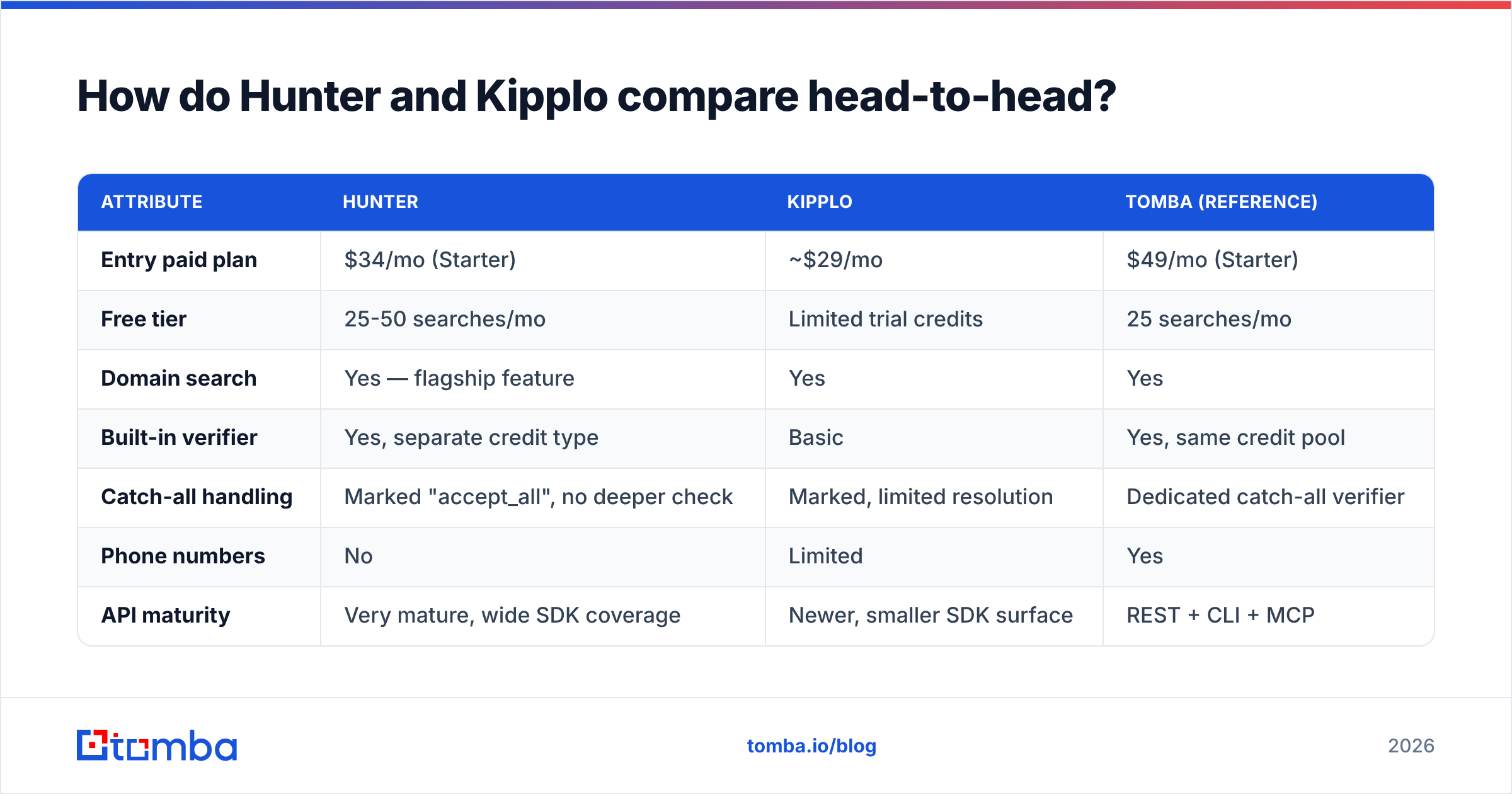
Here is the practical comparison. Prices are list prices as published on each vendor's pricing page; always re-check before you commit to an annual plan, since this category revises pricing roughly twice a year.
| Attribute | Hunter | Kipplo | Tomba (reference) |
|---|---|---|---|
| Entry paid plan | $34/mo (Starter) | ~$29/mo | $49/mo (Starter) |
| Free tier | 25-50 searches/mo | Limited trial credits | 25 searches/mo |
| Domain search | Yes — flagship feature | Yes | Yes |
| Built-in verifier | Yes, separate credit type | Basic | Yes, same credit pool |
| Catch-all handling | Marked "accept_all", no deeper check | Marked, limited resolution | Dedicated catch-all verifier |
| Phone numbers | No | Limited | Yes |
| API maturity | Very mature, wide SDK coverage | Newer, smaller SDK surface | REST + CLI + MCP |
| Bulk CSV | Yes | Yes — a core strength | Yes |
| Best for | Reliable single-domain research | Cheap high-volume list building | Mixed find + verify workflows |
Two things jump out of that table.
First, Hunter's separate credit types for search and verification are a real budgeting annoyance. You buy one bucket, exhaust it, and discover the other bucket is the one you actually needed. Kipplo simplifies this, and so does Tomba's single-pool model.
Second, neither Hunter nor Kipplo resolves catch-all domains properly. Both will tell you a domain accepts all mail. Neither will tell you whether sarah.chen@ specifically exists behind that wall. For B2B prospecting into mid-market and enterprise — where catch-all configurations are common — this is not a footnote. It is often 20-30% of your target list sitting in an "unknown" bucket you either send to blind or throw away.
Which one is more accurate?#
Neither, reliably, in a way that survives a fair test. Here is why the question is harder than vendor marketing admits.
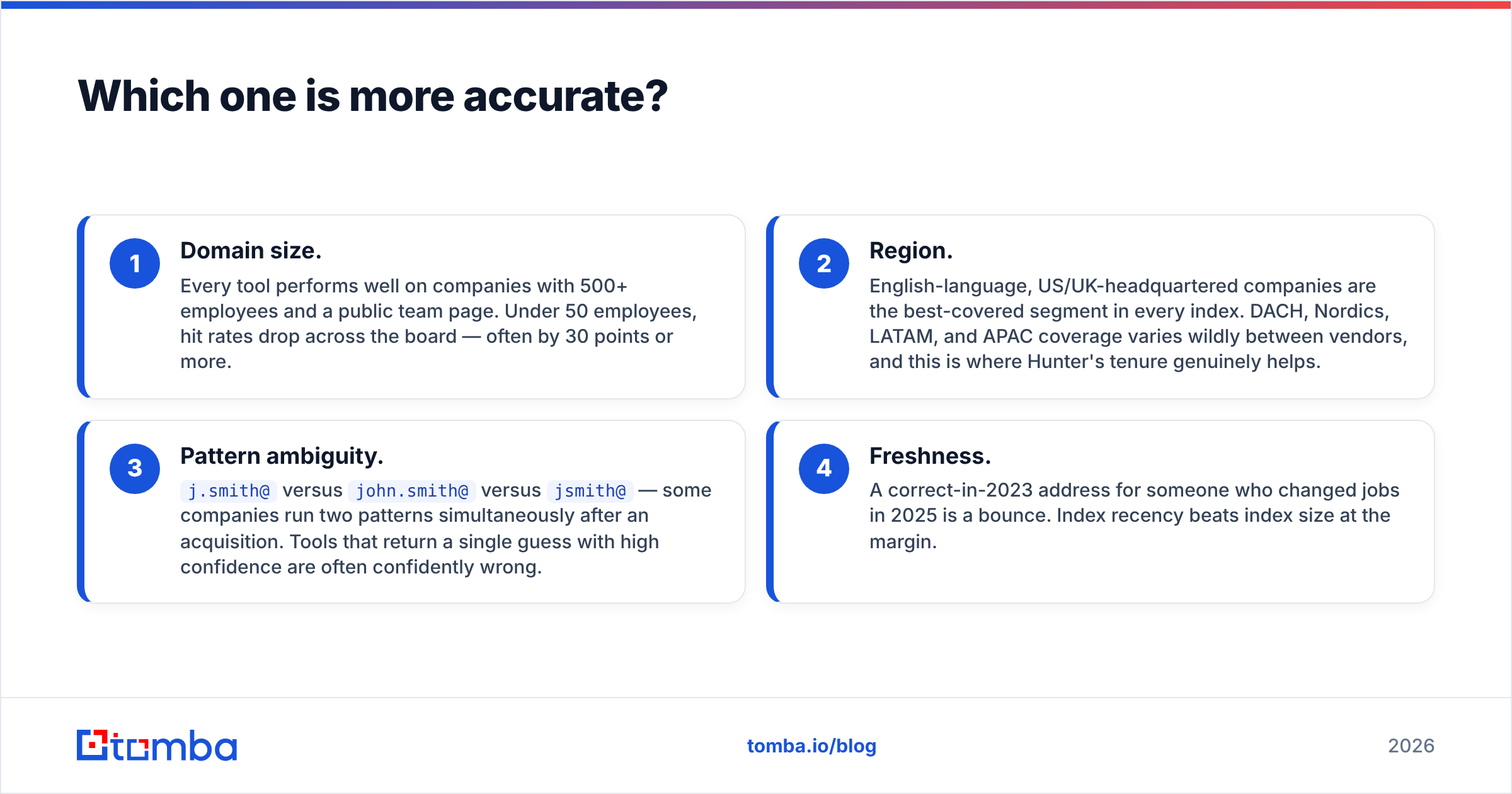
Accuracy claims in this category are almost always measured on a self-selected sample. A vendor runs its own index against domains its index already covers well, then publishes the hit rate. That number is real but not transferable to your list. What matters is accuracy on your ICP, which is a function of four things:
- Domain size. Every tool performs well on companies with 500+ employees and a public team page. Under 50 employees, hit rates drop across the board — often by 30 points or more.
- Region. English-language, US/UK-headquartered companies are the best-covered segment in every index. DACH, Nordics, LATAM, and APAC coverage varies wildly between vendors, and this is where Hunter's tenure genuinely helps.
- Pattern ambiguity.
j.smith@versusjohn.smith@versusjsmith@— some companies run two patterns simultaneously after an acquisition. Tools that return a single guess with high confidence are often confidently wrong. - Freshness. A correct-in-2023 address for someone who changed jobs in 2025 is a bounce. Index recency beats index size at the margin.

The only defensible way to compare Hunter vs Kipplo is to build a 100-row control list from your pipeline — real companies you already sell to, with real contacts whose addresses you can confirm — and run both free tiers against it. Score three columns: found, correct, and verified-deliverable. Most teams discover the winner is domain-segment-specific, not universal. Hunter wins on established mid-market. The cheaper tool often ties on SaaS startups, where public data is abundant and the index depth advantage evaporates.
If you want an independent read rather than vendor claims, G2's email-finder category reviews are noisy but useful for spotting consistent complaints — support responsiveness, billing surprises, credit rollover — which are more predictive of your experience than a headline accuracy percentage.
What does each actually cost per verified email?#
This is the metric that should drive your decision, and almost nobody calculates it.
Cost per verified email = (monthly plan cost) ÷ (contacts you can actually send to). Not credits purchased. Not emails returned. Emails that pass verification and do not bounce.
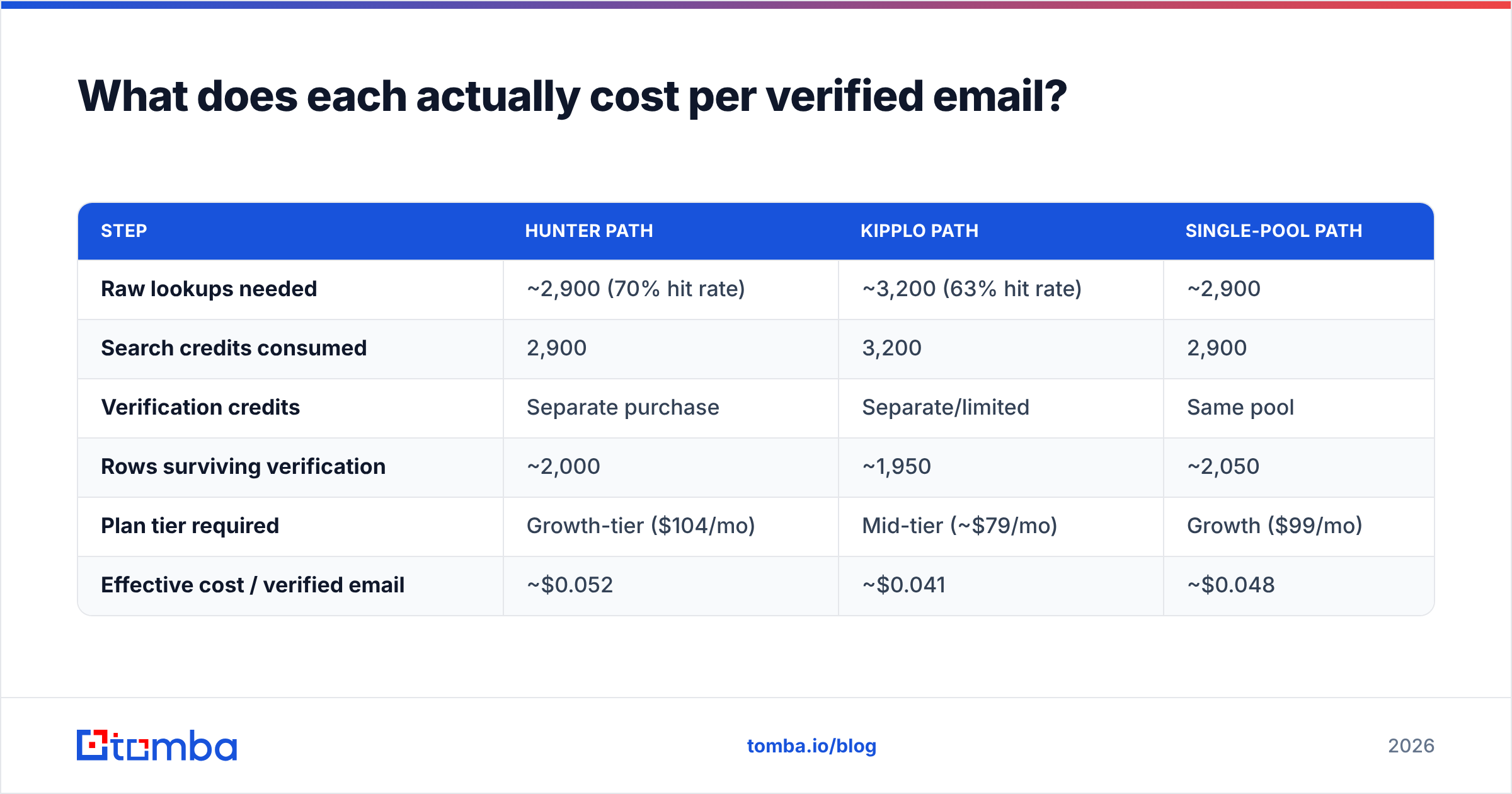
Work a realistic example. You need 2,000 verified contacts a month.
| Step | Hunter path | Kipplo path | Single-pool path |
|---|---|---|---|
| Raw lookups needed | ~2,900 (70% hit rate) | ~3,200 (63% hit rate) | ~2,900 |
| Search credits consumed | 2,900 | 3,200 | 2,900 |
| Verification credits | Separate purchase | Separate/limited | Same pool |
| Rows surviving verification | ~2,000 | ~1,950 | ~2,050 |
| Plan tier required | Growth-tier ($104/mo) | Mid-tier (~$79/mo) | Growth ($99/mo) |
| Effective cost / verified email | ~$0.052 | ~$0.041 | ~$0.048 |
Those hit rates are illustrative — plug in your own from the control-list test above. The structural point holds regardless: a cheaper per-credit price does not automatically win once you account for failed lookups and separately-billed verification. Kipplo's advantage is real but narrower than the headline price suggests. Hunter's premium is real but buys you index depth you may not need if you sell exclusively to Series A SaaS.
For a like-for-like reference, Tomba pricing runs Free (25 searches/mo), Starter $49/mo, Growth $99/mo, and Pro $249/mo, with finding and verification drawing from one pool — which removes the two-bucket arithmetic entirely.
When should you pick Hunter?#
Pick Hunter if any of these describe you:
- You research one company at a time. The Chrome extension and domain-search UI are still the best-in-class for "I'm on this company's site, who do I email?" workflows. Kipplo is built for bulk; Hunter is comfortable at n=1.
- Your ICP skews European or established. A decade of crawling shows up as coverage in exactly the segments newer indexes have not reached yet.
- You need a mature API with real SDKs. If an engineer is wiring this into your product, Hunter's API documentation and client libraries save days.
- You already send through Hunter Campaigns. Vertical integration is worth something; do not break a working sending setup to save $20/mo.
- Procurement cares about vendor age. Unfair, but real in enterprise deals.
When should you pick Kipplo instead?#
Pick Kipplo if:
- Volume is your constraint, not depth. You are building 5,000-row lists monthly and can tolerate a lower hit rate because your downstream sequence is cheap to run.
- Your targets are tech-forward and well-documented. Newer indexes over-index on companies with heavy public web presence — which is most of SaaS.
- Budget is genuinely tight. At small volumes the absolute dollar difference is trivial; at 10,000+ lookups a month it compounds into real money.
- You want simpler credit accounting. One number to watch beats two.
What you give up: catch-all resolution depth, phone data, and the long tail of oddly-configured domains that a decade-old crawler has already seen.

What do both tools miss?#
Three gaps show up in nearly every Hunter-vs-Kipplo evaluation, and they are worth naming because they are the reason many teams end up running a third tool anyway.
Catch-all verification. Both flag catch-all domains and stop there. Resolving whether a specific mailbox exists behind a catch-all requires additional signal — historical send data, pattern confidence, secondary sources. A dedicated catch-all verifier turns a discard pile back into sendable contacts, and on enterprise-heavy lists that can be a quarter of your total addressable set.
Phone coverage. Neither tool is a serious phone-data provider. If your motion is email-then-call, you are buying a second subscription regardless — or picking a tool with a phone finder built in.
Deliverability hygiene after the find. Finding an address is step one. Whether it lands is a separate problem governed by your sender reputation, authentication records, and volume ramp. No email finder fixes a misconfigured SPF record. Check yours before blaming the data — a clean list sent from a cold domain still ends up in spam. HubSpot's guide to email deliverability is a reasonable starting point if this is new territory.
It is also worth noting that not every list-building need is a find-the-email need. If you want pre-built, human-verified contact lists rather than on-demand lookups, providers like BookYourData solve a genuinely different problem — you are buying a curated dataset, not querying an index. Comparing them to Hunter or Kipplo is a category error; they sit at a different point in the workflow.
How should you actually run the evaluation?#
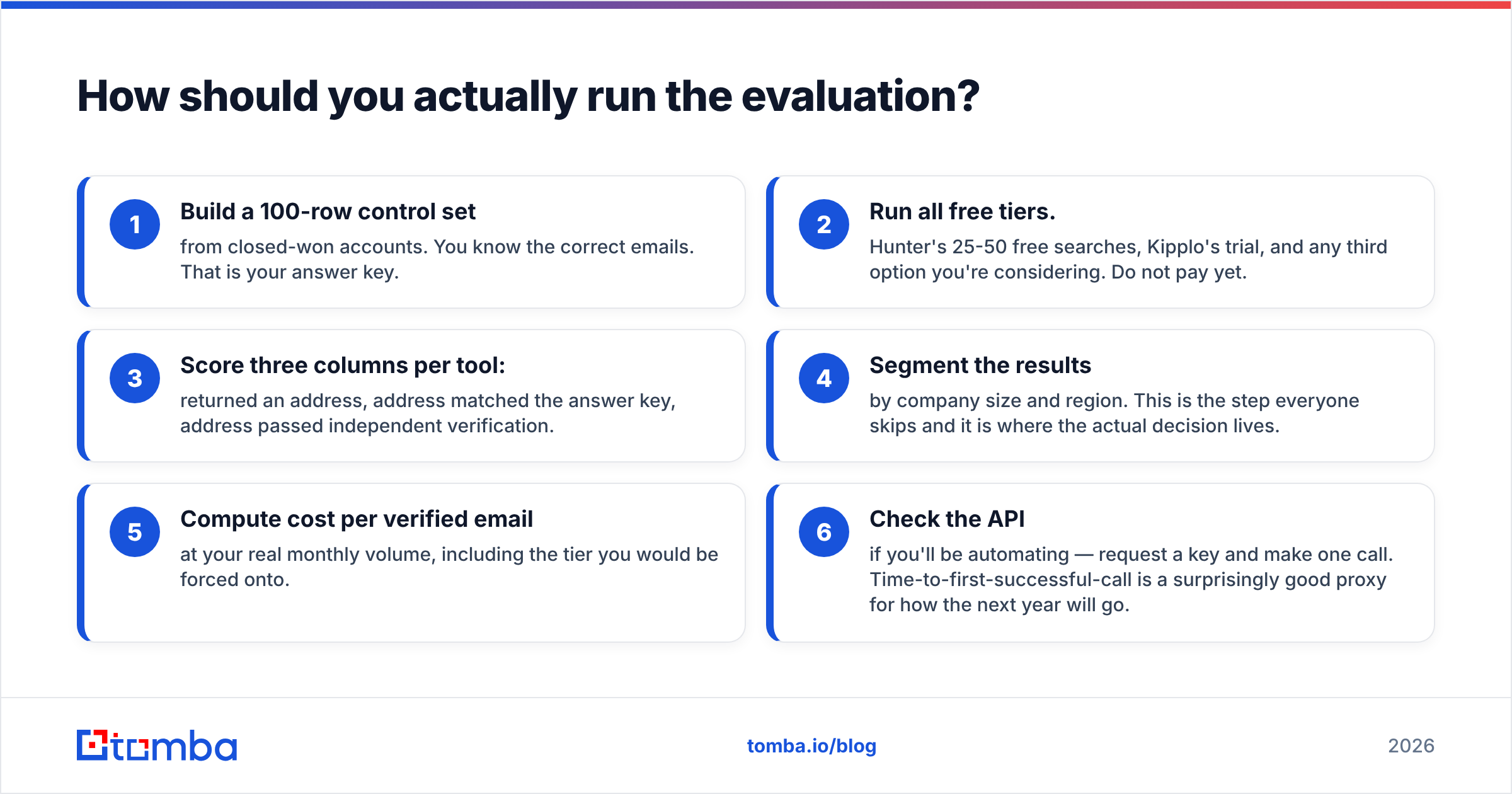
Do not read comparison posts (including this one) as a substitute for testing. Run this in an afternoon:
- Build a 100-row control set from closed-won accounts. You know the correct emails. That is your answer key.
- Run all free tiers. Hunter's 25-50 free searches, Kipplo's trial, and any third option you're considering. Do not pay yet.
- Score three columns per tool: returned an address, address matched the answer key, address passed independent verification.
- Segment the results by company size and region. This is the step everyone skips and it is where the actual decision lives.
- Compute cost per verified email at your real monthly volume, including the tier you would be forced onto.
- Check the API if you'll be automating — request a key and make one call. Time-to-first-successful-call is a surprisingly good proxy for how the next year will go.
If step 3 shows two tools within a few points of each other, stop optimizing accuracy and pick on price, credit model, and whether the email verification is included or bolted on. That is where the durable difference lives.
The verdict#
Hunter wins on depth and maturity; Kipplo wins on price at volume; neither fully solves verification. If you are a solo founder researching twenty companies a week, Hunter's free tier plus its extension is hard to beat and you can stop reading. If you are running programmatic list-building at five figures of lookups per month and your ICP is well-documented SaaS, Kipplo's economics are defensible.
The case for looking past both is narrower but real: you need finding and real verification and catch-all resolution and phone data, billed from one pool, with an API you can wire up in an afternoon. That is a stack question, not a feature question, and it is the reason the "Hunter vs X" search never quite ends — most teams are looking for one tool where they currently run two.
If that sounds like your situation, the Tomba Email Finder is built for exactly that consolidation: find by name, domain, or company, verify from the same credit pool, resolve catch-alls instead of discarding them, and pull phone numbers where they exist. Start on the free tier with 25 searches, run it against your control list alongside Hunter and Kipplo, and let the answer key decide. Paid plans start at $49/mo, and the Tomba API is one endpoint away if you want it inside your own workflow rather than in another browser tab.
Related guides#
// get started
Find, verify and enrich your first contacts today
Start on the free plan with 25 searches a month, then scale when your team is ready.
Free plan · No credit card required · GDPR & CCPA
// about the author