Hunter vs Labnify: Which Email Tool Wins for B2B Outreach?
Hunter finds and verifies B2B email addresses. Labnify is built to send at volume. They get compared constantly, but they solve different halves of the same problem — here is how to pick, and what each one really costs.
TL;DR
- Hunter and Labnify are not direct competitors. Hunter is a data-acquisition tool (find + verify addresses). Labnify is a sending infrastructure tool (deliver mail at volume). Buying one instead of the other usually means you have a gap somewhere.
- If your bottleneck is "I don't have contacts," Hunter is the relevant category. If your bottleneck is "my mail isn't landing," Labnify's category is the relevant one.
- Hunter's paid entry point sits around $49/mo, and credits get expensive fast once you scale past a few thousand lookups a month.
- Labnify's pricing is volume-based (sends, not searches), which makes a like-for-like cost table impossible — you have to model both separately.
- Most teams end up running a finder + verifier + sender stack anyway. The cheapest honest version of that stack is a finder with a strong API and a per-credit price you can defend at board level.
What job does Hunter actually do?#
Hunter is an email-finding and verification platform. You give it a domain or a name + company, and it returns the most likely professional address plus a confidence score and the public sources it saw that address on.
Its core surfaces:
- Domain Search — dump every public address the crawler has associated with a domain, grouped by department.
- Email Finder — first name + last name + domain in, one address out, with a confidence percentage.
- Email Verifier — syntax, MX, SMTP and catch-all signals rolled into a valid/risky/invalid verdict.
- Campaigns — a lightweight cold-email sender bolted on top, capped at a modest daily volume per mailbox.
That last one matters for this comparison. Hunter does send, but Campaigns is a convenience feature for solo founders and small teams, not an outbound sending platform. You can read the current feature set on hunter.io directly.
The honest summary: Hunter is a data product with a small sending appendix.
What is Labnify, and is it even the same category?#
Labnify sits on the other side of the funnel. It's positioned as a high-volume mailer and SMTP platform — you bring the list, it handles the sending infrastructure, throttling, dedicated IPs, and campaign delivery. Its marketing leans on send volume and per-email cost rather than data coverage or match rates. You can check the current positioning on labnify.com.
So why do people search "Hunter vs Labnify" at all? Three reasons:
- Both platforms use the words "email" and "campaigns" in their marketing, so search engines lump them together.
- Both offer some list validation, so a buyer skimming feature grids sees overlap that isn't really there.
- Buyers frequently don't know which half of the problem is actually broken — data or delivery — so they shop both at once.
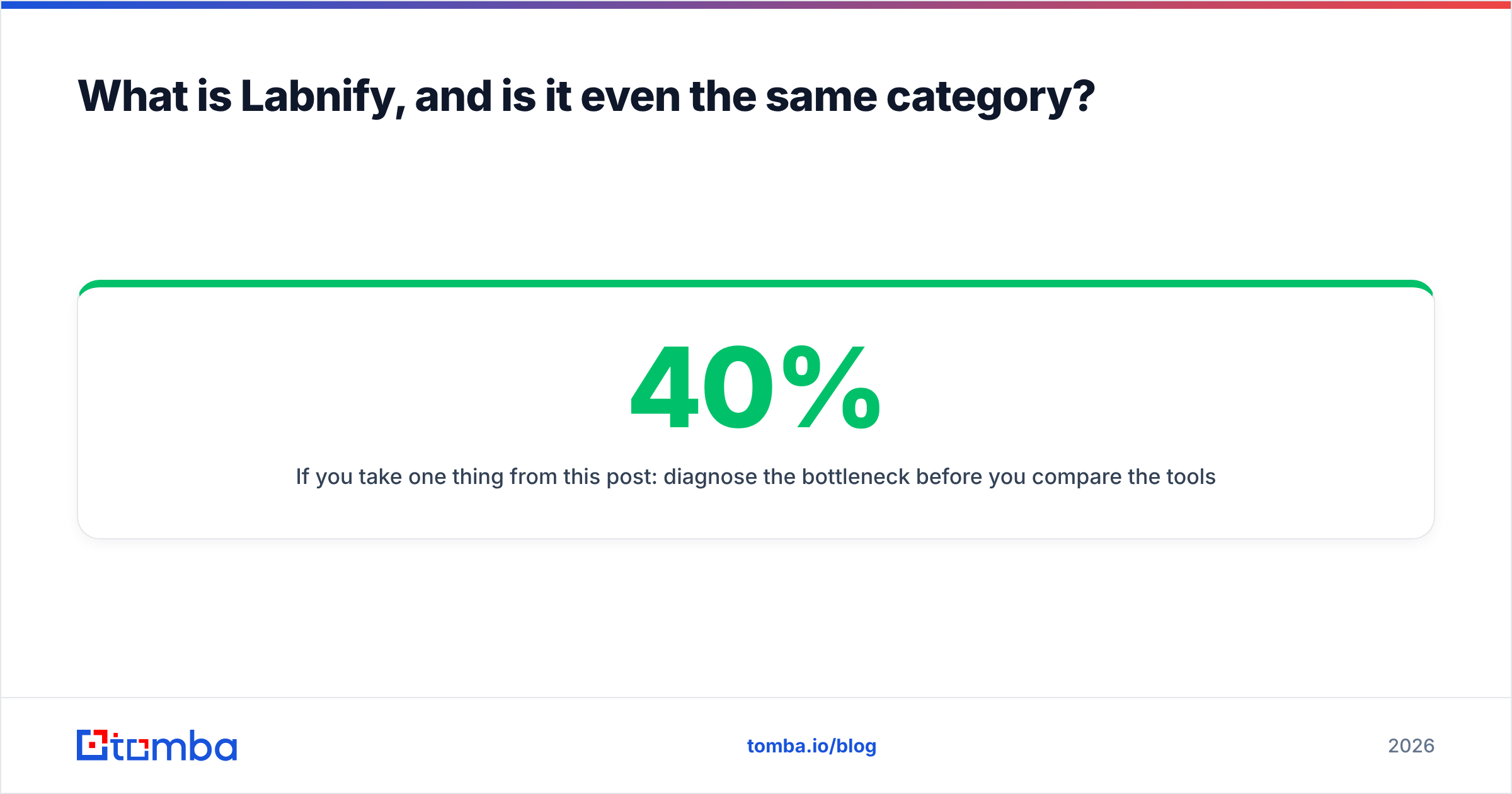
If you take one thing from this post: diagnose the bottleneck before you compare the tools. A 40% bounce rate is a data problem, and no sending platform fixes it. A 2% bounce rate with a 0.4% reply rate is not a data problem, and no email finder fixes it.
Wait — that renders as a link. Here it is properly:

How do Hunter and Labnify compare feature by feature?#
Here is the head-to-head where the two products actually touch, plus Tomba as a third reference point since it competes directly with Hunter on the data side.
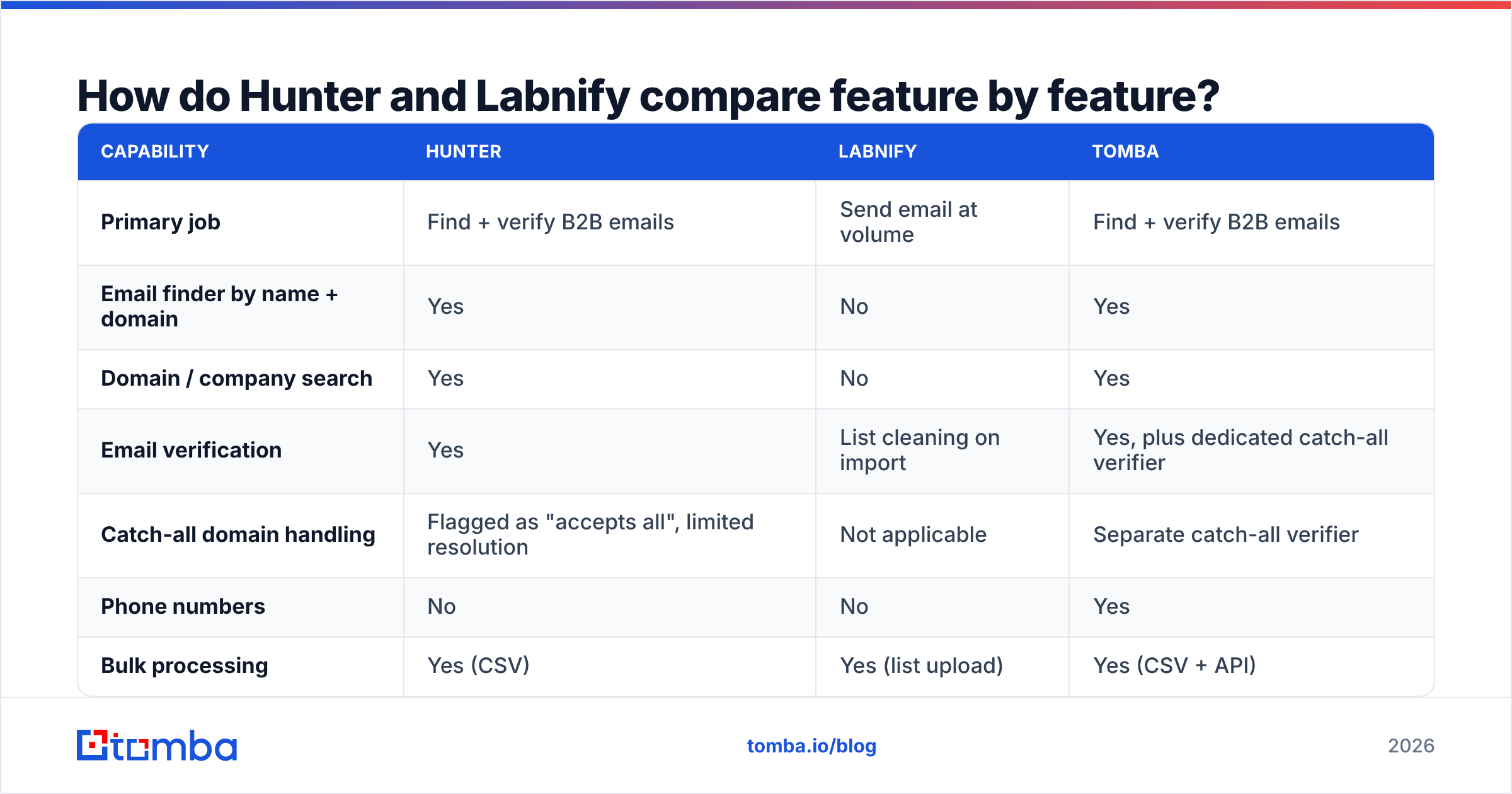
| Capability | Hunter | Labnify | Tomba |
|---|---|---|---|
| Primary job | Find + verify B2B emails | Send email at volume | Find + verify B2B emails |
| Email finder by name + domain | Yes | No | Yes |
| Domain / company search | Yes | No | Yes |
| Email verification | Yes | List cleaning on import | Yes, plus dedicated catch-all verifier |
| Catch-all domain handling | Flagged as "accepts all", limited resolution | Not applicable | Separate catch-all verifier |
| Phone numbers | No | No | Yes |
| Bulk processing | Yes (CSV) | Yes (list upload) | Yes (CSV + API) |
| Public API | Yes | Yes (SMTP/API sending) | Yes, with CLI and MCP server |
| Chrome extension | Yes | No | Yes |
| Native sending / SMTP relay | Light (Campaigns) | Core product | No — integrates with your sender |
| Entry paid price | ~$49/mo | Volume-based, see vendor | $49/mo |
| Free tier | 25 searches/mo | Trial-based | 25 searches/mo |
Two takeaways from that grid. First, the "overlap" column is one row deep — list hygiene. Second, whichever way you go, you are buying two products eventually, so compare the pair cost, not the single-line price.

Which one is more accurate?#
This question only makes sense on the data side, so it's really "how accurate is Hunter, and how accurate are its alternatives."
Accuracy in this category breaks into three separate measurements that vendors love to blur together:
- Match rate — of 1,000 contacts you asked for, how many came back with any address at all. High match rates are easy to fake by guessing patterns.
- Deliverable rate — of those returned addresses, how many actually accept mail. This is the number that shows up on your bounce report two weeks later.
- Catch-all resolution — of the domains that accept everything at the gateway, how many the tool can still resolve to a real mailbox. This is where most tools quietly give up and hand you a "risky" label.
- Freshness — how recently the record was confirmed. A 2023-confirmed address at a company with 30% annual churn is a coin flip.
Hunter does well on measurement 1 and publishes a confidence score, which is more transparency than most. Where it gets thinner is measurement 3: catch-all domains — which now cover a large share of mid-market and enterprise targets — usually come back as "accept all" with no further resolution, and you're left deciding whether to risk the send.
That's the specific gap a dedicated catch-all verifier is built to close, and it's worth testing on your own target list rather than trusting anyone's marketing chart — including this one.

Labnify doesn't belong on an accuracy chart at all, because it isn't sourcing contacts. Its equivalent metric is inbox placement — what percentage of what you send reaches a primary inbox rather than spam. Different number, different tool, different vendor claim to be skeptical about.
What does each one cost in 2026?#
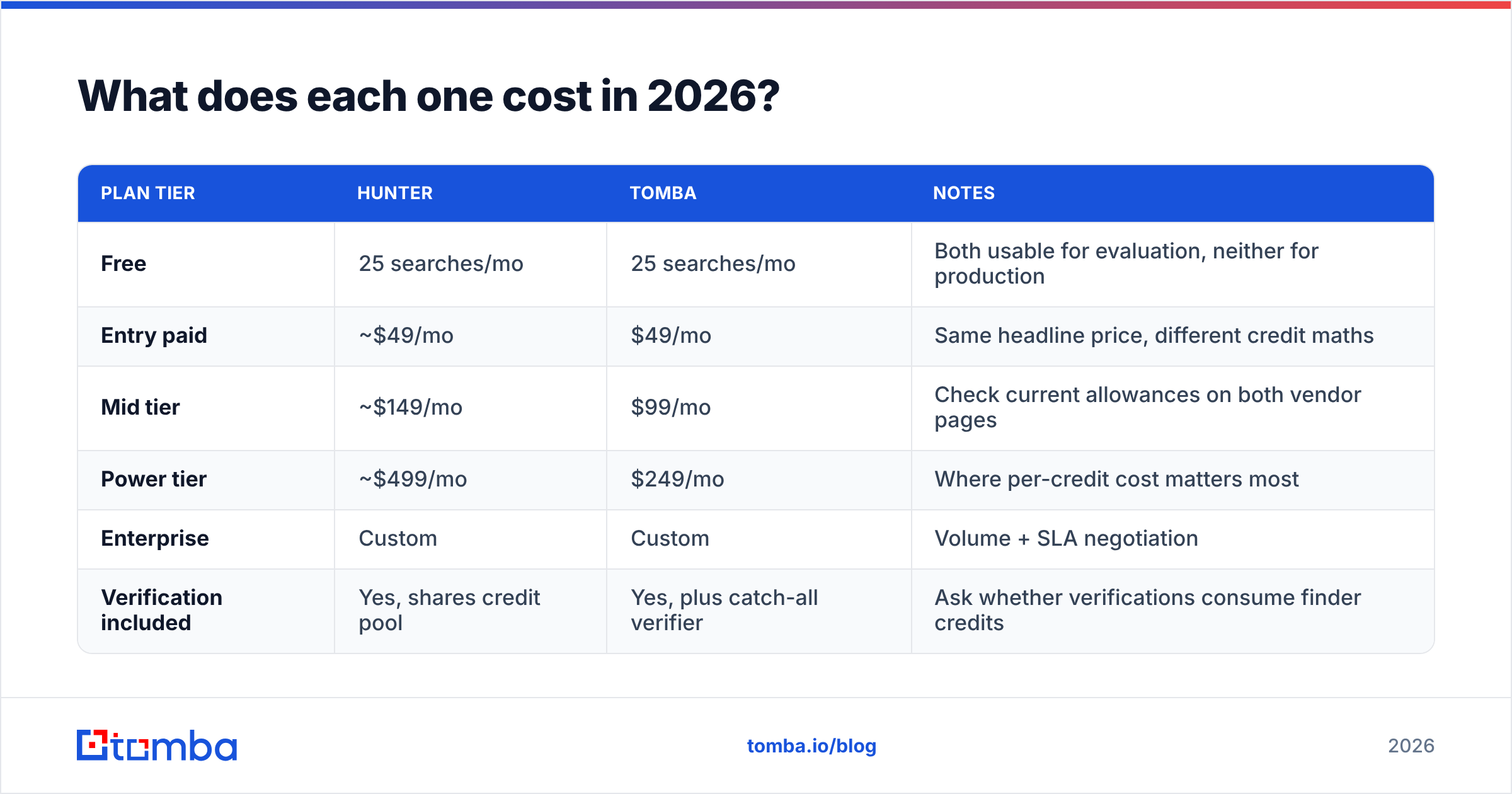
Cost comparison is where "Hunter vs Labnify" falls apart as a question, because the two products meter completely different units. Hunter charges per lookup. Labnify charges per send. A team doing 2,000 lookups and 200,000 sends per month has a wildly different bill profile than one doing 50,000 lookups and 5,000 sends.
Here's what a like-for-like data-side comparison looks like, which is the part you can actually run apples to apples:
| Plan tier | Hunter | Tomba | Notes |
|---|---|---|---|
| Free | 25 searches/mo | 25 searches/mo | Both usable for evaluation, neither for production |
| Entry paid | ~$49/mo | $49/mo | Same headline price, different credit maths |
| Mid tier | ~$149/mo | $99/mo | Check current allowances on both vendor pages |
| Power tier | ~$499/mo | $249/mo | Where per-credit cost matters most |
| Enterprise | Custom | Custom | Volume + SLA negotiation |
| Verification included | Yes, shares credit pool | Yes, plus catch-all verifier | Ask whether verifications consume finder credits |
Current Tomba pricing is public and per-plan; Hunter's is on its own pricing page and changes periodically, so confirm before you budget. For Labnify, model it separately as a sending-cost line item — sends per month, sending domains, and dedicated IP needs — because it will never map onto a per-search table.
The trap in every one of these plans is the shared credit pool. If verifying an address burns the same credit as finding one, your effective cost per usable contact is roughly double the sticker price. Ask that question in the sales call.

Which should you pick for your use case?#
Pick by bottleneck, not by feature count.
- You have a target account list but no contacts. You need a finder. Hunter, Tomba, or a peer — Labnify does not solve this. Start with domain-level discovery, then resolve named contacts.
- You have a big list and terrible deliverability. You need verification first, then sending infrastructure. Clean the list with a dedicated email verifier, then evaluate Labnify or another sender. Sending a dirty list through better infrastructure just burns better infrastructure.
- You're a solo founder doing 50 emails a day. Hunter's built-in Campaigns is probably enough. Don't buy a volume mailer for volume you don't have.
- You're an agency sending on behalf of 10 clients. You need real sending infrastructure with domain isolation — that's Labnify's category — plus a finder with an API so enrichment isn't manual per client.
- You're building a product feature, not running campaigns. Skip the campaign layer entirely and integrate an email finder API directly. Both Hunter and Tomba expose one; evaluate on rate limits, response latency, and per-call price.
- You're doing account-based outbound into enterprise. Catch-all resolution and phone fallback matter more than raw match rate. Budget for a tool that resolves catch-alls rather than labelling them.
If you're still unsure which half is broken, run a diagnostic: take 500 addresses from your last campaign and re-verify them. If more than 5% come back invalid, it's a data problem. If they're clean and replies are still flat, it's a copy or targeting problem — and neither vendor sells a fix for that.
Does Hunter's built-in Campaigns replace a real sender?#
Not past a certain volume, no. Campaigns is a convenience layer: connect a mailbox, write a sequence, send. It's fine for low daily volume from a single domain.
What it doesn't give you is what dedicated sending platforms exist to provide — sending-domain isolation, IP warmup control, per-domain throttling, bounce and complaint feedback loops wired into suppression, and the ability to send tens of thousands of messages without putting your primary business domain at risk.
If you're at that scale, the honest architecture is three layers, not one product:
- Data layer — find and verify contacts (Hunter, Tomba, or similar).
- Sending layer — deliver at volume from isolated domains (Labnify or a peer).
- Orchestration layer — your CRM or sequencer, holding the logic and the reporting.
Trying to collapse all three into one vendor is how teams end up with a tool that does everything at 60%. Check the review distributions on G2 for either category and you'll see the same complaint pattern: the bundled feature is always the weakest one.
Where does Tomba fit between the two?#
On the data side, directly opposite Hunter — same job, different price curve and a wider tool surface.
The practical differences worth testing yourself:
- Catch-all resolution as a first-class feature, not a "risky" label you have to gamble on.
- Phone numbers alongside emails, so a bounced contact isn't a dead contact.
- Developer surface — REST API, CLI, and an MCP server, which matters if you're wiring enrichment into an agent or a data pipeline rather than clicking through a UI.
- Per-credit economics at the mid and upper tiers, where the gap between vendors widens fastest.
Tomba doesn't compete with Labnify at all — it has no sending infrastructure, by design. If you land on Labnify (or any other sender) for delivery, you still need a finder feeding it, and that's the slot to evaluate carefully.
What's the verdict?#
There isn't a single winner, because there isn't a single contest.
Choose Hunter if you need contact data and you want the most established brand in the category, with a UI your team will figure out in an afternoon.
Choose Labnify if your problem is sending volume, domain isolation, or per-email sending cost — and you already have a clean list to send to.
Choose neither, or both, if the diagnostic says so. Most teams that ask "Hunter vs Labnify" discover after ten minutes of honest analysis that they need one of each, and the real decision is which finder gives them the best per-credit cost against the accounts they actually sell to.
Whatever sender you land on, the list feeding it decides your bounce rate. Run 100 of your hardest target accounts through Tomba's Email Finder on the free tier, compare match rate and deliverability against whatever you're using now, and let the numbers pick the vendor instead of the pricing page. If the results hold, the Starter plan at $49/mo covers most small teams — and the API is there when you outgrow the dashboard.
Related guides#
Ready to find emails that actually work?
Join 150,000+ professionals who stopped guessing and started sending. Free credits on signup — no credit card required.
Get the Tomba newsletter
Practical outbound tactics and product updates — once every two weeks.
About the author