Hunter vs Leadzen.ai (2026): Which Email Finder Wins?
Hunter is the trusted domain-search veteran. Leadzen.ai is the India-first lead intelligence engine with phone data. Here is how they actually compare on accuracy, credits, and cost in 2026 — plus when neither is the right pick.
Hunter vs Leadzen.ai is a simple choice once you know where your buyers sit. Hunter is built for Western domains. Leadzen.ai is built for India and APAC, and it ships phone numbers. Here is the short version, then the detail.
TL;DR#
- Hunter wins on domain-level email discovery, transparency, and integrations. It is the safest default if your workflow is "give me every email at this company."
- Leadzen.ai wins on breadth of contact data in India and APAC, and on phone numbers. Its email coverage in North America and Europe is thinner than Hunter's.
- Pricing models are not comparable. Hunter sells predictable search/verification credits with public prices. Leadzen.ai routes most buyers through a demo and a quote.
- Neither tool verifies aggressively enough on its own. Both will hand you catch-all domains marked "accept-all" and leave the risk with you.
- If you want Hunter-style discovery plus verification and enrichment on one bill, Tomba starts at $49/mo with a free tier of 25 searches.
What are Hunter and Leadzen.ai, exactly?#
They solve overlapping problems from opposite directions.
Hunter is a domain-first email finder. You feed it a company domain. It returns the email addresses it has for that domain, a confidence score for each, the pattern it inferred ({first}.{last}@, {f}{last}@, and so on), and the public sources it crawled. It has done exactly this since 2015. The product has barely drifted from that core loop. Around it sit a verifier, a bulk uploader, a Chrome extension, a lightweight campaign sender, and a well-documented API.
Leadzen.ai is a lead intelligence platform. You start from a person, a company, or a filter set, and it returns a contact record: email, mobile number, designation, company attributes. It leans on a LinkedIn browser extension and a "real-time" search claim. Its data is densest in India, where it started, and across parts of APAC. It sits closer to Apollo or Lusha than to Hunter.
That difference in shape drives almost everything else. Hunter answers "who works at this domain and what is their email format." Leadzen.ai answers "give me a list of people matching this profile, with phones."
Hunter vs Leadzen.ai: how do they compare feature by feature?#
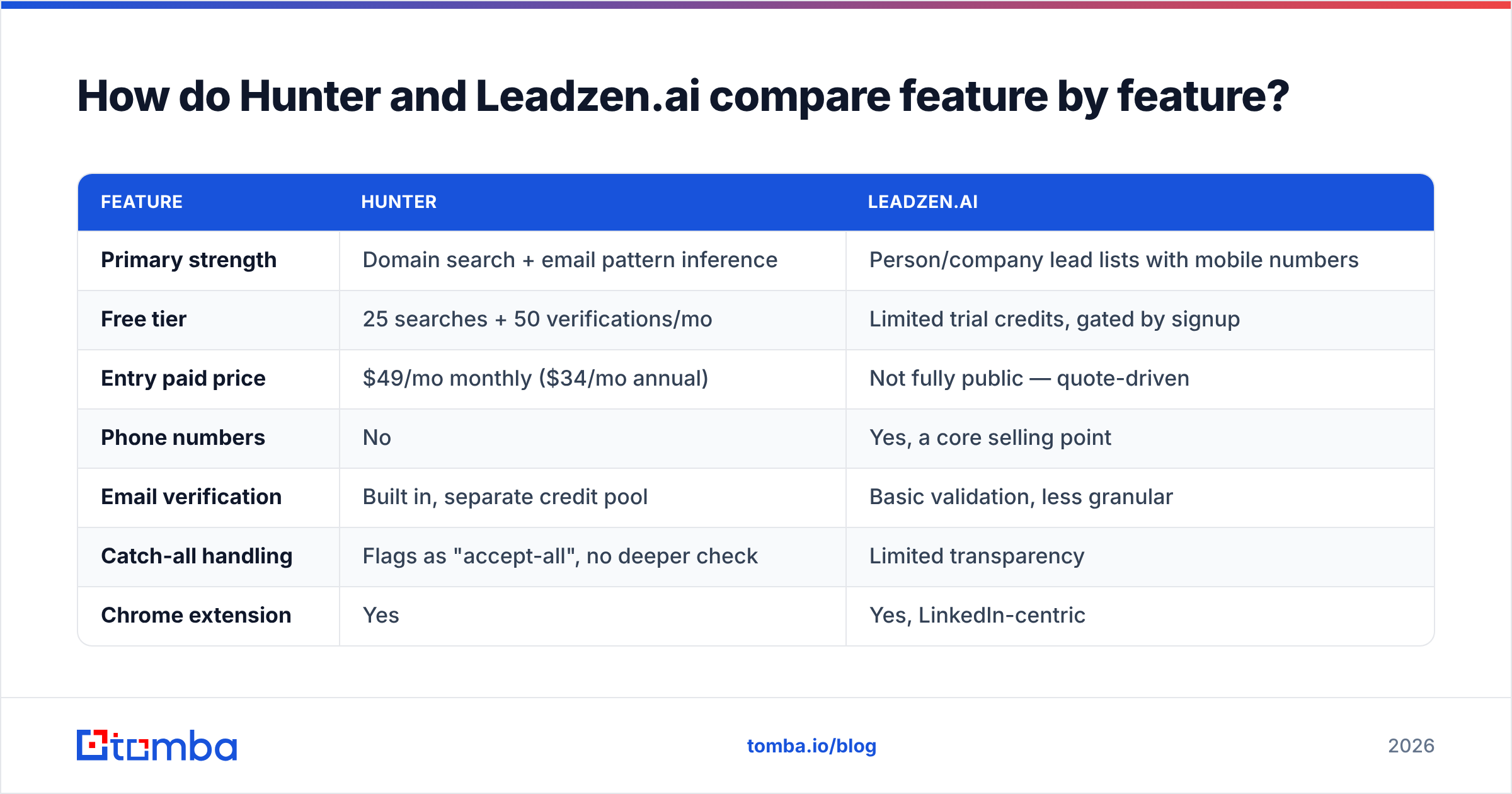
Here is the head-to-head on the attributes that actually change your day-to-day workflow.
| Feature | Hunter | Leadzen.ai |
|---|---|---|
| Primary strength | Domain search + email pattern inference | Person/company lead lists with mobile numbers |
| Free tier | 25 searches + 50 verifications/mo | Limited trial credits, gated by signup |
| Entry paid price | $49/mo monthly ($34/mo annual) | Not fully public — quote-driven |
| Phone numbers | No | Yes, a core selling point |
| Email verification | Built in, separate credit pool | Basic validation, less granular |
| Catch-all handling | Flags as "accept-all", no deeper check | Limited transparency |
| Chrome extension | Yes | Yes, LinkedIn-centric |
| Public API docs | Mature, well documented | Available, thinner documentation |
| Data geography | Strong US/EU/global | Strongest India + APAC |
| Confidence scoring | Numeric score + source URLs | Confidence indicated, sources less visible |
| Best for | SDRs and marketers doing account-based outreach | Teams selling into Indian and APAC markets |
The row that decides most evaluations is the phone row. If your motion is email-only, Leadzen.ai's biggest differentiator is dead weight. You are paying for data you will never dial. If you run a multi-channel sequence with real calling, Hunter simply does not compete — you would need to bolt on a separate phone finder.
Which one actually finds more valid emails?#
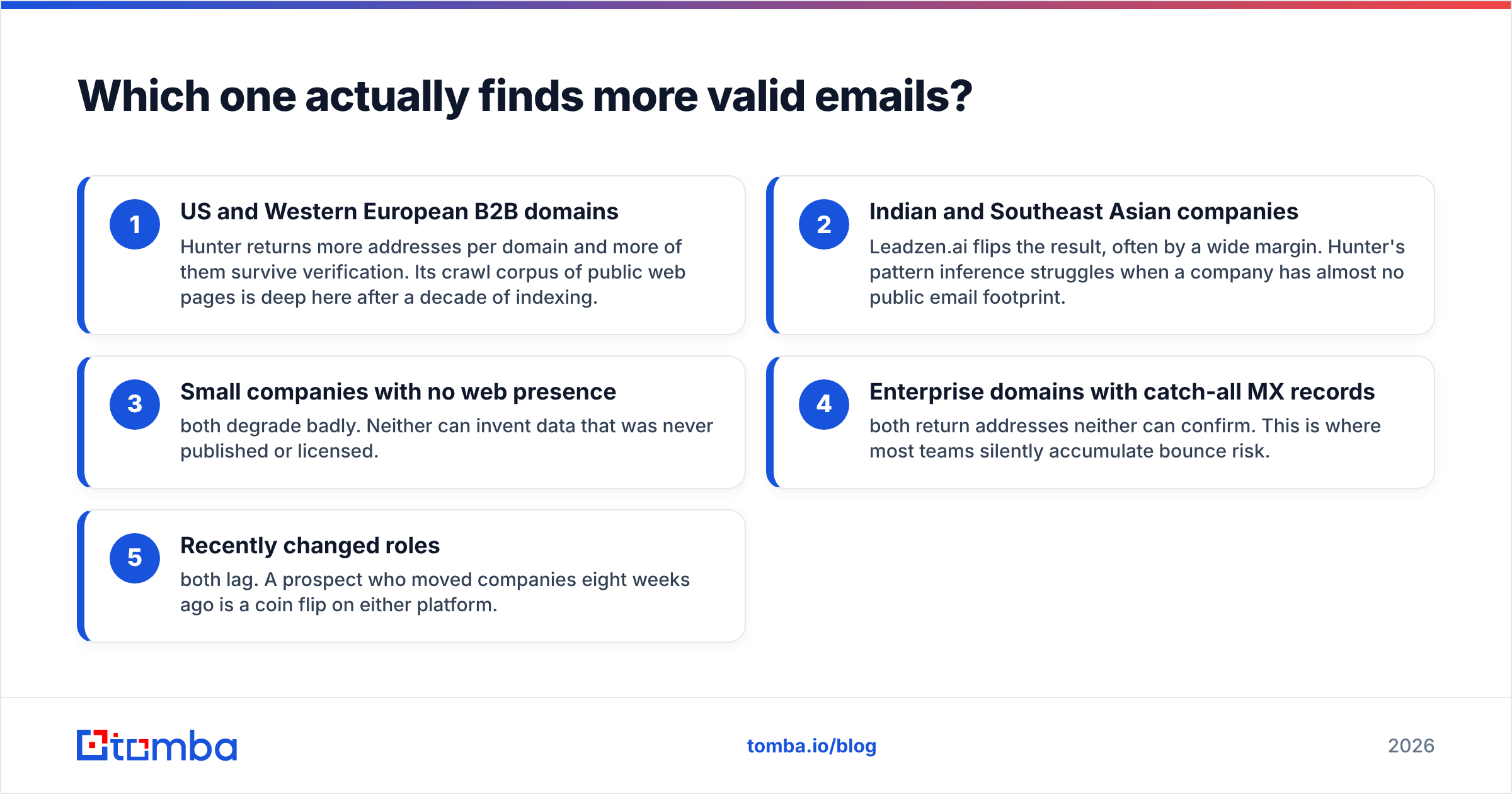
On accuracy, Hunter vs Leadzen.ai comes down to where your prospects sit. Anyone who gives you a single number is selling something.
Run the same 200-domain test list through both and you will typically see a pattern like this:
- US and Western European B2B domains — Hunter returns more addresses per domain and more of them survive verification. Its crawl corpus of public web pages is deep here after a decade of indexing.
- Indian and Southeast Asian companies — Leadzen.ai flips the result, often by a wide margin. Hunter's pattern inference struggles when a company has almost no public email footprint.
- Small companies with no web presence — both degrade badly. Neither can invent data that was never published or licensed.
- Enterprise domains with catch-all MX records — both return addresses neither can confirm. This is where most teams silently accumulate bounce risk.
- Recently changed roles — both lag. A prospect who moved companies eight weeks ago is a coin flip on either platform.
That fourth point deserves more attention than vendors give it. A catch-all domain accepts every address at the SMTP layer. So a standard verification returns "accept-all" rather than valid or invalid. Hunter is honest about labelling it. Leadzen.ai is less explicit. Either way, the resolution has to happen somewhere else, with a dedicated catch-all verifier that uses secondary signals instead of a single SMTP handshake. Skip that step and roughly 15 to 25 percent of a typical enterprise list becomes an unquantified bounce risk.

A second habit worth building: never judge a finder on hit rate alone. A tool that returns an address for 90 percent of your list but verifies at 60 percent is worse than one that returns 65 percent at 95 percent verified. The first fills your CRM with garbage and burns your sending domain. Check both numbers together, on your own list, before you sign anything.
How does pricing actually work on each platform?#
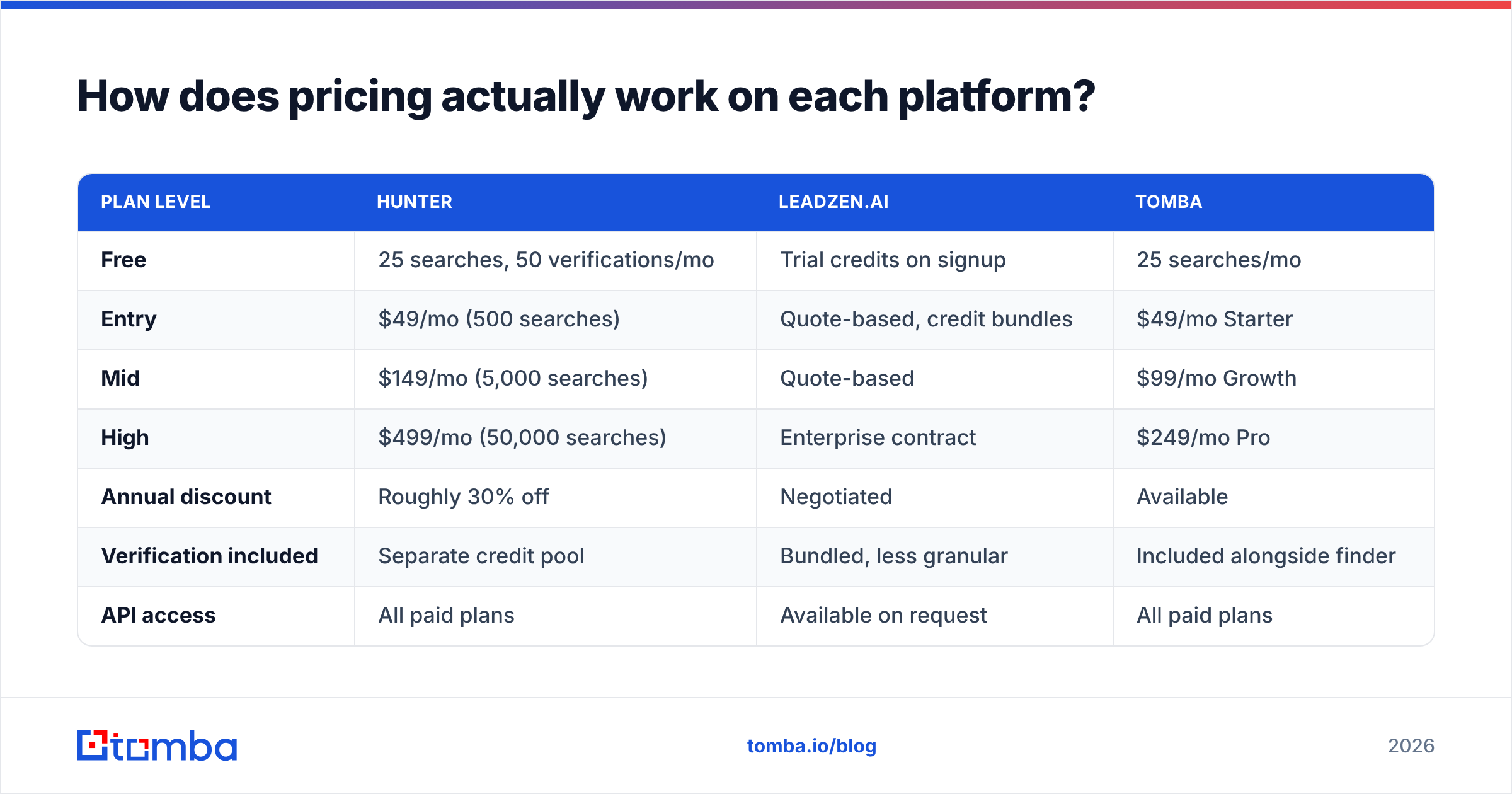
Hunter publishes everything. Leadzen.ai mostly does not, and that asymmetry matters more than the headline numbers.
| Plan level | Hunter | Leadzen.ai | Tomba |
|---|---|---|---|
| Free | 25 searches, 50 verifications/mo | Trial credits on signup | 25 searches/mo |
| Entry | $49/mo (500 searches) | Quote-based, credit bundles | $49/mo Starter |
| Mid | $149/mo (5,000 searches) | Quote-based | $99/mo Growth |
| High | $499/mo (50,000 searches) | Enterprise contract | $249/mo Pro |
| Annual discount | Roughly 30% off | Negotiated | Available |
| Verification included | Separate credit pool | Bundled, less granular | Included alongside finder |
| API access | All paid plans | Available on request | All paid plans |
Prices are as published at the time of writing; check each vendor's pricing page before you budget, since credit definitions shift.
Three practical notes on reading that table:
Hunter counts searches and verifications separately. A 500-search plan does not give you 500 verifications. If you verify everything you find — and you should — your effective cost per usable contact is higher than the sticker suggests.
Leadzen.ai's quote model cuts both ways. You may negotiate a genuinely good rate for high volume in your target geography. You may also spend three weeks in a sales cycle to price a tool you wanted to test on Tuesday. If procurement speed matters, that is a real cost.
A domain search and a person lookup are not the same unit. Hunter's domain search can return 40 addresses for one credit on some plans. A person-level lookup on a lead intelligence platform burns a credit per contact. Compare cost per verified contact you would actually email, not cost per credit.
Who should pick Hunter?#
Pick Hunter if three or more of these describe you:
- You sell into North America or Western Europe. This is where Hunter's corpus is deepest and its confidence scores are most trustworthy.
- Your workflow starts from a company list. You have 500 target accounts and need the right people at each one. Domain search is the native shape of that problem.
- You need auditable sourcing. Hunter shows the public URLs it found an address on. For GDPR-conscious teams, that provenance trail is not a nice-to-have.
- You want to be running today. Self-serve signup, public prices, no demo call.
- Your stack is already glued together. Hunter integrates cleanly with HubSpot, Salesforce, Zapier, Sheets, and most sequencers.
Where Hunter frustrates people: no phone data, credit pools that run out faster than expected, and a built-in campaign tool that is fine for 200 emails a month and inadequate beyond that. Most teams end up pairing Hunter with a dedicated sending platform anyway.
Who should pick Leadzen.ai?#
Pick Leadzen.ai if your situation looks like this:
- India or APAC is your primary market. This is the honest, non-negotiable case for the tool. Coverage there beats most Western-built databases, including Hunter's.
- You call as well as email. Mobile numbers attached to records save you a second vendor and a reconciliation headache.
- You build lists from attributes, not domains. "Show me heads of engineering at 200-to-1000-person SaaS companies in Bengaluru" is a query Hunter cannot answer at all.
- You have procurement patience. The quote cycle is unavoidable, so budget time for it.
Where Leadzen.ai frustrates people: opaque pricing, weaker documentation for developers wiring it into a pipeline, and coverage that thins noticeably once you cross into US and EU mid-market accounts. If you run a global list through it, expect an uneven fill rate that varies by region rather than by company size.

Where does each tool break down at scale?#
Both hit the same wall from different sides: the gap between finding an address and being confident you can send to it.
At 500 contacts a month, you can eyeball anomalies manually. At 10,000, you cannot. A 5 percent bad-data rate that felt invisible becomes 500 bounces. And 500 bounces against a domain sending 10,000 emails is enough to push you past the threshold where Google and Microsoft start filtering you into spam. Sender reputation is a lagging indicator. By the time your reply rate collapses, you have been degrading for weeks.
That means the real evaluation question is not "which tool finds more emails." It is "which tool gives me a defensible pipeline from raw domain to verified, deliverable, enriched contact." Score both on:
- Bulk throughput. Can you push 10,000 rows through in one job, or are you scripting around rate limits?
- Verification depth. Does it distinguish valid, invalid, catch-all, disposable, and role-based addresses, or does it collapse them into a binary?
- API ergonomics. Rate limits, webhooks, idempotency, error semantics. Read the docs before you buy, not after.
- Deduplication. Overlapping list pulls create duplicate outreach, which is the fastest way to look like a spammer to a real human.
- Refund or non-charge policy. Do you pay credits for a lookup that returns nothing? Vendors differ sharply here and it compounds at volume.
Hunter scores well on 1, 3, and 5, and adequately on 2. Leadzen.ai scores well on data breadth in its home markets but is harder to assess on 3 without hands-on access. Neither excels at 2 without a supplementary verification step.
What are the credible alternatives in 2026?#
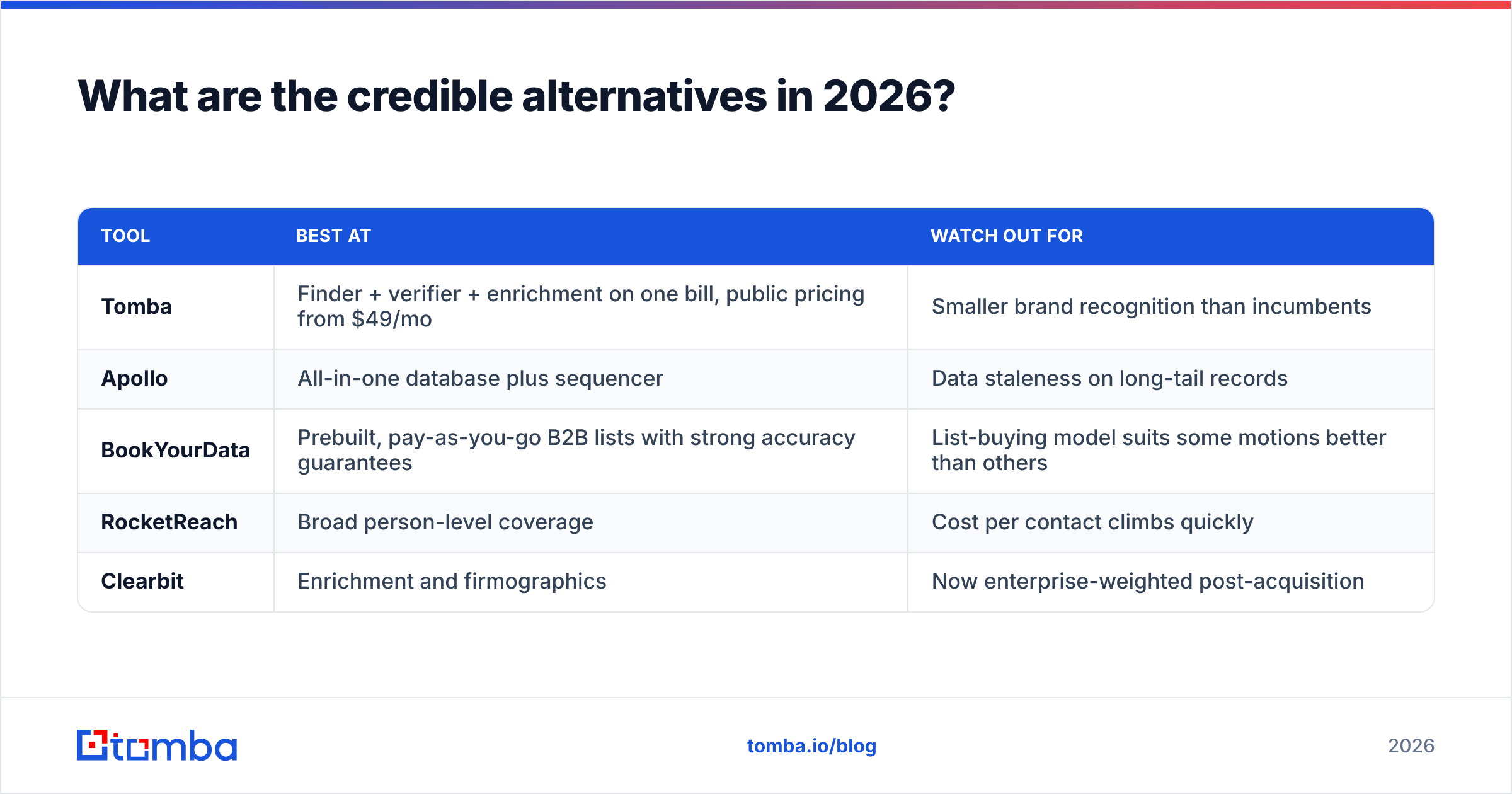
The market is crowded, which is good for buyers. G2's lead intelligence category lists dozens of tools with real user reviews, and it is worth 20 minutes before you commit to a contract.
A few worth shortlisting alongside Hunter and Leadzen.ai:
| Tool | Best at | Watch out for |
|---|---|---|
| Tomba | Finder + verifier + enrichment on one bill, public pricing from $49/mo | Smaller brand recognition than incumbents |
| Apollo | All-in-one database plus sequencer | Data staleness on long-tail records |
| BookYourData | Prebuilt, pay-as-you-go B2B lists with strong accuracy guarantees | List-buying model suits some motions better than others |
| RocketReach | Broad person-level coverage | Cost per contact climbs quickly |
| Clearbit | Enrichment and firmographics | Now enterprise-weighted post-acquisition |

The consolidation argument is straightforward: every vendor boundary you add is another credit pool to monitor, another API to maintain, and another place your data schema drifts. If Hunter's domain-search shape fits your workflow but you also need verification, catch-all resolution, and enrichment without three separate invoices, that is exactly the gap a consolidated platform fills. Compare Tomba pricing against the sum of what you would otherwise stack.
How should you actually run the evaluation?#
Do not trust anyone's benchmark, including this one. Run your own in under two hours:
- Build a 100-row control list from accounts you already closed or already have verified emails for. You know the right answers.
- Run it through every tool's free tier. Hunter gives you 25 searches. Tomba gives you 25. Leadzen.ai gives trial credits. That is enough for a directional read.
- Measure three numbers per tool: fill rate, verified-valid rate, and catch-all rate. Record them in a spreadsheet, not in your head.
- Divide the paid plan price by verified-valid contacts. That is your real cost per usable lead, and it will not match the headline pricing.
- Test one edge case deliberately — a company in your weakest geography, or one with no marketing site. That is where tools separate.
Teams that do this find the answer is often "neither, exclusively." A domain-first finder for account-based work, plus something regional where your coverage gaps are, plus a real email verifier sitting in front of your sequencer, beats any single-vendor bet. HubSpot's research on outbound performance has consistently found data quality to be the largest controllable variable in reply rates, ahead of copy and timing — which is a strong argument for spending your evaluation effort here rather than on subject lines.
The verdict#
Hunter if you sell to the West and start from domains. Leadzen.ai if you sell into India or APAC and need phones. Hunter vs Leadzen.ai is not really a fight over the same buyer, and the "which is better" framing hides that.
But if you found this comparison because your current stack is leaking budget across three tools and still bouncing 8 percent of your sends, the answer may be neither. Start with a single platform that does discovery and verification in the same pass.
Tomba's Email Finder does exactly that: domain search, pattern inference, built-in verification, catch-all resolution, and enrichment behind one API and one bill. The free tier gives you 25 searches a month with no card, Starter is $49/mo, and Growth is $99/mo. Run your 100-row control list through it alongside Hunter and Leadzen.ai this week and let the verified-valid column decide.
Related guides#
// get started
Find, verify and enrich your first contacts today
Start on the free plan with 25 searches a month, then scale when your team is ready.
Free plan · No credit card required · GDPR & CCPA
// about the author