Hunter vs LimeLeads (2026): Which Finds Better B2B Emails?
Hunter searches live domains for verified emails. LimeLeads sells you a pre-built contact list. Those are two different products solving two different problems — and picking the wrong one wastes an entire quarter of outbound.
Hunter vs LimeLeads — TL;DR
- Hunter vs LimeLeads is not a fair fight, because the two tools do different jobs. Hunter is a live email finder that looks up domains on demand. LimeLeads is a static B2B contact list you filter and export.
- Pick Hunter if you already know which companies you want. It finds emails for named people.
- Pick LimeLeads if you have no target list yet. You build one from firmographic filters.
- Both charge on credits. Both bill you for results you may throw away. Verification is where the real cost sits.
- Hunter's paid entry point is $49/month at list price. LimeLeads uses a credit model in a similar range, but publishes far less detail.
- If your bottleneck is verified emails at volume rather than list discovery, a finder-plus-verifier stack (Tomba, Findymail, Prospeo) usually beats both on cost per usable contact.
Hunter vs LimeLeads: what are they, actually?#
Think of it like groceries. Hunter is a butcher counter. You walk up, name the cut, and someone finds it fresh. LimeLeads is the meal kit aisle. Everything is portioned and sitting on the shelf, and freshness depends on when it got stocked.
Hunter is the older and better known of the two. It began as a domain-scanning email finder. Give it stripe.com and it returns the addresses it has crawled or guessed for that domain. Each one carries a confidence score and the sources it was found on. Over the years Hunter added a verifier, a small CRM ("Leads"), bulk tasks, a Chrome extension, and a cold email sender called Campaigns. Its core job has never changed. It answers one question: "what is this person's work email?"
LimeLeads sits on the other side of the funnel. It is a searchable B2B contact database. You filter by industry, employee count, revenue, job title, geography, and tech stack. Then you preview the matching records and spend credits to unlock and export them. You are not asking about a person you already picked. You are asking the database to tell you who to contact.
That one difference decides almost everything else: pricing model, data freshness, accuracy, and which team should own the tool.
Hunter vs LimeLeads: how do they compare head-to-head?#
Here is the honest side by side. Prices are published monthly list rates at the time of writing. Both vendors change their tiers, so check their pricing pages before you buy.
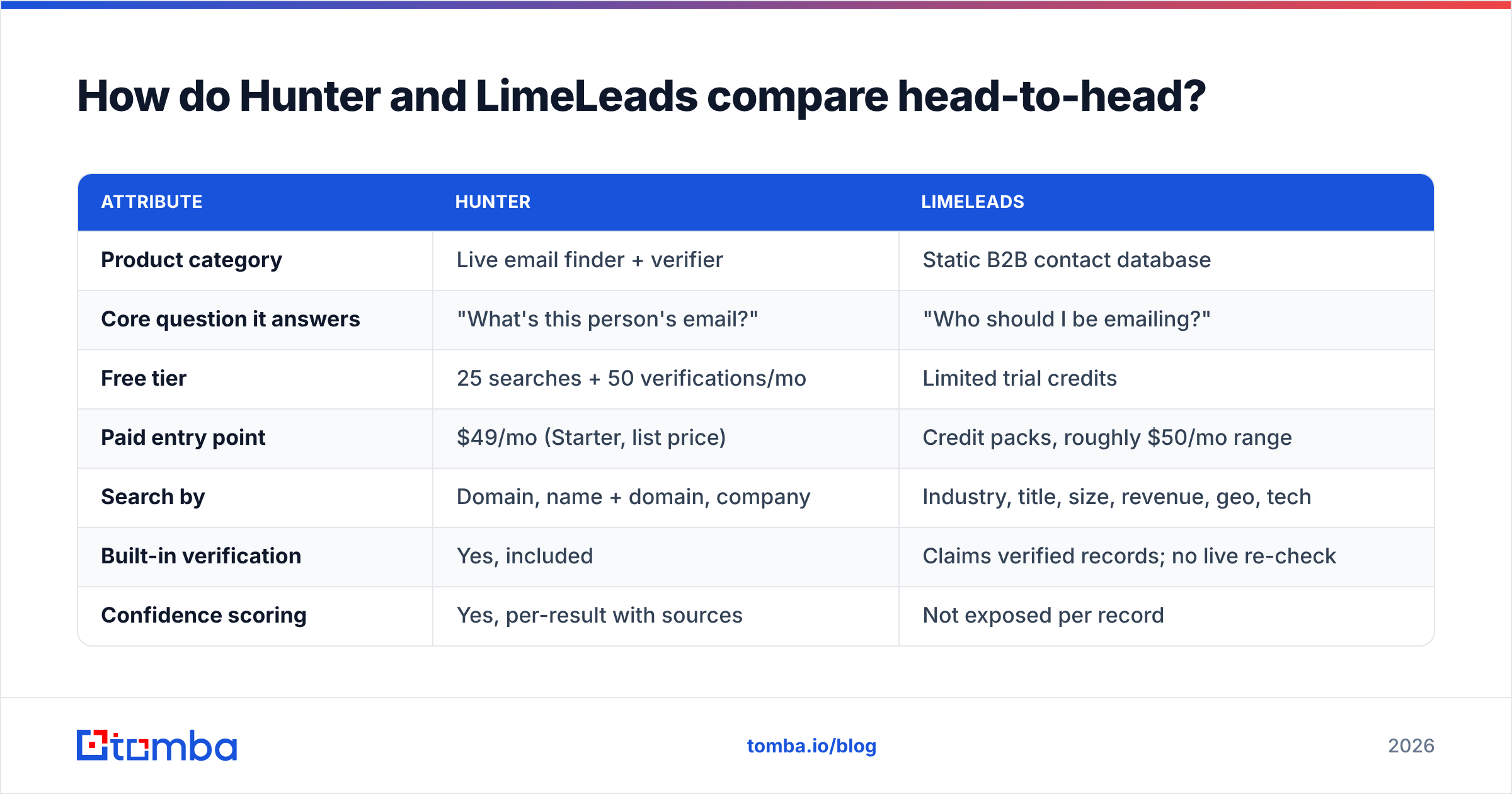
| Attribute | Hunter | LimeLeads |
|---|---|---|
| Product category | Live email finder + verifier | Static B2B contact database |
| Core question it answers | "What's this person's email?" | "Who should I be emailing?" |
| Free tier | 25 searches + 50 verifications/mo | Limited trial credits |
| Paid entry point | $49/mo (Starter, list price) | Credit packs, roughly $50/mo range |
| Search by | Domain, name + domain, company | Industry, title, size, revenue, geo, tech |
| Built-in verification | Yes, included | Claims verified records; no live re-check |
| Confidence scoring | Yes, per-result with sources | Not exposed per record |
| Bulk processing | Yes (CSV upload, bulk tasks) | Yes (filter + export) |
| API | Yes, well documented | Limited |
| Chrome extension | Yes | No |
| Cold email sending | Yes (Campaigns, basic) | No |
| Best for | Named-account outbound, agencies, recruiters | Cold list building from scratch |
| Weakest at | Discovering new accounts | Freshness on fast-moving roles |
The table makes the point better than any paragraph can: these tools are complements, not substitutes. Account-based teams usually need a discovery source and a finder. High-volume SMB teams often just need the database. Teams selling into a fixed named-account list only need the finder.

Hunter vs LimeLeads: which one has better data accuracy?#
Accuracy is the metric that matters most. It is also the one both vendors describe most vaguely.
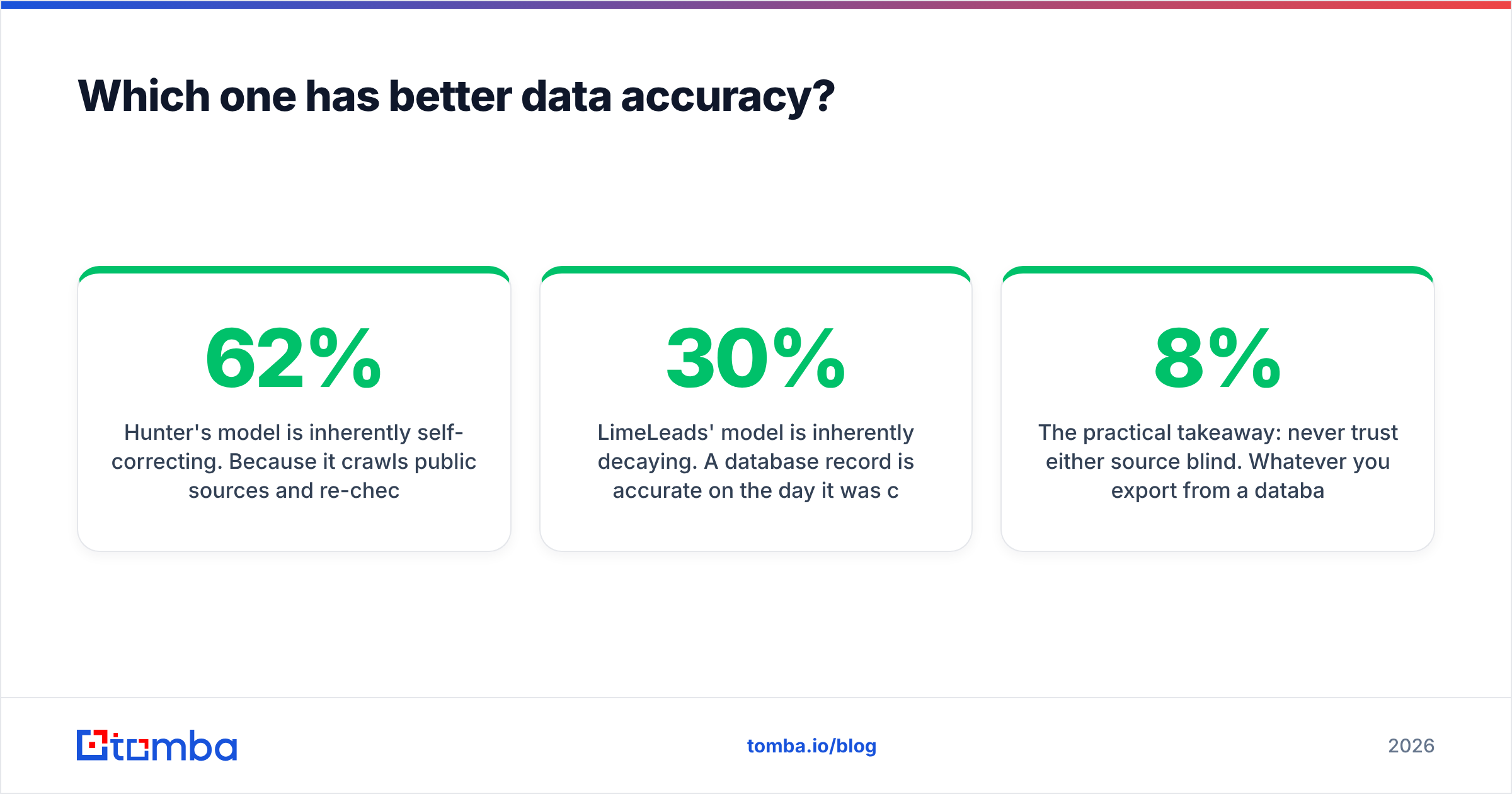
Hunter's model corrects itself. It crawls public sources and re-checks addresses when you ask. So each result carries a confidence score and a list of where the address was seen. When Hunter is wrong, it usually warns you first. A 62% confidence result is a flag, not a promise. That openness is useful. It is one reason Hunter has held its spot in G2's email finder category for years.
LimeLeads' model decays instead. A database record is accurate on the day it was built and less accurate every day after. B2B contact data churns at roughly 25–30% a year. People change jobs, companies rebrand, domains move. Vendors fight this with re-verification cycles. So your export is only as good as the last cycle that touched your slice of the data. LimeLeads does not publish a per-record "last verified" date in public. That makes the data hard to audit before you spend credits.

The practical takeaway: never trust either source blind. Run every export through an independent email verifier before it touches your sending domain. One campaign with an 8% bounce rate can cost you weeks of sender reputation repair. That is far more expensive than the verify credits you saved.
Four accuracy habits that survive any vendor choice:
- Re-verify at send time, not at export time. A list verified in March and mailed in June is not a verified list.
- Treat catch-all domains separately. They pass basic SMTP checks but tell you nothing. Route them through a catch-all verifier, or leave them out of the first send.
- Cap risky sends. Mail your lowest-confidence segment last. Send it only after the strong segment proves the domain is healthy.
- Track bounce rate per source. Tag the source field in your CRM. Within two campaigns you will know which tool earns its budget.
What does each actually cost in 2026?#
Most Hunter vs LimeLeads cost comparisons stop at sticker price. That is the wrong number. Cost per usable, verified, deliverable contact is the right one.
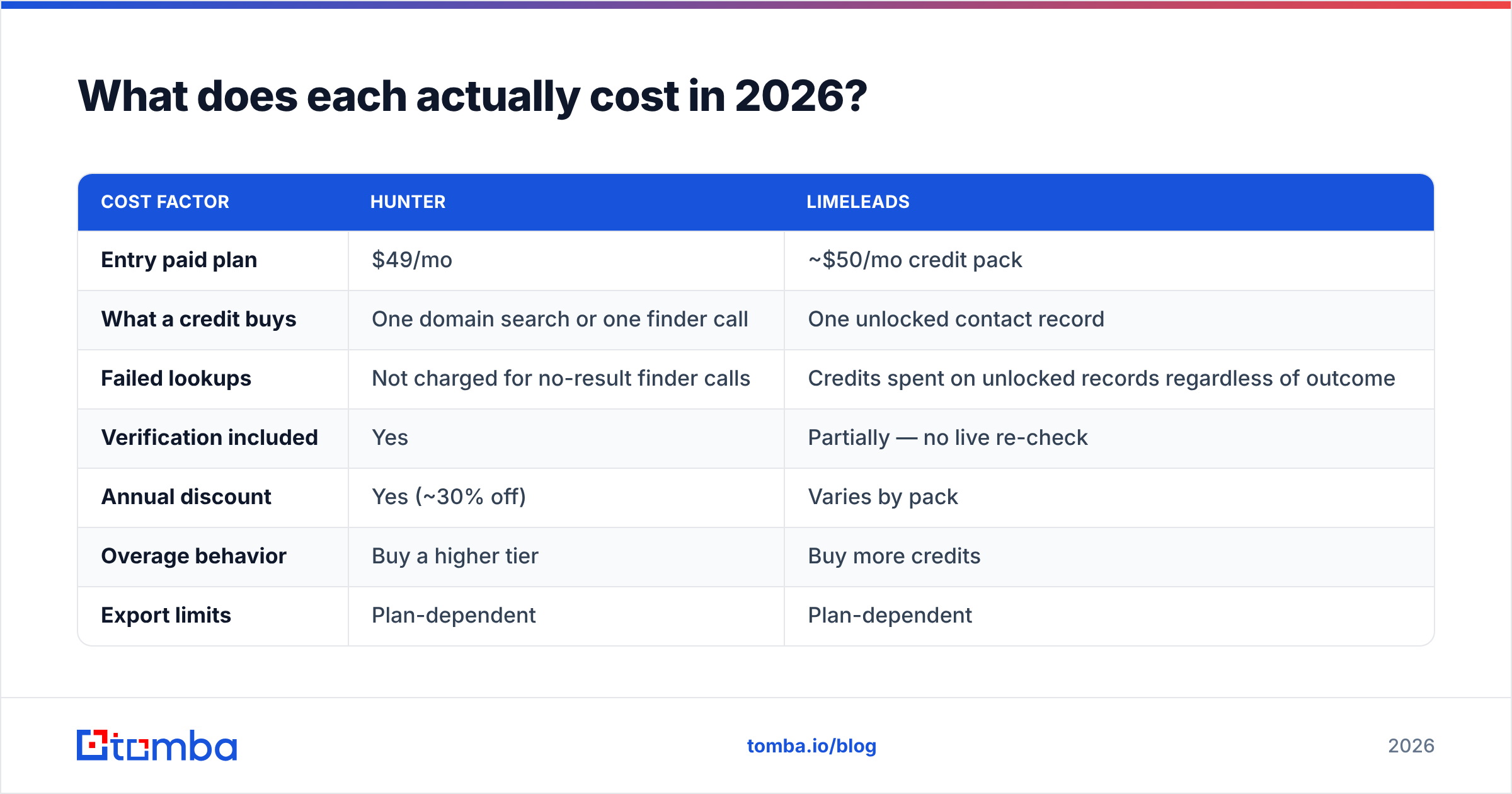
| Cost factor | Hunter | LimeLeads |
|---|---|---|
| Entry paid plan | $49/mo | ~$50/mo credit pack |
| What a credit buys | One domain search or one finder call | One unlocked contact record |
| Failed lookups | Not charged for no-result finder calls | Credits spent on unlocked records regardless of outcome |
| Verification included | Yes | Partially — no live re-check |
| Annual discount | Yes (~30% off) | Varies by pack |
| Overage behavior | Buy a higher tier | Buy more credits |
| Export limits | Plan-dependent | Plan-dependent |
Hunter's model rewards precision. Say you have 400 named prospects at 200 companies. You will burn a predictable number of credits and get a predictable number of results. LimeLeads rewards breadth. If you need 5,000 contacts that match a profile, and you do not care which humans they are, bulk unlocks cost less per row than 5,000 finder queries.
Both models get expensive in the middle case. That is when you need specific people, at specific companies, at volume. Credit burn compounds there. You pay database prices for discovery and finder prices for resolution.
For reference, Tomba's pricing covers that middle case. The free tier gives 25 searches a month. Starter is $49/month, Growth is $99/month, and Pro is $249/month. Finding, verification, domain search, and enrichment all draw from one pool instead of separate line items. The point is not that one number is smaller. It is that a single pool removes the double charge that surprises most teams in month two.
Which workflow does each tool actually fit?#
Match the tool to the shape of your pipeline, not to a feature list.
- Named-account ABM (50–500 target companies). Hunter wins. You know the accounts already, and you need emails for named decision-makers.
- Cold SMB volume outbound (5,000+ contacts a month). LimeLeads is the better start. Filtering at scale is what a database is for. Budget separately for re-verification.
- Recruiting and talent sourcing. Hunter, plus a LinkedIn finder. Databases skew to sales titles and thin out on engineering and design roles.
- Agency running client campaigns. Hunter's per-seat and API setup handles multi-client work more cleanly. Database exports raise data ownership questions nobody enjoys explaining.
- RevOps enriching an existing CRM. Neither one fits alone. You want a data enrichment endpoint that runs on a schedule.
- Content and PR outreach. Hunter, or an author finder. Databases rarely carry journalists at useful depth.
Where do both tools fall short?#
Being fair to both means naming the ceilings.
Hunter's limits. Coverage thins out on small companies and non-English domains. Firms under 20 people often return a pattern guess with weak confidence instead of a sourced address. Campaigns works, but it is no match for a real sequencer. Teams that start there usually move out within a year. Plan search caps also bite: a heavy week forces a tier upgrade you cannot undo mid-cycle.
LimeLeads' limits. Freshness is the structural risk. That is not unique to LimeLeads. It applies to every static database, including much bigger ones. Coverage also skews to the US, and phone data is thinner than email data. The weak API makes it awkward to wire into an automated GTM stack. If your workflow is "export CSV, upload to sequencer," that is fine. If it is "enrich every signup in real time," it is not.
The shared limit. Neither tool fixes deliverability. A perfect address still bounces if your domain is unwarmed, your SPF is broken, or your copy trips filters. Data quality and deliverability are separate budgets. Teams that mix them up blame the data vendor for an infrastructure failure.

Is there a better alternative to Hunter and LimeLeads?#
It depends on which half of the problem you have.
If your gap is list discovery, look at database vendors. BookYourData is a solid pick here. It is pay as you go, with no forced subscription and a bounce guarantee, so one-off campaigns are easy to budget. Apollo covers discovery plus sequencing in one vendor, at the cost of depth in each layer.
If your gap is resolution and verification at volume, that is a finder problem. Turning names and domains into deliverable addresses is where Hunter's pricing curve climbs fastest.

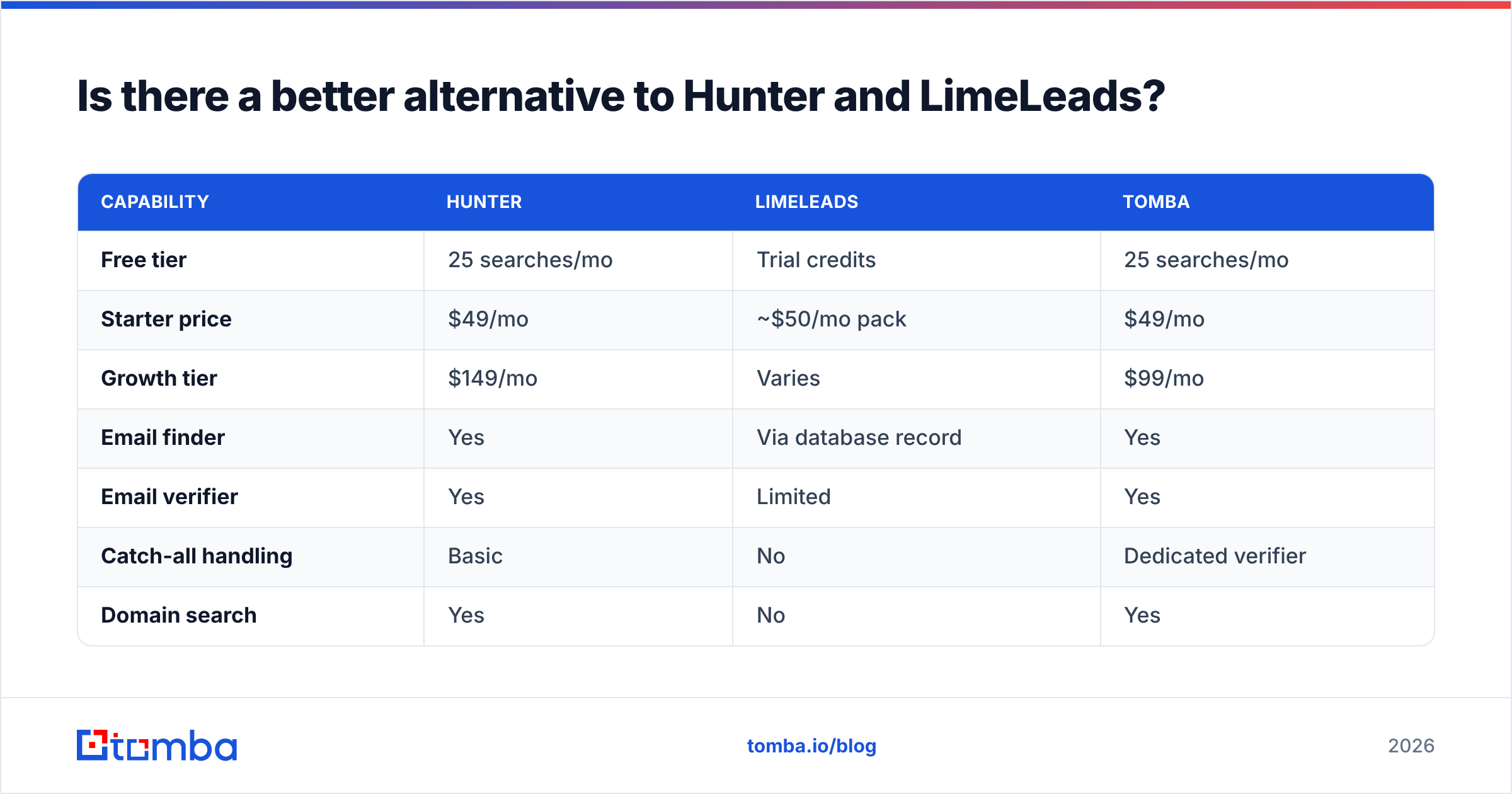
| Capability | Hunter | LimeLeads | Tomba |
|---|---|---|---|
| Free tier | 25 searches/mo | Trial credits | 25 searches/mo |
| Starter price | $49/mo | ~$50/mo pack | $49/mo |
| Growth tier | $149/mo | Varies | $99/mo |
| Email finder | Yes | Via database record | Yes |
| Email verifier | Yes | Limited | Yes |
| Catch-all handling | Basic | No | Dedicated verifier |
| Domain search | Yes | No | Yes |
| Phone finder | No | Limited | Yes |
| Bulk processing | Yes | Export-based | Yes |
| API + CLI + MCP | API only | Limited | All three |
| Sheets / Excel add-ons | Sheets | CSV export | Both |
The middle tier is where the gap compounds. At 2,000–10,000 lookups a month, Hunter moves from $49 to $149 while others move from $49 to $99. On the same volume that is about $600 a year, before verification credits billed separately.
How should you decide this week?#
Run a 200-record bake-off before you commit a quarter's budget.
- Pick one real segment you plan to sell into. Same industry, same title band, same geography.
- Source 100 contacts from each tool. Play to each tool's strength: Hunter from a known account list, LimeLeads from filters.
- Verify both sets with a neutral third-party verifier, so neither vendor grades its own homework. A free email checker works for spot checks. Use a bulk verifier for the full set.
- Record three numbers per source: valid rate, catch-all rate, and credits used.
- Send both sets in one campaign with a source tag. Compare reply rate, not open rate, which means little after MPP.
Whichever source brings more replies per dollar wins the Hunter vs LimeLeads call for your team. That number will be specific to your ICP. It will not match anyone's published benchmark, including the ones in this post.
Ready to test the resolution layer?#
Maybe your bake-off shows the real bottleneck is turning known companies into verified inboxes, not finding companies in the first place. If so, start with the Tomba Email Finder. The free tier gives you 25 searches a month with no card. That is enough to run the 100-record half of the test above. Finder, verifier, and domain search all draw from one credit pool, so you are not billed twice for the same contact. Run it against your hardest 100 accounts. Compare the valid rate to what you use now, and let the bounce report decide.
Related guides#
// get started
Find, verify and enrich your first contacts today
Start on the free plan with 25 searches a month, then scale when your team is ready.
Free plan · No credit card required · GDPR & CCPA
// about the author