Hunter vs MailRush.io: Which Cold Email Stack Wins in 2026?
Hunter finds and verifies addresses. MailRush.io sends to them. Here's an honest breakdown of pricing, accuracy, deliverability and which one actually belongs in your 2026 outbound stack.
Hunter vs MailRush.io is not really a fight, and that is the useful part. Hunter finds and verifies B2B email addresses. MailRush.io sends to them. Here is how the two compare on pricing, data accuracy and deliverability — and which one your 2026 outbound stack actually needs.
TL;DR
- Hunter vs MailRush.io is not a like-for-like matchup. Hunter is a data tool: it finds and verifies addresses. MailRush.io is sending infrastructure: SMTP, drip campaigns, dedicated IPs.
- Is your bounce rate the problem? Then you have a data problem, and MailRush.io will not fix it.
- Is your open rate the problem on a clean list? Then you have an infrastructure problem, and Hunter will not fix it.
- Hunter's list price starts at $49/month for 500 searches. MailRush.io prices by sending volume and contacts, not by lookups. The two bills do not line up.
- Most teams send under 5,000 emails a month. They still pay for two subscriptions when one data provider plus a mainstream sequencer would have been cheaper.
- Our pick for the data half: find and verify in one place (Tomba). Spend the savings on sending infrastructure that truly needs a dedicated IP.
What are Hunter and MailRush.io, actually?#
Hunter vs MailRush.io looks like a head-to-head. It isn't. The two tools solve different halves of the same problem. The comparison exists because both market themselves with the words "cold email."
Hunter (hunter.io) is a B2B email data company. Give it a domain or a person's name. It returns a professional email address, a confidence score, and the public sources behind the pattern. Around that core it stacks Domain Search, an email verifier, a Chrome extension, and a Google Sheets add-on. It also ships a light sequencing product called Campaigns. Campaigns sends through your own Gmail or Outlook mailbox.
MailRush.io (mailrush.io) is a cold email sending platform built on its own SMTP infrastructure. You upload a list, warm up a dedicated IP, and build a drip sequence. It handles the delivery mechanics: throttling, rotation, bounce processing, reply detection, unsubscribe handling. It bundles list cleaning. But cleaning only checks addresses you already have. It does not find the ones you lack.
That distinction is the whole post. Here is the practical version:
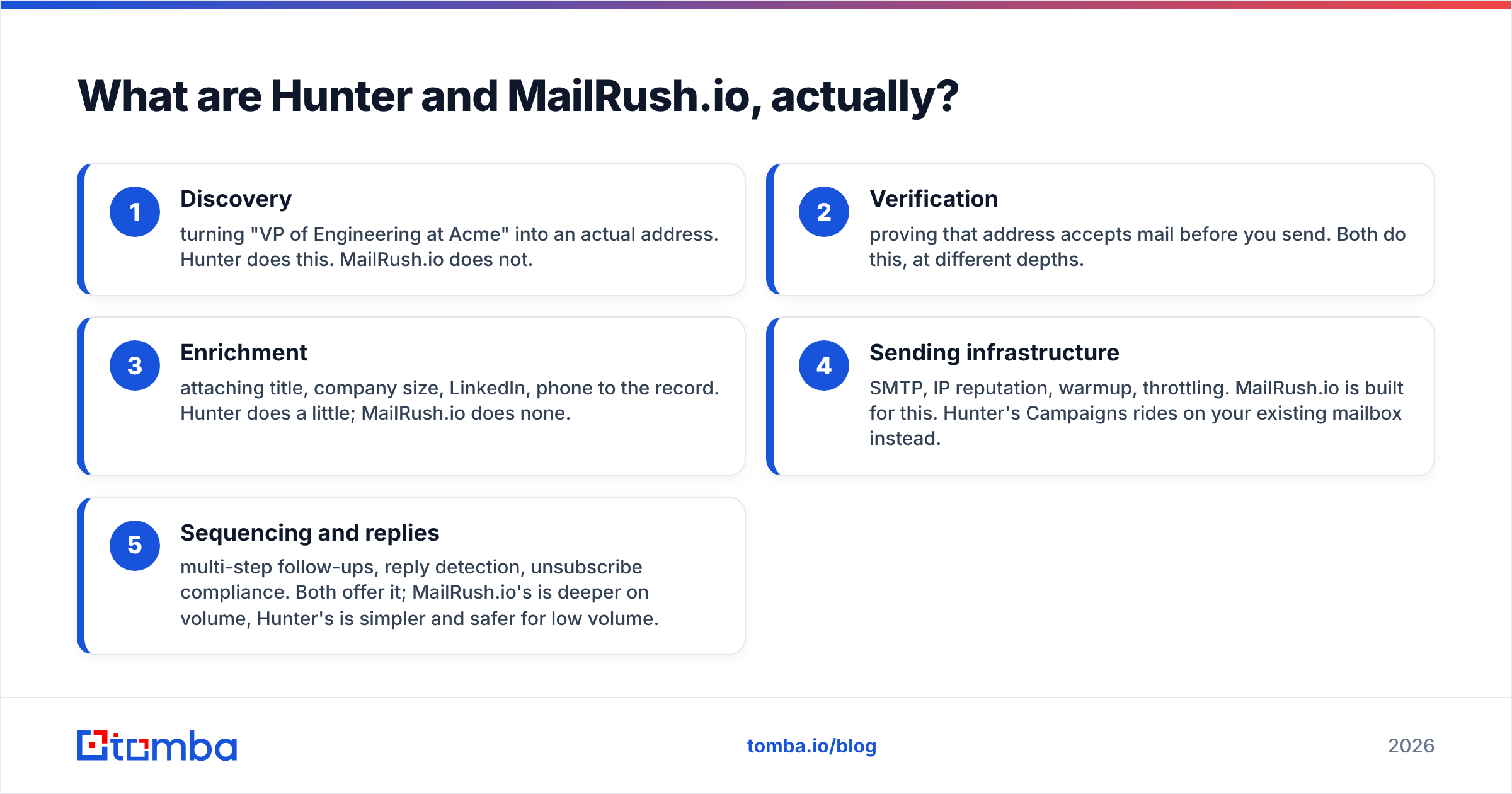
- Discovery — turning "VP of Engineering at Acme" into a real address. Hunter does this. MailRush.io does not.
- Verification — proving that address accepts mail before you send. Both do this, at different depths.
- Enrichment — adding title, company size, LinkedIn and phone to the record. Hunter does a little. MailRush.io does none.
- Sending infrastructure — SMTP, IP reputation, warmup, throttling. MailRush.io is built for this. Hunter's Campaigns rides on your existing mailbox.
- Sequencing and replies — follow-ups, reply detection, unsubscribe rules. Both offer it. MailRush.io goes deeper on volume. Hunter's is simpler and safer at low volume.
Map your real bottleneck onto that list. The "which one" question usually answers itself.

Hunter vs MailRush.io: how do they compare head-to-head?#
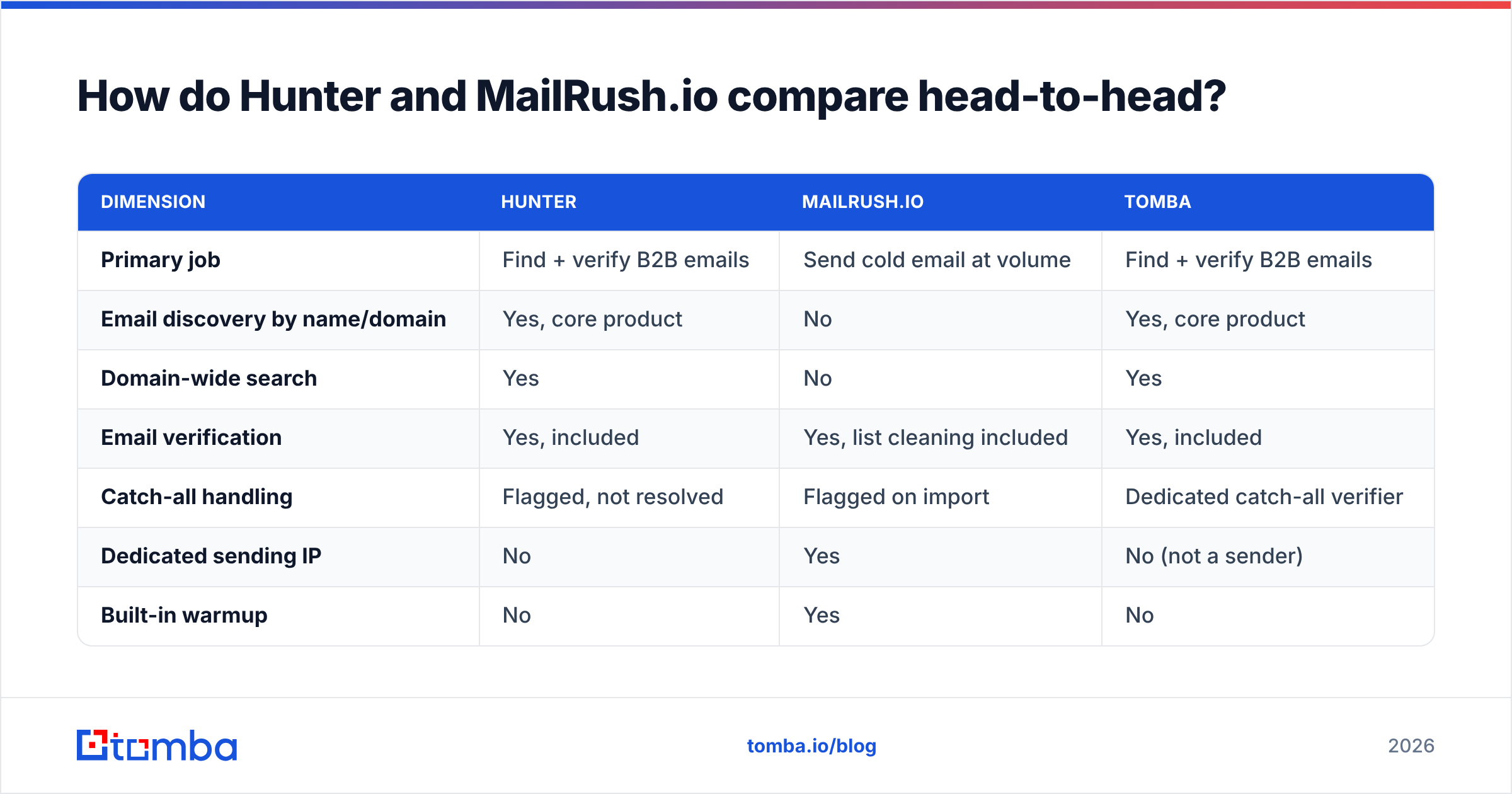
| Dimension | Hunter | MailRush.io | Tomba |
|---|---|---|---|
| Primary job | Find + verify B2B emails | Send cold email at volume | Find + verify B2B emails |
| Email discovery by name/domain | Yes, core product | No | Yes, core product |
| Domain-wide search | Yes | No | Yes |
| Email verification | Yes, included | Yes, list cleaning included | Yes, included |
| Catch-all handling | Flagged, not resolved | Flagged on import | Dedicated catch-all verifier |
| Dedicated sending IP | No | Yes | No (not a sender) |
| Built-in warmup | No | Yes | No |
| Drip sequences | Basic, via your mailbox | Yes, volume-oriented | No (integrates instead) |
| Phone numbers | No | No | Yes |
| Free tier | 25 searches/mo | Trial credits | 25 searches/mo |
| Entry paid price | $49/mo | Volume-based, check current rates | $49/mo |
| Public API | Yes | Yes (sending-focused) | Yes, plus CLI and MCP |
Two things jump out of that table.
First, the "email verification" row is misleading if you read it fast. Hunter verifies an address it just found. It uses SMTP checks plus its own pattern confidence. MailRush.io cleans a list you already imported. Same verb, very different inputs. A cleaner cannot tell you that firstname.lastname@ is the wrong pattern for that company. It only tells you the address you guessed does not exist.
Second, only one of the three columns has a dedicated IP. That is not a knock on the data tools. It is the point. Nobody should buy Hunter expecting sending infrastructure. Nobody should buy MailRush.io expecting a lead list.
Which one finds better email addresses?#
Hunter, by a wide margin — because MailRush.io does not compete here at all.
The better question is how good Hunter's discovery is next to the rest of the 2026 data market. That is the seat MailRush.io leaves empty in your stack. Three things matter.
Pattern quality. Any tool can guess first.last@domain.com. The hard cases look different. Companies with mixed patterns after a merger. Names that do not transliterate cleanly. Mail routed on a subdomain. Hunter is solid here. It also shows the public sources behind each guess, which helps a lot when you audit a bad batch.
Coverage outside the US and big tech. Coverage drops for European mid-market firms, agencies, and anything under 50 people. That is true of every provider, not just Hunter. So run your own sample test. Do not trust a headline accuracy number.
Catch-all domains. This is where most "verified" lists quietly rot. A catch-all server accepts everything. So a basic SMTP check returns "valid" for an address that will silently vanish. Hunter flags these as accept-all and hands the risk back to you. Do a lot of your target accounts run catch-all? That is common in big companies and behind Microsoft 365. Then you want a dedicated catch-all verifier, not a flag.
Run the same 200 test accounts through any two providers. You will see spreads of 10–20 points on found-rate. The winner flips by industry. Vendor accuracy claims are marketing until you test them on your own ICP. Review sites like G2 are a better sanity check than any vendor page, including ours.
Which one sends cold email better?#
MailRush.io, clearly. On the sending half of Hunter vs MailRush.io, it is not close.
Hunter's Campaigns sends through your connected Gmail or Outlook account. That is a deliberate choice with real upsides. You inherit your domain's reputation. There is no IP to warm. The mail looks like a normal one-to-one message, because it is one. The ceiling is low, though. You get provider throttles, no dedicated IP, and thin sending analytics. One aggressive campaign can damage the mailbox your reps use for real conversations.
MailRush.io goes the other way. Own SMTP, dedicated IP options, built-in warmup, throttling controls, bounce and complaint handling. Its reporting is built around deliverability, not around leads. Are you sending tens of thousands of messages a month across several domains? Then that is the right setup. Your reputation lives on infrastructure you control, not on a shared pool.
The tradeoff: a dedicated IP is a liability before it is an asset. A cold IP with no history looks suspect to every big mailbox provider. It needs weeks of slow, engaged sending to earn trust. Send a bad 10,000-message blast on day three and you have burned an asset you paid for. New to this? Read up on email deliverability basics before you buy dedicated infrastructure. The tool will not save you from the strategy.
A rough volume guide:
- Under 2,000 sends/month: stay on your own mailbox. Hunter Campaigns or any mailbox-based sequencer is fine. Dedicated IPs are overkill and risky.
- 2,000–10,000 sends/month: shared-pool sequencers still work if your list is clean. Most teams sit here. MailRush.io's edge is real but not decisive.
- 10,000+ sends/month across several domains: dedicated infrastructure earns its keep. MailRush.io is a fair answer here.

What does each actually cost in 2026?#
Hunter vs MailRush.io on price is not an apples-to-apples read, but start with the clearer of the two.
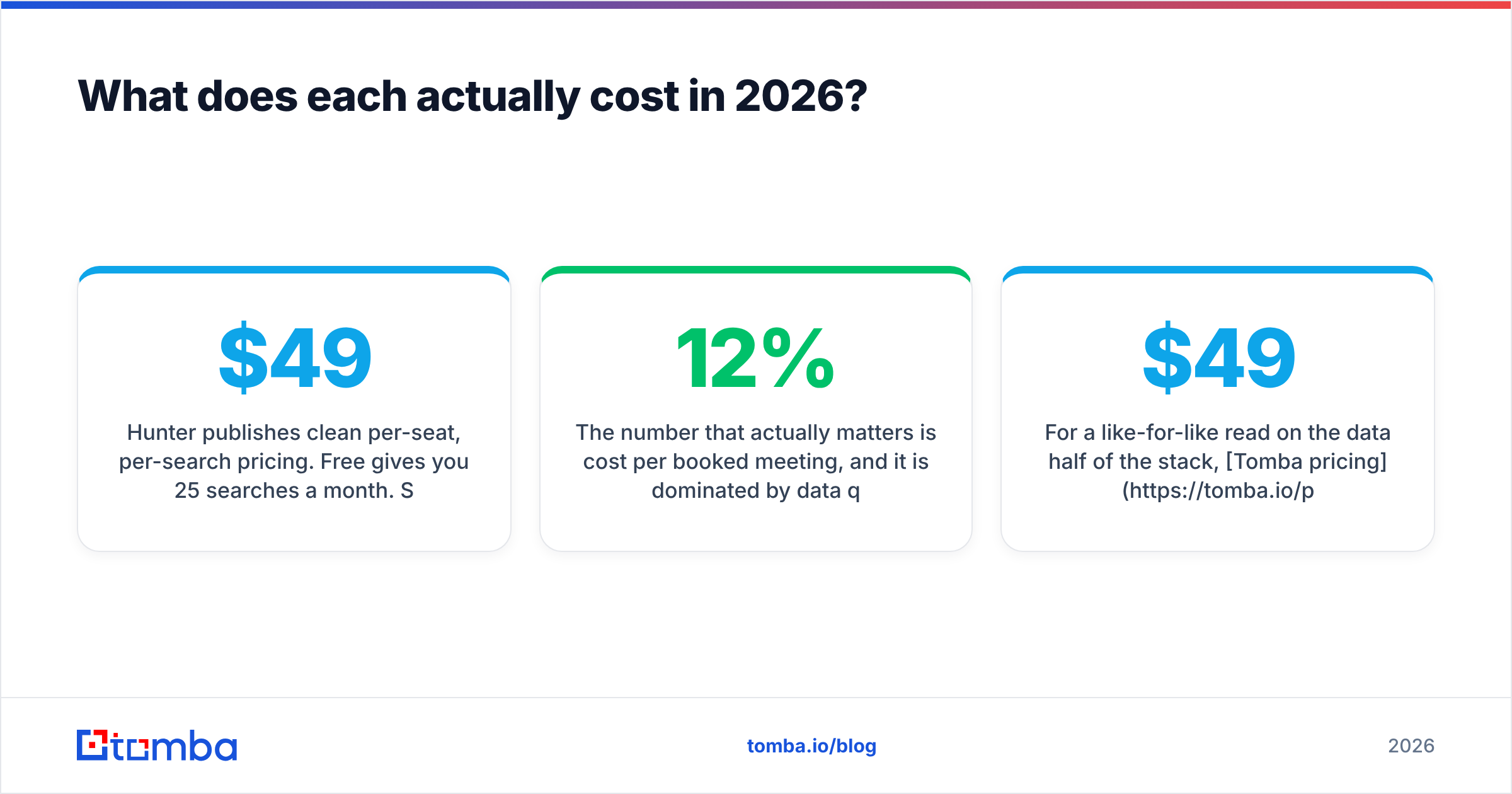
Hunter publishes clean per-seat, per-search pricing. Free gives you 25 searches a month. Starter is $49/month for 500 searches and 1,000 verifications. Growth sits at $149/month. The top self-serve tier runs into the several hundreds. Credits reset monthly and do not roll over. That matters more than people expect: bursty prospecting teams pay for a tier they use two weeks out of four.
MailRush.io prices on sending volume and contact count, not on lookups, with add-ons for dedicated IPs. The billing axis is different, so a side-by-side monthly number means little. Check current MailRush.io pricing directly rather than trusting any comparison post, including this one. Sending platforms revise tiers often.
The number that matters is cost per booked meeting. Data quality drives it, not the subscription price. Take a 5,000-contact campaign at a 12% bounce rate. It wastes roughly 600 sends. It drags your domain reputation down for every later campaign. And it costs you far more than the $50/month gap between any two vendors on this page. Cheap bad data is the most expensive line item in outbound.
Want a like-for-like read on the data half? Tomba pricing mirrors Hunter's structure: free at 25 searches, Starter at $49/month, Growth at $99/month, Pro at $249/month. Catch-all verification and phone lookup come out of the same credit pool. They are not sold as extras.
Where does each one break down?#
Hunter's weak spots:
- No real sending infrastructure. Campaigns is a convenience feature, not a platform.
- Credits expire monthly. If your prospecting is project-based, you overpay.
- Catch-all domains come back flagged, not resolved. The last-mile risk stays with you.
- No phone numbers. Any multichannel motion needs a second vendor.
MailRush.io's weak spots:
- Zero discovery. You must arrive with a list, so you need a second subscription either way.
- Dedicated IP warmup is a real project with a real failure mode. It punishes impatience.
- Smaller ecosystem and fewer native CRM links than the big sequencers. Expect Zapier or API glue.
- The learning curve is deliverability-shaped. Great if you want the controls. Heavy if you just want to send 500 emails a month.
Do you need both, or is there a third option?#
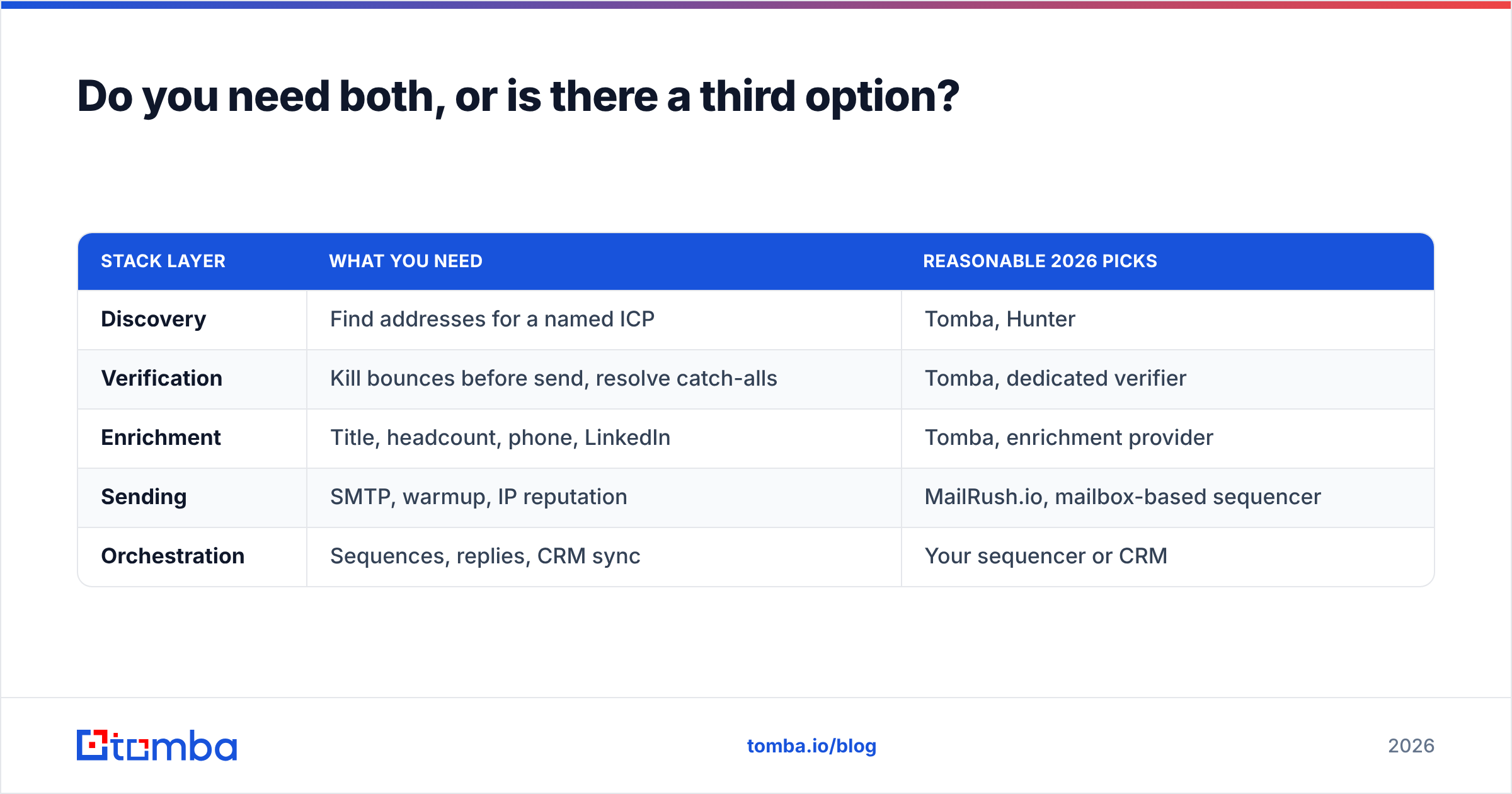
For most teams, Hunter vs MailRush.io is a false choice. Here is the structure they land on after a year of trial and error:
| Stack layer | What you need | Reasonable 2026 picks |
|---|---|---|
| Discovery | Find addresses for a named ICP | Tomba, Hunter |
| Verification | Kill bounces before send, resolve catch-alls | Tomba, dedicated verifier |
| Enrichment | Title, headcount, phone, LinkedIn | Tomba, enrichment provider |
| Sending | SMTP, warmup, IP reputation | MailRush.io, mailbox-based sequencer |
| Orchestration | Sequences, replies, CRM sync | Your sequencer or CRM |
The layers are separable, and that is the point. Buying Hunter and MailRush.io is a defensible stack. One covers rows 1–2. The other covers row 4. What is not defensible is paying for the same verification twice. That is the default outcome when a sending platform bundles list cleaning and your data vendor already verified everything on the way out.
Consolidate rows 1–3 with one provider and you cut both the bill and the busywork. Tomba's email finder and email verifier draw from the same credit pool. The Tomba API lets you verify at the moment of send, not at the moment of import. That one change is the highest-leverage move most outbound teams can make. Lists decay at roughly 2–3% a month. A list verified in January and sent in April is not a verified list.
Which should you pick?#
- You have leads but can't reach inboxes at volume. MailRush.io. Your bottleneck is infrastructure, not data.
- You have infrastructure but no leads. A data provider — Hunter or Tomba. Sending harder into a bad list makes it worse.
- You're under 2,000 sends/month. Skip dedicated sending. Buy good data, send from your real mailbox, and keep the money.
- You're running multichannel with phone. Neither tool covers that alone. Pick a data provider that includes B2B phone numbers so you don't stitch three vendors together.
- Your bounce rate is above 5%. Stop and fix verification before you touch either product. No sending platform outruns a dirty list.
Here is the framing that helps. Hunter vs MailRush.io is not a same-shelf comparison. It is closer to a supplier next to a delivery truck. You need both jobs done. You just don't need to buy them from vendors that each half-do the other's job.
Start with the data layer, because it compounds. Every metric downstream — bounce rate, sender reputation, reply rate, cost per meeting — rests on whether the address was right in the first place. Run your next 25 target accounts through the Tomba Email Finder free tier. Compare found-rate and bounce-rate against your current tool. Then let your own numbers decide. The test is free and takes about ten minutes.
Related guides#
// get started
Find, verify and enrich your first contacts today
Start on the free plan with 25 searches a month, then scale when your team is ready.
Free plan · No credit card required · GDPR & CCPA
// about the author