Hunter vs Prosperfleet Valgen: Which Email Finder Wins in 2026?
One of these email finders has a decade of public benchmarks. The other has almost no verifiable footprint. Here is how Hunter and Prosperfleet Valgen actually compare in 2026 — and what to test before you pay either one.
TL;DR
- Hunter is the incumbent: a decade of public product history, published pricing, a documented API, and thousands of third-party reviews you can actually read before you buy.
- Prosperfleet Valgen has almost no verifiable public footprint — no widely indexed pricing page, no independent accuracy benchmarks, no meaningful review volume. That is not proof it is bad; it is proof you cannot evaluate it from the outside.
- If a vendor will not publish price, bounce-rate guarantees, or API docs before a sales call, treat that as a data point, not a formality.
- On raw cost per verified contact, both Hunter and most challengers get undercut by mid-market tools — Tomba starts at $49/mo with a free tier of 25 searches, and publishes its data sourcing openly.
- The only honest test is your own list. Run 200 of your real ICP contacts through every finalist and measure valid rate, catch-all rate, and cost per usable email. Everything below tells you how.
What are Hunter and Prosperfleet Valgen?#
Hunter (originally Email Hunter, launched in 2015) is one of the oldest email-finding tools still standing. Its core loop is simple: give it a domain, it returns the email addresses it has associated with that domain plus a confidence score; give it a first name, last name, and domain, and it guesses-and-verifies the most likely pattern. Around that sit a verifier, a Chrome extension, a Google Sheets add-on, and a lightweight cold-email sender called Campaigns.
Prosperfleet Valgen is the harder half of this comparison to write about honestly. It surfaces in B2B tooling lists as an email-finding and contact-enrichment product, but as of this writing it has no substantial independent footprint: no widely cited accuracy benchmark, no public changelog, thin review volume on the major software marketplaces, and no consistently indexed pricing page. Every claim you can find about it traces back to the vendor.
That asymmetry is the comparison. When one side has a decade of public receipts and the other has a landing page, the question stops being "which has better features" and becomes "which one can I verify before I spend money."
Here is the thing most buyers get wrong: they treat vendor-supplied accuracy numbers as data. They are marketing. Hunter's, Tomba's, and Prosperfleet Valgen's self-reported figures all deserve the same treatment — interesting, unverified, and worth exactly as much as your own test run.
Why is Prosperfleet Valgen hard to evaluate?#
Before comparing feature grids, run this checklist against any email finder with a thin public record. It takes 20 minutes and kills most bad purchases:
- Published pricing. Can you see the price without talking to a human? Vendors that hide pricing at the sub-$500/mo tier are usually optimising for negotiation leverage, not for you. Hunter and Tomba both publish tiers openly; if a challenger does not, ask why.
- Public API documentation. Not "we have an API" on a features page — actual endpoint docs, rate limits, error codes, and a sandbox key. If you cannot read the docs before signing, you cannot scope the integration, and you cannot leave later without a rebuild.
- Named data sources. Where do the emails come from? Crawled public web pages? Contributed address books? Purchased lists? This determines both accuracy decay and your GDPR/CCPA exposure. Tomba publishes its data sources; demand the equivalent from every vendor on your shortlist.
- Independent review volume. Ten reviews is a friends-and-family sample. Look for a few hundred on G2 or Capterra, then read the two-star ones specifically — that is where credit-refund policies and support response times show up.
- A real free tier or trial with export. Trials that block CSV export exist to stop you from measuring quality. A finder confident in its data lets you export 25–50 rows and check them.
- A bounce guarantee in writing. "99% accurate" in a headline means nothing. "We refund credits for any email marked valid that hard-bounces" is a contractual claim you can enforce.
Prosperfleet Valgen currently fails items 1, 2, and 4 from the outside — which does not mean the product is weak, only that you are being asked to buy on trust. Hunter passes all six. That gap is the entire practical difference for most teams.
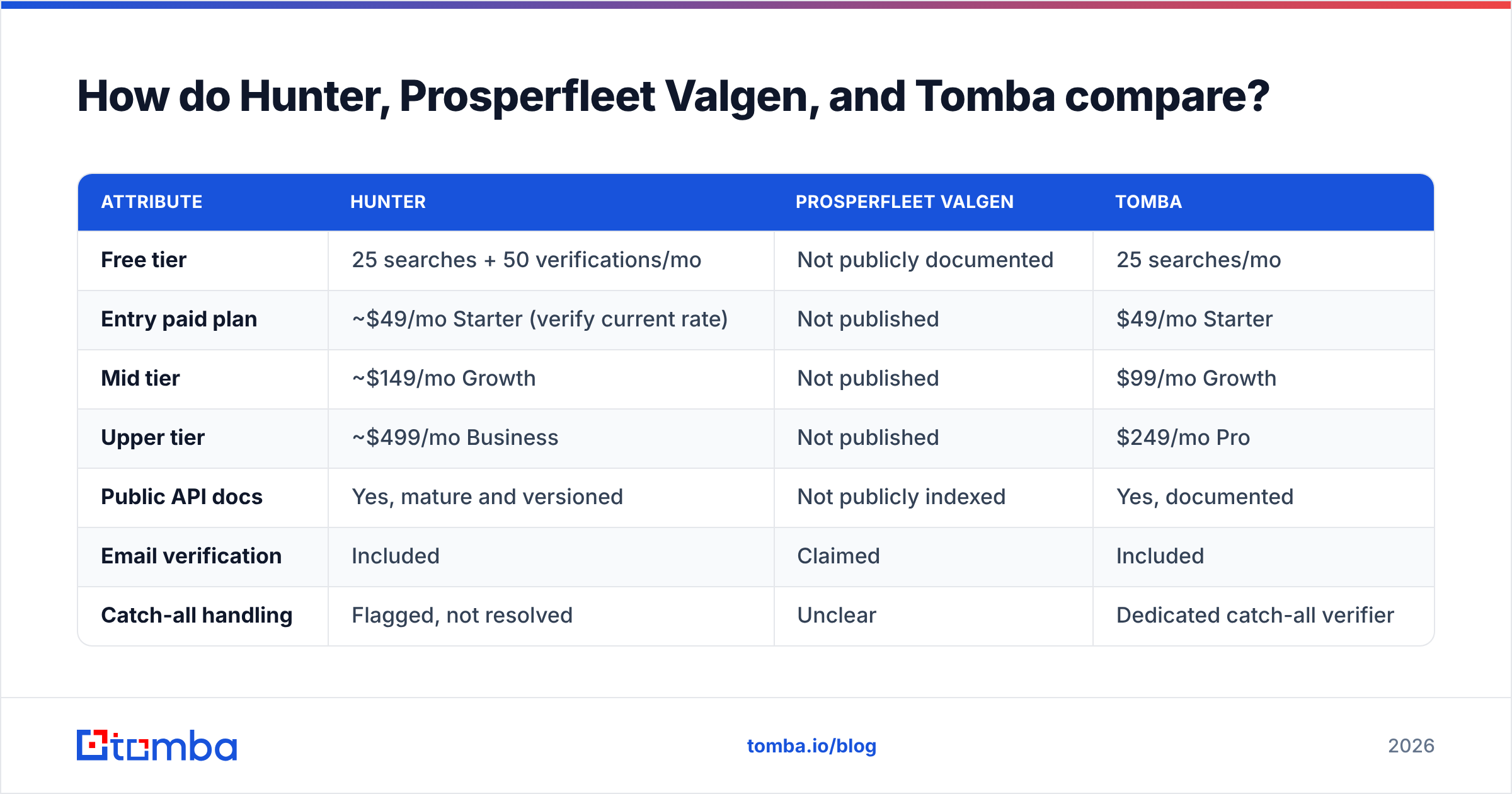
How do Hunter, Prosperfleet Valgen, and Tomba compare?#
| Attribute | Hunter | Prosperfleet Valgen | Tomba |
|---|---|---|---|
| Free tier | 25 searches + 50 verifications/mo | Not publicly documented | 25 searches/mo |
| Entry paid plan | ~$49/mo Starter (verify current rate) | Not published | $49/mo Starter |
| Mid tier | ~$149/mo Growth | Not published | $99/mo Growth |
| Upper tier | ~$499/mo Business | Not published | $249/mo Pro |
| Public API docs | Yes, mature and versioned | Not publicly indexed | Yes, documented |
| Email verification | Included | Claimed | Included |
| Catch-all handling | Flagged, not resolved | Unclear | Dedicated catch-all verifier |
| Phone numbers | No | Unclear | Yes, phone finder + validator |
| Chrome extension | Yes | Unclear | Yes |
| Spreadsheet add-ons | Google Sheets | Unclear | Sheets, Excel, Airtable |
| Independent review volume | High (1,000+) | Minimal | Moderate and growing |
| Track record | Since 2015 | Limited public history | Since 2019 |
Two caveats on that table. First, Hunter's exact price points move — check hunter.io/pricing before quoting me in a budget doc, and note that annual billing changes the effective monthly rate meaningfully. Second, every "not publicly documented" cell is a genuine research finding, not a dig: if Prosperfleet Valgen publishes this information after this post goes live, the row should be updated, and the fact that you had to ask is still the point.

Which one is actually more accurate?#
Accuracy in this category is three separate numbers that vendors deliberately blur into one:
- Coverage — of 1,000 target contacts, how many does the tool return any email for? This is where big databases win and small ones quietly fail.
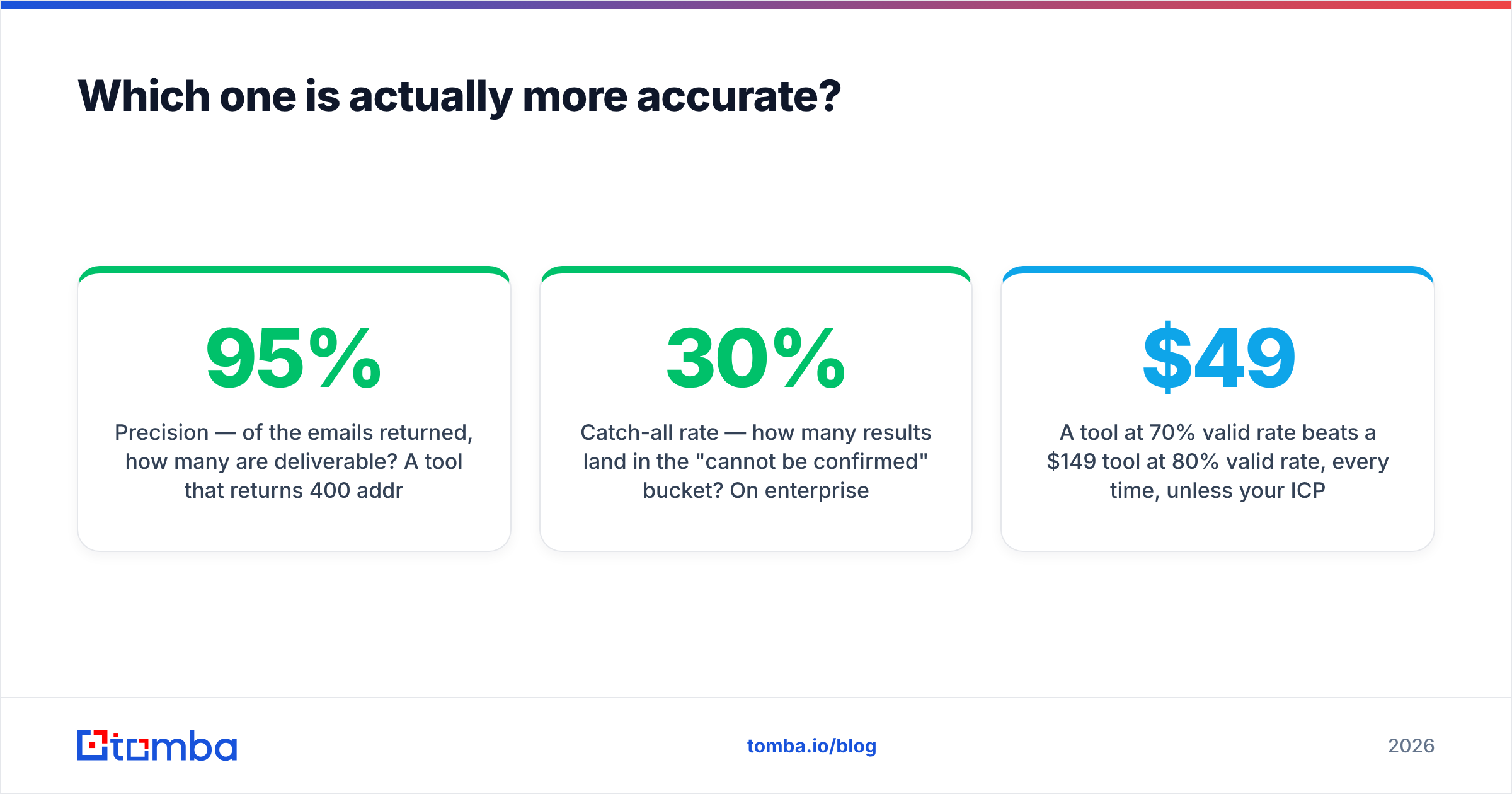
- Precision — of the emails returned, how many are deliverable? A tool that returns 400 addresses at 95% precision beats one that returns 900 at 55%.
- Catch-all rate — how many results land in the "cannot be confirmed" bucket? On enterprise domains this can be 20–30% of results, and how a vendor treats that bucket changes your effective yield enormously.
Hunter's public methodology is conservative: it tends to return fewer results with higher stated confidence, and it labels catch-all domains rather than gambling on them. That is the right default for teams sending from a domain they care about, and it is why Hunter's precision holds up well in independent tests while its coverage on smaller companies lags database-first tools.
Prosperfleet Valgen has no published methodology to assess. Any accuracy figure you have seen for it came from its own marketing.

The practical move is to stop reading benchmarks — including this one — and generate your own. Take 200 contacts you can independently confirm (past customers, current pipeline, conference attendee lists), strip the emails, and run the names + domains through each tool. Then score:
cost per usable email = (plan cost ÷ credits used) ÷ valid-rate
A $49/mo tool at 70% valid rate beats a $149/mo tool at 80% valid rate, every time, unless your ICP is so narrow that coverage is the binding constraint. Most teams discover their binding constraint is coverage on companies under 200 employees — which is exactly where legacy crawl-based indexes thin out.
What does each tool cost per verified contact?#
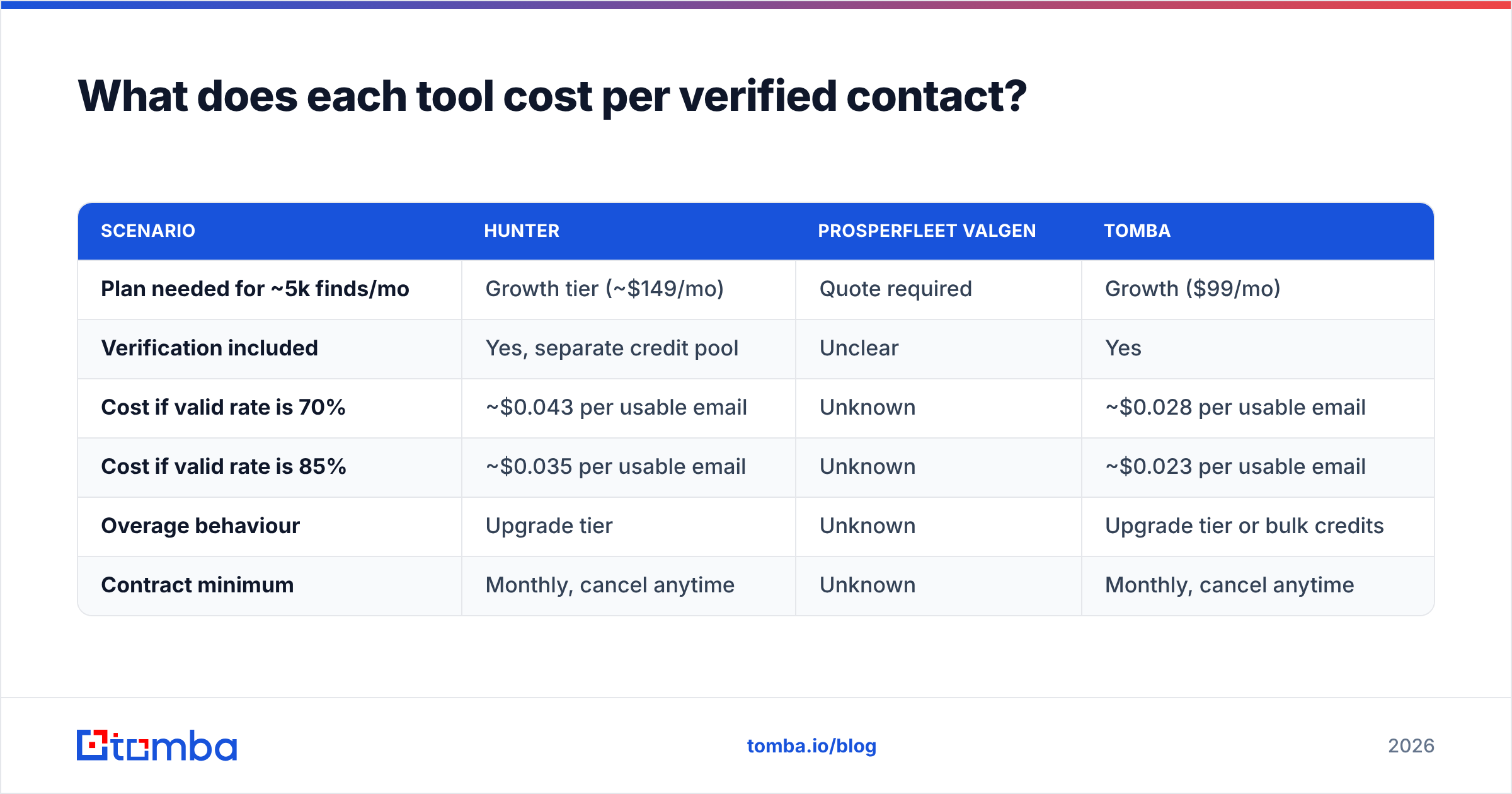
Sticker price is the wrong unit. Here is the same three tools normalised to a monthly workload of 5,000 finds:
| Scenario | Hunter | Prosperfleet Valgen | Tomba |
|---|---|---|---|
| Plan needed for ~5k finds/mo | Growth tier (~$149/mo) | Quote required | Growth ($99/mo) |
| Verification included | Yes, separate credit pool | Unclear | Yes |
| Cost if valid rate is 70% | ~$0.043 per usable email | Unknown | ~$0.028 per usable email |
| Cost if valid rate is 85% | ~$0.035 per usable email | Unknown | ~$0.023 per usable email |
| Overage behaviour | Upgrade tier | Unknown | Upgrade tier or bulk credits |
| Contract minimum | Monthly, cancel anytime | Unknown | Monthly, cancel anytime |
The "unknown" column is the honest answer, and it is also the reason Prosperfleet Valgen struggles to make a shortlist for teams that have to forecast CAC. You cannot model a line item you cannot price.
Is Hunter still worth it in 2026?#
Yes, with a specific profile. Hunter is the right pick when:
- You are a small team with a low-volume, high-value ICP. 200–500 finds a month, enterprise targets, and a strong preference for precision over coverage. Hunter's conservatism is a feature here.
- You want the least-controversial answer in a procurement review. Ten years of history, SOC-style trust signals, and a name your CFO has heard of.
- You need Campaigns bundled. Hunter's built-in sender is basic but adequate for one-person outbound, and consolidating two tools into one has real value under 1,000 sends/month.
Hunter is the wrong pick when you need phone numbers, when your ICP skews to companies under 200 employees, when catch-all domains dominate your target list, or when you are running high volume — the $149 and $499 tiers get expensive fast relative to what mid-market tools charge for the same credit counts.
When would you pick a challenger over the incumbent?#
There are legitimate reasons to buy from a less-established vendor: aggressive pricing, a regional data advantage, a workflow integration nobody else has, or genuinely better coverage in your exact niche. Challengers earn their way in by being measurably better at one thing.
The way to test that safely is to run the challenger in parallel, not as a replacement. Keep the incumbent for a full billing cycle, route the same 500 contacts through both, and compare the email verification results on identical inputs. If the challenger wins on cost per usable email by more than 20%, switch. If it wins by 5%, the switching cost eats the gain.
What you should not do is sign an annual contract with a vendor whose pricing you had to request, whose API you have not read, and whose accuracy you have not measured. That is not risk-taking, it is guessing with a budget.
Where does Tomba fit in this comparison?#
Full disclosure — this is the Tomba blog, so weigh the following accordingly and go verify it.
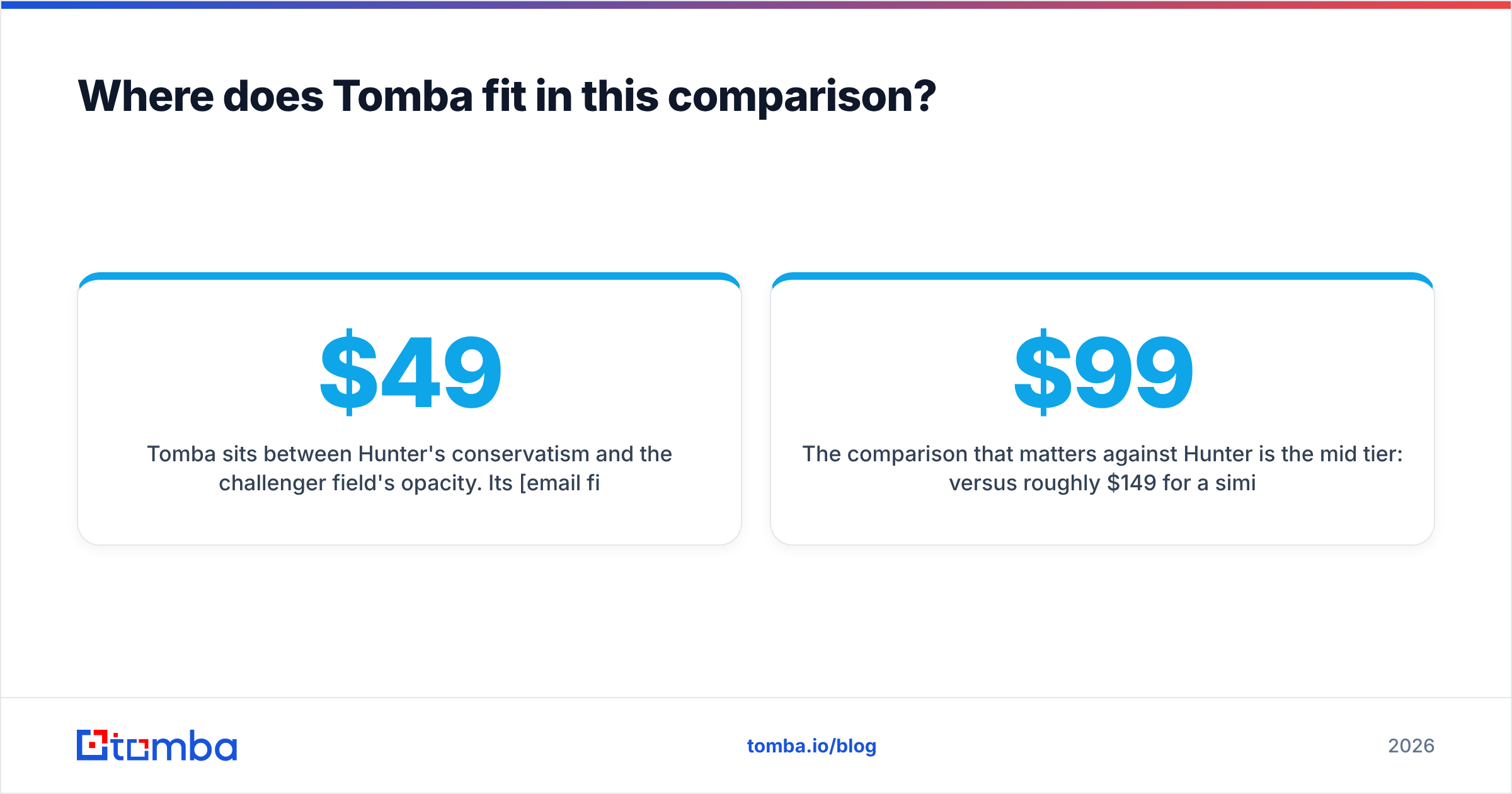
Tomba sits between Hunter's conservatism and the challenger field's opacity. Its email finder does the same core job — name plus domain in, verified address out — but the surrounding toolkit is wider: domain search for mapping an entire company, a dedicated catch-all verifier for the bucket most tools abandon, phone finding and validation, LinkedIn-based lookup, and bulk processing for list work. Pricing is public and simple: free tier at 25 searches/month, Starter at $49/mo, Growth at $99/mo, Pro at $249/mo, Enterprise on request.
The comparison that matters against Hunter is the mid tier: $99 versus roughly $149 for a similar workload, with catch-all resolution and phone data included rather than absent. The comparison against Prosperfleet Valgen is simpler — you can read every one of those numbers without booking a call.
None of that means Tomba wins your specific test. It means Tomba can be tested, on the same terms as Hunter, before you commit.
What should you do next?#
Shortlist two tools, not five. Pull 200 contacts you can verify independently. Run them through both on free tiers. Score valid rate, catch-all rate, coverage on your smallest target accounts, and cost per usable email. Pick the winner and re-run the test in six months, because data quality decays and vendor rankings change more often than the review sites admit.
If your current bottleneck is finding verified work emails at a predictable, published price — with catch-all handling and an API you can read before you buy — start with the Tomba Email Finder. The free tier gives you 25 searches a month, which is enough to run the test above on a sample and see the numbers for yourself. Compare them against Hunter's free tier on the same list, and let your own data pick the winner instead of anyone's comparison post — including this one.
Related guides#
// get started
Find, verify and enrich your first contacts today
Start on the free plan with 25 searches a month, then scale when your team is ready.
Free plan · No credit card required · GDPR & CCPA
// about the author