Hunter vs ReachStream: Which B2B Email Data Tool Wins?
Hunter finds and verifies emails one domain at a time. ReachStream sells you a list. Here is how the two actually differ on accuracy, pricing, workflow, and compliance — plus which one fits your outbound motion.
Hunter vs ReachStream comes down to one question. Do you need to find a specific person's email, or buy a list? Hunter finds. ReachStream sells lists. Everything else follows from that split.
TL;DR
- Hunter is a finder. ReachStream is a database. Hunter resolves emails for people and domains you already care about. ReachStream sells pre-built contact lists you filter and download. That difference decides almost everything else.
- Hunter wins on precision and verification. Domain search, confidence scores, and a built-in verifier make it the safer choice when your ICP is narrow and named.
- ReachStream wins on raw volume per dollar. If you need 20,000 contacts in a broad segment and you plan to verify them yourself, list pricing is cheaper per record.
- Both leave a gap: freshness. A downloaded list decays roughly 2–3% per month. A finder that only works one lookup at a time doesn't scale. An API-first tool closes both gaps.
- Our pick: Hunter for targeted outbound, ReachStream for volume list-building, and an API-first alternative like Tomba when you want find + verify + enrich in one pipeline at $49/mo.
What are Hunter and ReachStream, exactly?#
They get compared constantly, and they shouldn't be — they solve two different halves of the same problem.
Hunter (originally Emailhunter, launched 2015) is an email-finding engine built on crawled public web data. You give it a domain or a name-plus-company, it returns the most likely work email with a confidence score and the public sources it found. Around that core sit a verifier, a Chrome extension, a Google Sheets add-on, bulk CSV processing, a lightweight campaign sender, and Discover for company search.
ReachStream is a B2B contact database. You don't search for a person — you build a segment. Filter by industry, job title, employee count, revenue, geography, technology, then download the matching contacts as a CSV or push them to your CRM. It's list-building in the classic sense: you're buying rows, not resolving individuals.
The mental model: Hunter is a locksmith who opens the specific door you point at. ReachStream is a hardware store that sells you a box of keys and lets you sort through them.
Hunter vs ReachStream: how do they actually differ?#
Six differences matter more than the feature checklists on either homepage. The first three shape your daily workflow:
- Input model. Hunter takes a known target — a domain, a name, a LinkedIn URL — and returns an address. ReachStream takes filter criteria and returns a population. Already have a target account list? Hunter fits it natively. Still deciding who to target? ReachStream does.
- Data provenance. Hunter cites public web sources for most finds, so you can see where the pattern came from. ReachStream aggregates from partner feeds, public registries, and its own collection. That is more opaque, but broader.
- Verification depth. Hunter runs SMTP-level checks and grades results as deliverable, risky, or unknown, with a numeric confidence score. Most list vendors, ReachStream included, verify on a refresh cycle instead of at the moment you export.
The other three shape your budget and your risk:
- Decay exposure. A ReachStream CSV is a snapshot. B2B contact data decays around 2.1% per month by most industry estimates. That means a quarter of your list is stale within a year. Hunter re-queries live, so its answers age far more slowly.
- Pricing logic. Hunter charges per search and per verification on a monthly credit model. List databases usually charge per record or per seat with export caps. That favours bulk buyers and punishes one-off lookups.
- Compliance posture. Hunter is French-headquartered and heavily GDPR-oriented, with source transparency built into the product. Any purchased list, from any vendor, still needs your own lawful basis for contacting EU records.
Hunter vs ReachStream: which one has better data accuracy?#
Neither vendor's headline number means what you think it means.
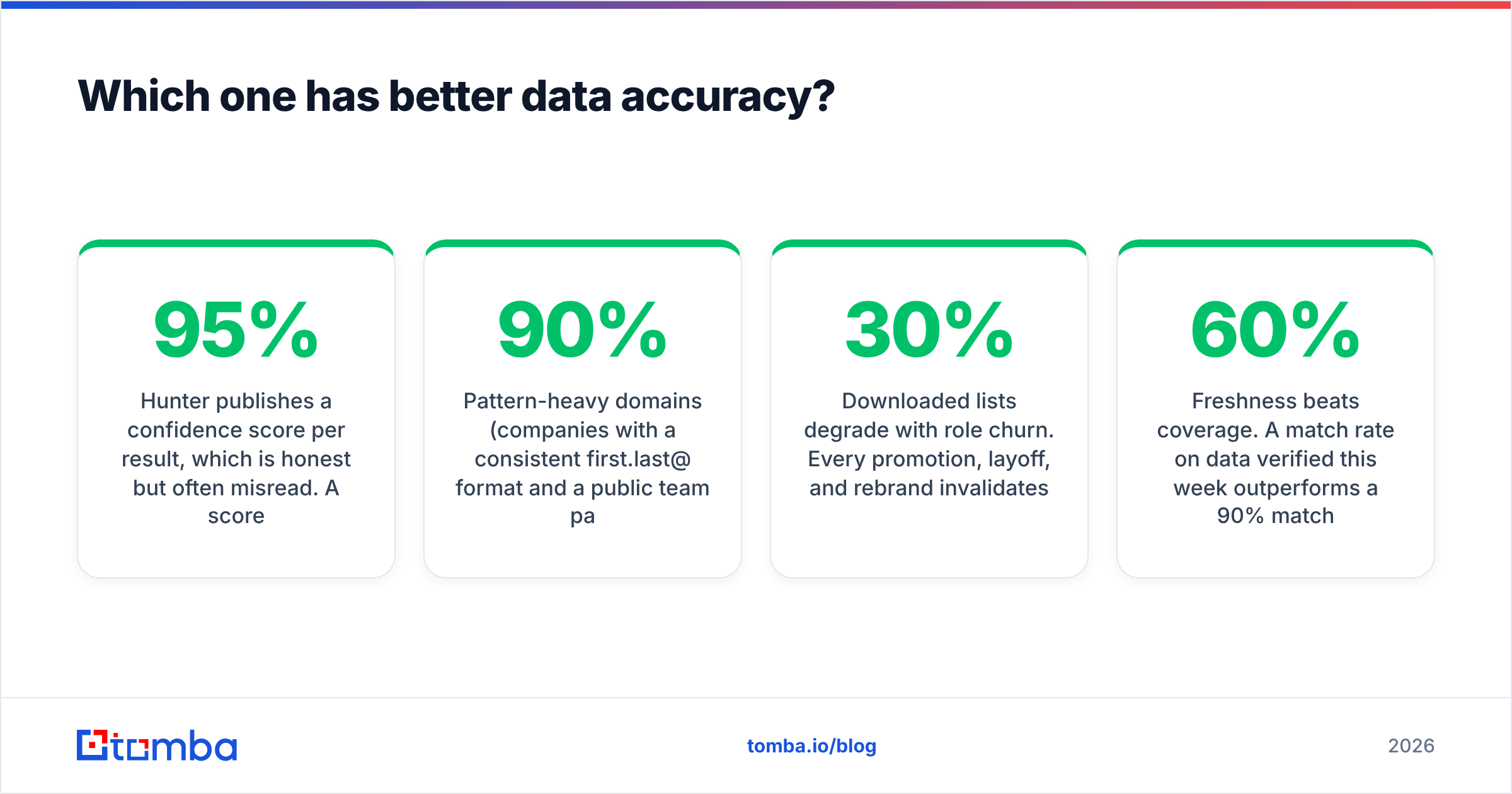
Hunter publishes a confidence score per result. That is honest, but often misread. A 95% score on a pattern-derived address means the format is nearly certain for that domain. It does not mean the human still works there. List providers quote a blended accuracy figure across the whole database — true in aggregate, useless for your specific 500-row segment.
Here's what we see when teams benchmark on their own ICP instead of a vendor's sample:
- Pattern-heavy domains (a consistent first.last@ format and a public team page) resolve at 90%+ from almost any credible finder. This is the easy tier.
- Catch-all domains are where tools separate. A catch-all accepts every address at SMTP level, so naive verifiers mark everything "valid." Real accuracy here needs a dedicated catch-all verifier that uses secondary signals, not just a handshake.
- Downloaded lists degrade with role churn. Every promotion, layoff, and rebrand invalidates rows silently. Bounce rates on unverified purchased lists routinely land in the 15–30% band.
- Freshness beats coverage. A 60% match rate on data verified this week outperforms a 90% match rate on data collected 14 months ago, every time.

The practical takeaway: re-verify at the moment of send, not at the moment of purchase. If your sequence launches three weeks after the export, run the list through an email verifier again first. That single step is usually worth more than switching vendors.
How do Hunter and ReachStream compare on features and pricing?#
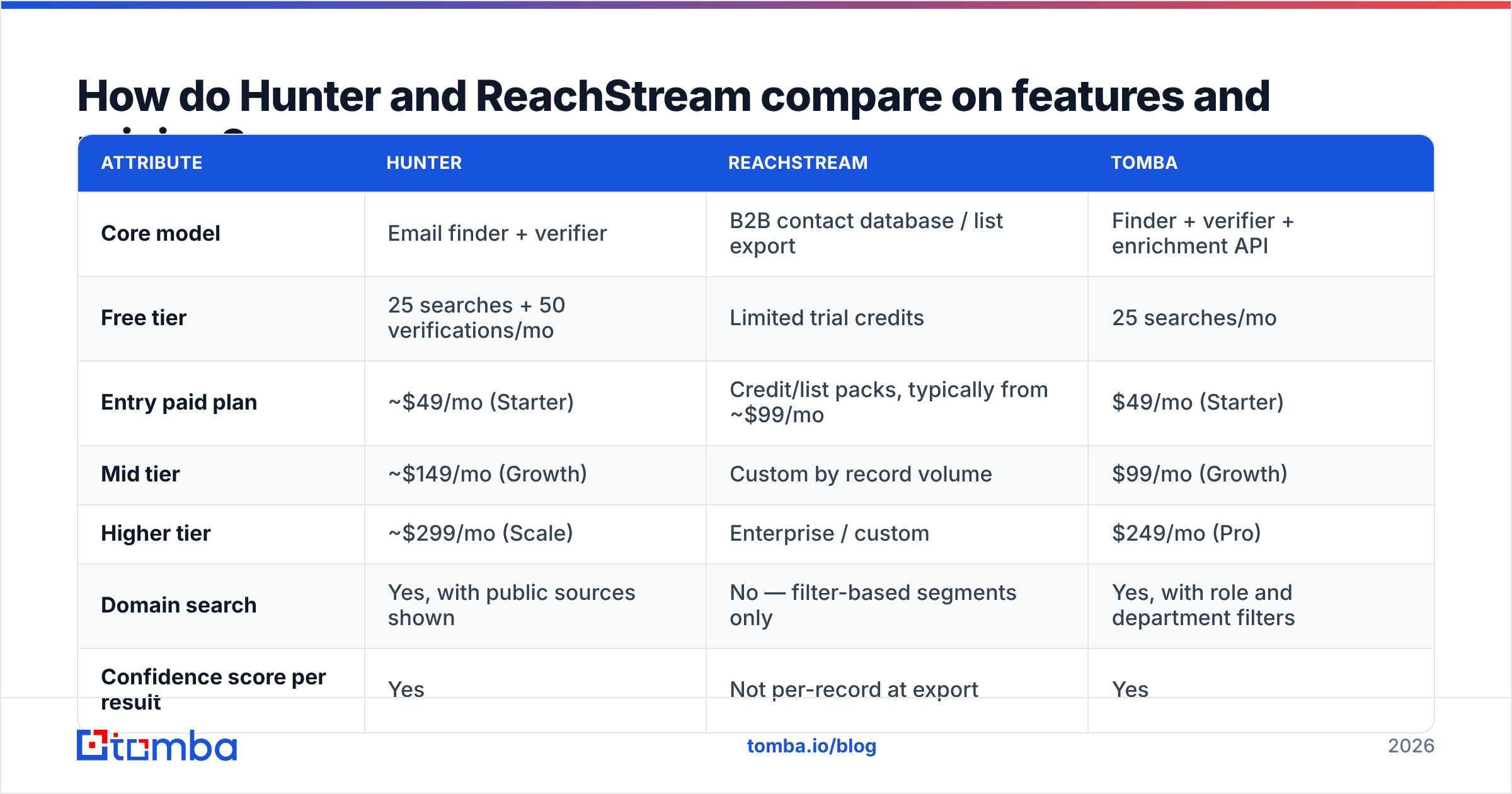
Prices and limits below reflect published plans at time of writing. Both vendors adjust tiers, so check their pricing pages before you sign an annual contract.
| Attribute | Hunter | ReachStream | Tomba |
|---|---|---|---|
| Core model | Email finder + verifier | B2B contact database / list export | Finder + verifier + enrichment API |
| Free tier | 25 searches + 50 verifications/mo | Limited trial credits | 25 searches/mo |
| Entry paid plan | ~$49/mo (Starter) | Credit/list packs, typically from ~$99/mo | $49/mo (Starter) |
| Mid tier | ~$149/mo (Growth) | Custom by record volume | $99/mo (Growth) |
| Higher tier | ~$299/mo (Scale) | Enterprise / custom | $249/mo (Pro) |
| Domain search | Yes, with public sources shown | No — filter-based segments only | Yes, with role and department filters |
| Confidence score per result | Yes | Not per-record at export | Yes |
| Catch-all handling | Flags as "accept-all" | Not surfaced at export | Dedicated catch-all verifier |
| Bulk processing | CSV upload, credit-based | Native (whole model is bulk) | Bulk find + bulk verify |
| API access | Yes, all paid plans | Yes on higher tiers | Yes, on every paid plan |
| Phone numbers | No | Yes, on many records | Yes, via phone finder |
| Chrome extension | Yes | Limited | Yes |
| Built-in sending | Basic campaigns | No | No — integrates with your sequencer |
| Best for | Targeted, account-based outbound | High-volume segment list-building | Programmatic find + verify in your own stack |

Read the table row by row and the split is obvious. Hunter's paid tiers buy you precision per lookup. ReachStream's buy you rows per dollar. The two aren't substitutes. Plenty of teams run both, and use Hunter to repair the gaps in a purchased list.
Is Hunter better than ReachStream for cold outreach?#
For most B2B teams under 50 reps: yes — but with a caveat.
Hunter is better when your outbound is account-led. You've picked 300 target companies, you know the personas, and you need the right human at each one. Hunter's domain search equivalent workflow — enter domain, see the org's discoverable addresses with roles — maps directly onto that motion. You spend credits only on accounts you already qualified, so cost per meeting stays sane.
ReachStream is better when your outbound is segment-led. You're testing a new vertical, you have no account list yet, and you need 15,000 marketing directors at 50–500 employee SaaS companies in North America to find out whether the message lands at all. Paying per lookup for 15,000 unknown contacts would be absurd; buying the segment is the correct move.
The caveat: segment-led lists carry a deliverability tax. Sending to an unverified purchased list is the fastest way to torch a sending domain. If you go the list route, budget for verification and for a proper email warmup ramp before you scale volume. Google and Yahoo now enforce bulk sender rules: a spam complaint rate under 0.3%, authenticated sending, and one-click unsubscribe. Sloppy lists get punished for it. G2 reviews of every list vendor in this category are full of teams who learned that the expensive way.
What are the real limitations of each?#
Hunter's limits:
- No phone numbers. If your motion needs multichannel, you'll bolt on a second vendor.
- Credit consumption is coupled to searching, not finding. Broad exploratory work burns budget fast.
- Coverage skews toward companies with a public web footprint. Small local businesses and stealth-mode startups are thin.
- The bundled campaign tool is functional but not competitive with dedicated sequencers.
ReachStream's limits:
- Export snapshots go stale the moment they land in your CRM. There's no live re-resolution.
- Per-record verification status at export time isn't as granular as a dedicated verifier's grading.
- Filter-based discovery can't answer "what's Jane Doe's email at this specific company" — the exact question SDRs ask 20 times a day.
- Enterprise-tier pricing negotiation is opaque compared to Hunter's published plans.
Both limits point the same direction: neither tool alone covers the full find → verify → enrich → refresh loop. That's why so many stacks end up with two or three data vendors and a Zapier bill.
Where does Tomba fit between them?#
Tomba sits deliberately in the middle: finder-grade precision with database-grade batch throughput, exposed as an API you can wire into your own stack.
One account covers the whole loop. Find an address from a name and domain. Run domain-wide role searches. Verify at SMTP level with catch-all handling. Resolve B2B phone numbers and enrich leads with firmographics. No stitching a finder to a list vendor to a verifier.
Pricing is published and flat: free tier at 25 searches/month, Starter at $49/mo, Growth at $99/mo, Pro at $249/mo, Enterprise custom. Full Tomba pricing is on the site with the exact credit allocations per tier. Every paid plan includes Tomba API access — not just the top ones — which matters if you're building automated enrichment rather than clicking through a UI.
Where Tomba is not the answer: if you genuinely need to browse and buy a 50,000-row segment with no target accounts in hand, a dedicated database like ReachStream or BookYourData — a solid, well-regarded option in the pay-as-you-go list space — is the right instrument. Use the database to define the universe, then use a finder-plus-verifier layer to keep it alive.
Which should you choose in 2026?#
The Hunter vs ReachStream call comes down to motion, not feature count:
- Account-based, under 1,000 targets/month, precision matters most → Hunter. Its confidence scoring and source transparency are hard to beat at that scale.
- New vertical, no account list, need volume to test messaging → ReachStream (or a comparable list provider), then verify everything before send.
- You're building automation — CRM enrichment, inbound form lookups, ops workflows → an API-first tool. Per-lookup UI credits don't survive contact with a real pipeline.
- Mixed motion, one budget line → consolidate. Two vendors at $149 each usually beats one at $99, but three vendors at $99 each never beats one at $249.
- Deliverability is already shaky → stop buying data entirely for 30 days. Fix authentication, warm the domain, clean the existing list. New contacts on a burned domain are wasted money.
One test settles it faster than any comparison post. Take 100 rows from your actual ICP, not a vendor sample. Run them through each tool's free tier. Then check the outputs against a neutral verifier. Match rate and bounce rate on your segment are the only numbers that matter. Hunter gives you 25 free searches, Tomba gives you 25, and ReachStream offers trial credits. That's enough for a real bake-off.
Ready to test it on your own list?#
If your bottleneck is finding the right person at accounts you've already chosen, start with the Tomba Email Finder. The free tier gives you 25 searches a month with no card. Starter is $49/mo. Every paid plan ships with API access, catch-all verification, and bulk email finder processing, so you can run a whole segment in one pass instead of one row at a time.
Run 100 of your real target accounts through it, compare the bounce rate to whatever you're using now, and let the numbers pick your vendor.
Related guides#
// get started
Find, verify and enrich your first contacts today
Start on the free plan with 25 searches a month, then scale when your team is ready.
Free plan · No credit card required · GDPR & CCPA
// about the author