Hunter vs Startup Tracker: Which B2B Data Tool Wins in 2026?
Hunter finds email addresses. Startup Tracker finds funded companies. They get compared constantly, but they solve different halves of the same problem — here's which one your pipeline actually needs, and what it costs to run both.
TL;DR
- Hunter is a contact-data tool: you give it a domain or a name, it gives you an email address and a confidence score. Startup Tracker is a signal database: it tells you which companies just raised money, hired, or launched.
- They are not substitutes. Roughly 20% of their functionality overlaps (basic company profiles and some contact fields); the other 80% answers completely different questions.
- Hunter's paid plans run $49 → $149 → $499/mo. Startup Tracker sells on a much smaller, signal-focused footprint with a free browsing tier and paid alerting/export tiers.
- If you already know who you want to reach, buy contact data. If you don't, buy signals — then bolt a cheaper finder onto it.
- The most common mistake: paying $499/mo for a top-tier finder plan when a $49–$99 finder plus a signal feed covers the same job for less.
What are Hunter and Startup Tracker actually built for?#
Hunter started life as a domain-scraping email finder and grew into a full contact-data suite: Domain Search, Email Finder, Email Verifier, a Chrome extension, a lightweight campaign sender, and an API. Its unit of value is a single deliverable email address attached to a name and a company. Everything else in the product exists to make that address easier to find, verify, or send to.
Startup Tracker inverts the question. Its unit of value is an event: a seed round closing, a Series A, a new market entry, a founder change. It maintains company profiles — heavily weighted toward European and startup-stage companies — and pushes alerts when something changes. Contact details exist in the product, but they are supporting cast, not the headline.
That difference explains why head-to-head reviews of Hunter vs Startup Tracker usually feel unsatisfying. Reviewers score them on the same rubric (data accuracy, coverage, price per record) and one always looks worse, because half the rubric doesn't apply. A funding tracker with 40% email coverage is not "inaccurate" — it was never sold as a finder. A finder that can't tell you who raised last week is not "thin" — it was never sold as an intent feed.
The honest framing is a pipeline one. Outbound has two bottlenecks: knowing which accounts are worth a touch, and being able to reach the person inside them. Startup Tracker attacks the first. Hunter attacks the second.
How do their data models actually differ?#
Before you compare prices, compare what each system stores and how it decays. This is the part that determines whether the tool is still useful in month six.
- Primary key. Hunter is organised around domain → people → email pattern. Startup Tracker is organised around company → event timeline. That means Hunter is queryable by person and Startup Tracker is queryable by moment.
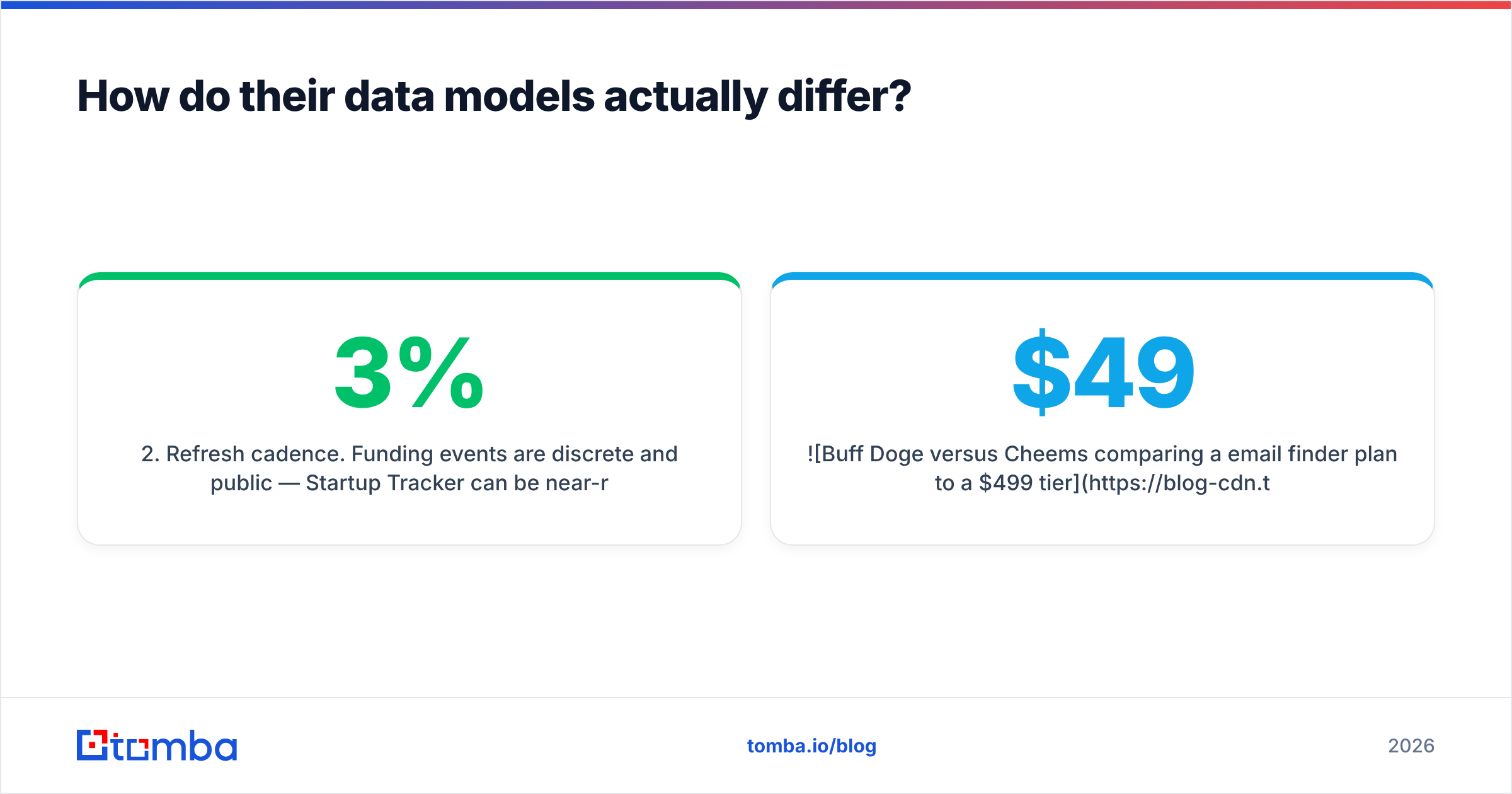
- Refresh cadence. Funding events are discrete and public — Startup Tracker can be near-real-time because press releases, registry filings, and funding announcements are timestamped. Email data decays continuously (roughly 2–3% of B2B contacts go stale per month as people change jobs), so a finder has to re-derive and re-verify constantly rather than "publish once."
- Confidence model. A good finder ships a per-record confidence score and an SMTP-level verification state (valid / invalid / catch-all / unknown). A signal database ships a source citation instead — the article, filing, or announcement the event came from.
- Coverage shape. Startup Tracker is deliberately narrow and deep: startup-stage companies, strong European coverage, rich event history. Hunter is broad and shallow: tens of millions of domains, but a handful of fields per person.
- What "wrong" looks like. In a finder, wrong means a bounce. In a signal feed, wrong means a stale or duplicated event — annoying, but it doesn't hurt your sender reputation.
Point five matters more than most buyers realise. Bad contact data has a compounding cost: bounces degrade your domain reputation, which suppresses deliverability on the good addresses you send to later. Bad signal data just wastes a rep's twenty minutes. That asymmetry is why you can tolerate a mediocre signal source but should never tolerate a mediocre verifier.

Hunter vs Startup Tracker: how do features and pricing compare?#
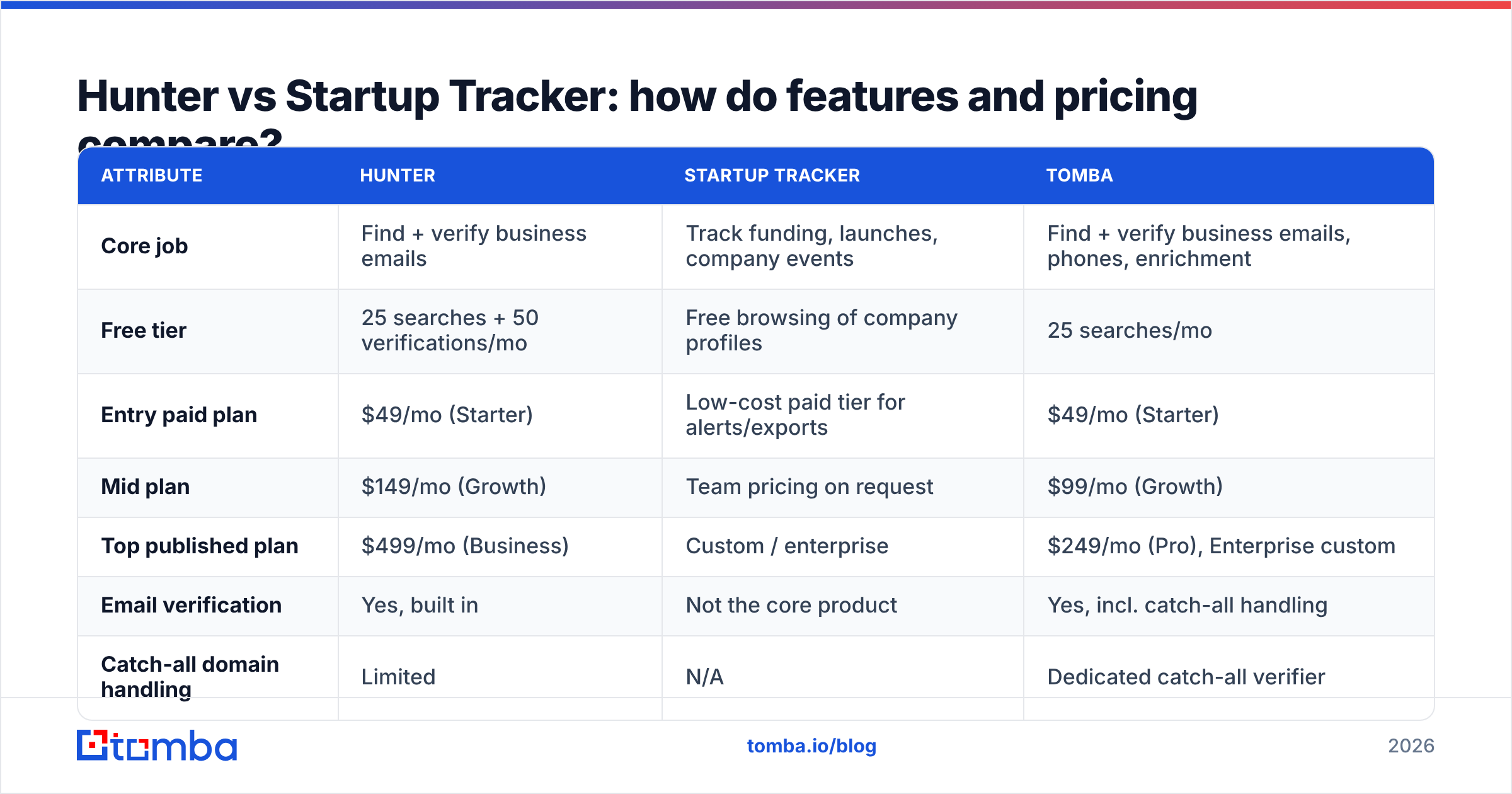
Here's the head-to-head, with Tomba included as the third data point most buyers end up shortlisting once they realise the finder half of the stack is commoditised.
| Attribute | Hunter | Startup Tracker | Tomba |
|---|---|---|---|
| Core job | Find + verify business emails | Track funding, launches, company events | Find + verify business emails, phones, enrichment |
| Free tier | 25 searches + 50 verifications/mo | Free browsing of company profiles | 25 searches/mo |
| Entry paid plan | $49/mo (Starter) | Low-cost paid tier for alerts/exports | $49/mo (Starter) |
| Mid plan | $149/mo (Growth) | Team pricing on request | $99/mo (Growth) |
| Top published plan | $499/mo (Business) | Custom / enterprise | $249/mo (Pro), Enterprise custom |
| Email verification | Yes, built in | Not the core product | Yes, incl. catch-all handling |
| Catch-all domain handling | Limited | N/A | Dedicated catch-all verifier |
| Phone numbers | No | Limited | Yes |
| Funding / intent signals | No | Yes — core product | No (via integrations) |
| Geographic strength | Global, US-weighted | Europe-weighted, startup-stage | Global |
| API | Yes | Yes | Yes, plus CLI and MCP server |
| Best for | Reaching known targets at scale | Deciding who to target this week | Reaching known targets at lower cost per credit |
Two things jump out.
First, the finder column is a price fight, not a capability fight. Hunter and Tomba both do domain search, name-based lookup, and verification; the meaningful gap is what you pay per usable record at the volume you actually run. Hunter's jump from $149 to $499 for the next credit tier is where a lot of teams quietly start shopping — Tomba's $249 Pro plan sits in that gap, and the full pricing breakdown is worth putting next to your current invoice before renewal.
Second, Startup Tracker has no real competitor in the other two columns of your stack. Comparing it to a finder on cost-per-email is like comparing a smoke detector to a fire extinguisher on litres of water.
Which one finds more usable email addresses?#
Hunter, by a wide margin — but "usable" needs defining, because hit rate and deliverable rate are different numbers and vendors love to blur them.
A finder returns three outcomes: a verified address, a guessed-but-unverified address (usually pattern-derived), and nothing. Marketing pages quote the first two combined as "coverage." Your bounce rate only cares about the first. When you benchmark, run the same 200-row list through each tool and score it on verified deliverable addresses divided by rows submitted, not on rows returned.
Startup Tracker will lose that test and it should — it isn't derived from an email-pattern corpus. What it will give you is a list of 40 companies that closed a round in the last 14 days, which is a far better starting list than the 2,000 random SaaS companies you'd otherwise pull from a filter.
The practical workflow is to let each tool do its half:
- Pull the account list from the signal source (recently funded, recently hired a VP of Sales, recently opened a US office).
- Push the domains through a domain search to get the people and the email pattern.
- Verify before send. Always. A catch-all domain that a finder marks "accept-all" is not a green light — run it through a dedicated email verifier so you know whether the mailbox exists or the server is just being polite.
That third step is where most Hunter-vs-anything comparisons go wrong. Teams treat "found" as "safe to send" and then blame the finder when their reply rate collapses three weeks later.
When is Startup Tracker the better buy?#
Buy the signal feed first if any of these describe you:
- You sell to startups. Recruiting tools, dev infrastructure, fintech rails, agencies, fractional services — post-raise companies have budget and urgency, and the window is short. Reaching a company nine days after their Series A converts materially better than reaching them nine months after.
- Your ICP is European. Startup Tracker's coverage skews toward European ecosystems in a way most US-built databases don't match.
- You already have contact data. If you're paying for a finder or a database with credits you don't fully use, adding targeting intelligence lifts the ROI of spend you've already committed.
- Your reps are guessing. If your list-building process is "filter by industry and headcount, then sort by nothing," a timing signal is worth more than another 10,000 rows.
The failure mode: buying Startup Tracker and expecting it to replace a finder. You'll end up manually hunting addresses for every company it surfaces, which is exactly the tax the finder exists to remove.

When is Hunter the better buy?#
Buy the finder first if:
- You already know your accounts. ABM lists, conference attendee lists, customer-lookalike lists, partner referrals — the targeting problem is solved and the reachability problem isn't.
- You need verification, not discovery. Cleaning an inherited list of 30,000 contacts before a re-engagement send is a verification job.
- Volume is your constraint. If the bottleneck is "we can only build 200 contacts a week manually," bulk lookup and an API fix it.
- You need a global footprint. US, APAC, and LATAM coverage in a startup-specific European tracker will disappoint you.
The failure mode here is the pricing ladder. Finder pricing is credit-based, and credit consumption grows faster than most teams model — every unverified guess, every re-check, every enrichment call burns budget. Teams hit the ceiling of a $149 plan in month three and get quoted $499 for the next step. At that point it's worth running the same 500-row sample through two or three vendors and comparing verified-deliverable-per-dollar. Independent review volume on G2 is a reasonable sanity check on vendor claims, but nothing beats your own list against your own ICP.
Where does Tomba fit between them?#
Tomba competes squarely with Hunter on the finder side and doesn't pretend to compete with Startup Tracker on signals. That's the point — the two products aren't in the same market, so the real decision most buyers face is "which finder do I pair with my signal source."
Three things make the pairing cheap to run:
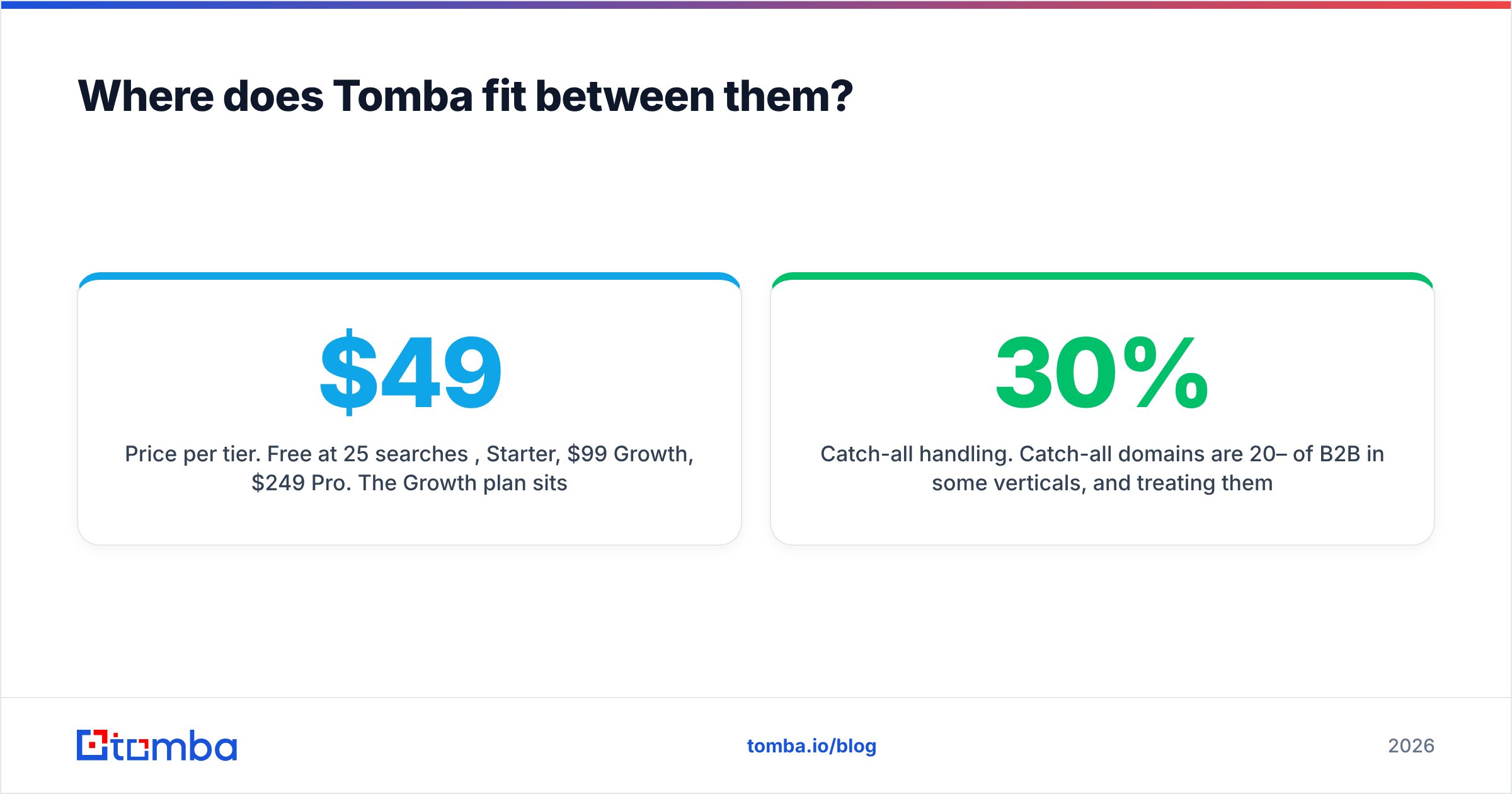
- Price per tier. Free at 25 searches/mo, $49 Starter, $99 Growth, $249 Pro. The Growth plan sits at a price point where most two-to-five-rep teams never need to escalate.
- Catch-all handling. Catch-all domains are 20–30% of B2B in some verticals, and treating them as unknown throws away real prospects. A dedicated catch-all check turns "maybe" into a decision.
- Automation surface. A REST email finder API, plus CLI and MCP access, means the signal feed can trigger enrichment without a human in the loop: new funding event → domain lands in your CRM → contacts get found and verified → sequence starts.
Prebuilt list vendors like BookYourData are a legitimate third path when you'd rather buy a filtered, ready-made list than build one from signals — different trade-off, same end goal of a clean send list.
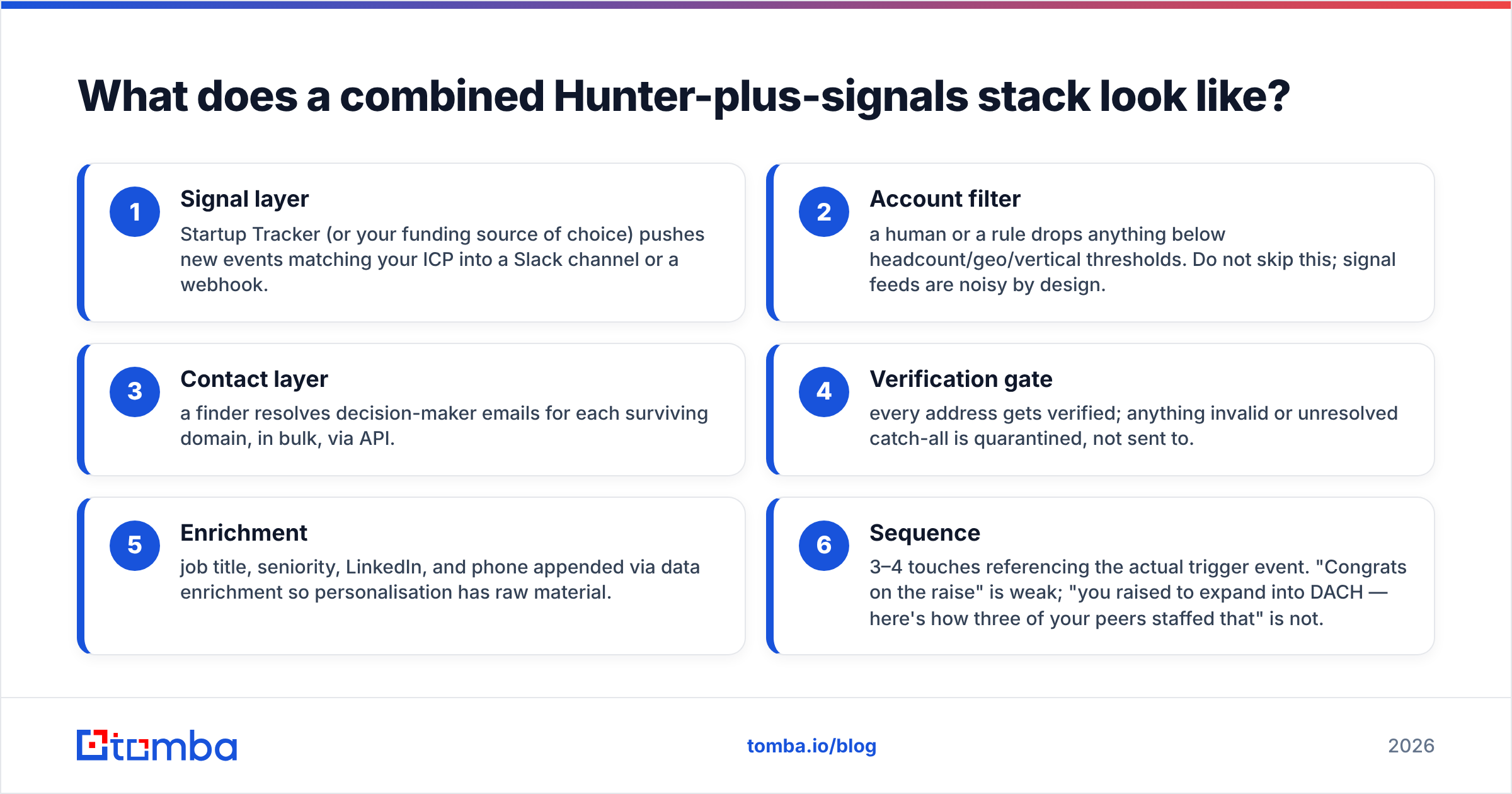
What does a combined Hunter-plus-signals stack look like?#
If you want the whole thing running in a week, this is the shape:
- Signal layer — Startup Tracker (or your funding source of choice) pushes new events matching your ICP into a Slack channel or a webhook.
- Account filter — a human or a rule drops anything below headcount/geo/vertical thresholds. Do not skip this; signal feeds are noisy by design.
- Contact layer — a finder resolves decision-maker emails for each surviving domain, in bulk, via API.
- Verification gate — every address gets verified; anything invalid or unresolved catch-all is quarantined, not sent to.
- Enrichment — job title, seniority, LinkedIn, and phone appended via data enrichment so personalisation has raw material.
- Sequence — 3–4 touches referencing the actual trigger event. "Congrats on the raise" is weak; "you raised to expand into DACH — here's how three of your peers staffed that" is not.
Cost check: signal feed plus a $99/mo finder plan runs most small teams under $200/month all-in. That's less than a single top-tier finder plan, and it covers both bottlenecks instead of one.
So which wins in 2026?#
Neither, alone. Hunter wins the contact-data half and loses the targeting half; Startup Tracker wins the targeting half and doesn't seriously contest the contact half. If you're forced to buy one, buy for your actual bottleneck: signals if your list is generic, a finder if your list is good but unreachable.
If your bottleneck is the finder — and for most teams comparing Hunter vs Startup Tracker it turns out to be — the deciding factor is cost per verified deliverable address at your volume, not the feature grid. Run a 500-row bake-off, count verified sends, divide by spend, and buy the winner.
Start with the Tomba Email Finder. The free tier gives you 25 searches a month — enough to run a real sample of your own list against it before you commit a dollar, and enough to see whether a $49 plan does what your $499 renewal quote claims to.
Related guides#
// get started
Find, verify and enrich your first contacts today
Start on the free plan with 25 searches a month, then scale when your team is ready.
Free plan · No credit card required · GDPR & CCPA
// about the author