Hunter vs Stirista: Which B2B Data Tool Fits Your Team?
Hunter finds work emails one domain at a time. Stirista sells audience data by the million. They solve different problems — here's which one your pipeline actually needs in 2026, and what each really costs.
Hunter vs Stirista is a fair question with an unfair answer: the two tools do not do the same job. One finds a single work email. The other sells a whole audience. Here is how to pick.
TL;DR
- Hunter is a self-serve email finder and verifier. Type a domain, get work emails, export a CSV. It starts free and scales to a few hundred dollars a month.
- Stirista is a data-and-identity company. You book a call, scope an audience, then buy records or ad activation. There is no free tier and no public price list.
- In a real Hunter vs Stirista bake-off, the two barely overlap. Hunter competes with tools like Tomba and Findymail. Stirista competes with audience-data and identity-graph vendors.
- Pick Hunter (or a cheaper email finder) if reps need contacts for named accounts today. Pick Stirista if you need big, filtered audiences for programmatic, CTV, or direct mail.
- Need verified work emails at volume, through an API, with no sales call? Then neither one is the default pick. That is where a self-serve provider like Tomba usually wins on cost per usable contact.
What are Hunter and Stirista, actually?#
Both companies sell B2B contact data. They sell it in very different shapes. That is why the Hunter vs Stirista search confuses so many buyers.
Hunter is a domain-first email finder. The loop is simple. Give it stripe.com. It returns the email pattern that company uses, plus the public addresses it has indexed. Each result carries a confidence score. Add a first and last name, and it builds and checks the most likely address.
Everything is self-serve. Sign up with a Google account and run searches in the browser. The same results come through the API, a Chrome extension, or a Google Sheets add-on. Hunter launched in 2015. It is one of the oldest names in the category, and one of the most reviewed on G2.
Stirista is a different animal. It is a San Antonio data company built around an identity graph. That graph ties an email address to a device, a household, a postal address, and a set of traits.
Stirista sells that in three ways: raw data licensing and appends, audience activation into ad platforms (display, CTV, social), and email deployment. Buyers are marketing and media teams. They build audiences of 50,000 to several million records. They are not SDRs looking up one CFO.
So here is the honest frame. Hunter is a precision tool. Stirista is a volume channel. It is a scalpel next to a delivery truck. Both move things. Only one fits in your pocket.
Hunter vs Stirista: how do they compare head-to-head?#
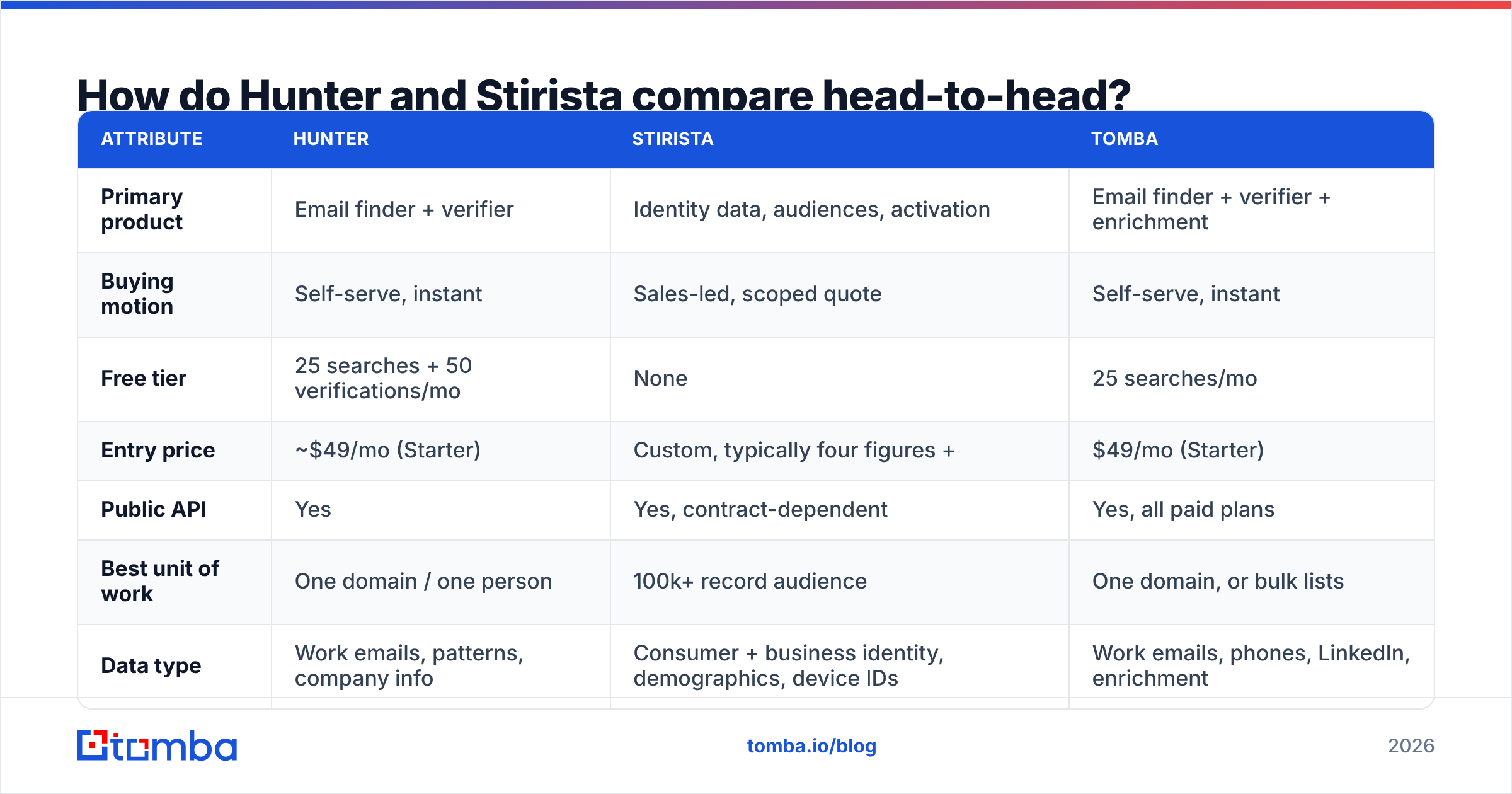
Here is the practical breakdown. A self-serve option sits in the third column, so you can see where the price floor really is.
| Product and buying | Hunter | Stirista | Tomba |
|---|---|---|---|
| Primary product | Email finder + verifier | Identity data, audiences, activation | Email finder + verifier + enrichment |
| Buying motion | Self-serve, instant | Sales-led, scoped quote | Self-serve, instant |
| Free tier | 25 searches + 50 verifications/mo | None | 25 searches/mo |
| Entry price | ~$49/mo (Starter) | Custom, typically four figures + | $49/mo (Starter) |
| Public API | Yes | Yes, contract-dependent | Yes, all paid plans |
| Contract | Monthly, cancel anytime | Annual or per-campaign | Monthly or annual |
| Data and fit | Hunter | Stirista | Tomba |
|---|---|---|---|
| Best unit of work | One domain / one person | 100k+ record audience | One domain, or bulk lists |
| Data type | Work emails, patterns, company info | Consumer + business identity, demographics, device IDs | Work emails, phones, LinkedIn, enrichment |
| Ad activation | No | Yes (programmatic, CTV, social) | No |
| Typical buyer | SDR, founder, growth marketer | Media buyer, demand gen lead, agency | SDR, RevOps, developer |
Two things jump out. First, the buying motion gap is the real decision point. If you cannot stomach a discovery call and a two-week scoping cycle, Stirista is off the table. Data quality will not change that. Second, ad activation is Stirista's real moat. Hunter cannot push an audience into a CTV buy. If you need that, no email finder can stand in.
Which one fits your use case?#
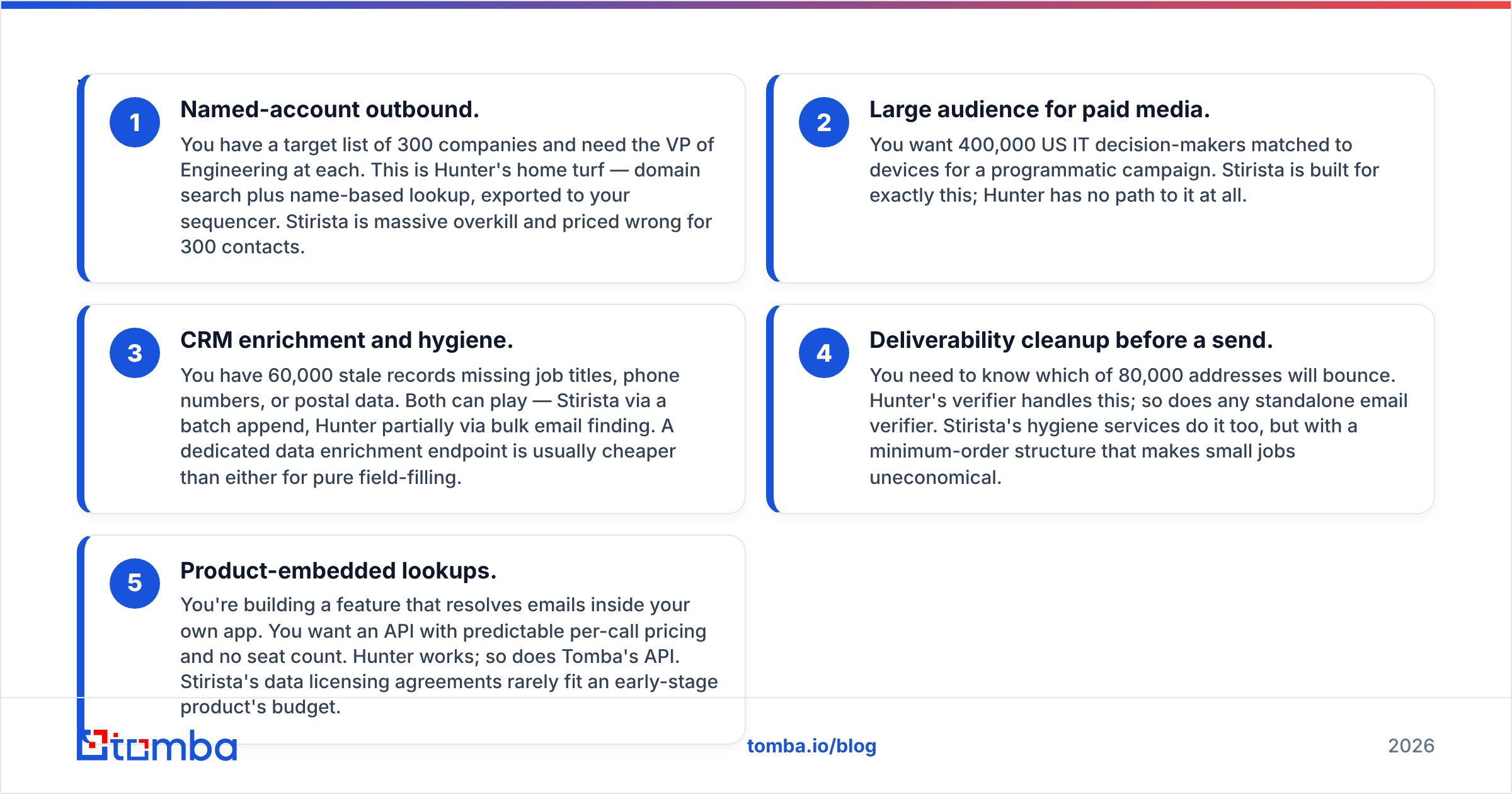
Match the tool to the job, not to the review score. Five common cases:
- Named-account outbound. You have 300 target companies. You need the VP of Engineering at each one. This is Hunter's home turf: domain search plus a name lookup, exported to your sequencer. Stirista is overkill here, and priced wrong for 300 contacts.
- A large audience for paid media. You want 400,000 US IT decision-makers matched to devices for a programmatic campaign. Stirista is built for this. Hunter has no path to it at all.
- CRM enrichment and hygiene. You have 60,000 stale records with no job titles, phones, or postal data. Both can play. Stirista does a batch append. Hunter helps through bulk email finding. For pure field-filling, a data enrichment endpoint is usually cheaper than either.
- Cleanup before a send. You need to know which of 80,000 addresses will bounce. Hunter's verifier handles it. So does any standalone email verifier. Stirista offers hygiene too, but minimum orders make small jobs a bad deal.
- Product-embedded lookups. You are building a feature that resolves emails inside your own app. You want an API with clear per-call pricing and no seat count. Hunter works. So does Tomba's API. Stirista's licensing rarely fits an early product's budget.
The pattern is simple. Under about 50,000 records, at person level? That is email-finder work. Above it, at audience level? That is data-vendor work. Most teams searching Hunter vs Stirista sit in the first bucket. They just do not know the second one exists for a reason.
Hunter vs Stirista pricing: what does each one cost in 2026?#
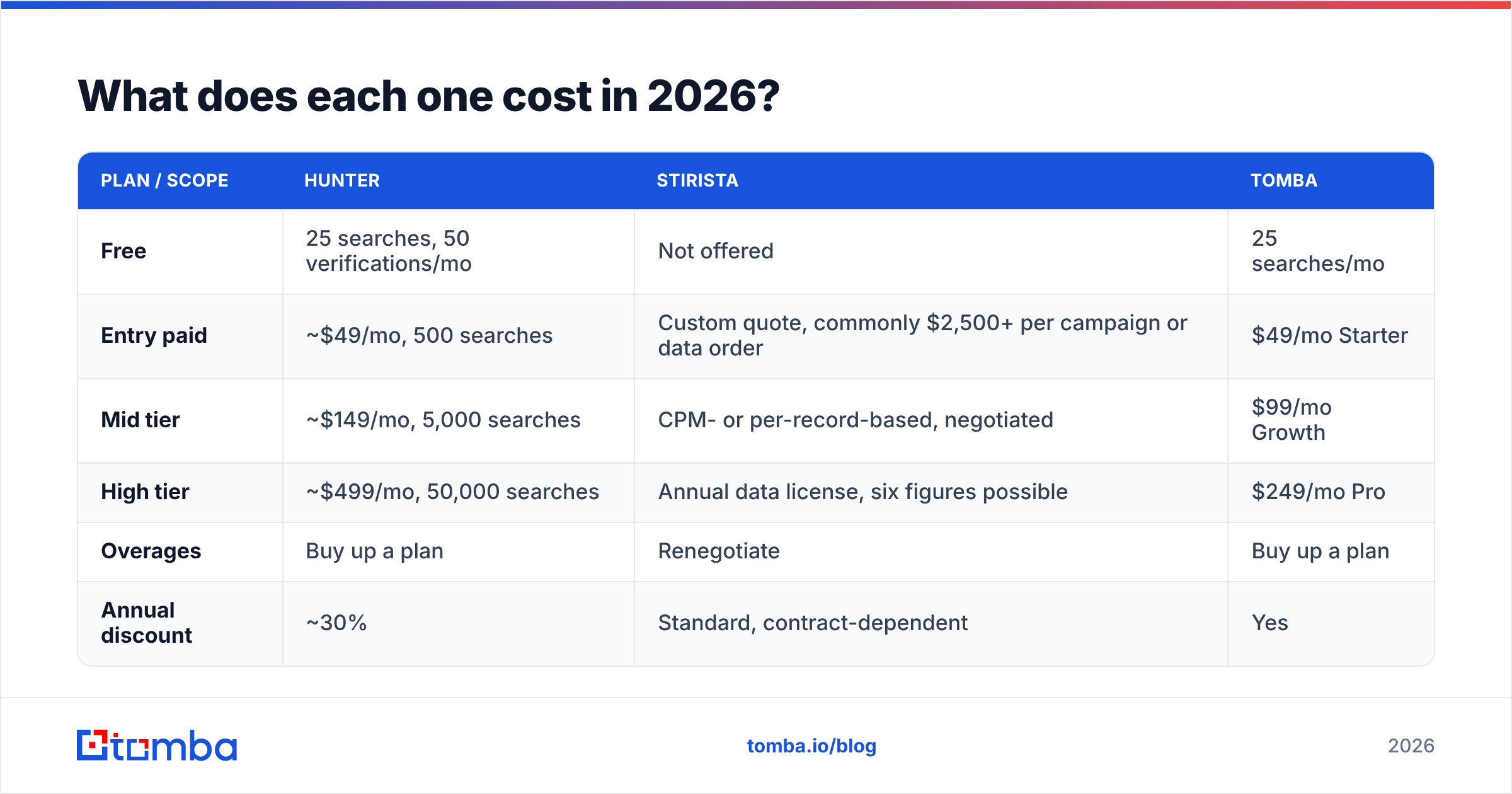
Hunter publishes prices. Stirista does not. That gap is itself a decision input.
| Plan / scope | Hunter | Stirista | Tomba |
|---|---|---|---|
| Free | 25 searches, 50 verifications/mo | Not offered | 25 searches/mo |
| Entry paid | ~$49/mo, 500 searches | Custom quote, commonly $2,500+ per campaign or data order | $49/mo Starter |
| Mid tier | ~$149/mo, 5,000 searches | CPM- or per-record-based, negotiated | $99/mo Growth |
| High tier | ~$499/mo, 50,000 searches | Annual data license, six figures possible | $249/mo Pro |
| Overages | Buy up a plan | Renegotiate | Buy up a plan |
| Annual discount | ~30% | Standard, contract-dependent | Yes |
Hunter's tiers change now and then. Treat those numbers as directional and check their site. Stirista's numbers swing with data type, geography, and whether you license or rent the audience. Any single figure would mislead you. Still, the floor sits well above a $49 SaaS plan, and there is almost always a minimum order.
Here is a useful sanity check. Divide total spend by usable contacts, not by records delivered. A $3,000 audience order might land 340,000 impressions and 12 replies. A $99 month might give your SDRs 2,000 verified addresses they actually email. Those are different products. Compare against Tomba pricing for a public reference at the self-serve end of the market.
How accurate is the data on each side?#
Accuracy means two things here. Mixing them up is how teams end up unhappy.
For Hunter, accuracy means one address lands. Every result carries a confidence score. That score reflects how many public sources confirm the pattern, whether the MX record resolves, and whether the mail server accepts the recipient. High-confidence Hunter results rarely bounce. Low-confidence guesses on catch-all domains bounce a lot.
That last part is true across the category. Catch-all domains accept every address at the mail-server layer. So no finder can prove an address exists without extra signals. If catch-alls are a big share of your ICP, use a dedicated catch-all verifier instead of trusting one score.
For Stirista, accuracy means the traits are right across a crowd. Does the segment really contain IT managers at 500+ employee companies? Is the income band right? Is the device graph fresh? You test that with a match-rate check and a sample audit. One bounced email tells you nothing.
Ask any audience vendor for a match-back report and a sample file before you sign. A 60% match rate versus a 30% one quietly doubles what you pay per thousand.
The failure mode is buying the wrong kind of accuracy. Teams buy an audience file, load it into a cold email tool, and get hit with bounces and spam complaints. Bulk audience data is licensed for ads and permissioned sends. It is not licensed for one-to-one cold outreach from your own domain. Read the license terms. This is where B2B, opt-in vendors like BookYourData or a per-record email finder are the safer instrument. They are built around addresses you are meant to email directly.
What are the hidden costs on each side?#
Hunter's hidden costs come down to credit math. A search that returns nothing still counts in many workflows. Verifications are metered apart from finds. And the jump between tiers is steep: going from 500 to 5,000 monthly searches triples your bill, even if you only needed 900.
Teams often overbuy a tier for two weeks of a quarter. Seat rules matter too on bigger plans. Check whether every rep needs a login, or whether they can share one pool of credits through the bulk email finder.
Stirista's hidden costs are structural. Scoping and onboarding take time your campaign calendar may not have. Minimum orders mean a small test costs nearly as much as a real launch. Licensed data usually has time windows and channel limits. Use it outside those terms and you have a contract problem, not just a technical one. Measuring lift on an audience buy also takes analyst time most small teams do not have.
One more cost never shows up on a quote: the wait between "we need contacts" and "reps are sending." With a self-serve finder, that is under an hour. With a data vendor, it is two to six weeks from first call to delivered file. For a team testing a new segment, that gap decides the quarter.
Is there a better middle option?#
Often, yes. Most Hunter vs Stirista shoppers are really asking one thing: how do I get accurate work emails at a price I can predict?
That question has many answers. Hunter is the incumbent. Tomba covers the same job with a public API, a CLI, browser extensions, and a $49/mo entry tier. Finding, verification, and enrichment all draw from one balance there, not three metered pools.
Findymail and Prospeo compete on cost per lead. BookYourData sells verified B2B contacts by the record, with an accuracy guarantee. That is a different model, and a useful one if you would rather buy a clean list than run lookups yourself. Apollo bundles finding with a sequencer if you want one vendor for both.
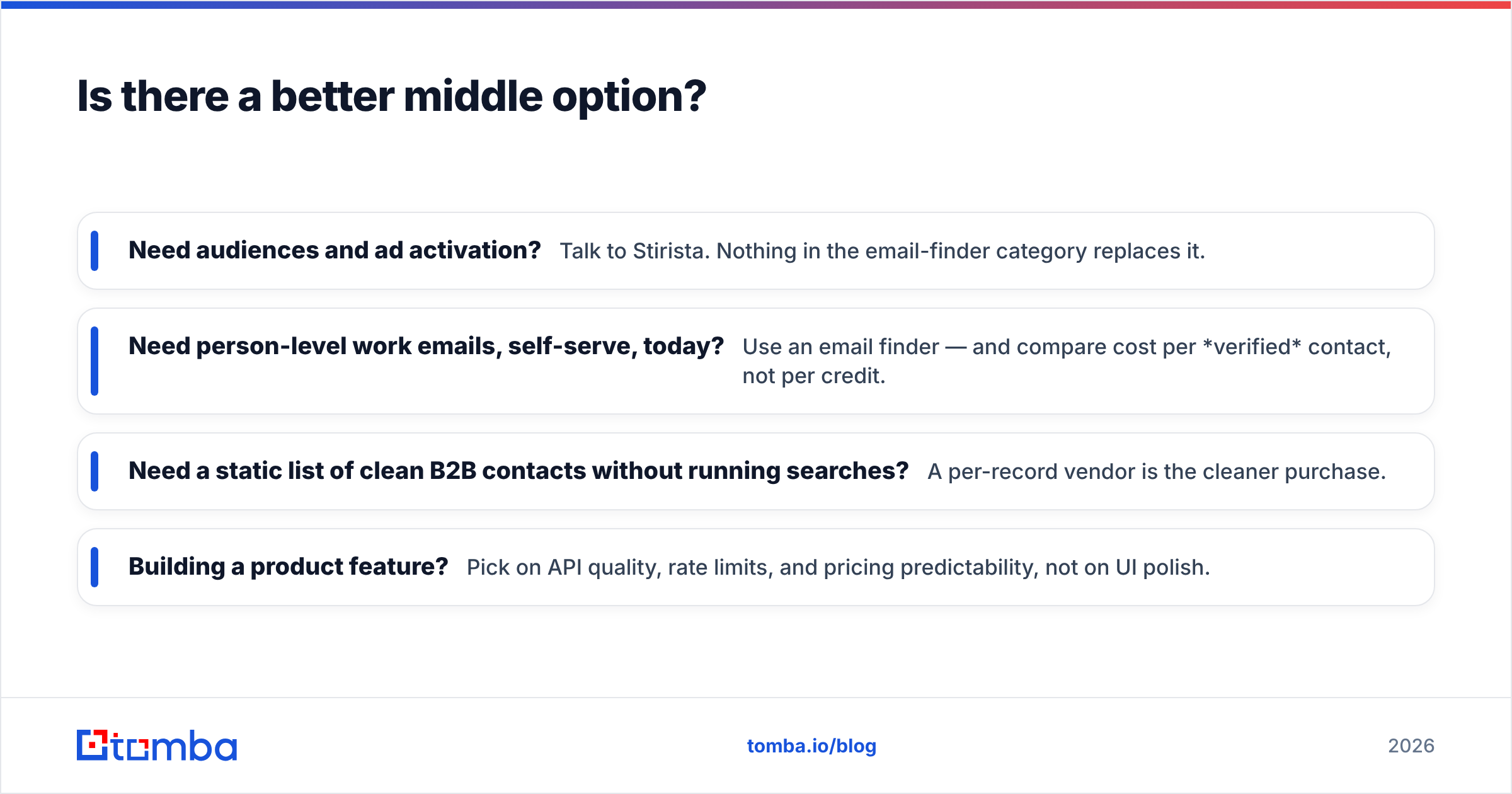
The decision tree is short:
- Need audiences and ad activation? Talk to Stirista. Nothing in the email-finder category replaces it.
- Need person-level work emails today, self-serve? Use an email finder. Compare cost per verified contact, not per credit.
- Need a clean static list, with no searching? A per-record vendor is the simpler buy.
- Building a product feature? Pick on API quality, rate limits, and clear pricing. Not on UI polish.
Verdict: Hunter vs Stirista?#
For nine out of ten teams reading this, the answer is Hunter — or a tool like it. The real need is person-level emails for named accounts. That is a self-serve problem, not a procurement problem. Stirista wins in the narrower case: large, filtered audiences pushed into paid channels. If that is your motion, make the call. It is not a worse tool. It is a different one.
The Hunter vs Stirista debate gets interesting inside the email-finder half. Hunter's brand is strong. But its credit tiers are coarse, and verification is metered apart from search. If you are shopping the category anyway, run the same 200-domain test list through two or three providers. Measure three numbers: hit rate, bounce rate on the addresses returned, and total cost to reach 200 usable contacts. The biggest logo rarely wins.
Start that test with the Tomba Email Finder. The free tier gives you 25 searches a month with no card. Finding and verification draw from the same balance. Every paid plan from $49/mo includes full API access, so you can benchmark at scale before you commit to anyone.
Related guides#
Ready to find emails that actually work?
Join 150,000+ professionals who stopped guessing and started sending. Free credits on signup — no credit card required.
Get the Tomba newsletter
Practical outbound tactics and product updates — once every two weeks.
About the author