Hunter vs Vitamail: Which Email Finder Wins in 2026?
Hunter is the default choice most teams inherit. Vitamail is the newer challenger built around waterfall enrichment. Here is how the two actually differ on coverage, catch-all handling, and real cost per verified email in 2026.
Hunter vs Vitamail comes down to one question: do you want a database to search, or a pipeline to feed names into? Everything else follows from that. Here is the short version first.
TL;DR
- Hunter is the safe, mature default. Huge domain index, clear confidence scores, a real API. Pricing jumps hard from $49/mo to $149/mo once you outgrow the entry tier.
- Vitamail is the leaner challenger. It runs waterfall-style enrichment on credit-based pricing, which suits low-volume users who want to pay for what they use.
- Neither tool wins on raw "accuracy." They win on coverage of your specific ICP. A 100-contact spot check on your own list beats every vendor benchmark, including this one.
- The number that matters is cost per verified, deliverable email. Not list price. Not credits. Not database size.
- Need domain-wide discovery plus catch-all handling on a $49/mo budget? Tomba sits between the two on price and ahead of both on catch-all resolution.
Hunter vs Vitamail: what is each tool, exactly?#
They solve the same job with different philosophies.
Hunter has been in the market since 2015, and most SDRs have used it at least once. Its core asset is a crawled index of public web pages mapped to company domains. You give it stripe.com, and it returns the people it has seen at that domain, the detected email pattern ({first}@stripe.com), a confidence score per address, and the public sources for each one.
Around that core it has added a verifier, a Chrome extension, a Google Sheets add-on, a light campaign sender, and a well-documented API.
Vitamail is the newer entrant, and it is built for a different buyer. Instead of "here is our index, search it," the pitch is "give us a name and a domain, and we will run it through several resolution methods until one verifies." That is the waterfall model, the same idea behind Findymail or BetterContact. It also changes the economics: you pay per successful find rather than per seat, and coverage on hard domains beats what a single-source index can manage.
The Hunter vs Vitamail split drives almost everything below. Hunter is a database you query. Vitamail is a resolution pipeline you feed.
Verify vendor pricing before you buy. Both companies have changed plan structures more than once. The figures below reflect published pricing at the time of writing; check hunter.io and vitamail.io directly before committing budget.
How do Hunter and Vitamail compare feature by feature?#
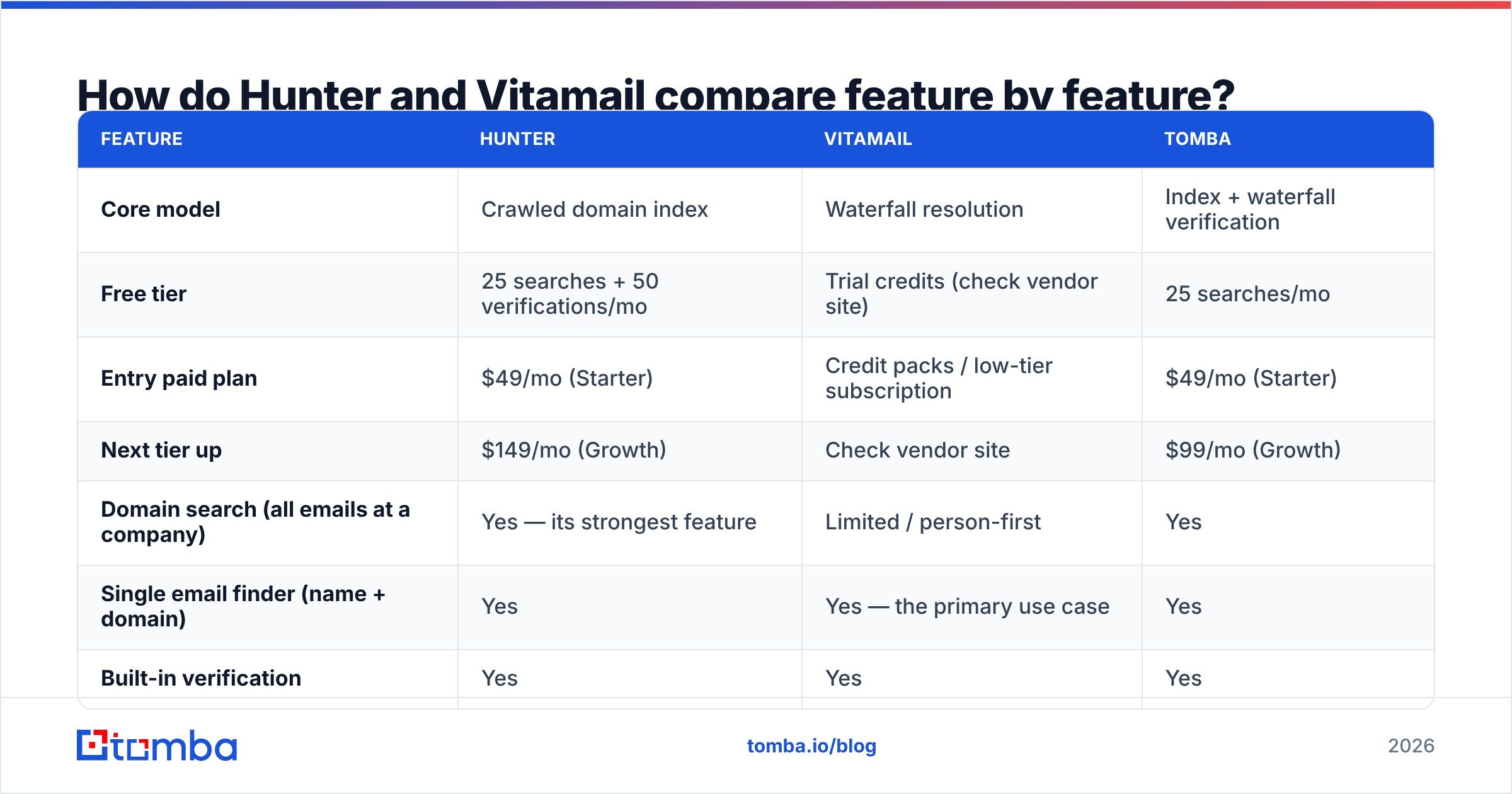
| Feature | Hunter | Vitamail | Tomba |
|---|---|---|---|
| Core model | Crawled domain index | Waterfall resolution | Index + waterfall verification |
| Free tier | 25 searches + 50 verifications/mo | Trial credits (check vendor site) | 25 searches/mo |
| Entry paid plan | $49/mo (Starter) | Credit packs / low-tier subscription | $49/mo (Starter) |
| Next tier up | $149/mo (Growth) | Check vendor site | $99/mo (Growth) |
| Domain search (all emails at a company) | Yes — its strongest feature | Limited / person-first | Yes |
| Single email finder (name + domain) | Yes | Yes — the primary use case | Yes |
| Built-in verification | Yes | Yes | Yes |
| Catch-all resolution | Flagged, not resolved | Partial | Dedicated catch-all verifier |
| Phone numbers | No | Varies by plan | Yes |
| Confidence score shown | Yes, percentage per result | Yes | Yes |
| Public API | Yes, mature | Yes | Yes |
| Chrome extension | Yes | Yes | Yes |
| Sends cold email campaigns | Yes (basic) | No | No |
| Best for | Account-based domain sweeps | One-off person lookups | Mixed workflows on a budget |
The table exposes the real trade-off. Hunter is broader: discovery, finding, verification, and a basic sender in one subscription. Vitamail is narrower and deeper. It does person-to-email resolution, and it wants to do that one thing well.
Broad is not automatically better. Plenty of teams pay Hunter's Growth tier and use two of its seven features.

Which one is more accurate?#
Neither vendor's published accuracy number should change your decision. Here is why: accuracy is measured against the vendor's own test set, and every test set leans toward domains that vendor already covers well.

What actually varies between tools is coverage by segment, and it varies wildly:
- Large US tech companies (500+ employees). Almost every tool covers these. Hunter, Vitamail, Apollo, Tomba — you will see 80-95% hit rates and near-identical results. This segment tells you nothing.
- Sub-50-person startups. Index-based tools degrade here, because there are fewer public pages to crawl. Waterfall tools like Vitamail usually pull ahead.
- Non-English European and LATAM domains. Coverage drops for everyone, but unevenly. Test this yourself if it is your market.
- Catch-all domains. This is where the spread is enormous — see the next section.
- Enterprise with strict SMTP policies. Verification results get unreliable across the board. Confidence scores matter more than binary valid/invalid flags here.
The honest framing: Hunter wins on discovery breadth (everyone at this company). Vitamail wins on targeted resolution (this one person, whatever it takes). If your motion is account-based and you want a full org map, that favors Hunter's domain search workflow. If you already have names from LinkedIn Sales Navigator and just need addresses, that favors Vitamail.
What do they actually cost per verified email?#
List price is the wrong unit. Do the arithmetic on cost per usable address instead.
Take a realistic scenario: you need 2,000 verified contacts a month.
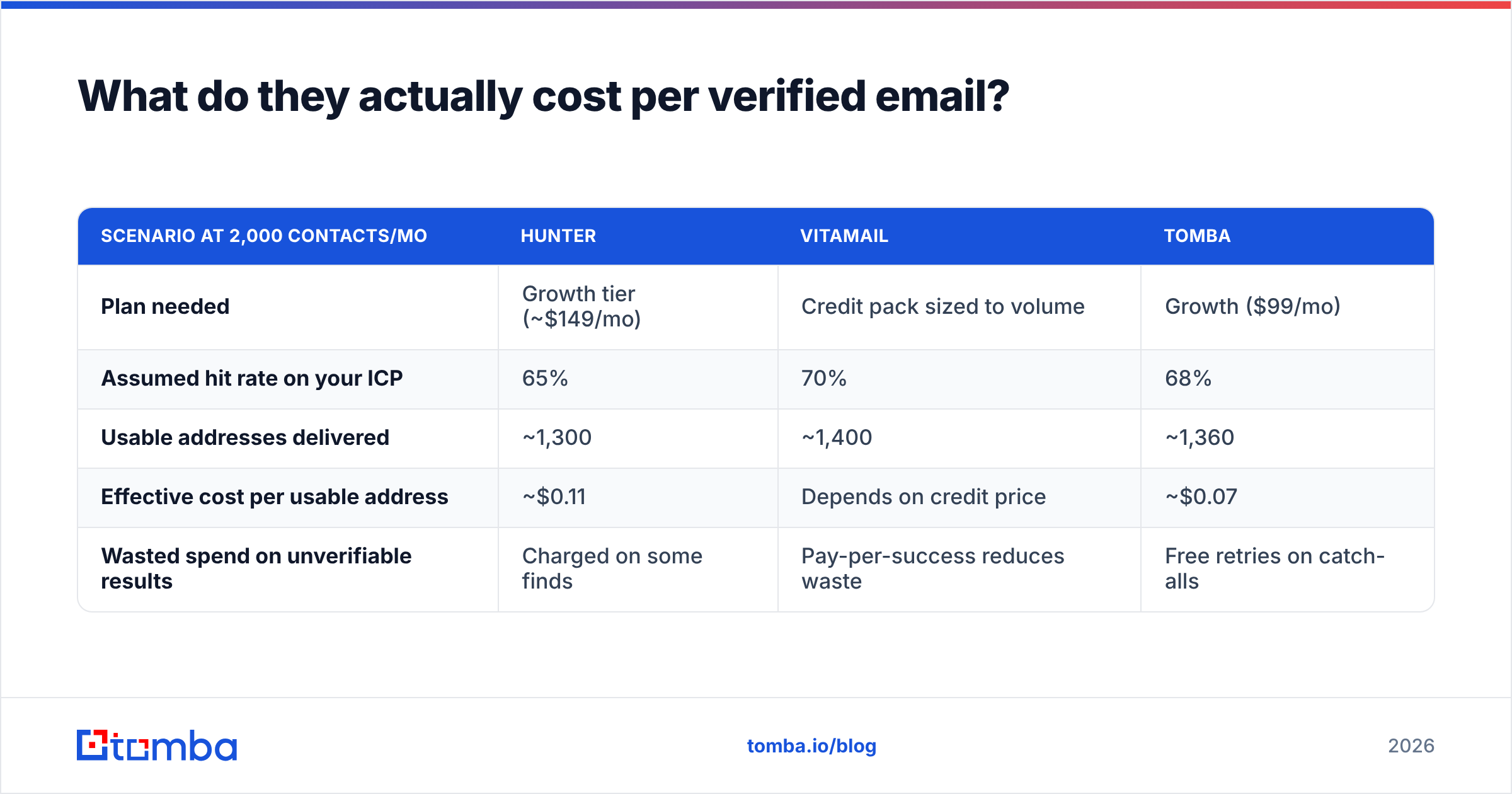
| Scenario at 2,000 contacts/mo | Hunter | Vitamail | Tomba |
|---|---|---|---|
| Plan needed | Growth tier (~$149/mo) | Credit pack sized to volume | Growth ($99/mo) |
| Assumed hit rate on your ICP | 65% | 70% | 68% |
| Usable addresses delivered | ~1,300 | ~1,400 | ~1,360 |
| Effective cost per usable address | ~$0.11 | Depends on credit price | ~$0.07 |
| Wasted spend on unverifiable results | Charged on some finds | Pay-per-success reduces waste | Free retries on catch-alls |
Two things fall out of this.
First, pay-per-success pricing is genuinely better for spiky usage. If you prospect in bursts — a campaign one month, nothing the next — a credit model beats a subscription every time. That is Vitamail's structural advantage, and it is real.
Second, subscription pricing wins on steady, high volume. If you pull 2,000+ contacts every month, a flat plan amortizes better than credits. That is Hunter's structural advantage, right up until the $49 → $149 jump. There is no middle tier. You are either under 500 searches or paying triple.
That gap is why the middle of this market got crowded. Tomba's pricing fills it deliberately: Free (25 searches), Starter $49, Growth $99, Pro $249. The $99 tier exists for teams who have outgrown a starter plan but cannot justify $149.

What about catch-all domains?#
This is the section most comparison posts skip, and it is the one that decides your bounce rate.
A catch-all domain accepts mail sent to any address at that domain. definitely-not-real@company.com returns the same SMTP response as the CEO's real inbox. Roughly a fifth to a quarter of B2B domains are set up this way, and the share is higher in enterprise.
Standard verification cannot resolve these. Most tools do one of two things:
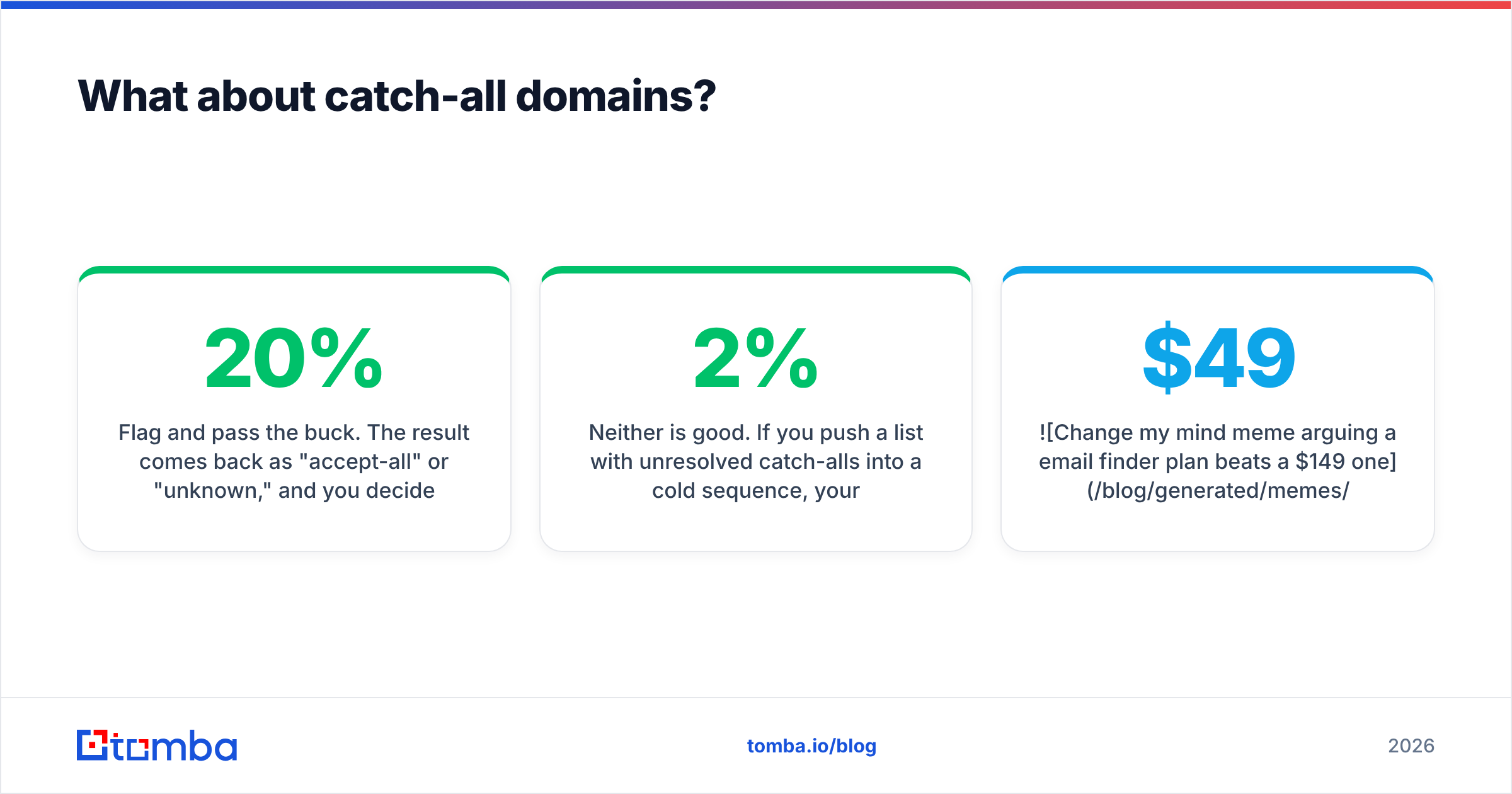
- Flag and pass the buck. The result comes back as "accept-all" or "unknown," and you decide whether to risk it. Hunter takes this approach. It is honest, but it leaves 20% of your list in limbo.
- Guess optimistically. Mark it valid, let you send, let you eat the bounce. This is how sender reputations die.
Neither is good. Push a list with unresolved catch-alls into a cold sequence and your bounce rate climbs. Once you cross roughly 2% bounces, mailbox providers start throttling you. Google and Microsoft both tightened bulk-sender rules in the last two years, and email deliverability damage compounds. A bad month affects the next three.
The workable third path is a dedicated resolution layer. It uses pattern confidence, cross-source corroboration, and past engagement signals instead of a single SMTP handshake. Tomba's catch-all verifier is built for exactly this, and it is the clearest functional gap between it and both tools here. If many of your target accounts run catch-all domains — common in finance, healthcare, and large enterprise — this one feature outweighs most of the feature-table differences above.

Which tool fits which team?#
Match the tool to the motion, not to the review score.
- Account-based sales mapping whole orgs — Hunter. Domain search is its best feature, and nothing in Vitamail replaces it. One query gives you the pattern and the roster.
- SDRs working from a Sales Navigator list — Vitamail. You have the names already. You need resolution, not discovery.
- Recruiters chasing hard-to-find people — Vitamail, with a LinkedIn finder as a second pass. Waterfall models handle the long tail better.
- Agencies running campaigns for several clients — Tomba or Hunter. A bulk email finder and predictable monthly cost beat per-lookup elegance.
- Engineers building enrichment into a product — compare API docs first. Tomba's email finder API covers finding, verification, and enrichment under one key. Test rate limits at your real concurrency.
- Solo founders under 25 lookups a month — the free tiers. Hunter gives 25 searches plus 50 verifications; Tomba gives 25 searches.
How should you run your own 100-lead test?#
Thirty minutes of testing beats thirty comparison articles. Here is the protocol:
Step 1 — Build a representative sample. Pull 100 real prospects from your actual ICP. Not 100 well-known companies. Mix company sizes, geographies, and seniority the way your real pipeline does. Include at least 15 companies you suspect run catch-all domains.
Step 2 — Run the same list through each tool. Use free tiers or trials. Export raw results, including confidence scores and status flags. Do not clean anything yet.
Step 3 — Score three columns, not one. Record hit rate (did it return an address), verification status (valid / catch-all / invalid / unknown), and confidence. A tool that returns 90 addresses with 40 marked "unknown" is worse than one returning 70 with 68 confirmed.
Step 4 — Send a small real test. Take 30 verified addresses per tool and send a genuine, low-volume sequence from a warmed domain. Measure the actual bounce rate. This is the only number that cannot be gamed. Check your sender reputation before and after, so you can attribute any movement.
Step 5 — Divide cost by confirmed deliveries. Not by credits, not by API calls. By emails that landed. Now you have a comparable number.
Run this and you will often find the "worse" tool on paper is cheaper per landed email on your list. Peer reviews on G2 are useful for spotting support and billing complaints, but they say nothing about coverage of your accounts.
So which one should you buy?#
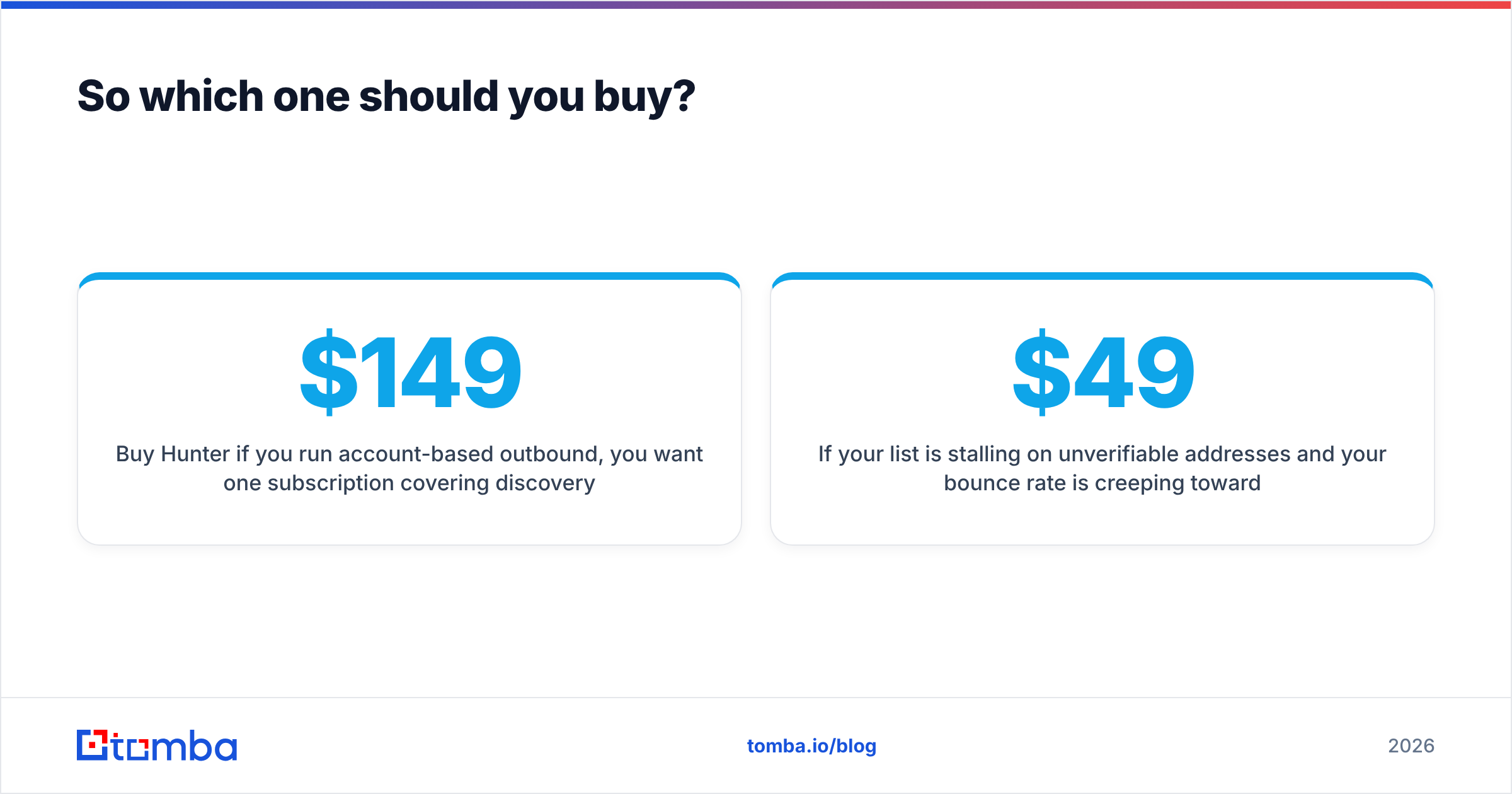
Buy Hunter if you run account-based outbound, you want one subscription covering discovery through sending, and the $149 Growth tier fits your budget. It is the most mature product here, and its confidence scoring is transparent. You always know why it thinks an address is right.
Buy Vitamail if your volume is spiky, you already have names, and you would rather pay per successful find than carry a subscription through slow months. The waterfall approach earns its keep on small companies and hard domains.
Look at a third option if you need domain-wide discovery and catch-all resolution on a mid-market budget. That combination is where both tools have a gap. Hunter flags catch-alls without resolving them. Vitamail is person-first rather than domain-first.
That is the honest Hunter vs Vitamail read. Not every comparison ends in a knockout, and this one does not. The tools are built for different motions, and each does its own motion well.
If your list is stalling on unverifiable addresses and your bounce rate is creeping toward the danger zone, start with the piece that fixes the bleeding. Run your next 25 lookups free through the Tomba Email Finder, push the results through the email verifier, and compare the confirmed-deliverable count against whatever you pay for today. If the number is better, Starter is $49/mo and Growth is $99, with no $149 cliff in between. If it is not better, you lost half an hour and now know which tool to renew.
Related guides#
// get started
Find, verify and enrich your first contacts today
Start on the free plan with 25 searches a month, then scale when your team is ready.
Free plan · No credit card required · GDPR & CCPA
// about the author