Hunter vs Vocus.io (2026): Which Email Tool Actually Wins?
Hunter finds and verifies emails at scale. Vocus.io automates Gmail outreach. They get compared constantly, but they solve different halves of the same problem — here is which one you actually need in 2026.
TL;DR
- They are not the same category. Hunter is a data platform — domain search, email finder, verifier, plus a light campaign tool. Vocus.io is a Gmail/Google Workspace extension — mail merge, tracking, follow-ups, scheduling, CRM sync.
- Pick Hunter if your bottleneck is getting valid addresses for people you have never contacted.
- Pick Vocus.io if your bottleneck is sending and following up from your own inbox without paying for a full sequencer.
- Most teams need both halves, which is why the honest comparison is "Hunter + a sender" vs "Vocus.io + a data source."
- Cost shape differs wildly: Hunter charges per credit and scales into the hundreds per month; Vocus.io charges roughly $5–$20 per user per month. Comparing headline prices without normalising for volume is meaningless.
What are Hunter and Vocus.io, actually?#
Think of cold outreach like running a restaurant. Hunter is the supplier who delivers verified ingredients to your back door. Vocus.io is the kitchen line that plates and serves them. Confusing the two is why so many "Hunter vs Vocus.io" threads go nowhere — people are arguing about a truck versus a stove.
Here is the practical breakdown:
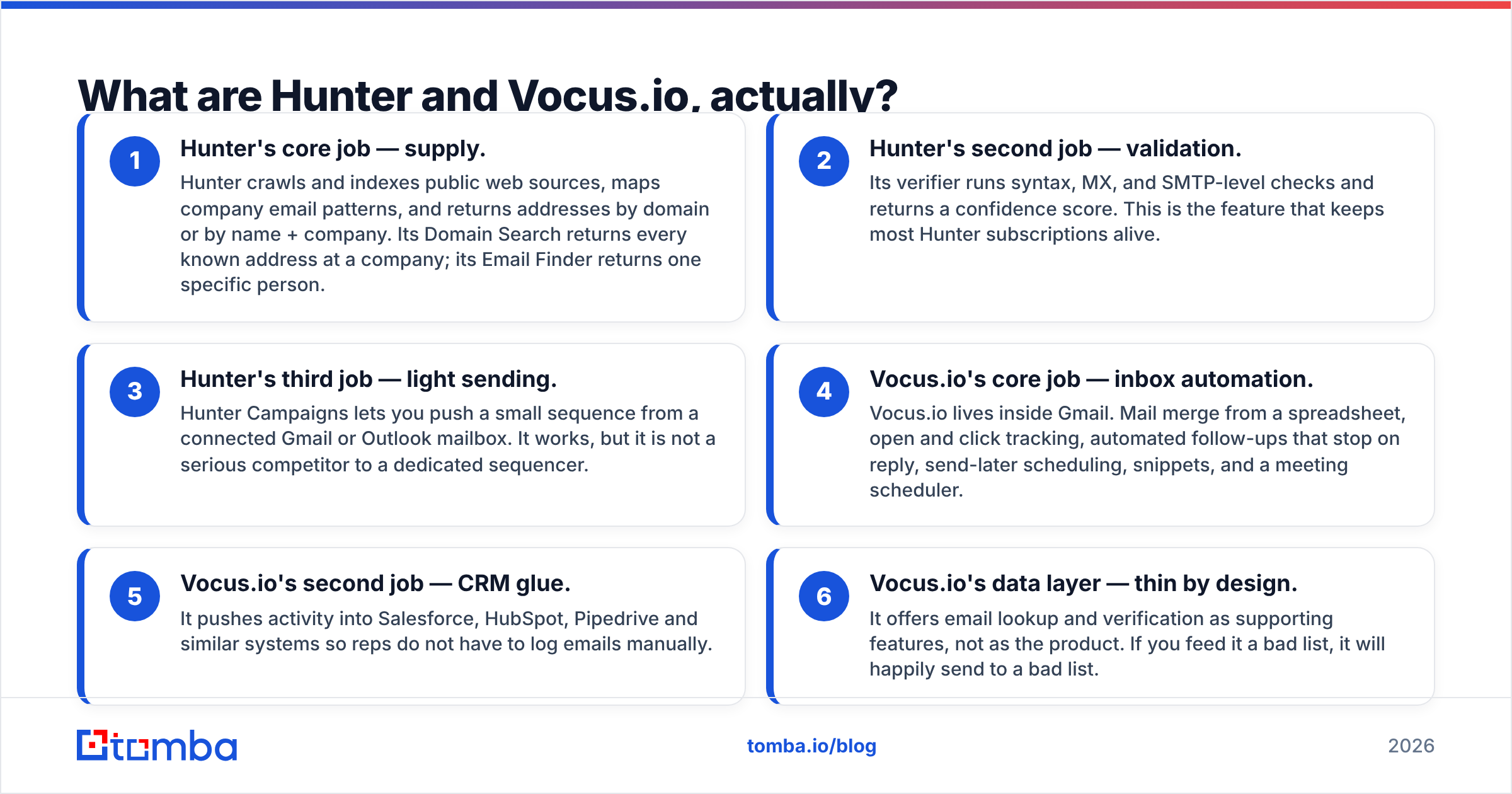
- Hunter's core job — supply. Hunter crawls and indexes public web sources, maps company email patterns, and returns addresses by domain or by name + company. Its Domain Search returns every known address at a company; its Email Finder returns one specific person.
- Hunter's second job — validation. Its verifier runs syntax, MX, and SMTP-level checks and returns a confidence score. This is the feature that keeps most Hunter subscriptions alive.
- Hunter's third job — light sending. Hunter Campaigns lets you push a small sequence from a connected Gmail or Outlook mailbox. It works, but it is not a serious competitor to a dedicated sequencer.
- Vocus.io's core job — inbox automation. Vocus.io lives inside Gmail. Mail merge from a spreadsheet, open and click tracking, automated follow-ups that stop on reply, send-later scheduling, snippets, and a meeting scheduler.
- Vocus.io's second job — CRM glue. It pushes activity into Salesforce, HubSpot, Pipedrive and similar systems so reps do not have to log emails manually.
- Vocus.io's data layer — thin by design. It offers email lookup and verification as supporting features, not as the product. If you feed it a bad list, it will happily send to a bad list.
That last point is the crux of the whole comparison. Vocus.io is an excellent execution layer sitting on top of whatever data you give it. Hunter is a data layer that happens to include a sending feature.

How do Hunter and Vocus.io compare feature by feature?#
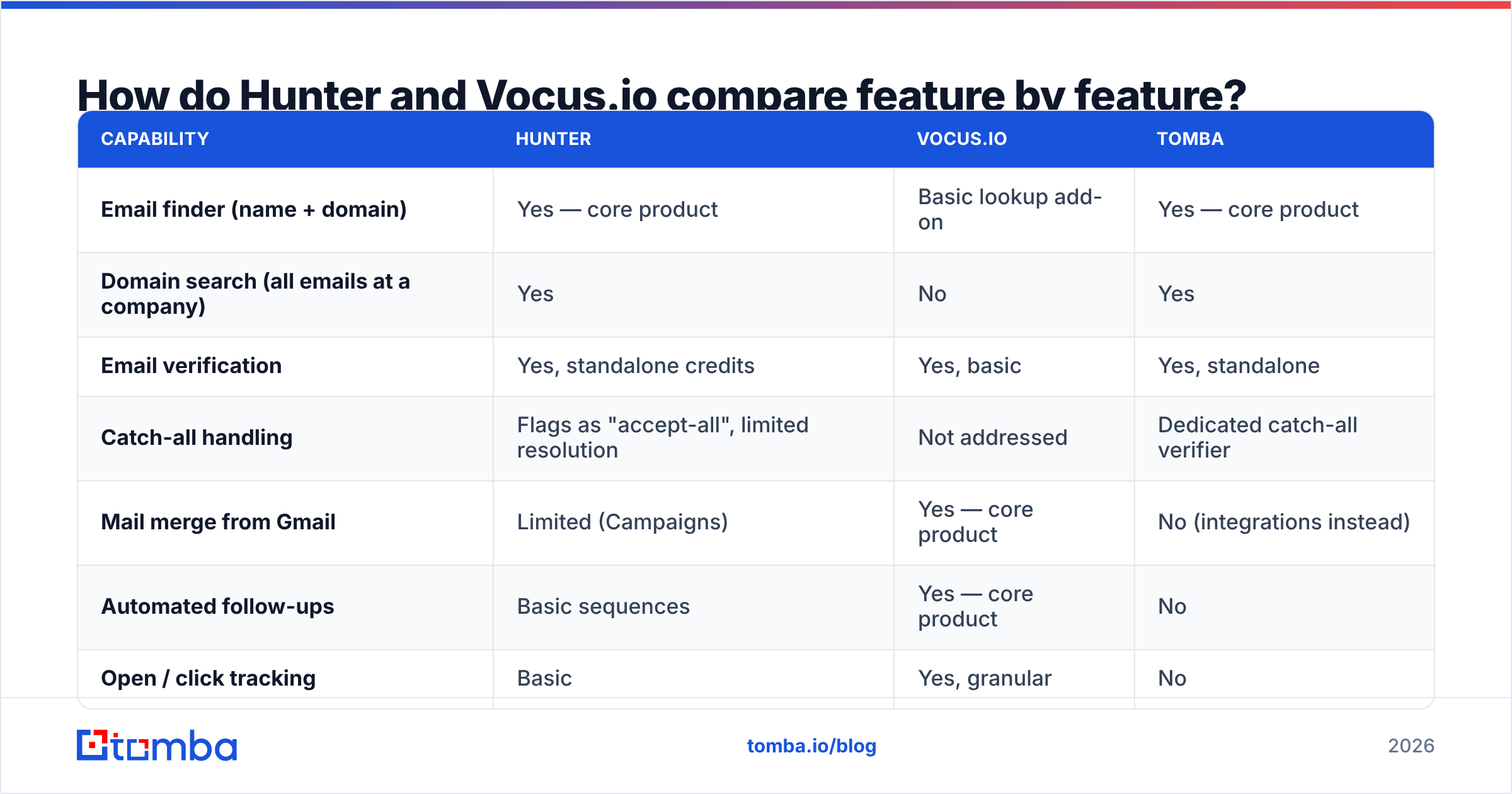
| Capability | Hunter | Vocus.io | Tomba |
|---|---|---|---|
| Email finder (name + domain) | Yes — core product | Basic lookup add-on | Yes — core product |
| Domain search (all emails at a company) | Yes | No | Yes |
| Email verification | Yes, standalone credits | Yes, basic | Yes, standalone |
| Catch-all handling | Flags as "accept-all", limited resolution | Not addressed | Dedicated catch-all verifier |
| Mail merge from Gmail | Limited (Campaigns) | Yes — core product | No (integrations instead) |
| Automated follow-ups | Basic sequences | Yes — core product | No |
| Open / click tracking | Basic | Yes, granular | No |
| Meeting scheduler | No | Yes | No |
| CRM activity sync | Via integrations | Native, deep | Via integrations |
| Phone numbers | No | No | Yes |
| Public API | Yes | Limited | Yes |
| Bulk CSV processing | Yes | Import for merge only | Yes |

Read that table as two vertical stripes rather than a row-by-row scorecard. The top third belongs to Hunter and Tomba. The middle third belongs to Vocus.io. There is barely any overlap — and where there is overlap, both sides are running a weaker version of the other's specialty.
Which one finds more valid emails?#
Hunter wins this outright, and it is not close. Vocus.io's lookup is a convenience feature for the address you happen to be missing on a contact record. Hunter's index exists to answer that question at volume.
The more useful question is how Hunter's data holds up against other dedicated finders, because that is your real decision if data quality is the bottleneck.

Three things determine whether a finder is actually accurate, and vendor marketing usually only mentions the first:
- Hit rate — what percentage of your input list returns any address. High hit rates are easy to fake by returning pattern guesses.
- Deliverable rate — of the addresses returned, how many actually accept mail. This is the only number that protects your sender reputation.
- Catch-all behaviour — roughly a quarter of B2B domains accept everything at the SMTP layer. A finder that returns "accept-all" and shrugs has handed you an unqualified guess. A finder with a real catch-all verifier tries to resolve it.
Hunter is conservative and transparent: it gives you a confidence score and tells you when a domain is accept-all. That honesty is worth paying for, but it also means a meaningful slice of your results arrive as "we are not sure." Tomba's email verifier and catch-all tooling exist specifically to shrink that grey zone, which matters when your list is heavy on small companies and self-hosted mail servers.
Vocus.io does not seriously compete on any of these three dimensions, and to its credit does not claim to.
What does each one actually cost?#
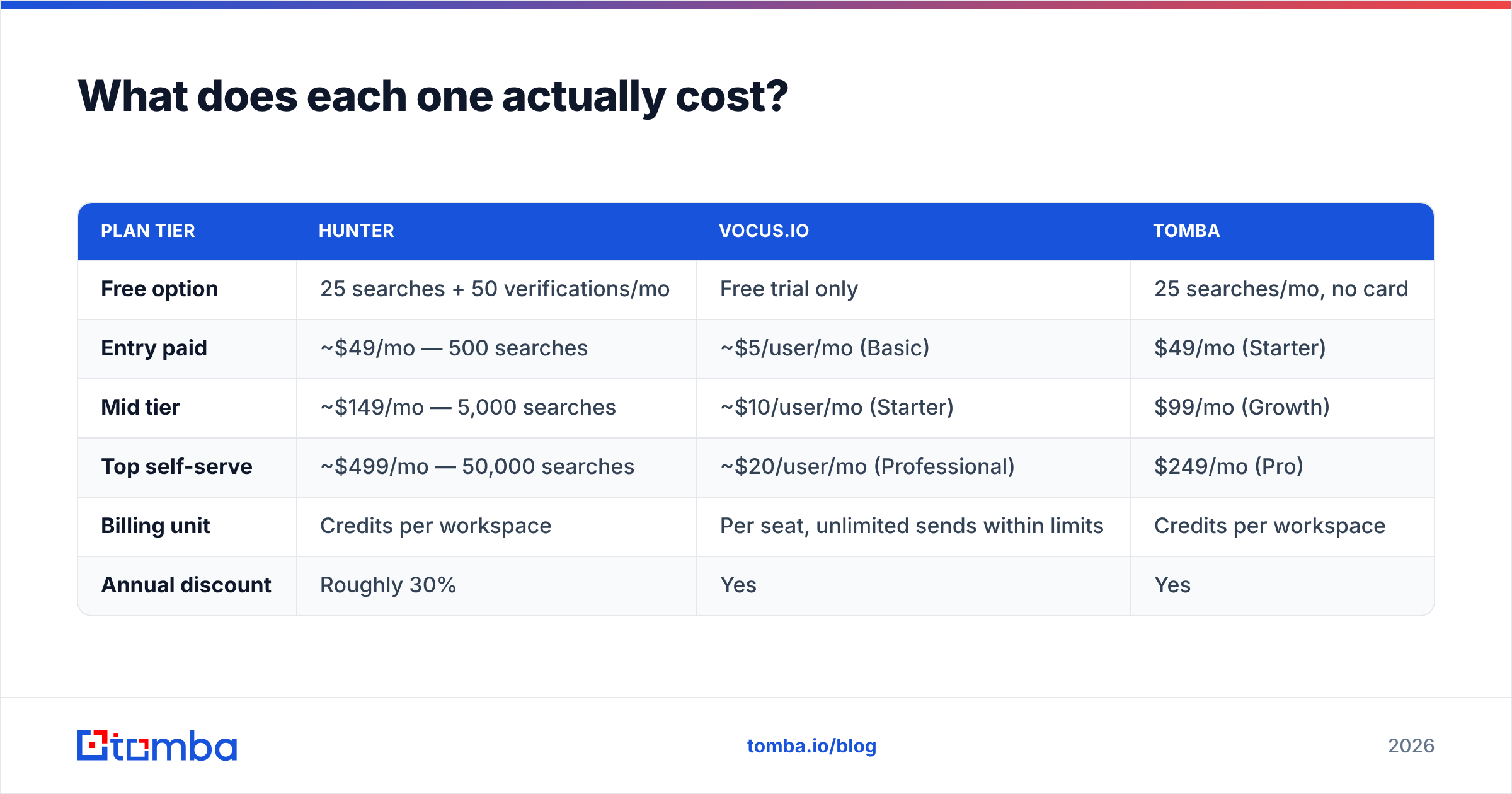
Pricing changes often — check each vendor's page before you commit. Approximate self-serve tiers at the time of writing:
| Plan tier | Hunter | Vocus.io | Tomba |
|---|---|---|---|
| Free option | 25 searches + 50 verifications/mo | Free trial only | 25 searches/mo, no card |
| Entry paid | ~$49/mo — 500 searches | ~$5/user/mo (Basic) | $49/mo (Starter) |
| Mid tier | ~$149/mo — 5,000 searches | ~$10/user/mo (Starter) | $99/mo (Growth) |
| Top self-serve | ~$499/mo — 50,000 searches | ~$20/user/mo (Professional) | $249/mo (Pro) |
| Billing unit | Credits per workspace | Per seat, unlimited sends within limits | Credits per workspace |
| Annual discount | Roughly 30% | Yes | Yes |
The billing unit row is the one that decides your bill. Vocus.io is per-seat: a five-person team on the Professional plan pays about $100/month regardless of how many prospects they touch. Hunter is per-credit: one rep running 8,000 lookups a month costs more than five reps running 500 each.
So the real cost comparison depends on your shape:
- Few reps, huge lists → data cost dominates. Optimise the finder. Compare Tomba pricing against Hunter's Growth tier on a cost-per-1,000-verified-contacts basis, not on sticker price.
- Many reps, small curated lists → seat cost dominates. Vocus.io is genuinely cheap here, and a per-seat sequencer beats buying data credits nobody uses.
- Both → you are buying two products. Budget accordingly instead of trying to force one tool to cover the gap.

Is Vocus.io better than Hunter for cold outreach?#
For the sending half, yes — clearly. Vocus.io's follow-up engine, reply detection, snippets, and scheduler are the daily-driver features a rep actually touches. Hunter Campaigns feels like what it is: a feature built so the data product has somewhere to send its output.
But "better for outreach" carries a large asterisk. Vocus.io sends from your real Gmail mailbox. That is a strength — no separate sending infrastructure, no odd tracking domains — and a liability, because a dirty list burns the mailbox your entire company relies on. Google's own Postmaster Tools thresholds punish sustained spam complaints and hard bounces regardless of which extension caused them.
Which means: Vocus.io is only as safe as the list you load into it. If you plan to run it, budget for verification separately. Run your CSV through a bulk email finder and verification pass before the merge, not after the bounces come back.
A reasonable stack looks like this:
- Source — domain search or Hunter to build the raw list.
- Verify — remove invalids and resolve catch-alls before anything is sent.
- Enrich — add titles, company data, and a personalisation hook.
- Send — Vocus.io from Gmail for small, high-touch volumes; a dedicated sequencer once you exceed a few hundred sends a day.
- Log — CRM sync so pipeline reporting is not a manual chore.
Where do both tools fall short?#
Neither product is a complete GTM stack, and both have known rough edges worth knowing before you buy.
Hunter's weak points:
- Credit consumption on unsuccessful searches frustrates people who expect a pure pay-for-results model. Read the credit rules before you scale.
- No phone numbers, no intent data, no visitor identification. It is deliberately narrow.
- Campaigns is fine for 50 emails a week and cramped beyond that.
- Coverage skews toward mid-size and enterprise domains. Very small companies and non-English markets are thinner — check reviews on G2 for your specific segment before committing to an annual plan.
Vocus.io's weak points:
- Gmail-first by design. Outlook-heavy teams are not the target user.
- Deliverability is entirely your responsibility. There is no warmup, no inbox rotation, no bounce-based list hygiene.
- The data features are supporting cast. Do not expect them to replace a real finder.
- As a browser extension, it is exposed to Gmail UI changes in a way that server-side tools are not.
The pattern here is consistent: each tool is excellent inside its lane and thin outside it. The mistake is buying one and expecting it to cover both lanes.
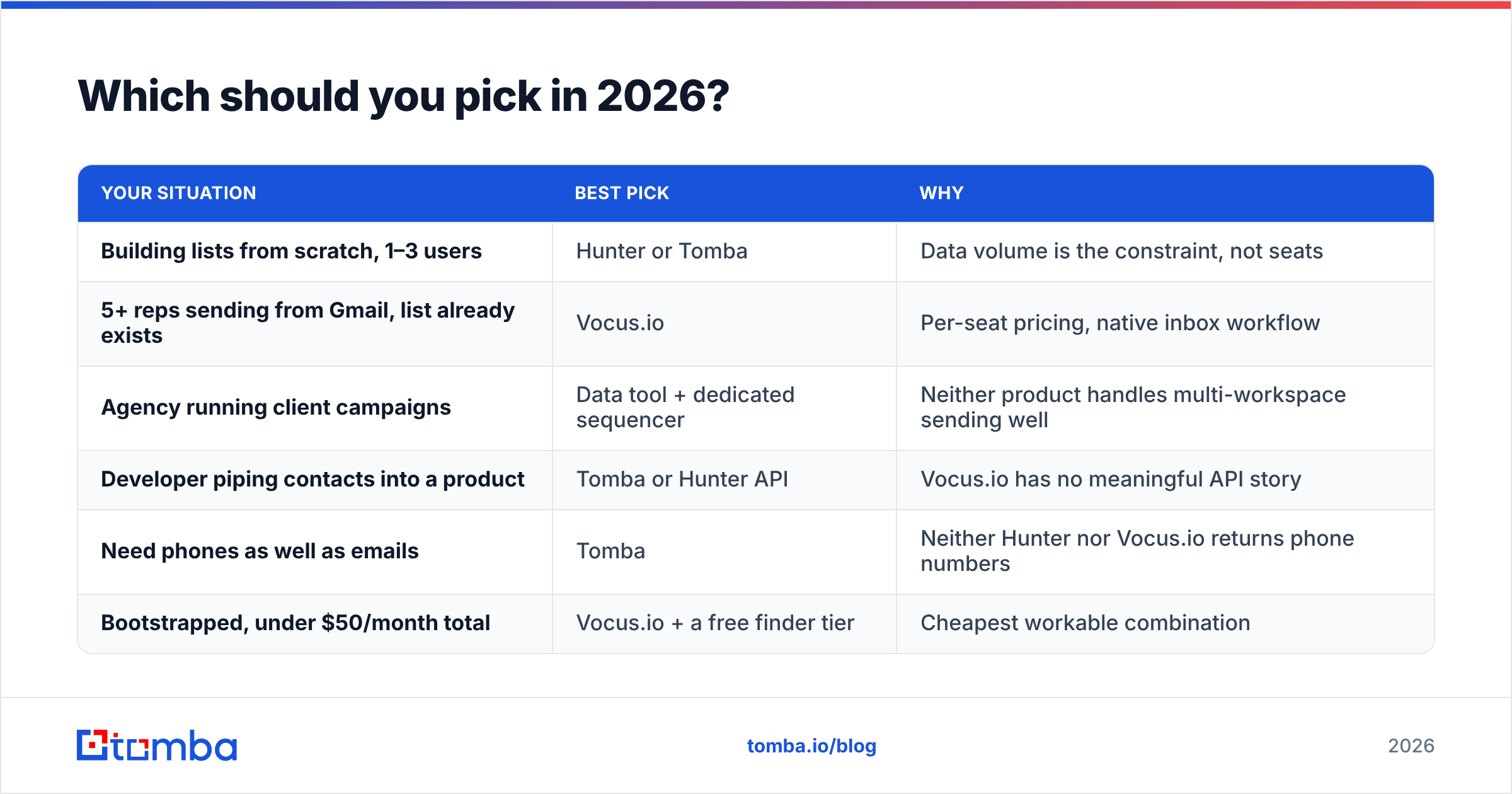
Which should you pick in 2026?#
| Your situation | Best pick | Why |
|---|---|---|
| Building lists from scratch, 1–3 users | Hunter or Tomba | Data volume is the constraint, not seats |
| 5+ reps sending from Gmail, list already exists | Vocus.io | Per-seat pricing, native inbox workflow |
| Agency running client campaigns | Data tool + dedicated sequencer | Neither product handles multi-workspace sending well |
| Developer piping contacts into a product | Tomba or Hunter API | Vocus.io has no meaningful API story |
| Need phones as well as emails | Tomba | Neither Hunter nor Vocus.io returns phone numbers |
| Bootstrapped, under $50/month total | Vocus.io + a free finder tier | Cheapest workable combination |
If your honest answer is "I need both," the sensible sequence is to fix the data first. A great sequencer sending to a 20% invalid list produces worse results than a mediocre sequencer sending to a clean one, and the damage — deliverability loss — compounds for months after you fix the underlying list.
What is the fastest way to test both without wasting money?#
Run a controlled bake-off instead of reading more comparison posts:
- Build one 100-row test list of companies that look like your actual ICP — same size band, same geography, same industry mix.
- Run it through each finder on free or entry tiers. Record hit rate and how many results come back as accept-all or low-confidence.
- Verify every result with a neutral third verifier. Never grade a finder using its own verifier — that is a marker grading its own exam.
- Compute cost per deliverable contact, not cost per credit. This single number resolves most vendor arguments.
- Send a 50-email pilot through Vocus.io from a secondary mailbox and watch bounce rate and reply rate for a week.
By the end of that, the decision usually makes itself — and it is often "one tool for data, a different one for sending," which is exactly what the market structure suggests.
The bottom line#
Hunter and Vocus.io are complements dressed up as competitors. Hunter answers "who do I email and is this address real?" Vocus.io answers "how do I email them from Gmail without doing it manually?" Buying the wrong one for your bottleneck wastes budget in the most annoying way possible: the tool works perfectly and your pipeline still does not move.
If your bottleneck is data — coverage, accuracy, catch-alls, bounces — start with the finder. Tomba's Email Finder gives you 25 free searches a month with no card, domain search and verification in the same workspace, and a Starter plan at $49/mo that scales on credits rather than seats. Test it against your own ICP list next to Hunter, grade both with a neutral verifier, and let the deliverable-contact number pick the winner.
Related guides#
// get started
Find, verify and enrich your first contacts today
Start on the free plan with 25 searches a month, then scale when your team is ready.
Free plan · No credit card required · GDPR & CCPA
// about the author