The Hybrid Appointment Setting Model: A 2026 Field Guide
Pure in-house SDR teams burn cash. Pure outsourced setters burn your brand. The hybrid appointment setting model splits the work by where the leverage actually is — here's how the math and the handoffs work.
TL;DR
- A hybrid appointment setting model keeps strategy, list ownership, and closing in-house while outsourcing high-volume, repeatable touches (dials, first-touch email, LinkedIn connection sequences) to an external team or contractors.
- The economics only work when you split by repeatability, not by seniority. Anything requiring account judgment stays inside; anything requiring throughput goes outside.
- Typical fully loaded cost per held meeting: $280–$650 in-house, $180–$400 outsourced, $210–$450 hybrid — but hybrid holds its cost as you scale, where pure in-house does not.
- The model fails in exactly one place: the handoff. If your outsourced setters book meetings your AEs did not want, you have built a no-show factory.
- Data ownership is the non-negotiable. You supply verified contact data; the vendor supplies activity. Reverse that and you are renting your pipeline.
What is a hybrid appointment setting model?#
A hybrid appointment setting model is a pipeline-generation structure where the work of booking sales meetings is deliberately split between an internal team and an external one, with an explicit boundary defining which activities live where.
Think of it like a restaurant that bakes its own bread but buys its produce. The bread is the thing customers taste and remember, so the kitchen controls it end to end. The produce is a commodity where a specialist buyer with scale and daily market access beats anything the chef could do alone. Nobody calls that outsourcing the restaurant. It is outsourcing the part where somebody else's scale is genuinely better.
Technically: you retain ICP definition, account selection, messaging ownership, data acquisition, CRM system of record, and the AE conversation. You externalize the throughput layer — outbound dials, first-touch email sends, LinkedIn connection requests, follow-up cadences, and calendar coordination. The external layer operates inside your CRM, on your data, against qualification criteria you wrote.
The distinction that matters: this is not "we hired an agency." An agency model hands over the whole funnel including the list. A hybrid model hands over labor, not judgment.
Why are companies moving away from pure in-house SDR teams?#
Because the unit economics broke around 2023 and never recovered.
A fully loaded US-based SDR now costs roughly $78,000–$95,000 a year (base plus variable plus benefits plus tooling plus the manager's time slice). Ramp is 3–4 months. Median tenure sits near 15 months across B2B SaaS, which means you get about 11 productive months per hire before you are recruiting again. That is a brutal denominator.
Meanwhile the throughput per rep fell. Connect rates on cold dials dropped as carrier spam labeling matured, and inbox providers tightened bulk sender rules — Google's 2024 bulk sender requirements alone forced most teams to cut daily send volume per mailbox by half or more. Two reps now do what one rep did in 2019.
Pure outsourcing did not solve it either. The classic failure pattern: an offshore team books 40 meetings in month one, your AEs sit through 40 conversations, and 31 of them are with people who were never going to buy. Your close rate craters, your AEs stop trusting the calendar, and you cancel the contract in month four having burned goodwill with 400 accounts you can no longer re-approach cleanly.
Hybrid emerged as the compromise that survives contact with reality. And to be fair, some outsourced providers have gotten genuinely good — vendors like BookYourData built real data infrastructure underneath their offering rather than just renting seats, which is exactly why the "outsourcing is always bad" take is lazy. The failures come from unclear boundaries, not from the concept.
How does hybrid compare to in-house and fully outsourced?#
Here is the honest side-by-side. Numbers reflect mid-market B2B SaaS with an ACV between $15k and $60k.
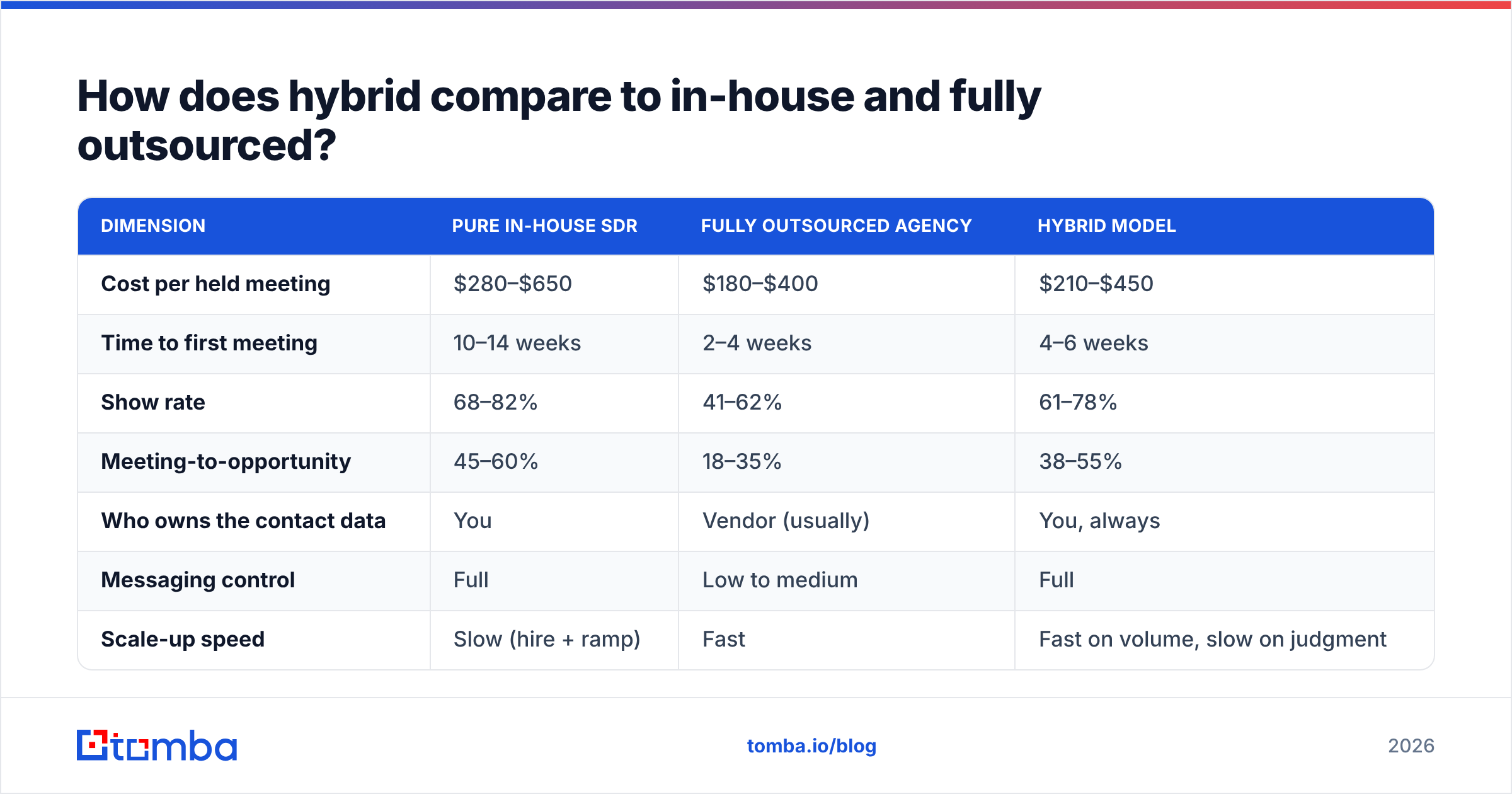
| Dimension | Pure in-house SDR | Fully outsourced agency | Hybrid model |
|---|---|---|---|
| Cost per held meeting | $280–$650 | $180–$400 | $210–$450 |
| Time to first meeting | 10–14 weeks | 2–4 weeks | 4–6 weeks |
| Show rate | 68–82% | 41–62% | 61–78% |
| Meeting-to-opportunity | 45–60% | 18–35% | 38–55% |
| Who owns the contact data | You | Vendor (usually) | You, always |
| Messaging control | Full | Low to medium | Full |
| Scale-up speed | Slow (hire + ramp) | Fast | Fast on volume, slow on judgment |
| Cost behavior at 3x scale | Rises faster than output | Flat but quality decays | Roughly linear |
| Brand risk | Low | High | Medium-low |
| Best fit ACV | $40k+ | Under $12k | $12k–$80k |
Read the "cost behavior at 3x scale" row twice. That is the entire argument. In-house looks competitive at small scale and gets worse as you grow because management overhead compounds. Fully outsourced looks cheap forever until you notice the meeting-to-opportunity rate quietly halved. Hybrid is rarely the cheapest line on any single row and is usually the best total.
What exactly should stay in-house?#
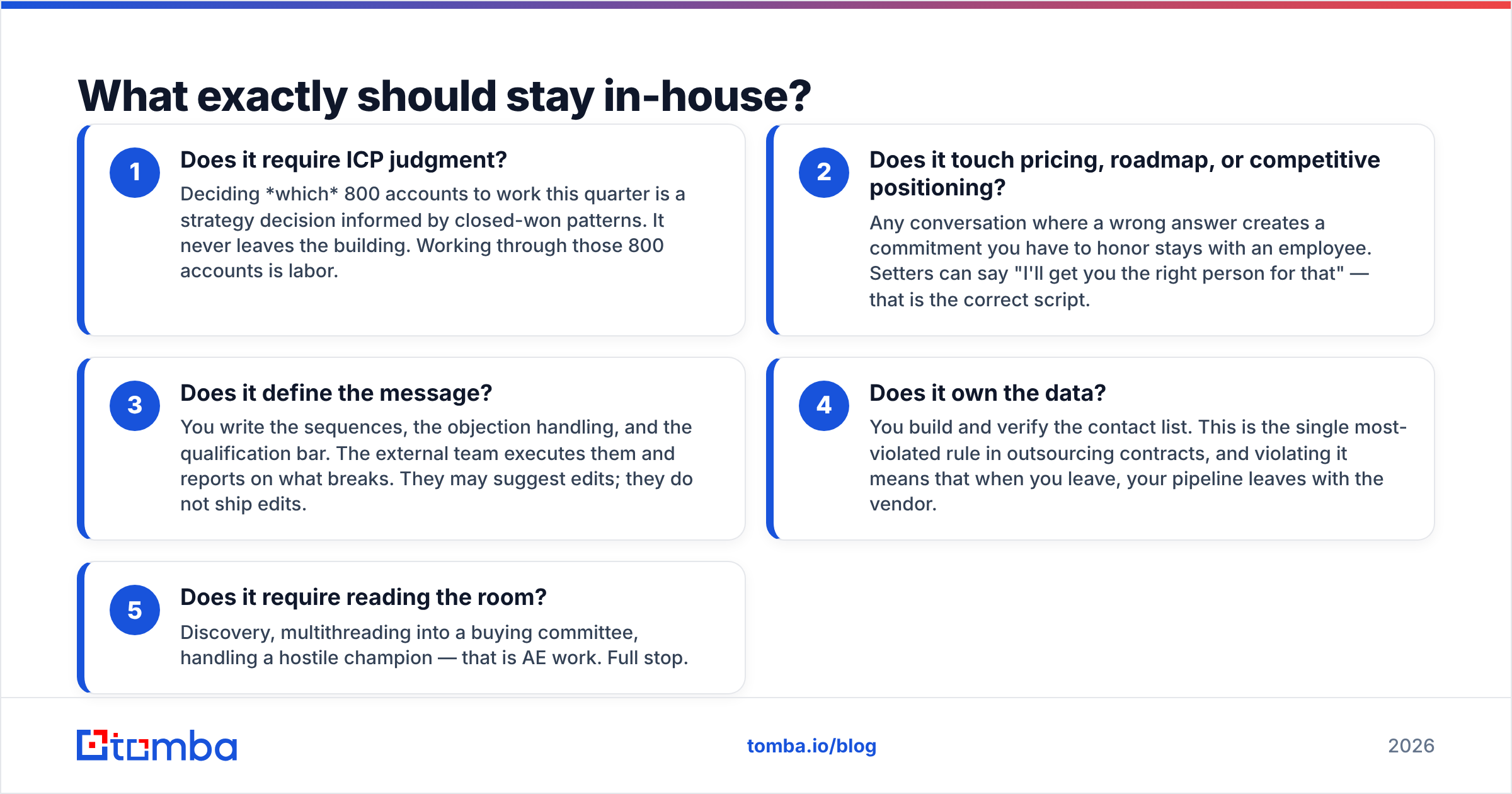
Split by repeatability, not by title. Use these five tests — if a task fails any of them, it stays inside.
- Does it require ICP judgment? Deciding which 800 accounts to work this quarter is a strategy decision informed by closed-won patterns. It never leaves the building. Working through those 800 accounts is labor.
- Does it touch pricing, roadmap, or competitive positioning? Any conversation where a wrong answer creates a commitment you have to honor stays with an employee. Setters can say "I'll get you the right person for that" — that is the correct script.
- Does it define the message? You write the sequences, the objection handling, and the qualification bar. The external team executes them and reports on what breaks. They may suggest edits; they do not ship edits.
- Does it own the data? You build and verify the contact list. This is the single most-violated rule in outsourcing contracts, and violating it means that when you leave, your pipeline leaves with the vendor.
- Does it require reading the room? Discovery, multithreading into a buying committee, handling a hostile champion — that is AE work. Full stop.
Everything that fails none of those tests — dials, first-touch email, follow-up 2 through 6, calendar wrangling, no-show recovery, data entry — is a candidate for the external layer.
Why does contact data determine whether hybrid works?#
Because outsourced throughput multiplies whatever data quality you feed it, in both directions.
Give an external team a list at 72% deliverability and they will burn your sending domains at three times the speed an internal team would, because their whole job is volume. You will not find out until your sender reputation has already tanked and your AEs' one-to-one emails start landing in spam too. The hybrid model concentrates data risk exactly where you have the least visibility.
So the sequencing is: data first, vendor second. Before any external team touches a mailbox, your list needs to clear a hard bar — valid MX, verified mailbox, no role accounts on cold first-touch, catch-all domains flagged and routed separately rather than blasted.

This is where the in-house half earns its keep. Running domain search across your target account list, then passing every result through an email verifier before it reaches the outsourced sequence, means the volume layer amplifies good data instead of bad. Catch-all domains — which are roughly a third of enterprise domains now — should go through a catch-all verifier and, if they stay ambiguous, get routed to the phone channel instead of email.
One practical rule: never let the vendor's data source into your CRM. If they enrich, they enrich into a staging table you review. Contacts entering your system of record should come from a source you control and can audit — see where Tomba gets data for what that audit trail should look like.
How do you structure the handoff so meetings actually hold?#
The handoff is where hybrid models die. Here is the structure that survives.
Define "qualified" as a checklist, not a vibe. Write five to seven binary criteria. Company size band. Named tech in the stack or absence of it. Title within an approved list. Stated or inferred trigger event. Confirmed budget authority or a confirmed path to it. If the setter cannot check every box, the meeting does not get booked — it gets logged as a nurture contact and routed back to your internal team.
Pay on held-and-qualified, not booked. This one contractual change fixes most of the incentive problem. If your vendor is paid per booking, you will get bookings. If they are paid on meetings that both showed up and passed AE qualification 24 hours later, your interests align. Expect to pay 25–40% more per unit; expect your effective cost to drop.
Build a 48-hour rejection window. AEs can reject a meeting within two business days with a reason code. Reason codes roll up weekly. Three consecutive weeks of the same code means the qualification criteria or the script is wrong — fix it upstream rather than complaining downstream.
Confirm twice, from your domain. The setter books it. Your calendar system sends the confirmation from your domain. A human on your side sends a short note 24 hours prior. Show rates on hybrid-booked meetings move 12–20 points with that single addition, because the prospect's last touch before the call is from the company they will actually be talking to.

Instrument the whole thing in one CRM. Not the vendor's dashboard. Yours. If activity data lives in a system you cannot query, you are managing on their narrative. Push everything into HubSpot, Salesforce, or whatever your system of record is, and build the funnel report yourself.
What does the cost math look like in practice?#
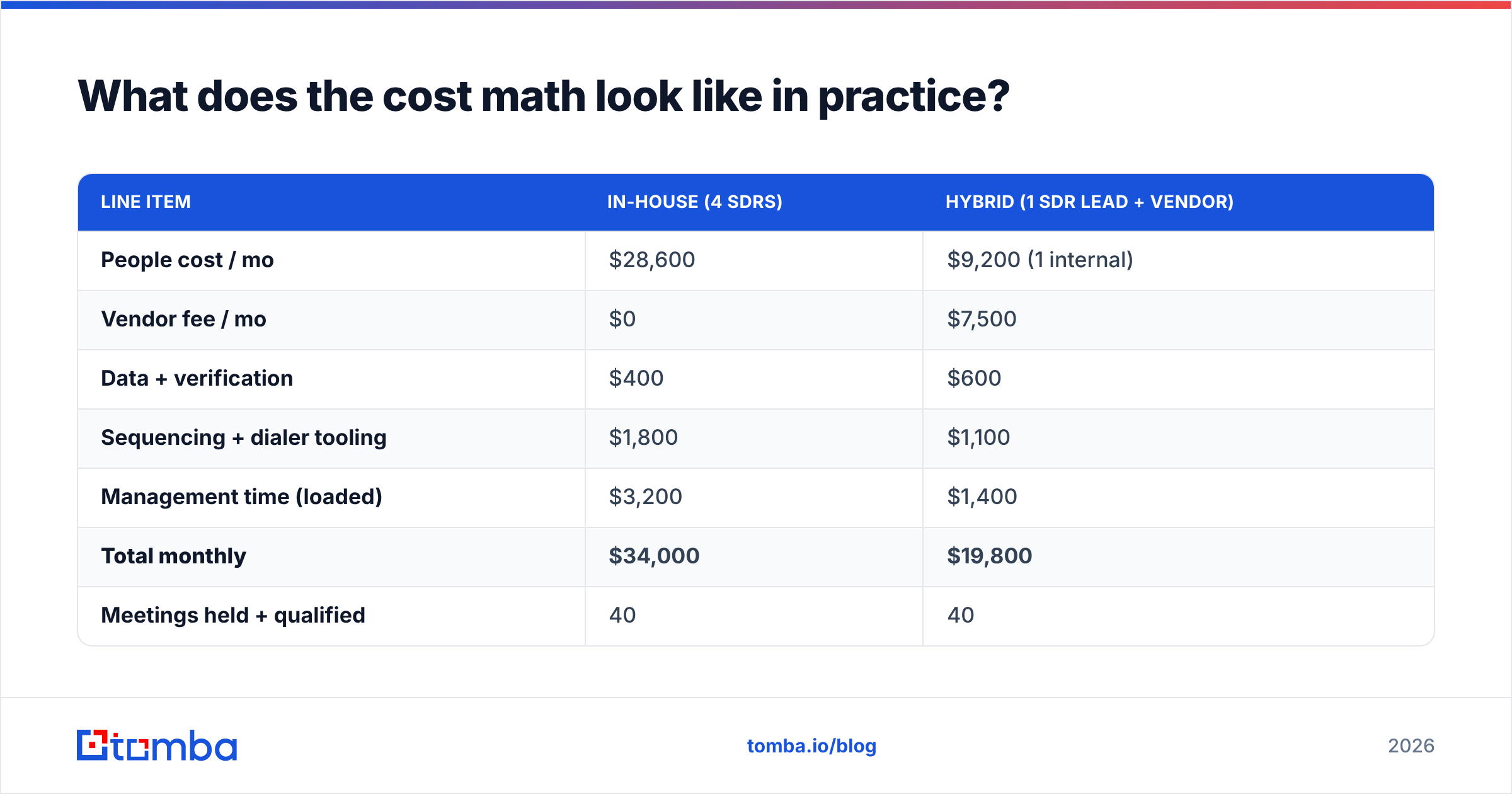
Run it on a concrete target: 40 held, qualified meetings per month.
| Line item | In-house (4 SDRs) | Hybrid (1 SDR lead + vendor) |
|---|---|---|
| People cost / mo | $28,600 | $9,200 (1 internal) |
| Vendor fee / mo | $0 | $7,500 |
| Data + verification | $400 | $600 |
| Sequencing + dialer tooling | $1,800 | $1,100 |
| Management time (loaded) | $3,200 | $1,400 |
| Total monthly | $34,000 | $19,800 |
| Meetings held + qualified | 40 | 40 |
| Cost per meeting | $850 | $495 |
| Time to steady state | 14 weeks | 5 weeks |
Two caveats before you take that to a board deck. First, the in-house column assumes you actually hit 10 qualified meetings per SDR per month, which is above median. Second, the hybrid column assumes the "held and qualified" contract structure — under a pay-per-booking contract, you would need roughly 62 bookings to net 40 qualified, and the real cost per meeting lands closer to $700.
The delta is real but it is not the 60% savings the outsourcing vendors put on their landing pages. Budget for 35–45%, and treat speed-to-steady-state as the bigger win.
When should you not use a hybrid model?#
Three situations where hybrid is the wrong answer.
- ACV above roughly $150k with under 300 total addressable accounts. At that density, every touch is a strategic act. You want named AEs owning accounts end to end. Outsourcing any touch dilutes a relationship you cannot rebuild.
- Highly regulated or technical first conversations. If the opening call requires a clinical, legal, or deep engineering answer to survive 90 seconds, an external setter will lose the prospect before they hand off. Some categories genuinely cannot be split.
- You have not written the playbook yet. Hybrid amplifies a process. If your qualification criteria are still "AEs know it when they see it," the external layer has nothing to execute against. Get to a documented, working motion with two internal reps first, then add volume outside. Companies that outsource to discover a motion almost always fail — Gartner's sales research has been consistent on this for years: process precedes scale.
How do you run a 90-day hybrid pilot?#
Days 1–15 — Build the data layer. Define the account list. Enrich and verify every contact. Set up separate sending domains for the outbound layer so nothing touches your primary domain. Establish the qualification checklist and reason codes.
Days 16–30 — Run internal-only baseline. Two internal reps work the exact sequences you intend to hand over. This gives you a control group. Record connect rate, reply rate, meeting rate, show rate, qualification pass rate. Without this baseline you cannot tell whether the vendor is good or your list is good.
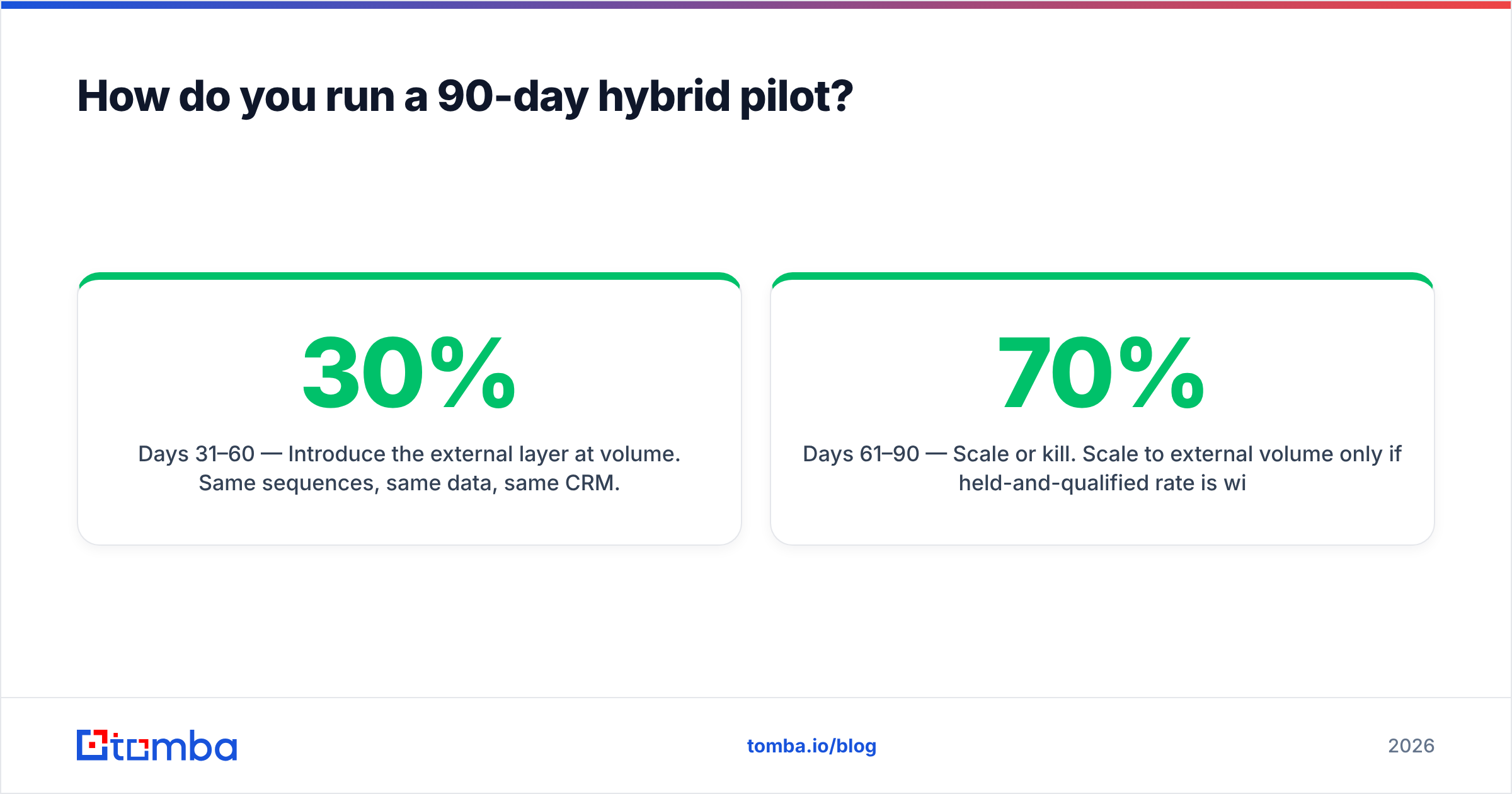
Days 31–60 — Introduce the external layer at 30% volume. Same sequences, same data, same CRM. Compare every metric against your baseline. Expect the vendor to underperform internal by 15–25% on reply quality initially — that is normal and should close by week 8. If it does not close by week 10, the problem is the vendor, not ramp.
Days 61–90 — Scale or kill. Scale to 70% external volume only if held-and-qualified rate is within 15% of your internal baseline. Otherwise terminate. Do not extend "one more quarter" — the sunk-cost extension is the most expensive decision in this entire model.
Track weekly in one place. If you need the raw contact throughput for the pilot, bulk email finder workflows and a Google Sheets sync will get you from account list to verified, sequence-ready contacts faster than any manual process, and the Tomba API handles it if you would rather wire it directly into your CRM. Also worth reviewing G2's outbound services category before you shortlist vendors — the review depth there is better than most vendor-supplied references.
The bottom line#
The hybrid appointment setting model wins because it puts scale where scale is cheap and judgment where judgment is irreplaceable. It is not a cost hack — it is an architecture decision. The teams that get 40% cheaper meetings out of it are the ones that treated data ownership and the qualification handoff as contract-level requirements, not implementation details.
Start with the data. An outsourced team working from a verified, ICP-matched list will outperform an internal team working from a scraped one, and the reverse is equally true. Build the list in-house, verify it before anyone dials, and keep the system of record yours.
If you are standing up the data layer for a hybrid pilot, the Tomba Email Finder is the fastest way to go from a target account list to verified, sequence-ready contacts — free tier covers 25 searches a month if you want to test the workflow before committing, and Tomba pricing starts at $49/mo for the volume a real pilot needs.
Related guides#
Ready to find emails that actually work?
Join 150,000+ professionals who stopped guessing and started sending. Free credits on signup — no credit card required.
Get the Tomba newsletter
Practical outbound tactics and product updates — once every two weeks.
About the author