Hybrid Sales in 2026: How to Blend Field and Remote Selling
Hybrid sales is now the default B2B motion, not a pandemic hangover. Here is what actually changes in your pipeline, comp plan, and tech stack when reps sell both remotely and in person.
TL;DR
- Hybrid sales means one selling motion that deliberately mixes remote and in-person touches per deal stage — not "some reps travel, some don't."
- Buyers already work this way: most B2B research happens digitally, and face-to-face time is reserved for high-stakes moments like multi-stakeholder consensus and contract negotiation.
- The failure mode is not technology, it's routing. Teams that assign channel by rep preference instead of by deal characteristics burn travel budget on deals that would have closed on Zoom anyway.
- Hybrid raises the bar on contact data. A field visit that reaches the wrong stakeholder costs $800 and a week; a bad remote touch costs a bounce.
- Comp plans, territory design, and pipeline stages all need edits. Copying an inside-sales playbook onto a field team is the most common way hybrid programs stall.
What is hybrid sales, exactly?#
Hybrid sales is a go-to-market model where a single seller (or a single account team) moves a deal forward using both digital-remote channels and in-person interaction, choosing the channel based on what the deal stage requires rather than on job title or geography.
The distinction matters. Plenty of companies claim a hybrid model when what they actually run is a split model: an SDR team that books meetings, an inside team that closes SMB, and a field team that flies to enterprise accounts. That's segmentation, and it has been around since the 1990s. Hybrid is different — it assumes the same account will get a video demo in week two, a Slack Connect channel in week four, an on-site workshop in week seven, and a remote redline session in week nine.
Think of it like a hospital triage desk. Everyone comes through the same front door, but the desk decides in about ninety seconds whether you get a nurse, a scan, or a surgeon. Hybrid sales asks the same question at every stage boundary: what's the cheapest channel that still moves this deal forward?
Three things make the model work:
- A channel decision rule. Written, not vibes. "Deals above $75k ARR with 4+ buying-group members get one mandatory on-site before the proposal stage." Every rep should be able to recite it.
- Shared account context across channels. The person who ran the on-site and the person who sends the follow-up sequence need the same notes, or the buyer notices immediately.
- Contact data that survives channel switching. You need the mobile number for the field visit confirmation, the work email for the proposal, and the LinkedIn profile for the warm reintroduction six months later. That's three data types per stakeholder, times five stakeholders.
Why did hybrid sales become the default in 2026?#
Because buyers stopped treating remote as a downgrade, and sellers stopped treating travel as a status symbol.
Gartner's long-running research on the B2B buying journey has consistently found that buyers spend the clear majority of their purchase cycle away from any supplier rep — researching independently, talking to peers, and building internal consensus. When they do engage a seller, they want that interaction to be dense with information they couldn't get elsewhere.
That produces a specific pattern. Low-information touches (discovery calls, product walkthroughs, pricing overviews) migrate to video because there's no premium for being in the room. High-friction touches — the ones where you need to read six faces at once, or where a CFO and a security lead disagree in front of you — retain real value in person.
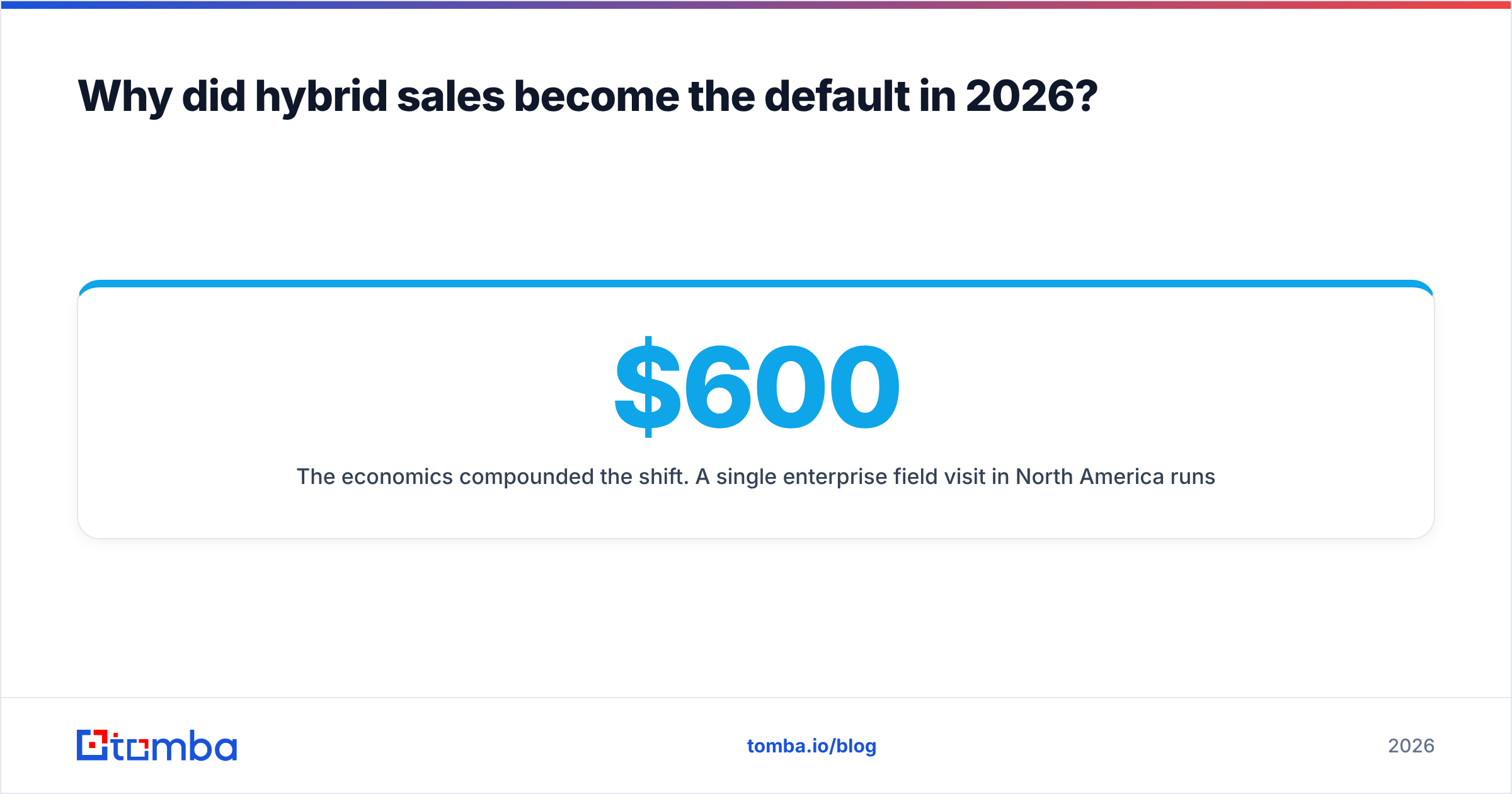
The economics compounded the shift. A single enterprise field visit in North America runs $600–$1,200 fully loaded once you count airfare, hotel, ground, meals, and the productive selling hours lost to travel. Against a $40k deal, that's a rounding error you can't afford. Against a $400k deal with a stalled security review, it's the cheapest unblocking mechanism you have.
What does hybrid sales look like across the funnel?#
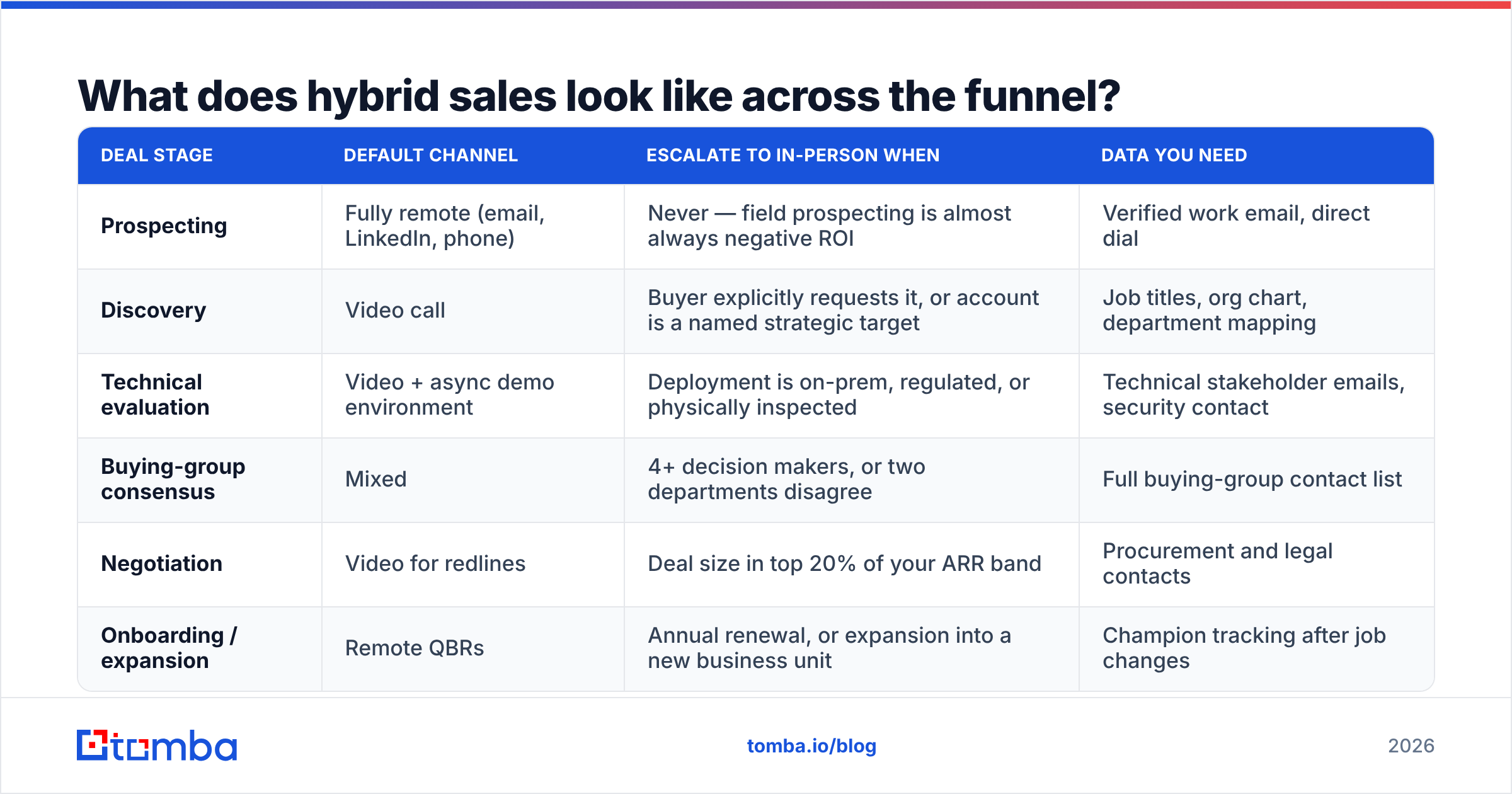
Here's the channel map most functioning hybrid teams converge on. Use it as a starting template, then tune the thresholds to your own win-rate data.
| Deal stage | Default channel | Escalate to in-person when | Data you need |
|---|---|---|---|
| Prospecting | Fully remote (email, LinkedIn, phone) | Never — field prospecting is almost always negative ROI | Verified work email, direct dial |
| Discovery | Video call | Buyer explicitly requests it, or account is a named strategic target | Job titles, org chart, department mapping |
| Technical evaluation | Video + async demo environment | Deployment is on-prem, regulated, or physically inspected | Technical stakeholder emails, security contact |
| Buying-group consensus | Mixed | 4+ decision makers, or two departments disagree | Full buying-group contact list |
| Negotiation | Video for redlines | Deal size in top 20% of your ARR band | Procurement and legal contacts |
| Onboarding / expansion | Remote QBRs | Annual renewal, or expansion into a new business unit | Champion tracking after job changes |
The right-hand column is where hybrid programs quietly break. Every escalation to in-person assumes you know exactly who's in the room and how to reach them beforehand. If your CRM has a single generic info@ address for the account, you can't confirm attendance, you can't send a pre-read, and you can't follow up with the two people who spoke least.
How is hybrid sales different from inside sales or field sales?#
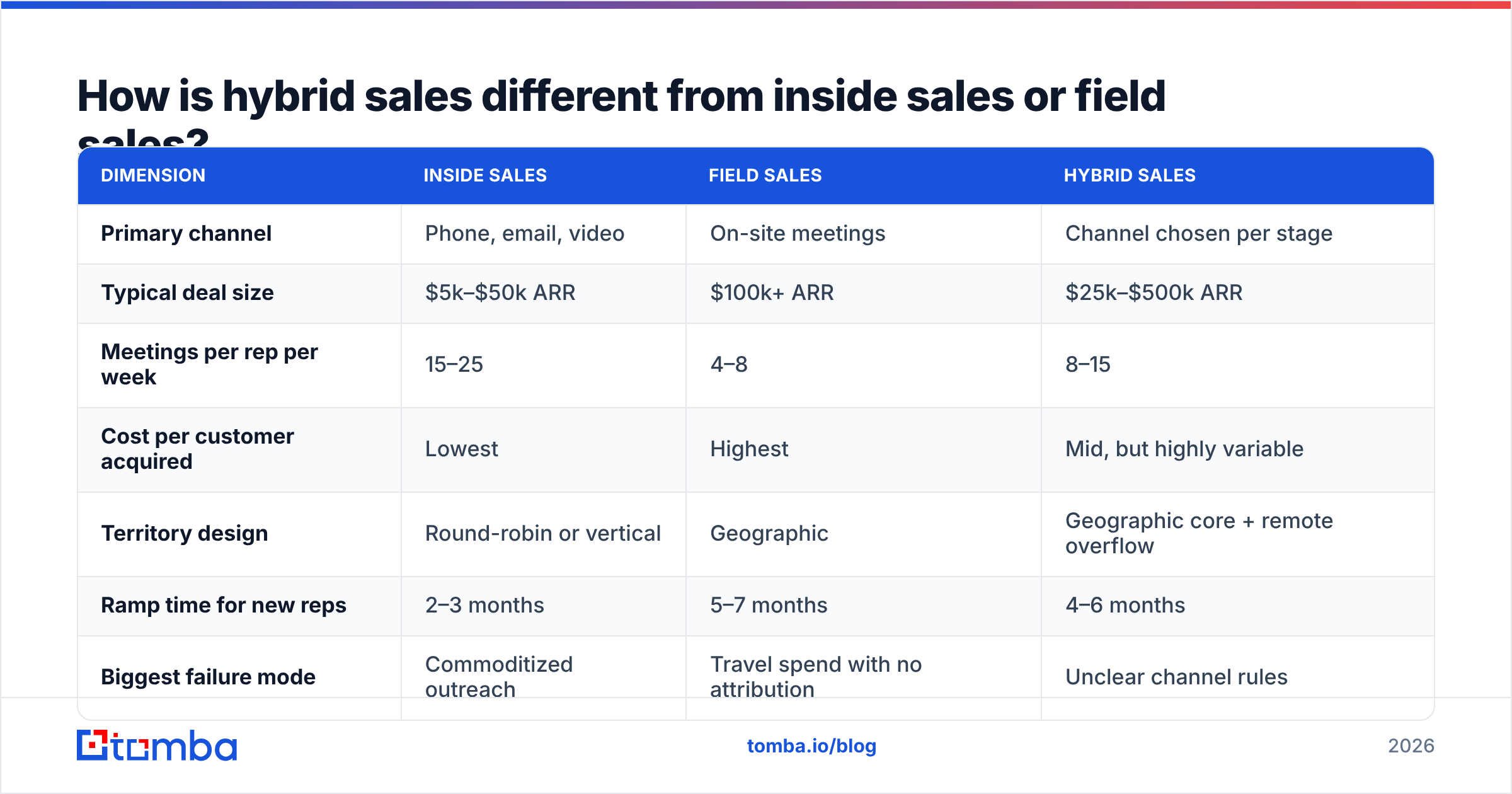
The three models differ less in tooling than in how they allocate the scarcest resource — seller hours in front of a human.
| Dimension | Inside sales | Field sales | Hybrid sales |
|---|---|---|---|
| Primary channel | Phone, email, video | On-site meetings | Channel chosen per stage |
| Typical deal size | $5k–$50k ARR | $100k+ ARR | $25k–$500k ARR |
| Meetings per rep per week | 15–25 | 4–8 | 8–15 |
| Cost per customer acquired | Lowest | Highest | Mid, but highly variable |
| Territory design | Round-robin or vertical | Geographic | Geographic core + remote overflow |
| Ramp time for new reps | 2–3 months | 5–7 months | 4–6 months |
| Biggest failure mode | Commoditized outreach | Travel spend with no attribution | Unclear channel rules |
| Data dependency | Email accuracy | Relationship depth | Both, at full buying-group width |
Notice the ramp-time row. Hybrid reps carry two skill sets, so they take longer to become productive than pure inside reps — a fact that gets ignored when leadership converts an inside team to hybrid and expects flat productivity in quarter one. Budget for the dip.
What breaks when you switch to hybrid?#
Four things, reliably.
1. Territory math stops working. Geographic territories assume travel is the constraint. Once half the motion is remote, a rep in Denver can cover accounts in Lisbon with no marginal cost, but still can't be in two US cities on the same Tuesday. Most teams end up with a hybrid territory design too: a geographic "drivable core" of 20–40 accounts that get field coverage, plus a remote book sized by segment fit rather than distance.
2. Comp plans reward the wrong behavior. If you pay a travel-expense allowance without tying it to deal criteria, you get travel. If you pay flat commission with no channel weighting, reps default to whatever's comfortable — which is video for introverts and airports for extroverts, and neither correlates with win rate. The fix is boring: fund travel from a manager-approved pool with a written threshold, and audit it quarterly against closed-won rate.
3. Pipeline stages lose meaning. A "meeting held" stage means something different when the meeting was a 22-minute Zoom versus a four-hour on-site. Add a channel field to your stage transitions so your win rate analysis can separate the two. Most teams discover their in-person meetings convert 2–3x better — and then discover that's selection bias, because they only fly to deals that were already qualified.
4. Contact data debt gets expensive. This is the one nobody plans for. Remote-only selling tolerates a stale contact list because a bounce costs you nothing but a bounce. Hybrid doesn't. You schedule a visit around a champion who left three months ago, or you show up with a pre-read addressed to a VP who's now a director at a competitor. The cost of bad data scales with the cost of the touch.
That last point is why hybrid teams tend to tighten their data hygiene loop first. Running a quarterly pass with an email verifier across your active-opportunity contacts, and a data enrichment refresh on accounts entering a field-visit stage, costs a fraction of one wasted trip.
How do you decide which deals get face time?#
Score it. Don't debate it deal by deal in pipeline review.
Build a simple additive model and set a threshold. Here's a version that works for most mid-market B2B teams — adjust weights against your own closed-won history rather than adopting these numbers as gospel:
- Deal value relative to your median — score 0 to 3. A deal at 3x median gets 3 points. This is usually the heaviest single factor.
- Buying-group width — score 0 to 3. One point per distinct department involved beyond the first. Cross-departmental disagreement is the single strongest argument for being in the room.
- Competitive pressure — score 0 or 2. Add 2 if a named competitor is in an active evaluation. Presence beats a slide deck when the alternative is also demoing.
- Stall duration — score 0 to 2. Add 1 for each full month past your average stage duration. On-sites are a legitimate unsticking tool; they're a poor discovery tool.
- Strategic account flag — score 0 or 2. Logo value, reference potential, or expansion ceiling that exceeds first-contract value.
- Travel feasibility — score -2 to 0. Subtract for intercontinental travel to a single meeting with no other accounts nearby.
Total 7 or higher, book the trip. Below 5, close it remote. Between 5 and 7, cluster it — wait until a second scored account in the same metro crosses the line and do both in one journey. That clustering rule alone typically cuts cost-per-field-meeting by a third.
What does a hybrid sales tech stack need?#
Less than vendors want you to believe, but with one non-obvious requirement: your stack has to keep a single record of the account across channels that were historically owned by different tools.
The functional layers:
- Contact acquisition and verification. You need work emails, direct dials, and LinkedIn identities for every member of the buying group — not just the champion. Tools like the email finder and phone finder cover the acquisition side; verification prevents the field-visit-to-a-ghost problem.
- Sequencing and engagement. Whatever runs your remote cadence. The requirement for hybrid is that it can pause automatically when a field meeting is booked, so a rep isn't shaking hands on Tuesday while an automated "just following up!" lands Wednesday morning.
- CRM with channel-tagged activities. Non-negotiable. If you can't query "closed-won rate for deals with ≥1 on-site," you cannot manage a hybrid model. Both HubSpot and Salesforce support custom activity types for this without heavy configuration.
- Meeting intelligence. Recording and transcription for remote calls creates an asymmetry — remote interactions become searchable and on-sites don't. Close it by requiring a structured debrief note within 24 hours of any field meeting.
- Scheduling with travel awareness. Underrated. A scheduler that doesn't know you'll be in a different time zone on Thursday will book you a 7 a.m. call.

What you don't need: a dedicated "hybrid sales platform." That category is mostly repackaged sales engagement software. The genuine gap in most stacks is data completeness across the full buying group, not another interface.
How do you manage and coach a hybrid team?#
Manage the channel decision, not the activity count.
Traditional inside-sales management runs on volume metrics — calls, emails, meetings booked. Field management runs on account plans and relationship depth. Hybrid managers who pick one and apply it universally produce either reps who spam their territory or reps who nurture four accounts into oblivion.
Three practices that hold up:
Run channel-attribution reviews monthly. Pull every closed deal from the prior 90 days, tag which touches were in-person, and calculate cost-per-closed-won by channel mix. You're looking for the point of diminishing returns on field touches — usually it's between one and two per deal, and the third adds cost without lift.
Ride along asymmetrically. Managers naturally join field visits because they're events. But the coaching leverage is higher on remote calls, where you can review a recording at 1.5x and give specific feedback on twelve calls in the time one flight takes. Reserve live ride-alongs for deals where the rep is genuinely stuck.
Protect focus blocks. The hidden tax of hybrid is context switching. A rep who does two on-sites Tuesday, four video calls Wednesday, and prospecting Thursday is doing three different jobs. Cluster like activities into days. Reps report this as the single biggest quality-of-life improvement when teams formalize it.
For teams sourcing their own pipeline rather than living off inbound, the prospecting block is where contact quality compounds. Building target lists with domain search across a defined account set — then verifying before anything gets sequenced — keeps the remote half of the motion from poisoning the in-person half with bounced pre-reads and wrong-number confirmations.
Is hybrid sales right for every B2B team?#
No, and the exceptions are predictable.
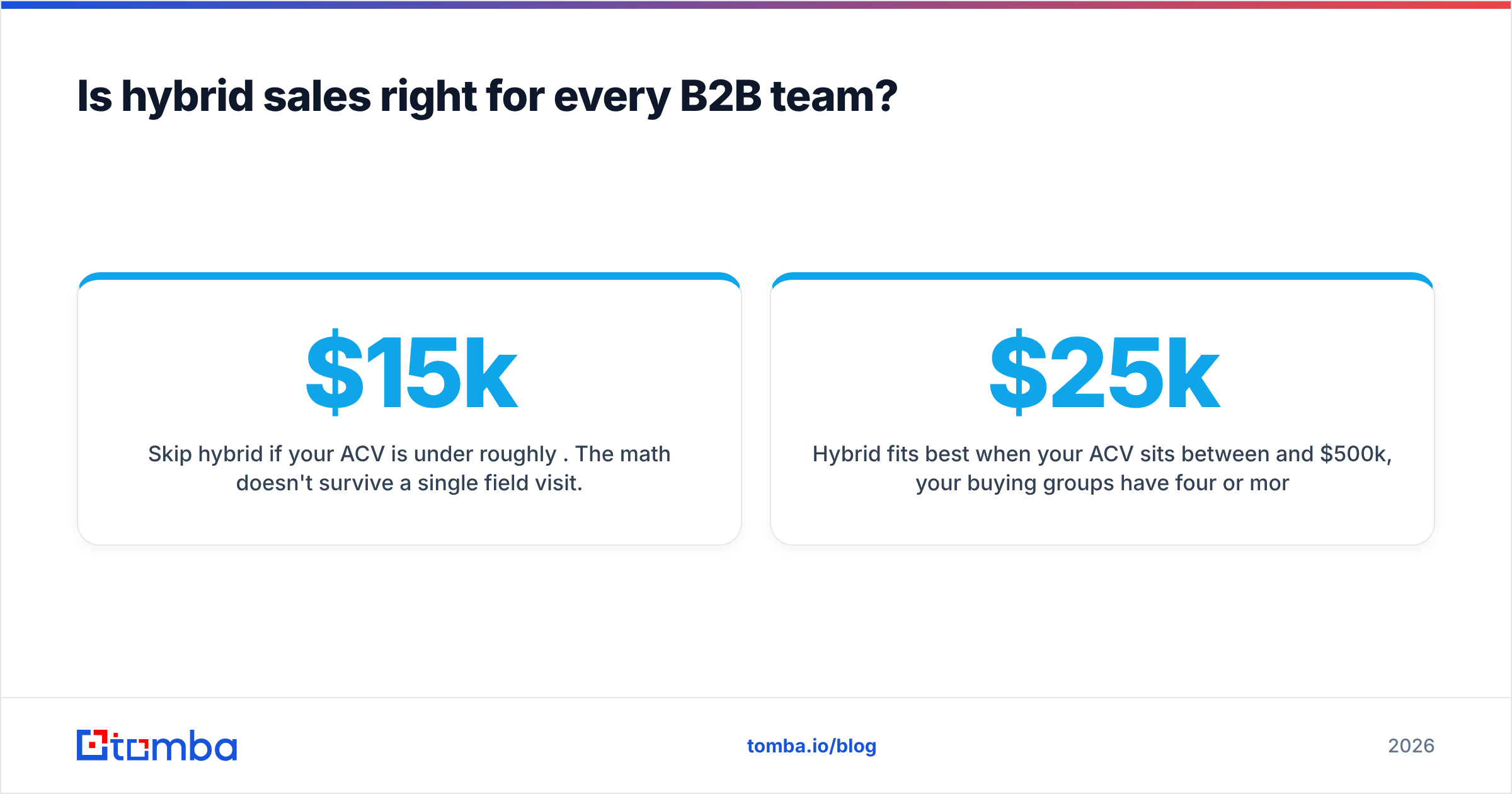
Skip hybrid if your ACV is under roughly $15k. The math doesn't survive a single field visit. Stay fully remote and invest the travel budget in better data and more touches.
Skip it if your buyers are geographically dispersed with no clustering. If your customer base is 3,000 accounts spread evenly across forty countries, you can't build drivable cores. Some vertical SaaS companies are structurally remote-only for this reason, and they're fine.
Reconsider if your product is genuinely physical or regulated. Manufacturing equipment, medical devices, and anything requiring site survey aren't hybrid candidates — they're field-first with remote support, which is a different model with different ratios.
Hybrid fits best when your ACV sits between $25k and $500k, your buying groups have four or more members, your accounts cluster in identifiable metros, and your competitive differentiation depends on trust rather than feature checklists. That describes a large share of mid-market B2B software, professional services, and industrial distribution.
If you're evaluating the model, run it as a controlled test before restructuring anything. Take one territory, apply a written channel-decision rule for a full quarter, and compare cost-per-closed-won against a matched control territory. Most teams find the answer is not "hybrid yes/no" but "hybrid at these three stages specifically" — and that's a far cheaper conclusion to reach with one territory than with a reorg.
Where should you start?#
Start with the data layer, because every other hybrid decision depends on knowing who's actually in the account.
Before you rewrite territories or comp plans, audit a sample of 50 open opportunities. For each, count how many distinct buying-group members you have a verified work email for, how many you have a direct dial for, and how many you'd be confident inviting to an on-site next week. Most teams discover the number is one or two per account — which means their "hybrid" motion is really a single-threaded relationship with two delivery channels. That's fragile in either direction.
Fix that first. Tomba's Email Finder finds and verifies professional email addresses by name, company, or domain, so you can widen a single-threaded account into a real buying-group map before you spend $900 on a plane ticket. The free tier covers 25 searches a month if you want to test it against accounts you already know, and paid plans start at $49/mo on Tomba pricing — roughly the cost of one airport lunch, against a quarter of not showing up to the wrong meeting.
Related guides#
// get started
Find, verify and enrich your first contacts today
Start on the free plan with 25 searches a month, then scale when your team is ready.
Free plan · No credit card required · GDPR & CCPA
Get the Tomba newsletter
Product and data updates
// about the author