Hybrid Sales Model: How Inside and Field Teams Win in 2026
Buyers now split their time between video calls, self-serve research, and the occasional in-person meeting. Here's how to build a hybrid sales model that matches that behavior — with coverage math, comp fixes, and the tooling that holds it together.
TL;DR
- A hybrid sales model splits one revenue motion across remote and in-person channels, assigning each channel to the deal stages where it actually changes the outcome — not to a rep's seniority or job title.
- The math usually favors hybrid: remote coverage costs roughly a fifth of a field visit per touch, but in-person meetings still lift win rates on large, multi-stakeholder deals.
- The failure mode is never "remote vs. field." It's unclear ownership at the handoff, comp plans that pay two people for the same deal, and data that only lives in one rep's inbox.
- Hybrid raises your data quality bar. When nobody walks into the building, contact accuracy, verified emails, and direct dials become the difference between coverage and guessing.
- Start by mapping deal size against stakeholder count. Anything above your median on both axes earns field time. Everything else stays remote until it proves otherwise.
What is a hybrid sales model?#
A hybrid sales model is a go-to-market structure where a single selling motion deliberately mixes remote channels (video, phone, email, chat, self-serve product) with in-person channels (site visits, executive dinners, conferences, on-site pilots), and routes each opportunity to the mix that fits its economics.
Think of it like a hospital triage desk. Not every patient needs surgery, and not every patient can be handled with a phone consult. The skill isn't in preferring one over the other — it's in the sorting rule. A hybrid sales model is that sorting rule, applied to revenue.
That's different from three things it gets confused with:
- Inside sales with occasional travel. If field visits are a reward or an escalation valve, you don't have a model — you have exceptions.
- Field sales with a remote SDR layer. Common, but that's a division of labor by function, not by channel economics. The AE still runs every deal the same way.
- Product-led growth with a sales assist. PLG is a hybrid of self-serve and human, which overlaps but isn't identical. Many hybrid teams run all three layers.
The defining test: can you state, in one sentence, which deals get in-person time and why? If you can't, you're improvising.
Why did hybrid selling become the default in 2026?#
Three shifts stacked on top of each other, and none of them reversed.
Buyers spread their evaluation across more channels than sellers can staff. B2B buying groups have grown, and most of the evaluation now happens without a rep in the room — reading docs, watching recorded demos, asking peers in private communities. Gartner's research on B2B buying has consistently found buyers spend only a small slice of their evaluation time with any single vendor's sales team. A field-only model spends its budget on the smallest slice.
Remote closing stopped being a stigma. Between 2020 and 2023, entire categories learned to sign seven-figure contracts over video. Once buyers accepted it, the cost argument became one-sided: a remote touch is cheap and repeatable, a field touch is expensive and finite.
Territory boundaries dissolved. When your buyer's committee is in four cities, "the Chicago rep" is a fiction. Coverage now follows accounts and personas, not zip codes.
What did not happen: in-person selling did not die. It concentrated. Field time moved up-market and late-stage, where the deal size justifies the cost per touch and where trust is the bottleneck rather than information.

How does hybrid compare to inside-only and field-only models?#
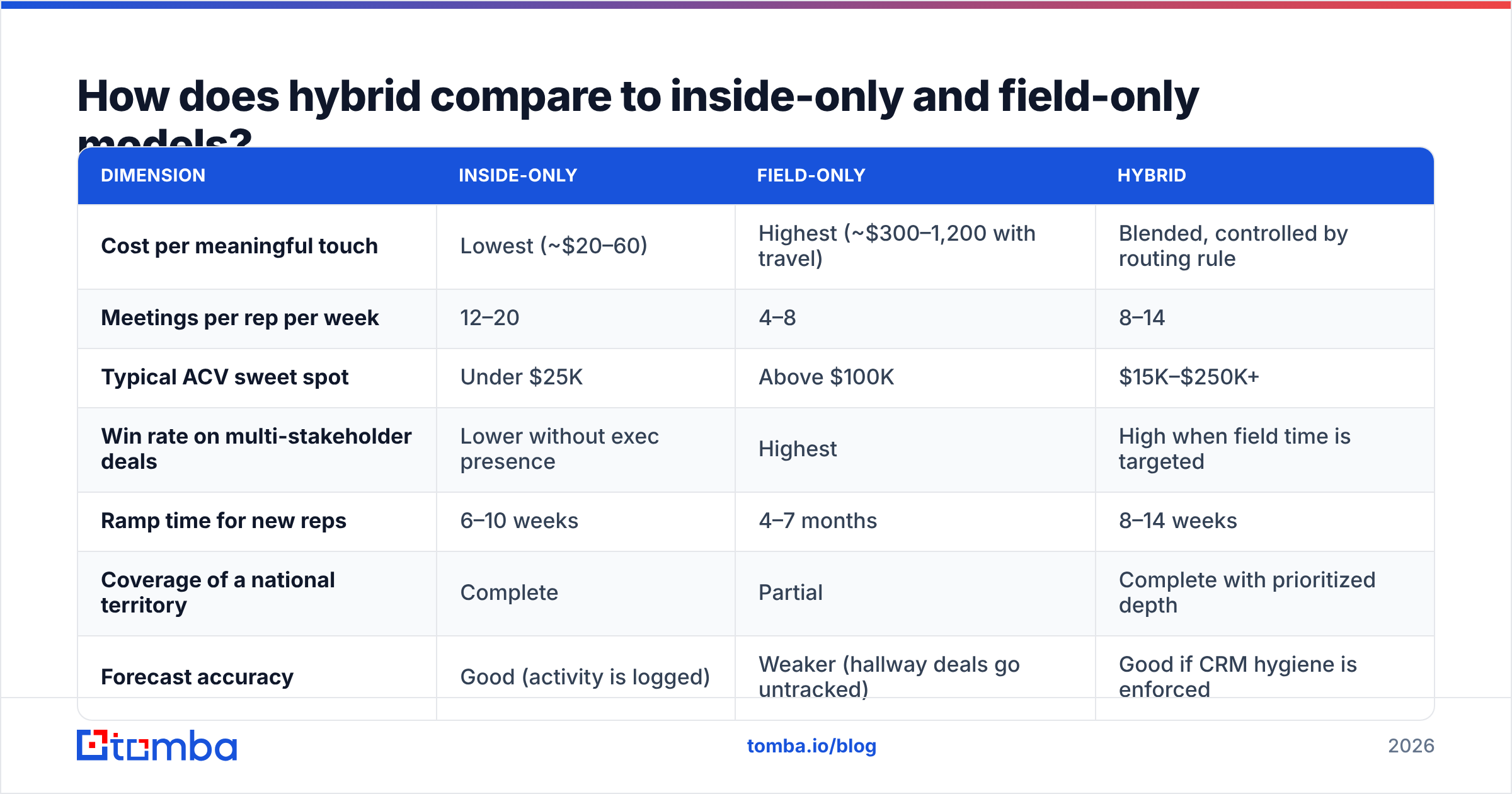
Here's the honest trade-off table. Numbers are directional planning benchmarks — run your own, because industry and ACV move them a lot.
| Dimension | Inside-only | Field-only | Hybrid |
|---|---|---|---|
| Cost per meaningful touch | Lowest (~$20–60) | Highest (~$300–1,200 with travel) | Blended, controlled by routing rule |
| Meetings per rep per week | 12–20 | 4–8 | 8–14 |
| Typical ACV sweet spot | Under $25K | Above $100K | $15K–$250K+ |
| Win rate on multi-stakeholder deals | Lower without exec presence | Highest | High when field time is targeted |
| Ramp time for new reps | 6–10 weeks | 4–7 months | 8–14 weeks |
| Coverage of a national territory | Complete | Partial | Complete with prioritized depth |
| Forecast accuracy | Good (activity is logged) | Weaker (hallway deals go untracked) | Good if CRM hygiene is enforced |
| Biggest failure mode | Stalls at procurement | Burns budget on small deals | Ambiguous ownership at handoff |
| Data dependency | High | Medium | Very high |
The row that decides most debates is the last one. Field reps can compensate for bad data by walking into a building and asking the receptionist. Hybrid teams can't. If your contact records are stale, hybrid amplifies the problem instead of hiding it.
What are the core components of a hybrid sales model?#
Six pieces have to exist before you can call it a model rather than a habit.
- A routing rule. One written sentence that determines channel mix per opportunity. Example: "Deals above $60K ACV with three or more identified stakeholders get one on-site before proposal; everything else stays remote through close."
- Channel-owned stages. Map each pipeline stage to a default channel. Discovery remote, technical validation remote, executive alignment in person, negotiation remote, kickoff in person. Deviating is allowed, but it should require a note.
- Shared account ownership with a single deal owner. More than one person touches the account. Exactly one person owns the number. Write this down before your first comp dispute, not after.
- A common data layer. Every contact, title, verified email, direct dial, and meeting note lives in the CRM, not in a rep's notebook. Hybrid dies without this.
- Asynchronous artifacts. Recorded demos, mutual action plans, shared docs. In a hybrid motion the buyer does most of their work when you're not there, so give them something to work with.
- A field-time budget. Treat on-site visits as a scarce, allocated resource with a quarterly cap per rep. Unlimited travel isn't a perk; it's an unmanaged cost center.
How do you decide which deals earn in-person time?#
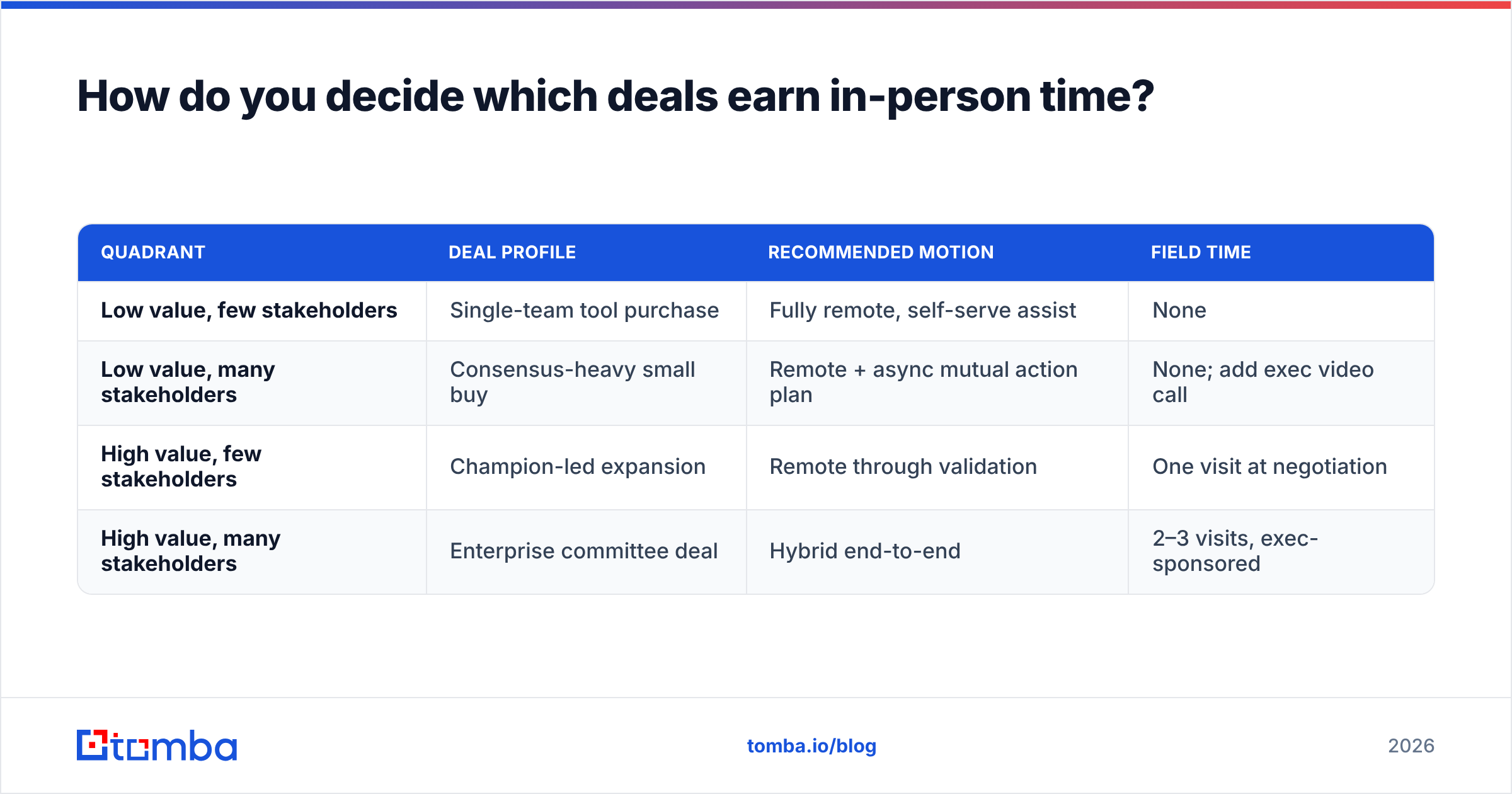
Plot two axes: expected contract value and number of identified stakeholders. Your median on each axis creates four quadrants.
| Quadrant | Deal profile | Recommended motion | Field time |
|---|---|---|---|
| Low value, few stakeholders | Single-team tool purchase | Fully remote, self-serve assist | None |
| Low value, many stakeholders | Consensus-heavy small buy | Remote + async mutual action plan | None; add exec video call |
| High value, few stakeholders | Champion-led expansion | Remote through validation | One visit at negotiation |
| High value, many stakeholders | Enterprise committee deal | Hybrid end-to-end | 2–3 visits, exec-sponsored |
Two refinements that matter in practice:
- Competitive displacement adds a visit. If you're replacing an incumbent, the switching-cost conversation lands better in a room.
- Renewal risk adds a visit. A quiet renewal with a new economic buyer deserves in-person time even if the original sale was remote. That's cheaper than a churn recovery.
A practical constraint: field time only pays off when your pre-meeting data is right. Flying to a meeting where two of the four attendees changed roles last quarter is how travel budgets get cut. Verify the buying group before you book anything — a quick pass through a data enrichment workflow on the account's contact list costs minutes and protects a four-figure trip.
What tooling does a hybrid sales team actually need?#
Skip the 40-logo stack diagram. Five categories carry the load.
Contact data and enrichment. In a field model, proximity generates contacts. In a hybrid model, a database does. You need verified work emails, current titles, and direct dials for buying-group members you've never met. Tomba's email finder and phone finder cover the discovery side; the email verifier keeps bounce rates low enough that your remote channel stays viable. Bounce rates above roughly 3% start damaging sender reputation, and once your domain is throttled, the cheap half of your hybrid model stops working.
Conversation capture. Call recording and transcription for remote meetings, plus a discipline for logging in-person ones. The asymmetry here is real and dangerous: remote conversations are automatically documented, field conversations are not. Hybrid teams systematically under-record their most expensive interactions. Fix it with a mandatory post-visit voice memo within two hours.
Mutual action plans. A shared, dated plan the buyer can edit. This is the async substitute for hallway follow-ups.
Scheduling and routing. Round-robin for inbound, territory logic for outbound, and a travel-aware calendar so field days cluster geographically instead of scattering.
Pipeline analytics segmented by channel. You must be able to answer: what's our win rate on remote-only deals versus deals that got a visit, controlled for deal size? Without that split, you can't tune the routing rule. Both G2 and HubSpot's sales research publish category-level benchmarks worth calibrating against, but your own split matters more.
How should you compensate a hybrid sales team?#
Comp is where most hybrid rollouts break, and it breaks the same way every time: two people believe they earned the same deal.
Three workable structures:
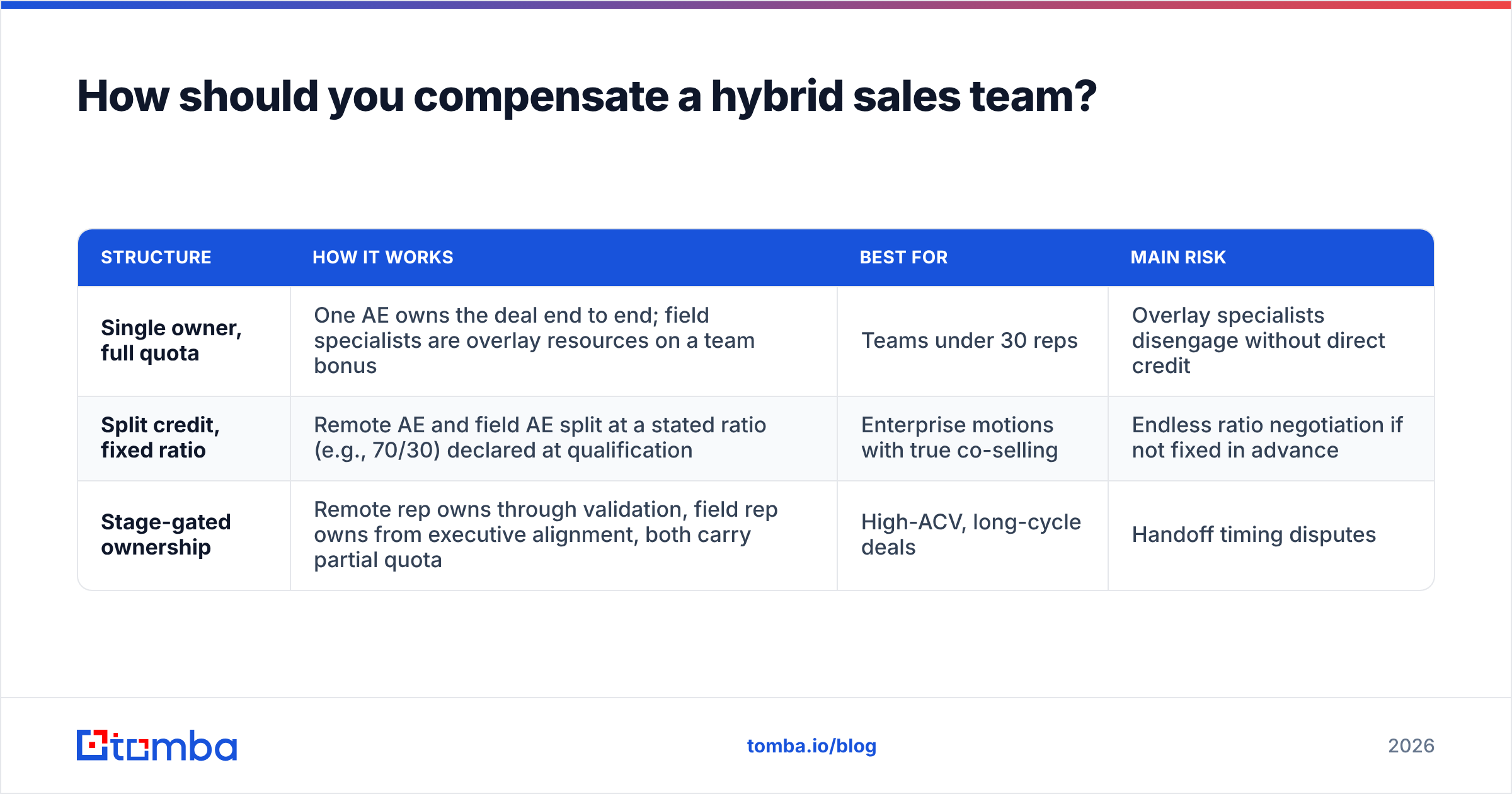
| Structure | How it works | Best for | Main risk |
|---|---|---|---|
| Single owner, full quota | One AE owns the deal end to end; field specialists are overlay resources on a team bonus | Teams under 30 reps | Overlay specialists disengage without direct credit |
| Split credit, fixed ratio | Remote AE and field AE split at a stated ratio (e.g., 70/30) declared at qualification | Enterprise motions with true co-selling | Endless ratio negotiation if not fixed in advance |
| Stage-gated ownership | Remote rep owns through validation, field rep owns from executive alignment, both carry partial quota | High-ACV, long-cycle deals | Handoff timing disputes |
Whichever you pick, three rules hold:
- Declare the split at qualification, never at close. Retroactive splits poison teams faster than a bad quota.
- Pay for the channel behavior you want. If you want field time reserved for large deals, don't pay a travel-heavy accelerator on small ones.
- Cap overlay stacking. When three people can claim credit, your cost of sale silently doubles.
Salesforce's guidance on sales compensation planning is a reasonable starting framework, but the hybrid-specific piece — declaring channel ownership at qualification — is something you have to add yourself.
What metrics tell you if hybrid is working?#
Track five, and track them split by channel mix.
- Win rate delta from field time. Compare deals of similar size with and without an on-site. If the delta is under ~8 points, your field time is being spent on the wrong deals.
- Cost per closed-won by motion. Fully loaded, including travel. This is the number that justifies or kills the model.
- Stage velocity by channel. Where do remote-only deals stall? Usually executive alignment or procurement. That's your field-time insertion point.
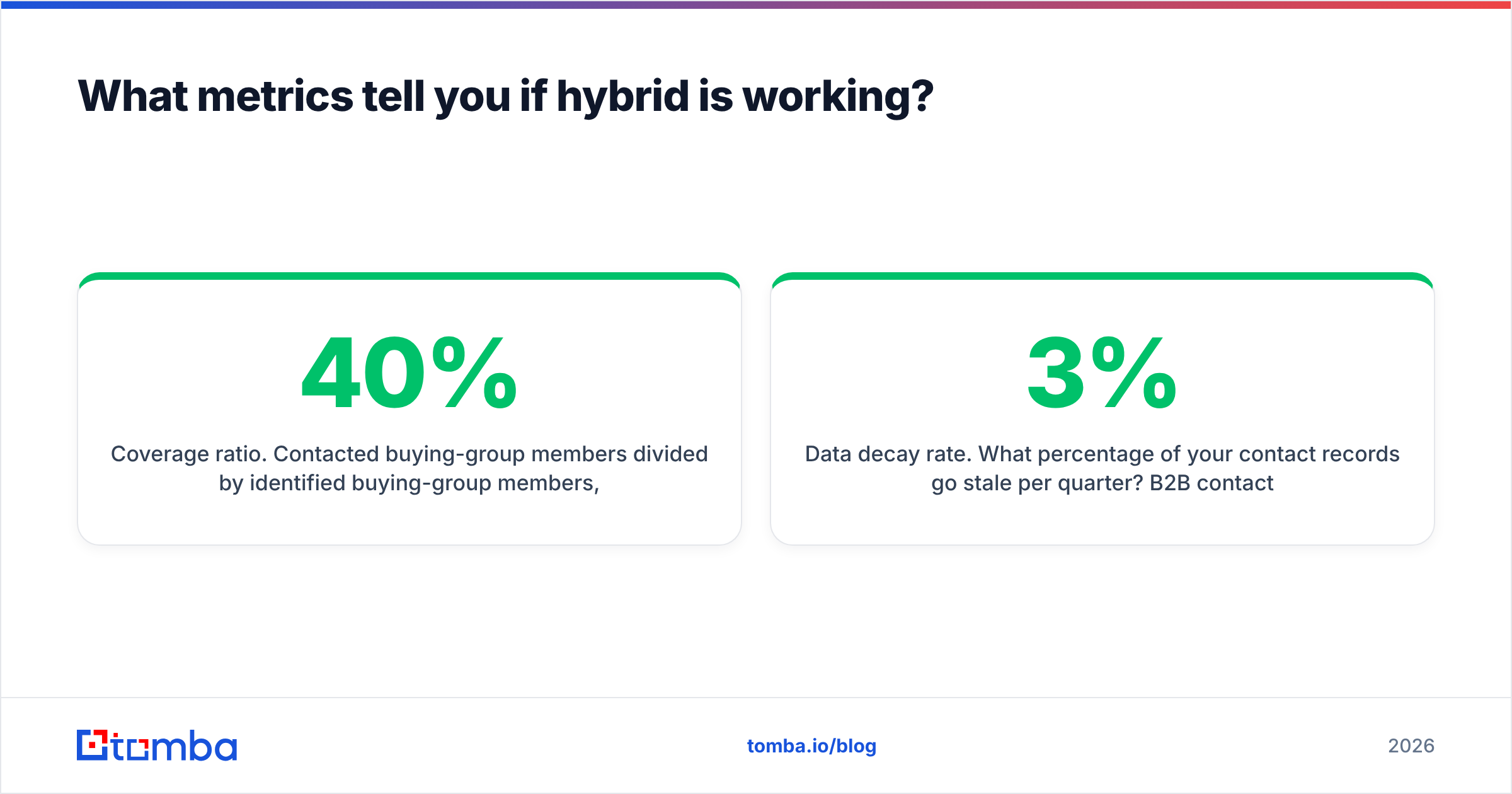
- Coverage ratio. Contacted buying-group members divided by identified buying-group members, per open opportunity. Hybrid teams routinely sit at 40% and don't know it. Anything under 60% on an enterprise deal is a single-threaded risk.
- Data decay rate. What percentage of your contact records go stale per quarter? B2B contact data typically decays around 2–3% per month through job changes alone. If you aren't re-verifying, your remote channel degrades quietly.
The coverage ratio deserves extra attention because it's the metric most specific to hybrid. In a field model, coverage gaps announce themselves — you show up and someone you've never met is in the room. Remotely, you can run an entire cycle with one champion and mistake it for a healthy deal. Running a periodic domain search against target accounts to surface roles you haven't contacted is a cheap way to close that gap before it costs you a quarter.
What are the most common hybrid sales mistakes?#
Treating hybrid as a cost-cutting exercise. Teams that adopt hybrid purely to cut travel budgets usually cut the visits that were working. Hybrid is a reallocation, not a reduction.
Letting the field rep become the "closer." The moment reps believe deals only close in person, remote reps stop trying to close and start creating handoffs. Your remote win rate collapses within two quarters.
Under-investing in data while over-investing in tooling. A polished sequencer firing at unverified addresses is worse than nothing. Verified contact data is the substrate; everything else is an accelerant. If you're evaluating providers, competitors like BookYourData offer strong prepackaged B2B lists, while Tomba leans toward real-time discovery and verification against live domains — different shapes of the same need, and plenty of teams run both.
No written routing rule. Without one, field time gets allocated by whoever asks loudest.
Ignoring the in-person documentation gap. Your CRM shows a complete picture of remote deals and a partial picture of field deals, so your forecast is systematically wrong on exactly the deals that matter most.
Assuming ramp time is the same. Hybrid reps have to be competent in both motions. Budget more onboarding than an inside-sales hire, less than a field hire, and build the field skills second.
Is a hybrid sales model right for your team?#
Run this check. If you answer yes to four or more, hybrid is likely the right structure:
- Your ACV range spans more than 5x between your smallest and largest typical deals.
- Your buying groups regularly include three or more people from different functions.
- Your customers are geographically distributed beyond two or three metros.
- Your current field team spends meaningful time on deals under your median ACV.
- Your remote team stalls at a consistent, identifiable stage.
- Your fully loaded cost of sale has grown faster than ACV for two consecutive years.
If you answered yes to fewer than three, you probably have a channel-optimization problem, not a model problem. Fix the routing before restructuring the org.
And if you're on the fence: hybrid is reversible in a way that a full field build-out is not. You can pilot it on one segment for two quarters, measure the win-rate delta, and expand or retreat. That optionality is worth something.
How do you roll out hybrid in one quarter?#
Weeks 1–2: write the routing rule and get it approved by sales leadership and finance. One sentence.
Weeks 3–4: audit contact data on your top 100 open opportunities. Measure the coverage ratio. This number will be worse than you expect, and it sets your baseline.
Weeks 5–6: assign channel defaults to each pipeline stage in the CRM. Add a required field for "field visit justification" on any on-site.
Weeks 7–9: run the model on one segment. Don't boil the ocean — pick the segment with the clearest ACV band.
Weeks 10–12: pull the win-rate delta and cost-per-closed-won by motion. Adjust the routing rule threshold. Then expand.
The single highest-leverage step in that list is week 3–4. Every downstream decision — who to visit, who to call, which accounts are single-threaded — depends on knowing who's actually in the buying group and whether you can reach them.
Where should you start?#
Start with coverage, because it's the constraint that hybrid exposes fastest. Before you redesign comp plans or rebuild territories, find out how many people in each open buying group you can actually contact today.
Tomba's Email Finder surfaces verified professional email addresses by name, company, or domain, so you can map an entire buying committee before deciding whether it deserves a plane ticket. Pair it with the email verifier to keep your remote channel deliverable, and check Tomba pricing — the free tier gives you 25 searches a month to audit a sample of accounts, and paid plans start at $49/mo when you're ready to run it across the whole pipeline.
Get the coverage number first. The model design gets much easier once you know what you're actually working with.
Related guides#
// get started
Find, verify and enrich your first contacts today
Start on the free plan with 25 searches a month, then scale when your team is ready.
Free plan · No credit card required · GDPR & CCPA
// about the author