Hyper Personalization AI in 2026: What Actually Works
Hyper personalization AI is sold as 1:1 outreach at infinite scale. Some of it works, most of it is a mail-merge with extra steps. Here is the data layer, tool stack, and workflow that actually move reply rates.
TL;DR
- Hyper personalization AI means generating outreach from live, per-prospect signals — funding, hiring, tech stack, product changes — instead of swapping
{{first_name}}into a template. - The AI layer is the cheap part. The expensive, decisive part is the data layer: verified contacts plus structured signals. Bad inputs produce fluent, confident nonsense at scale.
- Realistic lift over a good generic sequence is roughly 1.5x–3x on reply rate, not the 10x you see in demo screenshots.
- Tool budgets in 2026 split into three layers — data ($49–$249/mo), signal/orchestration ($149–$800/mo), and sending ($30–$100/mo per inbox pool). Buying layer two before layer one is the most common way teams waste money.
- Personalization has a ceiling. Past ~2 relevant details per email, reply rates flatten and creepiness starts costing you meetings.
What is hyper personalization AI?#
Hyper personalization AI is the use of language models plus real-time data signals to write outreach that is specific to one company and one person, produced automatically at list scale.
The everyday version: a mail merge is a photocopier that changes the name on the top of the page. Hyper personalization is a researcher who reads the prospect's last earnings call, notices they just hired three data engineers, and writes two sentences no other prospect could receive. AI does not replace the researcher — it replaces the typing. The research still has to come from somewhere real.
Technically, three components have to be present or it is not hyper personalization:
- A resolved contact record. A verified email, role, seniority, and company domain. Without this, everything downstream is guesswork addressed to a bouncing inbox.
- At least one time-bound signal. Funding round, job posting, new integration, executive hire, pricing page change, conference attendance. "They're in SaaS" is a segment, not a signal.
- A generation step constrained by that signal. The model gets the signal as structured input and is forbidden from inventing details it was not given.
Drop any one of the three and you are running spray-and-pray with better grammar.

Why did generic personalization stop working?#
Because buyers pattern-matched the tokens. When 80% of the cold email a VP of Engineering receives opens with "I saw you're the VP of Engineering at Acme," the phrase stops signaling effort and starts signaling automation.
Three structural changes compounded this between 2023 and 2026:
- Volume exploded. AI writing tools made it trivial to send 10,000 personalized-looking emails a week. Inbox scarcity did the rest.
- Filtering got smarter. Google and Yahoo's bulk sender requirements pushed authentication and complaint-rate thresholds into hard gates. Poor targeting now costs you deliverability, not just replies. Google's own bulk sender guidelines are the current baseline, and complaint rates above 0.3% get you throttled regardless of how clever your copy is.
- Buyers consolidated. Gartner's B2B buying research has consistently found buyers spend the minority of their journey with any single vendor's sales team. You are competing for a narrow attention window, and a generic opener burns it in one line.
The result: personalization that used to be a differentiator is now table stakes, and the bar moved from "mentions my name" to "clearly understands what my team is doing this quarter."
What does hyper personalization AI actually need to run?#
Here is the honest dependency chain, in order. Skipping a step does not save time — it just moves the failure downstream where it is more expensive.
- Verified contact data. Emails that resolve, at the right seniority, with correct company mapping. This is the foundation and the single largest determinant of campaign outcome. Run every list through an email verifier before a single AI token is spent — generating 5,000 beautiful emails to a list with 22% bounce is pure waste.
- Firmographic and technographic enrichment. Headcount, funding stage, industry, tech stack, revenue band. This is what lets the model pick the right angle, not just the right facts. Data enrichment turns a bare email into a record a model can reason over.
- A live signal feed. Job boards, funding databases, news, review-site activity, product changelogs. Signals decay fast — a funding round is worth mentioning for about six weeks, a job posting for about three.
- A constrained prompt layer. Your prompt should pass structured fields and explicitly instruct the model to reference only those fields. "Write a personalized email to a CTO" is how you get hallucinated product features.
- A human review gate — at first. Sample 50 outputs per new segment before scaling. Approve the pattern, not each email.
- Deliverability infrastructure. SPF, DKIM, DMARC, warmed domains, sane daily volume. Hyper personalization improves replies; it does not exempt you from authentication.
Note the ordering. Most teams buy a shiny generation tool (step 4) and then discover their step 1 is broken.
Which hyper personalization AI tools are worth it in 2026?#
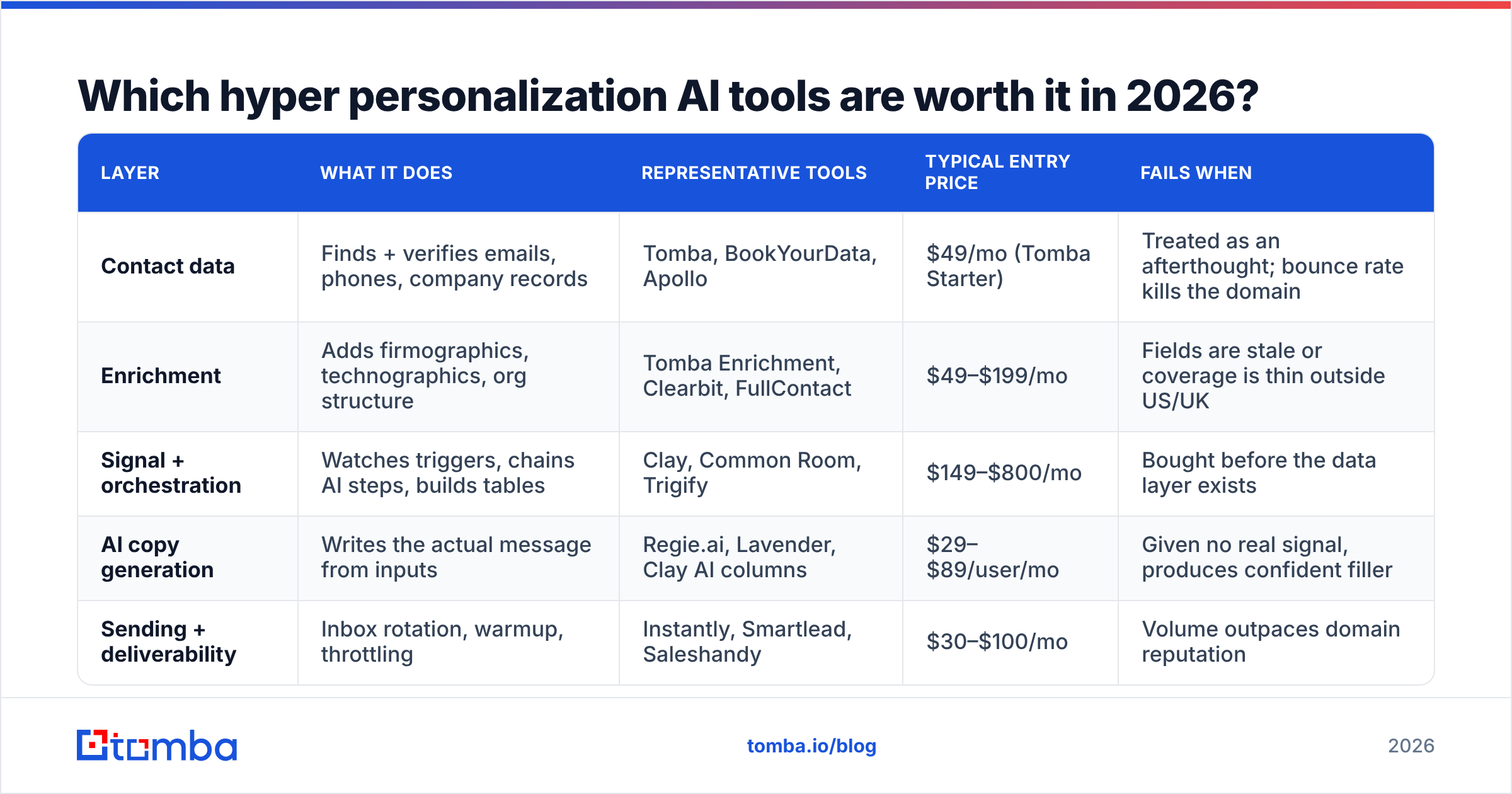
The market splits into layers that get confused with each other constantly. A signal-orchestration platform is not a data provider, and neither is a sequencer. Here is how the categories compare on the attributes that matter when you are actually writing a check.
| Layer | What it does | Representative tools | Typical entry price | Fails when |
|---|---|---|---|---|
| Contact data | Finds + verifies emails, phones, company records | Tomba, BookYourData, Apollo | $49/mo (Tomba Starter) | Treated as an afterthought; bounce rate kills the domain |
| Enrichment | Adds firmographics, technographics, org structure | Tomba Enrichment, Clearbit, FullContact | $49–$199/mo | Fields are stale or coverage is thin outside US/UK |
| Signal + orchestration | Watches triggers, chains AI steps, builds tables | Clay, Common Room, Trigify | $149–$800/mo | Bought before the data layer exists |
| AI copy generation | Writes the actual message from inputs | Regie.ai, Lavender, Clay AI columns | $29–$89/user/mo | Given no real signal, produces confident filler |
| Sending + deliverability | Inbox rotation, warmup, throttling | Instantly, Smartlead, Saleshandy | $30–$100/mo | Volume outpaces domain reputation |
Two practical notes on this table.
On data layers. Tomba and BookYourData approach the same problem differently and both are legitimate choices — BookYourData sells curated, pay-as-you-go lists with a strong verified-on-download guarantee, which suits teams doing episodic campaigns. Tomba is subscription and API-first, which suits teams enriching continuously inside a workflow. If your motion is "one list per quarter," a credit pack is simpler. If your motion is "every inbound signup gets enriched in under a second," you want an email finder API. Pick by motion, not by brand loyalty.
On orchestration. Clay and similar table-based platforms are genuinely powerful and genuinely expensive. They are waterfall enrichment engines with AI columns bolted on — meaning they call other providers' APIs and bill you for the credits. If your data layer is already solid, orchestration multiplies it. If it isn't, orchestration multiplies the mess.
How much lift should you actually expect?#
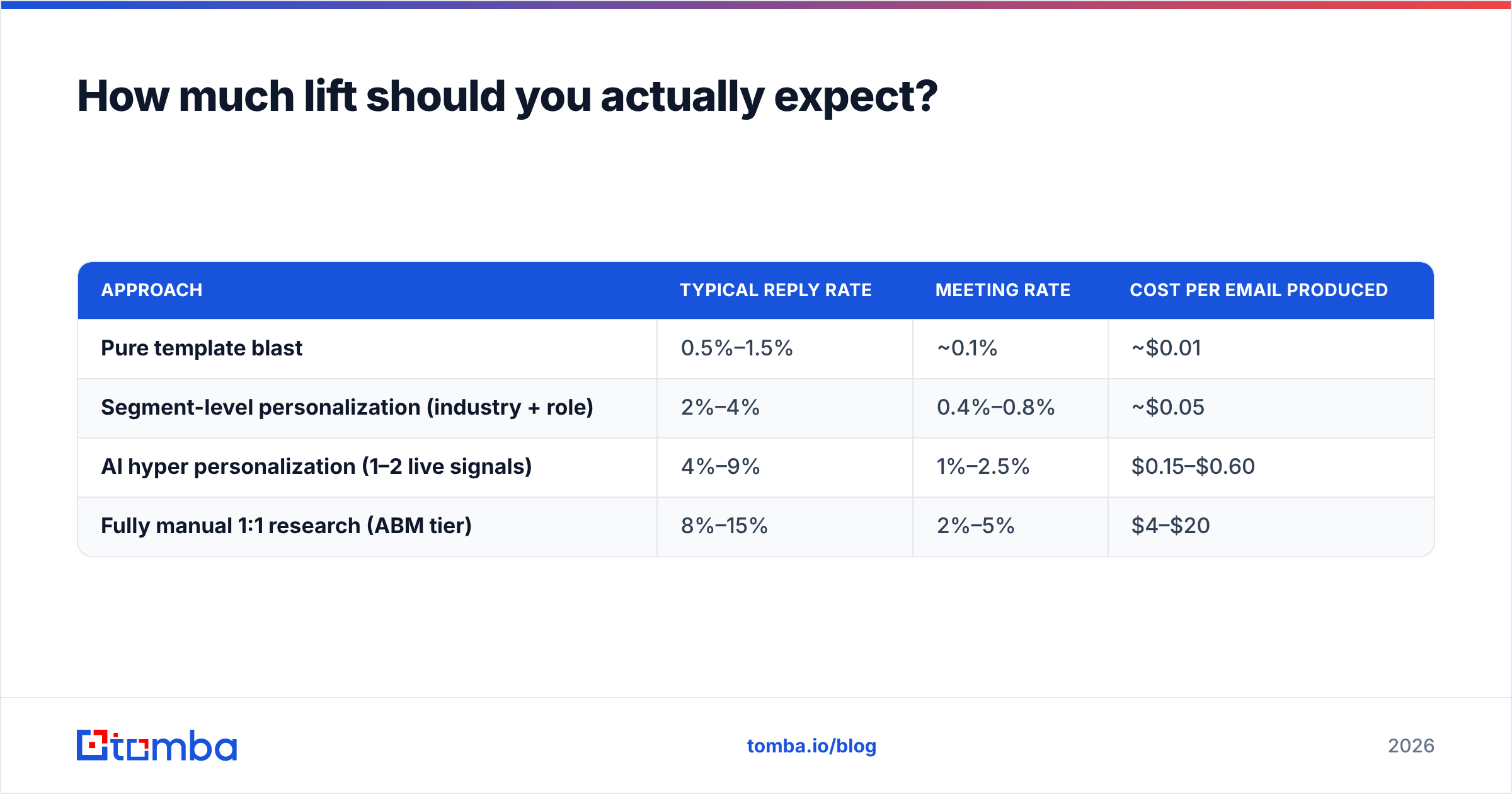
Set expectations before you set budgets. Across the outbound teams publishing real numbers, the pattern is consistent:
| Approach | Typical reply rate | Meeting rate | Cost per email produced |
|---|---|---|---|
| Pure template blast | 0.5%–1.5% | ~0.1% | ~$0.01 |
| Segment-level personalization (industry + role) | 2%–4% | 0.4%–0.8% | ~$0.05 |
| AI hyper personalization (1–2 live signals) | 4%–9% | 1%–2.5% | $0.15–$0.60 |
| Fully manual 1:1 research (ABM tier) | 8%–15% | 2%–5% | $4–$20 |
The interesting row is the third. Hyper personalization AI captures most of the manual-research lift at roughly 3% of the cost. That is the actual business case — not that it beats a human researcher, but that it gets close enough at a price that lets you run it across 2,000 accounts instead of 40.
What it does not do is rescue a bad offer. If your response rate is near zero on a well-targeted list, personalization is not your bottleneck; your value proposition is. AI will happily generate 5,000 elegantly worded versions of a message nobody wants.
What does a hyper-personalized sequence look like in practice?#
Concrete example. Target: Head of Data at a Series B fintech that just posted three analytics engineer roles.
Weak (token merge):
Hi Sarah, I saw you're Head of Data at Northwind. We help data teams move faster. Open to a chat?
Strong (signal-driven):
Hi Sarah — three analytics engineer roles open at Northwind in six weeks usually means the warehouse is outgrowing the team, not the other way round. Two other Series B fintechs we work with hit the same wall right after their Snowflake spend doubled. Worth 15 minutes on how they cut model runtime before hiring seat four?
The second email uses exactly two facts (job postings, funding stage) plus one inference. It does not list her career history. It does not mention her alma mater. That restraint is deliberate — and it is the part most AI setups get wrong.
A workable production flow:
- Trigger: job-board scrape flags 3+ relevant roles at a target account.
- Resolve: domain search pulls the decision-maker at that account, verified.
- Enrich: funding stage, headcount, current data stack appended.
- Generate: model receives those five fields and a strict instruction set, returns a 60-word opener.
- Review: first 50 per segment reviewed by a human; approved patterns run unattended.
- Send: throttled across a warmed inbox pool, 30–50/day/inbox.
Where does hyper personalization AI fail?#
Four recurring failure modes, in order of how much damage they do.
Hallucinated specifics. The model invents a product launch, a headcount number, or a quote. One fabricated detail in a cold email to a VP does more brand damage than fifty ignored generic emails. Fix: pass only structured fields, forbid free-form inference in the prompt, and reject any output containing a number that was not in the input.
Creepy over-reach. Referencing someone's marathon time, their kid's school, or a five-year-old blog comment reads as surveillance, not research. Stay at the professional-signal layer. If the fact would not appear in a trade publication, leave it out.
Signal decay. Personalizing on a funding round from 14 months ago is worse than not personalizing — it proves your data is stale. Timestamp every signal and expire it.
Deliverability collateral. Higher personalization tempts teams into higher volume, which is exactly backwards. Every extra unverified send degrades sender reputation for the whole domain. Personalization should let you send fewer, better emails — that's the point.
There is also a compliance dimension worth naming. GDPR and similar regimes treat enrichment-derived profiling as processing that needs a lawful basis, and "we scraped it" is not one. HubSpot's overview of GDPR for sales teams is a reasonable starting point if your list touches EU contacts. Buyer-side reviews on G2 also increasingly flag data-provenance questions in vendor evaluations — expect procurement to ask.
How do you build the stack without overspending?#
Sequence the spend. A workable 90-day build for a team of 3–5 reps:
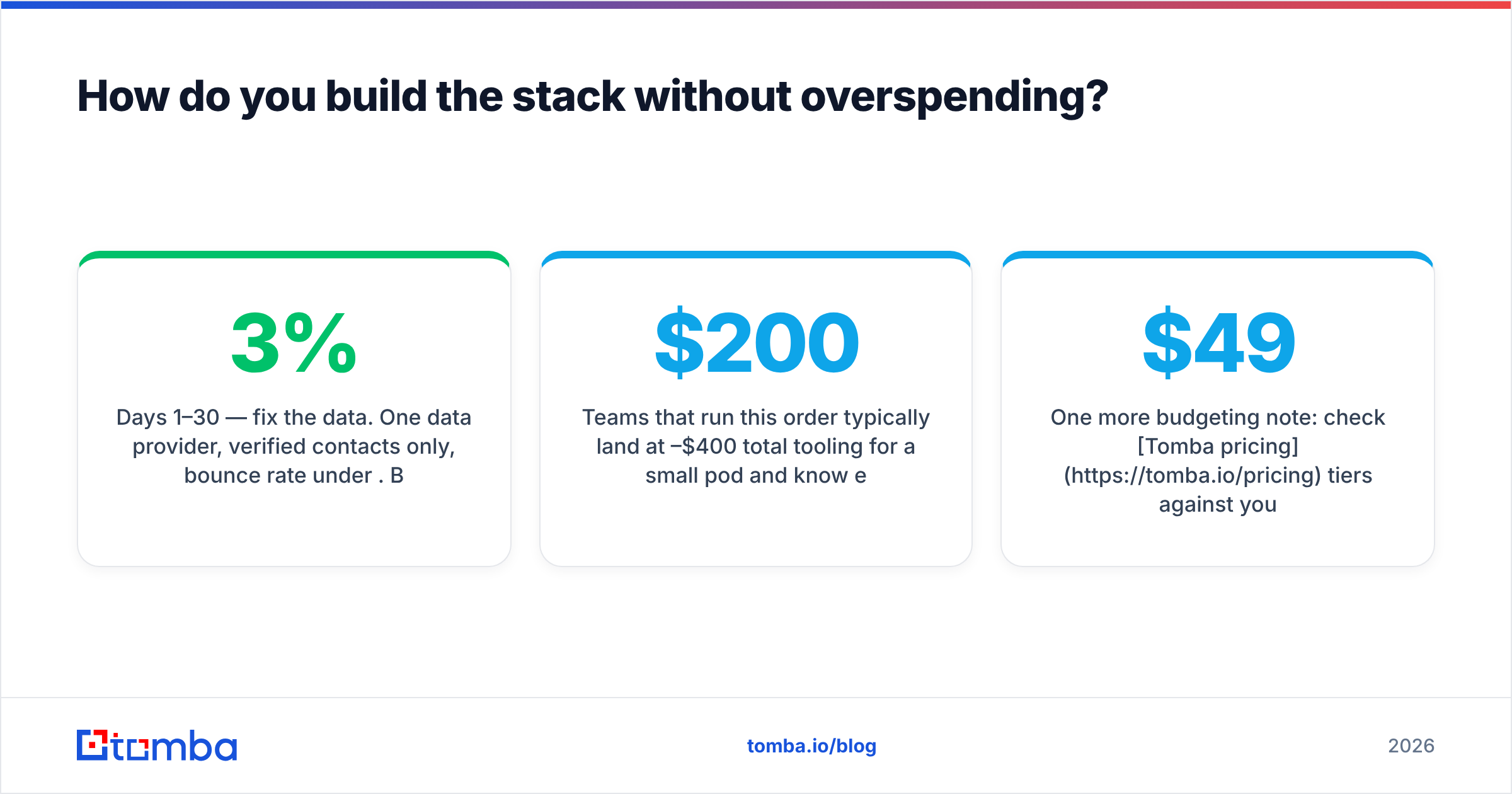
- Days 1–30 — fix the data. One data provider, verified contacts only, bounce rate under 3%. Budget: ~$49–$99/mo. Do not add AI yet. Run your existing sequence against a clean list and record the baseline. You cannot prove lift without one.
- Days 31–60 — add one signal. Pick the single trigger most correlated with your best closed-won deals. Usually hiring or funding. Build one segment around it. Measure against the baseline.
- Days 61–90 — add generation. Now introduce the AI copy layer, constrained to the fields you already trust. Add orchestration only if you have more than three signal types to manage.
Teams that run this order typically land at $200–$400/mo total tooling for a small pod and know exactly which layer produced which lift. Teams that buy the $800/mo orchestration platform in week one usually cannot answer that question a quarter later.
One more budgeting note: check Tomba pricing tiers against your actual monthly enrichment volume rather than your aspirational one. The Free tier's 25 searches/month is enough to validate match rates on your ICP before committing; Starter at $49/mo covers most sub-10-rep teams; Growth at $99/mo and Pro at $249/mo make sense once enrichment is running continuously through an API rather than in batches.
Is hyper personalization AI worth it for your team?#
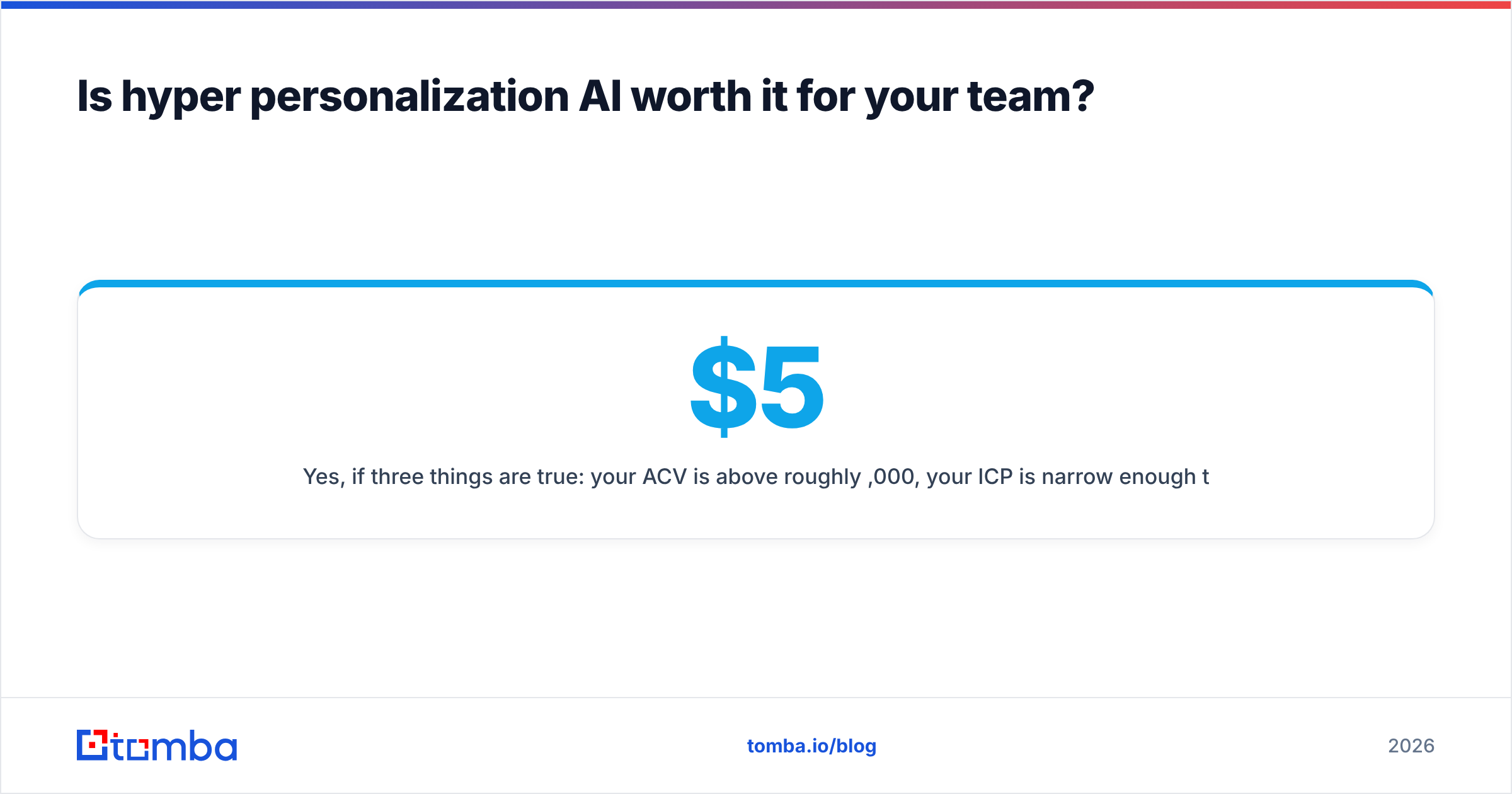
Yes, if three things are true: your ACV is above roughly $5,000, your ICP is narrow enough that signals are meaningful, and your data layer is already clean. Under those conditions the math is straightforward — a 2x reply-rate improvement at a $0.30 marginal cost per email pays for itself inside one campaign.
No, if you are selling a low-ACV product to a broad market, or if you are hoping personalization will compensate for a list you have not verified. In the first case the unit economics do not clear. In the second case you are decorating a broken foundation.
The honest summary: hyper personalization AI is a multiplier, not an engine. It multiplies whatever your targeting and data quality already are. Point it at a verified, well-segmented list with real signals attached and it produces outreach a human would be proud to have written. Point it at a scraped CSV and it produces 5,000 fluent, confident, undeliverable emails — faster than any human could.
Start with the layer everything else depends on. The Tomba Email Finder resolves verified professional emails by domain, name, or company, with verification and enrichment sitting in the same workflow — so the records feeding your AI layer are correct before a single prompt runs. Free tier covers 25 searches a month, which is enough to check match rates against your own ICP before you commit to anything. Fix the inputs first; the personalization gets easy after that.
Related guides#
Ready to find emails that actually work?
Join 150,000+ professionals who stopped guessing and started sending. Free credits on signup — no credit card required.
Get the Tomba newsletter
Practical outbound tactics and product updates — once every two weeks.
About the author