9 Best Hyperise Alternatives in 2026 for Personalized Outreach
Hyperise pioneered personalized images in cold email, but it is no longer the only option. Here are nine alternatives compared on pricing, personalization depth, and the data layer that actually decides your reply rate.
TL;DR
- Hyperise is an image and website personalization layer for outbound — dynamic screenshots, logos, and name overlays injected into cold emails and landing pages.
- People leave it for three reasons: per-seat pricing that scales badly for agencies, image-heavy emails hurting deliverability, and the fact that it does not supply contact data.
- The strongest alternatives split into three camps: all-in-one sequencers with built-in personalization (lemlist, Smartlead), image/video generation APIs (Bannerbear, Placid, Nexweave, Sendspark), and AI text personalization (Warmer.ai, Twain-style writers).
- If your reply rate is flat, the personalization layer is usually not the bottleneck. Bad or unverified contact data is.
- Cheapest realistic stack for most teams in 2026: a verified data source plus a sequencer with native merge-tag images. You often do not need a dedicated personalization tool at all.
What is Hyperise, and why are people looking for alternatives?#
Hyperise is a personalization engine, not a sending tool. You build an image template — a mockup laptop, a billboard, a coffee cup — then drop dynamic layers on top: the prospect's first name, company logo, a live screenshot of their website. The tool generates a unique image URL per contact and you embed that URL in your cold email, LinkedIn message, or landing page.
It works. Personalized images were genuinely novel in 2019 and they still earn attention when used sparingly. But the market has moved, and four complaints show up consistently in review sites like G2 and in outbound communities:
1. Pricing scales by integration and seat, not by value. Small teams pay for capacity they never use; agencies running dozens of client accounts hit ceilings fast.
2. Image-heavy cold email is a deliverability liability. Every externally hosted image is a tracking-shaped object to a spam filter. Gmail and Outlook have both tightened bulk-sender rules since 2024, and a first-touch email that is 60% image is a soft target.
3. It does not solve the hard part. Hyperise personalizes a message to a contact you already have. It does not find the contact, verify the address, or tell you whether the domain is a catch-all.
4. Novelty decay. In 2020 a mockup image with a prospect's logo felt custom. In 2026 buyers have seen the template. The lift is real but smaller than it was, and it inverts when the image is obviously automated.
So the question is not really "what replaces Hyperise". It is "what part of the job do I actually need to buy".
What should a Hyperise alternative actually do?#
Before you shortlist anything, score candidates against the six jobs a personalization stack has to cover. Most tools do two or three well and none do all six.
- Dynamic asset generation — produce a unique image, video thumbnail, or landing page per contact, at API speed, without manual design work per lead.
- Data binding — accept variables from your CSV, CRM, or enrichment API and fail gracefully when a field is empty. A template that renders "Hi {{firstName}}," is worse than no personalization at all.
- Deliverability safety — serve assets from a reputable domain, keep file sizes small, and let you A/B a text-only variant against the image variant.
- Sequencing or clean handoff — either send the emails itself or integrate cleanly with the tool that does (Smartlead, Instantly, HubSpot, Salesforce).
- Fallback logic — when a logo or screenshot cannot be fetched, substitute a generic asset rather than shipping a broken image box.
- Per-client isolation — agencies need workspaces, separate billing, and white-label asset domains. This is where most cheap tools fall apart.
Hyperise scores well on 1, 2, and 5. It is average on 3 and 6, and it does not attempt 4 or the data problem beneath all of it.
Which Hyperise alternatives are worth testing in 2026?#
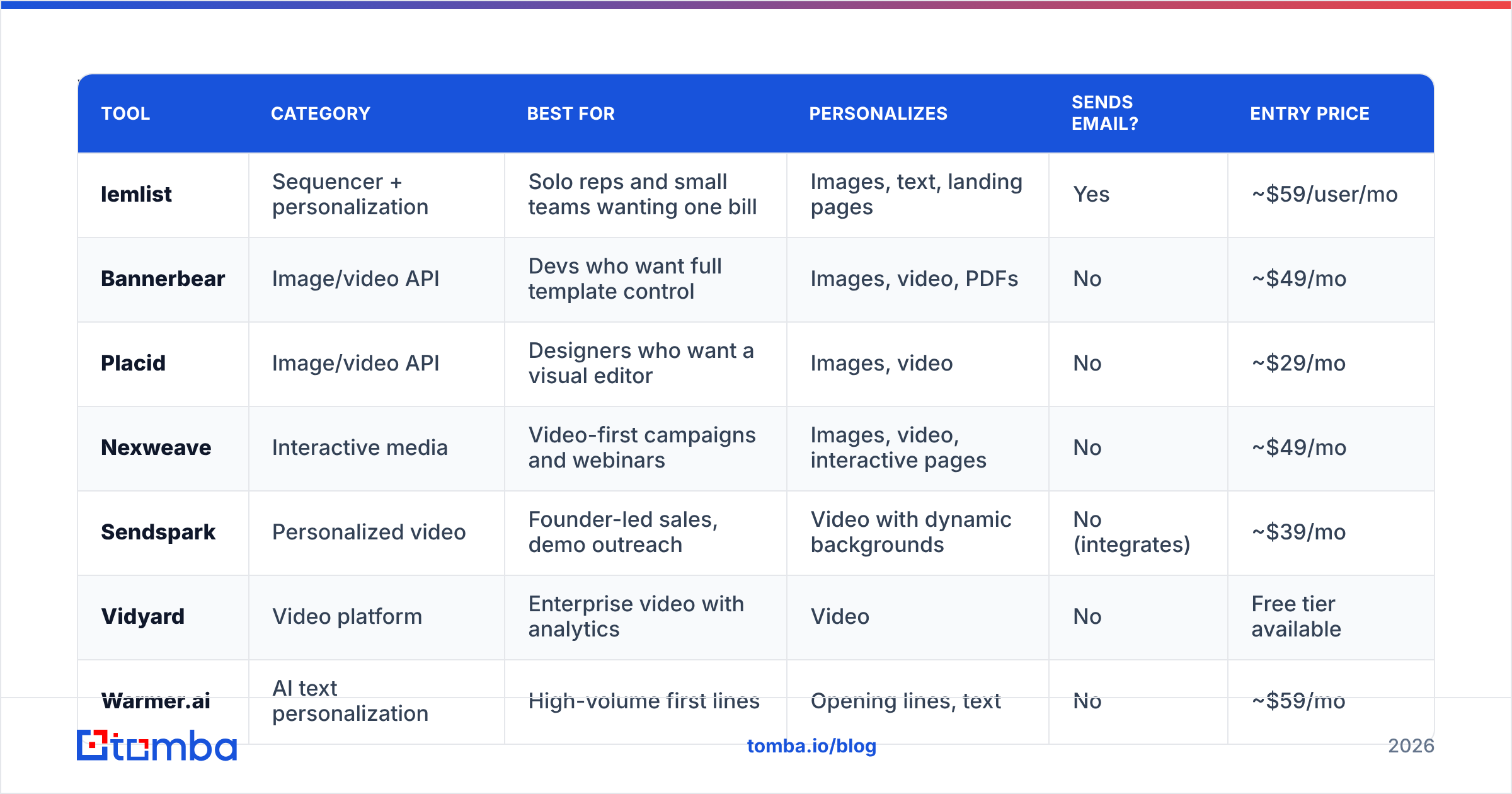
Here is the shortlist, grouped by what they replace.
| Tool | Category | Best for | Personalizes | Sends email? | Entry price |
|---|---|---|---|---|---|
| lemlist | Sequencer + personalization | Solo reps and small teams wanting one bill | Images, text, landing pages | Yes | ~$59/user/mo |
| Bannerbear | Image/video API | Devs who want full template control | Images, video, PDFs | No | ~$49/mo |
| Placid | Image/video API | Designers who want a visual editor | Images, video | No | ~$29/mo |
| Nexweave | Interactive media | Video-first campaigns and webinars | Images, video, interactive pages | No | ~$49/mo |
| Sendspark | Personalized video | Founder-led sales, demo outreach | Video with dynamic backgrounds | No (integrates) | ~$39/mo |
| Vidyard | Video platform | Enterprise video with analytics | Video | No | Free tier available |
| Warmer.ai | AI text personalization | High-volume first lines | Opening lines, text | No | ~$59/mo |
| Smartlead | Sequencer at scale | Agencies running many inboxes | Spintag/merge text, image URLs | Yes | ~$39/mo |
| Tomba | Data layer | Everyone — feeds every tool above | Contact data, not pixels | No | Free tier, then $49/mo |
Prices are list prices at the time of writing and change often. Always confirm on the vendor's own pricing page before you budget.
lemlist — the closest like-for-like swap#
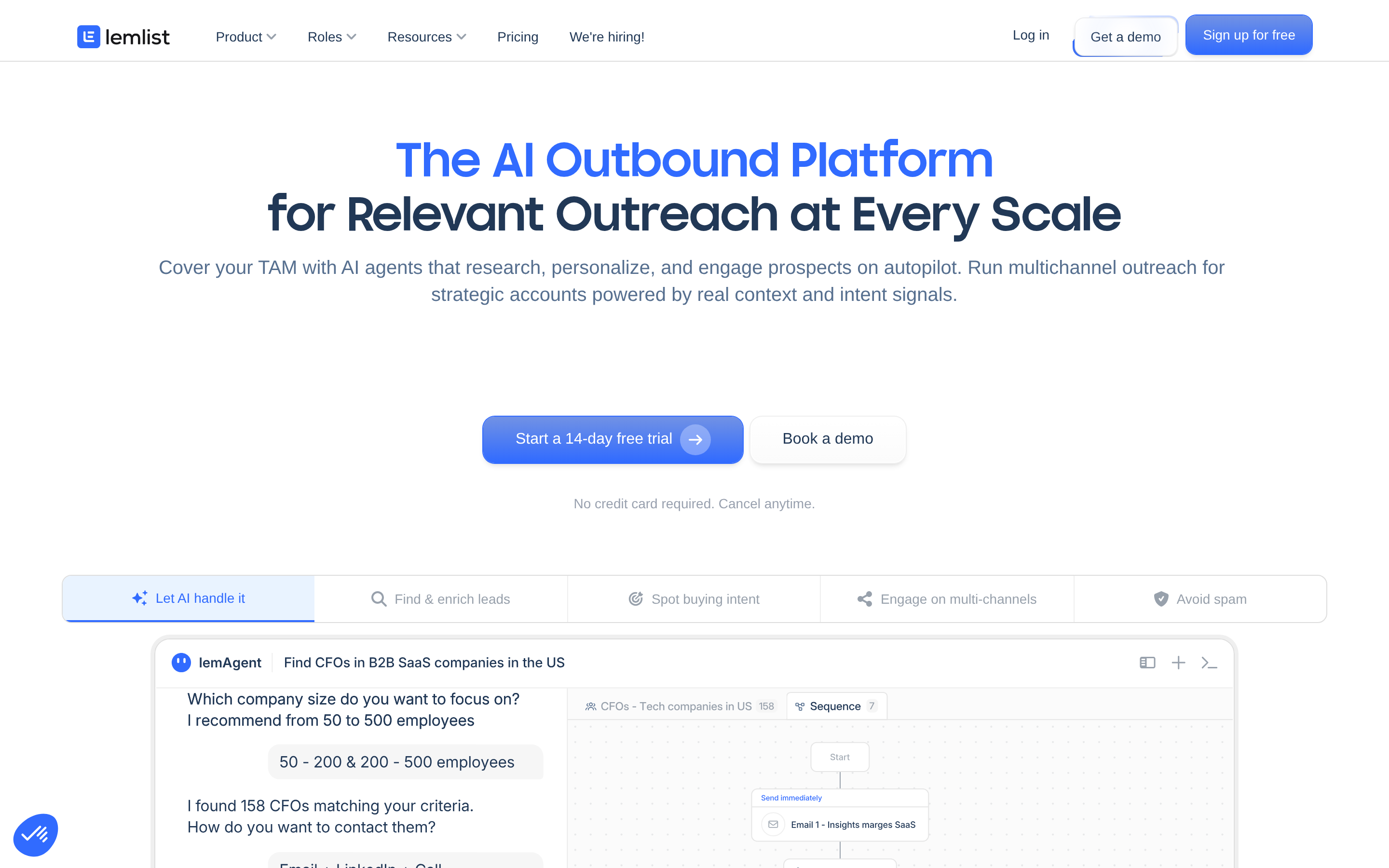
lemlist built image personalization directly into its sequencer years ago, which makes it the most direct Hyperise substitute if you also need sending. You get dynamic image text, logo insertion, custom landing pages, and liquid-syntax conditionals in the same tool that runs your sequence and warms your inbox.
The trade-off is per-seat pricing. One rep is fine. A five-person team plus an SDR contractor gets expensive quickly, and the image editor is less flexible than a dedicated design tool.
Pick it if: you want one bill, one login, and personalization that is good enough rather than pixel-perfect.
Bannerbear and Placid — the API route#
Both generate images and short videos from templates via API. You design once, then POST a payload of variables and get back a hosted URL. Bannerbear leans developer-first with strong docs and Zapier support; Placid leans designer-first with a friendlier editor and lower entry pricing.
Neither knows anything about cold email. There is no logo scraping, no website screenshot layer, no fallback logic tuned for outbound. You build that yourself. In exchange you get unlimited creative control and per-image costs that drop hard at volume.
Pick it if: you have someone who can write a script or wire up a Make/Zapier scenario, and you are generating thousands of assets a month.
Nexweave and Sendspark — when video beats a static image#
Static mockups have novelty decay. Video does not, yet. Nexweave produces interactive images and videos with dynamic layers; Sendspark records one video and swaps the background, browser tab, or intro card per prospect.
The catch is production cost. Personalized video needs a human on camera for the base recording and a reason for the recipient to press play. It works beautifully for founder-led sales into 200 named accounts. It falls apart at 5,000 sends.
Pick it if: your ACV justifies a human recording, and your list is small and named.
Warmer.ai — personalize the words, not the pixels#
A different bet entirely: instead of a picture, generate a genuinely researched first line from the prospect's LinkedIn or website. Warmer.ai and similar AI writers read the source, produce one or two custom sentences, and hand back a CSV column you merge into any sequencer.
This sidesteps the deliverability problem completely. Text-only emails render everywhere, load instantly, and do not trip image-blocking rules. The risk is generic output. If every "personalized" line reads "I noticed you're scaling your GTM team", you have automated the appearance of effort without the effort.
Pick it if: deliverability is your constraint and you send at volume.
Smartlead — scale and inbox rotation#
Smartlead is not a personalization tool, it is an infrastructure tool. Unlimited mailboxes, rotation, warmup, and per-client workspaces at a price agencies can absorb. Personalization is merge tags and spintax, plus any image URL you paste in from Bannerbear or Placid.
Pick it if: you run outbound for multiple clients and the personalization layer is a component, not the product.
How do the top options compare on the things that break campaigns?#
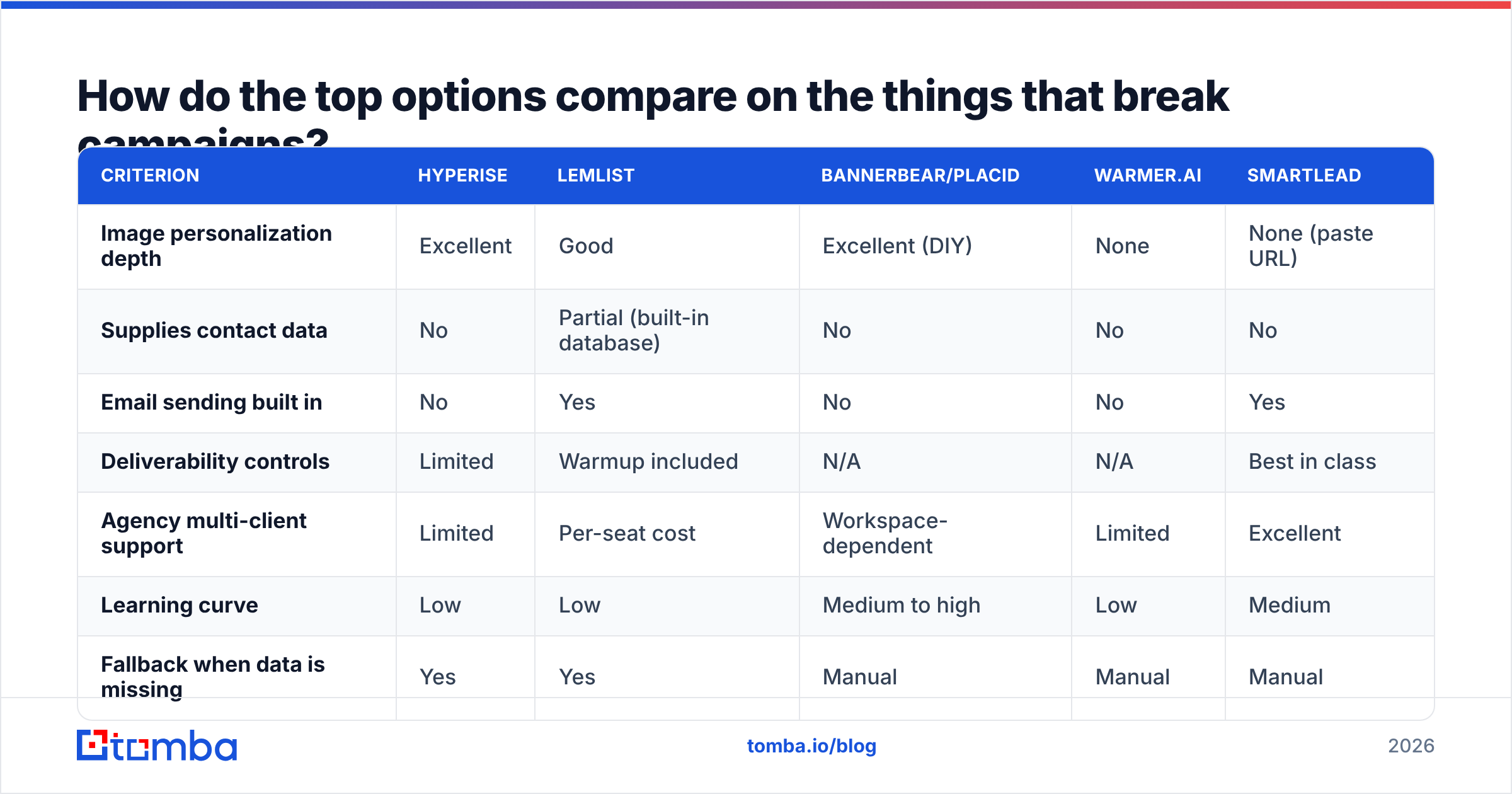
Feature lists lie. Here is the comparison that predicts whether a campaign works.
| Criterion | Hyperise | lemlist | Bannerbear/Placid | Warmer.ai | Smartlead |
|---|---|---|---|---|---|
| Image personalization depth | Excellent | Good | Excellent (DIY) | None | None (paste URL) |
| Supplies contact data | No | Partial (built-in database) | No | No | No |
| Email sending built in | No | Yes | No | No | Yes |
| Deliverability controls | Limited | Warmup included | N/A | N/A | Best in class |
| Agency multi-client support | Limited | Per-seat cost | Workspace-dependent | Limited | Excellent |
| Learning curve | Low | Low | Medium to high | Low | Medium |
| Fallback when data is missing | Yes | Yes | Manual | Manual | Manual |
Read the second row carefully. Every tool on this list assumes you already have a clean list of verified addresses with company domains attached. None of them produce one.
Does image personalization still lift reply rates in 2026?#
Yes, but the effect is conditional and smaller than the case studies from 2019 suggest.
Personalized images help when three things are true: the image contains information the prospect could not have expected you to know, it loads fast, and the surrounding copy is not generic. A mockup with a scraped screenshot of their pricing page next to a sentence referencing what you saw there is a coherent message. The same mockup next to "Hope this finds you well" is a costume.
They hurt when the email is image-first. Filters weigh the text-to-image ratio, external image hosts carry reputation of their own, and many corporate Outlook installs still block remote images by default — which means a large share of recipients see an empty rectangle where your entire value proposition used to be. Always write the email so it works with images disabled.
The honest hierarchy of impact on reply rate, from largest to smallest:
- Whether the address is valid and the person still works there — a bounce is a zero, and bounces compound into domain damage.
- Whether the offer matches the segment — right person, wrong problem, no reply.
- Whether the copy is short and specific — under 90 words beats clever.
- Whether there is a personalized image — a real but marginal lift on top of the three above.
Do you need personalization software, or better data first?#
Run this diagnostic before you buy anything.
Pull your last 1,000 sends. Calculate bounce rate. If it is above 3%, stop shopping for personalization tools — you have a data problem, and every dollar spent on pixels is being poured into a leaky bucket. Fix the list first with an email verifier, then revisit.
If bounce rate is clean and reply rate is still under 2%, look at segmentation and offer before creative. If reply rate is healthy and you want incremental lift on a high-value segment, that is the moment personalized images or video earn their subscription.
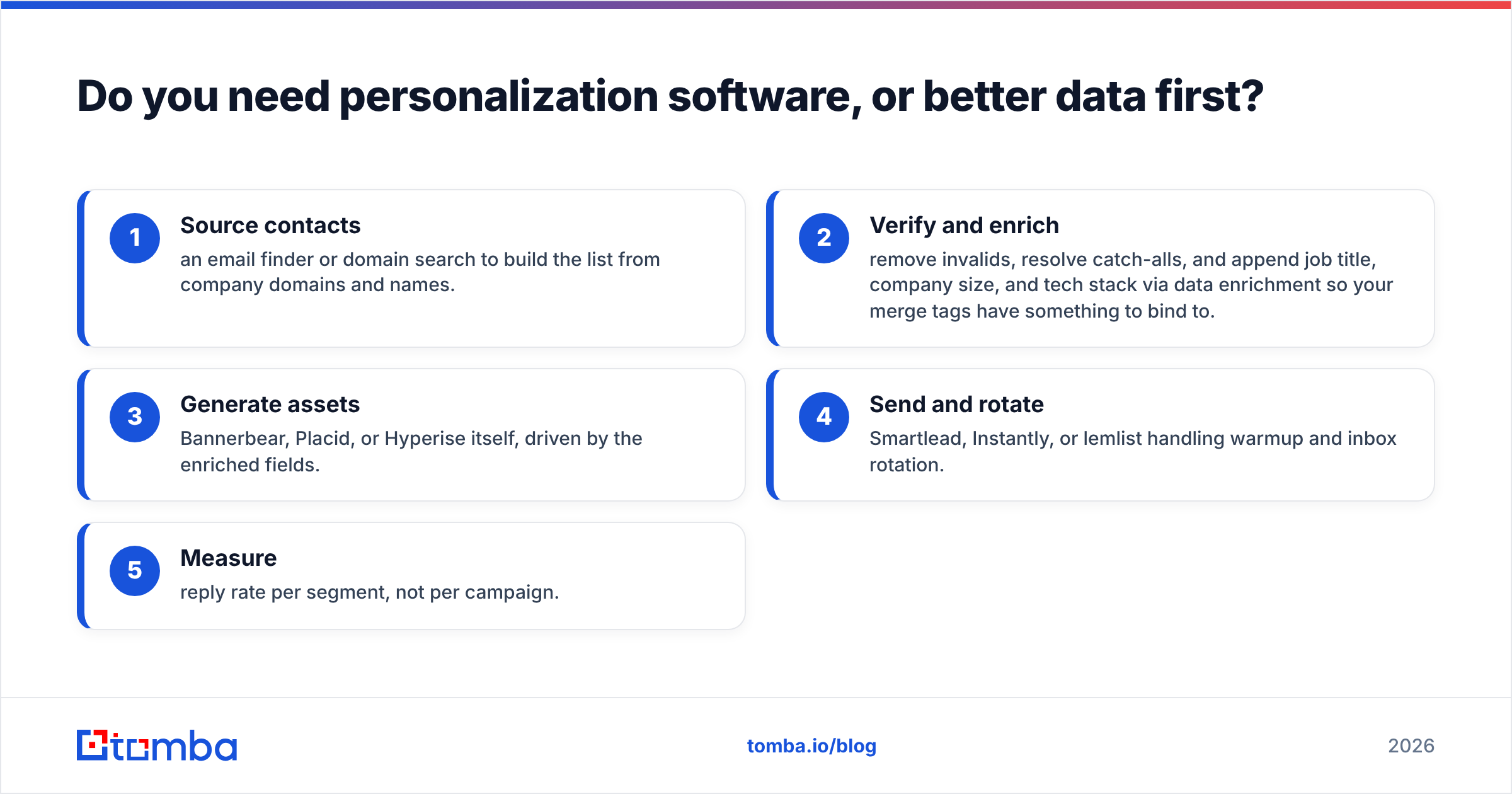
This is also where the tool categories stop competing and start stacking. A workable 2026 stack looks like:
- Source contacts — an email finder or domain search to build the list from company domains and names.
- Verify and enrich — remove invalids, resolve catch-alls, and append job title, company size, and tech stack via data enrichment so your merge tags have something to bind to.
- Generate assets — Bannerbear, Placid, or Hyperise itself, driven by the enriched fields.
- Send and rotate — Smartlead, Instantly, or lemlist handling warmup and inbox rotation.
- Measure — reply rate per segment, not per campaign.
Note that steps 1 and 2 are prerequisites for step 3. A logo layer needs a company domain. A "your website" screenshot needs a verified URL. A first name needs to be the actual first name, not "info". Personalization tools are only as good as the fields you feed them, which is why data providers — Tomba, Clearbit-style enrichment services, and list vendors like BookYourData for pre-built verified lists — sit underneath the whole category rather than beside it.
Which Hyperise alternative fits your situation?#
- Solo founder, under 500 sends a month, wants one tool: lemlist. The personalization is good enough and you avoid a second subscription.
- Agency with 10+ client accounts: Smartlead for infrastructure plus Placid for assets. Cheaper and more flexible than per-seat personalization tools.
- Technical team, high volume, custom creative: Bannerbear via API, driven from your own enrichment pipeline.
- Enterprise ABM into named accounts: Sendspark or Nexweave. The production cost is justified when a single meeting is worth five figures.
- Deliverability is your bottleneck: Warmer.ai or plain text. Drop images entirely until inbox placement recovers.
- You are not sure your list is clean: none of the above yet. Verify first.
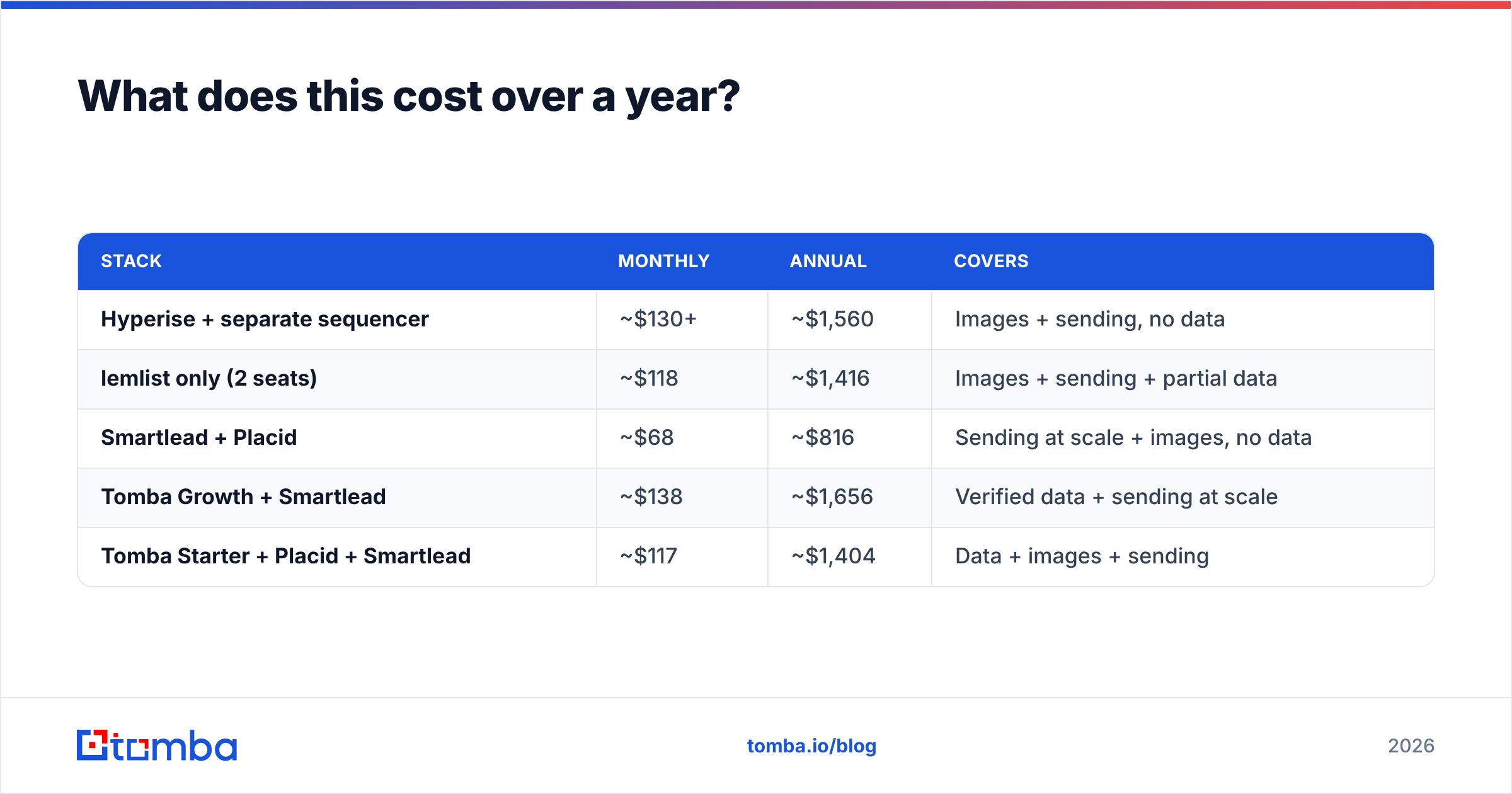
What does this cost over a year?#
| Stack | Monthly | Annual | Covers |
|---|---|---|---|
| Hyperise + separate sequencer | ~$130+ | ~$1,560 | Images + sending, no data |
| lemlist only (2 seats) | ~$118 | ~$1,416 | Images + sending + partial data |
| Smartlead + Placid | ~$68 | ~$816 | Sending at scale + images, no data |
| Tomba Growth + Smartlead | ~$138 | ~$1,656 | Verified data + sending at scale |
| Tomba Starter + Placid + Smartlead | ~$117 | ~$1,404 | Data + images + sending |
The third row is the cheapest working stack for agencies. The last row is the most complete. Compare current Tomba pricing against whatever bundle you are considering — the free tier gives you 25 searches a month to test list quality before committing to anything.
Start with the layer everyone skips#
Every tool on this page personalizes a message to a contact. None of them find the contact, and none of them tell you whether the address is real. That is the layer that decides whether the rest of your budget does anything.
Run your next target account list through the Tomba Email Finder before you pick a personalization vendor. Find the addresses by domain or name, verify them, and enrich the rows with company and role fields your image templates can actually bind to. If bounce rate drops and reply rate climbs on plain text alone, you just saved a subscription. If it does not, at least you will be personalizing to people who exist.
Related guides#
Ready to find emails that actually work?
Join 150,000+ professionals who stopped guessing and started sending. Free credits on signup — no credit card required.
Get the Tomba newsletter
Practical outbound tactics and product updates — once every two weeks.
About the author