9 Best Hypertide Alternatives in 2026 (Tested & Compared)
Hypertide is one of a wave of newer B2B contact-data tools. Here are nine alternatives compared on verified-email accuracy, credit models, API depth, and what they actually cost once your team scales past one seat.

TL;DR
- Most teams searching for Hypertide alternatives aren't unhappy with the concept — they're unhappy with credit burn, per-seat pricing, or bounce rates that survived "verified" labels.
- The honest split: pick a finder-first tool (Tomba, Hunter, Findymail) if you already have a target list, a database-first tool (Apollo, BookYourData) if you need to build lists from scratch.
- Verification is the real differentiator. A tool that returns 500 "found" emails at 82% deliverability is worse than one that returns 340 at 97%.
- Budget check: usable entry plans in this category cluster around $39–$99/month. Anything advertised as unlimited usually isn't.
- If you run outbound programmatically, weigh the API and credit-rollover terms harder than the UI. That's where the cost difference compounds.
What is Hypertide, and why are people searching for alternatives?#
Hypertide sits in the crowded B2B contact-data and prospecting category — the same shelf as email finders, enrichment APIs, and lead databases. It's a smaller, newer name than Apollo or Clearbit, which is exactly why it draws comparison searches: buyers want to know whether a lesser-known vendor is a bargain or a risk before they commit budget.
A caveat, stated up front: Hypertide's plans, credit allowances, and coverage claims change more often than those of established vendors, and I'm not going to invent numbers for them. Check the vendor's current pricing page before you sign anything. What this post can do reliably is show you what the mature alternatives charge, what they actually return, and which one matches your motion.
The recurring reasons teams switch away from any tool in this category are consistent enough to be predictable:
- Credits vanish on failed lookups. Some vendors bill you whether or not they return a result. Over a 10,000-row list, that's the difference between one month of budget and two.
- "Verified" is doing a lot of work. Pattern-guessed addresses (first.last@domain.com) pass a syntax check and fail an SMTP handshake. You find out on send day.
- Per-seat pricing punishes growth. A $49 plan becomes $245 the moment five SDRs need logins.
- Thin API or rate limits. Fine for manual prospecting, painful for anyone enriching a CRM on a schedule.
- No catch-all handling. Roughly a fifth of B2B domains accept everything at the gateway. Tools that shrug at catch-alls hand you an "unknown" bucket you can't use.
If two or more of those describe your situation, the rest of this comparison is worth your time.
What should a Hypertide alternative actually do?#
Before comparing logos, fix your requirements. Buyers who skip this step end up paying for a database when they needed a finder, or vice versa.
- Find, not guess. The tool should return a source or confidence score, not just an address. Ask any vendor how they distinguish a verified address from a permutation.
- Verify in the same pass. Separate finding and verification into two vendors and you pay twice and reconcile twice. Look for a bundled email verifier.
- Handle catch-all domains explicitly. A dedicated catch-all verifier turns an unusable "unknown" segment into a risk-scored one.
- Charge only for results. Credit-on-success is the single biggest lever on real cost per contact.
- Expose a real API. If your RevOps team can't call it from a workflow, you'll rebuild the process manually forever.
- Support bulk work. CSV in, enriched CSV out — a bulk email finder is table stakes for list-building at any volume.
How accurate is the data behind these tools?#
Accuracy is where vendor marketing and reality diverge most. Every provider in this category advertises a number in the mid-to-high nineties. Those numbers are measured differently: some quote SMTP-acceptance on the subset they were confident about, others quote the whole return set, and a few quote their verifier's accuracy rather than their finder's.
The only comparison that matters to you is: of 1,000 rows I submit, how many usable, non-bouncing addresses come back? That's hit rate multiplied by deliverability, and it's usually 20–30 points below the headline figure.

Two practical tests before you buy:
Run the same 100-row sample through every trial. Use real accounts you're actually going to email, not a synthetic list of Fortune 500 CEOs — every vendor covers those well and almost nobody's ICP is made of them. Then send the results through a neutral verifier and count the hard-bounce risks. Tomba publishes its data sources openly, which makes that audit easier; vendors that won't say where data comes from are a harder sell to a legal team under GDPR or CCPA review.
Second, test your worst segment, not your best. Non-English domains, sub-50-employee companies, and freshly registered domains are where coverage collapses. If a tool holds up there, it'll hold up everywhere.
Which Hypertide alternatives are worth comparing in 2026?#
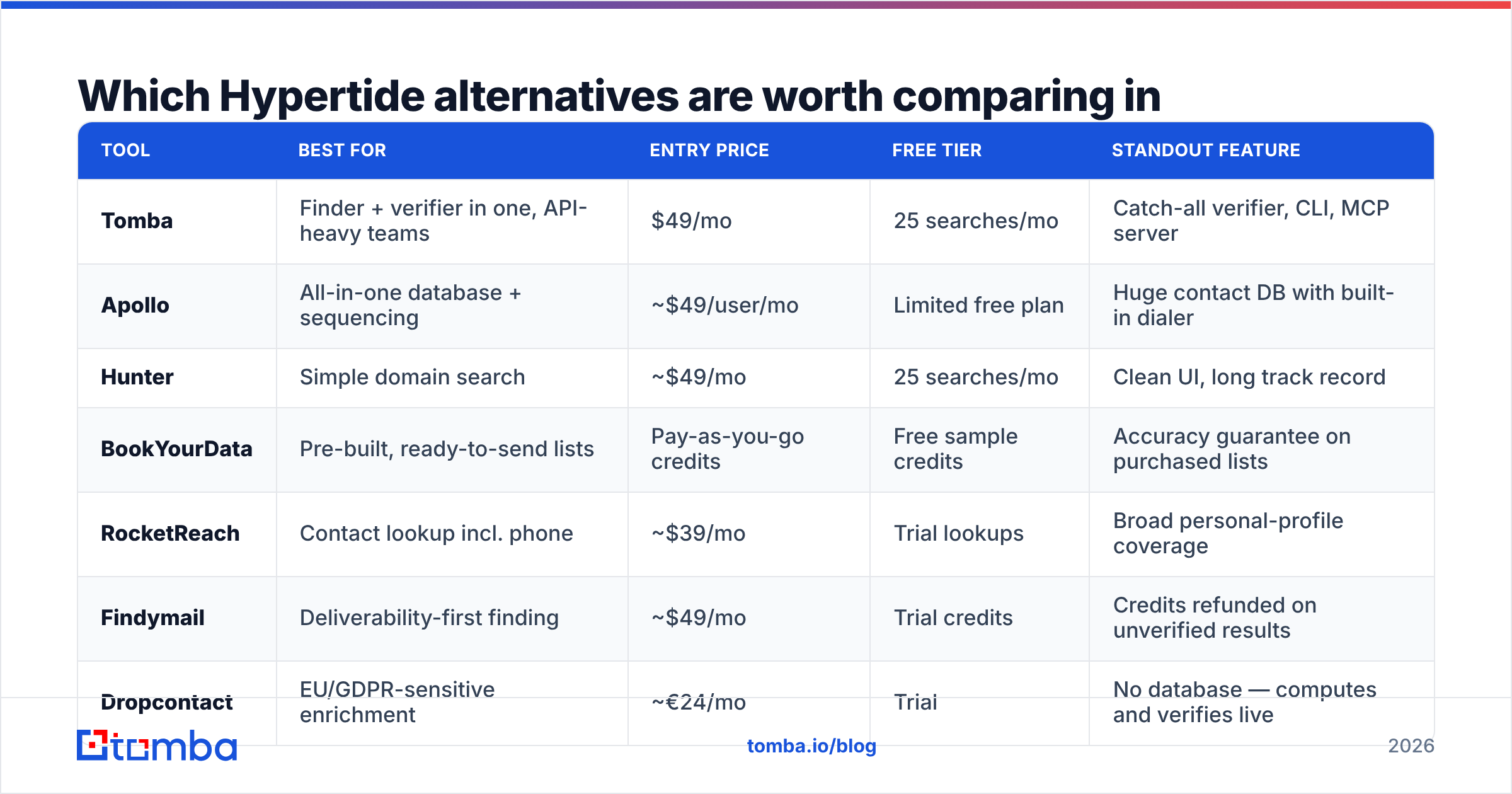
Nine tools cover the realistic decision space. Prices below were checked in September 2026 and are entry-tier list prices — annual billing and seat counts move them.

| Tool | Best for | Entry price | Free tier | Standout feature |
|---|---|---|---|---|
| Tomba | Finder + verifier in one, API-heavy teams | $49/mo | 25 searches/mo | Catch-all verifier, CLI, MCP server |
| Apollo | All-in-one database + sequencing | ~$49/user/mo | Limited free plan | Huge contact DB with built-in dialer |
| Hunter | Simple domain search | ~$49/mo | 25 searches/mo | Clean UI, long track record |
| BookYourData | Pre-built, ready-to-send lists | Pay-as-you-go credits | Free sample credits | Accuracy guarantee on purchased lists |
| RocketReach | Contact lookup incl. phone | ~$39/mo | Trial lookups | Broad personal-profile coverage |
| Findymail | Deliverability-first finding | ~$49/mo | Trial credits | Credits refunded on unverified results |
| Dropcontact | EU/GDPR-sensitive enrichment | ~€24/mo | Trial | No database — computes and verifies live |
| Clearbit (HubSpot) | Enterprise firmographic enrichment | Quote-based | No | Deep HubSpot-native enrichment |
| Lusha | Quick CRM-side contact reveal | ~$36/user/mo | 5 free credits/mo | Browser-extension workflow |
Note the structural difference hiding in that table: Apollo, BookYourData, RocketReach, and Lusha sell you access to a database. Tomba, Hunter, Findymail, and Dropcontact find and verify against live sources. Databases win on volume and on "I don't know who to target yet." Finders win on freshness and on "I have 4,000 company domains and need the right contact at each."
Which tool fits which team?#
If you're API-first and cost-sensitive#
Tomba is the straightforward pick here, and yes, this is the Tomba blog — judge the claim on the specifics. The email finder is priced per workspace, not per seat, so adding SDRs doesn't multiply the bill. The stack around it (domain search, catch-all verification, phone finder, enrichment) is included rather than sold as add-on modules, and there's a documented Tomba API plus a CLI and MCP server for teams wiring lookups into agents or scheduled jobs. Tomba pricing runs Free (25 searches/month), Starter $49/mo, Growth $99/mo, Pro $249/mo, Enterprise custom.
Where it's not the answer: if you want a contact database to browse and filter by intent signals, Tomba isn't that product.
If you need the database and the sequencer together#
Apollo remains the default for teams who want prospecting, sequencing, and dialing in one login. The trade is per-user pricing and data that skews stale on smaller companies. Plenty of teams run Apollo for list-building and a dedicated verifier before send — that combination costs more but bounces less. If you're specifically evaluating that swap, the Apollo alternative breakdown covers the credit math.
If you want lists you can send tomorrow#
BookYourData takes a different route: you buy targeted contact lists on a pay-as-you-go basis with an accuracy guarantee attached, rather than renting a seat. For a founder or a small team that needs 2,000 contacts once — not a subscription and a workflow — that model is genuinely simpler, and the per-contact economics can beat a monthly plan you'd underuse. Check current terms at bookyourdata.com.
If deliverability is the whole job#
Findymail built its positioning around not charging for results that fail verification, which is the right incentive alignment. Dropcontact appeals to European teams because it computes and verifies addresses rather than storing a database of individuals — a materially easier GDPR conversation. Both are narrower than Tomba or Apollo; that's the point.
If you're already deep in HubSpot or Salesforce#
Clearbit (now part of HubSpot's Breeze intelligence) enriches natively inside HubSpot and prices at enterprise levels. If you're not on HubSpot, the value drops sharply. Tomba's HubSpot integration covers the same enrichment job at a fraction of the price for teams that don't need the full firmographic depth. Cross-check both on G2 before you take either vendor's word for coverage.
How much do these tools really cost per usable contact?#
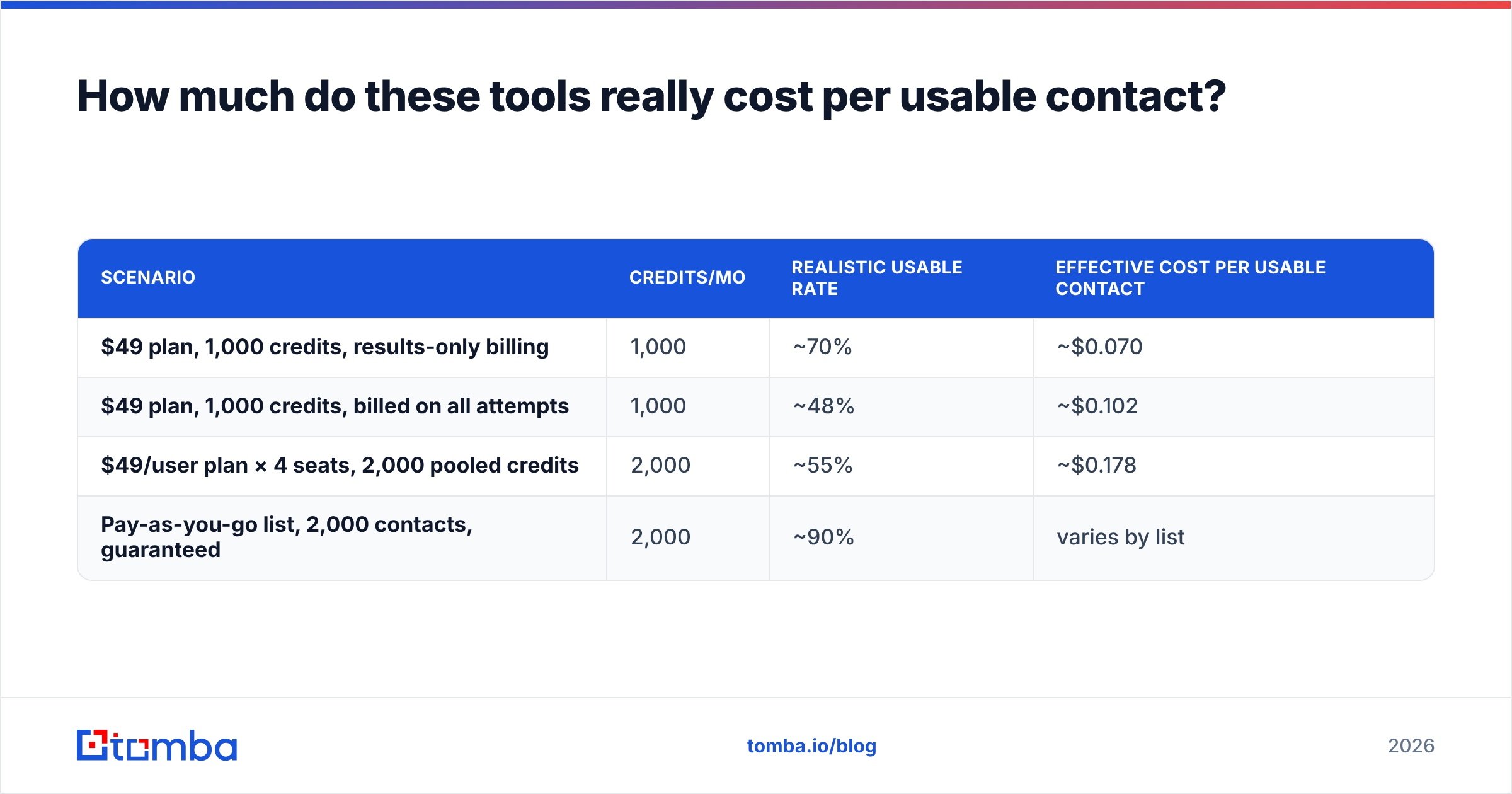
List price is the wrong unit. Cost per usable contact is the right one, and it's calculated as: monthly price ÷ (credits × hit rate × deliverability).
| Scenario | Credits/mo | Realistic usable rate | Effective cost per usable contact |
|---|---|---|---|
| $49 plan, 1,000 credits, results-only billing | 1,000 | ~70% | ~$0.070 |
| $49 plan, 1,000 credits, billed on all attempts | 1,000 | ~48% | ~$0.102 |
| $49/user plan × 4 seats, 2,000 pooled credits | 2,000 | ~55% | ~$0.178 |
| Pay-as-you-go list, 2,000 contacts, guaranteed | 2,000 | ~90% | varies by list |
The third row is why per-seat pricing quietly becomes the most expensive line in the stack. Four seats on a $49/user plan is $196/month before anyone checks whether the credits were pooled or split.

The second row is the credit-policy trap. Ask every vendor one question in writing: "Do you charge a credit when no email is found?" The answer reshapes your real cost by 40% or more, and it never appears on the pricing page.
Is switching away from Hypertide worth the migration effort?#
Switching costs in this category are lower than most people assume — contact data isn't a system of record, it's a feed into one. The migration is usually: export your saved lists, re-point one API key, update whatever Zapier or Make scenario calls the old endpoint, and re-verify anything older than 90 days.
Do it if any of these are true:
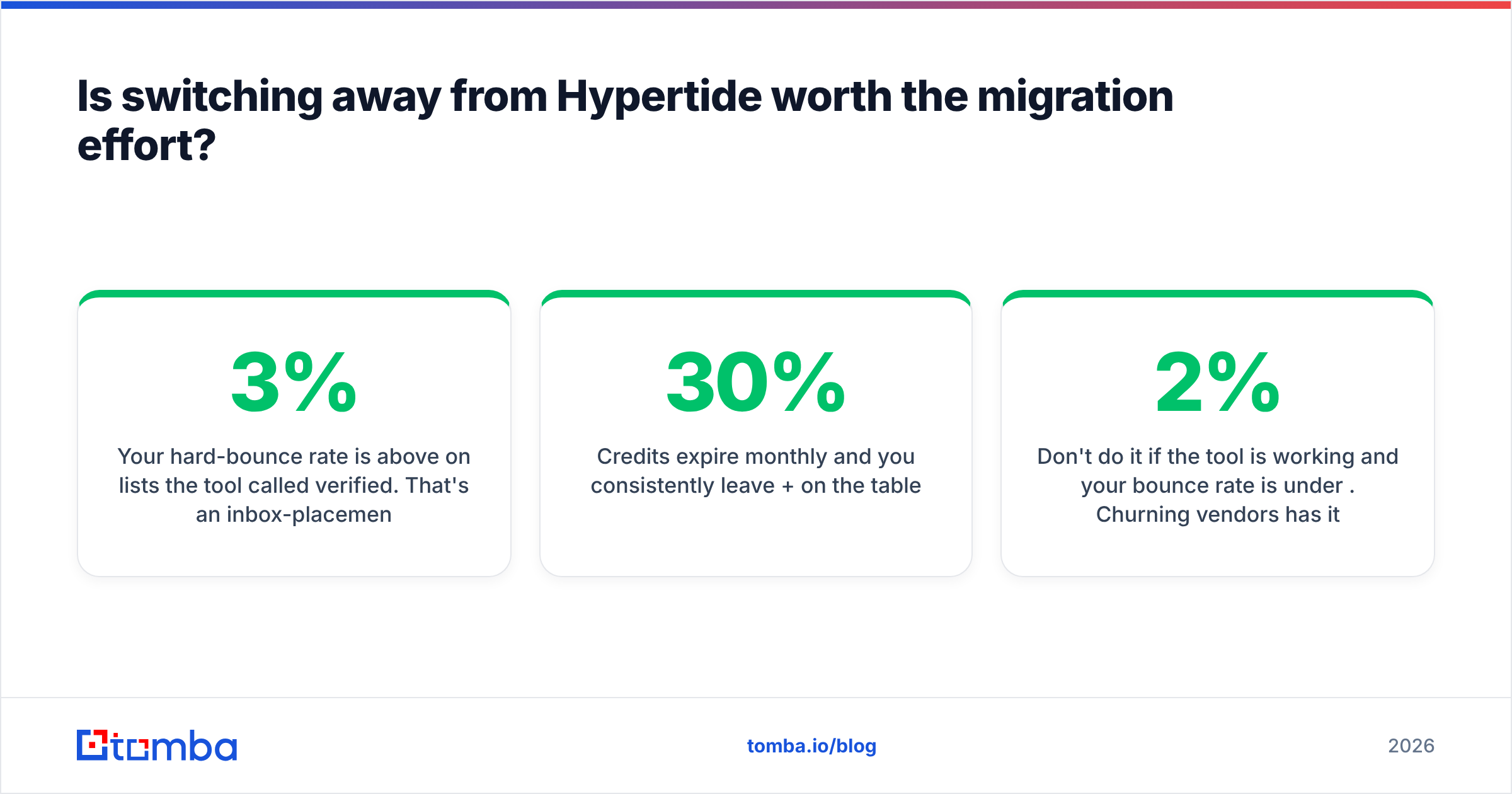
- Your hard-bounce rate is above 3% on lists the tool called verified. That's an inbox-placement problem, not a data problem you can ignore.
- You're paying per seat for a team that mostly needs bulk enrichment, not individual logins.
- Credits expire monthly and you consistently leave 30%+ on the table.
- You can't get a straight answer about data sourcing when compliance asks.
Don't do it if the tool is working and your bounce rate is under 2%. Churning vendors has its own cost, and every provider's coverage looks better in a demo than in your CRM. Run a 100-row bake-off, compare against your existing tool on the same rows, and let the numbers decide. If you want a zero-commitment starting point, the free email checker will tell you how bad your current list actually is before you spend anything.
Common questions about Hypertide alternatives#
Are free email finders enough to replace a paid tool? For fewer than 25 lookups a month, yes. Tomba's free tier and Hunter's free tier both cover that. Past a few hundred rows, free tools either cap you or return pattern guesses without verification, and the bounce cost exceeds the subscription you avoided.
Which alternative has the best data accuracy? It depends entirely on your segment. Database tools win on large US companies; live-verification tools win on small, recent, and non-US domains. Test your own list — vendor-published accuracy figures are measured on samples chosen by the vendor.
Can I use two tools together? Commonly, yes, and it's often the cheapest configuration: a database tool for discovery, a finder-plus-verifier for the enrichment and cleaning pass. Waterfall enrichment through an API is exactly this pattern.
Do these tools work for phone numbers too? Some. Apollo, RocketReach, Lusha, and Tomba's phone finder all return mobile or direct-dial numbers, with wide variation in coverage and much lower hit rates than email across the board. Budget for 30–50% coverage, not 90%.
Where to start#
If your shortlist came down to "something cheaper than a seat-priced database, but more reliable than pattern-guessing," start with the Tomba Email Finder. The free tier gives you 25 searches a month with no card, which is enough to run the 100-row bake-off described above across a few sessions and see real numbers on your own ICP rather than a vendor's demo list. If the hit rate and deliverability beat what you're getting today, Starter at $49/month covers most one-to-five-person outbound teams without per-seat math. If they don't, you'll have spent nothing and learned something concrete about your data — which is more than most vendor comparison pages will give you.
Related guides#
// get started
Find, verify and enrich your first contacts today
Start on the free plan with 25 searches a month, then scale when your team is ready.
Free plan · No credit card required · GDPR & CCPA
// about the author