"I Am Writing You to Follow Up On": 9 Better Alternatives
The phrase is grammatically shaky, instantly forgettable, and signals a rep with nothing new to say. Here are nine openers that actually earn replies — plus a five-touch cadence you can copy.
TL;DR
- "I am writing you to follow up on" is technically defensible in American English but reads as stiff, and most style guides prefer "I am writing to you" or — better — cutting the phrase entirely.
- The real problem is not grammar. The phrase burns your first line on an announcement the reader can already see from the thread, so it signals you have nothing new.
- Replace it with an opener that carries information: a trigger event, a specific artifact, a deadline, or a direct question.
- Follow-ups fail for two reasons — weak copy and dead data. Fixing the copy on a list that bounces 22% of the time changes nothing.
- Use the five-touch cadence table below, swap in the alternative openers, and verify addresses before the sequence starts.
Why does "I am writing you to follow up on" show up in every inbox?#
Because it is the safest thing a nervous writer can type. It announces intent, it is polite, and it delays the moment where you have to say something risky. Every sales rep, recruiter, and account manager has fallen back on it at least once.
That safety is exactly the problem. Your reader is scanning a preview pane roughly two lines wide. "I am writing you to follow up on our conversation last week" spends all of that space telling them something the subject line and the quoted thread already established. It is the email equivalent of clearing your throat for ten seconds before speaking.
Compare the information density:
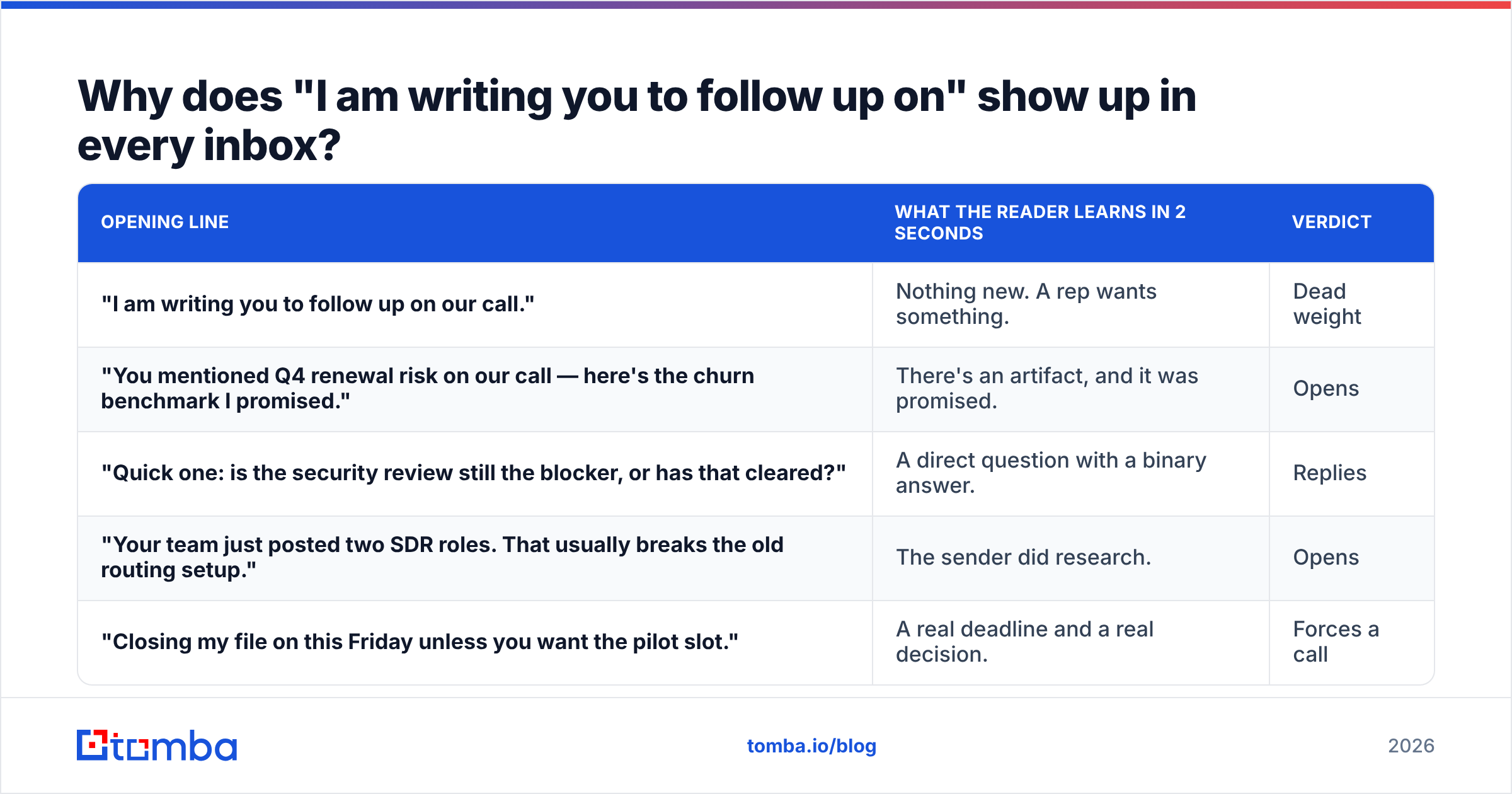
| Opening line | What the reader learns in 2 seconds | Verdict |
|---|---|---|
| "I am writing you to follow up on our call." | Nothing new. A rep wants something. | Dead weight |
| "You mentioned Q4 renewal risk on our call — here's the churn benchmark I promised." | There's an artifact, and it was promised. | Opens |
| "Quick one: is the security review still the blocker, or has that cleared?" | A direct question with a binary answer. | Replies |
| "Your team just posted two SDR roles. That usually breaks the old routing setup." | The sender did research. | Opens |
| "Closing my file on this Friday unless you want the pilot slot." | A real deadline and a real decision. | Forces a call |
Notice the pattern. The lines that work all put a fact in the first eight words. The default phrase puts a procedure there.
Is "I am writing you to follow up on" grammatically correct?#
Mostly yes, with a caveat worth knowing before you argue about it in a Slack thread.
"Write" can function as a ditransitive verb in American English — "write me a letter," "I'll write you tonight." So "I am writing you" is acceptable in US usage. British and Commonwealth English strongly prefer "I am writing to you," and a British reader will register the shorter form as slightly off, the same way an American registers "I'll write to you Thursday" as faintly formal.
Then there is the trailing preposition. "Follow up on" needs an object, and half the emails that use this phrase leave it dangling or bolt on something vague: "...to follow up on my previous email." That is a sentence whose entire content is a description of itself.
Three variants, ranked:
- "I am writing to follow up on the pricing sheet." — Grammatically clean everywhere. Still boring, but correct.
- "I am writing to you to follow up on..." — Safest for international audiences. Wordier.
- "I am writing you to follow up on..." — Fine in US business English. Avoid it in UK, Australian, Irish, or Indian-English contexts where the omitted preposition reads as sloppy.
If you must use the construction, pick option one. But the better move is to delete it. The response rate lift from a stronger opener beats any grammar debate.
What should you write instead? 9 alternatives that earn replies#
Each of these replaces the announcement with information. Pick based on what actually happened since your last touch.
- The artifact drop — "Here's the SOC 2 summary you asked for." Works when you promised something. Delivery is a legitimate reason to be in the inbox, and it resets the reciprocity clock.
- The trigger event — "Saw the Series B announcement — congrats. That usually means the data stack gets rebuilt in the next two quarters." Requires you to actually track the account. Highest open-to-reply conversion of anything on this list.
- The binary question — "Is budget the holdup, or timing?" Two options, one word to answer. Removes the effort excuse.
- The assumption close — "I'm assuming this slipped to next quarter. Want me to check back in January?" Gives the prospect a graceful exit, which is why so many take the other door instead.
- The one-line value add — "Three companies in your space moved off manual routing this quarter. Short teardown below." No ask in the first sentence at all.
- The permission ask — "Should I stop emailing about this?" Blunt, slightly risky, and consistently one of the highest-reply-rate lines in outbound. Use it as touch four or five, never as touch two.
- The internal-context line — "Our engineering team shipped the Salesforce sync you flagged as missing." Only works if it is true. It converts a dead deal into a live one.
- The deadline — "The pilot pricing ends the 30th; after that it's list." Real deadlines only. Fake urgency is the fastest way to get filtered.
- The forwarding request — "If this isn't yours, who owns vendor selection for outbound tooling?" Reframes the ask as a two-second favor rather than a purchase decision.
None of these open with the word "I." That is not an accident. The moment your first word is about you, the reader's attention budget drops.
How many follow-ups should a sequence have, and what goes in each?#
Four to six touches over two to three weeks is the range most outbound teams settle on. Beyond that, incremental reply rate flattens while spam complaints climb. HubSpot's sales blog has published extensively on the diminishing-return curve, and vendor-neutral reviews on G2's sales engagement category show the same cadence assumptions baked into nearly every sequencer.
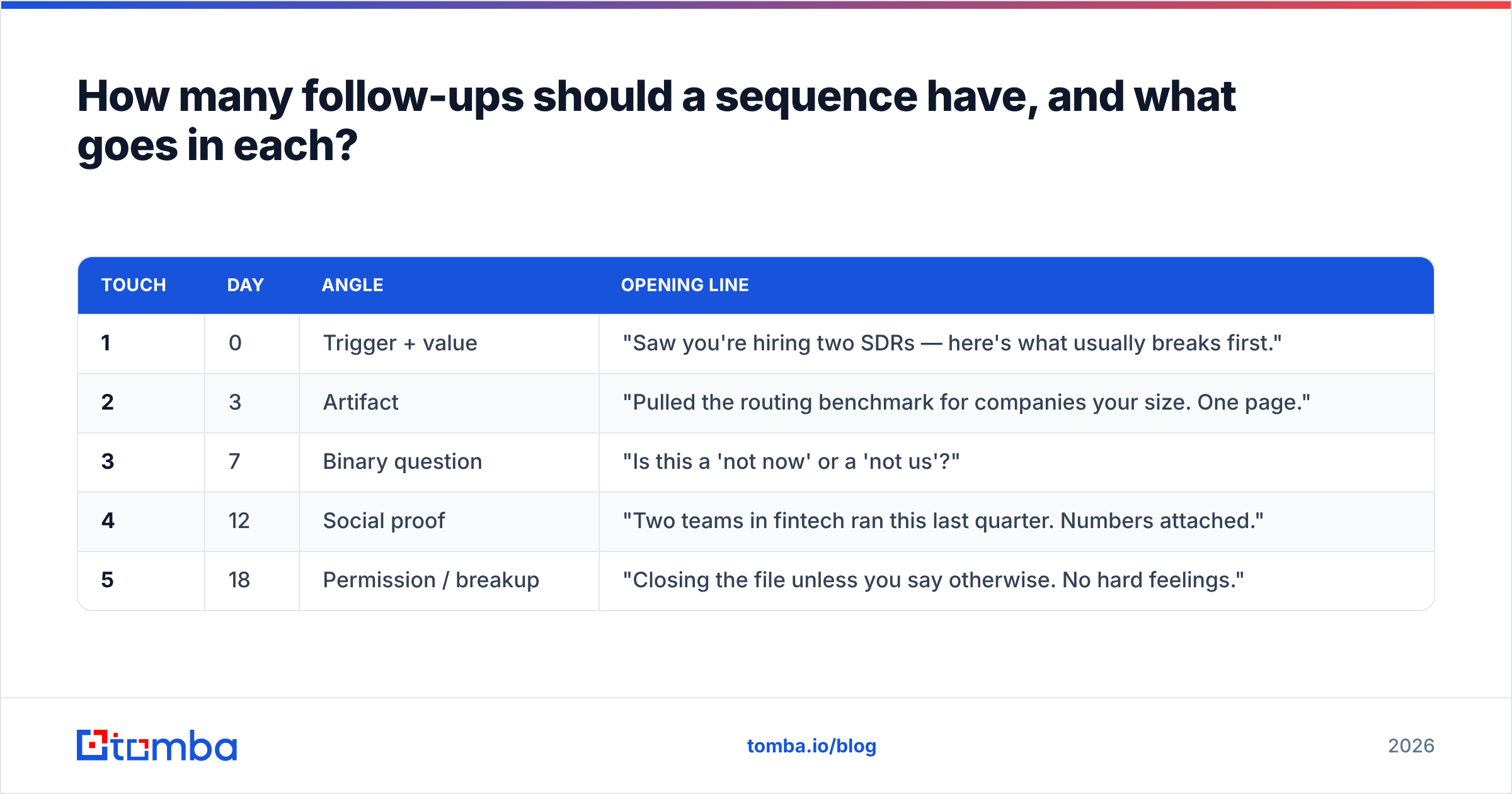
Here is a cadence you can lift directly. Note that no touch opens with "I am writing you to follow up on."
| Touch | Day | Angle | Opening line |
|---|---|---|---|
| 1 | 0 | Trigger + value | "Saw you're hiring two SDRs — here's what usually breaks first." |
| 2 | 3 | Artifact | "Pulled the routing benchmark for companies your size. One page." |
| 3 | 7 | Binary question | "Is this a 'not now' or a 'not us'?" |
| 4 | 12 | Social proof | "Two teams in fintech ran this last quarter. Numbers attached." |
| 5 | 18 | Permission / breakup | "Closing the file unless you say otherwise. No hard feelings." |
Two rules that matter more than the copy:
- Keep every touch under 90 words. Long follow-ups get archived. If you need a table or a chart, put it behind a link.
- Change the angle, not just the wording. Five paraphrases of "just checking in" is still one email sent five times.
Should you reply in-thread or start a new one?#
In-thread for touches two and three; new thread with a fresh subject for touches four and five.
Staying in-thread preserves context and keeps your history visible, which helps when the prospect finally forwards the chain internally. But by touch four, the thread has become visual evidence that you have been ignored three times. Breaking to a new subject line gives the reader a clean slate and gives you a fresh shot at the preview pane — run the new one through a subject line generator if you are recycling the same angle.
One caveat: never break thread on a warm reply. If a human answered you once, that thread is an asset.
Why do follow-ups fail even when the copy is good?#
Because the address was never real.
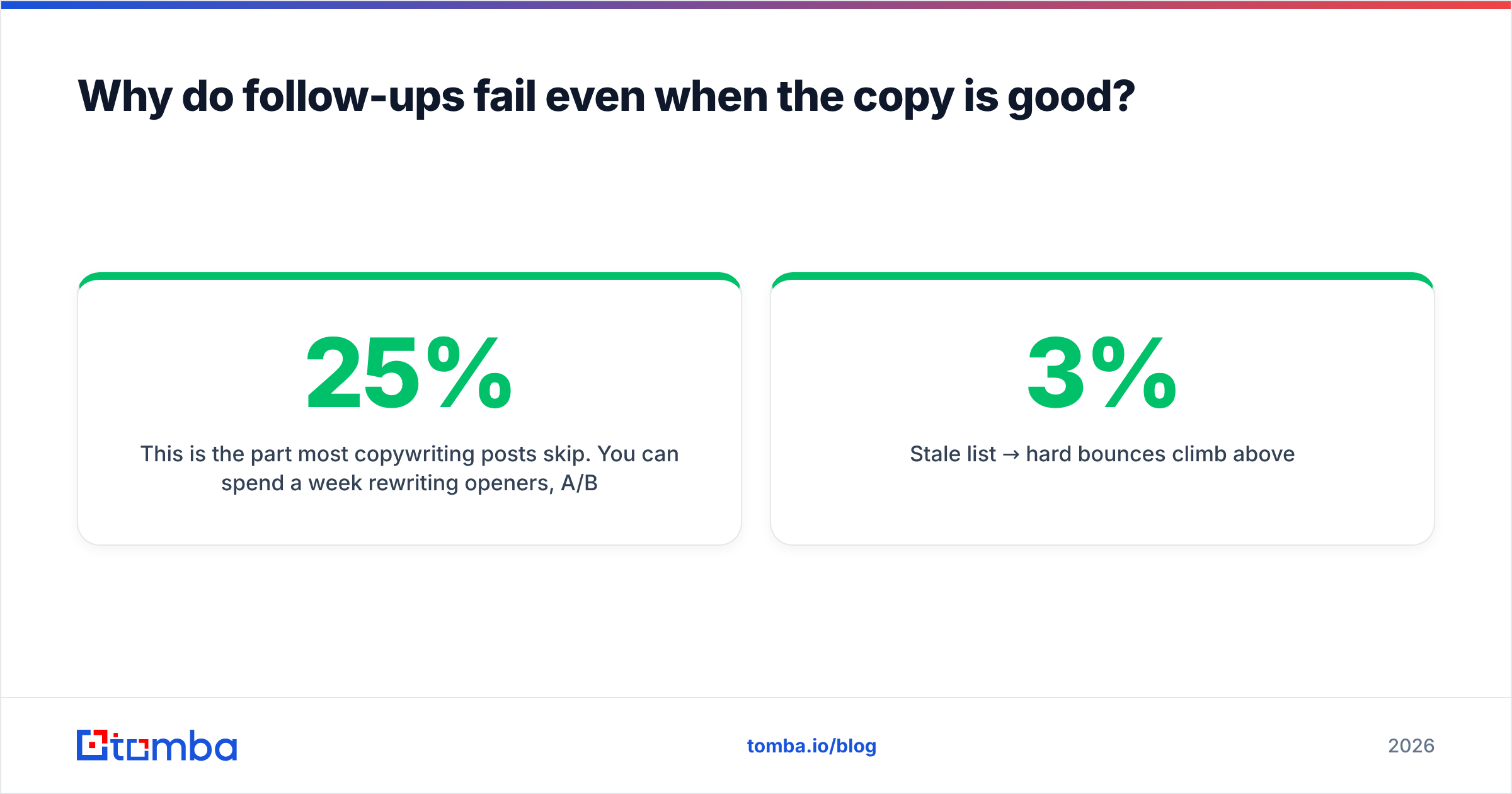
This is the part most copywriting posts skip. You can spend a week rewriting openers, A/B testing nine variants of "I am writing you to follow up on," and still see a flat reply rate — because 15–25% of a scraped or aging list is invalid. Those sends bounce, your bounce rate crosses the 3% threshold that mailbox providers watch, and your good emails start landing in spam. The follow-up that would have converted never got seen.
The failure chain looks like this:
- Stale list → hard bounces climb above 3%
- Bounce spike → sender reputation drops at Google and Microsoft
- Reputation drop → inbox placement falls for the whole domain
- Placement falls → your rewritten follow-up is invisible, and you blame the copy
Run the list through an email verifier before the sequence starts, not after the bounces come in. For domains that accept everything at the SMTP layer, a catch-all verifier is the only way to separate real mailboxes from black holes — and catch-all domains are common in enterprise, which is exactly where your best-fit accounts live.
What does a full replacement template look like?#
Here are two you can paste and edit. Both assume touch three of a five-touch sequence.
Template A — the binary question
Subject: routing or budget?
Hi Dana,
Short version: is the holdup budget, or is it the Salesforce routing rebuild?
If it's routing, I'll send the migration checklist our team put together and get out of your way until Q1. If it's budget, I can show you what the 20-seat tier looks like.
Either answer is useful.
— Marc
Word count: 62. One question, two exits, zero throat-clearing.
Template B — the artifact drop
Subject: the churn benchmark I mentioned
Hi Priya,
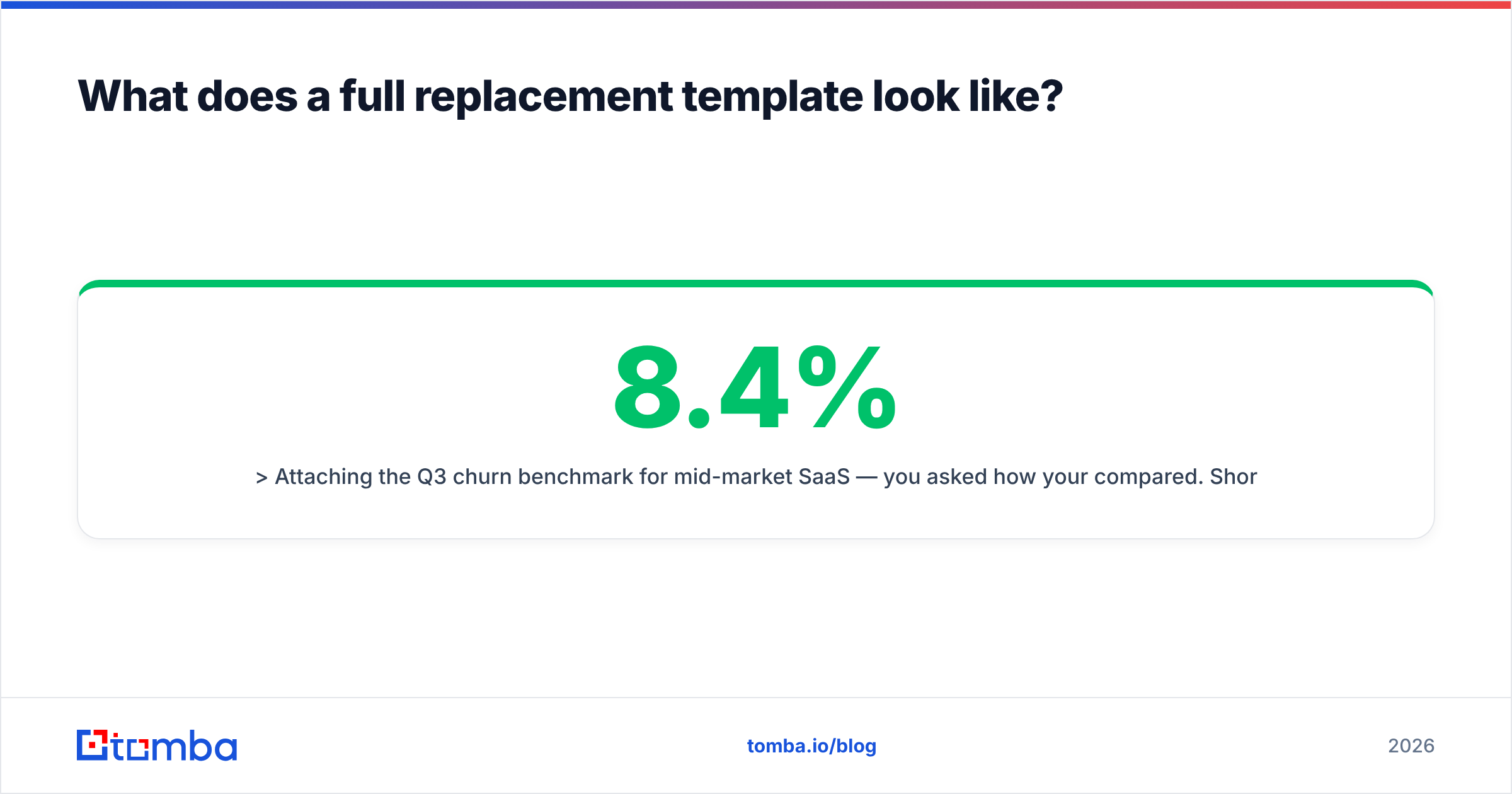
Attaching the Q3 churn benchmark for mid-market SaaS — you asked how your 8.4% compared. Short answer: median is 7.1%, top quartile is 4.3%.
The gap is almost entirely first-90-days onboarding. Happy to walk through the three levers if it's useful, otherwise the doc stands alone.
— Marc
Word count: 58. It delivers before it asks. If you want more starting points, the cold email templates library covers breakup emails, referral asks, and re-engagement sequences you can adapt to the same structure.
When is "I am writing you to follow up on" actually the right call?#
Rarely — but not never.
- Formal or legal correspondence. Contract renewals, compliance notices, and anything that might get printed and filed benefit from explicit, boring framing. Use "I am writing to follow up on our correspondence dated..." here.
- First contact with a government or academic institution. Procedural language signals you understand the process.
- Cross-cultural formality. In some markets, an abrupt opener reads as disrespectful rather than efficient. When in doubt with a first-time contact in Japan, Germany, or the Gulf, lean formal on touch one and loosen up once they reply in kind.
Outside those cases, the phrase is a tax on your reader's attention.
What should you check before your next follow-up goes out?#
Run this list before you hit send on a sequence:
- First eight words carry a fact, not an announcement of intent.
- Under 90 words per touch.
- One ask, and it is answerable in a single sentence.
- Angle changes between touches — not just synonyms.
- Addresses verified within the last 60 days.
- Sending domain warmed and authenticated with SPF, DKIM, and DMARC.
Five of those six are copy and process. The sixth is data — and it is the one that silently invalidates the other five.
Where should you start?#
Fix the data layer first, then the openers. A great follow-up sent to a bounced address performs exactly as well as a bad one.
Tomba's Email Finder gives you verified, source-attributed professional addresses so your five-touch sequence actually reaches five inboxes. The free tier includes 25 searches a month, and paid plans start at $49/mo — see Tomba pricing for the full breakdown. Build the list, verify it, then spend your energy on the part readers actually judge you on: the first eight words.
Related guides#
// get started
Find, verify and enrich your first contacts today
Start on the free plan with 25 searches a month, then scale when your team is ready.
Free plan · No credit card required · GDPR & CCPA
Get the Tomba newsletter
Product and data updates
// about the author